Quick Answer
Burnout recovery for executives is not about taking a holiday and returning to the same workload. Sustainable recovery requires structural changes to workload, decision-making, recovery rhythms, and leadership systems. Executives recover when they redesign how work flows through the organisation rather than simply trying to become more resilient.
Key Takeaways
- Burnout is a system failure, not a personal failure.
- Executive recovery requires structural redesign, not temporary relief.
- Workload architecture matters more than productivity hacks.
- Decision fatigue is one of the earliest indicators of leadership burnout.
- Sustainable leadership outperforms heroic leadership over time.
Introduction
Burnout recovery for executives has become one of the most urgent leadership challenges of the decade.
Across business, education, healthcare, government, and the public sector, leaders are facing expanding responsibilities, growing complexity, and constant digital demands. What was once considered a demanding leadership role has evolved into an often unsustainable combination of strategist, manager, coach, communicator, crisis responder, and culture builder.
The problem is not that executives have become less capable. The problem is that organisational systems have expanded expectations faster than support structures.
At Burn Bright Advisory, we describe burnout as a structural issue rather than a personal weakness. Sustainable recovery begins when leaders stop asking how to work harder and start asking what needs redesigning.
In this article you will learn why executive burnout happens, the warning signs leaders often miss, the Burn Bright recovery framework, how organisations can support sustainable recovery, and practical actions to rebuild leadership capacity.
Definition
Burnout recovery for executives is the process of restoring leadership effectiveness by redesigning workload, decision-making, recovery habits, and organisational systems that created chronic overload in the first place.
Why Are So Many Executives Burning Out?
Executive burnout rarely starts with a dramatic collapse. It begins with gradual overload.
The research within Burn Bright Not Out highlights several recurring patterns that consistently appear across sectors. Leaders face expanding responsibilities while resources remain static. Technology creates more communication rather than less. Meeting loads increase. Decision-making requirements multiply. Recovery time disappears.
The Burn Bright framework identifies five root causes:
Research from Gallup has consistently shown elevated burnout levels among managers compared with non-managers. At the same time, leadership turnover continues to increase across multiple sectors.
More effort cannot permanently compensate for broken systems. Better systems outperform more effort.
— Vincent Walters, Burn Bright Advisory
What Are the Early Signs of Executive Burnout?
One of the most dangerous aspects of burnout is that successful leaders often hide it. High performers continue delivering results long after their capacity has been exceeded.
Common Warning Signs
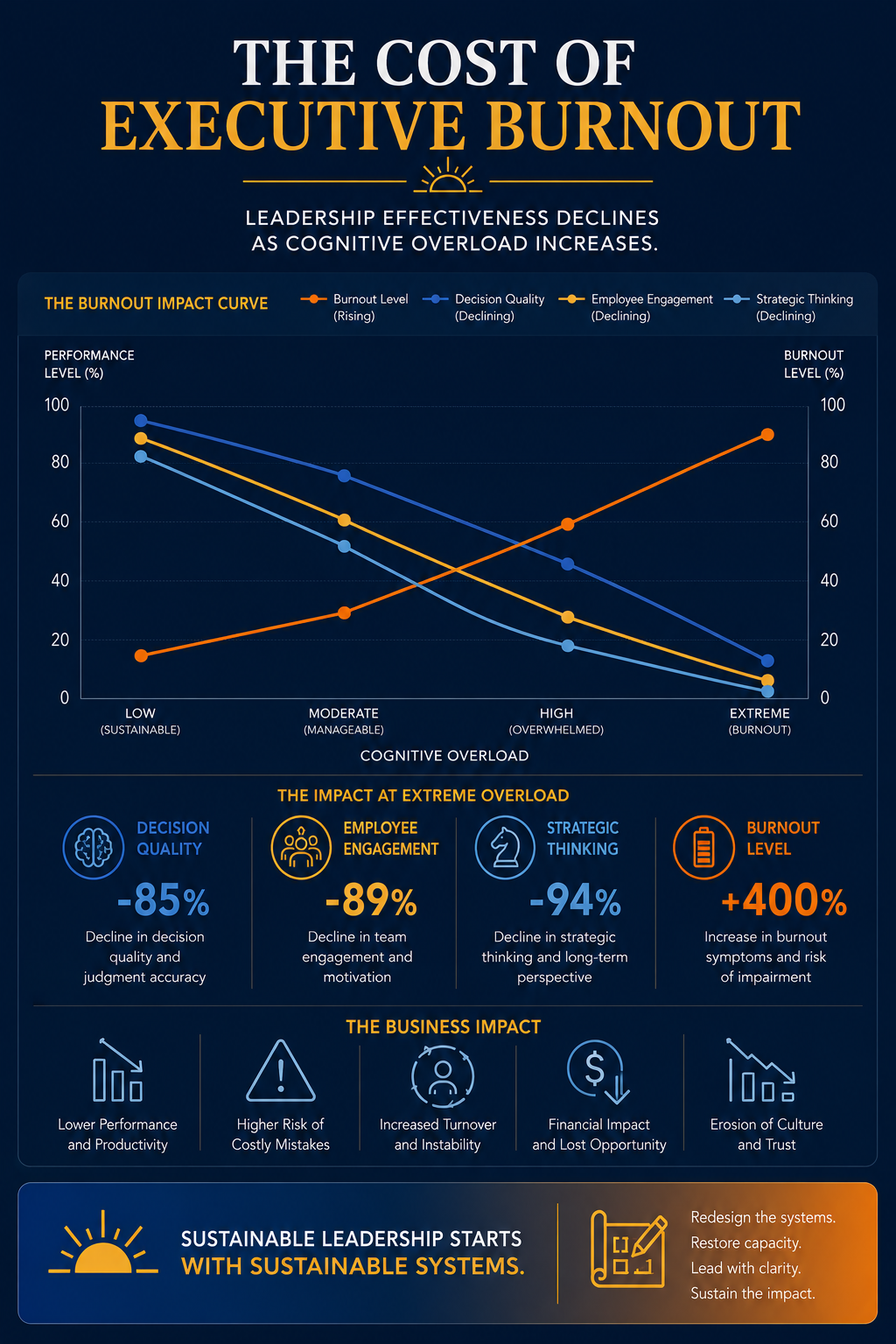
The Burn Bright Not Out research highlights a crucial distinction between stress and burnout. Stress can recover with rest. Burnout does not. Executives experiencing burnout frequently report returning from leave only to feel exhausted within days because the underlying structure remains unchanged.
A particularly important signal is declining decision quality. Leadership depends on judgement. When cognitive overload grows, leaders become reactive rather than strategic.
Why Doesn’t Rest Alone Fix Burnout?
Many executives assume recovery means taking annual leave. Unfortunately, burnout is rarely solved by time off alone.
Imagine a leader carrying an unsustainable workload for two years. Two weeks away from work may provide temporary relief. However, if they return to the same meetings, the same communication overload, the same unclear priorities, and the same decision burden — the exhaustion quickly returns.
This is why traditional wellbeing programmes often fall short. Burn Bright’s research argues that burnout interventions frequently focus on the individual while ignoring the system responsible for creating overload.
These Can Help — But Cannot Solve the Root Cause
Exercise ✓
Sleep ✓
Annual Leave ✓
None of these can permanently solve a workload architecture problem. Executives recover when structures change — not when symptoms are temporarily managed.
What Does Effective Burnout Recovery for Executives Look Like?
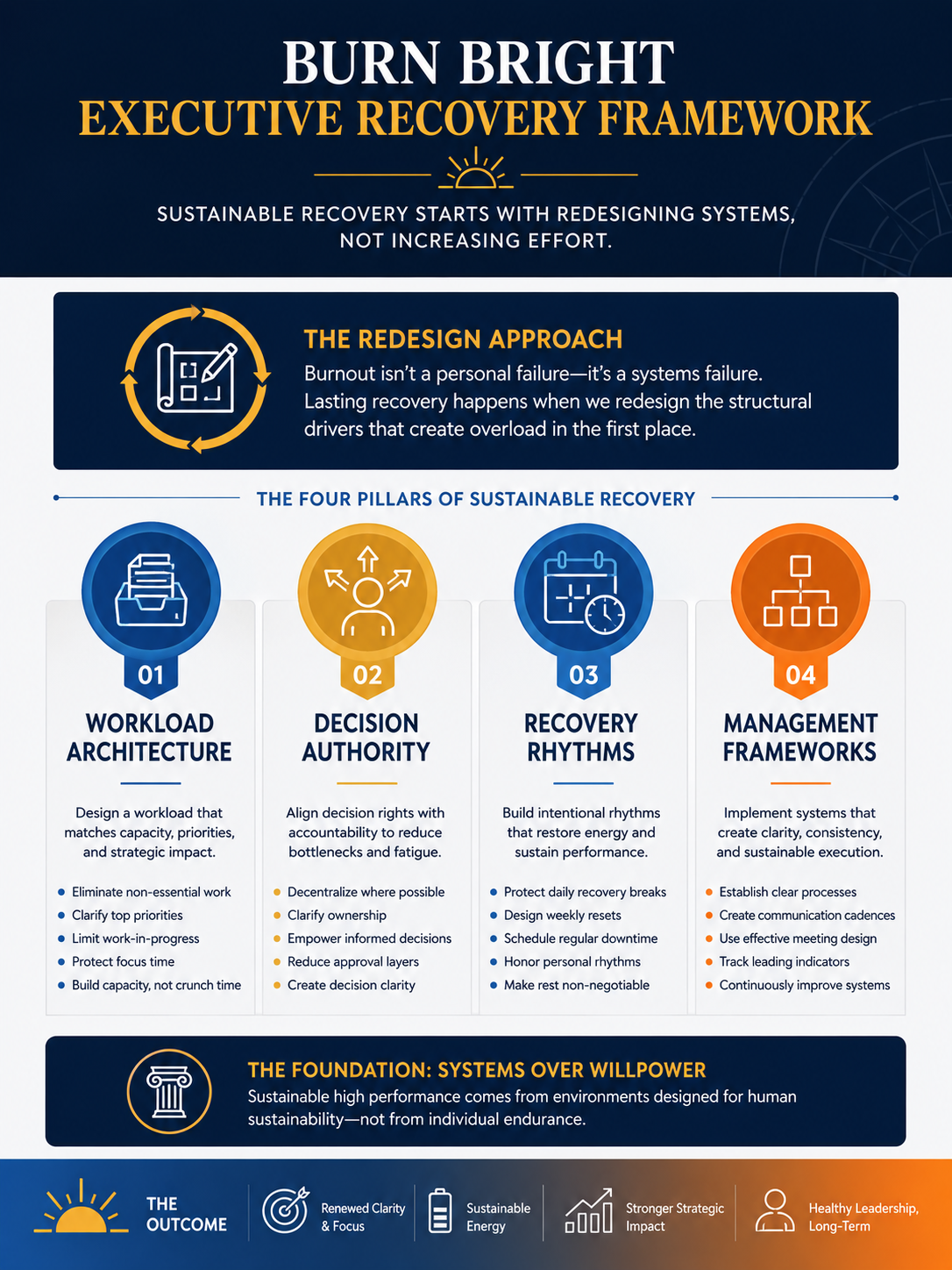
Recovery requires a shift from survival to redesign. The Burn Bright Structural Transformation Framework contains four pillars:
Workload Architecture
Executives must audit workload demand. Three key questions:
→ What can be delegated?
→ What should stop entirely?
Decision Authority
Decision overload is one of the fastest routes to depletion. Clear decision ownership reduces cognitive burden and improves organisational speed.
Recovery Rhythms
Recovery should not be reserved for holidays. It must be embedded into leadership operating systems as a non-negotiable discipline.
Management Frameworks
Frameworks reduce mental friction. When leaders repeatedly solve the same problems without structure, decision fatigue accelerates.
Fix the system, not the person.
— Vincent Walters, Burn Bright Advisory
How Can Organisations Support Executive Recovery?
Executive burnout is often treated as an individual issue. That approach misses the real opportunity. Organisations play a major role in creating either depletion or sustainability.
Practical organisational interventions include:
The Burn Bright framework introduces the concept of the Culture Tax — the hidden financial cost organisations pay through turnover, disengagement, reduced productivity, recruitment costs, and leadership transitions.
SENIOR LEADER
£500k+
Replacement cost
MIDDLE MANAGER
£75k+
Replacement cost
TRANSITIONS
34%+
Productivity loss
The financial argument for sustainable leadership is often stronger than the wellbeing argument alone.
| Traditional Recovery | Sustainable Recovery |
|---|---|
| Focuses on resilience | Focuses on redesign |
| Treats symptoms | Treats causes |
| Encourages coping | Improves systems |
| Relies on individual effort | Builds organisational support |
| Temporary improvement | Long-term sustainability |
| More productivity tools | Better workload architecture |
| Burnout returns | Burnout risk reduces |
Frequently Asked Questions
How long does burnout recovery for executives take?
Recovery varies significantly depending on severity and organisational support. Mild burnout may improve within weeks, while deeper burnout can require several months of structural change and recovery.
Can executives recover without leaving their role?
Yes. Many leaders recover successfully while remaining in position. The key is redesigning workload, authority, boundaries, and recovery practices rather than simply enduring the situation.
Is burnout caused by weakness?
No. Burnout is not a character flaw. Burn Bright research consistently frames burnout as a system failure caused by chronic mismatch between demands and available capacity.
What is the first step in executive recovery?
The first step is diagnosis. Leaders need clarity regarding workload, meetings, communication demands, and decision burden before meaningful structural change can occur.
Why does burnout keep returning?
Burnout returns when organisations address symptoms without changing structures. If workload architecture remains unchanged, recovery becomes temporary rather than sustainable.
Conclusion
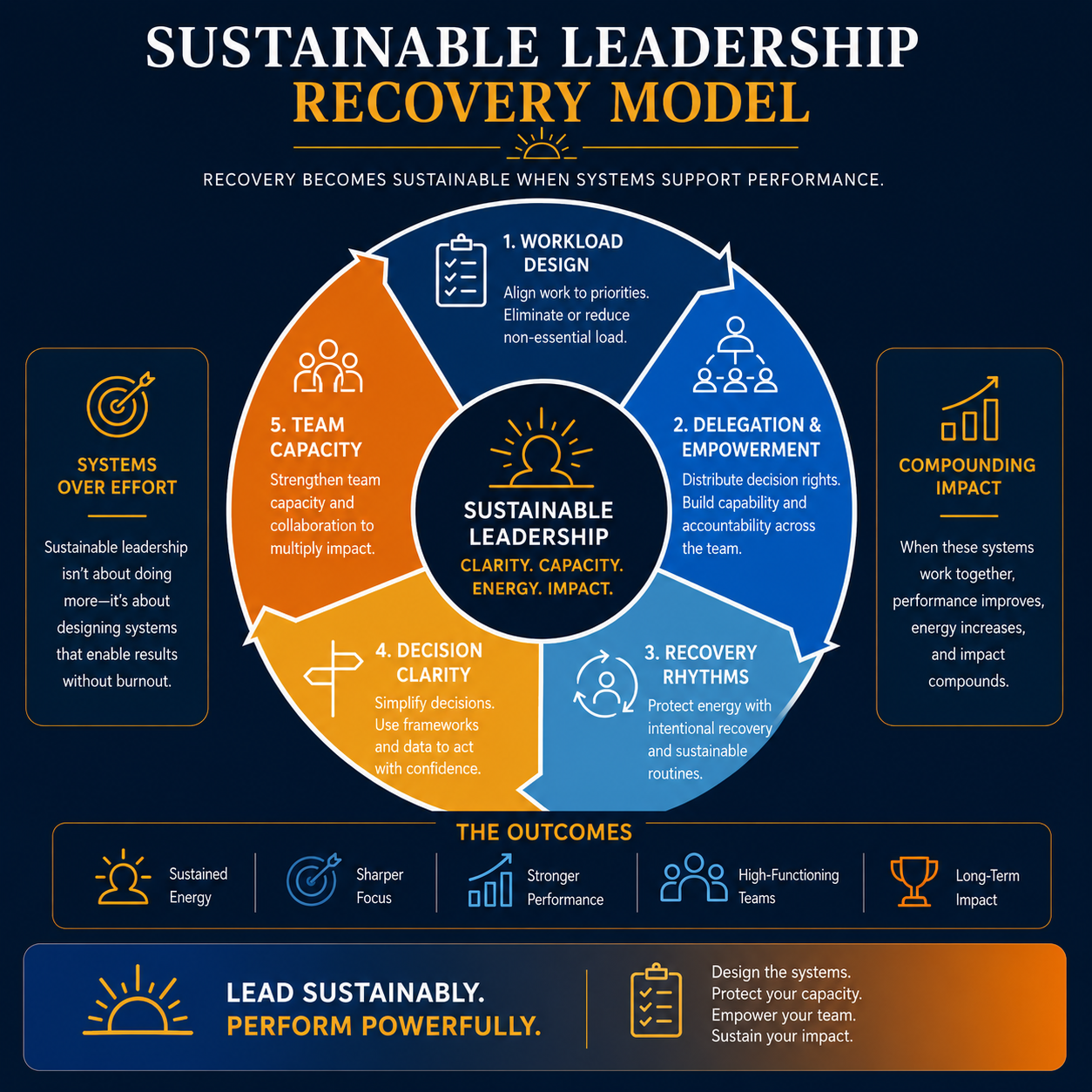
Burnout recovery for executives is not about becoming tougher. It is about becoming more sustainable.
The evidence is increasingly clear. Leaders cannot outwork broken systems. They cannot solve structural overload through personal sacrifice alone. Sustainable leadership requires intentional redesign of workload, decision-making, recovery rhythms, and organisational expectations.
Burnout is a system failure, not a personal failure. When leaders address the underlying structures creating depletion, they restore not only their own effectiveness but the performance of the teams and organisations they lead.
Recovery is not a retreat from leadership. It is a leadership discipline.
— Vincent Walters, Burn Bright Advisory
Free Resource
Take the Free Leadership Burnout Self-Assessment
Understand your current burnout risk and identify the structural causes behind your workload pressure. Free. Instant results.
Free Leadership Intelligence
Get Weekly Leadership Insights
Join thousands of leaders receiving practical strategies on burnout prevention, workload design, and sustainable performance every week.