Quick Answer
Leadership fatigue and cognitive overload occurs when the volume of decisions, meetings, communication, and competing priorities exceeds a leader’s mental processing capacity. The result is slower thinking, poorer decisions, emotional exhaustion, reduced performance, and increased burnout risk. The solution is rarely personal resilience alone. Sustainable improvement comes from redesigning workload, decision structures, recovery rhythms, and organisational systems.
Key Takeaways
- Leadership fatigue is often a structural problem, not a personal weakness.
- Cognitive overload reduces decision quality long before leaders recognise burnout.
- Constant communication creates hidden workload that most organisations fail to measure.
- Sustainable leadership requires workload architecture, not simply better time management.
- Recovery should be designed into leadership systems rather than treated as an afterthought.
Introduction
Leadership fatigue cognitive overload has become one of the defining leadership challenges of modern organisations.
Many leaders describe the same experience. They work harder than ever yet feel permanently behind. Meetings consume the day. Emails dominate the evening. Strategic thinking is replaced by constant reaction.
The problem is not a lack of capability. The problem is that leadership roles have expanded faster than organisational systems have evolved. Modern leaders manage more stakeholders, more communication channels, more reporting requirements, and more decisions than at any point in history.
Research consistently shows rising burnout rates among managers, executives, school leaders, healthcare leaders, and public sector professionals. Yet most solutions continue to focus on individual productivity rather than structural redesign.
This article explains what leadership fatigue and cognitive overload are, why they happen, how they affect decision-making, and what leaders can do to create sustainable performance.
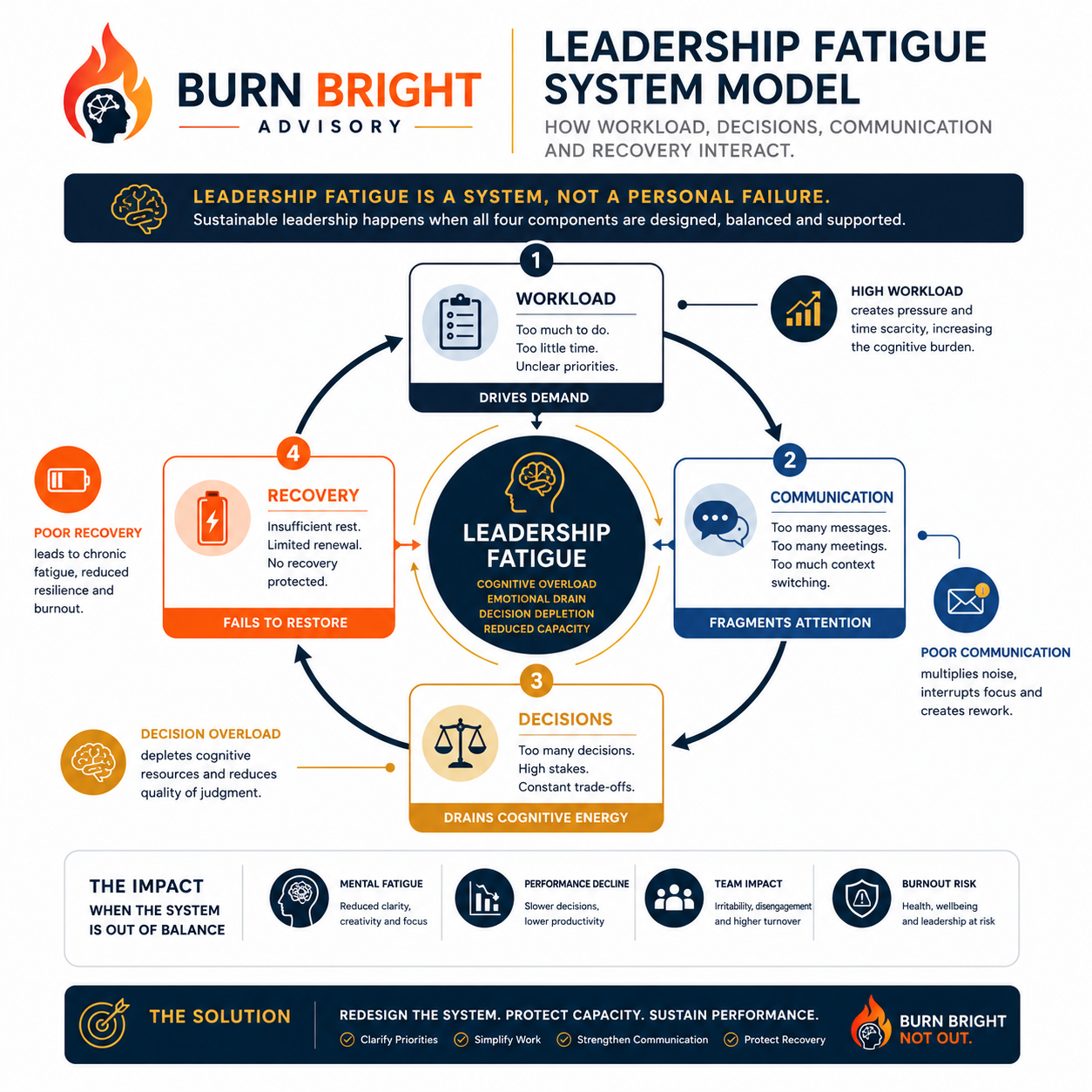
Definition
Leadership fatigue cognitive overload is a state where leadership demands exceed mental processing capacity, causing reduced decision quality, emotional exhaustion, impaired focus, and increased burnout risk.
What Causes Leadership Fatigue and Cognitive Overload?
Leadership fatigue rarely begins with one large event. Instead, it develops through the accumulation of small demands over time.
The Burn Bright Not Out framework identifies five common structural drivers:
Most organisations attempt to solve these challenges by helping leaders work faster. The evidence suggests the opposite approach is needed.
Work itself has fundamentally changed. Communication platforms, hybrid work, reporting requirements, compliance demands, and stakeholder expectations have created what many researchers describe as continuous partial attention. Leaders are constantly connected but rarely fully focused.
Gallup research has repeatedly found managers experience significantly higher burnout rates than many employee groups. Meanwhile, Deloitte and McKinsey studies have highlighted increasing leadership workload complexity across sectors.
Leaders spend more time coordinating work than completing meaningful work. Burnout is often the outcome. Not because leaders are weak. Because systems have become overloaded.
Why Does Cognitive Overload Damage Decision-Making?
Leadership is fundamentally a decision-making role. Every day leaders make decisions about people, priorities, resources, risk, communication, and strategy. Unfortunately, the human brain has limits. When decision volume becomes excessive, decision quality declines.
This phenomenon is commonly called decision fatigue. Leaders experiencing cognitive overload often show predictable symptoms:
Cognitive Symptoms
Avoidance of difficult choices
Increased reliance on familiar solutions
Reduced creativity
Higher error rates
Emotional reactivity
The danger is that these symptoms frequently appear before leaders recognise burnout. A leader may still appear productive while their judgement is deteriorating.
Research from organisational psychology consistently shows that mental exhaustion affects executive functioning, attention control, and strategic thinking. This explains why exhausted leaders often spend more time firefighting. The ability to think ahead disappears. Everything becomes urgent. Everything becomes reactive.
The Burn Bright Decision Fatigue Management framework identifies this as one of the most overlooked drivers of leadership burnout.
How Does Communication Overload Create Hidden Work?
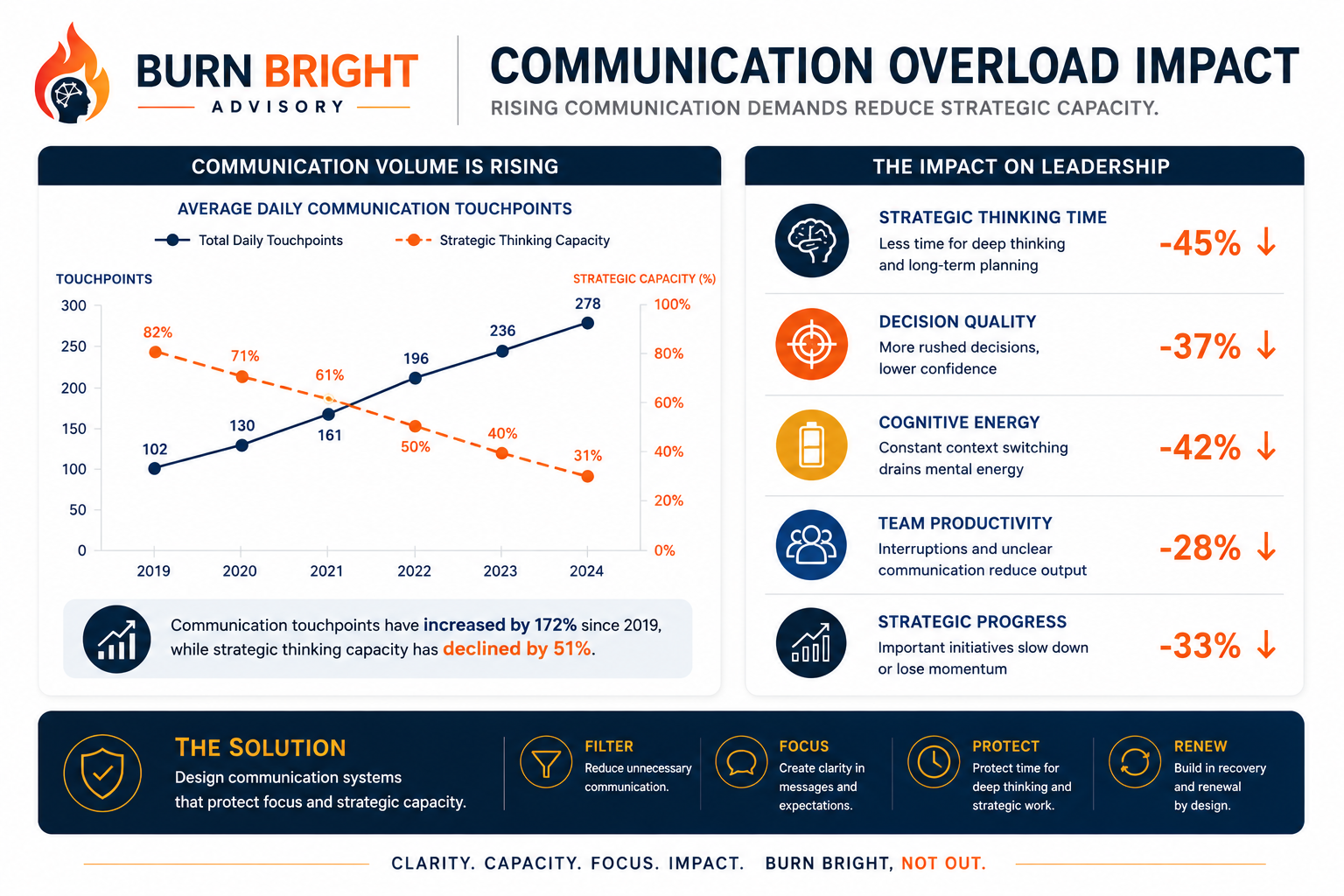
Many leaders underestimate how much work communication creates. The modern workplace operates through email, Teams, Slack, WhatsApp, project management systems, meetings, and video calls. Every message creates a cognitive cost. Every interruption forces the brain to switch context.
Research increasingly suggests that constant switching reduces concentration and increases mental fatigue. Vincent Walters describes this shift as moving from deep work to perpetual availability.
The challenge is not simply volume. It is fragmentation. A leader may spend an entire day responding to requests without advancing a single strategic priority. This creates what many executives describe as a sense of permanent busyness without meaningful progress.
| Traditional Leadership | Sustainable Leadership |
|---|---|
| Rewards responsiveness | Rewards effectiveness |
| Measures activity | Measures outcomes |
| Leaders solve everything | Teams share ownership |
| Constant availability | Clear boundaries |
| Heroic effort | System design |
| Recovery is optional | Recovery is planned |
What Are the Early Signs of Leadership Fatigue?
Many leaders do not recognise fatigue until it becomes severe. Common warning signs include:
PHYSICAL
→ Sleep disruption
→ Frequent headaches
→ Increased illness
EMOTIONAL
→ Cynicism
→ Reduced empathy
→ Emotional detachment
COGNITIVE
→ Poor concentration
→ Reduced creativity
→ Decision paralysis
These patterns appear consistently across education, healthcare, government, and business leadership environments. One of the strongest warning signs is losing the ability to think strategically. When leaders become trapped in operational survival mode, cognitive overload is usually already present.
This is why burnout should be treated as an organisational risk rather than an individual wellbeing issue.
How Can Leaders Reduce Cognitive Overload?
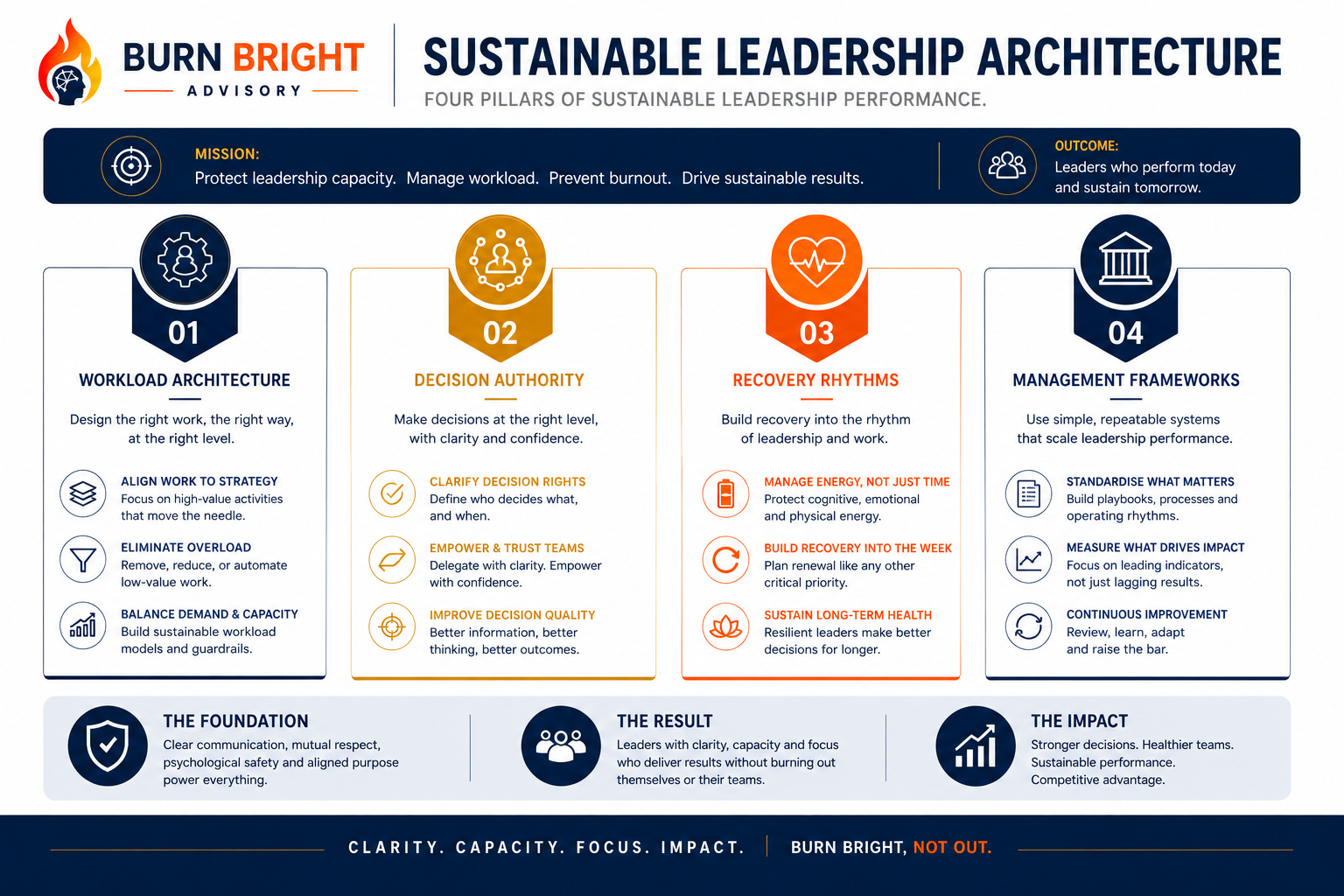
The solution is structural. The Burn Bright framework recommends four pillars of transformation:
Workload Architecture
Map where time is actually spent. Remove activities that create little value. Eliminate duplicate reporting and unnecessary meetings.
Decision Authority
Clarify who owns decisions. Reduce escalation. Prevent leaders becoming organisational bottlenecks.
Recovery Rhythms
Build recovery into schedules. Protect thinking time. Treat recovery as a leadership discipline.
Management Frameworks
Use systems such as RACI delegation, workload dashboards, and decision frameworks to reduce mental clutter.
Why Sustainable Leadership Outperforms Heroic Leadership
Many organisations still reward leaders who sacrifice themselves for results. This approach appears effective in the short term. Over time it becomes expensive.
Burn Bright refers to this as the Culture Tax — the hidden financial cost organisations pay when they treat symptoms instead of structures.
SENIOR LEADER REPLACEMENT
£500,000+
Cost of replacing a senior leader
MIDDLE MANAGER REPLACEMENT
£75,000+
Cost of replacing a middle manager
Sustainable leadership focuses on system design. Better systems outperform more effort. Leaders cannot outwork broken structures.
Frequently Asked Questions
What is leadership fatigue?
Leadership fatigue is physical, emotional, and cognitive exhaustion caused by prolonged leadership demands exceeding sustainable capacity.
What is cognitive overload?
Cognitive overload occurs when the brain receives more information, decisions, and demands than it can effectively process, reducing the quality of thinking, judgement, and decision-making.
Is leadership fatigue the same as burnout?
Not exactly. Leadership fatigue often develops before burnout. If unresolved, it can progress into full burnout. Fatigue is an early warning signal that structural intervention is needed.
Can resilient leaders still experience cognitive overload?
Yes. Resilience helps temporarily but cannot compensate for structurally unsustainable workloads indefinitely. Even the most resilient leaders have cognitive limits.
What is the fastest way to reduce cognitive overload?
Reduce decision volume, eliminate low-value meetings, clarify responsibilities, and create protected focus time. Structural changes produce faster and more durable results than individual coping strategies.
Conclusion
Leadership fatigue cognitive overload is not simply a personal productivity issue. It is increasingly a structural leadership challenge.
Modern organisations have expanded leadership responsibilities while leaving many underlying systems unchanged. The result is decision fatigue, communication overload, declining performance, and rising burnout.
The answer is not more effort. The answer is better design.
Burnout is a system failure, not a personal failure. Sustainable leadership requires workload architecture, clear decision authority, recovery rhythms, and management frameworks that protect human capacity while improving organisational effectiveness.
“As you look at your own situation today — are you leading from a place of clarity or a place of depletion?”
— Vincent Walters, Burn Bright Advisory
Free Resource
Take the Free Leadership Burnout Self-Assessment
Discover whether leadership fatigue and cognitive overload are affecting your performance and identify the structural risks driving burnout. Free. Instant results.
Free Leadership Intelligence
Get Weekly Leadership Insights
Join thousands of leaders receiving practical strategies on burnout prevention, workload design, and sustainable performance every week.