
Domain 9 of 9 — Compass™Take the Assessment →
Leadership Sustainability™
How leaders design their leadership for the long term — maintaining performance, wellbeing and effectiveness not just through peaks but across the full arc of their career.What Is Leadership Sustainability™?
Leadership Sustainability™ is the capacity to lead effectively over time — managing energy, workload, recovery and the structural conditions of leadership in ways that preserve performance without sacrificing wellbeing. It is the domain that determines whether a leader burns brightly or burns out.
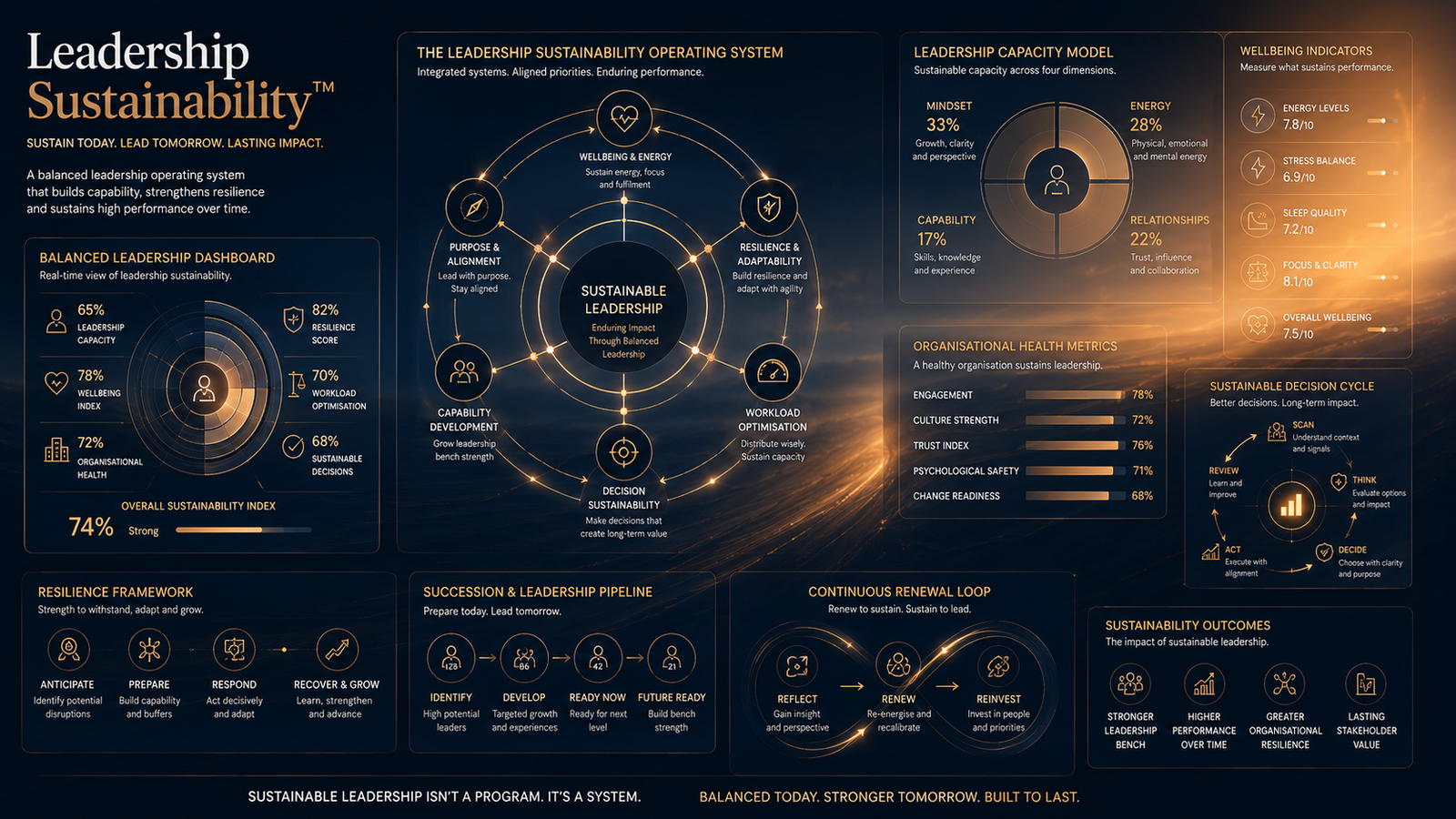
Leadership Sustainability™ — designing leadership for the long term so that performance, wellbeing and effectiveness are maintained across the full arc of a career.
Why Leadership Sustainability™ Matters
Sustainable leadership is not about doing less. It is about designing leadership systems that allow consistently high performance without the degradation of wellbeing that eventually forces a reckoning. The leaders who have the greatest long-term impact are not those who sacrifice everything in the short term — they are those who build the structural conditions for sustained excellence.Leadership Sustainability is also the domain most directly connected to the core belief at the heart of Burn Bright Advisory: burnout is a system failure, not a personal failure. When leaders burn out, it is usually because the systems around them have been designed for short-term output rather than long-term performance.Sustainable leadership is not a performance compromise. It is the design condition for lasting impact. The leader who is still performing at their best in year ten creates more value than the one who burns out in year three.
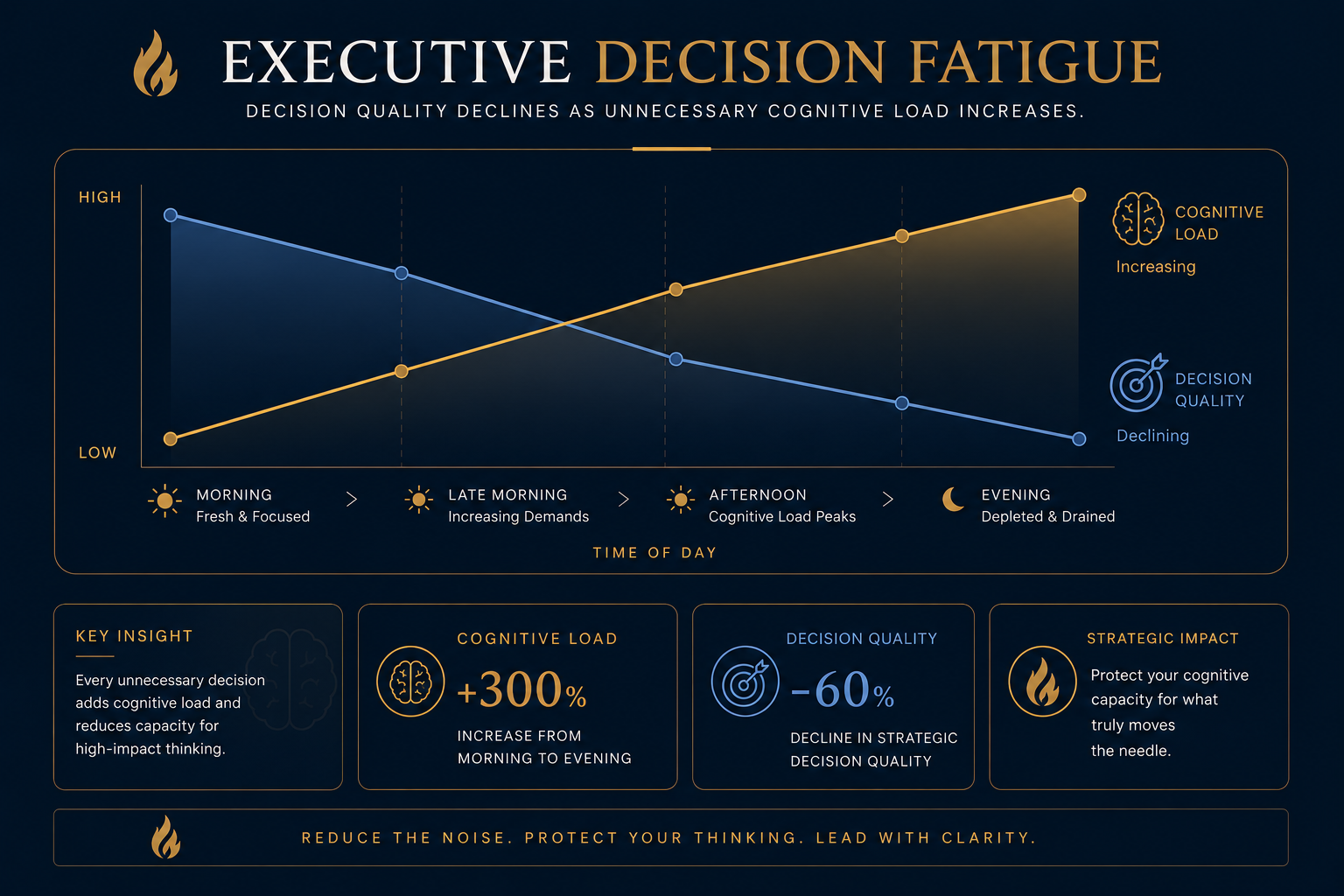
Executive decision quality declines as cognitive load increases. Leadership Sustainability Intelligence recognises this pattern early — and redesigns the structural conditions before crisis develops.
Who Leadership Sustainability™ Is For
Leadership Sustainability is relevant to every leader — but is urgently important for those experiencing burnout risk, operating in high-demand environments, or responsible for the wellbeing of other leaders within their organisation.What High Leadership Sustainability™ Looks Like
⚡
Energy Management
They manage their energy as deliberately as they manage their time — protecting recovery, recognising depletion and designing work patterns that sustain performance over time.🏗️
Workload Architecture
They design their leadership role to be sustainable — removing low-value activities, delegating appropriately and protecting the cognitive capacity that strategic leadership requires.🛑
Protective Boundaries
They establish and maintain boundaries around their availability, communication and working hours — not as a preference but as a structural requirement for sustained performance.🔄
Recovery by Design
They build recovery into their working rhythm — not as a reward for finishing work but as an active component of their performance system.👁️
Early Warning Recognition
They recognise the early signs of burnout — in themselves and in the people they lead — and respond structurally before crisis develops.🏛️
System Redesign
When burnout risk appears, they address the organisational systems creating it — workload, meeting culture, decision structures — rather than simply increasing personal resilience.⚠️ Warning Signs
- Treating availability as a proxy for commitment or performance
- Consistently working in ways that are sustainable only in the short term
- Ignoring early warning signs of burnout as temporary pressures that will pass
- Relying on resilience to compensate for structural overload rather than fixing the structure
- Modelling unsustainable working practices in ways that normalise them for the team
- Measuring leadership performance by hours invested rather than value created
How to Develop Leadership Sustainability™
Conduct a Workload Architecture Audit
List every significant claim on your leadership time. For each: Does this require my involvement? Does it create strategic value? Could it be delegated, eliminated or redesigned? Act on what you find.Design Your Recovery Rhythm
Identify specific recovery activities that genuinely restore your energy — and schedule them with the same commitment as strategic priorities. Recovery is not the absence of work. It is a structural performance requirement.Establish Communication Boundaries
Define the hours during which you are genuinely unavailable — and communicate them clearly. Then hold them. The quality of your boundaries models the permission your team has to establish their own.Learn Your Depletion Signals
Identify the three earliest signs that your energy, judgment or engagement is declining. For each: what is the signal? What does it tell you? What structural response does it require?Review Your Leadership Load Quarterly
Every 90 days, assess: Is this leadership role sustainable at its current design? What one structural change would have the greatest positive impact on my sustainability and performance?Leadership Sustainability™ Across Sectors
🎓 Education
A school leader who protects planning time, limits unnecessary meetings and models reasonable working hours builds a staff culture where sustainability becomes normal — reducing turnover and improving long-term performance.🏥 Healthcare
A clinical leader who designs sustainable rotas, monitors fatigue and addresses workload architecture proactively — rather than relying on staff commitment to absorb demand — protects both staff wellbeing and patient safety.🏢 Business
An executive who designs their leadership role for long-term performance — with protected strategic thinking time, delegation systems and genuine recovery rhythms — outperforms those who sacrifice sustainability for short-term output.🏛️ Public Sector
A public service leader who addresses the structural causes of workload overload — rather than expecting teams to absorb unlimited demand through commitment — builds the sustainable service delivery that the public actually needs.👥 HR & People
An HR leader who builds sustainability into organisational design from the outset — in job design, workload, management structures and performance culture — prevents the burnout they would otherwise spend significant resource addressing reactively.🚀 Entrepreneur
A founder who builds systems that allow the business to operate without their constant presence — through delegation, documentation and structural decision rights — creates both personal sustainability and the scalable business they are trying to build.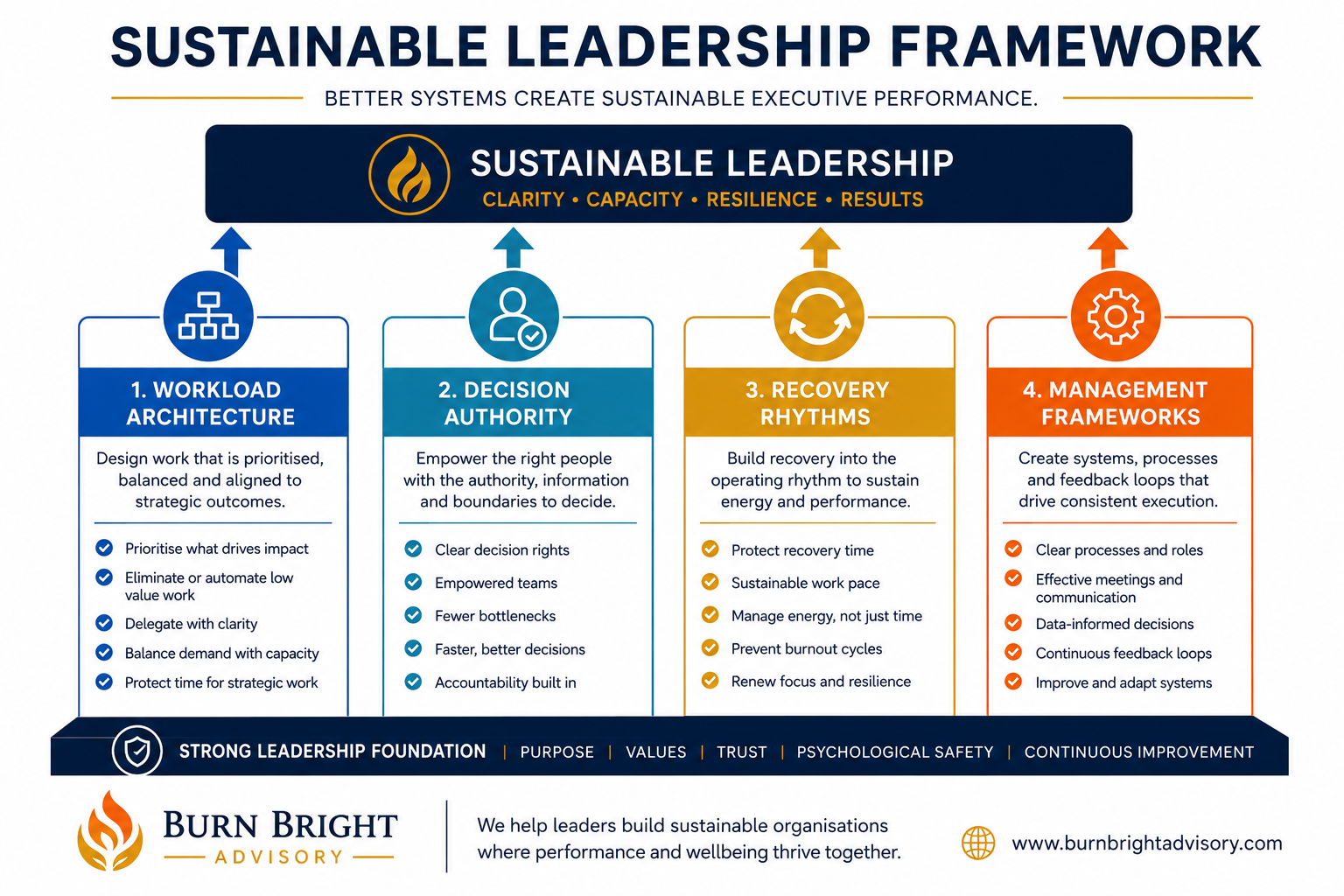
The Burn Bright Sustainable Leadership Framework — combining workload architecture, decision authority, recovery rhythms and management frameworks to create the structural conditions for long-term leadership performance.
Leadership Reflection Questions
- Is my current leadership role sustainable at its present design — honestly?
- What are the three earliest signals that my own leadership sustainability is under threat?
- What one structural change to my workload or role design would have the greatest impact on my long-term performance?
- How am I modelling sustainability — or unsustainability — for the people I lead?
- What am I currently sacrificing in the name of short-term performance that has a long-term cost?
- What would it look like to lead at my current level in a way that I could genuinely sustain for the next ten years?
Frequently Asked Questions
What is Leadership Sustainability™?
Leadership Sustainability™ is the ninth domain in the Leadership Intelligence Compass™. It measures a leader’s capacity to design and maintain their leadership for long-term effectiveness — managing energy, workload and recovery to sustain performance without sacrificing wellbeing.Is it the same as work-life balance?
No. Work-life balance is one component. Leadership Sustainability™ addresses the structural design of the leadership role itself — many sustainability problems exist within working hours.How does it connect to burnout prevention?
It is the domain most directly concerned with burnout prevention. Leaders with high Leadership Sustainability Intelligence recognise burnout risk early and address structural causes rather than relying on resilience.Can it be improved?
Yes — through workload architecture review, structured recovery design, boundary-setting practice and a shift in how performance is understood within the organisation.How is it assessed?
As part of the Leadership Intelligence Compass™ Assessment — a 36-statement instrument covering all nine domains, including a personalised radar chart and development recommendations.Next Step
Measure Your Leadership Sustainability™
Take the Leadership Intelligence Compass™ Assessment to see how you score across all nine domains — including a personalised radar chart and development recommendations.Free Leadership Intelligence
Get Weekly Leadership Insights
Practical strategies on leadership development, burnout prevention and sustainable performance — every week.
Members
Continue with the Full Implementation Pack
Take this framework further with 8 interactive tools — a diagnostic, workbook, capacity planner, and a structured 90-day roadmap.
Continue with the Full Implementation Pack →The Leadership Intelligence Journey
Every domain strengthens your progress along the full leadership journey.Discover
Assess
Understand
Reflect
Plan
Implement
Benchmark
Lead
Explore All 9 Compass™ Domains