Quick Answer
Key Takeaways
- Professionalism is a behavioural capability, not appearance or etiquette—it becomes most visible under pressure.
- Professionalism Intelligence™ has five dimensions: personal, relational, ethical, operational and developmental.
- Trust is built through repeated professional behaviour, not inspirational speeches or charisma.
- Professionalism acts as the connective tissue linking every other domain of the Leadership Intelligence Compass™.
- Professionalism prevents burnout by creating systems and structure, rather than relying on constant personal effort.
Professionalism Leadership: The Foundation of Sustainable High-Performance Leadership
Introduction
Leadership has never been more visible—or more scrutinised. Every email, meeting, online interaction and organisational decision contributes to a leader’s reputation. Employees evaluate authenticity. Customers assess integrity. Stakeholders observe consistency. Communities increasingly judge organisations not only by what leaders achieve, but by how those outcomes are delivered.
In this environment, professionalism has become one of leadership’s most valuable strategic assets. Unfortunately, professionalism is often reduced to simplistic behaviours such as dressing appropriately, communicating politely or following organisational procedures. These behaviours remain important, but they represent only a fraction of what modern professionalism requires.
Professionalism is a leadership operating system.
It shapes how decisions are made under pressure, how difficult conversations are managed, how accountability is demonstrated, how ethical dilemmas are resolved and how trust is sustained during periods of uncertainty.
Within Burn Bright Advisory™’s Leadership Performance Intelligence™ framework, Professionalism Intelligence™ is not an isolated competency. It acts as the stabilising force that enables every other leadership capability to function effectively. Without professionalism, technical expertise loses credibility, emotional intelligence becomes inconsistent, ethical intentions fail under pressure, strategic vision lacks execution and organisational culture gradually deteriorates.
Conversely, when professionalism becomes embedded throughout leadership practice, organisations experience stronger trust, greater accountability, higher engagement, improved collaboration and more sustainable performance.
Why Professionalism Has Become Leadership’s Greatest Competitive Advantage
Leadership has always required competence. Today, it requires credibility. In an increasingly transparent world where decisions are scrutinised instantly by employees, customers, regulators and artificial intelligence systems, professionalism has evolved from a desirable characteristic into a strategic organisational asset.
Technology has accelerated communication. Hybrid working has reshaped organisational relationships. Artificial intelligence has transformed decision-making. Public expectations of leadership have never been higher. Against this backdrop, professionalism provides the consistency that allows leaders to remain trusted even as circumstances continually change.
Professional leaders create environments where people know what to expect.
Consistency creates predictability.
Predictability builds trust.
Trust enables performance.
Without professionalism, even technically brilliant leaders struggle to sustain influence over time.
Professionalism Beyond Appearance
Historically, professionalism was often associated with visible behaviours—appropriate dress, punctuality, etiquette, formal communication and organisational hierarchy. While these remain valuable, modern leadership requires a much broader interpretation.
Professionalism now encompasses how leaders make decisions under uncertainty, communicate during crises, manage disagreement, demonstrate accountability, learn from mistakes, respond to ethical challenges, develop others and steward organisational culture.
This is why Professionalism Intelligence™ is fundamentally a behavioural capability rather than a cosmetic one.
Featured Snippet
The Five Dimensions of Professionalism Intelligence™
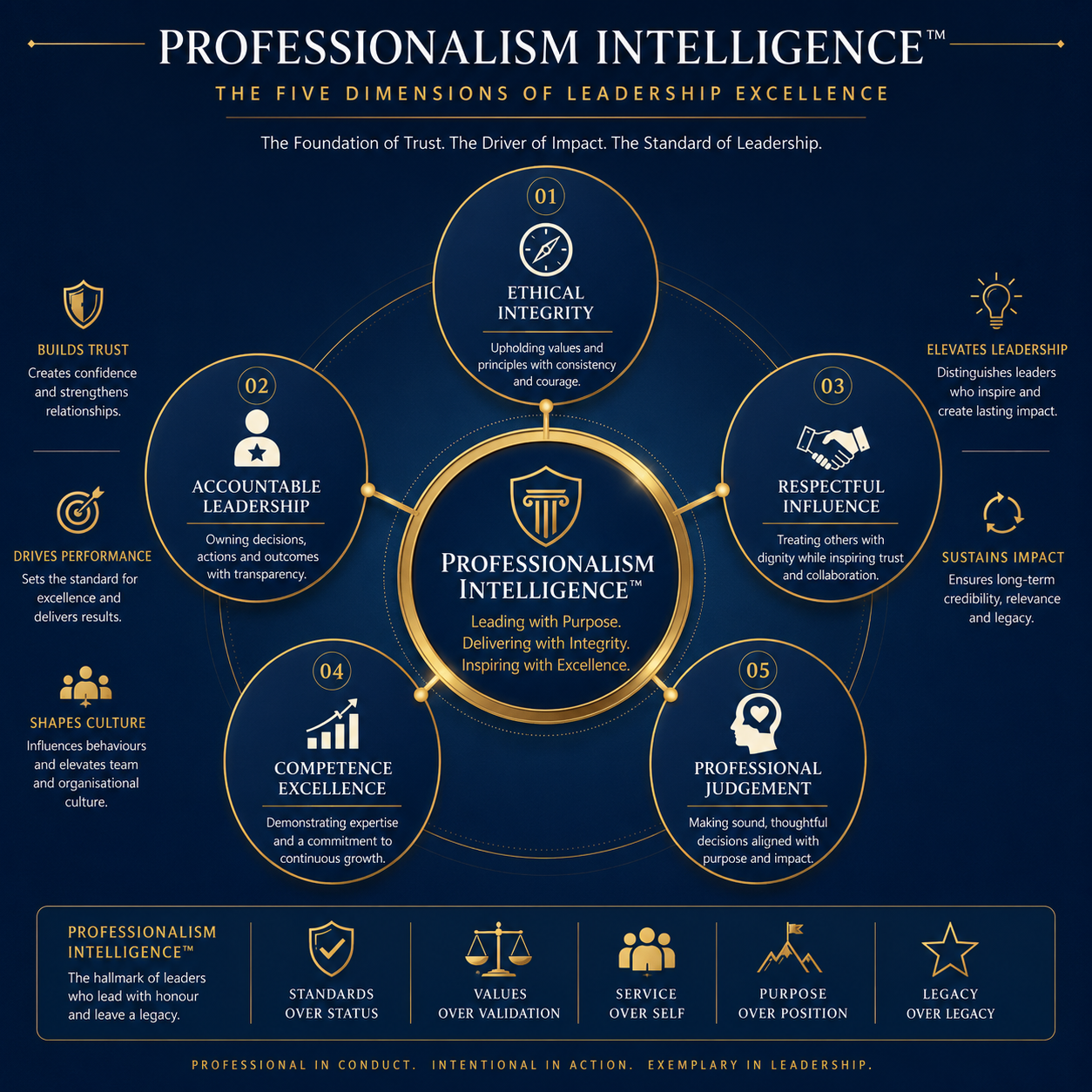
Burn Bright Advisory™ defines Professionalism Intelligence™ through five interconnected dimensions.
Dimension 1
Personal Professionalism
Leadership begins with self-management. Professional leaders regulate their behaviour regardless of external pressure, demonstrating emotional discipline, preparation, reliability, consistency, personal accountability and resilience.
Dimension 2
Relational Professionalism
Professional leaders recognise that leadership exists within relationships rather than authority structures. They intentionally develop respect, psychological safety, constructive feedback, collaborative decision-making, active listening and inclusive communication.
Dimension 3
Ethical Professionalism
Professionalism without ethics becomes compliance. Ethics without professionalism becomes inconsistency. Professional leaders integrate both, asking whether a decision is fair, transparent, defensible and aligned with organisational values.
Dimension 4
Operational Professionalism
Many leadership failures occur not because leaders lack vision but because they fail to execute consistently. Operational professionalism includes disciplined planning, dependable execution, effective delegation, evidence-based decision making and continuous improvement.
Dimension 5
Developmental Professionalism
Professional leaders remain learners. Rather than assuming expertise is permanent, they continually develop new knowledge, leadership capability, reflective practice, coaching skills, adaptability and strategic awareness.
Why Trust Begins With Professionalism
Trust is often described as leadership’s currency. However, trust is rarely created through inspirational speeches or charismatic personalities. Trust develops through repeated evidence. Every interaction becomes data, as employees unconsciously ask whether they can rely on this leader, whether commitments are kept, and whether expectations remain consistent.
Professionalism provides affirmative answers to these questions through behaviour rather than rhetoric. When leaders consistently demonstrate professionalism, organisations experience greater employee engagement, stronger collaboration, reduced conflict, faster decision making, improved customer confidence and increased organisational resilience.
Trust therefore becomes an organisational outcome generated by professional behaviour.
Leadership Performance Intelligence™ and Professionalism
Within Burn Bright Advisory™’s Leadership Intelligence Compass™, Professionalism Intelligence™ acts as the integrating capability connecting every other leadership domain.
| Leadership Domain | Professionalism Contribution |
|---|---|
| Ethics Intelligence™ | Enables ethical decisions to become consistent behaviours. |
| Emotional Intelligence™ | Provides emotional discipline during difficult interactions. |
| Adaptability Intelligence™ | Allows leaders to embrace change without abandoning standards. |
| Reflective Practice Intelligence™ | Encourages continual learning from experience. |
| Visionary Leadership Intelligence™ | Grounds ambitious strategy within credible execution. |
| Knowledge Development Intelligence™ | Creates a culture where continuous learning becomes professional responsibility. |
| Leadership Sustainability™ | Prevents burnout through disciplined leadership systems instead of reactive leadership. |
Rather than existing independently, these domains reinforce one another through professional practice. Professionalism therefore becomes the connective tissue linking leadership capability into an integrated system.
Professionalism During Organisational Change
Periods of change expose the true quality of leadership. During organisational stability, even inconsistent leadership may appear effective. During uncertainty, professionalism becomes highly visible.
Employees observe whether leaders communicate honestly, remain accessible, explain difficult decisions, maintain fairness, acknowledge uncertainty and continue demonstrating respect.
When professionalism remains visible throughout organisational change, employee confidence remains significantly higher because people trust both the process and those leading it. This explains why organisations investing in professional leadership cultures often recover from disruption faster than organisations relying primarily on charismatic leadership.
Professionalism Across Leadership Sectors
Professionalism is often described as a universal leadership quality, yet its practical application differs significantly across industries. The following examples illustrate how professionalism creates value across different leadership environments.
Business Leadership
Sustainable business leadership requires far more than achieving financial targets. Professional leaders make evidence-informed decisions, communicate transparently during change, manage commercial risk ethically and balance profitability with long-term sustainability—creating a competitive advantage rather than an administrative expectation.
School Leadership
Professional school leaders understand that their behaviour shapes organisational culture more powerfully than written policies. Their professionalism directly influences teacher retention, student outcomes, parental confidence and school improvement capacity.
Healthcare Leadership
Professional healthcare leaders balance patient safety, clinical governance, workforce wellbeing and ethical responsibility—remaining calm during crises while maintaining transparency and supporting multidisciplinary collaboration.
Public Service Leadership
Professional public service leaders demonstrate impartiality, accountability, transparency and stewardship of public resources, focusing on maintaining institutional trust rather than short-term popularity.
Human Resources and People Leadership
Professional HR leaders balance empathy with fairness, consistently demonstrating confidentiality, procedural integrity, unbiased decision-making and fair performance management—often becoming the cultural benchmark for the wider organisation.
Entrepreneurial Leadership
Professional entrepreneurs maintain standards while embracing innovation, demonstrating disciplined decision-making, responsible financial management and stakeholder transparency—transforming founder-led businesses into sustainable enterprises.
The Professional Leadership Cycle
Professionalism is not a static characteristic. It develops through continual reinforcement. Within the Leadership Performance Intelligence™ framework, Professionalism Intelligence™ can be understood as a continuous leadership cycle.
Stage 1 — Standards
Professional leaders establish clear personal and organisational standards that define expected behaviours, decision-making principles and organisational values. Without clear standards, consistency becomes impossible.
Stage 2 — Behaviour
Standards become visible only through repeated behaviour. Professional leaders intentionally demonstrate reliability, respect, accountability, preparation and integrity, converting leadership values into observable evidence.
Stage 3 — Trust
Repeated professional behaviour builds confidence. Trust develops because stakeholders experience consistency rather than unpredictability, reducing organisational friction and increasing collaboration, engagement and commitment.
Stage 4 — Influence
Trust expands leadership influence. People willingly follow leaders whose professionalism has been demonstrated consistently. Influence becomes earned rather than positional.
Stage 5 — Culture
As professional behaviours spread across teams, they become organisational norms. Culture begins reinforcing professionalism independently of individual leaders.
Stage 6 — Sustainability
Professional cultures create sustainable leadership systems. Instead of relying upon exceptional individuals, organisations develop leadership capability across multiple levels. Leadership becomes resilient, and performance becomes sustainable, as the cycle begins again.
Why Professionalism Prevents Leadership Burnout
One of the greatest misconceptions in leadership development is that professionalism demands perfection. In reality, sustainable professionalism reduces unnecessary pressure. Professional leaders establish systems instead of relying upon constant personal effort—delegating effectively, establishing boundaries, clarifying expectations, reducing unnecessary conflict and prioritising reflective practice.
This directly supports Leadership Sustainability™. Burnout frequently emerges not because leaders care too much, but because leadership lacks structure. Professionalism provides that structure.
Professional leaders recognise that the quality of leadership is determined not by how intensely they perform for a short period, but by how consistently they enable others to succeed over the long term.
Practical Framework: Developing Professionalism Intelligence™
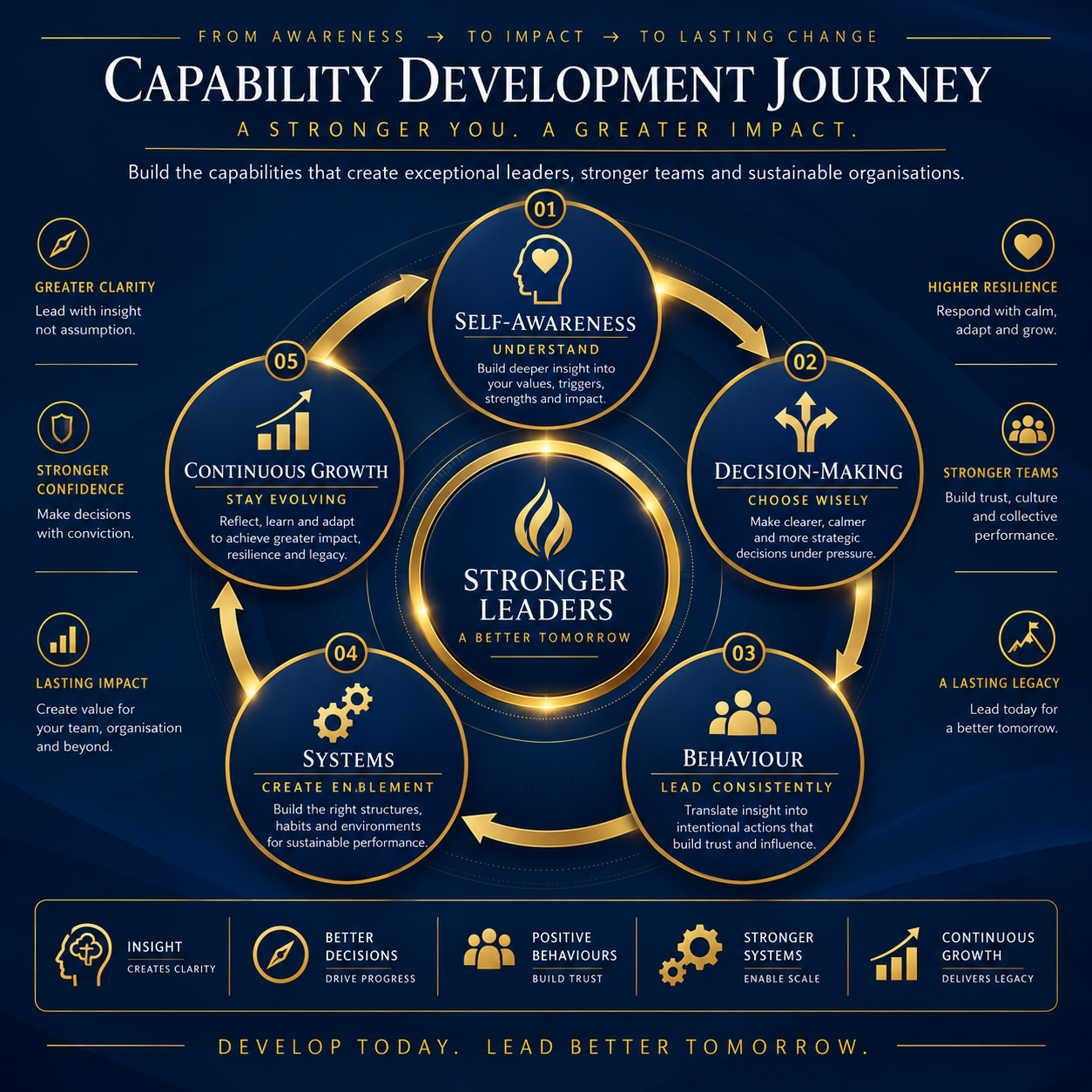
Professionalism develops through deliberate practice, continuous reflection and consistent behavioural reinforcement, cultivated through intentional development across five progressive stages.
Stage 1 Build Professional Self-Awareness
Professional leaders regularly examine not only what they do, but how they do it and the impact they have on others—asking difficult questions and actively seeking multiple perspectives through reflective practice, mentoring, coaching and leadership diagnostics.
Stage 2 Strengthen Professional Decision-Making
Professional decision-making balances ethics, evidence, organisational values, stakeholder impact, long-term sustainability and operational effectiveness—asking not only “can we?” but “should we?” and “who may be disadvantaged?”
Stage 3 Develop Consistent Leadership Behaviours
Employees rarely judge leaders by isolated actions—they evaluate repeated behavioural patterns of reliability, respect, accountability, preparedness and emotional regulation. Consistency creates predictability, predictability builds confidence, confidence creates organisational trust.
Stage 4 Create Professional Systems
Professional leaders avoid becoming organisational bottlenecks, instead creating clear decision-making frameworks, transparent communication processes, structured delegation and reflective learning routines that reinforce professionalism independently of individual personalities.
Stage 5 Sustain Professional Growth
Professionalism is never complete. Professional leaders intentionally invest in professional reading, evidence-informed practice, reflective journaling, leadership coaching and sector benchmarking—learning becomes part of professional identity rather than an occasional activity.
Common Barriers to Professional Leadership
Despite recognising the importance of professionalism, many leaders unintentionally undermine their own credibility. These barriers rarely arise from poor intentions—more commonly, they emerge through accumulated habits, organisational pressure and increasing complexity.
Case Study: Professionalism During Organisational Transformation
Imagine a regional healthcare organisation undergoing a major digital transformation. Electronic patient records are replacing long-established paper systems. Clinical staff are anxious, operational pressures continue, and public scrutiny remains high. The executive leadership team adopts two contrasting approaches.
| Organisation A (Deadline-First) | Organisation B (Professionalism-First) |
|---|---|
| Communication becomes inconsistent | Leaders communicate regularly and explain the reasons behind decisions |
| Concerns are dismissed | Clinical teams are involved in planning and mistakes are discussed openly without blame |
| Training is delayed | Training is prioritised and support remains visible throughout implementation |
| Staff confidence deteriorates and resistance increases | Trust remains strong even as challenges arise |
The technology eventually functions in both organisations. But in Organisation A, organisational trust has been significantly damaged. In Organisation B, trust remains strong because professionalism governs leadership behaviour throughout the process.
Employees remember not only what changed.
They remember how they were led.
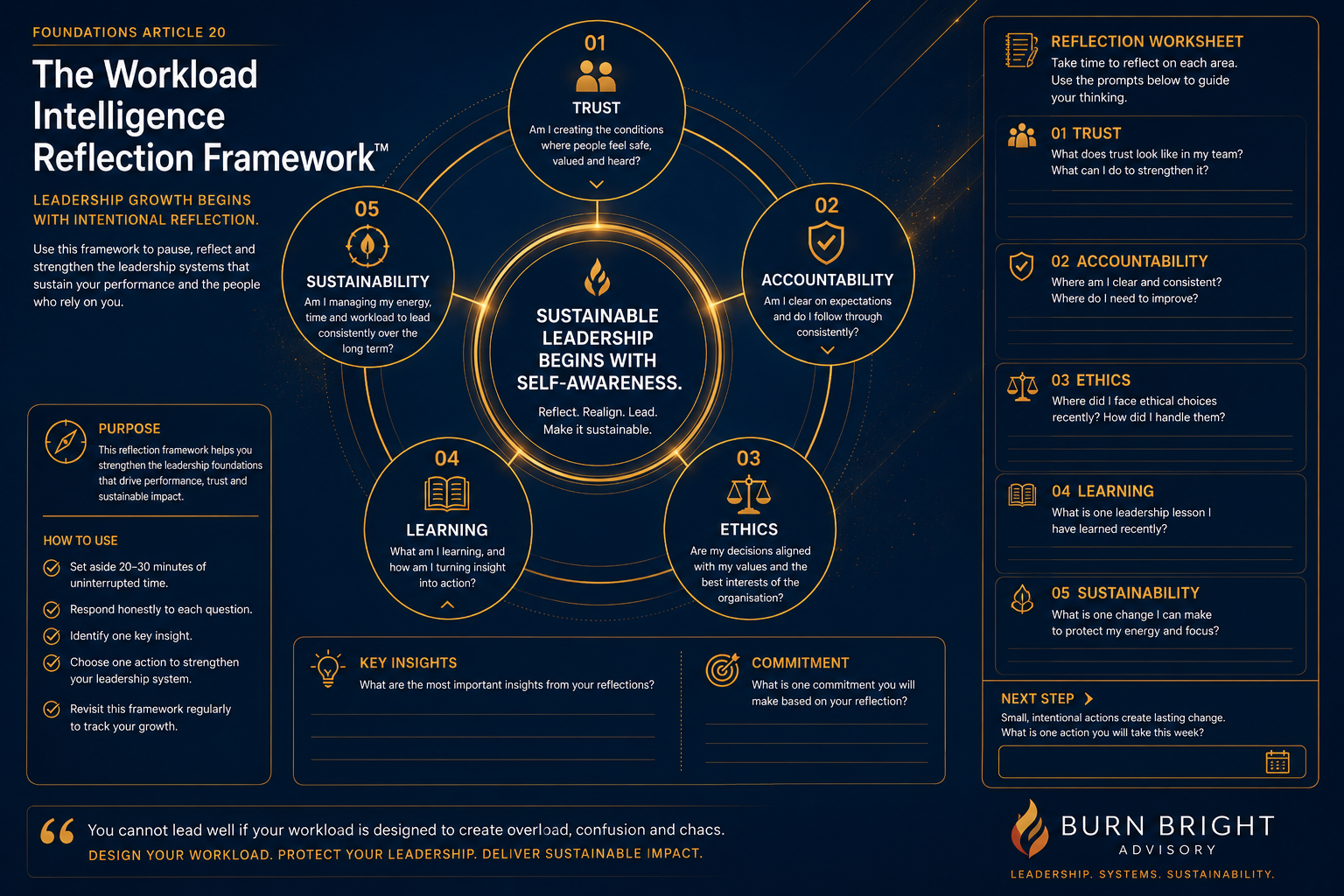
Reflection Questions
- Which professional behaviours do people consistently experience from my leadership?
- When under pressure, what habits most threaten my professionalism?
- How predictable are my decisions from the perspective of my team?
- Do my behaviours consistently reinforce organisational values?
- What systems currently support professionalism within my organisation?
- Where does professionalism depend too heavily upon individual personalities?
- Which Leadership Intelligence Compass™ domain should I strengthen alongside Professionalism Intelligence™?
- What one professional habit would have the greatest positive impact if practised consistently over the next 90 days?
Practical Action Steps
Developing Professionalism Intelligence™ requires consistent action rather than occasional inspiration. Start with these practical steps:
- Conduct a personal professionalism audit using structured feedback from colleagues
- Identify one recurring behaviour that strengthens your leadership credibility
- Establish one reflective practice routine each week
- Review how decisions are communicated throughout your organisation
- Clarify behavioural expectations for your leadership team
- Introduce regular discussions about professionalism during leadership meetings
- Strengthen accountability by making commitments visible and measurable
- Create a personal development plan linked to the Leadership Intelligence Compass™
- Benchmark your leadership practices against recognised professional standards
- Review progress every quarter to reinforce continuous improvement
Professionalism grows through disciplined repetition. Small, consistent improvements accumulate into significant leadership capability over time. The most trusted leaders are rarely those who make the fewest mistakes—they are the leaders who consistently demonstrate integrity, accountability, humility and professionalism, especially when leadership becomes most challenging.
What is professionalism leadership?
Professionalism leadership is the consistent practice of leading with integrity, accountability, competence, respect and reliability. It extends beyond appearance or etiquette to include ethical decision-making, effective communication, emotional discipline and continuous professional development.
Why is professionalism important in leadership?
Professionalism creates trust. When leaders behave consistently, communicate transparently and demonstrate accountability, employees develop confidence in both the leader and the organisation—supporting stronger culture, engagement, collaboration, decision-making and resilience.
How does professionalism differ from competence?
Competence refers to what a leader knows and can do. Professionalism reflects how that knowledge is consistently applied. A technically brilliant leader may lack professionalism if they demonstrate poor communication, inconsistent behaviour or limited accountability.
Can professionalism be developed?
Yes. Professionalism is a learnable leadership capability, strengthened through reflective practice, coaching, leadership feedback, ethical decision-making, continuous learning and consistent accountability.
How does professionalism improve organisational culture?
Culture develops from repeated leadership behaviours. When leaders consistently demonstrate professionalism, employees begin modelling similar behaviours, strengthening trust, collaboration, accountability and psychological safety over time.
What role does professionalism play during organisational change?
Professional leaders reduce uncertainty through honest communication, visible leadership, fair decision-making and transparent accountability, enabling organisations to navigate disruption while preserving stakeholder confidence.
How does Professionalism Intelligence™ connect with the Leadership Intelligence Compass™?
Professionalism Intelligence™ acts as the foundation connecting multiple leadership domains, strengthening Ethics Intelligence™, Emotional Intelligence™, Adaptability Intelligence™, Reflective Practice Intelligence™, Visionary Leadership Intelligence™, Knowledge Development Intelligence™ and Leadership Sustainability™ into a coherent, sustainable system.
What are the biggest threats to professionalism?
Common barriers include reactive leadership, inconsistent standards, excessive workload, poor communication, lack of reflection, ethical shortcuts, emotional impulsiveness and unclear organisational expectations.
Conclusion
Professionalism has become one of the defining leadership capabilities of the twenty-first century. In an era characterised by accelerating technological change, increasing organisational complexity and heightened stakeholder expectations, sustainable leadership depends less upon charismatic personalities and more upon consistent professional behaviour.
Professionalism provides that consistency. It enables leaders to make better decisions, communicate with greater clarity, build stronger relationships and establish cultures founded upon trust rather than control.
Within Burn Bright Advisory™’s Leadership Performance Intelligence™ framework, Professionalism Intelligence™ is not simply another leadership competency—it is the foundation upon which sustainable leadership is built. Ethical leadership depends upon professionalism. Emotional intelligence is strengthened through professionalism. Reflective practice becomes meaningful because of professionalism. Adaptability remains credible because professionalism provides stability amidst change.
Ultimately, organisations do not become exceptional through isolated acts of leadership. They become exceptional because professional behaviours are repeated consistently across individuals, teams and systems.
How Professional Is Your Leadership, Really?
Take the Leadership Burnout Self-Assessment to understand where inconsistency or overload may be quietly eroding trust in your leadership—and where to focus first.
Free Leadership Intelligence
Get Weekly Leadership Insights
Join thousands of leaders receiving practical strategies on burnout prevention, workload design, and sustainable performance every week.