Quick Answer
Key Takeaways
- Professionalism is the behavioural expression of leadership credibility, not simply etiquette or appearance.
- Burn Bright Advisory™ identifies five interconnected dimensions of Professionalism Intelligence™: personal, relational, organisational, strategic and adaptive.
- Unprofessional leadership rarely fails through major scandal — it erodes gradually through small, repeated behavioural compromises.
- Professionalism Intelligence™ underpins every other domain of the Leadership Intelligence Compass™, including Ethics Intelligence™ and Emotional Intelligence™.
- Professionalism can be deliberately developed through reflective practice, non-negotiable standards and measurement.
Professionalism Leadership: Why Professional Standards Are the Foundation of High-Performing Organisations
Leadership is often discussed through the lenses of vision, innovation, strategy or influence. Yet history repeatedly demonstrates that organisations rarely fail because leaders lacked ideas. More commonly, they fail because leaders gradually abandoned the professional behaviours that created confidence, stability and trust.
Professionalism is frequently misunderstood as something superficial: dress appropriately, respond to emails, arrive on time, speak respectfully. While these behaviours certainly contribute to professionalism, they represent only its visible surface. True professionalism reflects the internal standards that govern every leadership decision.
Professional leaders behave consistently whether under pressure or in routine circumstances. They maintain integrity when no one is watching. They remain accountable when outcomes disappoint. They demonstrate respect during disagreement. They pursue excellence without sacrificing ethics.
Without it, vision becomes rhetoric.
Authority becomes control.
Influence becomes manipulation.
Success becomes temporary.
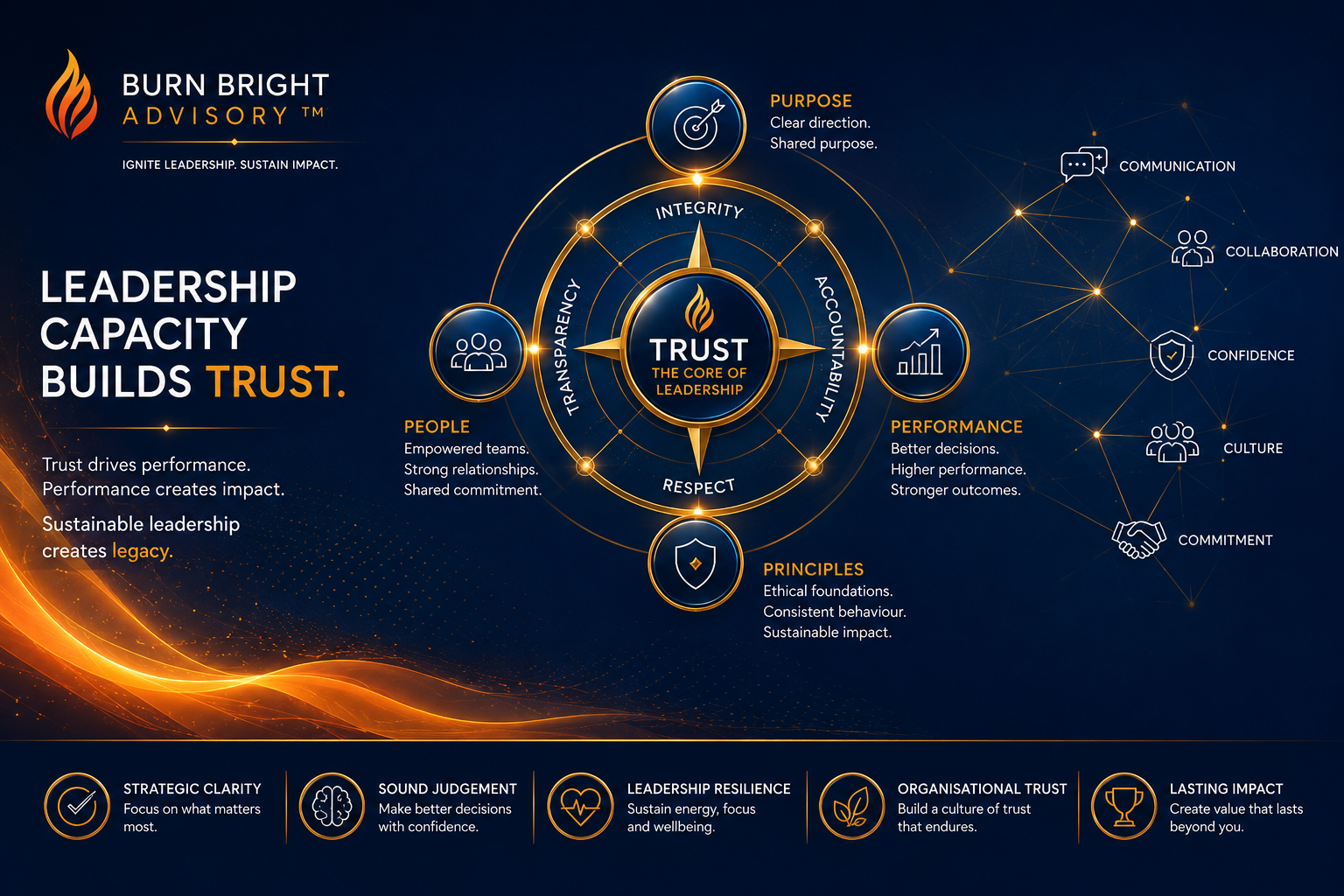
Within Burn Bright Advisory™’s Leadership Performance Intelligence™ model, professionalism serves as the behavioural infrastructure supporting every other leadership capability. Organisations cannot build sustainable leadership cultures unless professional behaviours become organisational norms rather than individual preferences.
Featured Snippet
Professionalism Is More Than Behaviour — It Is Leadership Identity
One of the greatest misconceptions surrounding professionalism is that it consists of isolated behaviours. Instead, professionalism reflects identity. Professional leaders continually ask themselves: How should I behave? What standard should I model? What expectations am I creating? What culture am I reinforcing? What legacy am I leaving?
These questions distinguish reactive managers from intentional leaders. Every conversation becomes an opportunity to reinforce organisational values. Every difficult decision becomes a demonstration of leadership character. Every interaction shapes organisational culture.
The Five Dimensions of Professionalism Leadership
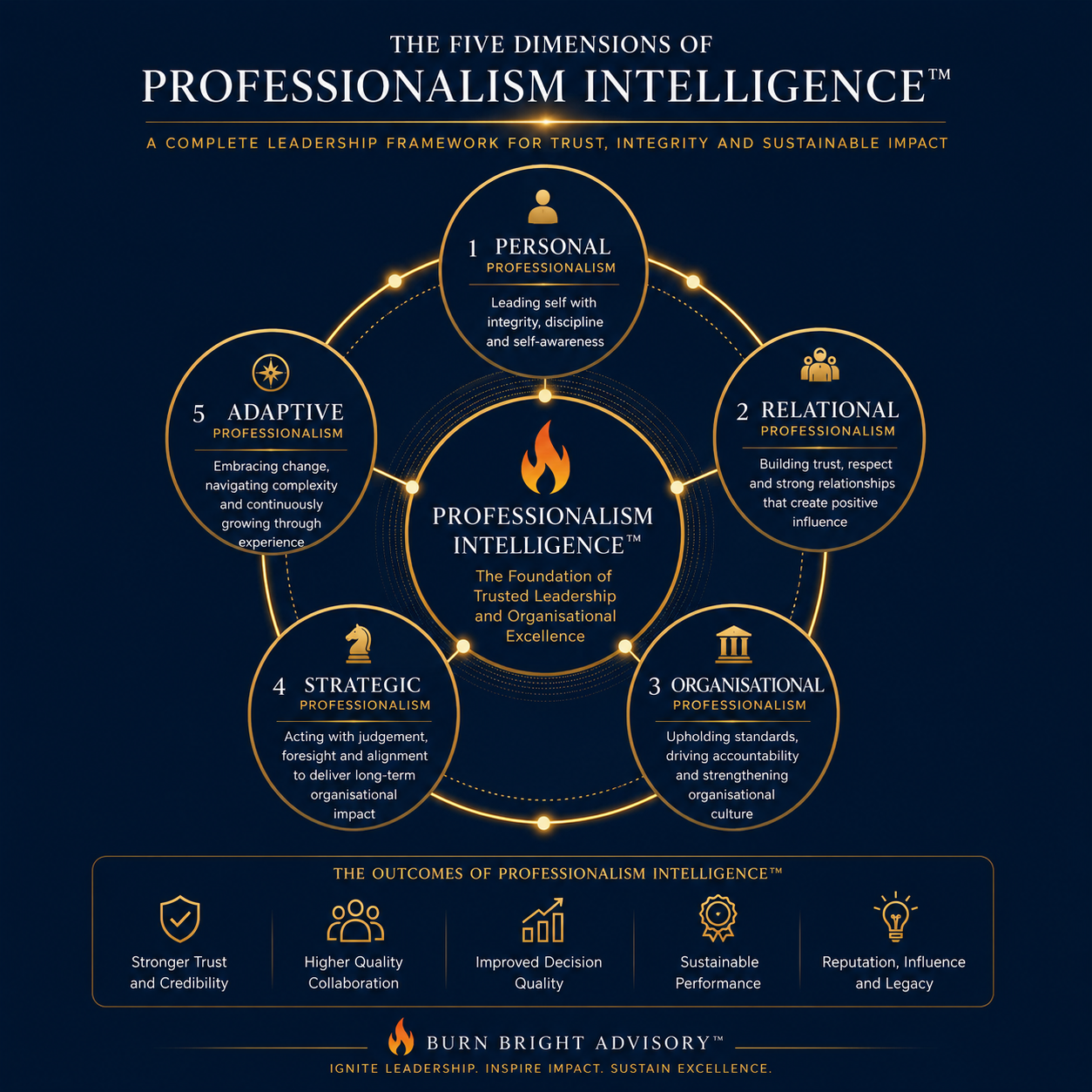
Burn Bright Advisory™ identifies five interconnected dimensions that together form Professionalism Intelligence™.
Pillar 1
Personal Professionalism
Professional leadership begins with self-management. Leaders who cannot manage themselves inevitably struggle to lead others.
- Emotional regulation
- Personal accountability
- Preparation and continuous learning
- Reflective practice and resilience
Pillar 2
Relational Professionalism
Professional leaders strengthen relationships through consistency. Trust grows from repeated professional interactions rather than occasional inspirational moments.
- Communicate respectfully and honour commitments
- Provide constructive feedback
- Resolve conflict professionally
- Encourage diverse perspectives and psychological safety
Pillar 3
Organisational Professionalism
Every leader shapes organisational standards. Employees rarely exceed the professionalism consistently demonstrated by leadership — culture always follows behaviour.
- Clear accountability and transparent decision-making
- Ethical governance
- Respectful communication and shared expectations
Pillar 4
Strategic Professionalism
Professional leaders avoid impulsive decisions, emotional reactions, political manipulation, hidden agendas and inconsistent priorities.
- Disciplined judgement aligned with organisational purpose
- Strategy that balances performance with long-term sustainability
Pillar 5
Adaptive Professionalism
Professional leaders remain adaptable without abandoning principles. Adaptability without professionalism creates inconsistency; professionalism without adaptability creates rigidity. Leadership requires both.
- Modify communication styles and leadership approaches
- Evolve operational systems and learning strategies
- Maintain unwavering standards on ethics, respect and accountability
Why Professionalism Has Become a Strategic Leadership Capability
Rapid technological change has transformed leadership expectations. Artificial intelligence can automate information processing, automation can improve efficiency, and digital systems can support decision-making — but none of these technologies can replace professional judgement. Professionalism remains uniquely human.
Organisations increasingly compete not only on products and services but on trust. Customers evaluate integrity. Employees evaluate culture. Investors evaluate governance. Communities evaluate reputation. Professionalism sits at the centre of all four.
The most respected organisations rarely become respected because they possess the best technology. They become respected because people consistently experience professional leadership at every organisational level.
The Cost of Unprofessional Leadership
Professional failures rarely begin with major scandals. Instead, they emerge through small behavioural compromises.
One missed commitment.
One ignored conversation.
One disrespectful meeting.
One inconsistent decision.
Repeated over months or years, these behaviours reshape organisational culture. Research consistently demonstrates that employees lose confidence in leadership long before organisations experience measurable performance decline. The sequence typically follows a predictable pattern: poor behaviour leads to reduced trust, which lowers engagement, decreases collaboration, increases turnover and ultimately reduces organisational performance.
Professionalism Leadership in Practice Across Every Sector
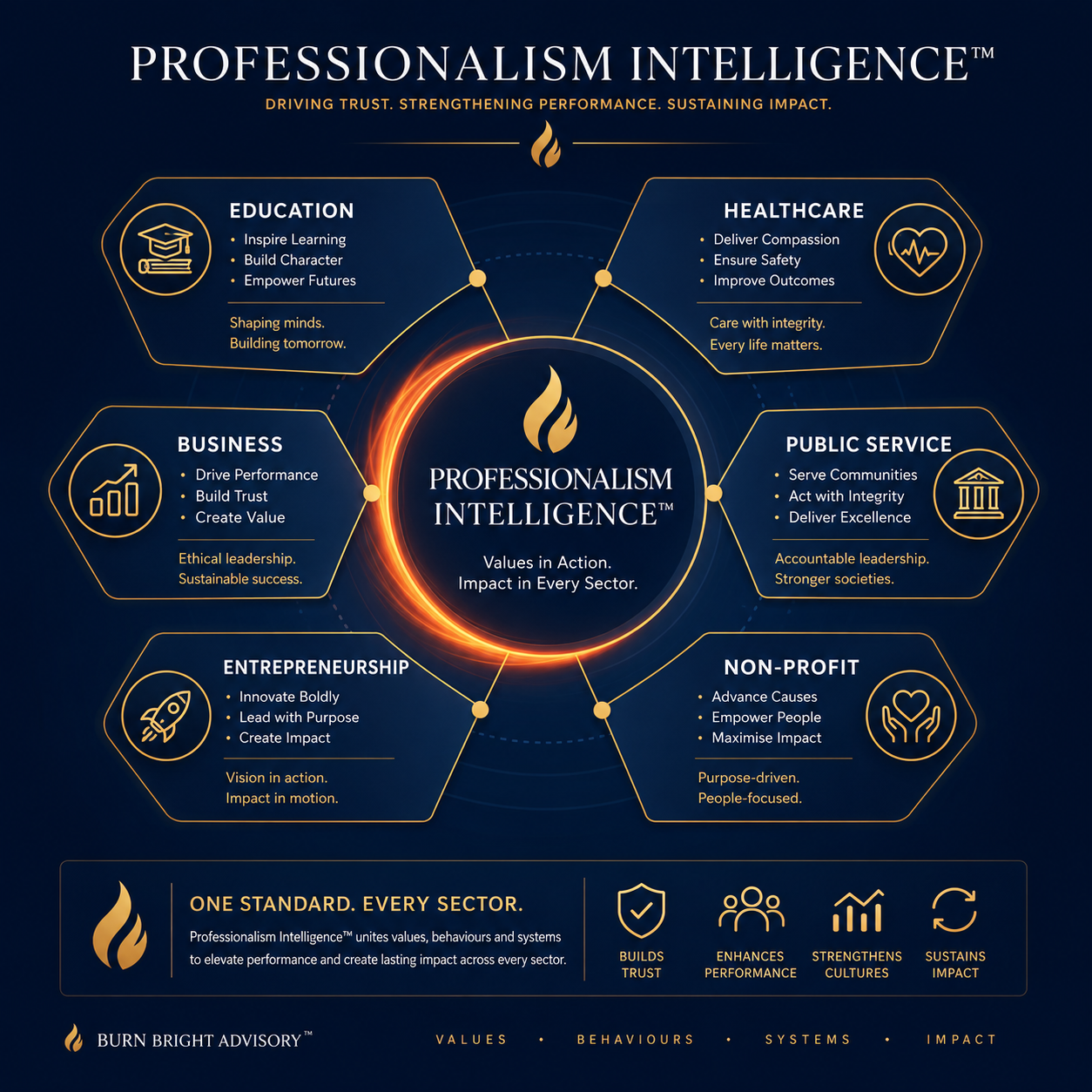
Professionalism is universal, but its application varies depending on organisational context. Professionalism Intelligence™ enables leaders to translate shared leadership standards into context-specific actions without compromising organisational values.
Business Growth Intelligence™
Professional leaders communicate strategic decisions transparently, maintain accountability during uncertainty, and protect organisational reputation through professional conduct. Where professionalism declines, organisations often see declining engagement, inconsistent customer experiences and higher staff turnover.
School Leadership Intelligence™
Schools do not simply educate students — they model society. Professional educational leaders model respectful communication, create psychologically safe learning environments and demonstrate consistency across policies. Students remember how adults behaved far longer than any single lesson.
Healthcare Leadership Intelligence™
Healthcare depends upon trust. Professional healthcare leadership requires ethical decision-making, compassionate communication and multidisciplinary collaboration. When professionalism weakens, patient confidence and safety culture can both be compromised.
Public Service Leadership Intelligence™
Public sector organisations operate under constant scrutiny. Professional public service leaders demonstrate transparency, stewardship, procedural fairness and accountability for public resources, strengthening institutional legitimacy.
HR & People Leadership Intelligence™
Human Resources professionals shape culture through every recruitment, promotion and performance conversation. Confidentiality, impartiality and procedural consistency strengthen employee confidence that decisions are fair and trustworthy.
Entrepreneur Performance Intelligence™
Professional habits established during early growth frequently become permanent cultural norms. Professional entrepreneurs honour commitments, communicate clearly and build trusted relationships with customers and investors from the first employee onwards.
Professionalism and Leadership Performance Intelligence™
Burn Bright Advisory™ defines Leadership Performance Intelligence™ as the integration of leadership capability, sustainable performance and organisational impact. Professionalism Intelligence™ sits at the centre of this model because it enables every other leadership capability to function effectively.
Without professionalism, emotional intelligence lacks consistency, ethical leadership lacks credibility, strategic leadership lacks trust, innovation lacks accountability, and organisational learning lacks discipline. Professionalism therefore acts as the behavioural infrastructure supporting sustainable leadership performance — which is why Burn Bright Advisory™ positions Professionalism Intelligence™ as one of the foundational domains within the Leadership Intelligence Compass™.
Building Professionalism Intelligence™
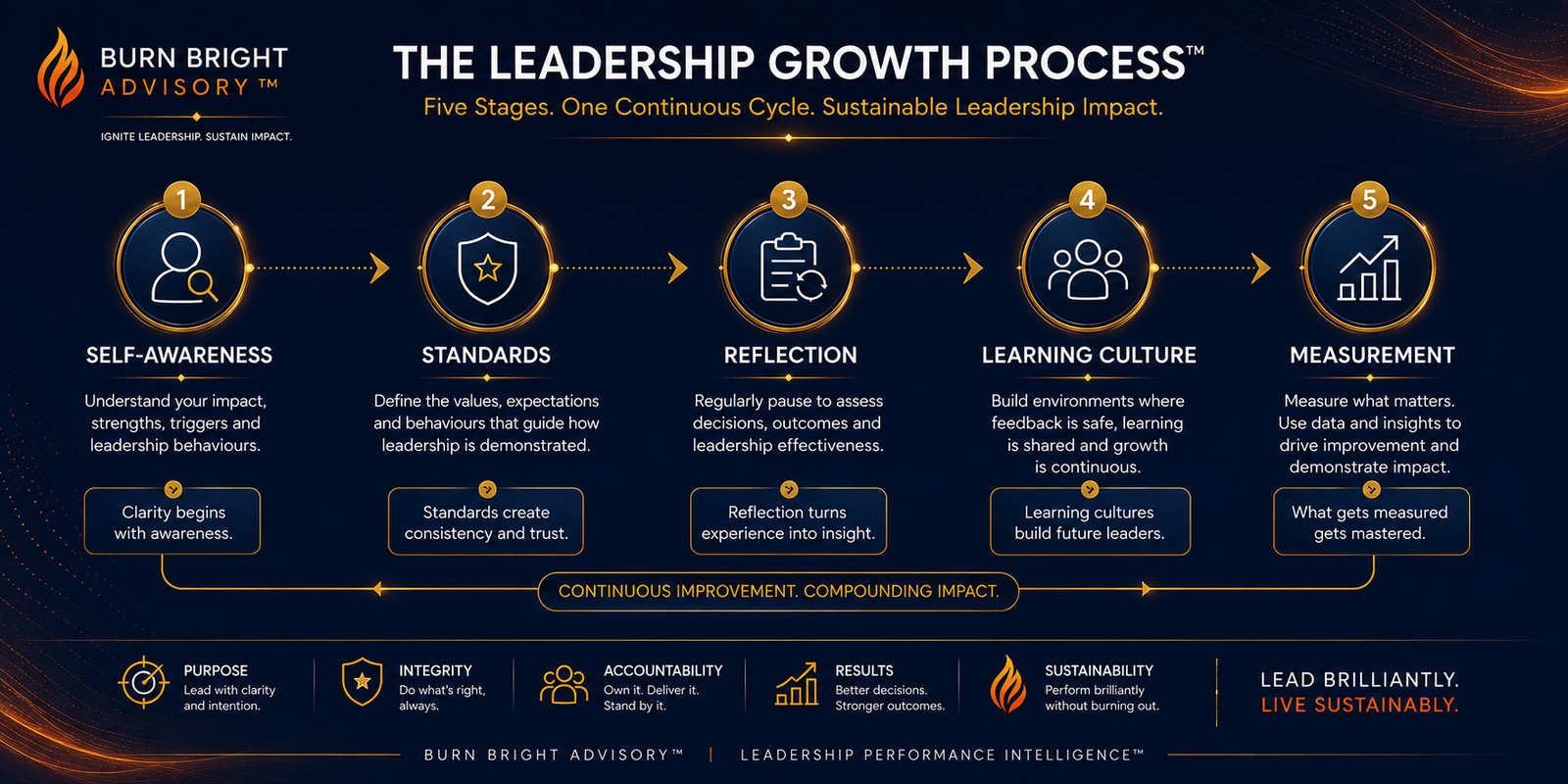
Professionalism develops intentionally. Like any leadership capability, it requires deliberate reflection, continuous learning and consistent practice. Burn Bright Advisory™ recommends five developmental practices.
Framework 1 Increase Leadership Self-Awareness
Professionalism begins with understanding how others experience your leadership. Professional growth begins with honest reflection rather than defensive justification.
- What behaviours build confidence?
- What behaviours reduce trust?
- Where am I inconsistent?
Framework 2 Establish Non-Negotiable Leadership Standards
Professional leaders identify behaviours they refuse to compromise regardless of organisational pressure. Consistency creates predictability, and predictability builds trust.
- Respectful communication and punctuality
- Ethical decision-making and fairness
- Accountability and transparency
Framework 3 Develop Reflective Leadership Practices
Reflection converts experience into learning and strengthens judgement while reducing repeated mistakes.
- Decisions made and conversations held
- Leadership challenges and stakeholder relationships
- Organisational outcomes
Framework 4 Create Professional Learning Cultures
Professionalism should never depend upon individual leaders alone. Professional cultures multiply leadership capability across every organisational level.
- Mentoring and coaching
- Peer learning and professional dialogue
- Continuous development
Framework 5 Measure Professional Behaviour
What organisations measure influences behaviour. Professionalism becomes sustainable when it becomes measurable.
- Trust and collaboration
- Accountability and communication quality
- Leadership credibility and organisational culture
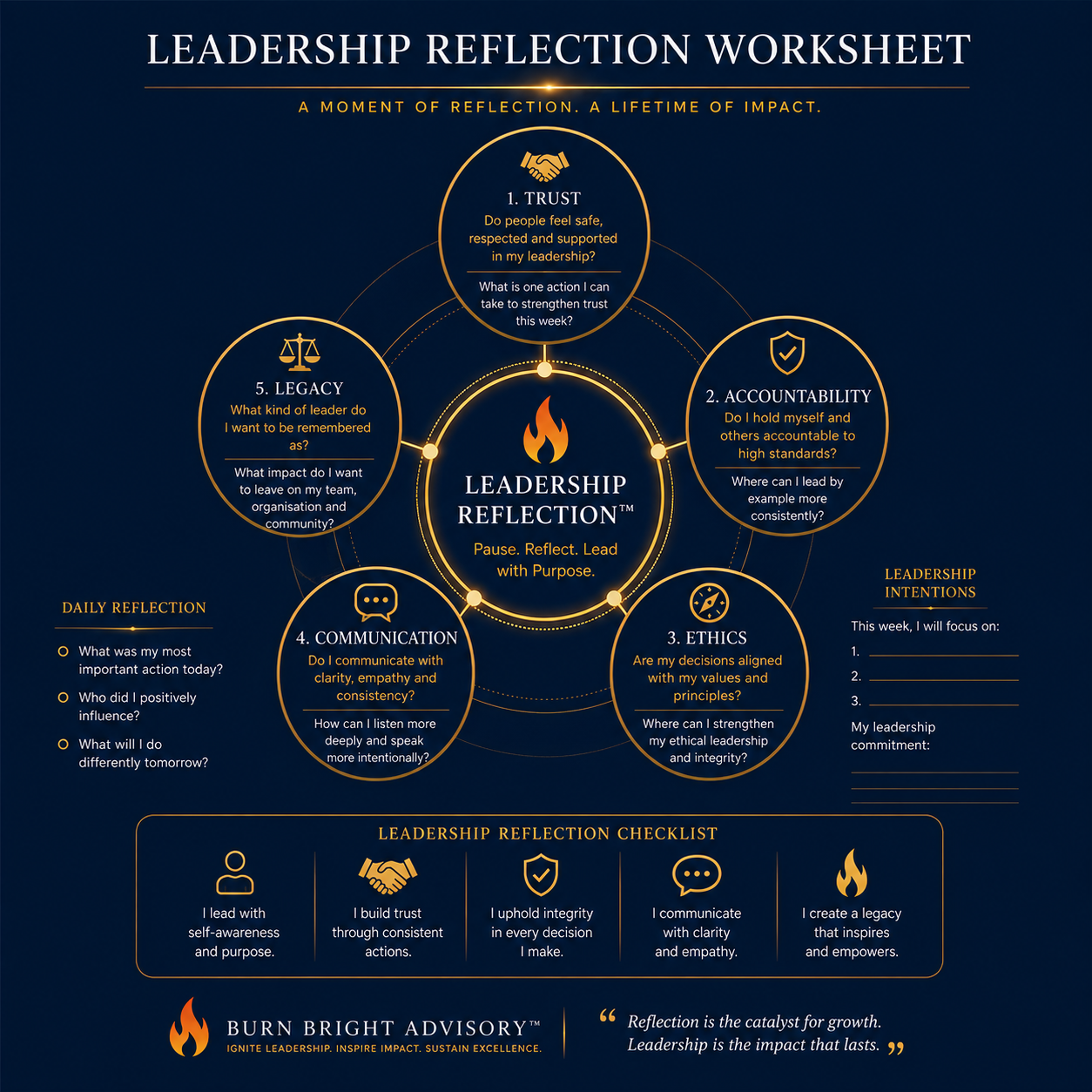
Leadership Reflection Questions
- How consistently do my behaviours align with the professional standards I expect from others?
- Which leadership behaviours strengthen trust most consistently?
- Where might inconsistency be reducing my credibility?
- How effectively do I model professionalism during periods of uncertainty?
- What organisational behaviours am I unintentionally reinforcing?
- Which aspect of Professionalism Intelligence™ requires the greatest development?
- How does my professionalism influence organisational culture?
- What professional legacy do I hope to leave?
Practical Action Steps
Over the next thirty days, consider implementing the following actions.
- Conduct a personal professionalism audit.
- Request confidential leadership feedback from colleagues.
- Define five non-negotiable professional behaviours.
- Schedule weekly reflective practice sessions.
- Review organisational communication standards.
- Celebrate professional behaviours publicly.
- Integrate professionalism into leadership development conversations.
- Align performance reviews with professional standards.
- Strengthen accountability processes.
- Develop a long-term Professionalism Intelligence™ improvement plan.
What is professionalism leadership?
Professionalism leadership is the consistent demonstration of ethical behaviour, accountability, competence, integrity and respect while leading individuals, teams and organisations.
Why is professionalism important for leaders?
Professionalism builds credibility, strengthens organisational trust, improves decision-making and supports sustainable organisational performance.
Is professionalism simply about behaviour?
No. Behaviour is only the visible expression of professionalism. Professionalism reflects leadership identity, values and internal standards that shape every decision and interaction.
How does professionalism influence organisational culture?
Leaders establish behavioural norms. Employees often mirror the professionalism consistently demonstrated by leadership, making professional conduct central to organisational culture.
Can professionalism be developed?
Yes. Through reflective practice, feedback, coaching, continuous learning and deliberate behavioural development, Professionalism Intelligence™ can be strengthened throughout a leader’s career.
How does Professionalism Intelligence™ relate to Leadership Performance Intelligence™?
Professionalism Intelligence™ provides the behavioural foundation that enables Leadership Performance Intelligence™ by strengthening trust, accountability, ethical leadership and organisational effectiveness.
Professionalism is often described as a desirable leadership quality. In reality, it is far more significant — it is the behavioural foundation upon which sustainable leadership is built. Every strategic decision, difficult conversation, ethical dilemma and organisational change is filtered through the professionalism of the leader making it. While vision may inspire, professionalism sustains. While expertise may open opportunities, professionalism earns lasting trust. And while authority may secure compliance, professionalism cultivates commitment.
Leaders who invest in Professionalism Intelligence™ strengthen every other aspect of their leadership. They create environments where accountability becomes normal, trust becomes resilient, learning becomes continuous, and performance becomes sustainable.
Where Does Your Leadership Stand on Professionalism Intelligence™?
Take the free Leadership Burnout Self-Assessment to benchmark your current leadership capability and identify where professional standards may be strengthening — or quietly eroding — your performance.
Free Leadership Intelligence
Get Weekly Leadership Insights
Join thousands of leaders receiving practical strategies on burnout prevention, workload design, and sustainable performance every week.