Quick Answer
Key Takeaways
- Professionalism without accountability becomes performative; accountability without professionalism becomes punitive. Sustainable leadership requires both.
- Professionalism Intelligence™ has five interconnected dimensions: conduct, judgement, responsibility, relationships and growth.
- Accountable professionals share seven consistent characteristics, from taking ownership before assigning it to developing accountability in others.
- Culture is shaped by what leaders reward, tolerate and model — not by values statements or policy documents.
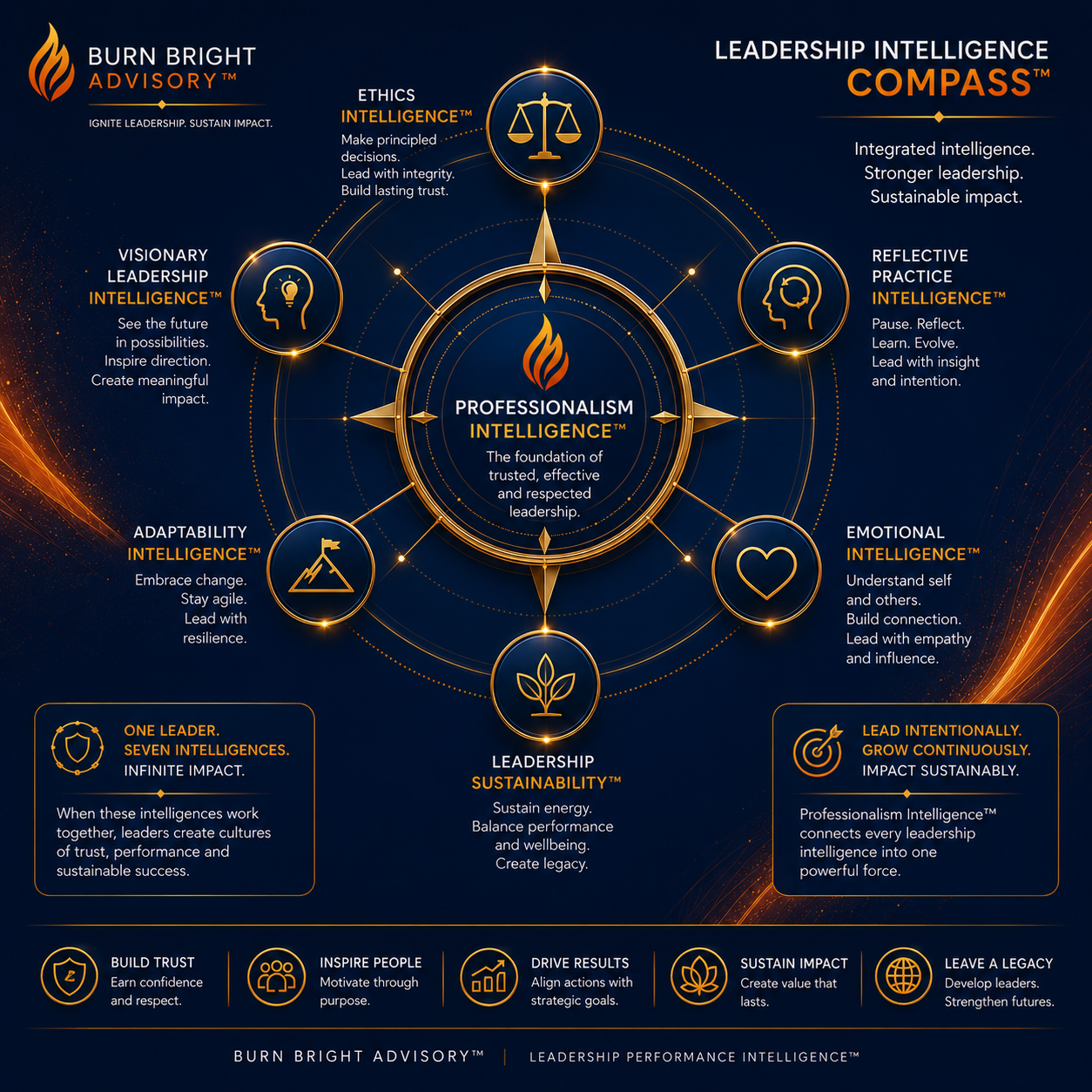
- Professionalism Intelligence™ strengthens every other domain of the Leadership Intelligence Compass™, including Ethics Intelligence™, Reflective Practice Intelligence™, Adaptability Intelligence™, Emotional Intelligence™ and Visionary Leadership Intelligence™.
Professionalism and Accountability: The Leadership Partnership That Builds Trust, Performance and Sustainable Success
Professionalism and accountability are complementary leadership capabilities that create trust, credibility and high performance. Professionalism establishes the standards for behaviour, communication and decision-making, while accountability ensures leaders take ownership of their actions, decisions and outcomes. Together they create organisations where expectations are clear, performance improves and trust is consistently reinforced.
Professionalism is often misunderstood as appearance, etiquette or following organisational policies. While these elements contribute to professional conduct, they represent only the visible surface of a much deeper leadership capability. True professionalism reflects the values, behaviours and judgement that enable leaders to earn trust over time.
Equally, accountability is frequently reduced to performance management or assigning blame when results fall short. In reality, accountability is the willingness to accept responsibility for decisions, behaviours and outcomes — particularly when circumstances become difficult.
Leadership Performance Intelligence™ recognises that these two capabilities cannot operate independently. Professionalism without accountability becomes performative, where leaders project competence but avoid responsibility. Accountability without professionalism can become punitive, focusing solely on compliance rather than ethical leadership and continuous improvement.
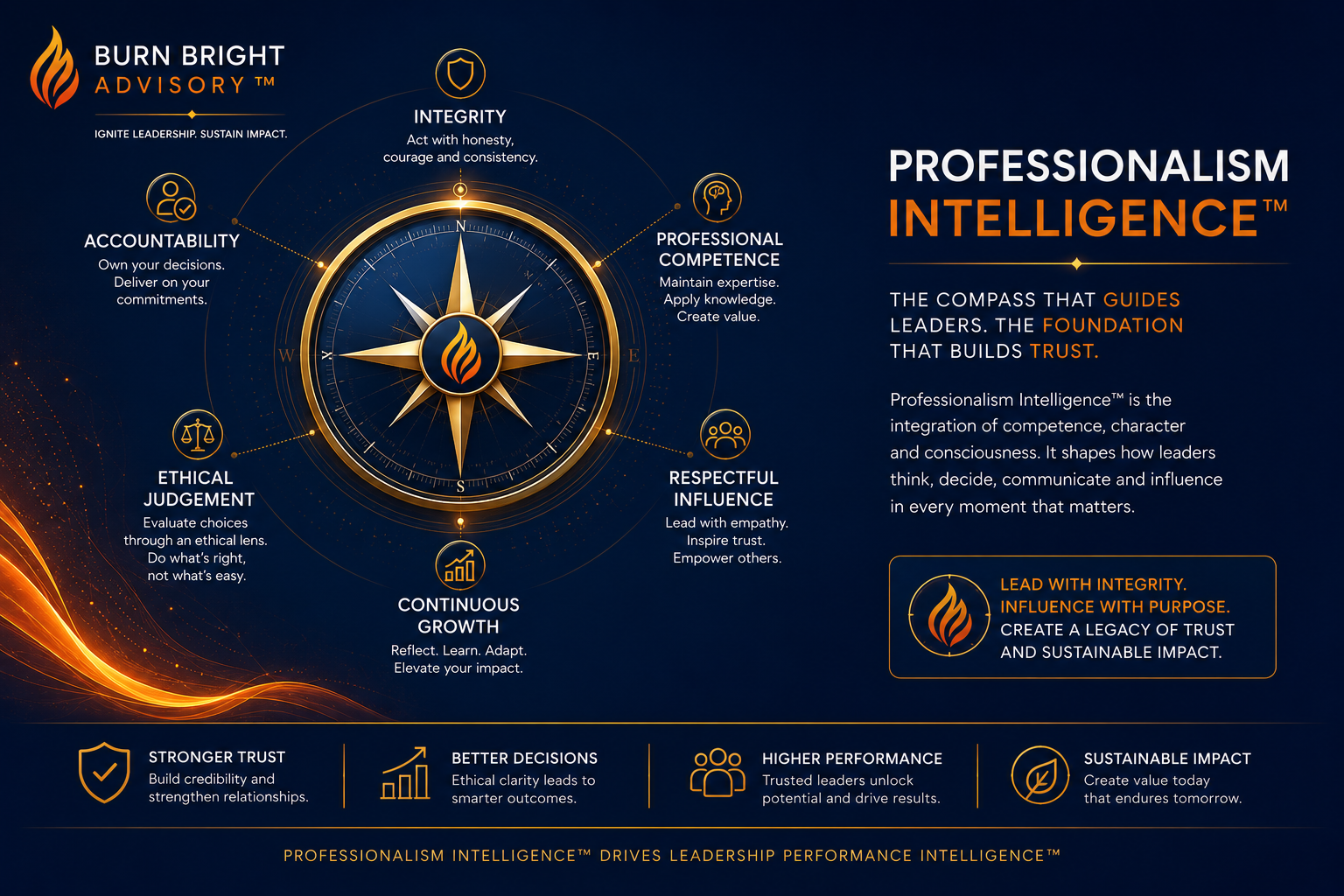
Across business, healthcare, education and public service, organisations increasingly recognise that technical competence alone is insufficient for sustainable leadership. Stakeholders expect leaders who demonstrate integrity, transparency and consistent professional behaviour, especially during periods of uncertainty and organisational change.
Within Burn Bright Advisory’s Leadership Intelligence Compass™, Professionalism Intelligence™ provides the behavioural foundation that supports every other leadership capability. Accountability strengthens this foundation by ensuring that values are consistently translated into action. Together they create leaders who are trusted not because they claim credibility, but because they demonstrate it repeatedly through responsible leadership.
Professionalism and Accountability: Why They Can No Longer Be Separated
Customers trust organisations to deliver quality.
Employees trust leaders to make fair decisions.
Communities trust public institutions to act responsibly.
Investors trust executives to protect long-term value.
Behind every one of these relationships lies a simple expectation: leaders will behave professionally and accept responsibility for their actions. When either expectation is absent, confidence begins to erode.
Many organisations mistakenly believe professionalism is primarily about presentation. Employees are encouraged to dress appropriately, communicate politely and follow organisational policies. While these behaviours remain important, they do not guarantee professional leadership.
Likewise, accountability is often introduced only after mistakes occur. Performance reviews, disciplinary procedures and investigations frequently become the primary mechanisms through which organisations discuss accountability. This reactive approach overlooks accountability’s real purpose: creating ownership before problems arise rather than assigning blame afterwards.
The relationship between professionalism and accountability becomes most visible during moments of pressure. When projects fail, professional leaders do not search for someone else to blame. They examine evidence, acknowledge mistakes, communicate honestly and focus attention on improvement.
These behaviours cannot be achieved through policy alone. They require leaders to develop what Burn Bright Advisory describes as Leadership Performance Intelligence™ — the capacity to integrate ethical judgement, reflective practice, professionalism and accountability into everyday leadership decisions. This perspective moves beyond compliance towards leadership maturity, recognising that professional behaviour is not simply about following rules but understanding why those rules exist and applying sound judgement when circumstances become complex.
Featured Snippet
Professionalism Intelligence™: Turning Values into Consistent Leadership
Professionalism is often viewed as a behavioural standard, while accountability is seen as a performance expectation. In reality, these concepts operate as an integrated leadership system. One establishes the standard; the other ensures that standard is consistently upheld.
Within Burn Bright Advisory’s Leadership Intelligence Compass™, Professionalism Intelligence™ provides the behavioural discipline that transforms leadership values into daily practice. It is not defined by credentials, seniority or organisational status. Instead, it is reflected in the consistency between what leaders believe, what they communicate and what they actually do.
This relationship can be understood through a simple progression:
| Leadership Element | Primary Focus | Leadership Outcome |
|---|---|---|
| Professionalism | Standards and behaviours | Trustworthiness |
| Accountability | Ownership and responsibility | Credibility |
| Combined | Consistent professional action | Sustainable trust |
Trust is rarely created through isolated acts of excellence. Instead, it develops through repeated demonstrations of professional behaviour supported by visible accountability.
Leadership Performance Intelligence™ Perspective
Leadership Performance Intelligence™ recognises that sustainable organisational performance depends upon more than technical expertise or strategic capability. It requires leaders to consistently align behaviour with organisational purpose.
Professionalism answers the question: “How should a leader behave?” Accountability answers: “Who accepts responsibility for the outcome?” Leadership Performance Intelligence™ asks a broader question: “How do professional behaviours and responsible decisions improve long-term organisational performance?”
Many organisations reward short-term achievement while unintentionally overlooking the behaviours used to achieve those outcomes. Targets may be exceeded through poor communication, excessive workload or compromised ethical standards. While immediate performance appears successful, long-term organisational trust gradually declines. Leadership Performance Intelligence™ challenges this approach by recognising that how results are achieved is just as important as the results themselves.
The Professionalism Intelligence™ Framework
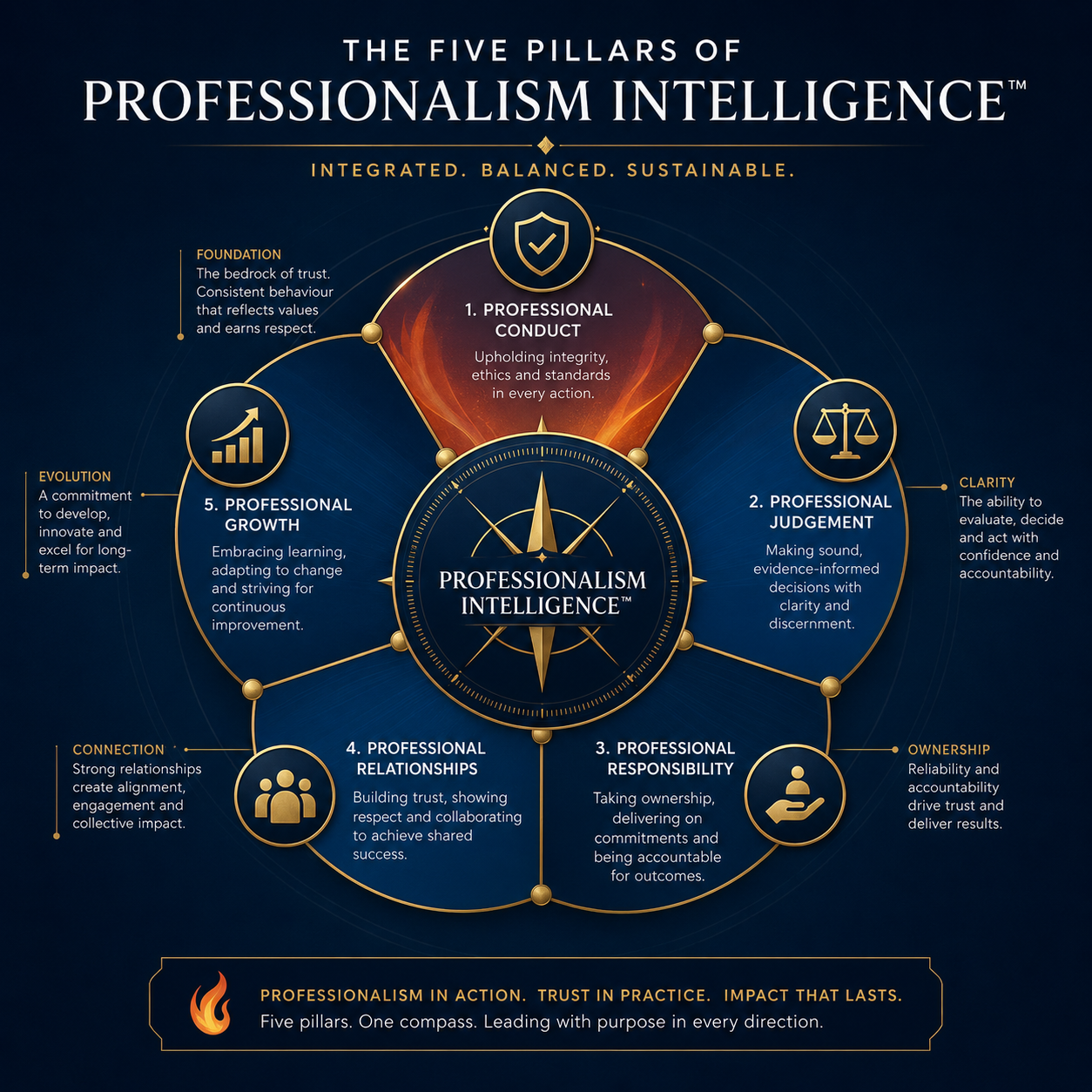
Professionalism Intelligence™ can be viewed as five interconnected dimensions that reinforce accountable leadership.
Dimension 1 Professional Conduct
Professional leaders demonstrate consistency in behaviour regardless of circumstance. They remain respectful during disagreement, communicate clearly during uncertainty and avoid emotional reactions that undermine confidence. Professional conduct creates psychological stability for teams — people know what to expect, and consistency reduces unnecessary anxiety.
Dimension 2 Professional Judgement
Rules cannot anticipate every situation. Professional leaders apply informed judgement rather than relying solely on policy. They evaluate evidence before making decisions, consider multiple perspectives and remain open to changing direction when new information becomes available. Accountability strengthens judgement because leaders understand they remain responsible for the consequences of every decision.
Dimension 3 Professional Responsibility
Responsibility extends beyond completing assigned tasks. Professional leaders accept ownership for organisational culture, team wellbeing and stakeholder confidence, asking “What is my responsibility in improving this situation?” rather than “Who caused this problem?” This subtle shift transforms accountability from blame into leadership ownership.
Dimension 4 Professional Relationships
Leadership is fundamentally relational. Professionalism shapes how leaders build trust with employees, customers, governing bodies and communities. Accountable leaders maintain credibility because their behaviour remains consistent across every relationship — integrity cannot be selective.
Dimension 5 Professional Growth
Professionalism requires continuous development. Accountable leaders actively seek feedback, reflect upon mistakes and invest in expanding their knowledge, recognising feedback as information that strengthens future decision-making rather than criticism to defend against.
Professionalism and Accountability Across Sectors
Although the principles remain universal, their application varies across industries.
Business Leadership
A senior executive announces ambitious organisational goals. Professionalism requires transparent communication about expectations, available resources and organisational priorities. Accountability requires the executive to review progress regularly, acknowledge strategic mistakes and adjust direction when evidence suggests change is necessary. Employees gain confidence because leadership remains visible throughout implementation rather than appearing only during success.
Healthcare Leadership
Healthcare professionals operate within environments where professional judgement directly influences patient outcomes. Professionalism requires evidence-informed decisions, respectful multidisciplinary collaboration and compassionate communication. Accountability ensures that adverse events become opportunities for organisational learning rather than individual blame.
Education Leadership
School leaders establish professional expectations not only through policy but through personal example. Teachers observe whether leaders communicate consistently, honour commitments and demonstrate fairness during difficult decisions. Instead of asking “Who performed poorly?”, effective educational leaders ask “What systems need strengthening to improve learning?”
Public Service Leadership
Public sector leaders manage resources entrusted by communities. Professionalism demands impartiality, transparency and evidence-based decision-making. Accountability requires leaders to explain decisions openly, accept public scrutiny and ensure resources are used responsibly. Public confidence depends less upon perfection than upon visible integrity.
From Compliance to Commitment
One of the greatest misconceptions surrounding professionalism is that it can be enforced solely through policies and procedures. Policies establish minimum expectations; professionalism establishes leadership culture. Similarly, accountability is often introduced through audits, performance reviews and compliance frameworks. These systems remain important, but they represent only external accountability.
The strongest organisations cultivate internal accountability, where individuals accept responsibility because it aligns with their professional identity rather than because they fear disciplinary consequences. Employees begin asking “How can I improve?” and “What responsibility should I accept?” instead of merely asking “What is the minimum I must do?” Professionalism therefore evolves from compliance into commitment, and accountability evolves from monitoring into ownership.
Seven Characteristics of Accountable Professionals
Professionalism is demonstrated not by isolated moments of excellence but by patterns of behaviour that remain consistent over time. Leadership Performance Intelligence™ views accountability as a proactive leadership capability rather than a reactive management process.
Characteristic 1
They Take Ownership Before Assigning Responsibility
The strongest leaders begin by examining their own contribution to a situation before questioning the performance of others, asking what influence they had and what they could have done differently.
Characteristic 2
They Honour Commitments Consistently
Professional credibility is built through reliability — delivering what is promised, communicating when circumstances change, and following through after meetings.
Characteristic 3
They Welcome Constructive Feedback
Accountable professionals interpret feedback as data rather than criticism, asking what they might be missing and how a decision might affect others.
Characteristic 4
They Make Decisions Transparently
Professional leaders communicate the evidence considered, the principles guiding a decision, alternative options explored, anticipated risks and how success will be evaluated.
Characteristic 5
They Maintain Professional Standards Under Pressure
Under pressure, accountable professionals become calmer rather than louder, continuing to demonstrate respect during disagreement and separating performance conversations from personal criticism.
Characteristic 6
They Learn Publicly
When projects fall short, they ask what was learned, which assumptions proved incorrect and how the approach should change — demonstrating intellectual honesty rather than defensiveness.
Characteristic 7
They Develop Accountability in Others
Rather than solving every problem themselves, effective leaders ask what options a colleague has considered and what support would help them succeed — building capability rather than dependency.
Common Behaviours That Undermine Professional Accountability
While most leaders value accountability, several behaviours unintentionally weaken professional credibility.
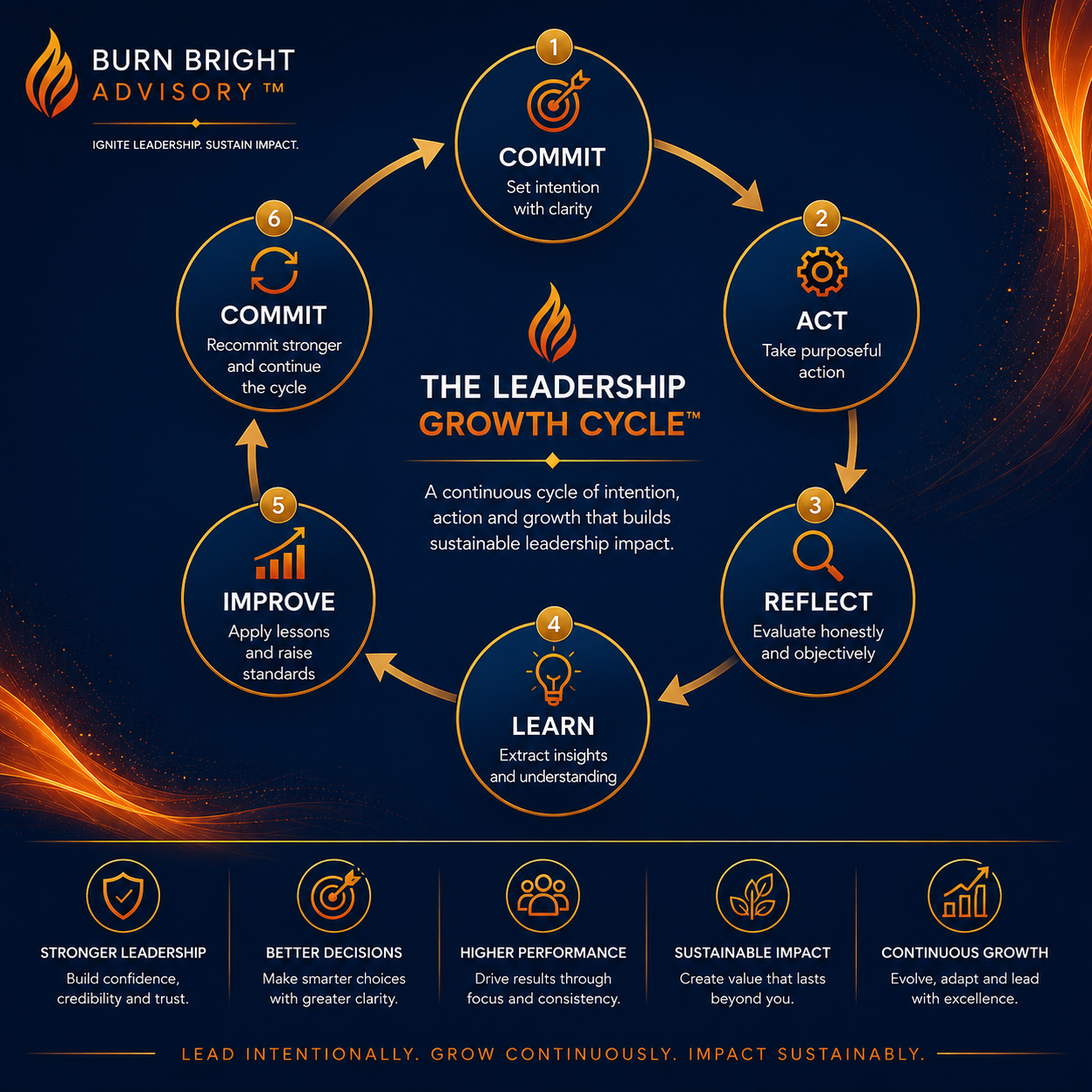
Reflection Framework: Evaluating Professional Accountability
Leadership development begins with reflection. Consider your ownership, reliability, transparency, learning and culture — do you accept responsibility before assigning it, can colleagues depend on your commitments, do you explain the reasoning behind important decisions, and does your behaviour encourage accountability throughout the organisation? These questions encourage leaders to move beyond compliance and towards professional maturity.
Accountability as a Leadership Legacy
Professional leaders are remembered less for individual achievements than for the standards they establish. Their influence extends beyond immediate results because their behaviour shapes organisational expectations long after they leave. Leadership Performance Intelligence™ therefore views accountability not as a management technique but as a leadership legacy.
The most respected leaders rarely ask “Who is accountable?” Instead, they ask “How can I create a culture where accountability becomes everyone’s professional responsibility?” That question shifts accountability from an obligation to a shared organisational value — one that supports trust, continuous improvement and enduring leadership excellence.
Building a Culture of Professionalism and Accountability
Professionalism and accountability become truly valuable when they move beyond individual leadership behaviours and become embedded within organisational culture. Culture is not determined by what appears on posters or strategic plans — it is shaped by the behaviours that leaders consistently reward, tolerate and model.
The question therefore changes from “Are our leaders accountable?” to “Does our culture make professionalism and accountability the normal way of working?” This distinction separates organisations that merely promote values from those that consistently live them.
Creating a Professional Accountability Culture
Leadership Performance Intelligence™ identifies five interconnected foundations that create sustainable accountability cultures.
Foundation 1 Establish Clear Expectations
Professional organisations define behavioural expectations, professional standards, decision-making responsibilities, communication principles, ethical boundaries and performance expectations. Ambiguity creates inconsistency; clarity creates confidence.
Foundation 2 Model Accountability at Every Leadership Level
Culture cannot be delegated. Leaders who openly admit mistakes, acknowledge uncertainty and explain decisions demonstrate that accountability is both expected and respected, creating psychological permission for others to behave similarly.
Foundation 3 Encourage Reflection Rather Than Blame
Professional organisations replace blame with structured reflection, asking what worked well, what evidence supported decisions and what should improve — maintaining accountability without creating defensiveness.
Foundation 4 Recognise Professional Behaviour
Sustainable leadership requires organisations to recognise professional behaviours alongside results — integrity under pressure, collaborative decision-making and ethical judgement — reinforcing that how work is achieved matters as much as what is achieved.
Foundation 5 Develop Accountability as a Leadership Capability
Accountability is not an inherent personality trait — it is a capability that develops through coaching, mentoring, reflective supervision and evidence-informed feedback, strengthening Professionalism Intelligence™ throughout the organisation.
Connecting Professionalism to the Leadership Intelligence Compass™
Within Burn Bright Advisory’s Leadership Intelligence Compass™, Professionalism Intelligence™ does not operate independently. It strengthens every other leadership domain.
Compass Domain
Ethics Intelligence™
Professionalism ensures ethical principles influence everyday leadership behaviour. Accountability demonstrates that ethical standards apply equally to everyone. Together they create integrity.
Compass Domain
Reflective Practice Intelligence™
Reflection transforms accountability into learning. Professional leaders evaluate both successful and unsuccessful decisions with equal honesty, preventing repeated mistakes while strengthening organisational capability.
Compass Domain
Adaptability Intelligence™
Professional leaders remain accountable even when circumstances change. Professionalism provides stability; adaptability provides resilience — together enabling sustainable organisational performance.
Compass Domain
Emotional Intelligence™
Professional accountability requires emotional maturity — regulating emotional responses, listening actively, managing conflict respectfully and communicating with empathy.
Compass Domain
Visionary Leadership Intelligence™
Professional leaders inspire confidence through credibility. Stakeholders follow leaders whose behaviour consistently aligns with their stated purpose, transforming vision into organisational commitment.
Organisational Case Examples
Business
A technology company introduced quarterly Leadership Reflection Forums where executive teams examined leadership decisions alongside financial performance, openly discussing strategic mistakes and lessons learned. Within two years, employee engagement increased, cross-functional collaboration improved and leadership trust scores rose significantly.
Education
A secondary school shifted its lesson observation process from inspection to collaborative professional learning, with school leaders modelling vulnerability by sharing their own development goals alongside staff. Teacher engagement increased because accountability became developmental rather than punitive.
Healthcare
A hospital department implemented structured multidisciplinary learning reviews following complex patient cases, examining decision-making processes collectively rather than assigning individual blame. This strengthened patient safety by increasing psychological safety and willingness to report concerns.
Public Service
A local authority introduced transparent decision summaries for major policy changes, explaining available evidence, stakeholder consultation and anticipated risks. Public confidence improved because accountability became proactive rather than reactive.
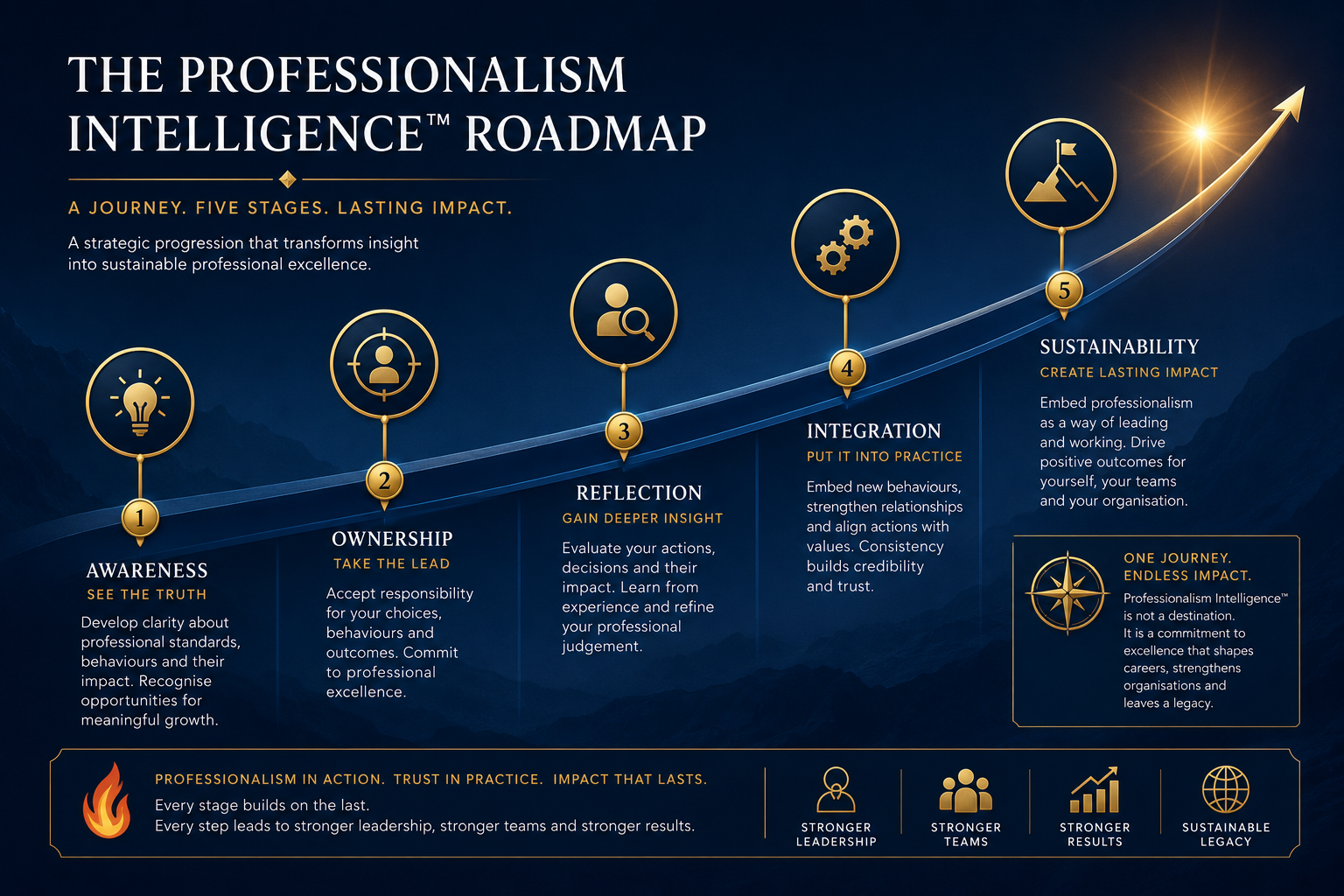
The Professional Accountability Roadmap
Leadership cultures rarely transform overnight. Professionalism develops through repeated behaviours reinforced consistently over time.
| Stage | Leadership Focus | Organisational Outcome |
|---|---|---|
| Awareness | Clarify professional expectations | Shared understanding |
| Ownership | Leaders model accountability | Increased trust |
| Reflection | Learn from successes and failures | Continuous improvement |
| Integration | Embed professionalism into systems | Cultural consistency |
| Sustainability | Develop future accountable leaders | Long-term organisational resilience |
Professionalism as a Strategic Advantage
Professionalism is often discussed as an ethical obligation. Increasingly, it is also becoming a competitive advantage. Organisations known for professional leadership attract stronger talent. Customers remain loyal because trust reduces uncertainty. Partners collaborate more effectively because expectations remain clear.
Leadership Performance Intelligence™ therefore positions professionalism not as organisational compliance but as strategic capability. Accountability ensures this capability remains authentic. Professionalism ensures accountability remains constructive. Together they produce organisations capable of sustaining high performance while protecting trust, wellbeing and long-term organisational reputation.
Conclusion: Professionalism and Accountability as the Foundation of Sustainable Leadership
Professionalism and accountability have long been viewed as desirable leadership qualities. In today’s increasingly complex organisational environment, they have become essential leadership capabilities. Professionalism establishes the standards that shape behaviour, relationships and decision-making. Accountability ensures those standards are consistently translated into action. Neither capability is sufficient in isolation.
Professionalism without accountability becomes image management.
Accountability without professionalism becomes compliance.
Across business, education, healthcare and public service, the organisations most likely to thrive are those where professionalism is understood as a daily leadership practice rather than an organisational slogan. Their leaders do not merely expect accountability — they model it. Leadership is ultimately remembered less for individual achievements than for the culture leaders leave behind.
Leadership Reflection Questions
Personal Reflection
- How consistently do my actions align with my stated leadership values?
- Would my colleagues describe me as dependable?
- When mistakes occur, what is my first instinct: defend, explain or learn?
Team Reflection
- Are expectations consistently understood across our team?
- Do people feel psychologically safe admitting mistakes?
- Do leaders model the standards expected of others?
Organisational Reflection
- Is professionalism discussed only during performance reviews or demonstrated daily?
- Are accountability systems developmental or punitive?
- Does our culture encourage ownership or avoidance?
Action Steps
Leaders seeking to strengthen Professionalism Intelligence™ should begin with practical, measurable actions.
Week One
Review your personal leadership commitments, clarify expectations with your team, ask for honest feedback from trusted colleagues and identify one area where accountability could become more visible.
Month One
Introduce reflective learning conversations following significant projects, review organisational communication practices and ensure leadership decisions are explained transparently.
Quarterly
Evaluate organisational trust, review leadership behaviours alongside performance outcomes, assess psychological safety and update professional development objectives.
What is the difference between professionalism and accountability?
Professionalism refers to the behaviours, standards and judgement expected of leaders. Accountability is the willingness to accept responsibility for decisions, actions and outcomes. Together they create trustworthy leadership.
Why are professionalism and accountability important in leadership?
They strengthen trust, improve decision-making, encourage ethical behaviour and create organisational cultures where continuous improvement becomes possible.
Can accountability exist without professionalism?
Only partially. Accountability without professionalism often becomes compliance driven, focusing on blame rather than learning and improvement.
How does Professionalism Intelligence™ improve organisational performance?
Professionalism Intelligence™ encourages consistent behaviour, ethical judgement, reflective leadership and responsible decision-making, strengthening both culture and long-term organisational performance.
How can organisations improve accountability?
By creating clear expectations, modelling responsible leadership, encouraging reflective learning, recognising professional behaviours and investing in leadership development rather than relying solely on compliance systems.
What role does reflection play in accountability?
Reflection transforms accountability into learning. Rather than assigning blame, reflective leaders examine decisions, identify lessons and improve future performance.
Which Leadership Intelligence Compass™ domains support Professionalism Intelligence™?
Professionalism Intelligence™ works alongside Ethics Intelligence™, Reflective Practice Intelligence™, Emotional Intelligence™, Adaptability Intelligence™, Visionary Leadership Intelligence™ and Leadership Sustainability™ to create Leadership Performance Intelligence™.
How can leaders begin developing Professionalism Intelligence™ today?
Start by honouring commitments, communicating transparently, seeking feedback, reflecting regularly, accepting responsibility before assigning it to others, and consistently modelling the behaviours expected throughout the organisation.
Where Does Your Leadership Stand?
Take the free Leadership Burnout Self-Assessment to understand how professionalism, accountability and sustainable performance show up in your leadership today.
Free Leadership Intelligence
Get Weekly Leadership Insights
Join thousands of leaders receiving practical strategies on burnout prevention, workload design, and sustainable performance every week.