Quick Answer
Key Takeaways
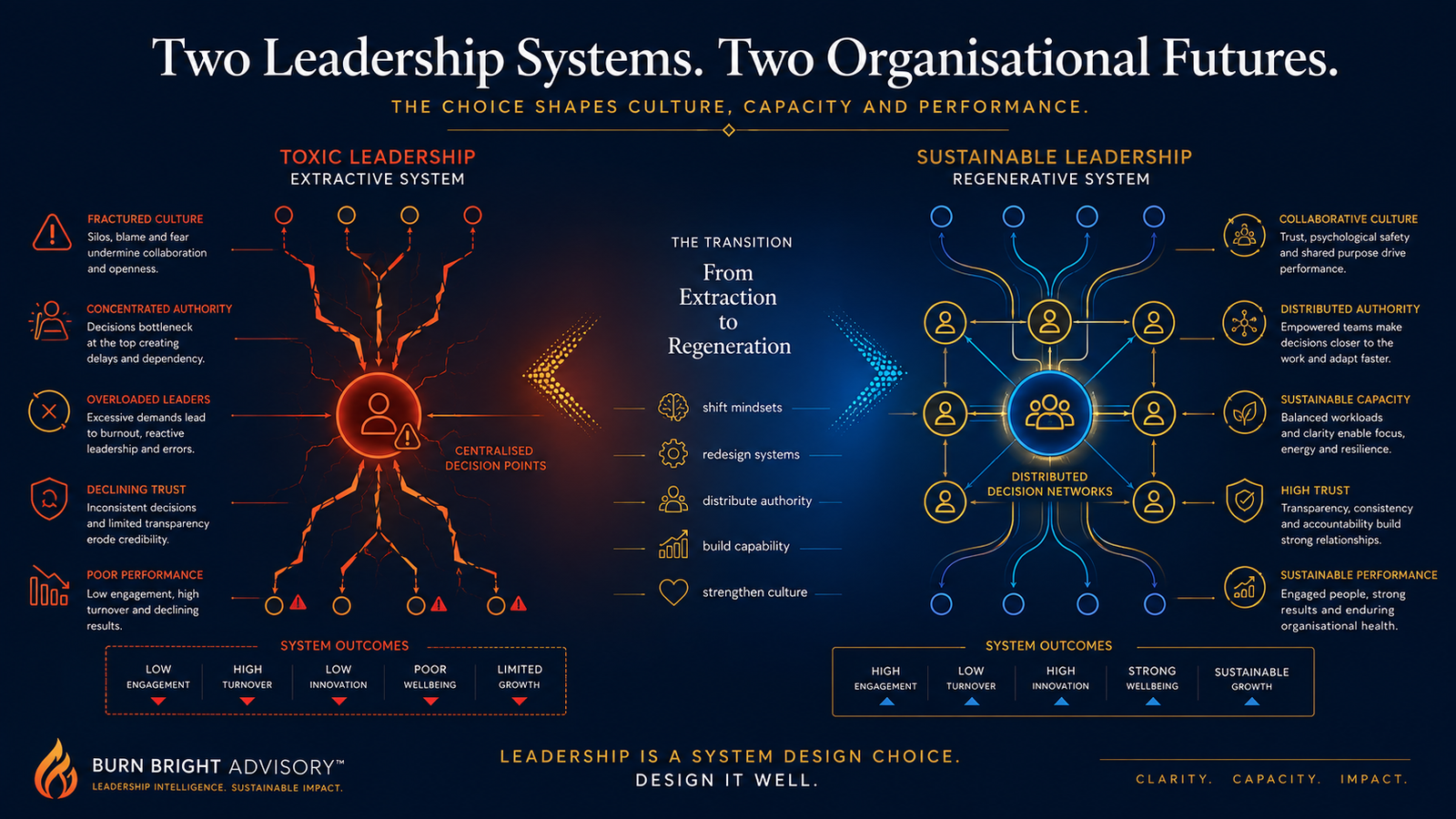
- Toxic leadership is a system problem, not only a personality problem — destructive behaviour becomes normalised when decision rights, accountability and psychological safety are unclear.
- Toxic leaders can deliver strong short-term results while accumulating invisible “leadership debt” that surfaces later as turnover, burnout and weak succession.
- Pressure, high expectations and difficult decisions are not inherently toxic — the ethical distinction lies in how authority is exercised.
- Five architectural conditions sustain toxic leadership: decision dependency, psychological insecurity, workload normalisation, accountability asymmetry and heroic leadership dependency.
- Sustainable leadership is built through design — clear decision authority, distributed capability, monitored workload and structured reflection — not through aspiration alone.
Toxic Leadership vs Sustainable Leadership: The Ethical Choice That Shapes Organisational Performance
The opposite of toxic leadership is not simply “nice leadership.”
It is sustainable leadership.
That distinction matters because organisations can mistakenly interpret toxicity as toughness. A leader may produce results while simultaneously creating fear, dependency, exhaustion, silence and declining organisational capacity. For a period, the numbers may still look good.
The damage appears elsewhere.
People stop challenging decisions. Talented employees leave. Managers protect themselves rather than collaborate. Problems travel upwards more slowly. Decision quality deteriorates. Leadership becomes concentrated in individuals rather than distributed through systems.
The organisation may still be performing, but it is consuming the conditions that make future performance possible.
Burn Bright Advisory™ approaches this through Leadership Performance Intelligence™: examining not only what leaders achieve, but the leadership conditions, behaviours, systems and capacities through which those outcomes are produced.
From this perspective, sustainable leadership is fundamentally an ethical issue. The central question becomes:
Toxic Leadership Is Not Simply About Difficult Personalities
Discussions about toxic leadership often begin with personality.
The controlling executive.
The intimidating manager.
The unpredictable founder.
The bullying department head.
These behaviours matter. But concentrating exclusively on personality can obscure the larger organisational problem.
Toxic leadership becomes especially damaging when organisational systems allow destructive behaviour to become normalised.
A leader who hoards decisions becomes more powerful when decision authority is unclear. A leader who creates excessive workloads becomes more dangerous when the organisation has no meaningful mechanism for assessing capacity. A leader who intimidates dissent becomes harder to challenge when psychological safety is absent. A leader who plays favourites gains greater influence when performance standards are inconsistent.
The behaviour and the system begin reinforcing one another.
This is why toxic leadership cannot be understood solely as a “bad boss” problem. It is a leadership system problem.
Burn Bright’s work on toxic leadership in small teams highlights how particularly intense this can become where there are few organisational buffers. In a small team, every interaction carries disproportionate weight. There may be no alternative reporting structure, little HR infrastructure and nowhere for employees to escape dysfunctional leadership patterns.
The result can be an amplification effect: leadership behaviour rapidly becomes team culture.
That gives organisations an important diagnostic principle:
Toxic Leadership Can Produce Results — Temporarily
One reason organisations tolerate toxic leaders is uncomfortable to acknowledge.
Some toxic leaders perform.
They meet targets.
They drive projects forward.
They demand accountability.
They create urgency.
They make difficult decisions.
That creates an ethical and strategic trap. When short-term outcomes are strong, organisations may conclude that the leadership approach producing them must also be effective.
But performance and sustainability are different measurements.
Imagine two leaders who both deliver the same annual target. Leader A achieves it through escalating hours, centralised decisions, fear of failure, constant availability and intense personal intervention. Leader B achieves it through clear priorities, distributed authority, appropriate challenge, effective delegation, disciplined workload and capability development.
On the annual report, the result may initially appear identical. Organisationally, it is not.
Leader A has potentially accumulated leadership debt. Leader B has potentially accumulated leadership capacity.
Leadership debt behaves much like other forms of organisational debt. Immediate performance is purchased by borrowing against future capacity. Eventually, repayment arrives through turnover, burnout, weak succession, dependency, poor decisions, cultural deterioration or reduced adaptability.
Sustainable leadership asks a more intelligent performance question:
Featured Snippet
The Ethical Difference Between Pressure and Harm
Sustainable leadership should not be confused with low expectations. Healthy organisations require accountability. Leaders sometimes need to make unpopular decisions, challenge underperformance, restructure responsibilities and insist upon demanding standards.
Difficulty is not toxicity.
Pressure is not automatically toxicity.
Disagreement is not toxicity.
The ethical distinction lies in how power is exercised. Constructive leadership uses authority to create clarity, accountability and capability. Toxic leadership uses authority in ways that repeatedly diminish dignity, voice, trust or sustainable capacity.
Consider performance management. A sustainable leader can say: “This standard has not been met. We need to understand why, establish what improvement looks like and agree the actions required.”
A toxic leader may address the same performance issue through humiliation, unpredictability, public criticism, threat or personal attack.
The standard may be identical. The exercise of power is not.
That makes Ethics Intelligence™ far more than compliance with rules or professional codes. It concerns judgement about power, consequences, responsibility and the conditions leaders create for others.
Ethical leadership asks not only: Can I do this? It also asks: What happens to people, performance and organisational capacity when I do?
Toxic Leadership vs Sustainable Leadership
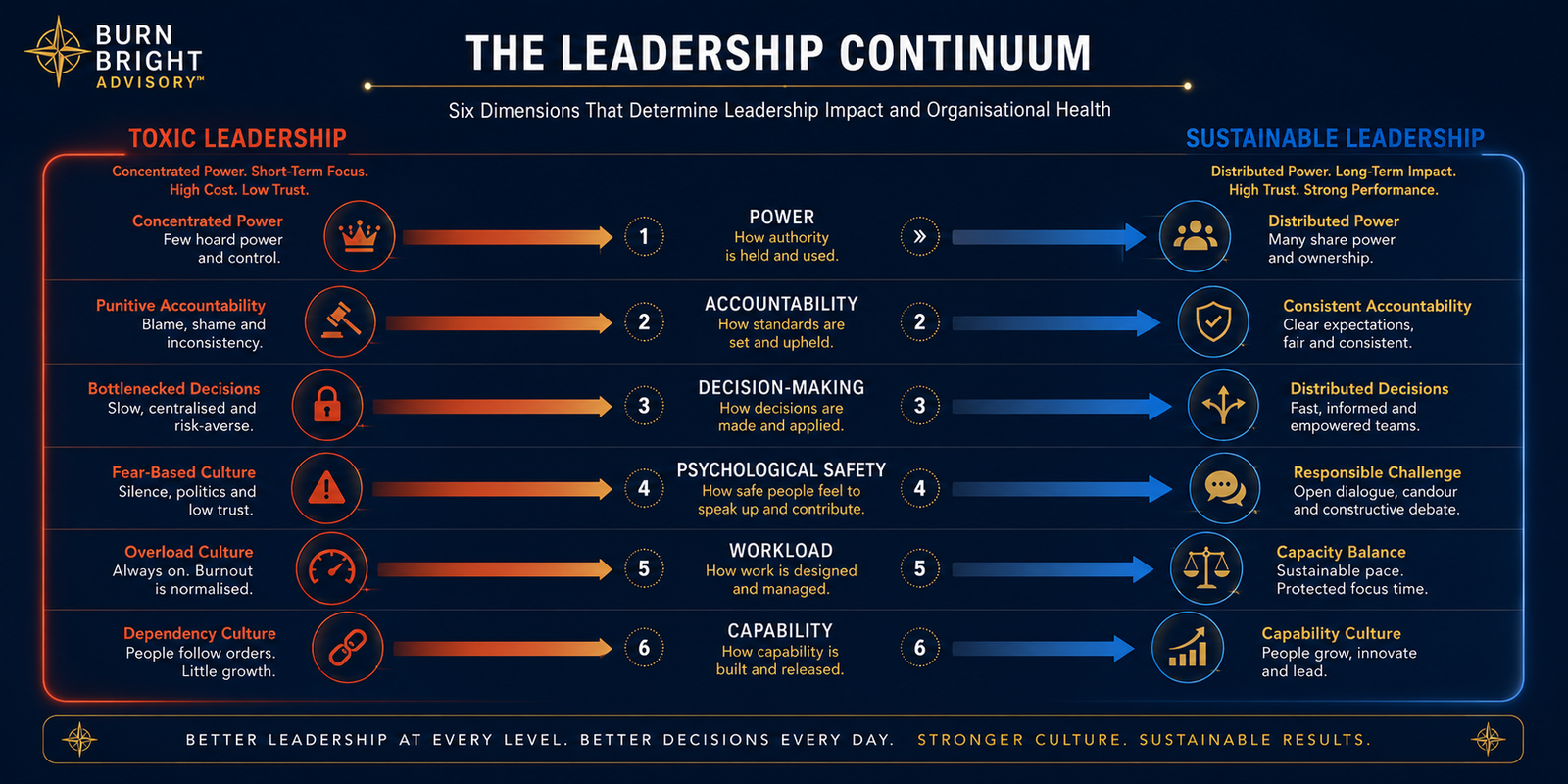
The contrast becomes clearer when leadership is examined as an operating system rather than a personality type.
| Toxic Leadership | Sustainable Leadership |
|---|---|
| Power concentrated and protective | Power responsible and distributed |
| Accountability selective or punitive | Accountability clear and consistent |
| Decision-making bottlenecked around the leader | Authority placed appropriately |
| Communication controlled, unpredictable or fear-based | Communication clear, transparent and purposeful |
| Challenge interpreted as disloyalty | Challenge used to improve judgement |
| Mistakes met with blame and concealment | Mistakes met with accountability and learning |
| Chronic overload normalised | Demand matched against capacity |
| Talent creates dependency | Talent develops capability |
| Culture of compliance and self-protection | Culture of trust and responsible challenge |
| Performance extracted | Performance built |
| “Organisation needs me” | “Organisation can perform without depending on me” |
| Leadership debt | Leadership capacity |
The final distinction is particularly important. Toxic systems often become dependent on individual leaders. Sustainable systems become increasingly capable without them.
That may appear paradoxical, but it is one of the strongest tests of leadership quality. The best leaders do not make themselves indispensable. They make leadership capacity more widely available.
The Hidden Architecture of Toxic Leadership
Toxic leadership often becomes visible through behaviour but survives through architecture. Five organisational conditions deserve particular attention.
Leadership Sustainability™ Changes the Performance Equation
Burn Bright Advisory™ defines sustainable leadership around more than personal wellbeing. It includes Leadership Capacity™, Leadership Workload™, Leadership Reflection™, resilience, decision quality, culture, connection and sustainable organisational performance.
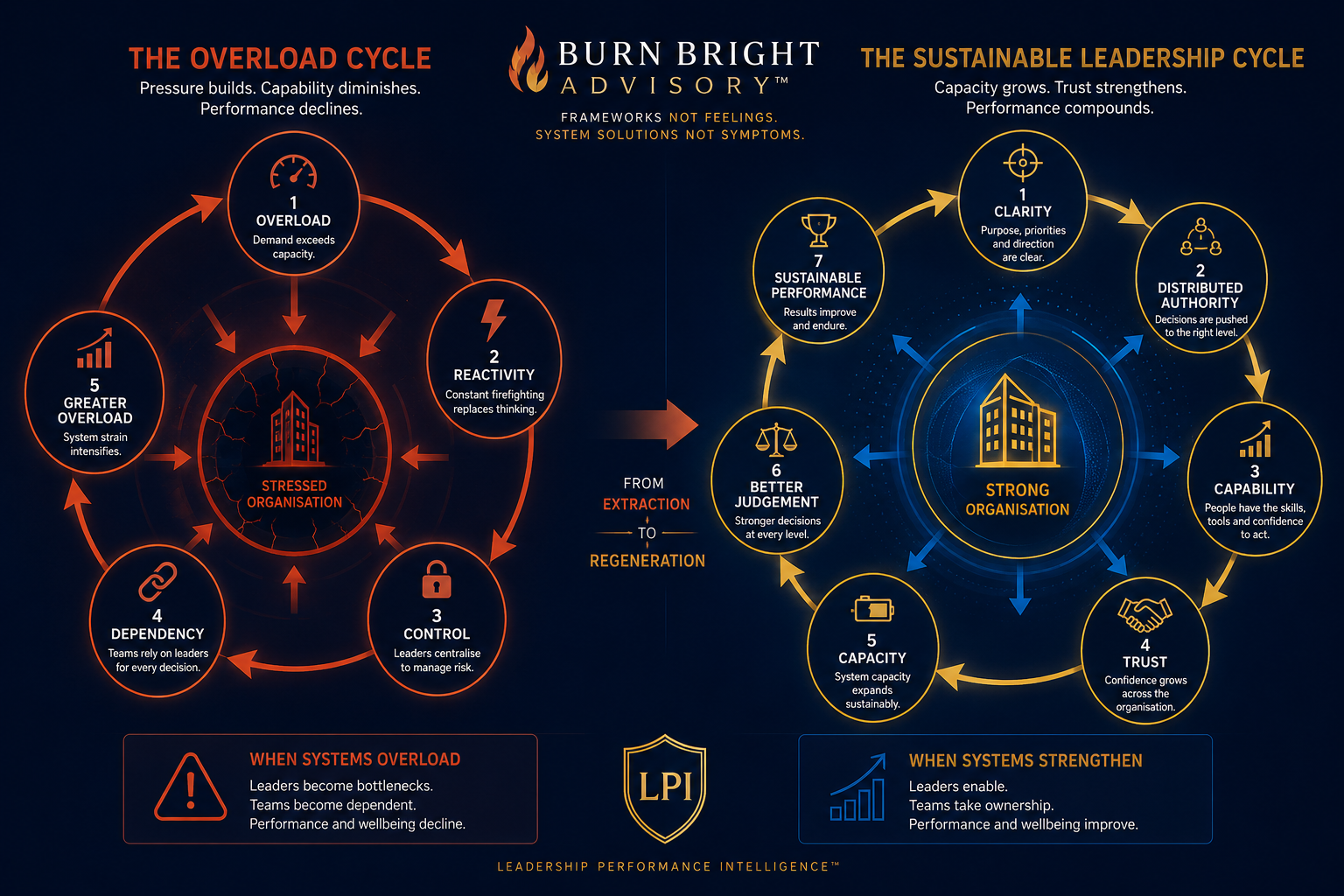
These factors interact. When workload becomes excessive, reflective capacity contracts. When reflection contracts, decisions become more reactive. When decisions become reactive, leaders intervene more frequently. When intervention increases, teams become more dependent. When dependency grows, the leader’s workload increases further.
A reinforcing cycle develops:
This can eventually resemble toxic leadership even when toxicity was never the leader’s intention. That is why organisations must distinguish between malicious toxicity and system-generated destructive behaviour. The consequences may overlap even when the causes differ, and the intervention must reflect the diagnosis.
A deliberately abusive leader requires accountability. An overwhelmed leader operating inside an impossible role may require role redesign, workload intervention, clearer decision authority and support. Sometimes both are necessary. Good leadership diagnostics resist simplistic labels.
The Sustainable Leadership Cycle
The alternative cycle looks different:
Clarity reduces unnecessary escalation. Distributed authority allows decisions to occur at the appropriate level. That builds capability. Capability increases trust. Trust reduces unnecessary control. Reduced control returns capacity to the leader. Greater capacity creates space for reflection, strategic thinking and better decisions. Better decisions strengthen organisational performance.
This is what Burn Bright means by Leadership Performance Intelligence™: understanding the conditions that repeatedly generate leadership performance rather than evaluating isolated outputs.
A Practical Leadership Sustainability Check™
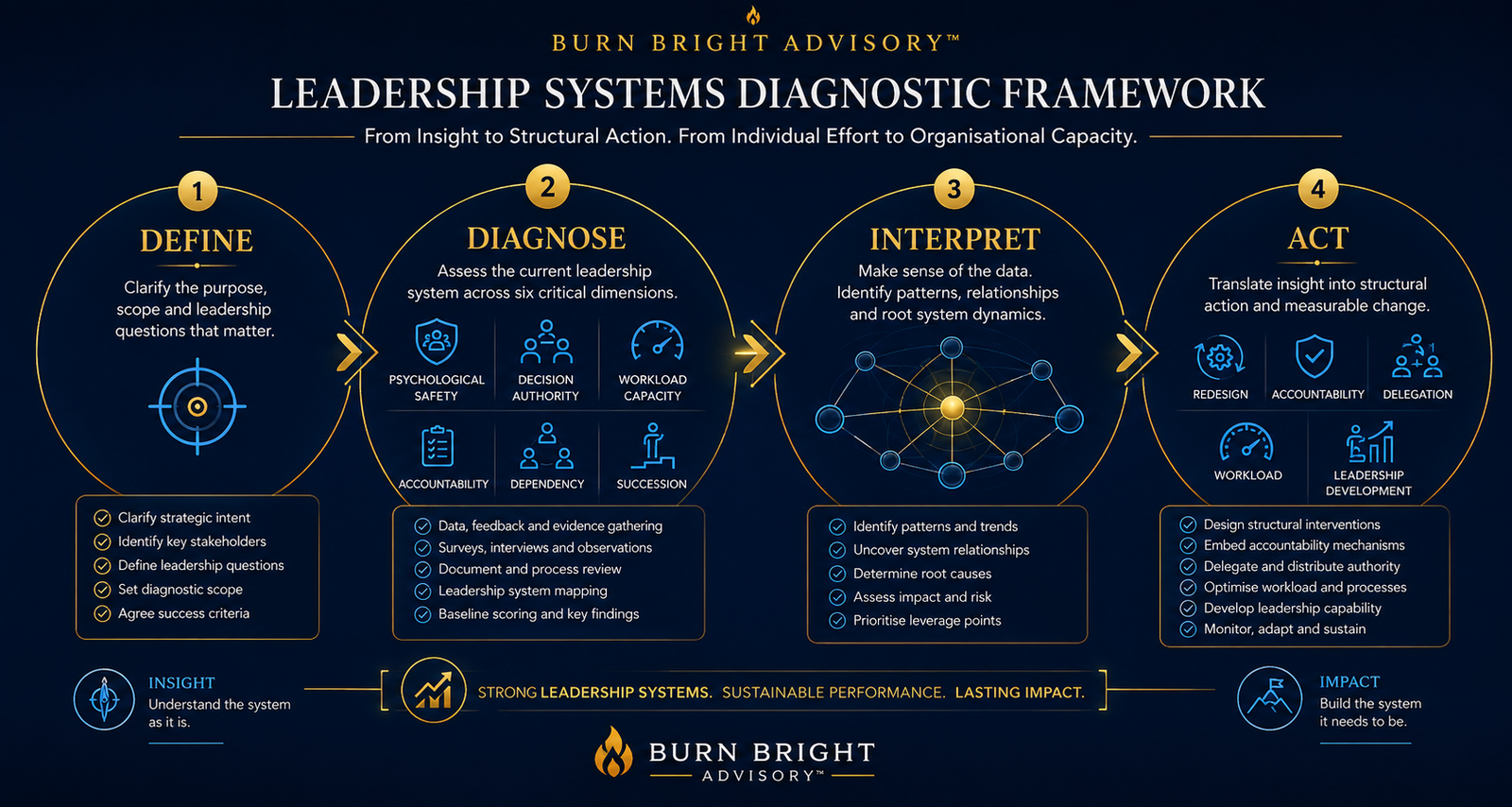
Executives can begin with four stages:
Stage 1 Define
Identify what sustainable leadership should mean in your context. What behaviours, systems and performance conditions should remain viable over time?
Stage 2 Diagnose
Examine six questions:
- Can people challenge senior decisions without disproportionate personal risk?
- Is decision authority clear at each organisational level?
- Are leadership workloads realistically achievable within available capacity?
- Are leaders accountable for how results are achieved as well as whether they are achieved?
- Does leadership develop capability or create dependency?
- Would performance continue if a key leader disappeared for three months?
Stage 3 Interpret
Do not treat weak scores independently. Look for relationships. For example, poor delegation plus excessive workload plus decision bottlenecks may indicate a dependency architecture rather than three separate problems. Low psychological safety combined with high reported “alignment” should also prompt scrutiny — agreement is meaningful only when disagreement is safe.
Stage 4 Act
Intervention should target the architecture producing the behaviour. That could mean:
- Clarifying decision rights
- Redesigning leadership roles
- Reducing unnecessary reporting
- Strengthening accountability
- Developing delegation capability
- Protecting strategic thinking time
- Introducing structured challenge
- Monitoring workload
- Developing succession
- Addressing harmful conduct directly
Sustainable leadership is created through design, not aspiration.
What Sustainable Leadership Looks Like Across Sectors
Business Growth Intelligence™
In business, toxic leadership may appear as founder dependency, executive micromanagement or relentless growth expectations unsupported by operational capacity. Sustainable leadership creates scalable decision architecture — the question moves from “how much can the founder personally drive?” to “how much performance can the organisation reliably generate without requiring the founder to remain the central operating system?”
School Leadership Intelligence™
In education, unsustainable leadership can become embedded through initiative overload, administrative burden and constant responsiveness. A sustainable school leader does not simply become more efficient at absorbing impossible demands. They examine what should stop, what can be delegated, where accountability sits and which activities genuinely improve educational outcomes.
Healthcare Leadership Intelligence™
Healthcare leadership operates within high-consequence environments where hierarchy can sometimes be necessary, but authority must not eliminate professional challenge. Sustainable healthcare leadership combines clinical accountability with psychological safety, recognising that people need sufficient confidence to raise concerns, question assumptions and escalate risk.
Public Service Leadership Intelligence™
Public-sector leaders often operate amid competing political, regulatory, operational and community expectations. Sustainability requires clarity around decision authority and professional accountability so that complexity does not produce paralysis, excessive escalation or defensive leadership.
HR & People Leadership Intelligence™
HR should resist treating toxic leadership exclusively as an employee-relations issue. The deeper question is whether organisational systems reward, tolerate or unintentionally generate destructive leadership behaviour.
Entrepreneur Performance Intelligence™
For entrepreneurs, one of the greatest sustainability risks is becoming the answer to every question. Founder capability can create early growth; founder dependency can later constrain it. The transition requires moving from personal control to organisational capability.
Sustainable Leadership Requires Reflection
There is another uncomfortable dimension to toxicity. Leaders are not always aware of their impact.
A leader can genuinely believe they are being decisive while employees experience them as controlling. They can believe they are protecting quality while creating dependency. They can believe they are demonstrating commitment while normalising exhaustion.
This is where Reflective Practice Intelligence™ intersects with Ethics Intelligence™. Intent matters. But impact matters too. Sustainable leaders continually examine the distance between the two.
That requires enough psychological security in the leader themselves to hear difficult information without immediately defending identity or authority.
The question is not: “Am I a toxic leader?” That binary question invites defensiveness.
A better question is: “Which conditions created by my leadership could become unsustainable if they continued for the next three years?” That produces reflection rather than accusation.
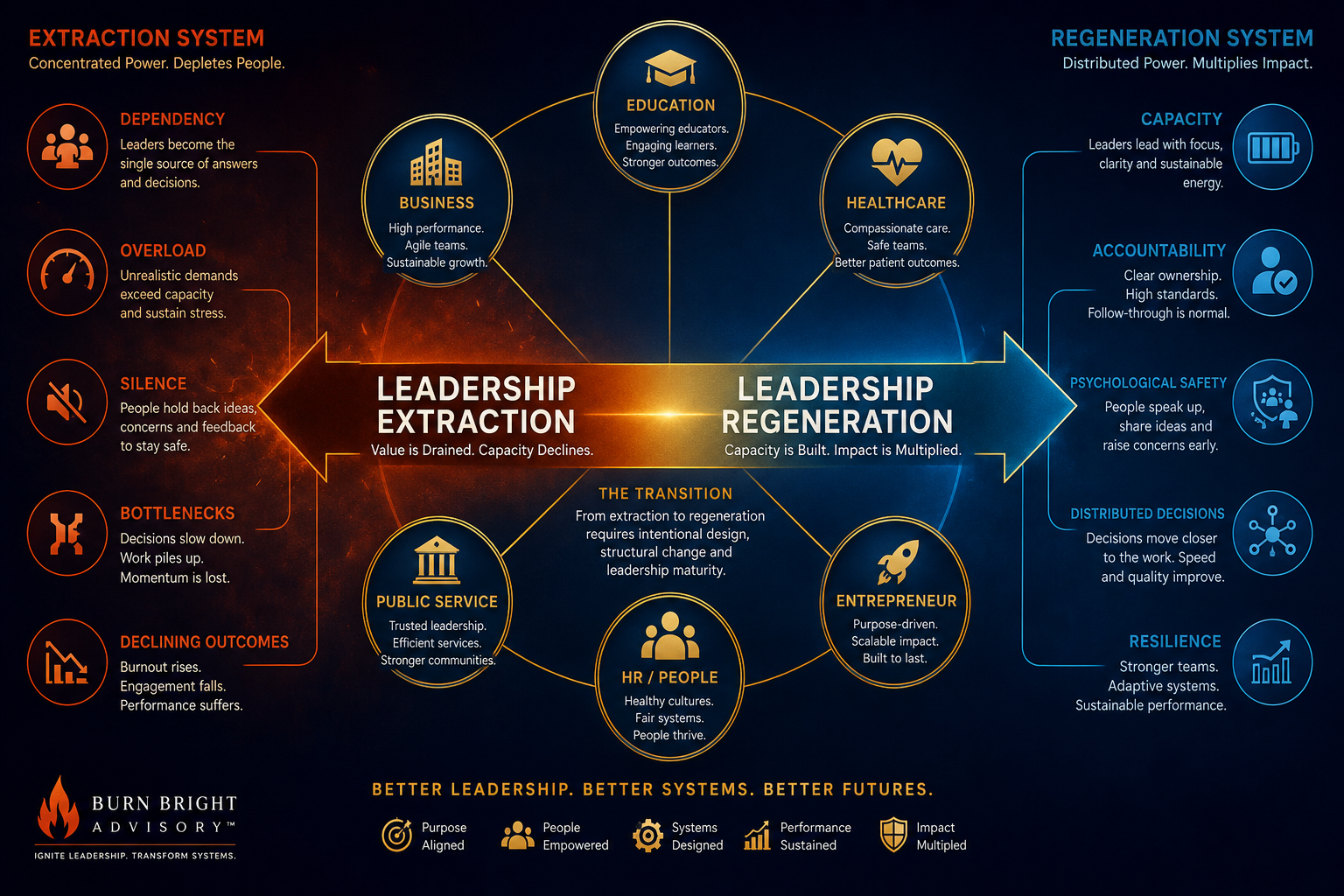
From Leadership Extraction to Leadership Regeneration
Perhaps the most important distinction is this:
Extraction consumes trust, energy, attention and capability faster than they can be replenished. Regenerative leadership produces outcomes while also developing the conditions required for future outcomes.
This does not mean every day is comfortable. Sustainable leaders still navigate crises, make difficult decisions and experience periods of intense demand. The difference is that temporary intensity does not become the permanent operating model.
Recovery exists.
Learning occurs.
Capacity is rebuilt.
Authority is distributed.
Systems improve.
People develop.
The organisation becomes stronger because leadership happened — not progressively weaker because leadership consumed it. That is the standard against which modern leadership should increasingly be judged.
Reflection Questions
Leadership Reflection Questions
- Where does our organisation currently confuse leadership intensity with leadership effectiveness?
- Which decisions remain unnecessarily concentrated around senior leaders?
- Where might silence be incorrectly interpreted as agreement?
- Are leaders evaluated on how they achieve results as well as the results themselves?
- Which roles currently depend upon individual heroics to remain functional?
- Where is workload exceeding sustainable leadership capacity?
- Which behaviours would become damaging if maintained for another three years?
- Does our current leadership architecture create greater organisational capability or greater dependency?
Action Steps
Begin by mapping leadership demand against genuine capacity. Identify decision bottlenecks and unnecessary escalation. Audit whether people can challenge authority safely. Review whether performance systems reward results without examining how those results are achieved. Identify roles dependent upon heroic effort. Then use the Leadership Sustainability Check™, Leadership Workload Audit™, Decision Authority Matrix and Leadership Operating Model™ Diagnostic to move the conversation from personality to organisational design.
The objective is not to remove challenge from leadership. It is to ensure challenge produces capability rather than damage.
Frequently Asked Questions
What is toxic leadership?
Toxic leadership is a repeated pattern of leadership behaviour that damages trust, dignity, psychological safety, capability or sustainable performance. It can involve intimidation, manipulation, excessive control, favouritism, blame, unpredictability or other destructive uses of authority.
What is sustainable leadership?
Sustainable leadership creates results while preserving and developing the capacity required to continue performing. It integrates ethical judgement, appropriate workload, clear accountability, distributed capability, reflection, resilience and long-term organisational health.
Is demanding leadership toxic?
No. High expectations, difficult feedback and firm accountability are not inherently toxic. The distinction concerns how authority is exercised and whether challenge strengthens capability or repeatedly creates fear, humiliation, dependency or harm.
Can a toxic leader still be high performing?
In the short term, yes. This is why toxic leadership can persist. Strong immediate outcomes can conceal accumulated leadership debt such as turnover, silence, burnout, dependency and weakened succession.
Can good leaders develop toxic behaviours?
Yes. Excessive workload, chronic pressure, poor role design and weak organisational support can contribute to controlling or reactive behaviour. This does not remove accountability, but it changes what an effective intervention may require.
What is the relationship between ethical and sustainable leadership?
Ethical leadership considers the consequences of how power is exercised. Sustainable leadership extends this into organisational capacity: results should not routinely depend upon practices that diminish people’s dignity, wellbeing, voice or future ability to perform.
How can organisations prevent toxic leadership?
Prevention requires more than leadership training. Organisations should establish clear behavioural standards, decision authority, accountability mechanisms, workload monitoring, psychological safety, leadership development, succession systems and effective routes for challenge.
How do you know whether leadership is sustainable?
Examine whether performance can continue without chronic overload, excessive dependency or fear. Sustainable systems maintain decision quality, leadership capacity, trust, adaptability and organisational performance over time.
Conclusion: The Real Test of Leadership Performance
The difference between toxic leadership and sustainable leadership cannot be reduced to whether employees like their manager.
It is considerably more important than that. It concerns how authority is exercised, how decisions are made, how pressure is distributed and whether today’s performance strengthens or consumes tomorrow’s capacity.
Toxic leadership can create compliance.
Sustainable leadership creates capability.
Toxic leadership can create dependency.
Sustainable leadership distributes intelligence and authority.
Toxic leadership can generate impressive short-term outputs while accumulating invisible organisational debt. Sustainable leadership seeks performance that can be repeated without requiring the continual depletion of leaders or their people.
For Burn Bright Advisory™, this sits at the intersection of Ethics Intelligence™, Leadership Sustainability™ and Leadership Performance Intelligence™.
The ultimate ethical question for leaders is therefore not simply: “Did we achieve the result?” It is: “What did our leadership create while achieving it?”
If the answer is greater trust, stronger judgement, deeper capability, clearer accountability and sufficient capacity to perform again tomorrow, leadership has done more than deliver. It has built something capable of lasting.
That is the difference between leadership that burns people out and leadership that enables people and organisations to Burn Bright. Not Out.™
Is Your Leadership Building Capacity or Accumulating Debt?
Take the free Leadership Burnout Self-Assessment to understand whether your current leadership approach is creating sustainable performance or quietly consuming tomorrow’s capacity.
Free Leadership Intelligence
Get Weekly Leadership Insights
Join thousands of leaders receiving practical strategies on burnout prevention, workload design, and sustainable performance every week.