Quick Answer
Key Takeaways
- Repeated firefighting is usually evidence of a system problem, not simply a busy leadership role.
- Leaders must distinguish genuine emergencies from predictable operational failures.
- Every recurring fire should trigger a root-cause question: Why did this reach me?
- Clear decision authority prevents routine problems travelling unnecessarily up the organisation.
- Sustainable leadership requires protected capacity for prevention, not permanent availability for reaction.
How to Stop Firefighting in Leadership
How to stop firefighting in leadership is not really a time-management question.
It is a systems question.
You start Monday intending to focus on strategy. By 9:15, somebody needs an urgent decision. At 10:30, a staffing problem lands on your desk. Before lunch, a client issue has escalated, two colleagues need you to resolve a disagreement and a deadline nobody mentioned last week has suddenly become critical.
Your strategic work moves to Tuesday.
Then Wednesday.
Then next week.
Eventually, firefighting stops feeling like disruption and starts feeling like leadership itself.
That is dangerous.
A leader who spends most of the working week responding to urgent problems has less capacity to address the conditions producing those problems. The result is a reinforcing cycle: less prevention creates more fires; more fires leave less time for prevention.
This is one reason leaders cannot simply outwork broken systems. The solution is not becoming faster at fighting fires. It is building an operating system that produces fewer of them. This article explains how.
To see the problem clearly, it helps to separate the visible crisis from the system underneath it.
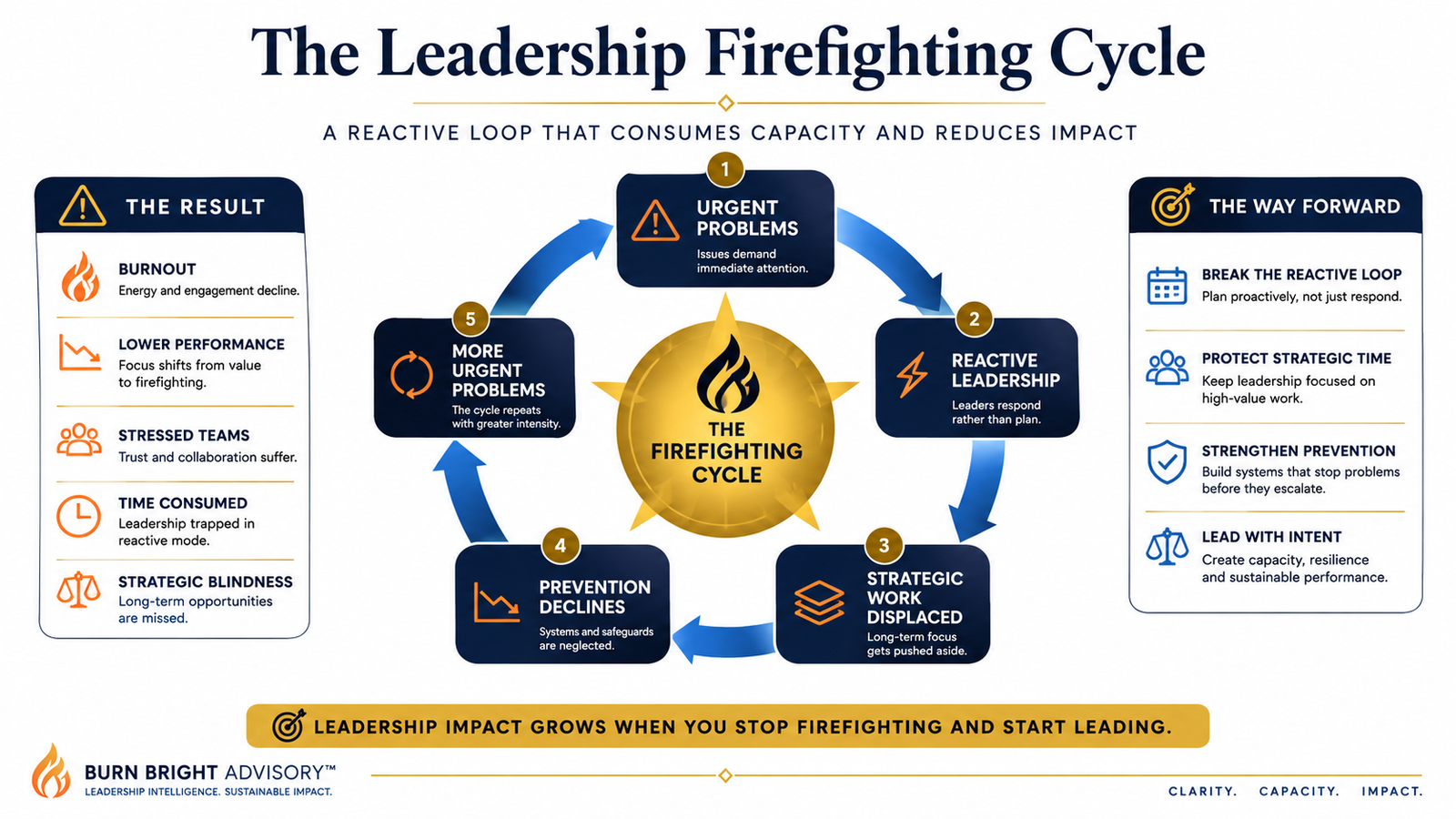
The critical point in this model is the feedback loop. Every hour absorbed by preventable escalation is an hour unavailable for redesign, coaching, planning and prevention.
Featured Snippet
Why Do Leaders Get Trapped in Constant Firefighting?
Firefighting rarely begins because somebody decides to become a reactive leader. It develops gradually.
A problem appears. You solve it.
A team member is unsure what to do. You decide for them.
A deadline is slipping. You step in.
A customer complains. You personally take control.
Each decision makes sense in isolation. Collectively, they can build a system that depends on you.
The Burn Bright framework identifies scope creep, meeting culture, communication chaos, decision overload and perfectionism culture as five structural root causes of burnout. When several operate simultaneously, firefighting becomes almost inevitable.
Consider decision overload. If your team does not know which decisions it can make independently, uncertainty travels upwards. Small decisions become management decisions. Management decisions become executive decisions.
Soon, the senior leader becomes the organisation’s human routing system. This creates a paradox. Being highly responsive can make the organisation less capable. Every time you solve something that could have been solved elsewhere, you may unintentionally teach the system to escalate rather than decide.
Gallup’s research illustrates the pressure already sitting inside management roles. It found that more than four in ten managers strongly agreed they faced multiple competing priorities, while managers were 67% more likely than individual contributors to report substantial workplace interruptions.
The latest picture is also concerning. Gallup’s State of the Global Workplace 2026 reports that global manager engagement fell from 31% in 2022 to 22% in 2025.
Those numbers should not be interpreted simply as evidence that managers need greater resilience. They should make organisations examine the job.
McKinsey has similarly found organisational bureaucracy — including excessive meetings, emails and approval processes — among the most significant obstacles preventing managers from doing the people-management work organisations supposedly employ them to do.
This is the structural issue. A manager cannot simultaneously be the escalation point for every problem, attend every meeting, approve every decision, respond instantly to every message and still maintain enough cognitive capacity for strategic leadership.
Something eventually gives.
Usually, it is strategic work first.
Then recovery.
Then judgement.
Then the leader.
What Is the Difference Between a Real Crisis and a System Failure?
Not every fire can be prevented. Leadership includes responding to genuinely unpredictable events. A cyberattack, serious safety incident, sudden regulatory intervention, major customer failure or unexpected loss of a critical employee may require immediate senior leadership attention.
That is crisis leadership.
Firefighting is different. Firefighting is when the supposedly unexpected keeps happening.
The same deadline slips every month.
The same department needs last-minute approval.
The same person escalates decisions.
The same meeting produces no decision, requiring another meeting.
The same client becomes an emergency because nobody acted when the first warning signs appeared.
The same senior leader ends another week saying: “I didn’t get to anything I planned.”
At that point, you do not have a collection of emergencies. You have a pattern. And patterns are diagnostic.
The World Health Organization defines burnout as resulting from chronic workplace stress that has not been successfully managed, characterised by exhaustion, increased mental distance or cynicism towards work, and reduced professional efficacy.
Notice the word chronic. The danger is not one demanding Tuesday. Leadership will always contain difficult days. The problem is an operating model that repeatedly generates excessive demand without creating the mechanisms required to control it.
This is why individual productivity techniques have limits. A better task manager might help you organise twenty urgent problems. It does not explain why twenty urgent problems reached you. A carefully colour-coded calendar might make overload more visible. It does not redesign the workload. An evening mindfulness session might help somebody decompress. It does not clarify who has authority to approve tomorrow’s routine operational decision.
That does not remove personal responsibility from leaders. It changes where that responsibility is applied. Instead of asking leaders to become endlessly better at absorbing dysfunction, we ask them to redesign the conditions producing it. That is a fundamentally different leadership task. And it begins by measuring the fires.
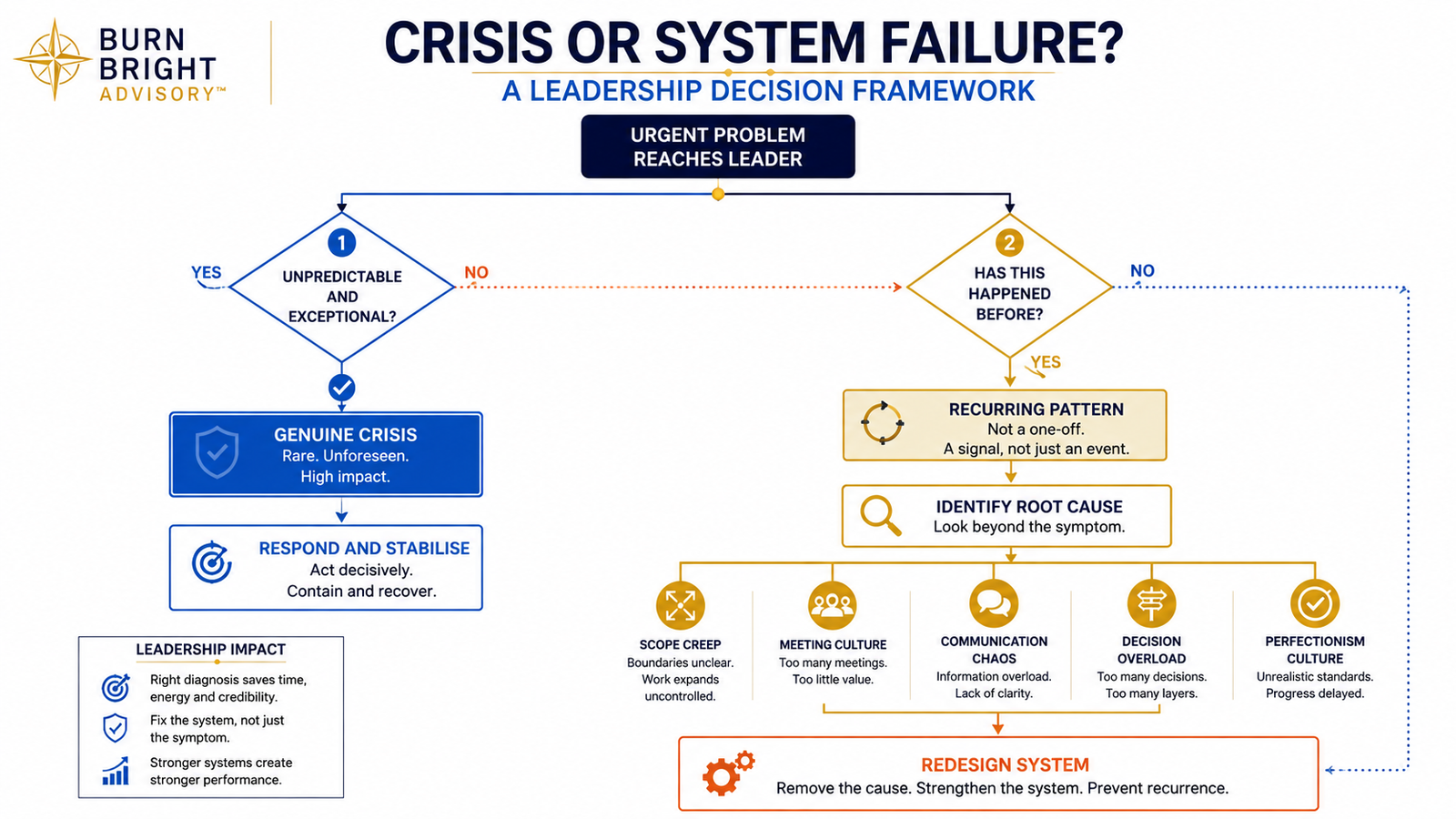
The distinction is simple: a genuine crisis requires response. A recurring crisis requires redesign.
How Can Leaders Identify the Fires That Keep Coming Back?
You cannot redesign what you have not diagnosed. Most leaders know they are firefighting. Far fewer have stopped long enough to examine what they are repeatedly fighting. That is the first practical step.
For one working week, keep a simple record of every unplanned issue that requires your attention. Do not make this complicated. Record four things:
- What happened?
- Why did it reach me?
- How much time did it consume?
- Has something similar happened before?
The fourth question is particularly important. Repeated events expose structural weaknesses.
A staffing issue that occurs once may be unpredictable. A staffing issue every Friday afternoon suggests a planning problem. One urgent approval may be reasonable. Twelve approval requests every day suggest unclear decision authority. A client escalation may be unavoidable. Repeated client escalations suggest something earlier in the process is failing.
This is where leaders need to move from incident thinking to pattern thinking.
The Firefighting Audit
At the end of the week, place each interruption into one of five categories:
| Firefighting Source | What It Looks Like | Structural Question |
|---|---|---|
| Scope creep | Responsibilities keep accumulating | What should no longer sit with me? |
| Meeting culture | Problems are discussed repeatedly without resolution | Which meetings should decide, delegate or disappear? |
| Communication chaos | Constant messages, interruptions and unclear channels | What communication rules are missing? |
| Decision overload | Too many decisions travel upwards | Who should have authority to decide? |
| Perfectionism culture | Work is repeatedly checked, revised or controlled | Where are we demanding unnecessary certainty or quality? |
These five categories are not random. They sit at the centre of the Burn Bright diagnosis of leadership burnout. The point is not simply to count interruptions. It is to discover which part of the operating system keeps generating them.
You may discover, for example, that you experienced 27 significant interruptions during the week. At first glance, that looks like a time problem.
But suppose 14 of those interruptions were requests for approval. Now the diagnosis changes — you may have a decision-authority problem. Another eight might come from colleagues asking questions already answered somewhere else — now you have a communication architecture problem. Perhaps the remaining five genuinely required your involvement.
Suddenly, the situation looks different. You did not have 27 unavoidable leadership emergencies. You had five genuine leadership issues and 22 pieces of organisational friction.
That distinction creates leverage. Because friction can be redesigned.
How Do You Stop Becoming the Decision Bottleneck?
One of the fastest ways to reduce firefighting is to examine decision authority. Many overloaded leaders are carrying decisions that should never have reached them.
This often happens gradually. A new manager asks for guidance. You help. Next time, they ask again. Eventually, asking you becomes the process. The organisation has accidentally created a dependency.
Leaders can reinforce this without realising it. When somebody brings them a problem, they solve it quickly because solving it themselves feels efficient. In the short term, it probably is. In the long term, it is expensive.
Every unnecessary decision made by the leader teaches somebody else that they do not need to make it. The result is reverse delegation. Work moves upwards. Authority becomes concentrated. The team waits. The leader becomes overloaded. And because the leader is overloaded, decisions take longer, creating more urgency downstream.
This is how decision overload turns into firefighting.
Use a Decision-Authority Test
For each recurring decision reaching you, ask three questions:
Does this decision genuinely require my authority?
There will always be decisions involving significant risk, strategy, safeguarding, finance, reputation or organisational direction that belong with senior leadership. Keep them. But do not confuse seniority with necessity.
Who has the information closest to the decision?
Often, the person closest to the work has better operational information than the senior leader approving it. Decision authority should sit as close as reasonably possible to the information required to make the decision safely.
What guardrails would allow somebody else to decide?
Delegation does not mean abandoning control. It means replacing constant approval with clear parameters — for example, “You can approve expenditure up to £5,000 within the agreed budget,” or “Proceed without asking me unless one of these four risk thresholds is triggered.”
That final approach is particularly powerful. Instead of defining everything somebody can decide, define the conditions under which the decision must be escalated. Everything else stays with the owner.
RACI Can Expose Hidden Decision Problems
A simple RACI Delegation Framework™ analysis can help. For significant recurring work, identify who is:
- Responsible — completing the work
- Accountable — ultimately answerable for the result
- Consulted — providing relevant expertise
- Informed — needing visibility after the decision
Firefighting often occurs when these roles blur. Everybody is consulted. Nobody feels authorised. Senior leaders become involved “just in case”. Meetings multiply. Decisions slow down. Then the delayed decision becomes urgent.
The solution is not another meeting. It is clearer authority.
Why Does Protecting Strategic Time Reduce Firefighting?
One of the cruelest features of reactive leadership is that the work required to prevent future problems is usually the first work sacrificed to current problems.
Think about what gets postponed when a leader’s calendar becomes overloaded: process redesign, staff development, strategic thinking, succession planning, data analysis, risk review, coaching, reflection.
These activities rarely arrive with flashing red warning lights. Nobody normally phones at 10:17 on Tuesday morning shouting “We have a strategic-thinking emergency.” So strategic work loses. Urgency wins.
But eventually the cost appears. The process nobody redesigned fails again. The manager nobody developed escalates another decision. The risk nobody reviewed becomes an incident. The succession plan nobody created becomes a recruitment crisis.
Yesterday’s postponed strategic work becomes tomorrow’s fire. That is why protected strategic time is not a luxury. It is preventative maintenance for leadership.
Move From Calendar Filling to Time Architecture™
A conventional calendar asks: Where can I fit everything? Time Architecture™ asks: What must this calendar protect if I am going to lead effectively? Those are different questions.
Start by dividing leadership time into four broad categories:
Category 1 Strategic Work
Thinking, planning, analysis, improvement and future-focused decisions.
Category 2 People Leadership
Coaching, feedback, development, difficult conversations and team alignment.
Category 3 Operational Oversight
Monitoring performance, resolving legitimate issues and maintaining delivery.
Category 4 Recovery Capacity
Periods that allow cognitive and emotional capacity to reset rather than keeping the leader permanently activated.
A sustainable week needs all four. A firefighting week becomes dominated by the third. Operational work expands until it consumes everything around it.
The answer is not to eliminate operational involvement. Senior leaders need visibility. The answer is to stop treating every operational problem as requiring senior leadership intervention. This principle sits at the heart of sustainable Workload Architecture™:
What Should Leaders Do When Everything Feels Urgent?
When everything is labelled urgent, urgency has stopped being useful information. It has become culture.
This happens frequently in overloaded organisations. Requests arrive marked “ASAP”. Messages are labelled “urgent”. People interrupt meetings because they “just need two minutes”. Deadlines suddenly appear. Senior leaders respond rapidly because they want to be helpful. Over time, the organisation learns that urgency is the fastest route to attention.
You have created an urgency economy. The people who escalate most effectively receive resources first. That is not prioritisation. It is organisational noise.
Replace Urgency With Impact
A useful alternative is to assess work against two dimensions: impact — what happens if we do or do not act — and time sensitivity — when does a decision genuinely become necessary. This produces four broad categories.
High Impact High Time Sensitivity — Act Now
These are genuine leadership priorities.
High Impact Lower Time Sensitivity — Protect and Plan
Protect time and plan deliberately. This is where much strategic leadership belongs.
Lower Impact High Time Sensitivity — Delegate
Delegate, automate or simplify wherever possible. These tasks often create disproportionate interruption.
Lower Impact Lower Time Sensitivity — Question It
Question whether the work needs doing at all. This is where many organisations struggle — good at adding work, poor at removing it.
Every new initiative arrives with a business case. Old work survives through habit. Eventually, leaders inherit an organisational workload built through years of accumulation. That is scope creep at system level.
A sustainable leader therefore needs another question: What are we going to stop? Not postpone. Not squeeze into Friday afternoon. Stop.
That question is often more strategically valuable than asking how the organisation can become more productive. Because sometimes the organisation does not need greater productivity. It needs less unnecessary work.
The Firefighting Reset: From Reaction to Prevention
Stopping firefighting does not mean trying to create an organisation where nothing unexpected happens. That would be unrealistic. The goal is to create enough structure that predictable problems stop pretending to be emergencies.
A practical reset can be built around five moves.
1. Capture the Fires
Track significant interruptions and escalations for at least one week. Look for frequency, source and time consumed. Do not rely on memory — firefighting creates cognitive overload, and overloaded leaders tend to remember the dramatic incidents rather than the repetitive friction consuming dozens of smaller blocks of time.
2. Find the Recurrence
Ask: where have I seen this before? Repeated incidents are evidence. Three different complaints may appear unrelated until you discover all three originated from the same unclear process. Find the pattern underneath the incidents.
3. Identify the Structural Cause
Use the five-root-cause diagnosis: scope creep, meeting culture, communication chaos, decision overload, perfectionism culture. Do not settle for “people need to communicate better” — that is too vague to redesign. Identify the mechanism.
4. Redesign Ownership
Decide who should own the problem in future. Clarify authority. Set thresholds. Document the process. Remove unnecessary approval. Then resist the temptation to take the work back when somebody initially struggles — delegation requires learning capacity.
5. Review Whether the Fire Returns
Structural improvement requires feedback. After 30 days, ask whether the problem recurred, whether it still reached you, whether the team resolved it without escalation and whether leadership time consumed has decreased. If not, redesign again.
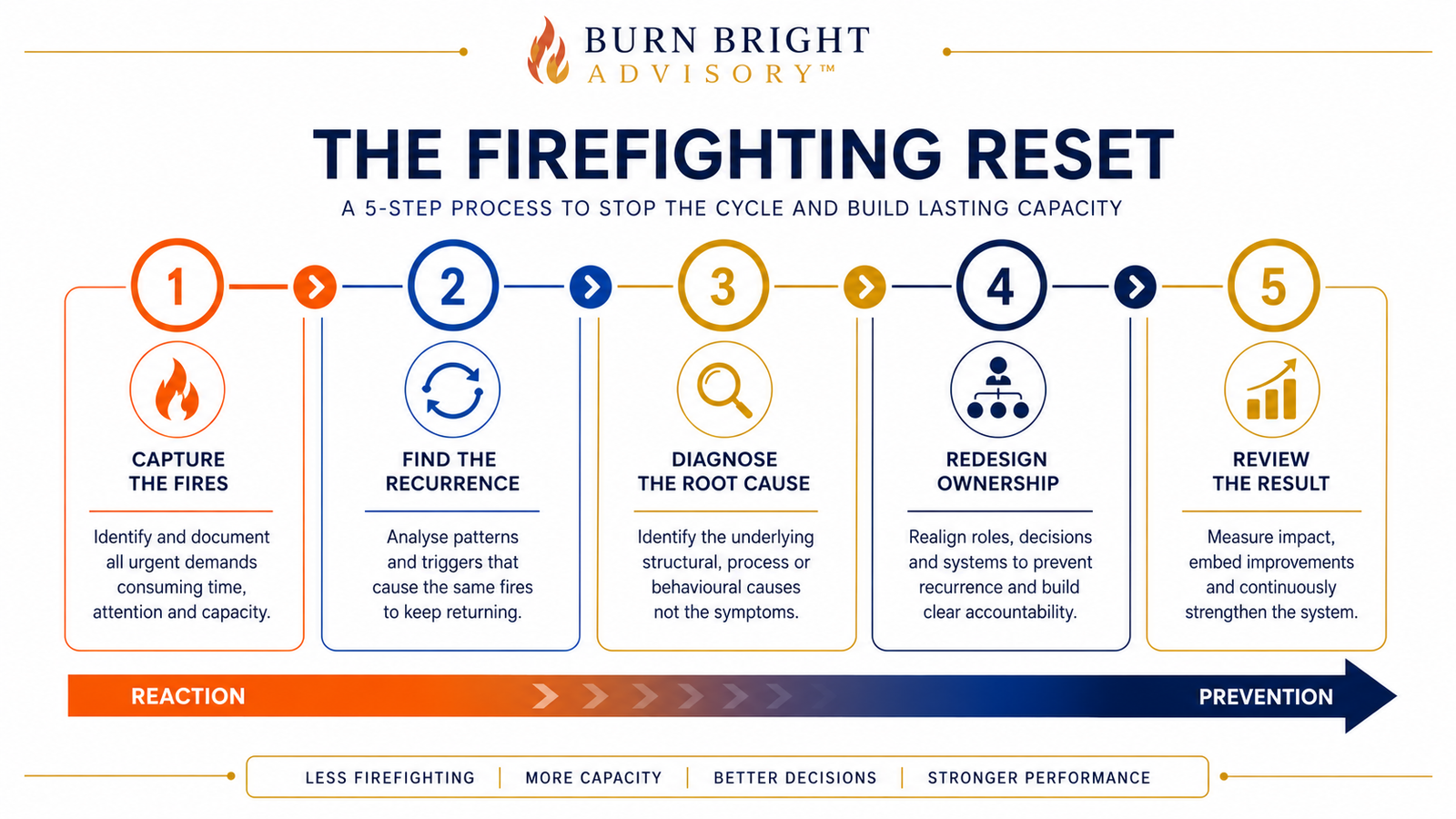
This is the shift from heroic leadership to sustainable leadership.
Heroic leadership asks: How many fires can I handle? Sustainable leadership asks: Why does the system keep producing fires?
The second question is harder. It is also where leadership begins.
How Can Organisations Make the Change Stick?
Stopping firefighting is not achieved by having one quieter week. The real test is whether the organisation can operate differently when pressure returns.
This is where many leadership interventions fail. A team agrees to delegate more, reduce unnecessary escalation and protect strategic time. For several weeks, things improve.
Then a deadline slips.
A client complains.
A senior executive asks for something immediately.
The old behaviour returns. The leader steps back in. Approvals move upwards. Meetings multiply. Protected time disappears. Within weeks, the organisation is firefighting again.
This happens because behaviour has changed, but the management framework has not. Sustainable change needs structure.
Burn Bright’s four-pillar structural transformation framework provides a useful way to think about that structure:
Pillar 1
Workload Architecture™
Is the amount and distribution of work realistic?
Pillar 2
Decision Authority™
Is it clear who can decide what without escalation?
Pillar 3
Recovery Rhythms™
Does the operating model allow capacity to be restored?
Pillar 4
Management Frameworks
Are there routines that identify overload before it becomes crisis?
These pillars matter because firefighting rarely has one cause. Reducing meetings while leaving decision rights unclear will not solve the problem. Delegating tasks without changing workload expectations simply redistributes overload. Protecting Friday afternoon for strategic work achieves little if the organisational culture expects immediate responses throughout that time.
The system needs to work together.
Use a 30-60-90 Day Reset
A practical transformation can be phased.
Days 1–30: Diagnose
Track fires. Identify recurring escalations. Audit meetings. Map decisions. Examine workload. Ask where senior leadership attention is being consumed unnecessarily.
Days 31–60: Redesign
Move decisions closer to the work. Remove low-value activity. Clarify responsibilities. Establish communication rules. Protect strategic capacity.
Days 61–90: Stabilise
Measure whether escalations have fallen. Check whether decisions are moving faster. Review whether protected strategic time survives busy periods. Identify where old patterns are returning.
This turns firefighting reduction from a good intention into an operating change. And operating changes can be measured.
Firefighting Leadership vs Sustainable Leadership
| Firefighting Leadership | Sustainable Leadership |
|---|---|
| Responds to every escalation | Defines what genuinely requires escalation |
| Measures responsiveness | Measures impact and prevention |
| Keeps decisions at the top | Distributes decision authority |
| Adds work when problems appear | Removes or redesigns low-value work |
| Treats availability as commitment | Protects leadership capacity |
| Solves recurring incidents | Investigates recurring causes |
| Depends on individual heroics | Builds repeatable systems |
| Delegates tasks | Delegates ownership and authority |
| Sacrifices strategic time first | Protects strategic time deliberately |
| Rewards urgency | Distinguishes urgency from impact |
| Treats recovery as personal | Builds recovery into operating rhythms |
| Asks “How do we get through this?” | Asks “Why does this keep happening?” |
The difference is not that sustainable leaders care less about urgent problems. They care enough to prevent unnecessary ones.
That distinction matters. Heroic leadership can look impressive from the outside. The leader is always available, always solving, always stepping in. But an organisation that can only function because one person repeatedly rescues it is not high performing.
It is fragile. Better systems outperform more effort.
Frequently Asked Questions
What does firefighting mean in leadership?
Firefighting in leadership means spending a large proportion of your time reacting to urgent problems, escalations and operational disruptions rather than focusing on prevention, strategy and development. Occasional crises are normal. Persistent firefighting usually indicates structural problems involving workload, decision authority, communication, accountability or organisational processes.
How do I stop firefighting as a manager?
Start by recording recurring interruptions for one week. Identify which problems repeatedly reach you and ask why. Then clarify decision rights, delegate genuine ownership, remove unnecessary work and protect time for prevention. The goal is not to become faster at handling every problem. It is to redesign the conditions that keep producing them.
Why does my team keep escalating everything to me?
Constant escalation often indicates unclear decision authority rather than an incapable team. People escalate when they do not know what they can decide, fear the consequences of getting decisions wrong or have learned that the leader prefers to remain involved. Define decision boundaries and explicit escalation thresholds so ownership becomes clear.
Can delegation reduce leadership firefighting?
Yes, but only when leaders delegate authority as well as tasks. Giving somebody responsibility while requiring senior approval for every meaningful decision does little to reduce leadership workload. Effective delegation establishes the outcome, ownership, decision parameters and circumstances under which escalation is genuinely required.
How much strategic time should leaders protect?
There is no universal percentage because leadership roles differ. The more useful question is whether sufficient uninterrupted capacity exists for planning, analysis, improvement, coaching and prevention. If strategic work is repeatedly postponed by operational problems, the calendar is providing evidence that the current leadership system needs redesign.
Is firefighting always a sign of poor leadership?
No. Genuine crises sometimes require intensive senior leadership involvement. The warning sign is recurrence. If the same categories of urgent problem repeatedly consume leadership attention, the issue is no longer simply crisis response. It is evidence that an underlying process, decision rule, workload or accountability structure needs attention.
Why do high-performing leaders get trapped in firefighting?
Competence can create dependency. Reliable leaders are frequently given additional responsibilities because they can handle them. They may also step in quickly when others struggle. Over time, decisions and responsibilities accumulate around them. What initially looks like high performance can become a system increasingly dependent on one person’s capacity.
Conclusion
Learning how to stop firefighting in leadership requires a fundamental change in what you consider effective leadership.
The objective is not to become the person who can absorb the greatest number of problems. It is to build an organisation that does not need you to.
Some crises will always require leadership intervention. But recurring fires should not be accepted as an inevitable feature of senior responsibility. They are information.
A repeated escalation tells you something about decision authority.
A permanently overloaded calendar tells you something about workload architecture.
Constant interruptions tell you something about communication design.
Problems that repeatedly return after being “solved” tell you that the symptom was treated but the structure remained unchanged.
That is the central Burn Bright principle. Burnout is a system failure. Leaders cannot outwork broken systems.
Instead of becoming more efficient at absorbing dysfunction, redesign the conditions creating it. Clarify ownership. Reduce unnecessary work. Move decisions closer to the people with the information to make them. Protect strategic capacity. Build recovery into the operating rhythm.
The goal is not a workplace without pressure. The goal is a leadership system that can handle pressure without requiring permanent heroics.
Fix the system, not the person.
Find Out What Is Driving Your Leadership Overload
If firefighting has become your normal operating mode, the first step is diagnosis. The Leadership Burnout Self-Assessment helps you identify where workload, decision pressure and structural demands may be creating unsustainable leadership conditions.
Free Leadership Intelligence
Get Weekly Leadership Insights
Join thousands of leaders receiving practical strategies on burnout prevention, workload design, and sustainable performance every week.