Quick Answer
Key Takeaways
- Sustainable work starts by redesigning the system, not asking exhausted leaders to try harder.
- Workload must be matched to actual capacity, not theoretical hours in a working week.
- Clear decision authority reduces bottlenecks, cognitive overload and unnecessary escalation.
- Recovery must be designed into the operating model rather than left to weekends and holidays.
- Sustainable leadership replaces individual heroics with structures that continue to work when pressure rises.
Sustainable Work Architecture: Build Work That Lasts
Sustainable work architecture starts with a different question.
Not: How can I fit more into my day?
But: Why has the work been designed so that fitting everything into the day is impossible?
That distinction matters.
Many senior leaders are already organised. They have calendars, task systems, priorities and productivity tools. They know how to work hard. Yet they remain permanently behind because the volume, complexity and fragmentation of their work have expanded faster than the structures supporting them.
The result is predictable. Longer hours. More interruptions. Decisions accumulating at the top. Strategic work pushed into evenings. Recovery treated as something that happens after the work is finished.
Except the work is never finished.
This is why burnout cannot be solved solely through better personal habits. When the architecture of work is creating overload, individual optimisation has limits.
In this article, I will show you what sustainable work architecture looks like, why conventional workload management frequently fails, and how leaders can begin redesigning work around capacity, authority, focus and recovery.
A useful way to see the problem is as an architectural one rather than a personal one.
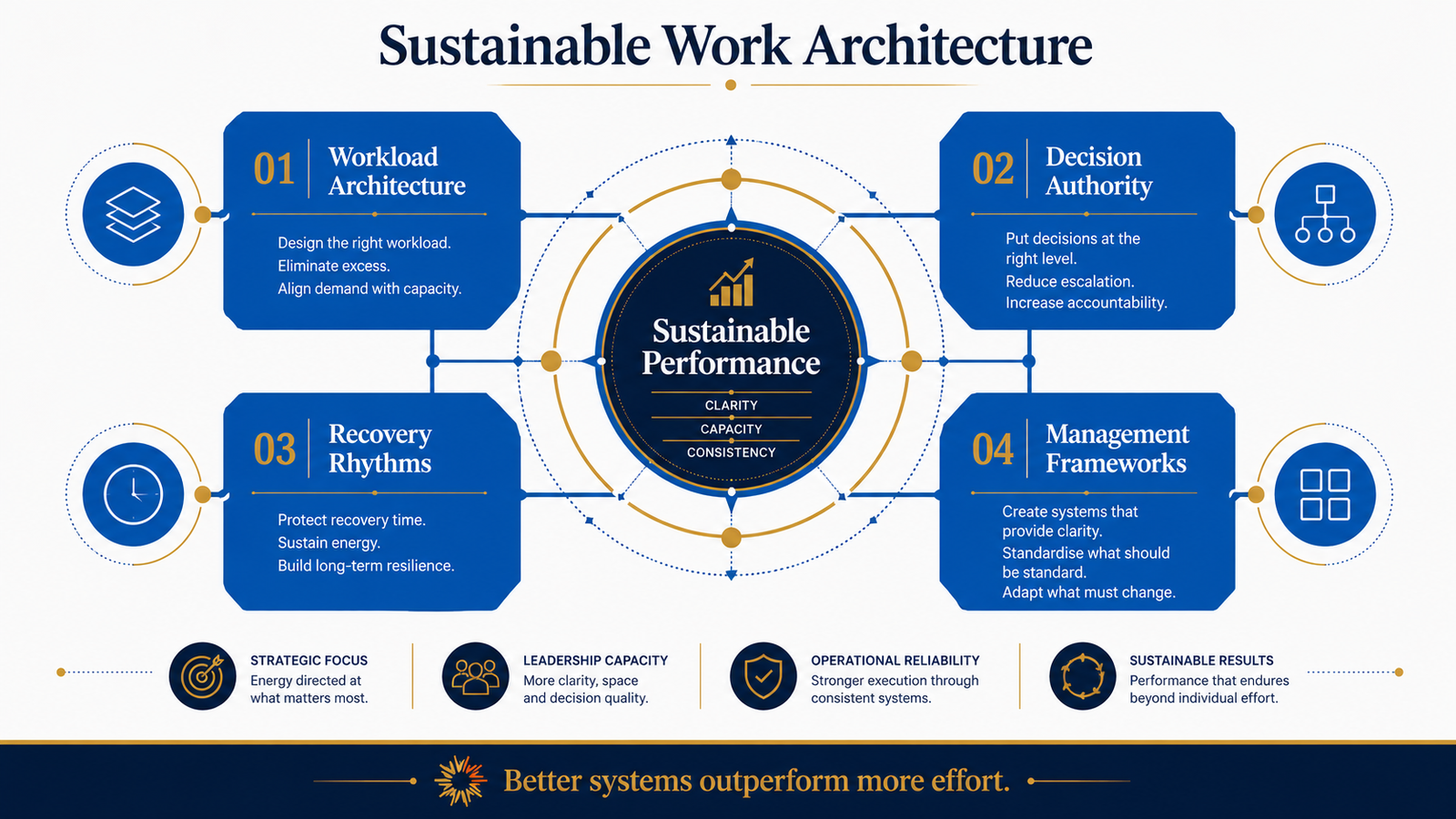
The model matters because leadership capacity is interconnected. Poor workload design creates time pressure. Unclear authority creates decision overload. Constant interruption destroys focus. Missing recovery reduces the capacity available to deal with all three.
Fixing one symptom while leaving the wider structure untouched rarely produces lasting change.
Featured Snippet
Why Does Modern Work Architecture Become Unsustainable?
Most leadership roles do not become unsustainable because of one dramatic decision.
They become unsustainable through accumulation.
A temporary responsibility becomes permanent. A new reporting requirement is introduced, but the old one remains. Another communication channel appears. A vacancy stays open, so the leader absorbs the work. A project needs rescuing, so another responsibility moves upwards.
Each addition looks manageable on its own.
Together, they change the architecture of the role.
This is scope creep, one of the five root causes of burnout in the Burn Bright framework. The others are meeting culture, communication chaos, decision overload and perfectionism culture.
The mistake organisations make is treating these as separate productivity problems. They are connected.
Scope creep increases workload. More workload creates more coordination. More coordination creates more meetings and messages. Unclear ownership pushes decisions upwards. Leaders then compensate by working longer, becoming more controlling or lowering the threshold for what they personally handle.
Eventually, the leader becomes the system.
That is where sustainable work architecture breaks down.
The workload has changed. The infrastructure has not.
Modern leadership increasingly involves managing multiple streams of work simultaneously. You are not simply completing your own responsibilities. You are responding to messages, resolving exceptions, attending meetings, reviewing other people’s work, making decisions, managing stakeholders, dealing with unexpected problems and trying to preserve enough uninterrupted time to think strategically.
This fragmentation carries a cost. A leader can appear productive all day while making very little progress on the work that actually requires leadership.
The calendar is full.
The inbox is moving.
People are getting answers.
But the strategic work keeps being pushed to tomorrow.
Then tomorrow becomes the weekend.
This is one reason traditional time-management advice has limits. Blocking two hours for strategic thinking does not solve the problem if the organisational system gives everyone permission to interrupt those two hours.
Prioritising harder does not solve a workload that exceeds available capacity. Processing email faster does not fix unnecessary communication.
The problem is architectural. The Burn Bright approach therefore asks leaders to diagnose five structural pressures:
- Scope: Has the role expanded without responsibilities being removed?
- Meetings: How much capacity is consumed by coordination rather than meaningful work?
- Communication: How much attention is fragmented across email, Teams, Slack, WhatsApp and other channels?
- Decisions: How many decisions unnecessarily travel upwards?
- Standards: Where is perfectionism creating work whose additional value does not justify the additional effort?
Those questions produce a very different conversation from: How can I become more productive?
The better question is: What is this system asking me to carry, and should I be carrying it at all?
That is the beginning of structural diagnosis.
Why Doesn’t Better Time Management Fix Leadership Overload?
Time management assumes the primary problem is how you use your available hours.
Sustainable work architecture asks whether the work assigned to those hours is realistic in the first place.
That is a fundamental difference.
Imagine a leader has 40 hours of nominal working time each week. Now subtract recurring meetings, one-to-ones, reporting, email, operational decisions, stakeholder requests and unexpected problems.
The theoretical 40-hour week may contain only a fraction of genuinely controllable capacity.
Yet organisations frequently allocate responsibilities as though every hour remains available.
This creates what I call a capacity illusion.
On paper, the role looks manageable.
Operationally, it is not.
The gap is then covered by personal time. The leader starts earlier. Finishes later. Works through lunch. Uses Sunday evening to prepare for Monday. Strategic thinking happens after everyone else has stopped sending messages.
For a while, this can look like commitment. Eventually, it becomes the operating model.
That distinction matters because organisations can easily mistake personal sacrifice for organisational capacity.
If a department only functions because its leader regularly adds ten or fifteen invisible hours to the working week, the department is not properly resourced. It is borrowing capacity from the leader. And that debt eventually becomes expensive.
This is why sustainable work architecture begins with Workload Architecture™, the first pillar of the Burn Bright structural transformation framework.
Instead of asking: Can the leader somehow get this done? Ask: Does the role have sufficient capacity for the work we have designed into it?
That requires examining the work itself. What must remain? What can stop? What can be delegated? What can be automated? What should move elsewhere? What requires a lower standard? What should never have entered the role in the first place?
These are structural questions. And they produce structural solutions.
A leader who continually compensates for poor workload design may keep the organisation moving today, but they also hide the problem that needs fixing.
| Traditional Overload Response | Sustainable Work Architecture |
|---|---|
| Work harder | Redesign the workload |
| Improve personal productivity | Examine system capacity |
| Add another time-management tool | Remove unnecessary work |
| Protect everything currently being done | Question whether the work should exist |
| Leader absorbs vacancies and gaps | Capacity gaps become visible |
| Decisions escalate upwards | Decision authority is distributed |
| Recovery happens after work | Recovery is built into work rhythms |
| Success depends on heroic effort | Success depends on repeatable systems |
The right-hand column does not remove accountability. It makes accountability more realistic.
Sustainable leadership is not about making leadership easier. It is about removing avoidable structural friction so leadership capacity is spent where it creates the greatest value.
How Do You Redesign Workload Around Real Capacity?
The first practical step is to stop treating every existing responsibility as fixed.
A task being on your calendar does not prove it belongs there. A report being produced every month does not prove somebody still needs it. A meeting existing for three years does not prove it needs a fourth. And a decision traditionally coming to you does not prove you are the right person to make it.
Workload architecture requires leaders to challenge inherited work. Start by dividing recurring work into four categories:
Category 1 Leadership-Critical Work
Responsibilities that genuinely require your authority, judgement, experience or organisational position — strategic decisions, sensitive personnel matters, critical stakeholder relationships and decisions carrying significant organisational risk.
Protect this work.
Category 2 Delegable Work
Responsibilities that matter but do not require you personally. This is where many overloaded leaders discover substantial hidden capacity. Delegation requires transferring sufficient authority, context and accountability for somebody else to own the outcome.
Category 3 Reducible Work
Activities that need to continue but not at their current frequency, duration or standard. A weekly meeting might become fortnightly. A 20-page report might become a one-page dashboard. Six approval stages might become three. The objective is proportionality, not carelessness.
Category 4 Removable Work
Where organisations frequently struggle. Stopping work feels more dangerous than adding it, but sustainable systems require subtraction. If every new priority is added to the existing workload, priorities are not actually being set.
This is where the Burn Bright IMPACT Matrix™ becomes useful. Instead of evaluating work purely by urgency, leaders examine the relationship between effort, strategic impact and the consequences of stopping or redistributing the activity.
The purpose is not to squeeze more activity into the week. It is to make the workload itself more intelligent.
A useful diagnostic question is: If this responsibility disappeared tomorrow, what would actually happen?
Not what might happen.
Not what convention says should happen.
What would actually happen?
That question can expose surprising amounts of organisational work maintained through habit rather than value.
At this point, it helps to visualise where leadership capacity is really going.
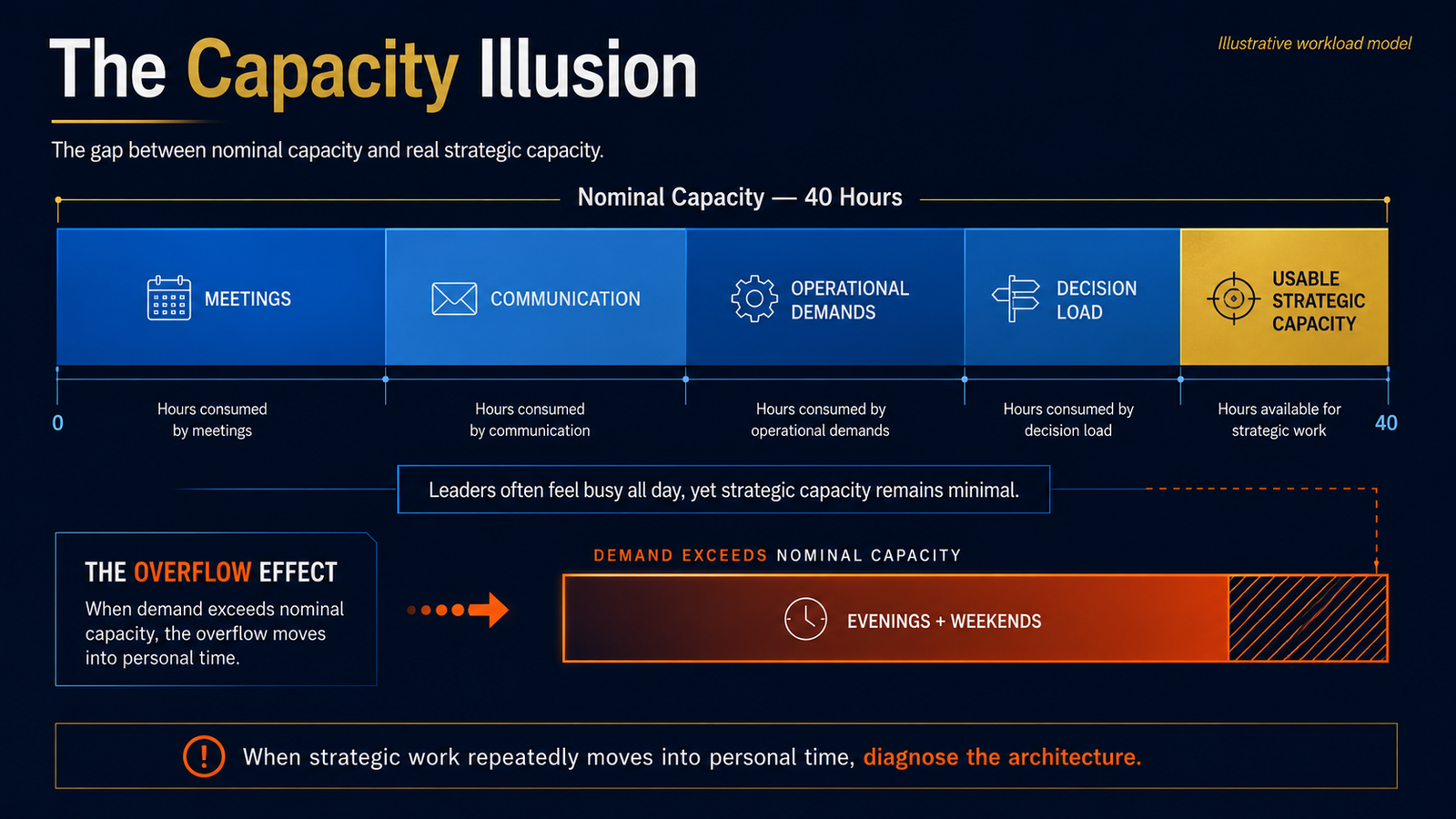
The visual should distinguish nominal capacity from usable leadership capacity. A 40-hour working week may look substantial until recurring coordination, communication and operational demands are mapped against it.
The implication is straightforward. When strategic work repeatedly spills into evenings and weekends, do not automatically diagnose poor discipline.
First diagnose the architecture. The leader may not need another productivity technique. The role may need redesigning.
How Does Decision Authority Make Work More Sustainable?
Workload is only one part of sustainable work architecture. A leader can reduce tasks and still remain overloaded if every significant decision continues to travel upwards.
This creates a decision bottleneck. Team members wait for approval. Projects slow down. Routine questions reach senior leaders. The leader spends the day switching between dozens of small decisions while the strategic decisions requiring deeper judgement are squeezed into whatever attention remains.
Eventually, the organisation becomes dependent on one person’s cognitive capacity.
That is not control.
It is structural fragility.
This is why Decision Authority™ is the second pillar of the Burn Bright structural transformation framework.
The objective is not to remove leaders from decisions. It is to determine which decisions genuinely require leadership authority and which should be made closer to the work.
Decision overload is often an authority problem
When I look at overloaded leadership roles, I would ask three questions:
- Who owns this decision? If the answer is unclear, the decision will often move upwards.
- Who has the information needed to make it? The most senior person is not automatically the best-informed person.
- What level of risk requires escalation? Teams need boundaries within which they can act without repeatedly asking permission.
Without those boundaries, delegation becomes superficial. A leader may delegate a task while retaining every meaningful decision connected to it. The work moves down. The cognitive load stays at the top.
This is where the RACI Delegation Framework™ becomes useful. Clarifying who is Responsible, Accountable, Consulted and Informed reduces ambiguity around ownership.
But a sustainable system must go further. People also need to understand their decision rights.
For example, imagine a department head approves every purchase, every schedule change and every external communication. Individually, each approval takes only a few minutes. Collectively, they create dozens of interruptions and teach the team that progress requires permission.
Now redesign the architecture. Routine purchases within an agreed budget are owned by designated managers. Scheduling decisions are made within defined staffing parameters. External communications follow an agreed protocol, with only high-risk cases escalated.
The leader has not lost control. The system has gained clarity.
That distinction is central to sustainable leadership. Control does not require personal involvement in every decision. Good architecture creates visibility, boundaries and escalation rules so decisions can happen without everything travelling through one person.
The result is faster execution for the team and greater cognitive capacity for the leader.
Why Must Recovery Be Designed Into the Working System?
Recovery is often treated as something that happens outside leadership. Finish the week. Take the weekend. Book a holiday. Return refreshed.
That model works only when the working system allows recovery to last.
If a leader returns from leave to hundreds of messages, unresolved decisions and a backlog created by their absence, the organisation has not created recovery. It has created a temporary interruption to overload.
Recovery by Design™ takes a different approach. Recovery becomes part of sustainable work architecture rather than compensation for an unsustainable one.
This matters because leadership performance depends on more than the number of hours available. It depends on the quality of the capacity available during those hours.
A depleted hour and a recovered hour are not equivalent.
Decision quality changes.
Patience changes.
Perspective changes.
The ability to handle complexity changes.
Strategic thinking changes.
Yet many organisations design working patterns as though cognitive capacity is constant. It is not.
Recovery rhythms operate at different levels
Sustainable leaders need recovery at three levels.
Daily recovery reduces continuous cognitive loading. This can include protected focus periods, genuine breaks between demanding activities and boundaries around non-critical communication. The purpose is not to create an easier day. It is to prevent every minute from becoming reactive.
Weekly recovery prevents one demanding day from becoming a permanently demanding operating rhythm. A calendar filled to capacity Monday to Friday leaves no margin for unexpected problems. When those problems inevitably arrive, the leader pays for them with evenings and weekends. Sustainable calendars therefore need deliberate capacity buffers.
Longer-cycle recovery allows leaders to step away without the organisation becoming dependent on their continued presence. This is an important test of system quality.
Recovery therefore connects directly to delegation and decision authority. A team with clear ownership can continue functioning. A team that depends on constant executive approval cannot.
This is why Burn Bright treats recovery as a leadership discipline rather than a personal reward.
The question is not simply: When can I take some time off? It is: What must be true about the system for me to step away without creating organisational debt?
That is a much more useful question.
The third part of the model can now be visualised as a reinforcing system rather than a collection of wellbeing activities.
Pillar 1
Workload Architecture™
Design the volume and type of work around realistic capacity.
Pillar 2
Decision Authority™
Move appropriate decisions closer to the work and establish clear escalation thresholds.
Pillar 3
Recovery Rhythms™
Build protected cognitive recovery into daily, weekly and longer operating cycles.
Pillar 4
Management Frameworks
Create repeatable systems for prioritisation, delegation, communication and accountability.
The critical point is the connection between them.
Reducing workload without changing decision authority leaves the leader as a bottleneck. Delegating without clear management frameworks creates confusion. Creating recovery time without reducing communication intrusion makes that time fragile. Changing the calendar without addressing scope creep simply moves the overload somewhere else.
Structural transformation requires the components to work together.
What Management Frameworks Support Sustainable Performance?
The fourth pillar of sustainable work architecture is Management Frameworks.
Frameworks matter because good intentions are unreliable under pressure.
A leader may intend to delegate more. Then a crisis arrives. They take everything back.
A team may agree to protect strategic time. Then an urgent request appears. The protected time disappears.
An organisation may commit to reducing meetings. Three months later, the calendar is full again.
Without a repeatable management structure, old behaviours return because they are familiar. Frameworks turn sustainable leadership from an intention into an operating method.
Within the Burn Bright approach, this includes tools such as the RACI Delegation Framework™, IMPACT Matrix™, Decision Fatigue Management, Upward Advocacy Framework, Recovery by Design™ and the 30-60-90 Day Plan.
Each addresses a different structural pressure. The RACI framework clarifies ownership. The IMPACT Matrix helps leaders distinguish valuable work from work that consumes disproportionate capacity. Decision Fatigue Management reduces unnecessary cognitive load. Recovery by Design protects capacity instead of waiting for exhaustion. Upward Advocacy gives leaders a structure for discussing unrealistic demands, competing priorities and resource constraints with those above them. And the 30-60-90 Day Plan turns structural diagnosis into sequenced change.
The frameworks are different. The principle behind them is the same:
Frameworks should reduce complexity, not add to it
There is an important warning here. A framework can itself become operational drag. Leaders do not need another complicated system requiring hours of administration.
The test is whether the framework makes work clearer.
- Does it reduce decisions?
- Does it clarify ownership?
- Does it remove unnecessary work?
- Does it protect capacity?
- Does it make problems visible earlier?
If not, it is probably adding complexity rather than reducing it.
Sustainable work architecture should ultimately make leadership less dependent on memory, constant monitoring and individual intervention. That is what good organisational design does. It makes the right behaviour easier to repeat.
How Can Leaders Start Building Sustainable Work Architecture?
Do not begin by redesigning the entire organisation. Begin by making the current system visible.
For one working week, examine where your leadership capacity actually goes. Look for the five root causes: scope creep, meeting culture, communication chaos, decision overload, perfectionism culture.
Then identify the structural response.
- If scope has expanded, audit the workload.
- If meetings consume capacity, redesign the calendar.
- If communication is fragmented, create clearer communication architecture.
- If every decision reaches you, redesign decision authority.
- If perfectionism is consuming disproportionate time, establish standards appropriate to the value and risk of the work.
Then ask a harder question: Which parts of my current workload exist because the system needs them, and which exist because I have learned to compensate for a weak system?
That distinction can change a leadership role.
A leader repeatedly rescuing missed deadlines may appear indispensable. But the rescue behaviour may also prevent the organisation from addressing poor accountability.
A leader answering messages at 10pm may appear committed. But the behaviour may establish an expectation of constant availability.
A leader personally checking every piece of work may believe they are protecting standards. But they may be creating a bottleneck and preventing others from developing judgement.
Heroic leadership often solves today’s problem while reinforcing tomorrow’s. Sustainable leadership does something different. It uses the immediate problem as data.
Why did this reach me?
Why was I required?
What failed earlier in the process?
What authority was missing?
What responsibility was unclear?
What system would prevent this from requiring the same intervention next time?
That is systems thinking in practice.
The goal is not to become less responsible. It is to stop confusing responsibility with personally carrying everything.
How Do You Know Whether Your Work Architecture Is Sustainable?
A sustainable system should not be judged by how well it performs during an easy week.
Judge it under pressure.
- Can the team absorb an unexpected problem without immediately extending working hours?
- Can you take leave without returning to a decision backlog?
- Can important work continue without your constant involvement?
- Can somebody challenge a new priority by asking what will stop?
- Can strategic work happen during the working day rather than being pushed into evenings?
- Can people recover after demanding periods?
If the answer to most of those questions is no, the problem may not be individual resilience. The architecture may be operating too close to its limits.
This is where leaders need to distinguish between maximum capacity and sustainable capacity. They are not the same.
Maximum capacity is what a person or team can produce temporarily when everything is pushed. Sustainable capacity is what they can repeatedly deliver while retaining enough margin to think, adapt, recover and respond when something unexpected happens.
Many organisations accidentally build around maximum capacity. Every hour gets allocated. Every vacancy creates redistribution rather than subtraction. Every efficiency gain becomes an opportunity to add more work. Every gap is absorbed by somebody already performing well.
This looks efficient until disruption arrives. Then there is nowhere for the additional demand to go. The system has no margin.
Margin is not wasted capacity
This is one of the hardest ideas for performance-driven organisations to accept. Unused capacity can look inefficient. But some capacity must remain available if an organisation expects people to handle complexity, change and unexpected demands.
Think about the leader whose calendar is booked at 100%. A 30-minute operational problem does not simply add 30 minutes of work. It displaces something else.
That displaced work moves later. Another meeting gets rearranged. An email goes unanswered. Strategic work moves into the evening. The consequences cascade.
A sustainable system therefore needs operational slack: enough capacity to absorb normal variation without immediately requiring personal sacrifice.
This is not lowering standards. It is designing for reality.
What Is the Difference Between Heroic and Sustainable Leadership?
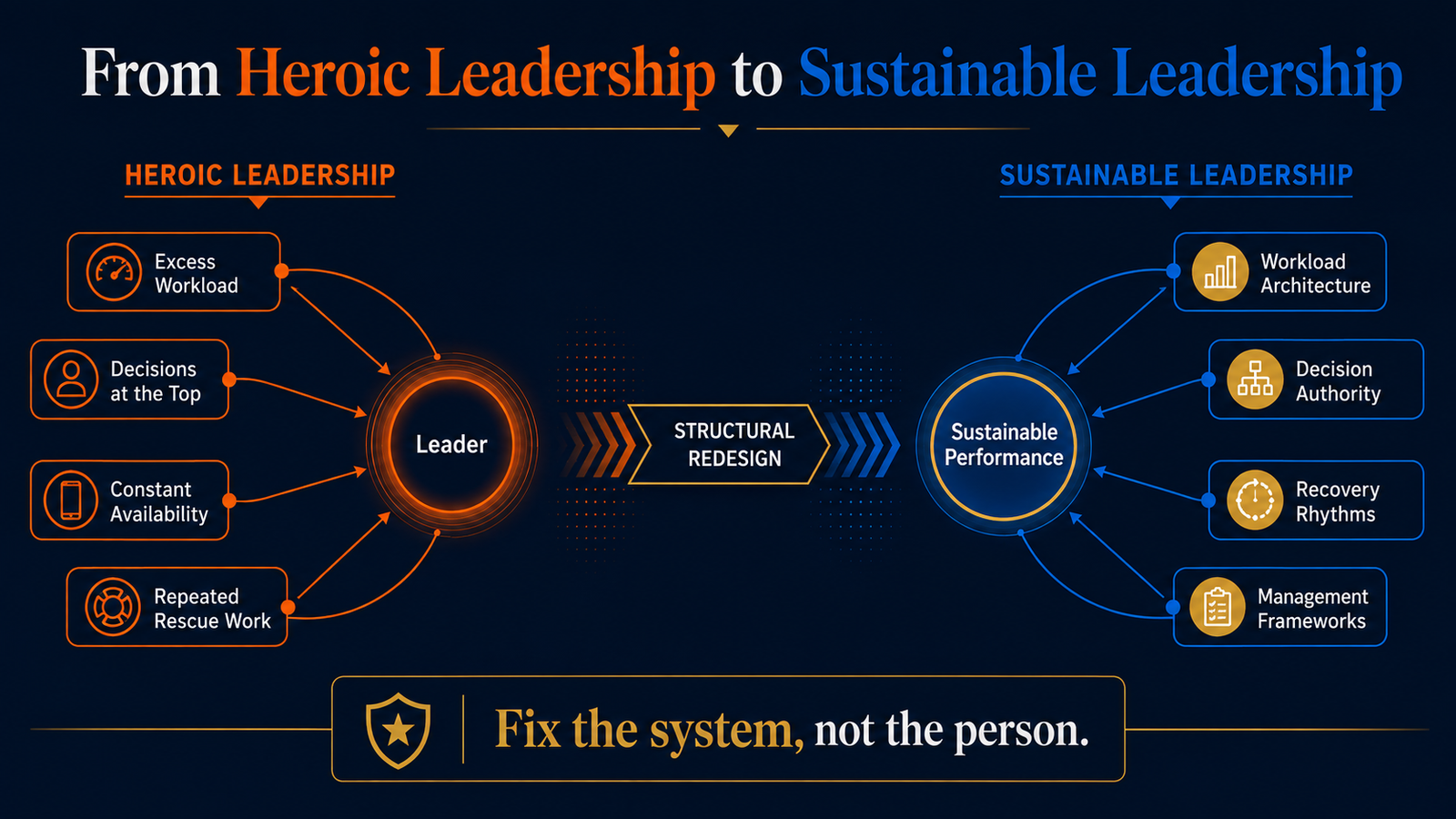
The distinction becomes clearest when we compare the operating assumptions behind the two models.
| Heroic Leadership | Sustainable Leadership |
|---|---|
| The leader absorbs excess workload | Workload is matched to capacity |
| Being needed proves leadership value | Building capability proves leadership value |
| Decisions accumulate at the top | Decision authority is distributed |
| Availability is treated as commitment | Boundaries protect leadership capacity |
| Problems are repeatedly rescued | Root causes are redesigned |
| Recovery happens after exhaustion | Recovery is built into operating rhythms |
| High standards mean maximum effort | Standards are proportional to impact and risk |
| Vacancies create additional personal workload | Resource gaps trigger reprioritisation |
| Strategic work happens after operational work | Strategic work receives protected capacity |
| Performance depends on individual effort | Performance depends on system strength |
Heroic leadership can be valuable in a genuine crisis. Sometimes a leader does need to work late, take control and carry additional responsibility.
The problem begins when crisis behaviour becomes normal operating behaviour. A temporary sprint becomes the permanent pace. The organisation then starts depending on extraordinary effort for ordinary performance.
That dependency can remain hidden for years because capable leaders are exceptionally good at compensating.
They work another evening.
They rescue another project.
They make another decision somebody else could have made.
They absorb another responsibility because explaining the capacity problem feels harder than simply getting the work done.
The organisation sees output. It does not necessarily see the cost of producing it.
That hidden cost is part of what I describe as the Culture Tax™: the cost organisations repeatedly pay when burnout, disengagement and turnover are treated as individual problems rather than signals of structural weakness.
The solution is not to remove ambition. It is to stop requiring depletion to achieve it.
What Does Sustainable Work Architecture Look Like in Practice?
Imagine a senior leader whose week is dominated by operational escalation.
Their calendar is heavily booked. Team members regularly request approval. Strategic projects move slowly because immediate issues take priority.
The conventional response might be better time management. Block the calendar. Turn off notifications. Create a more disciplined task list.
Those actions may help. But they do not necessarily change the underlying system.
A structural response starts somewhere else.
First, audit the work reaching the leader. Several recurring responsibilities are found to have migrated upwards during previous staffing shortages. They are reassigned.
Second, examine meetings. Two recurring meetings are removed. Another becomes fortnightly. Routine updates move to a short dashboard rather than requiring synchronous discussion.
Third, examine decisions. The team identifies routine decisions that managers can make within agreed parameters without executive approval.
Fourth, clarify escalation. Issues only move upwards when they cross defined thresholds involving risk, cost, people or strategic consequences.
Fifth, protect recovery and strategic capacity. The leader now has genuine periods where they are not expected to be immediately responsive to routine requests.
Notice what has happened. The leader has not simply become more productive. The work has been redesigned.
The team also benefits. People gain greater authority. Decision-making speeds up. Accountability becomes clearer. Meetings have a stronger purpose. Problems are handled closer to where they occur. The senior leader regains capacity for the work that actually requires senior leadership.
This is why organisational design shapes performance. The way work moves determines who becomes overloaded. The way decisions move determines where bottlenecks form. The way communication moves determines whose attention gets fragmented. The way accountability is designed determines whether leaders can delegate with confidence.
Burnout therefore contains information. It can tell you where the architecture is failing.
A Practical Sustainable Work Architecture Audit
You do not need a six-month transformation programme to begin.
Start with a structural audit. Take your current role and examine it through four lenses.
1. Workload Architecture™
List the recurring responsibilities currently sitting with you. For each one, ask:
- Does this genuinely require my role or authority?
- Could it be delegated, reduced, automated or stopped?
- When was this responsibility added?
- What was removed when it was added?
- What would actually happen if we stopped doing it?
Pay particular attention to responsibilities that arrived during temporary crises. Temporary work has a habit of becoming permanent work.
2. Decision Authority™
Track the decisions that reach you for one week. Then ask:
- Which decisions genuinely required my judgement?
- Which reached me because ownership was unclear?
- Which could have been made lower in the organisation?
- What decision parameters would allow somebody else to act safely?
- Where am I approving work rather than adding meaningful judgement?
Do not merely count decisions. Examine why they travelled to you.
3. Recovery Rhythms™
Look at the pattern of the working week. Ask:
- Where is uninterrupted cognitive capacity protected?
- How much margin exists for unexpected work?
- Does demanding work have recovery around it?
- Are evenings functioning as overflow capacity?
- Can I take leave without creating a significant backlog?
If recovery only exists when work stops completely, it is not yet designed into the system.
4. Management Frameworks
Finally, examine how the work is controlled. Ask:
- Are responsibilities clear?
- Are escalation rules understood?
- Are priorities genuinely ranked?
- Can the team distinguish urgent work from merely visible work?
- Do our systems reduce complexity or create more administration?
You are looking for recurring friction. Do not ask only: Where am I struggling? Ask: What feature of the system keeps producing this struggle?
That question moves the diagnosis from the person to the architecture.
From Diagnosis to Redesign
Once the problems are visible, resist the temptation to fix everything simultaneously. Structural change needs sequencing.
Choose one pressure point. Perhaps it is a meeting consuming five senior people for two hours every week. Perhaps it is an approval process routing routine decisions through you. Perhaps it is a report that takes half a day to produce and is barely used. Perhaps it is a responsibility you inherited two years ago during a vacancy and never handed back.
Remove or redesign one recurring source of load. Then measure what changes.
- Did capacity increase?
- Did decisions become faster?
- Did team ownership improve?
- Did strategic time become easier to protect?
- Did the work disappear, or did it simply move to somebody else?
That last question matters. Sustainable work architecture is not about transferring burnout down the hierarchy. If an overloaded executive delegates work to an already overloaded manager, the organisation has not solved a structural problem. It has relocated it.
The aim is to improve the architecture of work across the system. That may require stopping work. It may require challenging priorities. It may require additional resources. It may require redesigning roles. And it may require an upward conversation about the gap between expectations and capacity.
This is why structural leadership sometimes requires more courage than simply working harder. Working harder can avoid the conversation. Redesigning the work forces the organisation to confront reality.
The 30-60-90 Day Sustainable Work Architecture Reset
For leaders who want to move beyond diagnosis, the redesign can be structured across 90 days.
Days 1–30: Diagnose
Map the current system. Audit workload, meetings, decisions, communication demands and recurring interruptions. Identify the biggest sources of operational drag. Do not begin by adding new productivity tools — first understand where capacity is being consumed. The objective of the first 30 days is visibility.
Days 31–60: Redesign
Now change the architecture. Remove low-value work. Reduce unnecessary meetings. Clarify decision rights. Delegate ownership rather than isolated tasks. Introduce escalation thresholds. Protect strategic capacity. Establish clearer communication expectations. The objective of the second 30 days is structural change.
Days 61–90: Stabilise
The final stage is where many changes fail. Old habits return, meetings creep back, decisions move upwards again. So the final 30 days should focus on making the redesigned system repeatable — review what is working, track where work is creeping back, reinforce decision authority, address new bottlenecks and protect recovery rhythms. The objective is sustainability.
At 90 days, ask a simple question: Does this system require less heroic effort to produce the same or better results?
If the answer is yes, the architecture is improving. If the answer is no, continue diagnosing.
Because sustainable work architecture is not ultimately about getting more from people. It is about designing work so that strong performance does not require people to continually give more than the system can reasonably sustain.
What is sustainable work architecture?
Sustainable work architecture is the deliberate design of workload, decision authority, time, recovery and management systems around realistic human capacity. Instead of relying on leaders to compensate for structural problems through longer hours or greater personal effort, it redesigns how work moves through the organisation so strong performance can be sustained.
How does sustainable work architecture prevent leadership burnout?
It addresses the conditions that repeatedly create overload. That means reducing unnecessary work, clarifying decision authority, improving delegation, protecting cognitive capacity and building recovery into normal working rhythms. Burnout prevention therefore becomes an organisational design issue rather than simply asking individual leaders to become more resilient.
What is the difference between workload management and time management?
Time management focuses on how you organise the hours available to you. Workload management examines whether the amount and type of work assigned to those hours are realistic. You can manage your calendar extremely well and still burn out if the workload itself exceeds sustainable capacity.
How can leaders tell if their workload is unsustainable?
Look beyond working hours. Warning signs include strategic work repeatedly moving into evenings, decisions accumulating at the top, constant operational escalation, an inability to take leave without creating a backlog, disappearing recovery time and a calendar with no margin for unexpected demands. These are signs that the architecture of the role needs examination.
Does sustainable leadership mean lowering performance expectations?
No. Sustainable leadership is about making strong performance repeatable. It challenges the assumption that maximum effort should be the normal operating state. The objective is to remove avoidable friction, clarify ownership and protect capacity so leaders and teams can maintain performance without depending on chronic overwork.
How much spare capacity should a leader have?
There is no single percentage that applies to every role. The principle is more useful than an arbitrary number: a leadership system needs enough margin to absorb normal variation, unexpected problems and strategic thinking without immediately pushing work into personal time. A calendar permanently operating at 100% leaves no resilience when reality changes.
What should a leader redesign first?
Start with the recurring source of overload creating the greatest structural drag. That may be unnecessary meetings, excessive approvals, scope creep, fragmented communication or work that should be delegated or stopped. Fixing one recurring source of load can produce more lasting capacity than trying to optimise dozens of individual tasks.
Sustainable Work Architecture Changes the Leadership Equation
Sustainable work architecture changes the question leaders ask about performance.
Instead of asking: How much more can I personally carry?
Ask: How should the work be designed so that carrying more is not the default solution?
That shift matters.
Burnout often develops inside systems that reward compensation. Capable leaders absorb vacancies. They rescue failing processes. They accept another priority. They remain available because other people depend on them.
The organisation keeps functioning. So the structural weakness remains hidden.
Eventually, the leader’s capacity becomes the organisation’s unofficial contingency plan.
That is not sustainable leadership.
The alternative is to redesign workload around real capacity, distribute appropriate decision authority, build recovery into operating rhythms and use management frameworks that make ownership and escalation clear.
This does not remove pressure from leadership. It makes pressure manageable.
And it replaces a dangerous organisational assumption: that whenever the system demands more, the leader will somehow find more to give.
If your leadership role currently depends on longer hours, constant availability or repeated rescue work, do not begin by asking how you can become more efficient.
Diagnose the architecture. Then redesign it.
Diagnose the System Before You Push Harder
If your workload feels permanently full, your calendar has no margin or too many decisions depend on you, start by identifying where the structural pressure is coming from.
Free Leadership Intelligence
Get Weekly Leadership Insights
Join thousands of leaders receiving practical strategies on burnout prevention, workload design, and sustainable performance every week.