Quick Answer
Key Takeaways
- Most consequential ethical decisions do not arrive labelled as ethics — they appear as workload, budget, recruitment or restructuring decisions.
- Ethics Intelligence™ treats ethical judgement as a developable leadership capability, not simply a personal trait.
- Compliance is the floor of leadership responsibility, not the ceiling — ethical leadership begins where policy stops providing obvious answers.
- Ethical judgement deteriorates under pressure through “ethical fading,” where operational language quietly replaces ethical questions.
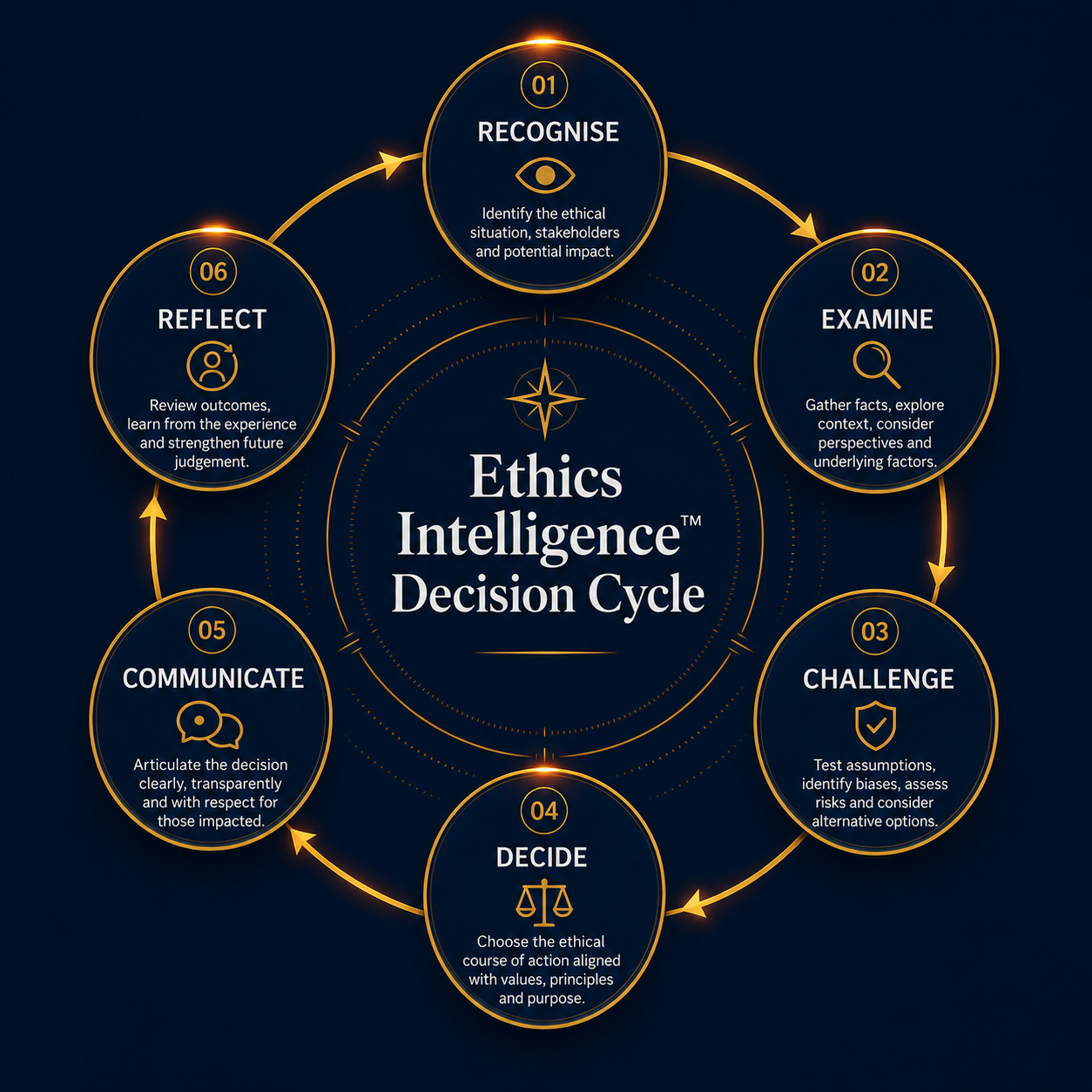
- Ethics Intelligence™ works best as a repeatable decision cycle — Recognise, Examine, Challenge, Decide, Communicate, Reflect — not as instinct alone.
Ethics Intelligence™: Ethical Leadership as a Performance Capability
Ethics is often treated as a constraint on leadership: a collection of rules, policies and boundaries defining what leaders must not do.
That interpretation is too narrow.
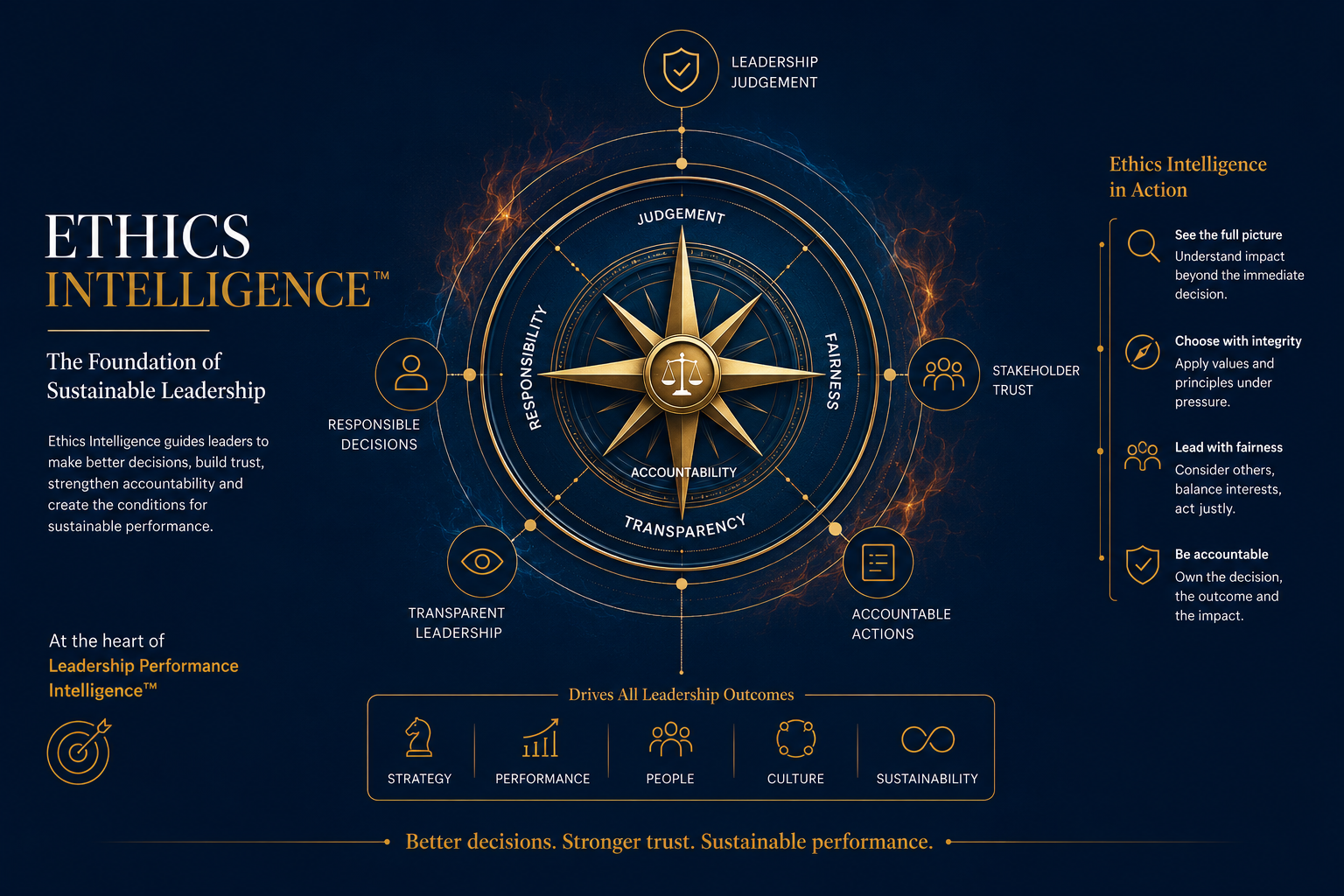
For Burn Bright Advisory™, ethical leadership should be understood as a component of Leadership Performance Intelligence™: the capacity to interpret complex situations, evaluate competing responsibilities, anticipate consequences and make decisions that leaders can explain and stand behind.
This distinction matters because many consequential leadership decisions do not arrive with an obvious ethical label. They appear as decisions about workload, recruitment, performance, budgets, restructuring, artificial intelligence, confidentiality, targets, resource allocation, promotion, risk or organisational change.
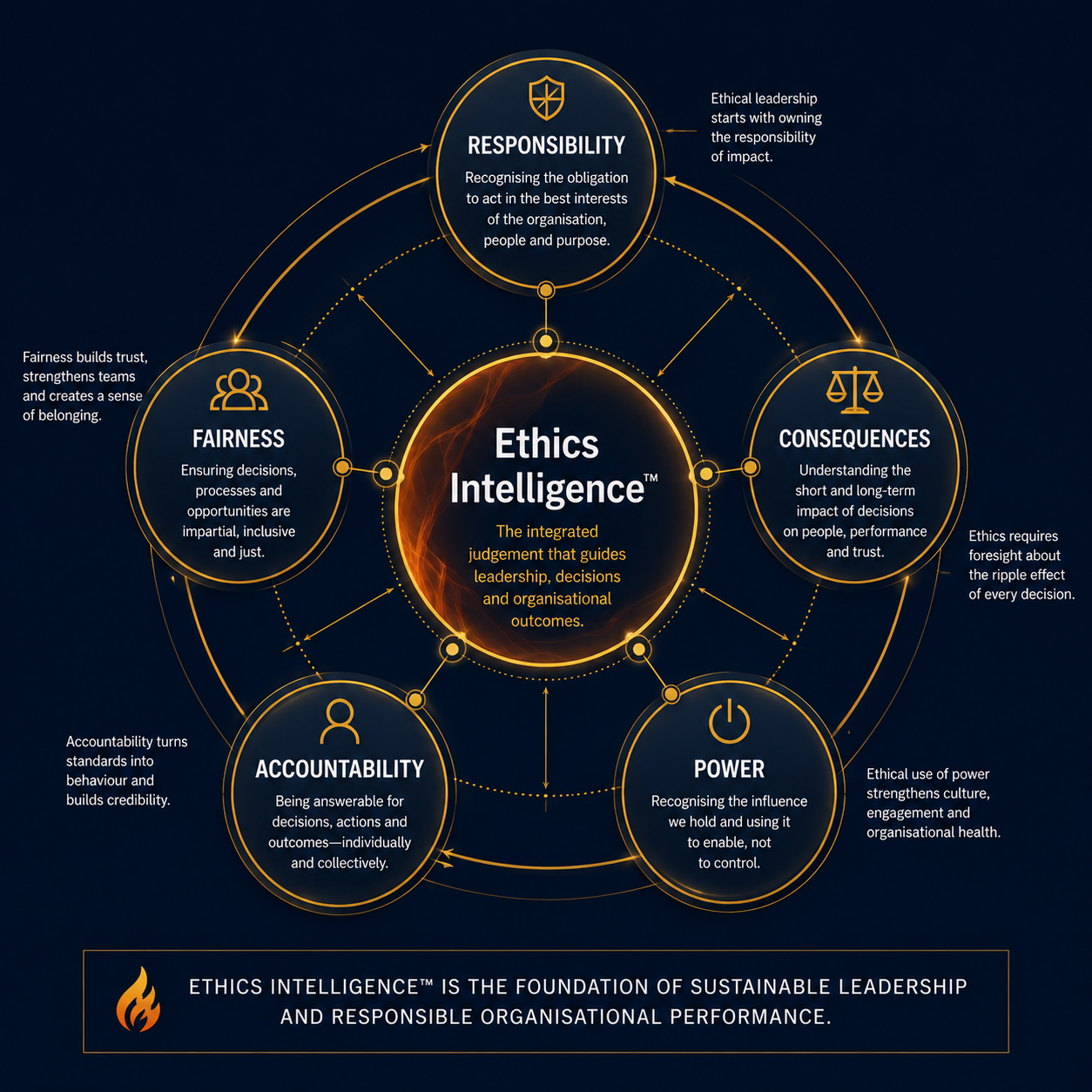
Yet beneath these apparently operational questions are questions of fairness, responsibility, transparency, power and consequence.
A leader can therefore comply with policy and still exercise poor ethical judgement. Equally, a leader can have good intentions and still create harmful consequences.
Ethics Intelligence™ addresses the space between intention, regulation and impact. It asks leaders to consider not simply:
Can we do this?
but:
Should we do this, who will be affected, what responsibilities do we carry, and can we justify the decision when its consequences become visible?
That makes ethical judgement a performance capability. Leaders who develop it are better positioned to protect trust, recognise ethical risk earlier, navigate competing interests and build organisations in which accountability is embedded in everyday decision-making rather than activated only after something goes wrong.
The Leadership Decisions That Matter Most Rarely Look Like Ethics Decisions
Imagine a senior leadership meeting. Performance is behind target. Costs are increasing. The organisation needs to improve results before the end of the quarter.
Three options are presented. The first protects staffing but reduces the financial target. The second protects the target but increases workloads significantly. The third removes several roles and redistributes their responsibilities among the remaining team.
On a spreadsheet, this appears to be an operational decision.
It is also an ethical one.
Who absorbs the consequences?
What level of workload is reasonable?
How honestly should employees be told about the organisation’s position?
Are the risks being distributed fairly?
Are leaders protecting short-term numbers by transferring hidden costs to employees?
What happens if the organisation technically achieves its target while damaging the capacity of the people required to deliver the next one?
These questions demonstrate why ethical leadership cannot be separated from leadership performance. Every significant leadership decision creates consequences. And every decision that distributes opportunity, pressure, resources, recognition, risk or authority contains an ethical dimension.
The difficulty is that leaders rarely make these decisions under ideal conditions. They operate with incomplete information, competing stakeholders, limited resources and time pressure.
The ethical challenge is therefore not simply knowing the difference between right and wrong. The harder challenge is exercising judgement when several legitimate responsibilities collide.
That is where Ethics Intelligence™ becomes important.
Featured Snippet
What Is Ethics Intelligence™?
It combines several capabilities:
- Awareness of consequences
- Clarity of values and responsibilities
- Recognition of power and stakeholder interests
- Consideration of fairness
- Willingness to challenge convenient assumptions
- Transparency about reasoning
- Accountability for outcomes
- Reflection after decisions have been made
Ethics Intelligence™ therefore goes beyond possessing personal values. Most leaders believe they have values. The more useful question is whether those values remain operational when circumstances make them inconvenient.
Consider a leader deciding whether to challenge an unrealistic deadline imposed by senior management. Agreeing may protect the leader’s reputation upward. Challenging it may protect the team downward. Neither option is completely risk-free.
Ethics Intelligence™ requires the leader to recognise that the decision is not merely about scheduling. It concerns responsibility, honesty, power, workload and sustainable performance.
This is why Ethics Intelligence™ connects naturally with other domains of the Leadership Intelligence Compass™. Professionalism Intelligence™ concerns the standards through which leadership responsibility is enacted. Reflective Practice Intelligence™ enables leaders to examine assumptions, decisions and consequences rather than simply defending them. Emotional Intelligence™ helps leaders understand the human impact of decisions. Leadership Sustainability™ asks whether performance expectations can be maintained without systematically exhausting leadership and organisational capacity.
Ethics Intelligence™ provides another question: Is the way we are achieving performance consistent with the responsibilities leadership carries?
Together, these capabilities contribute to Leadership Performance Intelligence™. Performance is not merely whether the organisation produced an outcome. Leadership performance also concerns how the outcome was produced, what it cost, what capability remains afterwards and whether the process strengthened or weakened the system responsible for future performance.
Ethical Leadership Is Not the Same as Compliance
One of the most important distinctions leaders can make is between compliance and ethics.
Compliance asks: What are we required to do?
Ethics asks: What is the responsible thing to do?
Sometimes those answers coincide. Sometimes they do not.
Policies, professional standards and legislation establish essential boundaries. They provide consistency and protection and should never be dismissed as unimportant. But rules cannot anticipate every situation leaders will encounter.
A restructuring decision may comply fully with employment requirements while still being communicated unnecessarily poorly. A workload allocation may satisfy contractual requirements while creating an inequitable burden. An AI system may meet organisational policy while introducing bias that nobody has adequately examined. A recruitment process may follow every formal procedure while informal influence still favours particular candidates. A healthcare leader may satisfy staffing requirements while knowing that sustained pressure is weakening the team’s capacity. A school leader may implement a mandated accountability process while inadvertently creating behaviours that encourage staff to protect metrics rather than improve learning.
The question is therefore not whether compliance matters. It does. The question is whether compliance represents the ceiling or the floor of leadership responsibility.
The Ethics–Performance False Choice
Leaders are sometimes encouraged to think of ethics and performance as competing priorities. The underlying assumption sounds something like this: “We would like to do the ideal thing, but we have a business to run.”
That framing is dangerous because it implies that ethical leadership belongs to the category of desirable extras — important when circumstances permit, but expendable when pressure increases.
A more sophisticated leadership model recognises that ethics and performance are deeply connected. Trust affects whether people speak openly. Psychological safety affects whether risks are raised. Fairness affects whether people remain committed. Transparency affects whether difficult decisions retain legitimacy. Accountability affects whether problems are corrected. Leadership behaviour affects whether employees believe organisational values are real or merely decorative.
The connection becomes especially visible when leadership becomes dysfunctional. Burn Bright’s work on toxic leadership in small teams illustrates how leadership behaviour can affect morale, communication, collaboration, trust and people’s willingness to speak openly. In small teams, where relationships are close and leadership influence is difficult to avoid, these effects can become particularly concentrated.
Ethics is therefore not external to performance. Ethics shapes the conditions under which sustainable performance becomes possible.
This does not mean ethical leadership guarantees comfortable outcomes. An ethical leader may still have to close a programme, reduce expenditure, remove someone from a role, reject a proposal, challenge poor performance, make redundancies, or choose between two imperfect alternatives.
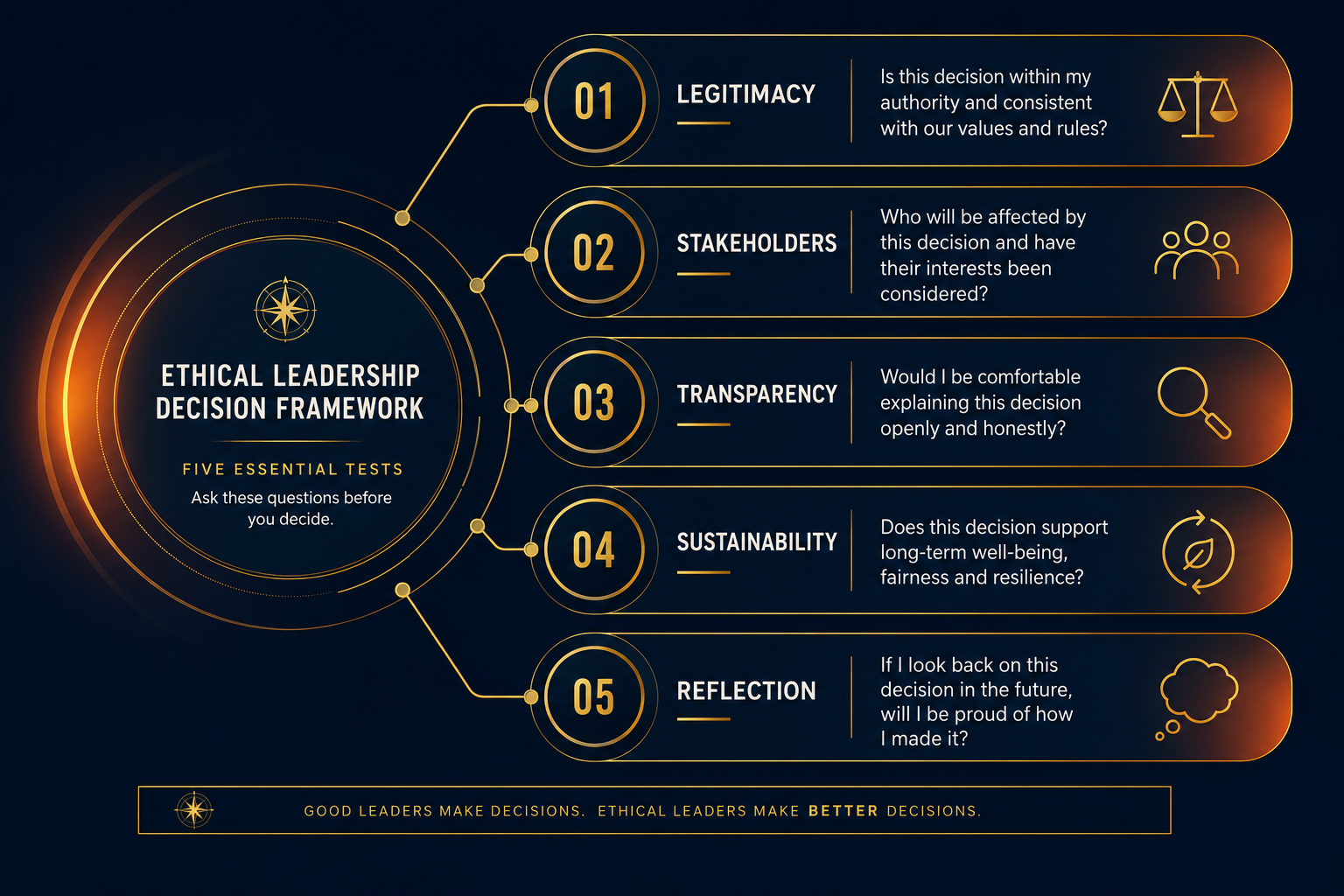
The Five Tests of Ethics Intelligence™
A practical way to strengthen ethical judgement is to move important decisions through five tests.
Test 1 The Legitimacy Test
Can this decision be justified beyond personal preference or positional authority? Leadership authority provides the ability to make decisions. It does not automatically make those decisions legitimate. The Ethics Intelligent™ leader should be able to explain the reasoning behind a significant decision in terms that extend beyond “because I am responsible” or “because senior management wants it.” Legitimacy requires a defensible rationale.
Test 2 The Stakeholder Test
Who receives the benefit, and who carries the cost? Leadership decisions distribute consequences. Sometimes the people benefiting from a decision are not the people absorbing its risks. That does not automatically make the decision unethical, but the imbalance should be visible.
Test 3 The Transparency Test
Would we be comfortable explaining how and why this decision was made? Secrecy is sometimes legitimate and confidentiality matters, but there is a difference between appropriate confidentiality and avoiding scrutiny.
Test 4 The Sustainability Test
What happens if we repeat this decision? An action can appear reasonable once while becoming damaging when it becomes normal practice. Ethics Intelligence™ therefore examines patterns, not merely incidents.
Test 5 The Reflection Test
If the outcome goes badly, will we still believe the decision-making process was responsible? A responsible decision can produce a disappointing result. An irresponsible decision can occasionally produce a successful one. Ethical leadership should not confuse luck with good judgement.
These five tests move ethics from abstract aspiration into everyday leadership practice. They also reveal something fundamental about Leadership Performance Intelligence™: the strongest leaders do not evaluate decisions solely by asking whether they worked. They ask whether the thinking, behaviour and system that produced the result are worthy of being repeated.
That is a much higher standard of leadership performance.
Why Ethical Judgement Deteriorates Under Pressure
Ethical failures in leadership rarely begin with a leader consciously deciding to become unethical. More often, they begin with pressure.
A target has to be reached. A difficult employee situation needs resolving. A project is behind schedule. A senior stakeholder expects an answer. Resources are insufficient. A team is exhausted. A mistake has been made and reputations are at risk.
Under these conditions, the ethical dimensions of leadership decisions can gradually disappear behind the language of urgency, performance and necessity.
This matters because leaders do not exercise Ethics Intelligence™ in ideal circumstances. They need it precisely when circumstances are difficult.
Burn Bright’s work on leadership sustainability identifies a fundamental problem in contemporary management: leaders increasingly operate amid competing demands, expanding responsibilities and workloads that can exceed sustainable human capacity. When leadership becomes dominated by constant urgency, decision quality, reflection and strategic thinking can deteriorate.
The ethical implication is significant. Pressure does not merely threaten wellbeing. It can change how leaders see problems.
Ethical Fading: When the Ethical Question Disappears
One of the most dangerous leadership situations occurs when an ethical issue is no longer recognised as ethical.
A leader does not think: Should I conceal this information? They think: We need to control the message.
They do not think: Am I placing an unreasonable burden on this team? They think: Everyone needs to step up.
They do not think: Are we treating these candidates fairly? They think: We need somebody who fits.
They do not think: Are people afraid to challenge me? They think: My team needs to become more resilient.
The language changes the frame. Once a question becomes exclusively operational, financial or political, its ethical dimension can become less visible.
This is why Ethics Intelligence™ begins with recognition. Before leaders can make better ethical decisions, they must learn to notice when ethical judgement is required.
That question creates cognitive space. It interrupts automatic reasoning. And it encourages leaders to examine consequences that performance metrics alone may not reveal.
Pressure Changes What Leaders Notice
Leadership pressure creates narrowing. When people face multiple demands simultaneously, attention naturally moves towards whatever appears most urgent. That is understandable. It can also become dangerous.
Imagine a hospital department facing persistent staffing shortages. The immediate leadership problem is coverage. Who can work? Which shifts remain unfilled? How can patient services continue? The operational urgency is obvious.
But repeated decisions to solve today’s shortage by asking the same reliable employees to absorb additional work create another set of questions. Who repeatedly carries the additional burden? What happens to fatigue? Are employees genuinely consenting to additional responsibilities, or do power relationships make refusal difficult? At what point does an emergency response become the normal operating model?
The same pattern can appear in a school. A leadership team facing performance pressure may introduce additional monitoring, reporting and intervention. Each initiative may be individually defensible. Collectively, however, they may significantly increase teacher workload. If leaders measure only whether the initiatives were implemented, they can miss the cumulative effect on professional capacity.
And the pattern appears in business. A company facing an aggressive growth target may encourage employees to demonstrate commitment by responding rapidly outside working hours. Nobody formally announces “You must always be available.” Yet leaders repeatedly praise those who are. An informal ethical system emerges.
Ethics Intelligence™ examines the difference between declared values and experienced reality.
The Ethics of Power
Leadership ethics cannot be understood without understanding power. Leaders possess forms of power that other people may not. They influence workload, access to information, opportunities, performance evaluations, promotion, recognition, resources, inclusion in decisions, professional reputation and, in some circumstances, continued employment.
This changes the meaning of leadership interactions. A request from a colleague and the same request from a manager are not necessarily equivalent.
When a senior leader says “It would be helpful if someone could work this weekend,” employees may interpret the statement as considerably more than a suggestion. When a principal asks “Would anyone like to volunteer for this initiative?”, teachers may calculate how refusing will be perceived. When a senior clinician dismisses a junior colleague’s concern, hierarchy may make further challenge difficult even if the concern remains.
Ethical leaders therefore cannot judge their behaviour solely according to what they intended. They must consider how power changes the experience of their behaviour.
This principle is especially important in small teams. Burn Bright’s work on toxic leadership highlights the amplification effect created when employees work closely with a leader and have limited alternative structures around them. In these environments, leadership behaviour can quickly influence communication, confidence, psychological safety and the willingness of team members to challenge decisions.
The ethical responsibility attached to leadership authority therefore increases with the leader’s ability to affect other people’s working lives. Power itself is not unethical. Leadership requires authority. The question is how intelligently that authority is exercised.
A Leadership Power Audit
Leaders can strengthen Ethics Intelligence™ by periodically asking:
- Where does my role give me disproportionate influence over others?
- Where might people agree with me because of my position rather than because they genuinely agree?
- Which decisions can people safely challenge?
- Who can tell me that I am wrong without fearing consequences?
- Whose perspective is least represented when important decisions are made?
These questions are not designed to weaken leadership authority. They make authority more intelligent.
The Problem of Competing Loyalties
Some of the most difficult ethical leadership decisions arise because leaders have responsibilities to multiple groups simultaneously.
A business leader may have responsibilities to employees, customers, investors, regulators, suppliers, communities and the organisation itself. A school leader may be accountable to students, teachers, families, governors, regulators, the wider community and future cohorts of learners. A healthcare leader must consider patients, clinical teams, organisational resources, professional standards, regulators, families and wider service demand. Public service leaders face similarly complex networks of accountability.
Ethical leadership cannot therefore be reduced to simply “putting people first.”
Which people?
Under what circumstances?
At whose cost?
For how long?
Leadership involves competing legitimate claims. Ethics Intelligence™ is the capacity to make those competing responsibilities visible rather than pretending they do not exist.
Consider a business experiencing severe financial pressure. Protecting every role may place the entire organisation at risk. Reducing staffing may protect organisational viability while causing genuine hardship to affected employees. There may be no option without human consequences.
Ethical leadership in such a situation does not mean discovering a magical decision in which nobody loses. It means examining the alternatives carefully, distributing consequences as responsibly as possible, communicating truthfully and refusing to disguise difficult trade-offs behind convenient language.
When Good Intentions Are Not Enough
Leadership ethics is frequently discussed through the language of intention: “I was trying to help.” “I wanted the best outcome.” “I was protecting the organisation.” “I didn’t mean it that way.”
Intentions matter. But they are insufficient.
Burn Bright’s work on toxic leadership illustrates why this distinction is essential. Leadership patterns capable of damaging a team can emerge even among leaders who believe they are protecting standards or improving performance. The source material describes, for example, a nurse leader whose concern for clinical quality coexisted with leadership behaviours experienced by staff as micromanaging and intimidating.
The ethical question therefore cannot stop at: What did I intend? It must extend to: What happened because of what I did?
This produces an important Ethics Intelligence™ equation:
Intention examines what the leader hoped to achieve. Behaviour examines what the leader actually did. Impact examines what others experienced and what consequences followed. Reflection examines what should be learned and changed.
Without reflection, leaders can become trapped in defensive reasoning. They evaluate themselves according to intention while everybody else experiences the impact. The gap can become substantial.
Cross-Sector Application: The Same Ethical Problem in Different Forms
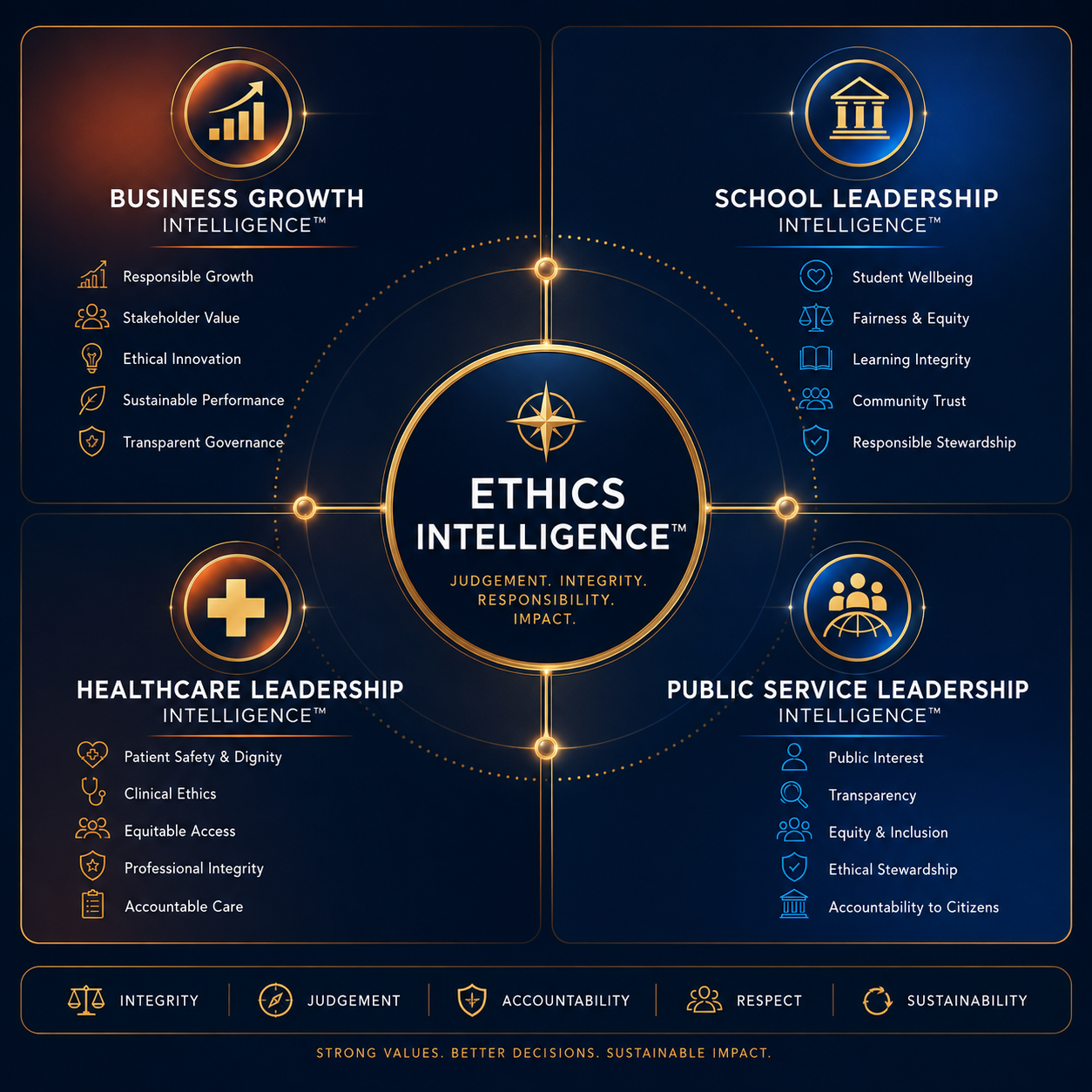
Ethics Intelligence™ becomes particularly useful when we recognise that similar leadership problems appear across very different sectors.
Business Growth Intelligence™ — The High Performer
A sales director has a top-performing manager who consistently exceeds targets but also has unusually high staff turnover. The ethical question is not simply whether the manager is delivering — it is what the full cost of that performance is. Revenue without leadership sustainability can represent borrowed performance: results achieved today by consuming capacity that will be needed tomorrow.
School Leadership Intelligence™ — The Improvement Initiative
A school introduces new lesson monitoring, assessment reporting and intervention meetings. Individually reasonable, but teachers report the cumulative workload is reducing planning time and increasing exhaustion. The question is whether the chosen improvement architecture creates more value than the capacity it consumes.
Healthcare Leadership Intelligence™ — Speaking Up
A junior clinician identifies a possible problem in an established procedure and a senior leader wants the team to continue. The ethical issue is whether hierarchy suppresses challenge, and whether the concern was evaluated on its evidence or dismissed because of the status of the person raising it.
Public Service Leadership Intelligence™ — The Unpopular Decision
A public service leader must allocate limited resources across competing community priorities, where every option benefits some groups more than others. Legitimacy depends on transparency about the criteria used and whether the process can withstand public scrutiny.
Psychological Safety Is an Ethical Issue
Psychological safety is frequently discussed as a team-performance concept. It is also an ethical leadership issue.
If employees cannot raise concerns, question assumptions or report mistakes without fear, leaders lose access to information they need to exercise responsible judgement.
Burn Bright’s leadership material repeatedly highlights the importance of environments in which people can question, learn and contribute without being undermined. The Unguarded Leader, for example, frames psychological safety as central to creating teams capable of curiosity, learning and honest contribution.
This creates a critical connection between Ethics Intelligence™ and Constructivism Intelligence™. Ethical leaders recognise that their own interpretation of a situation may be incomplete. Constructivist leadership recognises that knowledge can emerge through dialogue, competing perspectives and shared meaning-making.
That means disagreement is not necessarily resistance. Questions are not necessarily disloyalty. Alternative interpretations are not necessarily threats to authority. Sometimes they are the information that prevents an avoidable ethical failure.
From Ethical Heroism to Ethical Systems
Organisations often talk about ethics as though ethical performance depends primarily on finding good people. Character matters. But character alone is not enough.
Even conscientious leaders operate inside systems that shape behaviour. Targets shape attention. Incentives influence choices. Workloads affect judgement. Reporting structures affect whether people speak. Culture affects what gets normalised. Reward systems reveal what the organisation actually values.
This means organisations should not depend on ethical heroism. They should create ethical infrastructure, including clear decision rights, transparent escalation routes, meaningful challenge processes, workload monitoring, leadership reflection, independent oversight where appropriate, explicit accountability, psychological safety, and structured review of significant decisions.
This is where Burn Bright’s Leadership Development System™ becomes particularly important. Ethical capability should not be treated as a one-off workshop. It should be assessed, developed, practised, reflected upon and benchmarked.
The Leadership Intelligence Assessment™ can help leaders examine capability across interconnected domains. The Leadership Intelligence Library™ can deepen understanding. Diagnostics can expose risk. Planning tools can convert insight into action. Workshops can create shared leadership language. And Leadership Benchmarking™ can help organisations examine whether desired leadership standards are becoming observable practice.
Ethics Intelligence™ as Organisational Early Warning
One of the greatest benefits of mature Ethics Intelligence™ is that it helps leaders identify problems before they become crises.
A culture rarely becomes toxic overnight. Trust rarely disappears after one ordinary disagreement. Unsustainable workload rarely begins with an announcement that exhaustion is now expected. Ethical deterioration is often incremental.
An exception becomes a precedent. A workaround becomes routine. A difficult conversation gets postponed. A questionable behaviour produces good results and is tolerated. Employees stop challenging. Leaders receive increasingly filtered information. Eventually the organisation reaches a point where behaviour that once would have appeared unacceptable has become normal.
This is why ethical reflection must happen before crisis. Leaders need to notice weak signals:
These signals belong within Leadership Performance Intelligence™ because they reveal information about the future performance capacity of the organisation. They are not peripheral cultural issues. They are leadership intelligence.
The Central Question
Ethical leadership ultimately requires leaders to move beyond the narrowest definition of success.
A decision can produce the required number and still weaken the organisation. A leader can achieve a target while destroying trust. A restructuring can reduce cost while removing critical knowledge. A school can improve a metric while exhausting its teachers. A healthcare service can maintain coverage while normalising unsafe pressure. A senior team can appear aligned because nobody feels safe enough to disagree.
The question for Ethics Intelligence™ is therefore not simply: Did we achieve the outcome? It is: What did achieving the outcome require from the system, and would we deliberately choose to lead this way again?
That question changes leadership. It shifts attention from isolated results to the quality of the system producing them.
Turning Ethics Intelligence™ Into Leadership Practice
Recognising an ethical issue is only the beginning. The real test of Ethics Intelligence™ is whether leaders can translate awareness into repeatable behaviour when decisions are difficult, information is incomplete and competing demands are legitimate.
This is where ethical leadership must move beyond values statements. Organisations rarely suffer from a shortage of declared values. Words such as integrity, respect, accountability, fairness and trust appear in strategies, websites, professional standards and leadership frameworks across sectors.
The harder question is: What happens to those values when applying them carries a cost?
A commitment to transparency becomes meaningful when the information is uncomfortable.
A commitment to psychological safety becomes meaningful when somebody challenges a senior leader.
A commitment to wellbeing becomes meaningful when protecting capacity means changing a target or deadline.
A commitment to fairness becomes meaningful when an influential person expects preferential treatment.
A commitment to accountability becomes meaningful when the mistake belongs to leadership.
Ethics Intelligence™ therefore needs to become an operating discipline: a way of thinking that leaders can apply before, during and after consequential decisions.
The Burn Bright Ethics Intelligence™ Decision Cycle
A practical ethical leadership system can be organised around six connected stages: Recognise → Examine → Challenge → Decide → Communicate → Reflect.
The value of the cycle is not that it removes uncertainty. It creates a disciplined process for navigating uncertainty responsibly.
1. Recognise: Identify the Ethical Dimension
Ask what makes this more than an operational decision — where it affects fairness, wellbeing, opportunity, workload, dignity, confidentiality, safety, resources, professional responsibility, trust or the distribution of risk. This step prevents ethical fading.
2. Examine: Map Consequences and Responsibilities
Ask who benefits, who carries risk, who has influence and who has little influence but may experience significant consequences. The purpose is to prevent less powerful stakeholders from disappearing from the decision simply because they are less able to influence it.
3. Challenge: Test the Preferred Answer
Once leaders begin to favour an option, they naturally become more capable of finding reasons why it is correct. Deliberately ask someone to argue against the preferred option, question assumptions and identify whose voice is missing.
4. Decide: Make the Trade-Off Explicit
Ethical leadership does not remove trade-offs — it makes them visible. Acknowledge the cost, retain responsibility for managing it, and set a review point.
5. Communicate: Explain the Reasoning
Explain what was decided, why, what alternatives were considered, what trade-offs were accepted, what safeguards will operate and when the decision will be reviewed — without requiring disclosure of every confidential detail.
6. Reflect: Examine What Actually Happened
Ask whether the decision produced the intended result, what unintended consequences appeared, and what this reveals about the leadership system. Reflection closes one decision cycle and improves the next.
Ethics Intelligence™ and Leadership Capacity™
Ethical decision-making requires capacity. This connection is easily underestimated.
A leader who moves continuously from meeting to meeting, responds to hundreds of messages, manages repeated crises and carries an excessive workload may still possess strong personal values. But the conditions for reflective judgement are deteriorating.
Burn Bright’s leadership sustainability material challenges the assumption that leadership problems can always be solved through greater individual efficiency. It argues that excessive workload is frequently systemic rather than simply a time-management problem.
That has ethical significance. When leadership systems consume nearly all available cognitive and emotional capacity, organisations should not be surprised when judgement becomes more reactive.
This is why Leadership Capacity™, Leadership Workload™, Leadership Reflection™ and Leadership Sustainability™ should be understood as connected to Ethics Intelligence™. Reflection requires space. Challenge requires time. Listening requires attention. Complex stakeholder analysis requires cognitive capacity. Courageous conversations require emotional resources.
Leadership Reflection™: The Missing Discipline
Many organisations review performance. Far fewer systematically review leadership judgement.
A quarterly review may examine revenue, delivery, quality, attendance, customer satisfaction or operational targets. But how often does the leadership team ask which decisions tested our values this quarter, where commercial or operational pressure influenced judgement, which stakeholder voices were underrepresented, or where behaviour was tolerated because the person delivered strong results?
These are Leadership Reflection™ questions. They transform ethics from a policy topic into a leadership-learning discipline.
Reflection also helps prevent a common problem: judging decision quality entirely by outcome. Imagine two leaders making similar high-risk decisions. The first investigates carefully, seeks challenge, considers stakeholders, creates safeguards and documents the reasoning, but an unpredictable external event causes the initiative to fail. The second ignores warnings, bypasses challenge and takes an unjustified risk — and by chance, the initiative succeeds.
If the organisation judges leadership solely through outcome, it may reward the poorer decision process. Over time, that creates dangerous organisational learning.
Leadership Benchmarking™ should therefore examine the quality of leadership processes as well as the results those processes produce.
Ethical Leadership Requires the Courage to Be Challenged
One of the clearest tests of leadership ethics occurs when somebody disagrees with the leader. This is particularly significant because leadership authority changes the risk of disagreement. The more senior the leader, the easier it can become to misinterpret silence as agreement.
Burn Bright’s The Unguarded Leader develops a related argument: leadership becomes more adaptive when leaders stop treating uncertainty, curiosity and challenge as threats to authority. Its framing of psychological safety and curiosity provides an important foundation for ethical leadership because leaders need access to information that may contradict their preferred interpretation.
An Ethics Intelligent™ leader therefore asks: How easy is it to disagree with me? Not theoretically. Practically.
What happened the last time someone challenged a decision? Was the person heard? Did the leader become defensive? Was the issue investigated? Did the individual experience consequences afterwards? What did everyone else in the room learn from that interaction?
Every leadership response teaches the organisation something. If challenge is welcomed in policy but punished socially, employees learn quickly which rule matters.
Accountability Without Blame
Ethical leadership also requires a more sophisticated understanding of accountability.
Weak accountability has two common forms. The first is avoidance: nobody is really responsible. The second is blame: find the person responsible and punish them. Neither necessarily produces learning.
Ethics Intelligence™ asks a better sequence of questions: What happened? What decision contributed to it? Who held responsibility? What system conditions influenced the decision? Was the behaviour reasonable given the information available at the time? What needs correcting? What needs learning? What must change to reduce recurrence?
Individual accountability and systems thinking are not opposites. A leader can be responsible for a poor decision while the organisation simultaneously recognises that incentives, workload, culture or governance increased the probability of that decision.
The purpose is not to remove personal responsibility. It is to understand enough of the system to prevent repetition.
This distinction is particularly important when addressing toxic leadership. Burn Bright’s work on toxic leadership in small teams emphasises that harmful leadership patterns can become embedded through repeated behaviours, weak accountability and environments in which people struggle to challenge authority.
Ethical systems therefore need both behavioural accountability and organisational learning.
A Practical Ethics Intelligence™ Meeting Protocol
Organisations do not need to turn every decision into a philosophical seminar. They do need a mechanism for slowing down the decisions that carry substantial ethical consequences.
For significant decisions, a leadership team can use a short Ethics Intelligence™ protocol, working through: Decision, Purpose, Stakeholders, Evidence, Alternatives, Challenge, Values, Power, Sustainability, Transparency, Safeguards and Review.
For many decisions, this discussion can happen quickly. For high-impact decisions, it should not. The objective is proportionality — the greater the potential consequence, power imbalance or irreversibility, the greater the need for structured ethical reflection.
From Individual Capability to Leadership Development System™
If Ethics Intelligence™ matters to leadership performance, it should be developed with the same seriousness organisations apply to strategy, finance, operations or technical capability.
The Leadership Intelligence Compass™ provides a multidimensional view of leadership capability. The Leadership Intelligence Assessment™ can help identify areas requiring deeper examination. The Leadership Intelligence Library™ provides knowledge and evidence-informed development. Diagnostics help leaders move from general impressions to specific questions. Planning tools translate insight into deliberate action. Workshops create shared language and collective practice. Certification pathways support deeper capability development.
Together, these components form part of a Leadership Development System™ rather than a collection of disconnected leadership interventions.
Ethics Intelligence™ Never Operates Alone
Perhaps the most important insight is that ethical leadership cannot be isolated from other leadership capabilities.
Consider a leader facing a controversial organisational change. They need Ethics Intelligence™ to examine fairness and responsibility. They need Emotional Intelligence™ to understand the human response. They need Professionalism Intelligence™ to maintain standards and appropriate conduct. They need Reflective Practice Intelligence™ to examine their assumptions. They need Constructivism Intelligence™ to incorporate different interpretations. They need Adaptability Intelligence™ when new evidence requires the plan to change. They need Visionary Leadership Intelligence™ to connect difficult short-term decisions with longer-term direction. They need Knowledge Development Intelligence™ to learn from the process. And they need Leadership Sustainability™ to ensure the chosen approach does not consume the capacity required to deliver the future.
This interconnectedness is precisely why Leadership Performance Intelligence™ provides a broader way of thinking about leadership. Leadership performance cannot be adequately understood through a single trait. It emerges from multiple forms of intelligence interacting under real conditions. Ethics Intelligence™ provides the moral and responsibility dimension within that system.
What Ethical Leadership Looks Like in Practice
Ethical leadership is visible when a leader notices the human consequence hidden inside an operational decision, asks who carries the cost of an apparently successful outcome, makes challenge possible before decisions become irreversible, distinguishes legal permission from responsible action, acknowledges uncertainty rather than disguising it, explains difficult trade-offs instead of hiding them, protects people who raise legitimate concerns, reviews unintended consequences, accepts responsibility when leadership judgement fails, and changes systems rather than simply expressing regret.
None of these behaviours requires perfection. In fact, Ethics Intelligence™ depends partly on abandoning the idea that ethical leaders never make mistakes. They do. The difference is what happens next.
An ethically intelligent leader can say: “We made this decision for these reasons. This part worked. This part did not. These consequences were greater than we anticipated. This is what we have learned. This is what we are changing.”
That is not weakness. It is accountable leadership.
The Leadership Standard Is Higher Than “Nothing Went Wrong”
Organisations sometimes evaluate ethics negatively. No complaints. No investigations. No regulatory breaches. No public controversy. Therefore, everything must be fine.
But absence of visible failure is a weak measure of ethical leadership.
A stronger standard asks: Are leaders actively building conditions in which responsible judgement is more likely? Do people challenge? Are trade-offs visible? Are workloads examined? Are decisions reviewed? Are incentives aligned with stated values? Are leaders accountable for how results are produced? Can employees raise concerns? Does reflection alter future practice?
These questions transform ethics from risk avoidance into leadership capability. And they reveal why Ethics Intelligence™ belongs at the centre of Leadership Performance Intelligence™.
The purpose is not merely to prevent leaders from doing something wrong. It is to increase their capacity to make responsible decisions when there is no simple answer. That is the reality of modern leadership.
Action Steps: Building Ethics Intelligence™ Into Leadership Practice
- Identify one ethical decision. Select one live leadership decision with significant consequences — something real concerning staffing, restructuring, workload, performance, technology, resource allocation, recruitment or organisational change. Ask what its ethical dimension is.
- Map the stakeholders. Identify who benefits, who carries risk, who makes the decision, who can influence it, who has limited influence, and who may experience unintended consequences. Pay particular attention to people with the least positional power.
- Apply the five Ethics Intelligence™ tests. Evaluate the decision against legitimacy, stakeholders, transparency, sustainability and reflection.
- Create deliberate challenge. Before finalising a high-impact decision, nominate someone to challenge the preferred option and identify assumptions, overlooked stakeholders and alternative interpretations.
- Document the reasoning. Record the purpose, evidence considered, realistic alternatives, stakeholder consequences, principal risks, accepted trade-offs, safeguards and review date. This creates organisational memory.
- Review impact, not just outcome. Ask what the decision cost, what was learned, and whether the same decision would be made the same way again.
Leadership Reflection Questions
- Which decisions currently under my control have ethical dimensions that I may be treating primarily as operational issues?
- Where does my leadership position give me significantly more power than the people affected by my decisions?
- Who can challenge my judgement safely, and what evidence do I have that they genuinely can?
- Where might organisational pressure be narrowing my attention to immediate performance rather than wider consequences?
- Which people or stakeholder groups carry the greatest cost of our current priorities?
- Are any apparently exceptional workload practices becoming normal expectations?
- Where is there a gap between what our organisation says it values and what its systems actually reward?
- Which leadership decision from the past six months deserves deeper reflection because its unintended consequences were greater than expected?
- Where might I be evaluating my leadership according to my intentions while others are experiencing its impact differently?
- What would I change if every significant leadership decision had to be explained transparently to the people most affected by it?
What is ethical leadership?
Ethical leadership is the practice of exercising leadership authority responsibly by considering values, fairness, consequences, stakeholder interests, accountability and the way decisions affect others. It is not simply about avoiding misconduct — it influences how decisions are made, how power is exercised and how organisational outcomes are achieved.
What is Ethics Intelligence™?
Within Burn Bright Advisory’s Leadership Intelligence Compass™, Ethics Intelligence™ describes the capability to recognise ethical dimensions within leadership situations, evaluate competing responsibilities, understand consequences and make decisions capable of withstanding appropriate scrutiny. It treats ethical judgement as a developable leadership capability rather than simply a personal characteristic.
Why is ethics important in leadership?
Leadership gives people influence over resources, opportunities, workloads, decisions and other people’s professional experiences. The greater that influence becomes, the greater the consequences of poor judgement can become. Ethical leadership helps leaders exercise that authority responsibly while protecting trust, accountability and longer-term organisational legitimacy.
What is the difference between ethics and compliance?
Compliance asks whether an action satisfies relevant rules, regulations, policies or standards. Ethics asks whether the action represents responsible judgement. Compliance is essential, but rules cannot anticipate every leadership situation, so an action can be technically compliant while still raising important questions about fairness, transparency, workload, power or consequences.
Can ethical leadership improve organisational performance?
Ethical leadership should not be treated merely as a mechanism for producing better performance. However, many of the conditions required for responsible leadership — trust, accountability, challenge, transparency and willingness to raise concerns — also matter to organisational functioning. The more important question is whether performance is being achieved through methods capable of being sustained and responsibly repeated.
How does psychological safety relate to ethical leadership?
Leaders cannot make consistently responsible decisions if important information is withheld because employees fear the consequences of speaking. Psychological safety allows people to raise concerns, acknowledge mistakes, question assumptions and challenge decisions, providing leaders with information that can improve ethical judgement.
Can a well-intentioned leader behave unethically?
Yes. Good intentions do not guarantee good impact. Leaders can believe they are protecting performance, quality or organisational interests while behaving in ways that create unintended harm. Ethics Intelligence™ therefore considers intention, behaviour, impact and reflection rather than intention alone.
How can organisations develop ethical leadership?
Ethical leadership development should extend beyond policies and occasional compliance training. Organisations can strengthen ethical capability through structured reflection, decision protocols, diagnostics, leadership assessment, challenge mechanisms, psychological safety, planning tools, workshops and ongoing leadership development, so that responsible judgement becomes part of normal leadership practice.
Conclusion: Performance Is Also About How Results Are Produced
Leadership performance is easy to simplify. Did the organisation hit the target? Was the project delivered? Did results improve? Was the budget achieved?
Those questions matter. They are not enough.
Leadership decisions leave something behind. They can leave stronger trust or deeper suspicion. Greater capability or greater exhaustion. More openness or more silence. Better systems or greater dependence on individual heroics. A willingness to challenge or a culture of compliance.
The ethical quality of leadership is partly contained in this residue. That is why Ethics Intelligence™ belongs within Leadership Performance Intelligence™. It asks leaders to look beyond whether an outcome was achieved and examine the leadership system through which that outcome became possible.
Could we explain the decision?
Did we understand who carried its consequences?
Did we invite legitimate challenge?
Did positional power distort our judgement?
Did we learn from the impact?
Would we deliberately choose to operate this way again?
These questions do not make leadership easier. They make leadership more intelligent.
And that matters because the most consequential ethical challenges leaders encounter rarely announce themselves as ethical dilemmas. They arrive disguised as targets, deadlines, staffing problems, performance decisions, budgets, technologies and difficult conversations.
For leaders seeking to strengthen this capability, the next step is not simply to read another statement of organisational values. It is to examine their own leadership practice.
Because ethical leadership should not begin after something has gone wrong. It should shape how leadership works before the decision is made.
Assess Your Leadership Intelligence
Use the Burn Bright Leadership Burnout Self-Assessment to understand how the pressures shaping your decisions today may be affecting your judgement, capacity and leadership sustainability.
Free Leadership Intelligence
Get Weekly Leadership Insights
Join thousands of leaders receiving practical strategies on burnout prevention, workload design, and sustainable performance every week.