Quick Answer
Key Takeaways
- The hardest ethical leadership decisions rarely have an ethical option and an unethical option — they have several legitimate responsibilities pulling in different directions.
- Ethics Intelligence™ widens the frame beyond “what is the right thing to do” toward questions of obligation, power, fairness, precedent, transparency and sustainability.
- Five obligations recur in leadership decisions: to individuals, to the collective, to purpose, to standards, and to the future.
- Every leadership decision distributes cost — the ethical question is whether that distribution is reasonable, visible and defensible.
- Precedent turns individual decisions into culture: each choice teaches the organisation what it will really tolerate, protect or reward.
- Ethical leadership eventually becomes a question of system design — building an architecture where responsible judgement is more likely, rather than depending on one courageous individual.
Ethical Decision-Making in Leadership: How to Decide When Every Option Has a Cost
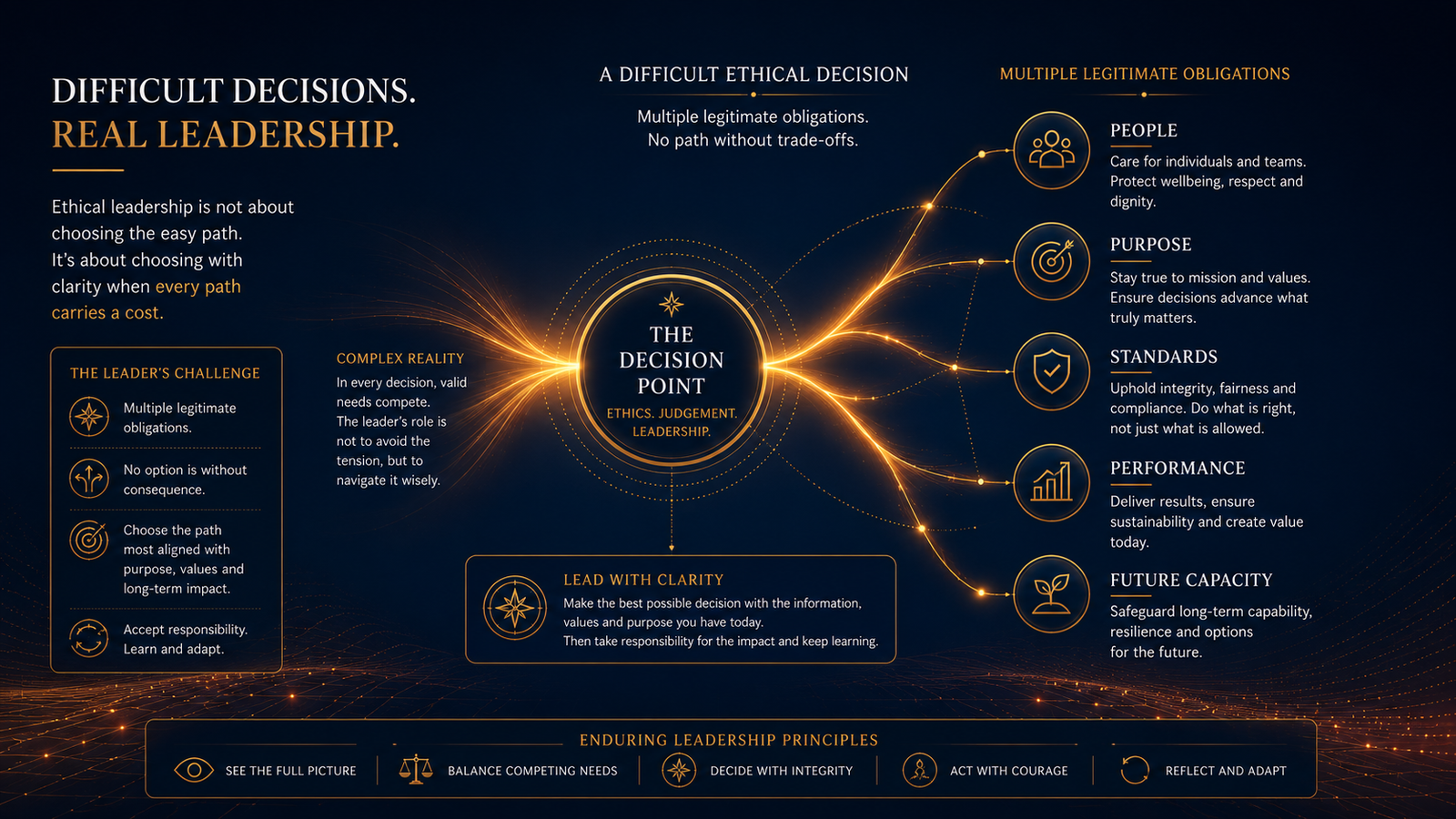
Some leadership decisions are difficult because the answer is unclear. Others are difficult because every available answer carries a cost.
Reduce expenditure or protect staffing.
Disclose information or preserve legitimate confidentiality.
Act quickly or consult more widely.
Support an individual or protect the wider team.
Maintain consistency or recognise exceptional circumstances.
Protect today’s service or preserve tomorrow’s workforce capacity.
These are not necessarily choices between right and wrong. They are often choices between competing responsibilities — and that distinction matters, because conventional discussions of ethical leadership can create the impression that leaders simply need stronger values. Yet many consequential decisions involve several legitimate values operating simultaneously: fairness may compete with compassion, transparency may meet confidentiality, individual autonomy may conflict with collective responsibility, and performance may conflict with sustainability.
The central capability is therefore not merely having values. It is developing the judgement required to determine what those values require when they point in different directions.
The Hardest Ethical Decisions Do Not Have an Ethical and an Unethical Option
Imagine a healthcare leader facing severe staffing shortages. The department must remain operational. Existing employees are already working close to their sustainable capacity. Temporary staff are expensive and budgets are constrained. Reducing service availability could affect patients. Increasing existing workloads could affect staff wellbeing and potentially the quality of care. Recruitment cannot solve the immediate problem. What is the ethical decision? There may be no solution that protects every legitimate interest.
The same pattern appears across sectors. A school leader has limited resources and must decide whether funding should support additional learning intervention, staff development or specialist wellbeing provision. A business leader needs to restructure to remain financially viable, knowing that jobs may be lost. A public-service leader must allocate finite resources between communities with equally legitimate needs. An HR director investigating a complaint must protect confidentiality while maintaining confidence that concerns are being taken seriously. An entrepreneur must choose between preserving cash and retaining a team built over several years.
In each case, saying “do the right thing” provides very little practical guidance. Several versions of “right” may be competing. That is where Ethics Intelligence™ begins.
Ethical Leadership Requires More Than Moral Certainty
Leaders understandably prefer certainty. It makes decisions easier to communicate, reduces anxiety and creates a sense of control. But complex leadership frequently does not offer that luxury. Ethical maturity sometimes requires leaders to acknowledge that there is no cost-free option — and that statement is not weakness. It can be evidence of sophisticated judgement.
The danger emerges when leaders remove complexity from a decision too early. A restructuring becomes simply a “business necessity.” A workload increase becomes “what the organisation needs.” A difficult performance decision becomes “following procedure.” Sometimes those descriptions may be accurate. But they can also function as mechanisms through which leaders stop examining the ethical dimensions of their choices. Language matters, because the way a problem is framed determines which questions become visible. Ethics Intelligence™ widens the frame and asks what else is present in the decision.
Featured Snippet
The Competing Obligations Model
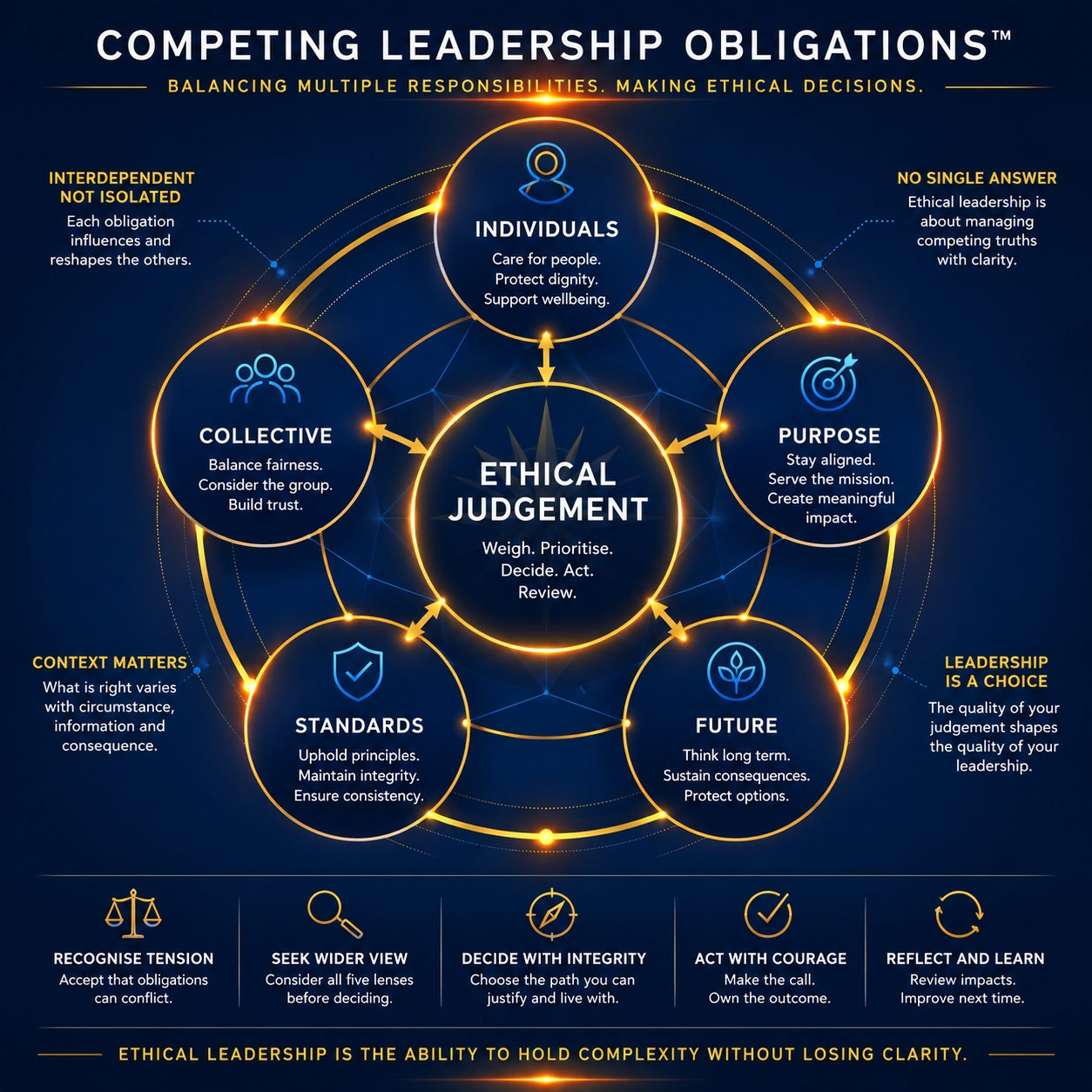
A useful way to understand difficult ethical decisions is to identify the obligations operating within them. Five frequently recur in leadership.
Obligation 1
Responsibility to Individuals
Leaders have responsibilities toward individual dignity, fairness, development, safety and legitimate personal circumstances. People are not simply units of organisational capacity — but individual interests cannot always determine organisational decisions.
Obligation 2
Responsibility to the Collective
Leaders also have responsibilities to teams, organisations, customers, students, patients and citizens. Supporting one individual may create consequences for many others, so judgement requires examining the relationship between individual and collective interests.
Obligation 3
Responsibility to Purpose
Businesses create value, schools educate, healthcare organisations care for patients, public institutions serve communities. Leaders have an ethical responsibility not only to people but to the legitimate purpose the organisation exists to fulfil.
Obligation 4
Responsibility to Standards
Professional obligations, policies, laws, governance expectations and codes of conduct create necessary boundaries. Ethical leadership does not dismiss these because circumstances are inconvenient — yet rules cannot anticipate every context, so judgement remains necessary.
Obligation 5
Responsibility to the Future
Leadership decisions have temporal consequences. A solution that resolves today’s problem by damaging tomorrow’s capability may be operationally attractive while remaining strategically and ethically weak — this is where Ethics Intelligence™ intersects directly with Leadership Sustainability™ and Leadership Capacity™.
The Fifth Obligation Is Often the One Leaders Miss
The responsibility to the future deserves particular attention. Organisations are frequently rewarded for solving immediate problems, so leaders can become highly effective at transferring costs forward. A vacancy is not filled. The remaining team absorbs the work. The budget improves. The immediate problem appears solved. But workload increases, development activity disappears, managers spend more time covering operational gaps, strategic thinking declines, and people begin leaving.
Future capacity is a stakeholder too. Leaders are custodians not only of today’s output but of the conditions through which tomorrow’s output will become possible. This is why Leadership Sustainability™ belongs within ethical decision-making rather than sitting separately as a wellbeing concern.
Ethics Intelligence™: From Intention to Performance
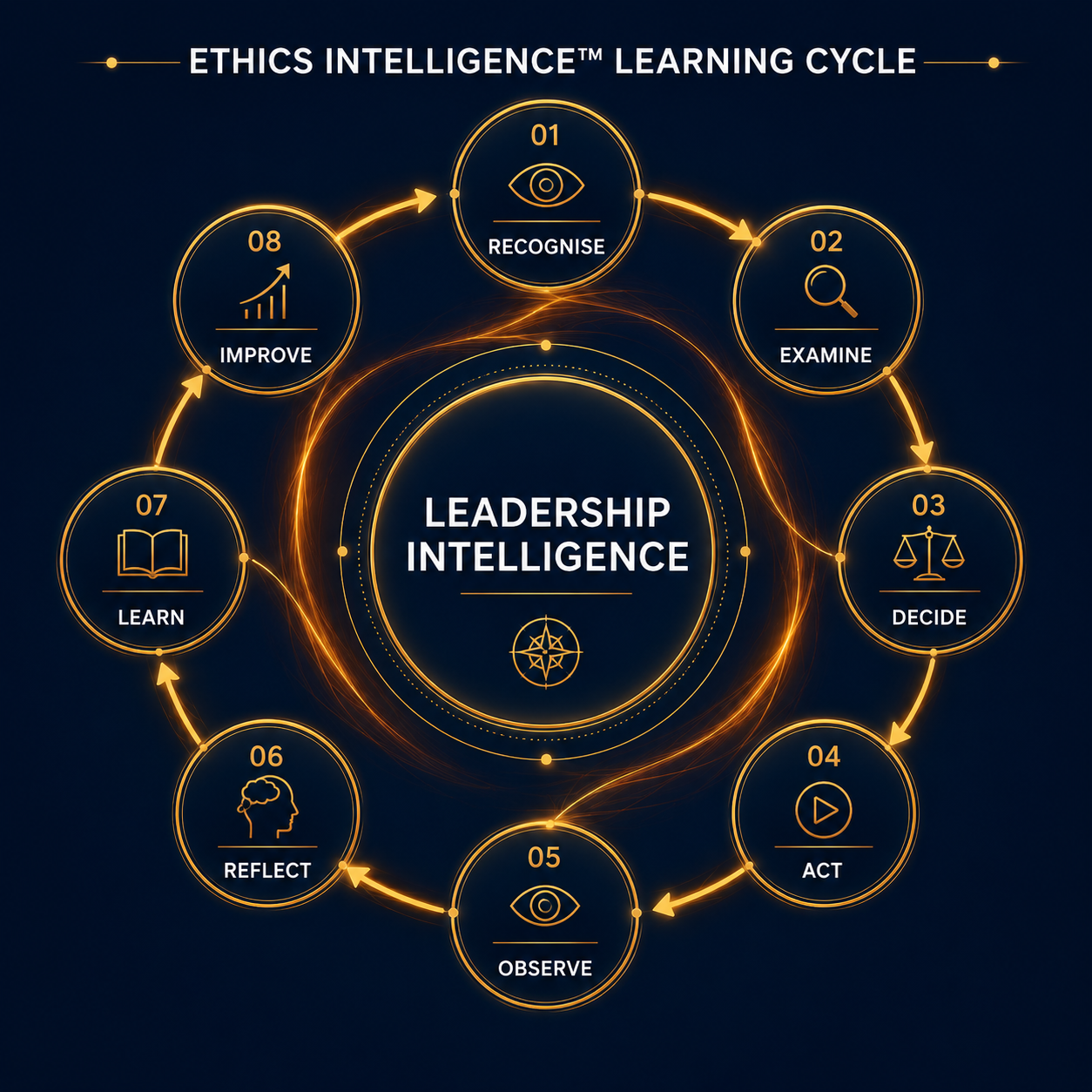
Burn Bright’s Ethics Intelligence™ architecture can be understood as a progression: Ethical Intention → Principles → Recognition → Judgement → Decision → Action → Impact → Reflection & Learning.
This matters because ethical leadership is sometimes evaluated only at the beginning of that sequence — did the leader care, did they have good values, were their intentions positive. Ethics Intelligence™ follows the decision all the way through to impact and learning. A leader can begin with ethical intention and still fail to recognise an affected stakeholder. A leader can identify the correct principle but misjudge the power dynamics surrounding implementation. Ethical leadership therefore requires feedback: what happened after we decided is as important as what did we decide.
The Ten Dimensions of Ethics Intelligence™
Burn Bright’s Ethics Intelligence™ Decision Wheel provides a practical architecture for examining consequential decisions across ten dimensions, including context, stakeholders, principles, power, fairness, consequences, precedent, transparency, accountability and sustainability. The purpose is not to create a bureaucratic ten-stage approval process — it is to prevent one dominant consideration, whether financial, operational, legal or people-related, from swallowing the entire decision.
When Fairness and Equality Are Not the Same Thing
One of the most common ethical tensions concerns fairness. Leaders often attempt to demonstrate fairness by treating everyone identically. Sometimes that is appropriate. Sometimes identical treatment creates unfair outcomes. Consider two employees requesting flexibility — one for personal preference, the other for exceptional caring responsibilities. Applying exactly the same rule to both may appear consistent, but is consistency the same as fairness?
Ethics Intelligence™ requires leaders to explain not merely what decision was made but why relevant differences justified different treatment. A useful test: if another person presented materially similar circumstances tomorrow, would we be willing to use the same reasoning? If the answer is no, the decision may be based less on principle than preference, status or convenience — and that is where precedent enters the equation.
Every Leadership Decision Teaches the Organisation Something
A decision does more than resolve the case immediately in front of the leader — it communicates information. Promote the brilliant performer who consistently undermines colleagues, and the organisation learns something about the real hierarchy of values. Ignore inappropriate behaviour because the individual is senior, and employees learn something about accountability. Punish somebody who raises inconvenient information, and people learn what “speak up” really means.
Leadership decisions are cultural signals. They tell people which principles survive contact with pressure. The ethical leader must ask: what will become easier to justify because we made this decision today? That question shifts attention from the isolated case to the system being created around it.
From Ethical Choice to Ethical Architecture
The most advanced form of ethics leadership is not making thousands of individually heroic ethical decisions. It is designing organisations in which responsible decisions become easier to make — establishing clear decision rights, creating meaningful challenge, protecting escalation routes, examining workload, making accountability visible, reviewing unintended consequences, and ensuring seniority does not create immunity.
The organisation should not have to depend upon a uniquely courageous individual being present every time a difficult decision arises. That is the transition from ethical leadership as personal virtue to Ethics Intelligence™ as organisational capability.
The Ethics Intelligence™ Trade-Off Framework
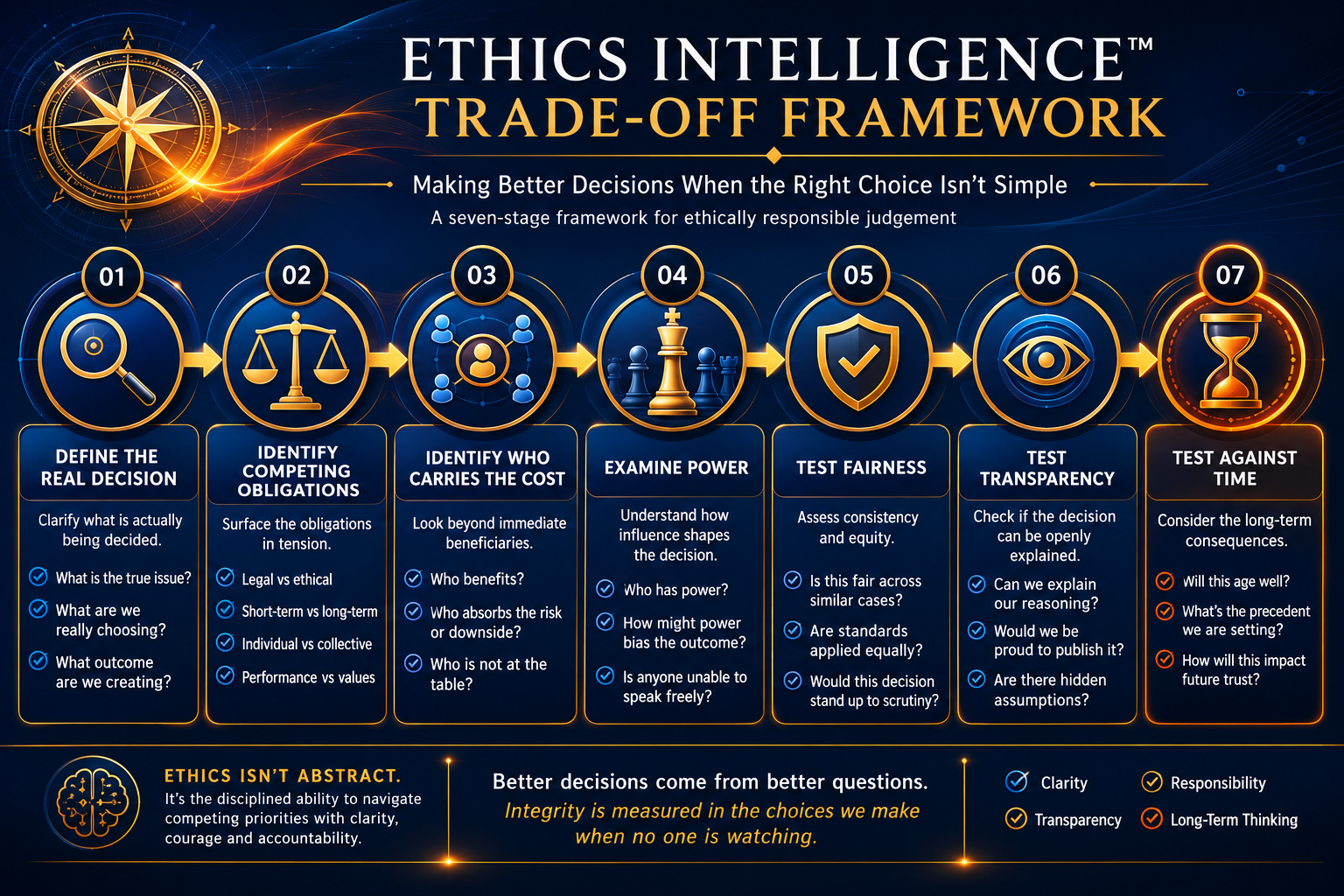
When every available option carries a cost, the objective of ethical leadership is not to discover a perfect answer — often, none exists. The objective is to reach the most responsible, proportionate and defensible decision available, while remaining explicit about what the organisation is protecting, what it is compromising and who will experience the consequences. Without a structured process, leaders can mistake decisiveness for judgement. Ethics Intelligence™ requires exposing the trade-off before resolving it, through seven questions.
1. What Is the Real Decision?
Define the decision accurately before evaluating options. A narrow framing such as “how do we reduce staffing costs” already limits the answers. A stronger framing — “how do we restore financial sustainability while protecting the capacity required to deliver our purpose” — opens more options. Ethical judgement begins before options are evaluated; it begins with how reality is described.
2. Which Obligations Are in Tension?
Identify the legitimate responsibilities competing within the decision. A weak process searches for one principle capable of ending the discussion. Ethics Intelligence™ asks which legitimate obligations each option would protect, and which it would compromise — making the trade-off visible.
3. Who Carries the Cost?
Every significant decision distributes benefits, burdens, risks and opportunities — rarely equally. A financial statement may record a saving without recording the transfer of cost onto managers, employees or customers. The question becomes: are those who benefit also carrying a reasonable proportion of the cost?
4. Examine the Power Differential
The person making a request and the person receiving it may experience the same interaction very differently. People can technically possess a choice while experiencing very little practical freedom to exercise it. Ethics Intelligence™ asks who controls the decision, the information, and who can realistically refuse.
5. Test Fairness Without Confusing It With Sameness
Distinguish between applying the same rule, applying the same reasoning, and producing an equitable outcome. A useful test: would our reasoning change if the person involved had less status, influence or organisational value? That question is particularly revealing.
6. Apply the Transparency Test
Transparency does not mean revealing everything — it means ensuring the reasoning behind a decision can withstand appropriate scrutiny. If leaders rely heavily on statements such as “people wouldn’t understand,” the transparency test becomes especially important.
7. Test the Decision Against Time
Ask what the decision solves today, what it might create tomorrow, and what people will learn from watching it happen. Leadership decisions are educational — precedent becomes culture.
A Worked Example: When Protecting Performance Threatens Capacity
Consider a hypothetical professional-services organisation. Demand has increased substantially over six months. Revenue is growing and client satisfaction remains strong, but staffing has not expanded at the same rate. Managers are absorbing additional work and employees are regularly working beyond normal hours. Senior leadership wants to delay recruitment until growth is proven sustainable.
On the surface, this is a commercial decision. Through the Ethics Intelligence™ Trade-Off Framework, it becomes more complex. The weak framing — “should we recruit now or wait” — narrows the answer. A stronger framing — “how should we balance financial prudence with the capacity required to sustain growth” — opens possibilities including temporary support, demand management, client prioritisation or workflow redesign.
Working through the framework surfaces the obligations to employees, clients, owners, financial sustainability, quality and future capacity; who carries the cost if recruitment is delayed versus if it proceeds and demand later falls; whether employees and managers genuinely feel able to say the workload is unsustainable; whether workload is distributed evenly; and whether leadership can openly explain why recruitment is being delayed, what is being monitored, and what threshold will trigger additional capacity.
The Ethics Intelligence™ conclusion is rarely a simple “recruit immediately” or “delay recruitment.” It is more often a managed response — for example, delaying permanent recruitment for a defined period while introducing temporary capacity, explicit workload limits, regular demand monitoring and predetermined recruitment triggers. That solution does not eliminate the trade-off. It manages it responsibly. That is ethical judgement.
What Ethics Intelligence™ Looks Like Across Sectors
The same architecture can be applied to very different leadership environments.
Business Growth Intelligence™
A company needs to discontinue a product line that employs a significant number of people. Ethics Intelligence™ does not pretend the commercial reality can be ignored — it asks whether alternatives were genuinely considered, when employees should be informed, and whether the people making the decision are insulated from its consequences.
School Leadership Intelligence™
A school must address persistent underperformance by an experienced teacher. An Ethics Intelligence™ approach prevents leaders reducing the situation to “support the teacher” or “students come first” alone, instead establishing a proportionate improvement process with explicit standards, timescales, support and accountability.
Healthcare Leadership Intelligence™
A clinical service has more demand than available capacity. The decision requires examining patient risk, workforce capacity, professional standards and resource allocation simultaneously — a service that protects today’s patients by progressively exhausting tomorrow’s workforce has only moved the ethical problem into the future.
Public Service Leadership Intelligence™
A public agency must reduce expenditure across several services. Ethical leadership requires transparent criteria rather than allowing political visibility alone to determine which services are protected, and asks which communities are least able to advocate for themselves.
HR & People Leadership Intelligence™
A highly valuable senior employee has generated repeated complaints about behaviour. If conduct that would trigger consequences for a junior employee is tolerated because someone is commercially important, leadership establishes a hierarchy of accountability that every other employee learns from.
Entrepreneur Performance Intelligence™
A founder discovers the business cannot continue operating at its current cost base. Ethical leadership can require painful action — the question becomes how honestly the situation is communicated, whether alternatives were considered, and whether affected people are treated with dignity.
Ethical Leadership Requires the Courage to Remain Uncertain
There is another capability underneath this framework: leaders must be capable of saying “I may not yet understand this decision well enough.” That is difficult in cultures where leadership credibility is associated with certainty, yet premature certainty can close down ethical reasoning. Burn Bright’s work on unguarded leadership argues for a shift away from leaders needing to possess every answer toward curiosity, psychological safety and the capacity to acknowledge uncertainty.
Ethical leadership does not require permanent indecision. Eventually, somebody must decide. But there is a significant difference between decisiveness after examination and certainty instead of examination. The first is leadership judgement. The second can become leadership risk.
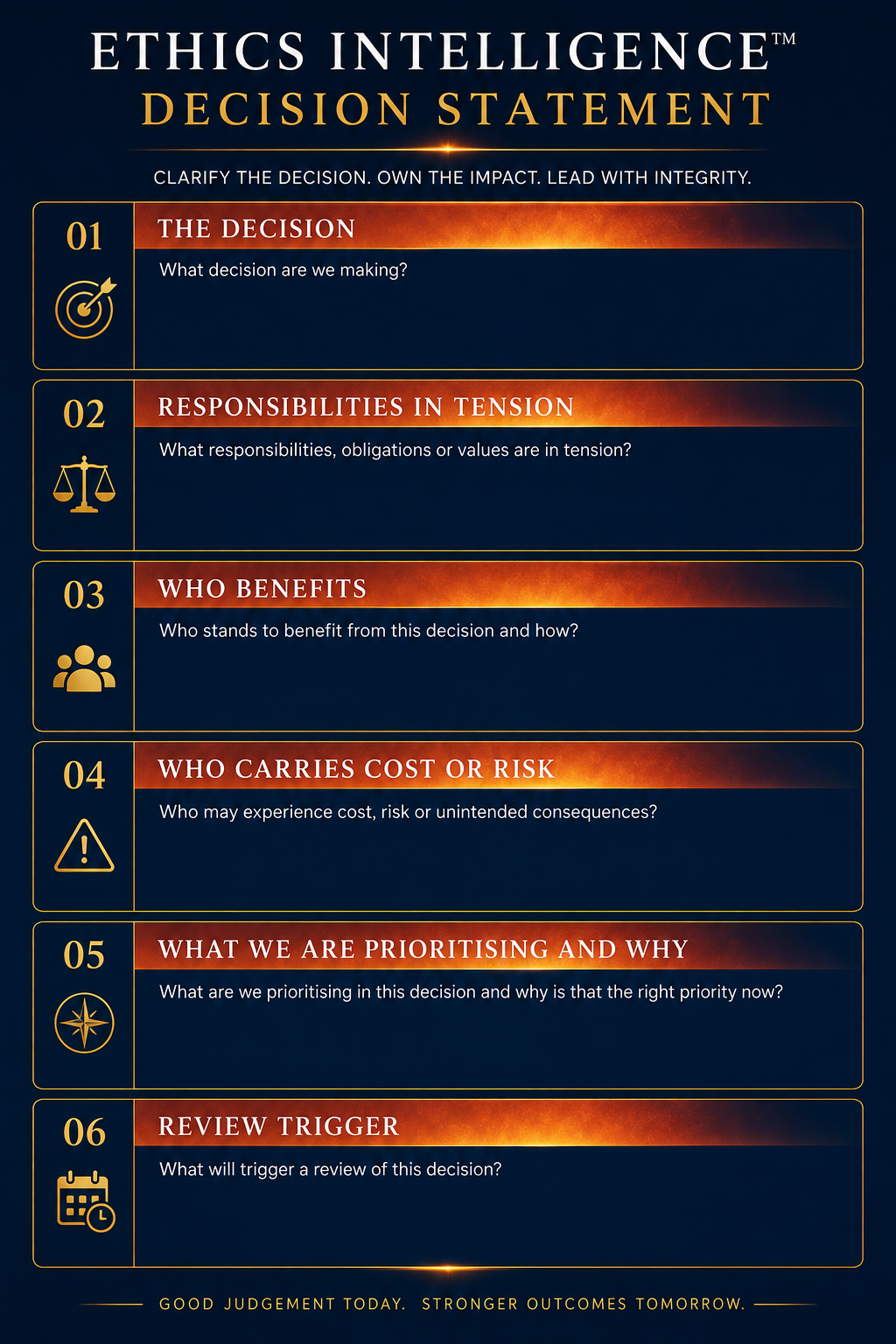
The Ethics Intelligence™ Decision Statement
For significant decisions, leadership teams can create a short Ethics Intelligence™ Decision Statement before final approval, completing six sentences: the decision we need to make is…; the legitimate responsibilities in tension are…; the people most likely to benefit are…; the people most likely to carry the cost or risk are…; we are prioritising ___ because…; we will review the decision when…
This simple discipline forces leaders to make the trade-off explicit and creates a record of the reasoning, not merely the decision — supporting Leadership Reflection™, organisational learning and Leadership Benchmarking™.
From Ethical Judgement to Ethical Infrastructure
The strongest organisations do not rely on individual leaders remembering to ask ethical questions at moments of pressure — they build those questions into the way leadership operates. Organisations should not depend on the presence of one unusually thoughtful individual; they need systems that make responsible judgement more likely across roles, teams and leadership levels. The question is no longer simply “is this leader ethical” but “does this organisation create the conditions in which ethical judgement can consistently operate.”
Practice 1 Build Ethical Questions Into Decision Papers
For significant decisions, include explicit questions alongside financial and risk analysis: who is affected, who benefits, who carries risk, which principles are in tension, and what precedent could be established.
Practice 2 Record the Reasoning, Not Only the Outcome
An Ethics Intelligence™ Decision Statement creates institutional memory, capturing the responsibilities considered, the trade-offs accepted and the conditions under which the decision should be reviewed.
Practice 3 Design Challenge Into Leadership Processes
Ethical judgement deteriorates when challenge depends on personal courage. Assign someone to test stakeholder impact, ask which assumption would most change the decision, and separate proposal ownership from challenge.
Practice 4 Track Repeated Exceptions
One exception may be appropriate. A pattern of exceptions — repeated workload breaches, repeated policy adjustments for high-status employees, repeated bypassing of consultation — may reveal a structural problem.
Practice 5 Review Impact After Implementation
A well-reasoned decision can still produce unintended consequences. Ask what happened, who experienced the decision differently than expected, and whether the decision strengthened or weakened trust.
Leadership Performance Intelligence™ and Ethical Trade-Offs
Ethics Intelligence™ matters because leadership performance cannot be understood through results alone. Two organisations can reach the same headline outcome through very different leadership systems — one through strong capability, clear decision rights and sustainable workload; another through overwork, fear and dependence on a small number of people. Traditional performance reporting may treat those outcomes as equivalent. Leadership Performance Intelligence™ does not — it examines the system producing the result, including how authority was used, what trade-offs were made, and what precedent was established.
This is why Ethics Intelligence™ cannot be separated from Leadership Sustainability™, Leadership Capacity™, Professionalism Intelligence™ or Reflective Practice Intelligence™. Together, they help leaders understand not only whether performance occurred, but whether the organisation became stronger or weaker while producing it.
Leadership Reflection Questions
- Which recent leadership decision had no genuinely cost-free option?
- Did we clearly identify the competing obligations before deciding?
- Who benefited most from the decision?
- Who carried the greatest burden or risk?
- Were those stakeholders represented in the decision process?
- What role did hierarchy, status or organisational power play?
- Did urgency prevent legitimate challenge?
- Which principle did we prioritise?
- What did we knowingly compromise?
- Could we explain our reasoning transparently to those affected?
- What precedent did the decision establish?
- Did we protect today’s performance by consuming future Leadership Capacity™?
- What evidence would cause us to revisit the decision?
- Have similar “exceptional” decisions occurred repeatedly?
- What have we learned since implementation?
Action Steps: Conduct an Ethics Intelligence™ Decision Review
Select one consequential decision from the previous 90 days and work through it using the following structure.
Document the Decision and Context
What was actually decided, and what pressures, constraints and uncertainties existed at the time?
Map the Obligations and Stakeholders
Which legitimate responsibilities were in tension, who benefited and who carried the cost?
Run the Power, Fairness and Transparency Tests
Who influenced the outcome, who had limited ability to challenge it, and could the reasoning be explained credibly to those affected?
Examine Precedent and Sustainability
What does the decision make easier to justify next time, and what long-term capacity or risk did it create?
Set a Review Trigger and Ask the Final Question
Decide when the organisation should reconsider the decision, then ask: knowing what we know now, would we make the same decision again?
Frequently Asked Questions
What is ethical decision-making in leadership?
It is the process of making responsible choices when decisions affect people, resources, trust, performance or organisational integrity, requiring leaders to examine competing obligations, stakeholder consequences, power relationships, fairness, precedent, accountability and long-term sustainability.
Why are ethical leadership decisions difficult?
Many involve competing legitimate responsibilities rather than a simple choice between right and wrong — balancing individual needs, organisational performance, professional standards, financial constraints and longer-term sustainability simultaneously.
What is Ethics Intelligence™?
Ethics Intelligence™ is the leadership capability to recognise ethical dimensions within decisions, examine competing principles and interests, understand the effects of power, and remain accountable for both decisions and consequences. It is one domain within Burn Bright Advisory’s Leadership Intelligence Compass™.
How is Ethics Intelligence™ different from having strong values?
Values establish principles. Ethics Intelligence™ concerns the application of those principles under real organisational conditions, where a leader may need judgement to determine what a value like fairness actually requires when circumstances differ.
What is an ethical trade-off?
An ethical trade-off occurs when protecting one legitimate interest or responsibility creates a cost for another — for example, maintaining staffing levels may protect service quality but increase financial risk, while reducing staffing may protect finances but increase workload.
How should leaders make decisions when every option has a cost?
Identify the real decision, clarify competing obligations, examine who carries the cost, analyse power, test fairness, assess transparency and consider longer-term consequences. The aim is not a perfect decision but the most responsible and defensible one available.
Why does power matter in ethical decision-making?
Power affects who can influence decisions, challenge assumptions, refuse requests and protect their own interests — a decision may feel voluntary to the person exercising authority while feeling compulsory to the person with less power.
Why should leaders consider precedent?
Every leadership decision communicates what the organisation is willing to tolerate, protect or prioritise. Repeated exceptions can gradually become organisational norms, so considering precedent helps leaders understand the cultural consequences of an apparently isolated decision.
What is the connection between Ethics Intelligence™ and Leadership Sustainability™?
Ethical decisions frequently involve how leadership capacity is used over time. A decision that solves an immediate problem by repeatedly increasing workload or exhausting key people may weaken future performance, so Leadership Sustainability™ forms part of responsible ethical judgement.
Can ethical leadership be measured?
No single metric captures ethical leadership completely, but organisations can assess decision quality through recurring indicators such as consistency, challenge, transparency, stakeholder impact, accountability, workload patterns, escalation behaviour and post-decision review, contributing to wider Leadership Benchmarking™ and Leadership Performance Intelligence™.
Conclusion: The Quality of Leadership Is Revealed in the Trade-Off
Ethical leadership is easy to describe when interests align. The difficult test arrives when they do not — when protecting employees creates financial pressure, when transparency conflicts with confidentiality, when today’s operational need threatens tomorrow’s capacity. At those moments, leadership cannot rely on slogans. It requires judgement.
Ethics Intelligence™ provides a framework for that judgement: recognise the real decision, identify competing responsibilities, make power visible, examine fairness, understand who carries the cost, consider precedent, test transparency, protect sustainability, and remain accountable after implementation. This does not eliminate difficult decisions. It makes the reasoning behind them stronger.
That distinction matters because leadership legitimacy does not depend upon everybody agreeing with every decision. People can disagree with an outcome while recognising that the process was serious, transparent and principled. Trust deteriorates when decisions appear arbitrary, inconsistent or designed primarily around the interests of those holding the greatest power.
Leadership decisions do more than determine what happens next — they gradually determine what kind of organisation is being built. The stronger question in difficult ethical leadership is not “which option has no cost,” because frequently none does. It is: which cost can we justify, who should reasonably carry it, what responsibility are we protecting, and are we prepared to remain accountable for the consequences? That is Ethics Intelligence™ in practice.
Strengthen the Judgement Behind Your Leadership Decisions
Explore the Leadership Intelligence Compass™ and take the free assessment to understand where your Ethics Intelligence™ and wider leadership capacity stand today.
Free Leadership Intelligence
Get Weekly Leadership Insights
Join thousands of leaders receiving practical strategies on burnout prevention, workload design, and sustainable performance every week.