Quick Answer
Key Takeaways
- Perfectionism can turn a capable leader into the team’s biggest operational bottleneck.
- Effective delegation transfers ownership and authority, not simply tasks.
- “Nobody can do it as well as I can” is often a warning sign that knowledge and decision-making have become too concentrated.
- Sustainable leaders distinguish between work that genuinely requires their judgement and work they have simply become accustomed to controlling.
- The goal of delegation is not to reproduce the leader. It is to build a team capable of delivering strong outcomes without constant leadership intervention.
Delegation and Perfectionism: Why Leaders Must Let Go
Delegation and perfectionism create one of the least visible causes of leadership overload.
The pattern often looks responsible from the outside.
You check the presentation before it reaches the board.
You rewrite the report because the wording is not quite right.
You step into a project because progress feels too slow.
You ask someone to take ownership, then remain involved in almost every decision.
Each intervention seems reasonable.
Collectively, they create a system in which too much work depends on you.
That matters because perfectionism is not simply a personality characteristic when you hold a leadership position. It can become part of the organisation’s operating architecture. Your standards influence who can make decisions, how quickly work moves and how much responsibility your team is genuinely allowed to carry.
This is why perfectionism culture sits among the five root causes of burnout in the Burn Bright Not Out Framework™, alongside scope creep, meeting culture, communication chaos and decision overload.
Before examining why perfectionist leaders struggle to delegate, it helps to see how the cycle creates its own workload.
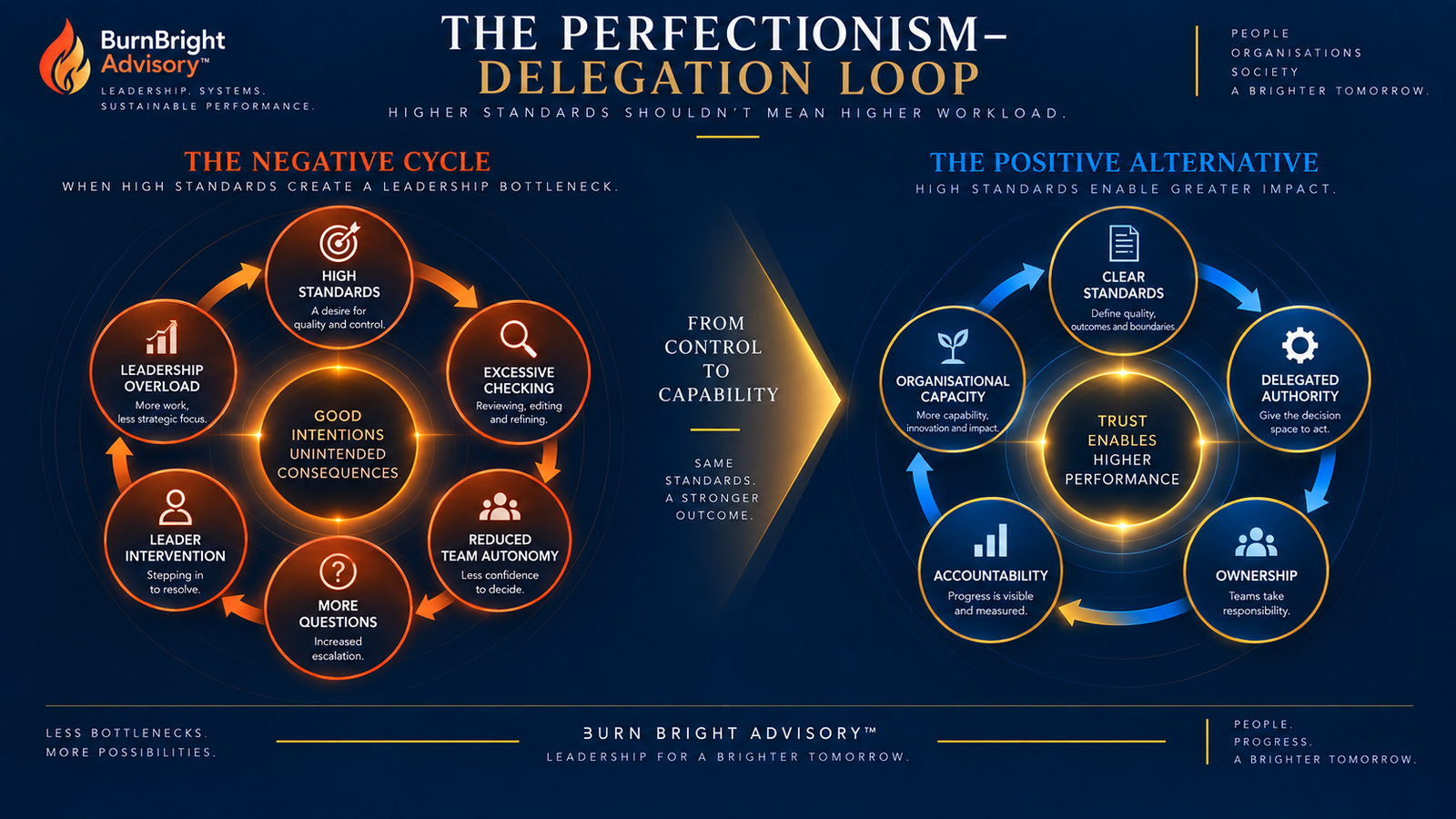
The critical point in this model is that perfectionism does not remain inside the leader’s head. Once it influences who can act, decide, approve and complete work, it becomes structural.
Featured Snippet
Why Does Perfectionism Make Delegation So Difficult?
Perfectionism makes delegation difficult because delegation requires something perfectionism resists: accepting that another competent person may achieve the right outcome differently from you.
That distinction matters.
Imagine you ask a member of your leadership team to prepare a strategic briefing. They produce a clear, accurate document that answers the required questions. Yet you spend another hour rewriting it because you would have structured the argument differently.
Was the work actually inadequate?
Or was it simply not yours?
That question exposes one of the central problems with perfectionist leadership.
Standards and preferences become blurred.
A genuine standard might be accuracy, legal compliance, safeguarding, financial control or an agreed level of quality. A preference might be the order of slides, a particular sentence structure, how somebody organises their workflow or the precise route they take towards the agreed outcome.
When leaders treat preferences as standards, delegation becomes almost impossible.
The Perfectionism Loop
The pattern usually develops gradually:
High standards → increased checking → reduced autonomy → more questions → leader intervention → greater workload → reduced trust → even more checking.
The leader concludes: “I knew I should have done it myself.”
The employee concludes: “There is little point taking full ownership because my manager will change it anyway.”
Both behaviours then reinforce each other.
Over time, the leader becomes increasingly overloaded while the team becomes increasingly dependent.
This is not effective delegation. It is task allocation with retained control.
The Burn Bright Not Out Framework™ identifies perfectionism culture as one of the five root causes of burnout and places the RACI Delegation Framework™ among the tools for structural transformation. That distinction is significant because leadership overload cannot be solved simply by telling an exhausted manager to “delegate more”.
The architecture around delegation has to change.
When “High Standards” Become a System Problem
High standards themselves are not the enemy. Leadership requires standards.
The problem begins when the organisation can only maintain those standards through the leader’s continuous personal involvement.
Consider a department head responsible for ten significant areas of work. If every meaningful decision requires their approval, every important document needs their final edit and every problem eventually returns to their desk, the organisation has not built a high-performance system.
It has built a dependency. And dependencies are fragile.
The Burn Bright Not Out Framework™ material describes how delegation fears, resource constraints and an expanding scope of responsibility can create personal bottlenecks in which the leader’s individual capacity limits the effectiveness of the entire team.
This is where delegation and perfectionism become directly connected to burnout.
The leader works longer because work keeps returning.
The team waits longer because authority remains concentrated.
Strategic work gets pushed into evenings because operational work consumes the day.
Eventually, the leader starts believing the workload itself is the problem. Sometimes it is. But sometimes the deeper issue is workload architecture.
You do not need to ask only: “How can I get through all this work?”
Ask instead: “Why does so much of this work still require me?”
How Does Perfectionism Turn Leaders Into Bottlenecks?
Most perfectionist leaders do not intend to become bottlenecks. They become bottlenecks because they are competent.
They solve problems quickly. They know the history. They understand the politics. They can often complete a task faster than explaining it to somebody else.
So they step in.
At first, this feels efficient.
A colleague asks a question. You answer it.
A project starts drifting. You take control.
A document needs improving. You rewrite it.
A decision feels risky. You make it yourself.
The problem is not any single intervention. The problem is what the organisation learns from repeated intervention.
People learn that difficult decisions eventually travel upwards. They learn that important work will be checked. They learn that the safest approach is to ask before acting.
And the leader gradually becomes the point through which everything must pass.
The competence trap
I call this the competence trap.
The more capable you are at rescuing work, the more work you are given to rescue.
Eventually, competence creates dependency.
This is particularly dangerous for senior leaders because their value should increasingly come from judgement, direction, organisational design and developing other people’s capacity.
Yet many leaders move in the opposite direction. They become more senior while retaining responsibilities from earlier versions of their role. They manage today’s responsibilities while continuing to own yesterday’s tasks.
Then new responsibilities arrive.
The result is scope creep.
Within the Burn Bright framework, scope creep and perfectionism culture are separate root causes of burnout, but in practice they frequently reinforce each other.
Perfectionism makes you reluctant to release work. Scope creep keeps adding more.
That combination is unsustainable.
What Is the Difference Between High Standards and Perfectionism?
High standards and perfectionism are not the same thing.
A leader with high standards defines what good looks like. A perfectionist leader often defines how good must be produced.
That difference changes everything.
Consider two leaders delegating the same report.
The first says: “We need an accurate six-page recommendation for Friday’s executive meeting. It needs to identify the three main risks, show the financial implications and make a clear recommendation. Send me the final draft by Thursday afternoon.”
The second explains the same outcome but also specifies the structure, formatting, sequence of analysis, wording, data presentation and process the employee should follow. They request several progress updates and then substantially rewrite the finished document.
Both leaders may describe themselves as maintaining standards. Only one has genuinely transferred ownership.
Use the outcome test
A useful test is to ask: would I reject this work because the outcome is inadequate, or because it is different from how I would have done it?
That question separates standards from preference.
This does not mean leaders should accept poor performance. Some work genuinely requires close oversight. Legal compliance, safeguarding, financial controls, major reputational decisions and high-risk operational activity may demand specific processes and approval points.
But not everything is high risk.
When every task receives high-risk levels of oversight, leadership capacity disappears into checking.
Sustainable leadership requires leaders to identify the few standards that genuinely matter and create freedom around everything else. Standardise the outcome where necessary. Do not standardise the person.
Your team does not need to become a collection of smaller versions of you. It needs sufficient clarity, capability and authority to deliver without you.
The connection between control and overload becomes clearer when we look at what workplace research tells us about chronic stress and organisational conditions.
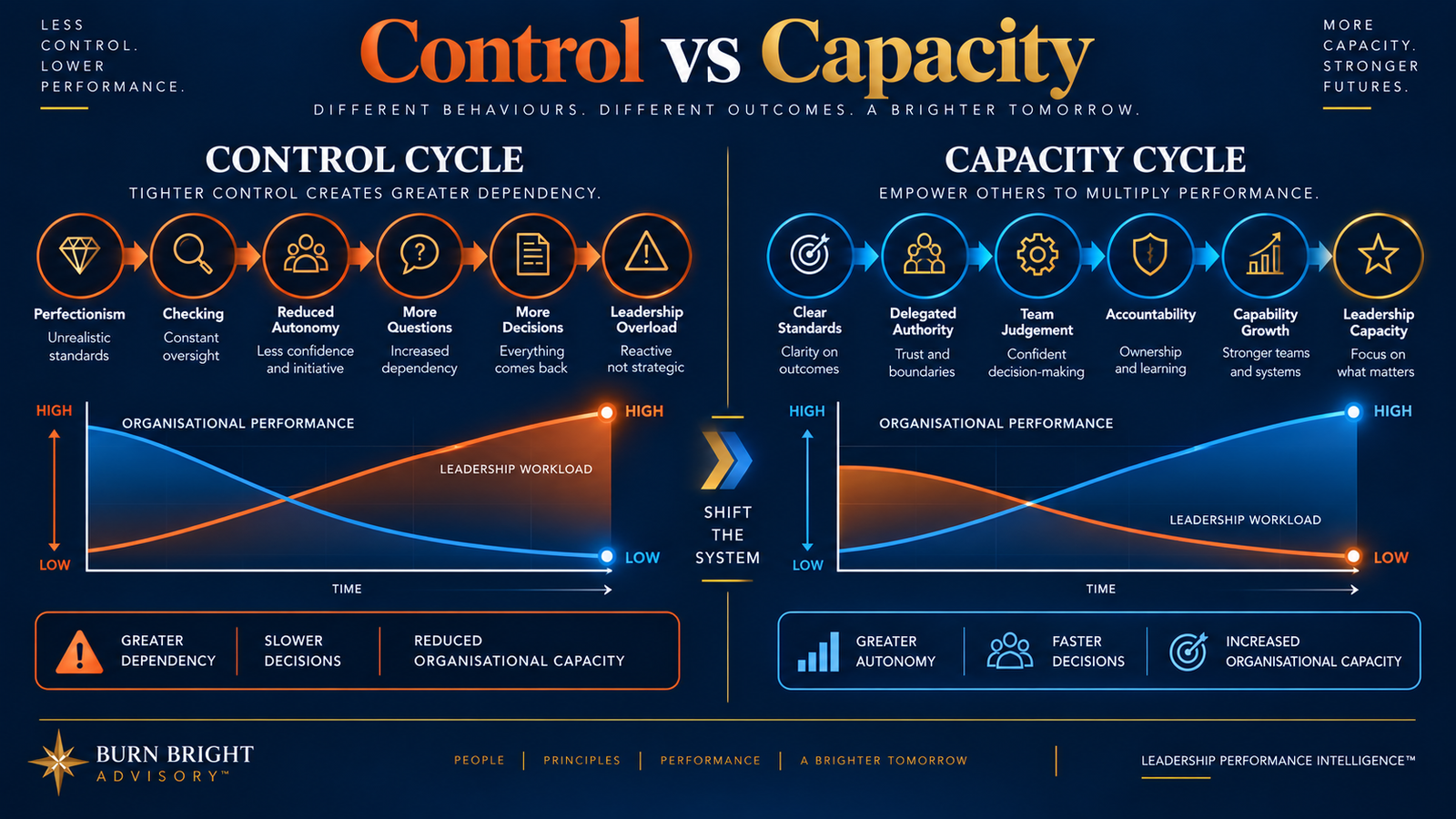
Control Cycle
- Perfectionism
- Checking
- Reduced autonomy
- More questions
- More decisions
- Leadership overload
Capacity Cycle
- Clear standards
- Delegated authority
- Team judgement
- Accountability
- Capability growth
- Leadership capacity
The distinction is structural. One system continually returns work to the leader. The other increases the organisation’s ability to operate without constant escalation.
Why Can Poor Delegation Increase Burnout Risk?
Burnout is sometimes discussed as though it were simply extreme tiredness. That definition is inadequate.
The World Health Organization defines burnout as an occupational phenomenon resulting from chronic workplace stress that has not been successfully managed. Its definition identifies three dimensions: exhaustion, increased mental distance or cynicism towards work, and reduced professional efficacy.
That matters for delegation and perfectionism because poor delegation can increase several conditions that make leadership work harder to sustain.
When too much responsibility remains concentrated at the top, the leader carries more tasks.
But they also carry more decisions.
More interruptions.
More approvals.
More context switching.
And more responsibility for solving problems that other capable people could have been authorised to resolve.
The issue is not simply the number of hours worked. It is the architecture of those hours.
WHO guidance on occupational stress identifies factors including time pressure, lack of control over work tasks, long working hours and lack of support as important risks for occupational stress, burnout and fatigue. Its organisational recommendations include optimising workloads and working time and increasing autonomy and participation in decision-making.
If you want autonomy from your own manager while denying meaningful autonomy to everybody below you, you create exactly the kind of dependency that eventually overwhelms you.
Leaders are already carrying significant pressure
This is not a theoretical concern.
Deloitte’s 2024 workplace research surveyed 3,150 executives, managers and workers across the United States, United Kingdom, Canada and Australia. At least four in ten respondents across workers, managers and executives said they often or always felt exhausted or stressed. The same research found that 66% of managers would seriously consider moving to another company that better supported their wellbeing.
There is an important lesson here. We cannot keep expanding management responsibility and then assume individual resilience will absorb the difference.
The Burn Bright approach starts somewhere else: fix the system, not the person.
If a leader is carrying 40 responsibilities and only 15 genuinely require their authority, teaching them another stress-management technique leaves the underlying problem untouched.
The better question is: why are the other 25 responsibilities still sitting with them?
Why Do Perfectionist Leaders Struggle to Let Go?
Perfectionism is rarely just about quality. Underneath it, there is often fear.
Fear that something will go wrong.
Fear that another person’s mistake will reflect on you.
Fear that standards will fall.
Fear that delegating will make you appear less valuable.
And sometimes a quieter fear: if I am no longer the person everybody needs, what is my role?
That final question deserves more attention than it receives.
Many leaders built their careers by being exceptionally reliable. They became known as the person who could solve the problem. Being needed became evidence of being valuable.
Then leadership requires them to do something psychologically difficult: stop being the primary problem-solver and start building other problem-solvers.
The behaviour that helped create their success can now restrict their effectiveness.
From hero to architect
This is the transition from heroic leadership to sustainable leadership.
Heroic leadership says: bring me the problem. Sustainable leadership asks: why does this problem require me?
Heroic leadership accumulates dependency. Sustainable leadership builds capability.
Heroic leadership measures value through personal intervention. Sustainable leadership measures value partly by what can function effectively without the leader’s intervention.
That does not make the leader less important. It changes where leadership value is created.
Your role becomes designing conditions in which other people can succeed.
Clear responsibilities.
Clear decision rights.
Clear escalation points.
Clear standards.
Clear accountability.
That is leadership architecture.
And it is why simply telling perfectionist leaders to “let go” is poor advice. They do not need vague encouragement to trust more. They need a framework that makes delegation safer.
How Can Leaders Delegate Without Lowering Standards?
The answer is not less accountability. It is better-designed accountability.
Before delegating significant work, establish five things:
- Outcome. What specifically needs to be achieved?
- Standard. What conditions must the finished work meet?
- Authority. Which decisions can the person make without returning to you?
- Boundaries. Which decisions or risks must be escalated?
- Review. When will progress or outcomes be assessed?
Once those five elements are clear, step back. Do not delegate the work and then continue making every decision associated with it.
That is not delegation. It is remote-control management.
The Burn Bright framework includes the RACI Delegation Framework™ precisely because sustainable delegation requires clarity about who is Responsible, Accountable, Consulted and Informed.
For overloaded leaders, one of the most revealing questions is therefore: how much work am I still Responsible for when I should only be Accountable, Consulted or Informed?
That question can expose years of accumulated leadership workload. It can also reveal the route out.
Because sustainable delegation is not abandoning responsibility. It is putting responsibility in the right place.
What Should Leaders Delegate — and What Should They Keep?
The goal of delegation is not to remove yourself from leadership. It is to remove yourself from work that does not require your leadership.
That distinction matters.
Overloaded leaders often approach delegation by asking: “What can I give away?”
Start with a better question: “What genuinely requires my authority, judgement or accountability?”
Everything else deserves examination.
The Burn Bright approach is based on Workload Architecture™: deliberately designing where work, decisions and accountability sit rather than allowing responsibilities to accumulate around the most capable person.
This matters because delegation and perfectionism frequently produce a distorted workload. The leader retains work because they can do it well. But capability is not the same as necessity.
You may be excellent at preparing reports, resolving routine operational problems, organising projects or analysing data. That does not mean you should still be doing them.
Use the four-question delegation test
Take a recurring responsibility and ask:
Question 1 Does this require my specific authority?
Some decisions belong with the leader because of governance, safeguarding, financial, legal or strategic accountability. Keep them.
Question 2 Does this require my unique expertise?
Be careful here. “I’m better at it” is not the same as “only I can do it”. If another capable person could learn the work with reasonable support, you may have identified a development opportunity rather than a permanent leadership responsibility.
Question 3 What happens if I remain the owner?
Calculate the hidden cost. Not just the 45 minutes required to complete the task. Consider interruptions, preparation, follow-up, decisions and the opportunity cost of strategic work you are not doing.
Question 4 What happens if somebody else owns it?
They may initially take longer. They may approach it differently. They may make small mistakes. But they may also develop capability that removes dozens of future tasks and decisions from your workload.
This is where perfectionism becomes expensive.
The perfectionist compares: my performance today versus their performance today.
The sustainable leader compares: my continuing involvement for the next three years versus their capability after three months of development.
How Does the RACI Framework Reduce Perfectionist Control?
One of the practical tools in the Burn Bright Not Out Framework™ is the RACI Delegation Framework™.
RACI creates four distinct positions:
| Role | Meaning | Leadership Question |
|---|---|---|
| Responsible | The person doing the work | Who actually executes this? |
| Accountable | The person ultimately answerable for the outcome | Who owns the result? |
| Consulted | People whose expertise or input is required | Who genuinely needs to contribute? |
| Informed | People who need visibility but not decision authority | Who simply needs to know? |
This looks simple. Its implications are significant.
Perfectionist leaders frequently place themselves in too many categories. They are Accountable. But they also remain Responsible. They expect to be Consulted. And they insist on being Informed at every stage.
The result is delegation on paper but dependency in practice.
Move from Responsible to Accountable
Suppose you lead a department and a monthly performance report is produced for the executive team.
Historically, you collected some of the data, checked every figure, rewrote the commentary, changed the formatting and submitted the report.
As your responsibilities expanded, the process never changed. You are still doing work designed for an earlier version of your role.
A RACI redesign could make a capable manager Responsible for producing the report while you remain Accountable for the final organisational outcome. Relevant specialists may be Consulted. Other stakeholders are Informed.
Your involvement changes from producing the work to ensuring the system produces the required result.
That is not withdrawal. It is leadership at the correct level.
Watch for reverse delegation
There is another problem. Delegated work has a remarkable ability to travel back uphill.
Someone encounters difficulty and asks: “What do you think I should do?”
The perfectionist leader answers. Then another problem arrives. The leader solves that too.
Within weeks, responsibility has quietly returned.
Instead of immediately providing the answer, ask: “What do you recommend?” Then: “What options have you considered?” Then: “Is this within your decision authority?”
These questions develop judgement rather than dependence.
What Does Sustainable Delegation Look Like in Practice?
Sustainable delegation requires more than assigning a task. It requires transferring enough clarity, authority and accountability for somebody else to genuinely own the outcome.
Use this five-part Burn Bright delegation sequence:
Step 1
Define the outcome
Describe what success looks like. Avoid dictating every step unless the process itself carries significant risk. Be precise about the result.
Step 2
Define the non-negotiables
Separate genuine standards from personal preferences. Ask: what absolutely must be true when this work is complete? That might include accuracy, budget limits, regulatory requirements, deadlines or agreed quality measures. Keep the list short — if everything is non-negotiable, nothing has really been delegated.
Step 3
Transfer decision authority
This is the part many leaders miss. A person cannot own an outcome if they must seek permission for every meaningful decision. State clearly: “You can decide these matters without coming back to me.” Then define the exceptions. Clarity reduces both risk and interruption.
Step 4
Agree escalation triggers
Delegation should not mean disappearing. Define the circumstances under which the leader needs to become involved — for example, if a budget variance exceeds an agreed threshold, if a safeguarding or legal risk emerges, if the deadline becomes materially threatened, or if the decision affects another strategic priority. Everything else remains with the owner.
Step 5
Review outcomes, not methods
This is where perfectionist leaders face the greatest test. Do not assess “did they do it exactly as I would?” Assess “did the outcome meet the agreed standard?” If yes, resist the temptation to redesign competent work around your preferences. That restraint is part of leadership development — not theirs, yours.
Two approaches to delegation can produce radically different organisational systems.
| Perfectionist Delegation | Sustainable Delegation |
|---|---|
| Leader specifies the outcome and method | Leader clarifies the outcome and essential standards |
| Work is delegated but authority remains at the top | Work and appropriate decision authority move together |
| Frequent checking provides reassurance | Agreed review points provide accountability |
| Different approaches are treated as errors | Different approaches are accepted when standards are met |
| Leader answers most difficult questions | Team members develop recommendations before escalation |
| Mistakes trigger tighter control | Appropriate mistakes become learning opportunities |
| Capability remains concentrated | Capability becomes distributed |
| Leader becomes a bottleneck | Leader creates organisational capacity |
| Success depends on leader availability | Systems continue functioning without constant intervention |
| Overload is treated as a time-management problem | Overload triggers workload redesign |
The difference is not simply management style. It is organisational design.
How Can Leaders Break the Perfectionism–Delegation Cycle?
Breaking the cycle does not require delegating half your role tomorrow. It requires identifying where unnecessary dependency currently exists.
Start with one week. Record every task, question, approval and decision that reaches you. Then divide them into four groups:
- KEEP — Work genuinely requiring your authority or strategic judgement.
- DELEGATE — Work another capable person can own.
- DEVELOP — Work somebody could own after coaching, experience or training.
- REMOVE — Work that should no longer exist.
The final category is easily overlooked.
Delegation is not the answer to unnecessary work. If a report is no longer useful, stop producing it. If an approval exists only because “we’ve always done it this way”, challenge it. If a meeting creates no meaningful decision or output, remove it.
Do not make your organisation more efficient at completing work it should not be doing.
Measure dependency, not busyness
After you redesign the work, track a different leadership metric: how many routine decisions still require me?
If that number falls while standards remain strong, your leadership system is becoming more mature.
You can also monitor:
- How often delegated work returns unnecessarily
- How many decisions are made at the appropriate level
- How much strategic time is protected
- How many responsibilities have clear ownership
- Whether team capability is increasing
This changes the definition of successful leadership.
Sustainable delegation can be visualised as a movement from personal control towards distributed capability.
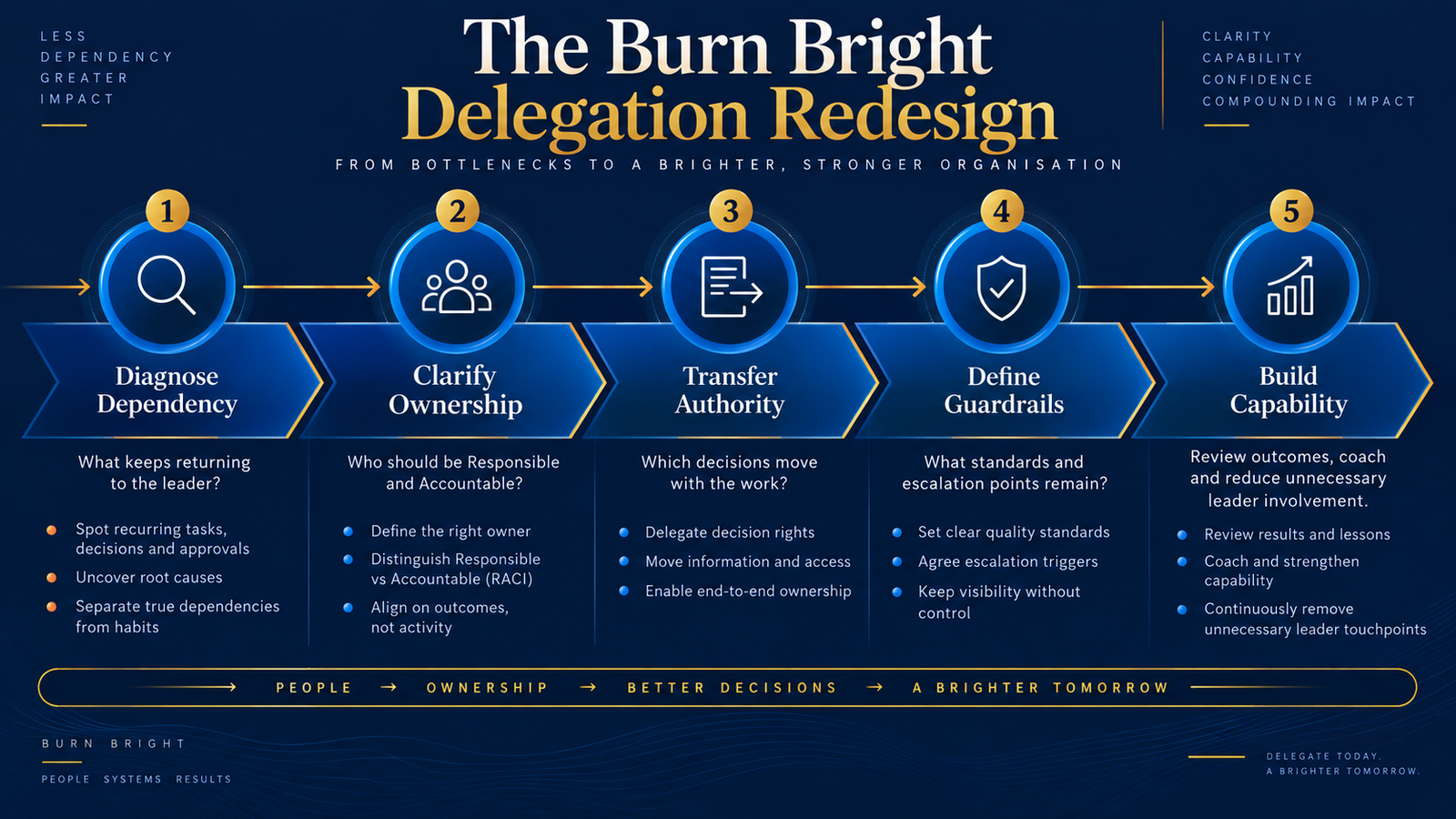
- Diagnose Dependency — What keeps returning to the leader?
- Clarify Ownership — Who should be Responsible and Accountable?
- Transfer Authority — Which decisions can move with the work?
- Define Guardrails — What standards and escalation points remain?
- Build Capability — Review outcomes, coach where needed and reduce unnecessary leader involvement.
The end state is not a leader with nothing to do. It is a leader doing more of the work that only leadership can do.
Why Is Delegation a Leadership Sustainability Strategy?
Delegation is often presented as a productivity technique. That undersells it.
Done properly, delegation is a form of organisational risk management.
A team that cannot operate without one person is vulnerable. If every major decision, client issue, approval or operational problem requires one leader, absence becomes dangerous. Holidays become difficult. Recovery becomes difficult. Succession becomes difficult.
The organisation has created a single point of failure.
The Burn Bright Not Out Framework™ places Workload Architecture™ and Decision Authority™ among its four structural transformation pillars.
That pairing matters. You cannot redesign workload without examining decision authority. And you cannot genuinely distribute responsibility while retaining every important decision at the top.
Better systems distribute work according to capability and authority. They create escalation rules. They develop people before the leader becomes overwhelmed. They reduce unnecessary dependencies.
Most importantly, they recognise that sustainable leadership cannot depend on one person’s willingness to keep absorbing more.
This is why delegation and perfectionism are not merely questions of personal management style. They are questions of organisational effectiveness.
If your team needs your constant involvement to maintain quality, the answer is not to keep becoming more available.
That is the shift from heroic leadership to sustainable leadership.
Better systems outperform more effort.
Frequently Asked Questions About Delegation and Perfectionism
Why do perfectionists struggle with delegation?
Perfectionists often struggle with delegation because they associate quality with personal control. They may trust another person’s capability but still believe the work needs to be completed in a particular way. Effective delegation separates genuine standards from personal preferences and gives capable people enough authority to deliver the agreed outcome.
How can I delegate without losing control?
Replace constant control with clear accountability. Define the outcome, non-negotiable standards, decision authority, escalation triggers and review points before work begins. You retain appropriate oversight without becoming involved in every step. The objective is not zero control. It is the right level of control for the level of risk.
What should a leader never delegate?
Leaders should retain responsibilities that genuinely require their authority, accountability or strategic judgement. Depending on the role, these may include critical governance decisions, sensitive people decisions, significant financial commitments, safeguarding responsibilities and strategic direction. The test is not whether you can do the work. Ask whether your position genuinely requires you to own it.
Can poor delegation cause leadership burnout?
Poor delegation can contribute to conditions associated with burnout by concentrating excessive work, decisions, interruptions and responsibility around one leader. The Burn Bright framework treats perfectionism culture, scope creep and decision overload as structural causes that can reinforce one another. Sustainable delegation reduces unnecessary dependency instead of asking leaders to become more efficient at carrying everything themselves.
How do I know if I am micromanaging rather than delegating?
Look at what happens after you assign work. If people still require your approval for routine decisions, you repeatedly check progress, rewrite competent work or dictate methods despite acceptable outcomes, you may have transferred tasks without transferring ownership. Genuine delegation gives people clear boundaries within which they can think, decide and act.
What is the best delegation framework for leaders?
RACI is useful because it distinguishes who is Responsible, Accountable, Consulted and Informed. For overloaded leaders, the revealing question is how many activities still place them in the Responsible category unnecessarily. The Burn Bright Not Out Framework™ includes RACI as one of its nine practical frameworks for addressing structural leadership overload.
Conclusion: Delegation Is About Building Capacity
Delegation and perfectionism become dangerous when high standards quietly turn into permanent leader dependency.
The problem is not caring about quality. The problem is building an organisation in which quality can only be maintained through your constant intervention.
If every significant document needs your rewrite, every difficult decision needs your approval and every problem eventually returns to you, working harder will not solve the problem.
The system needs redesigning.
Define the outcomes that matter. Separate standards from preferences. Put decision authority closer to the work. Establish clear escalation points. Develop people instead of repeatedly rescuing them. Use frameworks such as RACI to determine where responsibility genuinely belongs.
Then allow capable people to become capable in ways that are different from you.
That is one of the harder transitions in leadership. But it is also one of the most valuable.
Sustainable leadership is not about becoming indispensable to every process. It is about building systems, capability and accountability that do not require your permanent availability.
And when delegation and perfectionism collide, fix the system rather than asking the leader to absorb more.
As you look at your own situation today — are you leading from a place of clarity or a place of depletion?
Assess Where Leadership Overload Is Building
If delegation feels difficult because too much still depends on you, start with diagnosis rather than another productivity technique. The Leadership Burnout Self-Assessment can help you identify where workload, control and leadership pressure may be becoming unsustainable.
Free Leadership Intelligence
Get Weekly Leadership Insights
Join thousands of leaders receiving practical strategies on burnout prevention, workload design, and sustainable performance every week.