Quick Answer
Key Takeaways
- Reverse delegation occurs when delegated responsibility quietly returns to the manager.
- Helpful leaders can accidentally train teams to escalate problems instead of solving them.
- Unclear decision authority is often a bigger problem than employee capability.
- Taking work back may solve today’s problem while creating tomorrow’s dependency.
- Sustainable delegation requires explicit ownership, decision boundaries and escalation rules.
Reverse Delegation: Why Work Comes Back to Leaders
Reverse delegation is one of the least visible causes of leadership overload.
You delegate a piece of work on Monday. On Wednesday, someone asks for your opinion. By Thursday, you are reviewing the detail. On Friday, you are making the decision, rewriting the document or contacting the stakeholder yourself.
The task has quietly returned.
Nothing dramatic happened. Nobody refused to do their job. You may even feel that you were simply being supportive. But responsibility has moved in the wrong direction.
This matters because leadership burnout rarely comes from one catastrophic workload decision. It develops through hundreds of small transfers of responsibility. A question becomes a decision. A decision becomes a review. A review becomes ownership.
Eventually, the leader becomes the operational safety net for the entire team.
That pattern fits a wider Burn Bright principle: burnout is a system failure. The problem is not simply that leaders need to become tougher about delegation. The delegation system itself must make ownership, authority and escalation clear.
Here is how reverse delegation develops, why capable leaders unintentionally encourage it, and how to stop work continually climbing back up the organisational hierarchy.
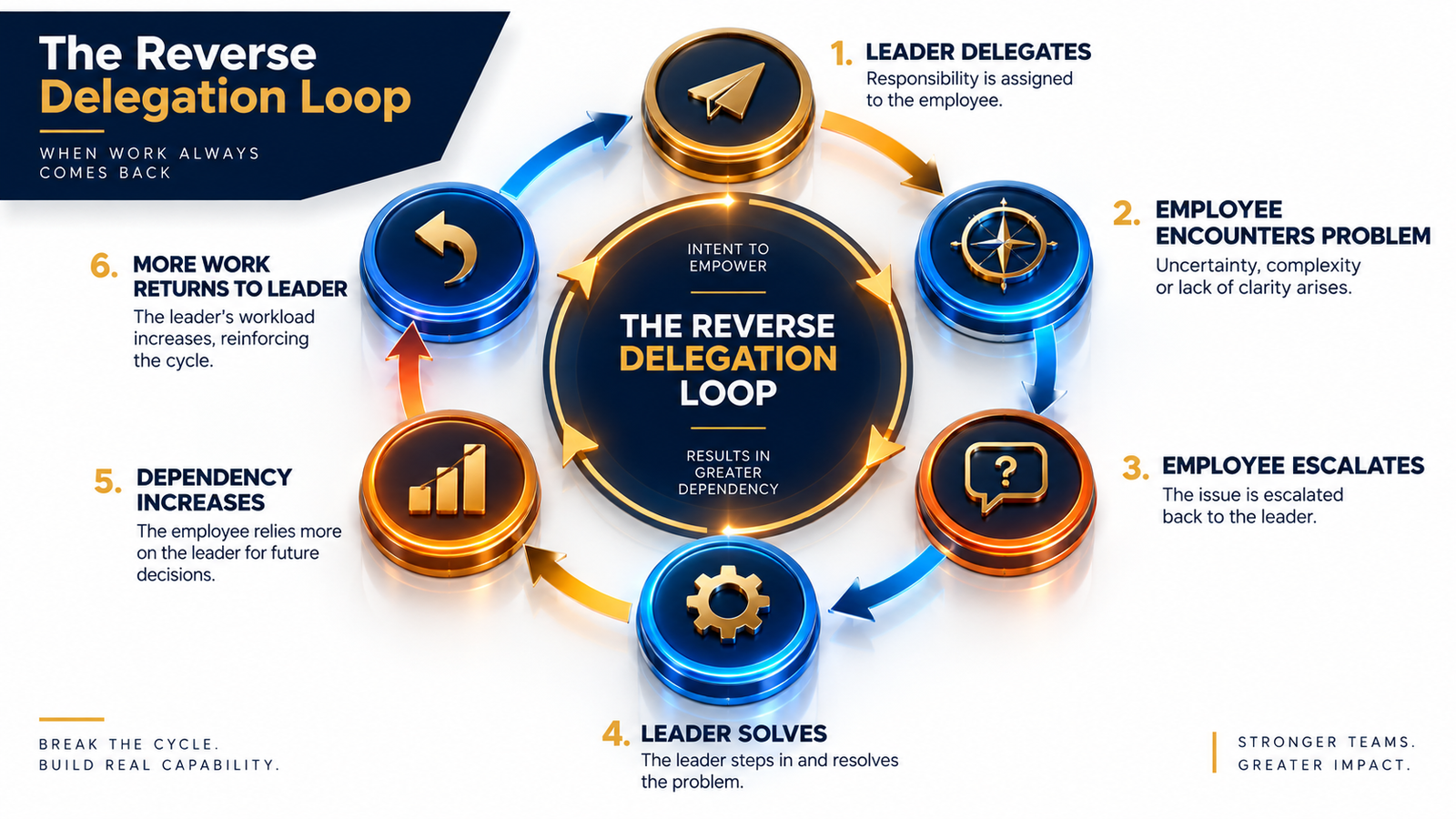
The critical point is that the task does not normally return in one obvious transfer. Ownership leaks back through repeated interactions.
Featured Snippet
What Is Reverse Delegation in Leadership?
Reverse delegation occurs when responsibility moves upwards instead of remaining with the person who has been given ownership.
It often begins innocently.
Imagine you ask a manager to prepare a proposal for improving a service. Two days later, they say: “I’ve looked at three options. Which one do you think I should choose?” You answer. Later they ask: “How would you present this to finance?” You explain. Then: “Could you look over the final version before I send it?” You rewrite three sections.
By the end of the process, they may still technically own the proposal. Functionally, however, you have become responsible for the analysis, decision and quality assurance.
That is reverse delegation.
The pattern matters because managers already operate under significant pressure. Gallup’s 2026 State of the Global Workplace reports that global manager engagement fell from 31% in 2022 to 22% in 2025. That nine-point decline matters because managers sit between organisational priorities and the teams expected to deliver them. Gallup has also identified competing priorities, workload, interruptions and job stress among recurring challenges for managers.
Reverse delegation adds another layer. The manager is not merely completing their own responsibilities. They become the decision processor for everybody else’s.
The Burn Bright framework identifies scope creep and decision overload as two root causes of burnout. Reverse delegation connects them. Every returned responsibility expands the leader’s operational scope while adding another decision to an already crowded cognitive workload.
This is why leaders need to distinguish between supporting the owner and becoming the owner.
You can coach someone without taking their problem.
You can provide context without making their decision.
You can challenge their thinking without completing their work.
Delegation fails when those boundaries disappear.
Why Does Reverse Delegation Happen?
Reverse delegation is easy to blame on employees. “They won’t take responsibility.” “They keep bringing everything back to me.” “They need constant reassurance.”
Sometimes capability is genuinely an issue. But stopping there produces a weak diagnosis.
Ask a more useful question: what has the system taught people to do?
Suppose every significant decision is challenged afterwards. Employees quickly learn that independent judgement carries risk. Suppose the manager rewrites work whenever it is imperfect. Employees learn that producing a first draft is enough because the manager will finish it. Suppose authority is vague. People learn that escalation is safer than ownership.
The resulting dependency may look like an individual performance problem, but the operating environment may be reinforcing it.
McKinsey has described the administrative burden experienced by middle managers as layers of process, paperwork and meetings. In one healthcare example, middle managers were dealing with more than 300 requests from headquarters in a week.
Add ambiguous decision rights to that environment and escalation becomes predictable.
There is another uncomfortable factor: high-performing leaders often reward reverse delegation without realising it.
Someone brings you a problem.
You know the answer.
Explaining how they should think about it may take 20 minutes.
Solving it yourself takes five.
So you solve it.
That feels efficient. It is not.
You have saved 15 minutes today while teaching the system to bring you the same category of problem tomorrow.
The fastest intervention today can therefore become the most expensive operating model tomorrow.
Better leadership asks a different question: am I resolving this issue, or am I strengthening the system that resolves issues? Those are not the same thing.
How Does Reverse Delegation Contribute to Burnout?
Burnout is frequently discussed as if the primary issue were personal resilience. The evidence points towards a more structural picture.
The World Health Organization defines burnout as an occupational phenomenon resulting from chronic workplace stress that has not been successfully managed. Its three dimensions include exhaustion, increased mental distance or cynicism towards work, and reduced professional efficacy.
The phrase that matters is chronic workplace stress.
Reverse delegation contributes to that stress because it makes workload unpredictable.
A leader may start Monday with ten genuine priorities. By Wednesday, five problems from other people’s roles have arrived in their inbox. None appeared in the original workload plan, yet each demands cognitive capacity.
This is invisible workload. It rarely appears on an organisational chart. It appears as:
“Can I quickly check something?”
“What would you do?”
“Could you approve this?”
“Can you join this meeting?”
“Would you speak to them?”
One request seems harmless. Fifty are not.
The problem becomes clearer when we examine workplace data. Deloitte’s 2024 research found that at least four in ten workers, managers and executives reported often or always feeling exhausted or stressed. It also found that 66% of managers would seriously consider moving to an organisation that better supported their wellbeing.
Deloitte’s UK research separately reported that 63% of respondents experienced at least one characteristic associated with burnout, while poor employee mental health was estimated to cost UK employers £51 billion annually.
The answer is not to turn delegation into another personal productivity technique. It is to redesign where work lives.
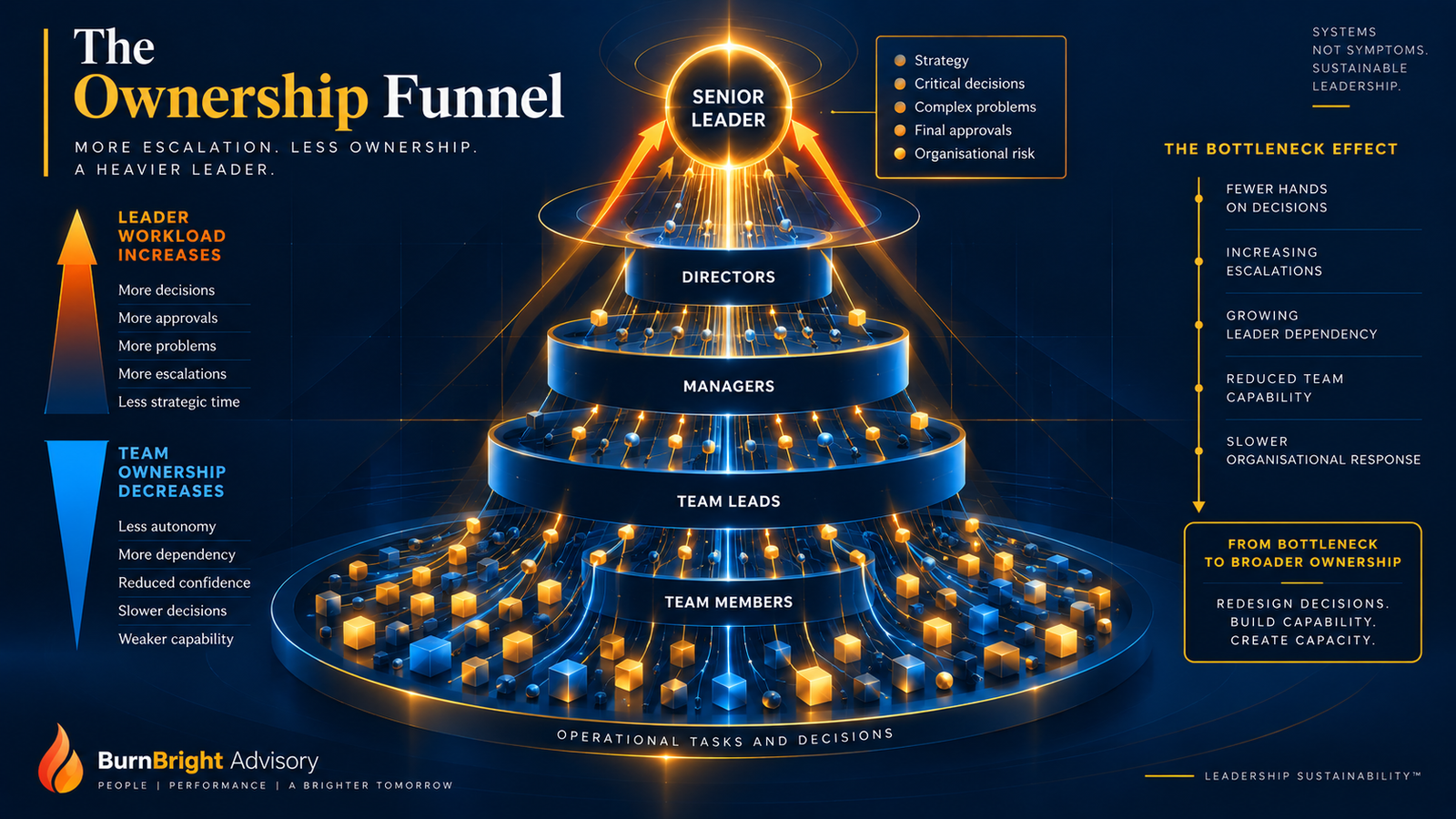
This visual exposes the structural problem. The higher the proportion of routine decisions that travel upwards, the less leadership capacity remains for strategic work.
A leader can have an organised calendar and still burn out if everybody else’s decisions keep landing inside it.
How Can Leaders Stop Work Coming Back to Them?
Stopping reverse delegation does not mean refusing to help people. It means changing the form of help.
When someone brings you a problem, resist immediately solving it. Instead, use three questions:
What do you think is happening?
This requires diagnosis rather than escalation.
What options have you considered?
This transfers cognitive work back to the owner.
What do you recommend?
This requires judgement.
The conversation changes immediately. Instead of “Here is a problem. Please solve it,” you create: “Here is a problem. Here is my analysis. Here are the options. Here is my recommendation.” That is a completely different management system.
The next step is to define decision authority. Delegation without authority is not genuine delegation. You have simply asked someone to carry a task while keeping the decision rights yourself.
The Burn Bright framework uses tools including Workload Architecture™, the RACI Delegation Framework™ and decision-fatigue management to address this structural problem.
A practical delegation conversation should establish five things:
- Outcome: What result is required?
- Owner: Who remains accountable for moving the work forward?
- Authority: What can they decide without permission?
- Escalation: Which circumstances genuinely require your involvement?
- Review: When will progress be assessed?
Notice what is missing. Constant checking.
If you delegate at 9:00 and ask for an update at 10:30, you are communicating something about ownership regardless of what you said verbally. You are saying: “I still hold this.”
This is why learning how to delegate without losing control requires a shift from monitoring activity to defining control points.
When Should a Problem Be Escalated?
Not all upward delegation is bad. Some decisions belong with senior leaders.
The problem is not escalation itself. The problem is unstructured escalation.
A team member should escalate when the decision exceeds their authority, creates significant organisational risk, requires resources they cannot authorise, crosses major functional boundaries or materially changes an agreed strategy. They should not escalate simply because the decision is uncomfortable.
This distinction matters. Many organisations accidentally create a culture where managers own every difficult decision while employees own only straightforward execution.
That is not empowerment. It is centralised dependency.
The solution is an escalation threshold, for example:
Level 1 Decide and Act
The employee has authority and does not need approval.
Level 2 Decide and Inform
The employee acts but keeps the manager aware.
Level 3 Recommend and Confirm
The employee conducts the analysis and recommends an action. The manager confirms because the consequences exceed delegated authority.
Level 4 Escalate
The matter involves substantial legal, financial, safeguarding, reputational or strategic risk and belongs at a higher level.
This removes one of the most common causes of reverse delegation: uncertainty.
Deloitte’s research reinforces why structural support matters. Its 2025 workplace survey found 66% of surveyed managers faced at least one organisational barrier preventing them from doing more to support employees, and 86% said they needed more help to improve employee wellbeing.
Managers cannot indefinitely absorb ambiguity on behalf of the organisation. Clear escalation rules distribute responsibility more intelligently. They also make building accountable teams far easier because accountability is connected to genuine authority.
What Does Sustainable Delegation Look Like?
Sustainable delegation is not about getting tasks off your desk. It is about designing a system in which work stays at the appropriate level.
That requires more than saying, “I trust you.” Trust matters. Architecture matters more.
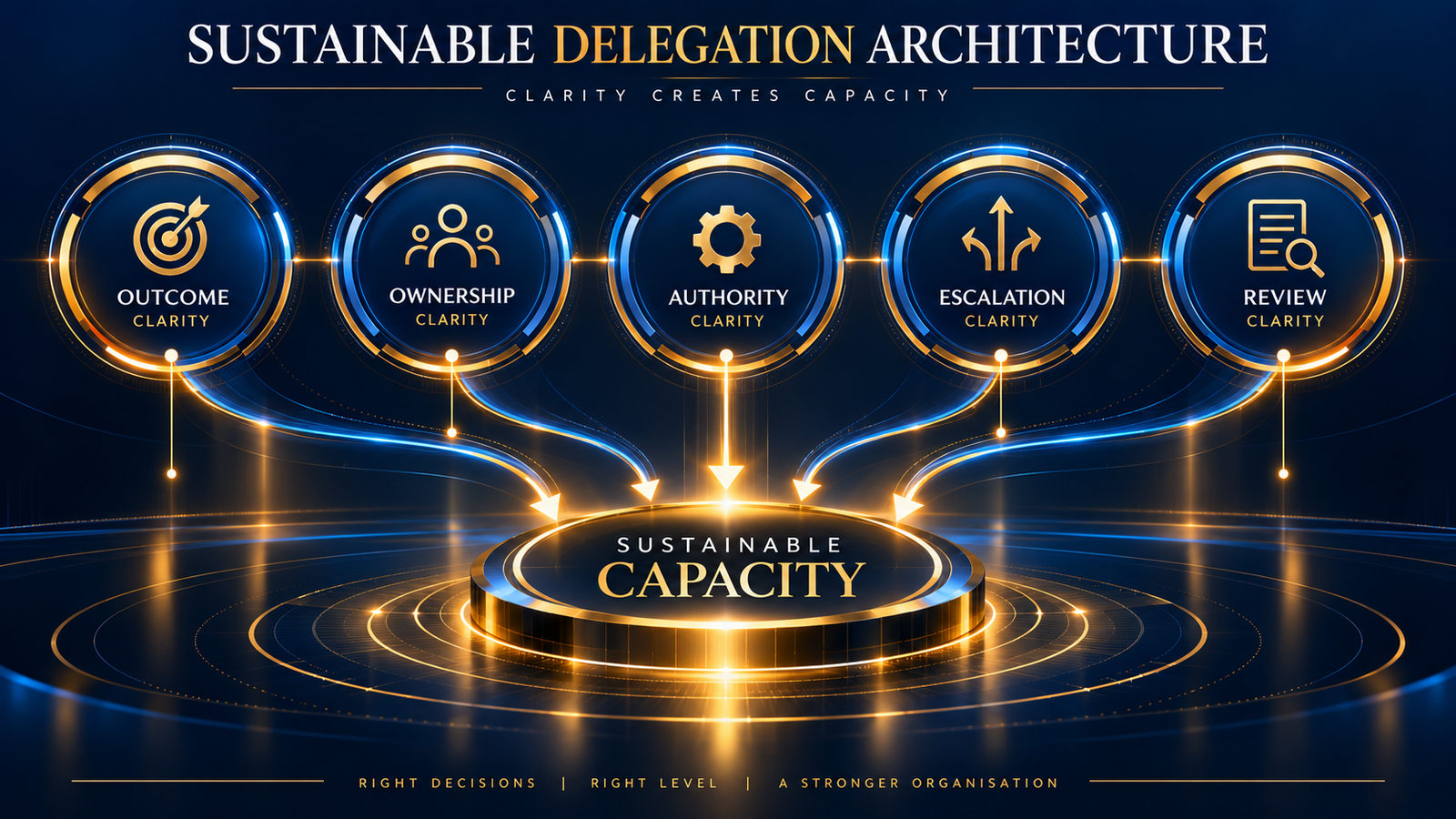
Think of delegation as a five-part architecture.
Element 1 Outcome Clarity
Defines what success looks like.
Element 2 Ownership Clarity
Identifies who carries responsibility.
Element 3 Authority Clarity
Determines what that person can decide.
Element 4 Escalation Clarity
Establishes when responsibility legitimately moves upwards.
Element 5 Review Clarity
Creates appropriate oversight without continuous intervention.
When these five elements are present, delegation becomes repeatable. Without them, delegation depends on personality. That is fragile.
The Burn Bright Not Out Framework™ argues for systems thinking over individual heroics and for workload management rather than simply expecting leaders to become more efficient.
That distinction is essential. You cannot sustainably lead an organisation in which every unresolved question eventually arrives at your desk. You also cannot develop future leaders if you continually protect them from making consequential decisions.
This is why delegation frameworks for leaders should be treated as organisational infrastructure rather than merely a management skill.
The same principle applies to delegation and perfectionism. If your standard is that every task must be completed exactly as you would complete it, responsibility will eventually return to you.
Sustainable leadership requires accepting a distinction between wrong and different. Someone else’s method can be different without being wrong.
Reverse Delegation vs Sustainable Delegation
| Reverse Delegation | Sustainable Delegation |
|---|---|
| Problems are escalated immediately | Problems arrive with analysis and recommendations |
| Manager remains default decision-maker | Decision rights sit at the appropriate level |
| Responsibility becomes ambiguous | Ownership remains explicit |
| Manager checks work continuously | Review points are agreed in advance |
| Mistakes lead to tighter control | Mistakes create learning and clearer guardrails |
| Employees seek reassurance | Employees exercise judgement |
| Manager becomes operational bottleneck | Team capacity expands |
| Workload accumulates at the top | Work is distributed through the system |
| Delegation creates temporary relief | Delegation creates sustainable capacity |
The difference is not whether the leader cares. Both leaders may care deeply. The difference is whether caring is expressed through rescuing or building capability.
How Can You Reset a Team That Already Reverse Delegates?
If reverse delegation is already established, simply telling people to “take more ownership” is unlikely to work. The existing behaviour developed inside an existing system.
Change the system.
Start with a one-week audit. Every time somebody brings you work, record what arrived and why. Do not judge it yet. At the end of the week, classify each item:
Category 1 Legitimate Escalation
It genuinely required your authority.
Category 2 Capability Gap
The employee lacked knowledge or experience.
Category 3 Authority Gap
The employee could have handled it but did not believe they had permission.
Category 4 Confidence Gap
The employee knew what to do but wanted reassurance.
Category 5 Habitual Reverse Delegation
The work returned because both parties had become accustomed to you taking it.
This diagnosis matters. Five similar interruptions may require five different responses. A capability gap requires development. An authority gap requires clearer decision rights. A confidence gap requires coaching. A habitual pattern requires behavioural boundaries. And a genuine escalation should still come to you.
This is structural leadership: diagnosis before intervention.
It also explains why leaders struggling to delegate cannot solve the issue merely by transferring more tasks. Poor delegation at greater scale simply creates more confusion.
Instead, redesign one recurring category of work first. Clarify its owner. Define decision authority. Set escalation thresholds. Agree the review point. Then observe what happens.
The goal is not to become unavailable. The goal is to become available for the work that genuinely requires leadership.
What is reverse delegation?
Reverse delegation occurs when work, responsibility or decisions previously delegated to an employee move back to the manager. It commonly happens through repeated escalation, excessive requests for approval, unclear decision authority or managers stepping in and completing work themselves.
Why do employees reverse delegate?
Employees may reverse delegate because authority is unclear, they fear making mistakes, previous decisions have been criticised, they lack capability or they have learned that escalating a problem is easier than solving it. The cause should be diagnosed before assuming the issue is poor attitude.
How do I stop reverse delegation without being unsupportive?
Change your response from providing answers to developing thinking. Ask what the employee believes is happening, which options they considered and what they recommend. Provide coaching and context while leaving responsibility for moving the work forward with the designated owner.
Is reverse delegation a sign of poor management?
It can indicate a management-system problem, but it should not automatically be treated as evidence of a bad manager. Reverse delegation can emerge from unclear roles, weak decision rights, risk-averse cultures, capability gaps and perfectionist leadership. Diagnose the pattern rather than blaming the individual.
When should employees escalate a decision?
Escalation is appropriate when a decision exceeds delegated authority or creates material legal, financial, safeguarding, strategic or reputational risk. Routine discomfort, uncertainty or fear of being wrong should not automatically trigger escalation if the decision sits within the employee’s authority.
Can reverse delegation cause leadership burnout?
Reverse delegation can contribute to leadership burnout because it creates hidden workload and decision overload. The leader becomes responsible not only for their own role but also for recurring decisions and problems from elsewhere in the team, reducing capacity for strategic work and recovery.
Conclusion
Reverse delegation looks small when viewed one interaction at a time.
A question here.
An approval there.
A document you decide to rewrite because doing it yourself feels faster.
But leadership overload is often built exactly this way. Responsibility moves upwards one decision at a time until the leader becomes the final destination for every difficult problem.
That is not sustainable leadership.
The solution is not to care less about your team’s work. It is to build stronger structures around ownership, authority, escalation and review.
Better systems outperform more effort. The leader’s job is not to personally carry every problem to completion. It is to create the conditions in which the organisation can solve more problems without depending on constant leadership intervention.
Take the Leadership Burnout Self-Assessment
If work is continually flowing back towards you, the issue may be larger than delegation. The Leadership Burnout Self-Assessment helps identify where workload, decision pressure and structural demands may be creating unsustainable leadership conditions.
Free Leadership Intelligence
Get Weekly Leadership Insights
Join thousands of leaders receiving practical strategies on burnout prevention, workload design, and sustainable performance every week.