Quick Answer
Key Takeaways
- Answering every question makes a leader feel useful, but repeated hundreds of times it turns the leader into the organisation’s thinking bottleneck.
- Leadership dependency is a system outcome: when escalation is rewarded and experimentation is punished, escalation becomes the rational choice.
- The Burn Bright Thinking Architecture™ (Interpret → Evidence → Challenge → Construct → Act) turns everyday problems into development.
- The Question–Coach–Challenge–Release Model™ moves people from dependence to independent judgement, and it only works if leaders genuinely release authority.
- Delegating tasks is not the same as developing judgement; one transfers work, the other transfers thinking.
- Constructivism Intelligence™ is not the abandonment of direction. It is knowing when to direct and when to develop.
- Distributing thinking capability multiplies Leadership Capacity™ and strengthens Leadership Sustainability™.
Executive Summary
One of the easiest ways for a knowledgeable leader to become indispensable is to answer every question.
It is also one of the easiest ways to create dependency.
A team member encounters a problem and asks the leader what to do. The leader has seen the problem before, so answering takes thirty seconds.
The problem disappears.
Everyone moves on.
It looks like effective leadership.
But repeat that interaction hundreds of times and something important begins to happen.
Employees become skilled at escalation rather than interpretation. Managers become hesitant to make decisions without approval. Meetings become forums for obtaining answers rather than developing understanding. The leader becomes increasingly overloaded while the people around them remain less capable than they could be.
The immediate problem has been solved.
The organisation’s long-term capability has not.
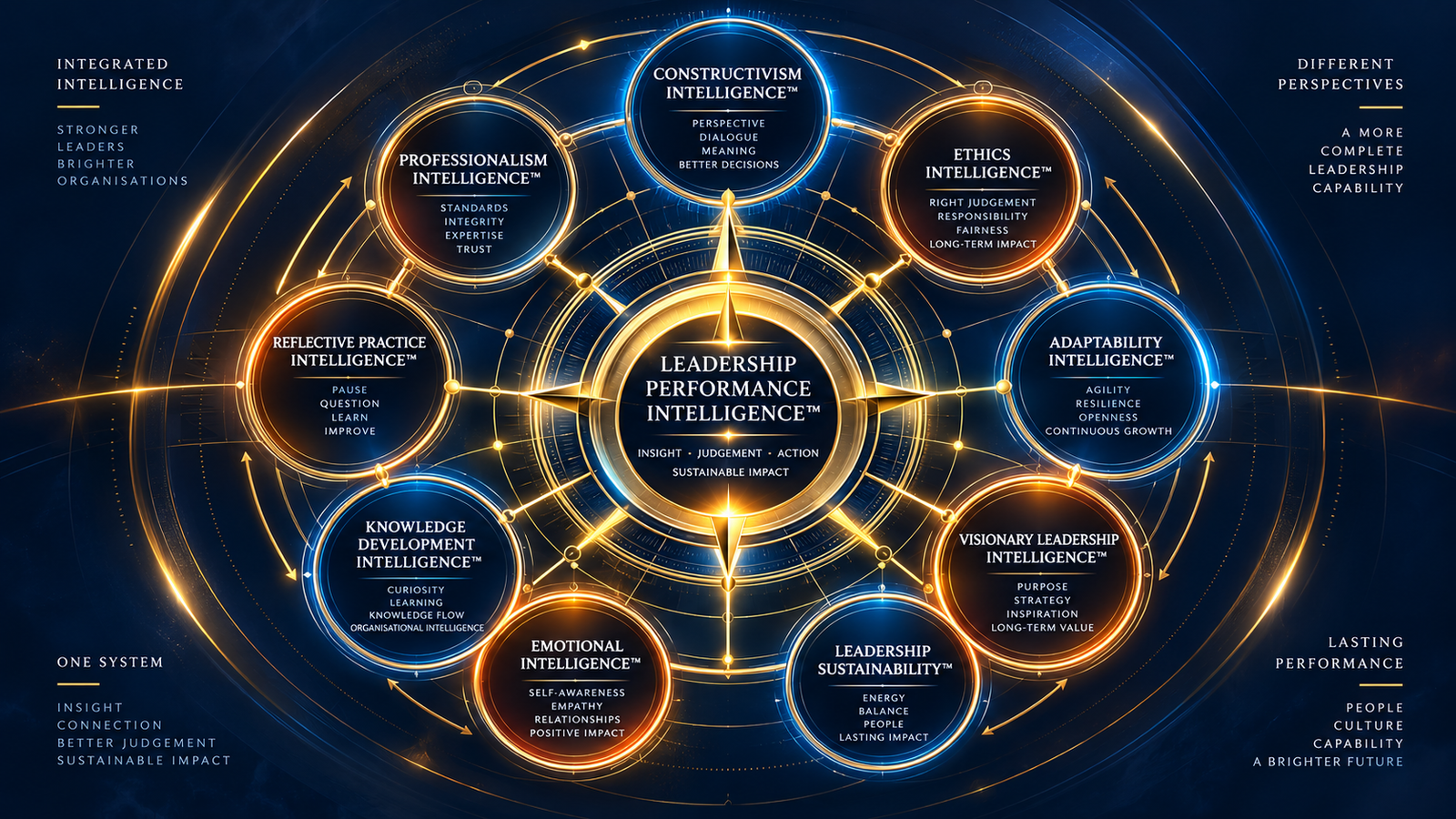
This is one of the central challenges addressed by Constructivism Intelligence™ within the Burn Bright Advisory™ Leadership Intelligence Compass™.
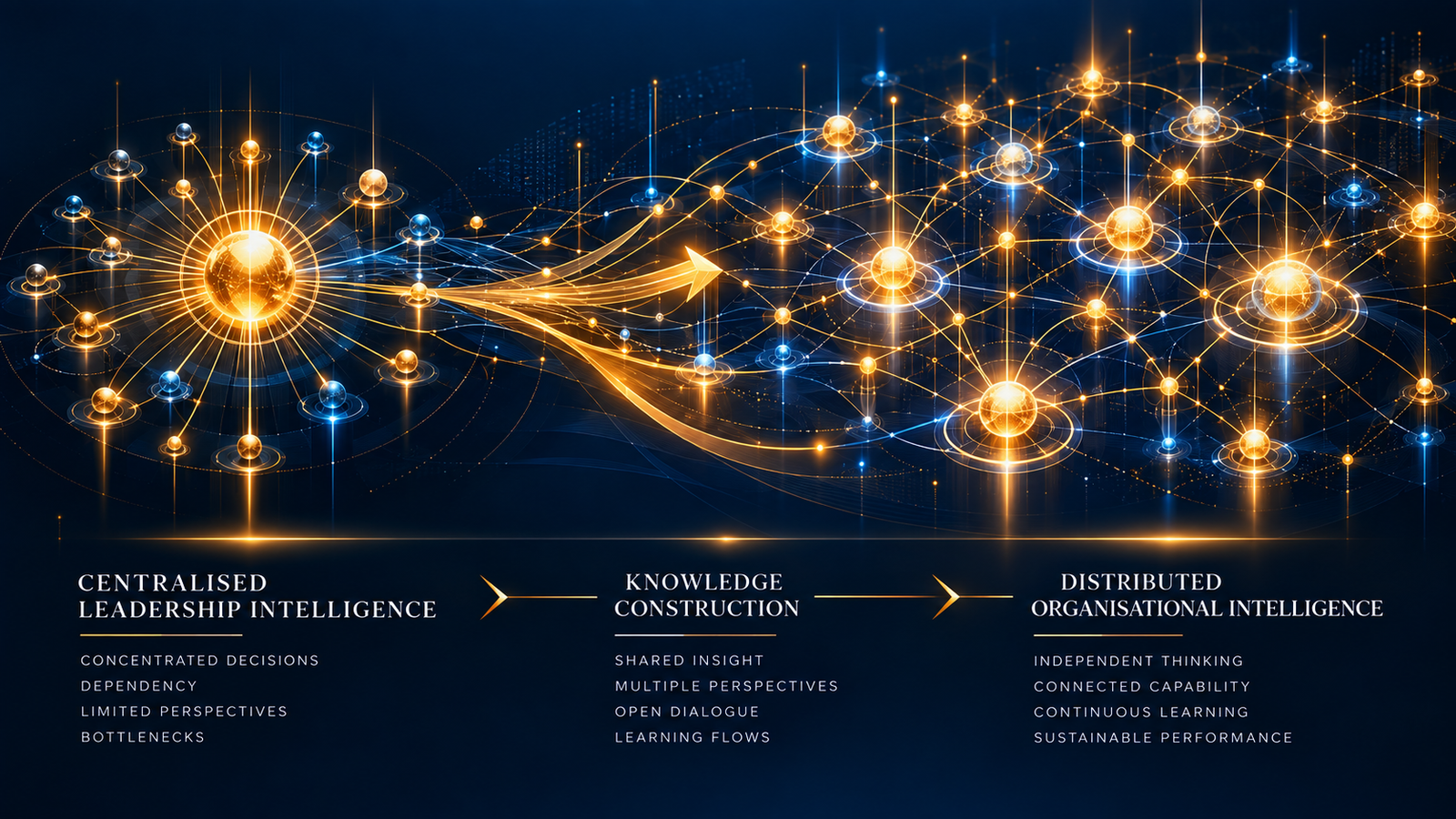
Constructivist leadership starts from a different premise: leadership development should not merely transfer the leader’s existing knowledge to other people. It should strengthen people’s capacity to construct knowledge, exercise judgement, test assumptions, interpret experience and solve increasingly complex problems themselves.
That requires a significant shift:
From answering to questioning.
From instructing to enabling.
From dependency to capability.
From being the source of intelligence to developing intelligence throughout the system.
This does not make leadership passive. It makes leadership developmental.
And in organisations where leaders are simultaneously confronting growing complexity, increasing workloads and constant demands for decisions, developing other people’s thinking may be one of the most important forms of leadership capacity building available.
The Hidden Cost of Being the Leader With All the Answers
Competence creates expectations.
The more capable you become, the more people bring you difficult problems.
Initially, this feels appropriate. You were promoted because of your knowledge. Your experience allows you to recognise patterns others miss. You can often reach a solution more quickly than someone encountering the problem for the first time.
So you answer.
Then you answer again.
Soon, the team learns something.
Not necessarily how to solve the problem. They learn where the answer lives.
With you.
Featured Snippet
The consequences can be subtle:
- Employees hesitate before acting.
- Managers escalate relatively routine decisions.
- Senior leaders become copied into increasing numbers of emails.
- Meetings accumulate because approval requires access to the decision-maker.
- People stop experimenting because asking the leader feels safer.
And the leader begins to wonder why nobody seems willing to take ownership.
Yet the system may be producing precisely the behaviour it rewards.
When people who ask receive immediate answers while people who experiment risk criticism for getting something wrong, escalation becomes rational.
When leaders routinely correct rather than explore thinking, people learn to seek validation before action.
When seniority becomes synonymous with having the answer, uncertainty becomes something employees hide rather than investigate.
- Who is expected to think?
- Who is permitted to interpret?
- Who can make meaning from experience?
- Who is trusted to exercise judgement?
- And where does intelligence sit within the organisation?
These questions are central to Leadership Performance Intelligence™.
What Constructivism Leadership Changes
Constructivism offers a different way of understanding development.
Knowledge is not treated simply as something one person possesses and another person receives.
People develop understanding by connecting new information with previous experience, testing assumptions, engaging with different perspectives, reflecting on consequences and reconstructing what they believe.
For leaders, this changes the developmental task.
The traditional response to a team member asking “What should I do?” is to provide an answer.
A constructivist response may begin with “What do you think is happening?” Then:
- “What options have you considered?”
- “What evidence supports your interpretation?”
- “What might you be missing?”
- “Who else sees this situation differently?”
- “What would you recommend if I weren’t available?”
Those questions can initially take longer than giving the answer. That is precisely why many overloaded leaders avoid them.
But leadership must distinguish between time saved today and capacity created for tomorrow.
Giving an answer may resolve one problem.
Developing judgement may resolve the next twenty without the leader.
That is the strategic value of constructivism leadership.
The Answer Trap
There is an uncomfortable leadership paradox here.
Consider an experienced school principal. A middle leader brings a difficult staffing issue. The principal has handled similar situations repeatedly and immediately explains what should happen.
Problem solved.
A week later, the middle leader brings another problem. Again, the principal solves it. Then another.
The principal eventually complains that middle leaders need to become more independent.
But independence cannot develop in an environment where difficult thinking is consistently transferred upward.
The same pattern appears across sectors:
- In business, a founder approves every significant commercial decision because nobody understands the company as deeply as they do.
- In healthcare, an experienced clinical leader becomes the person colleagues consult whenever ambiguity emerges.
- In public service, senior officials retain decision authority because the policy environment is considered too sensitive for less experienced staff.
- In HR, a senior people leader becomes the final interpreter of every complicated employee issue.
Each decision may be defensible individually. Collectively, however, they can produce a system in which expertise becomes concentrated rather than multiplied.
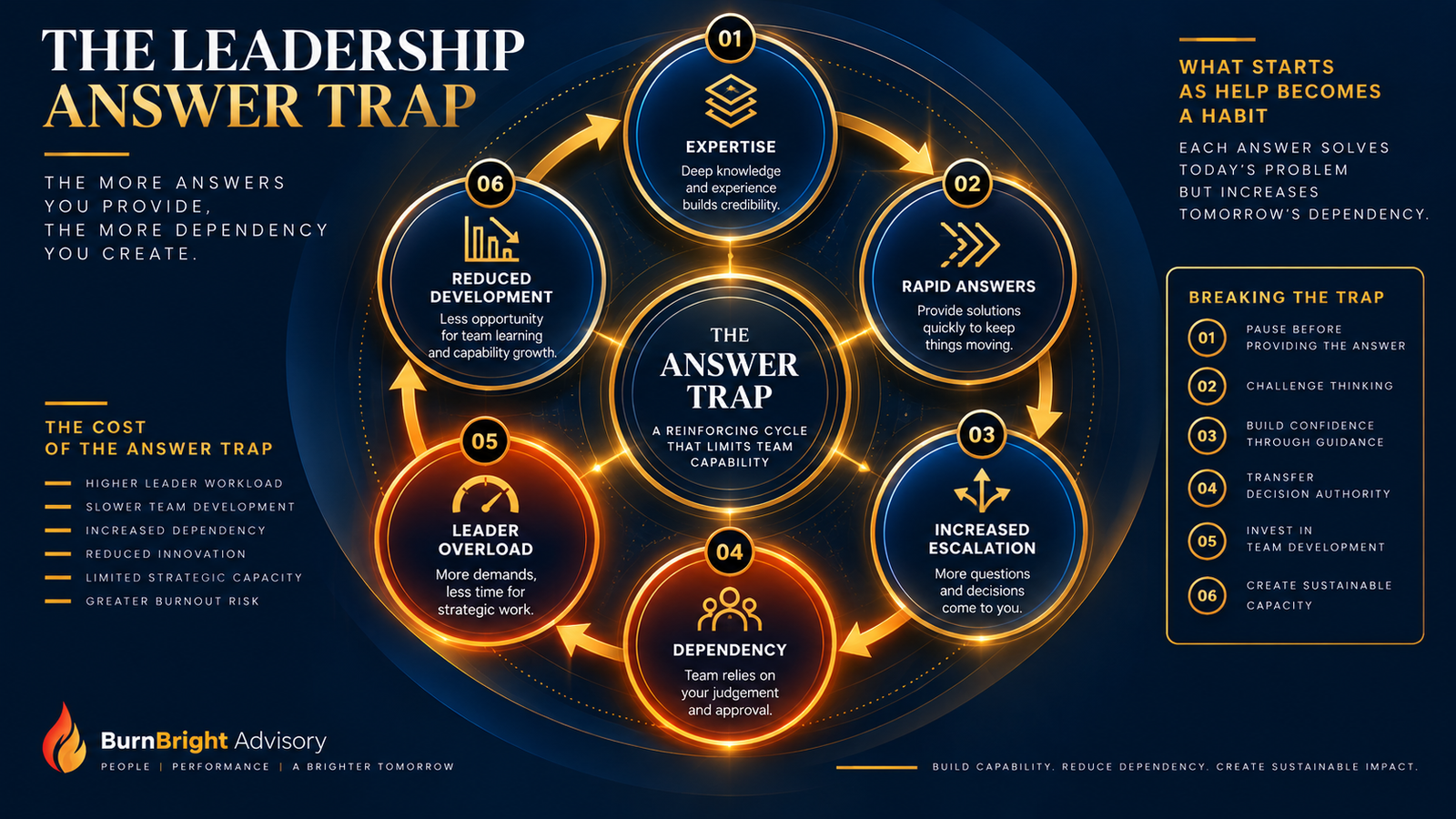
The answer trap follows a predictable pattern:
The leader’s competence unintentionally creates the conditions for greater dependence on that competence.
Breaking the cycle requires a different leadership question. Instead of “How quickly can I solve this?” ask:
That is Constructivism Intelligence™ in practice.
From Problem Solver to Thinking Architect
Constructivist leadership does not require leaders to stop solving problems. There are circumstances in which immediate direction is necessary:
- A safety emergency is not the moment for a forty-minute reflective conversation.
- A serious ethical breach requires clarity.
- A regulatory requirement may leave little room for interpretation.
- An inexperienced employee may need explicit instruction before independent judgement becomes appropriate.
Constructivism Intelligence™ is therefore not the abandonment of direction. It is the intelligent selection of when to direct and when to develop.
This distinction is important. A leader operating only in directive mode may produce compliance without capability. A leader operating only in facilitative mode may create ambiguity where clarity is required.
Leadership Performance Intelligence™ requires both. The question becomes:
That is a more sophisticated leadership question than simply deciding whether to tell or ask. It introduces development into everyday work.
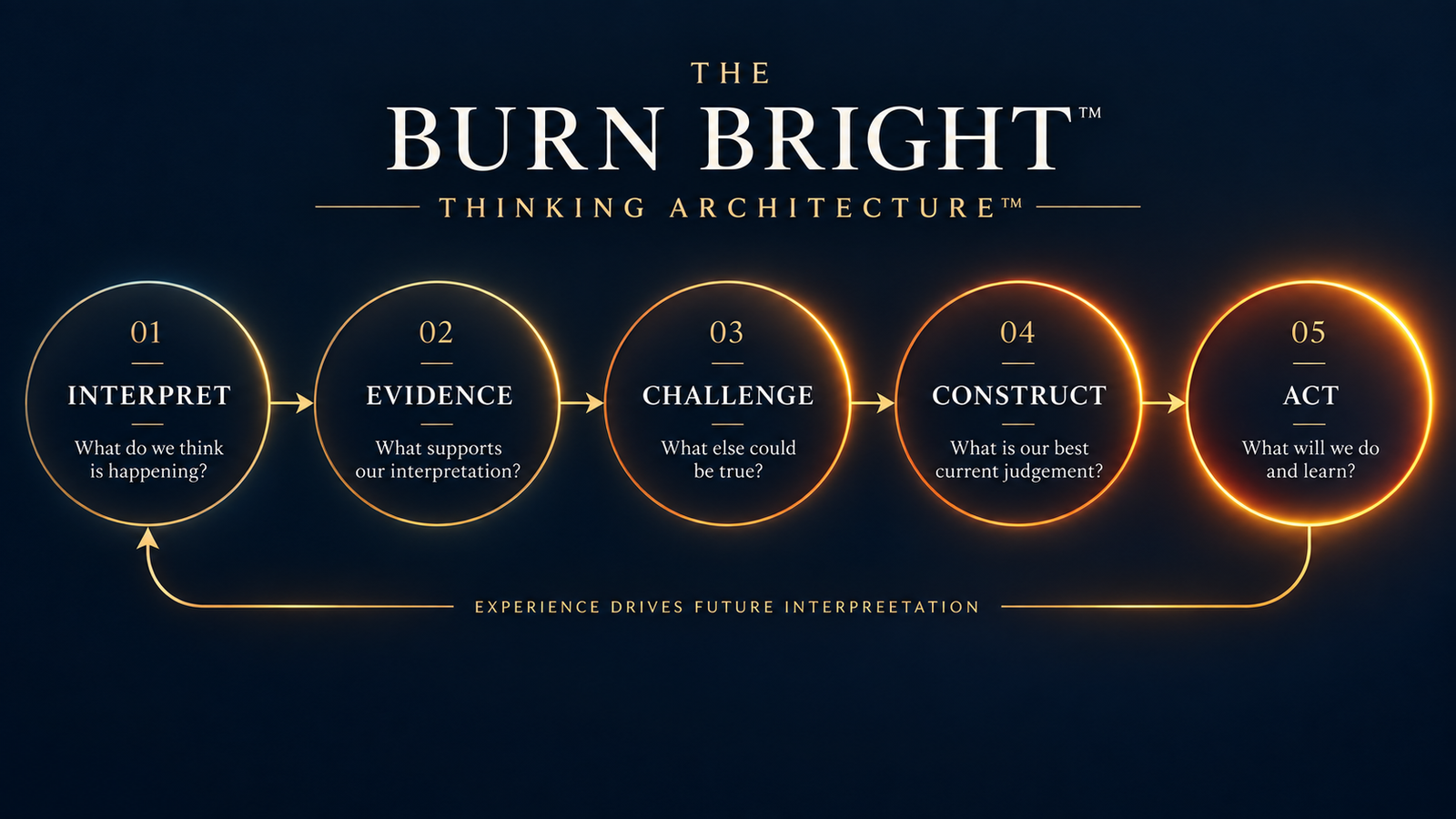
The Burn Bright Thinking Architecture™
A practical constructivist conversation can be organised around five stages:
Stage 1 Interpret: What Do You Think Is Happening?
Before offering your interpretation, invite theirs. This exposes the mental model behind the person’s proposed response.
- “What do you think the core issue is?”
- “What are you noticing?”
- “How are you interpreting the situation?”
This matters because two people can observe exactly the same event and construct very different explanations. An employee misses a deadline. One manager interprets this as poor accountability. Another sees workload overload. The employee sees unclear priorities. A colleague sees a dependency elsewhere in the workflow.
If the leader immediately declares the explanation, those competing interpretations disappear from consideration. Constructivist leaders surface them.
Stage 2 Evidence: What Makes You Think That?
Interpretation should then meet evidence.
- “What evidence supports that conclusion?”
- “What have you observed directly?”
- “What are you assuming?”
- “What information don’t we have?”
This is where constructivism separates itself from unstructured opinion-sharing. Collaborative leadership does not mean accepting every view as equally accurate. The purpose is to improve understanding. Evidence helps teams distinguish observation from assumption and confidence from accuracy.
Stage 3 Challenge: What Else Could Be True?
Good thinking requires friction. Not interpersonal conflict for its own sake, but intellectual challenge.
- “What alternative explanation could there be?”
- “How might the customer interpret this?”
- “What would someone who disagrees with us say?”
- “What are we not seeing from our position?”
- “What evidence would change your mind?”
These questions make assumptions visible. They also connect Constructivism Intelligence™ with Reflective Practice Intelligence™. Reflection becomes more powerful when leaders do not simply review what happened but examine the thinking that produced the action.
Stage 4 Construct: What Is Your Best Current Judgement?
The leader now asks the individual or team to construct a response. Not a perfect answer. A reasoned judgement.
- “What do you recommend?”
- “What would you do next?”
- “What have you changed your mind about?”
- “What is now the strongest interpretation?”
This is a critical developmental moment. If the leader asks ten excellent questions and then supplies the answer anyway, the underlying dependency remains. People need opportunities to convert thinking into judgement.
Stage 5 Act: What Will You Do and What Will We Learn?
Constructivist leadership ends with action.
- “What will you do?”
- “What outcome do you expect?”
- “What will tell us whether the assumption was correct?”
- “When should we review what happened?”
This converts work into a learning cycle. Action generates experience. Experience generates evidence. Evidence generates reflection. Reflection modifies understanding. And improved understanding influences the next action.
Why This Builds Leadership Capacity
The significance of this approach extends beyond individual development. It changes the distribution of intelligence across an organisation.
Imagine two teams of ten people.
In Team A, difficult judgement consistently travels upward to the manager. The organisation effectively has one primary decision-maker supported by nine implementers.
In Team B, the manager deliberately develops the judgement of the other nine people while maintaining appropriate accountability. The organisation gradually develops ten people capable of interpreting situations, identifying evidence, challenging assumptions and making increasingly sophisticated decisions.
And this is where Constructivism Intelligence™ connects directly with Leadership Capacity™.
Leadership capacity is not simply how much work a leader can personally absorb. A more sustainable definition asks how much effective leadership the system can generate.
The manager who personally solves 50 problems may appear highly capable. The manager whose team solves 45 appropriately and escalates the five that genuinely require senior judgement may have built considerably greater organisational capacity.
This also connects with Leadership Sustainability™. Leaders who remain the central point for knowledge, decisions, relationships and problem-solving create fragile systems:
- Their absence becomes operationally significant.
- Their workload expands with organisational growth.
- Their teams struggle to function independently.
- The leader becomes increasingly difficult to replace.
Sustainable leadership therefore requires more than personal resilience. It requires distributing capability. Constructivism leadership provides one mechanism for doing so.
The Difference Between Delegating Tasks and Developing Judgement
Many organisations believe they are distributing leadership because they delegate work. But task delegation and judgement development are not the same thing.
A leader can delegate considerable activity while retaining almost every meaningful decision. The team becomes busier without becoming more capable.
Consider the difference. A task-based instruction might be:
A judgement-development approach might be:
The first transfers work. The second begins transferring thinking.
Over time, the leader can progressively adjust the level of autonomy as capability develops.
This principle is consistent with a broader Burn Bright approach to sustainable delegation: successful delegation requires not merely transferring tasks but establishing success criteria, appropriate decision authority and clear escalation pathways.
Constructivism Intelligence™ takes this further. The objective is not simply “Can this person complete the task without me?” It becomes:
That is a far more valuable organisational capability.
| Answer-Driven Leadership | Constructivist Leadership |
|---|---|
| “Here’s what you need to do.” | “What do you think is happening, and what do you recommend?” |
| Delegates tasks: “Send it to me before anything goes to the client.” | Develops judgement: “Bring me the recommendation, the evidence, the risks and your decision.” |
| The team learns where the answer lives | The team learns how to interpret, reason and decide |
| One decision-maker supported by nine implementers | Ten people capable of sound judgement |
| The leader personally solves 50 problems | The team solves 45; only the 5 that need senior judgement are escalated |
| “How quickly can I solve this?” | “What does this situation allow someone else to learn?” |
| Capability concentrated; the leader becomes the bottleneck | Capability distributed; leadership is multiplied |
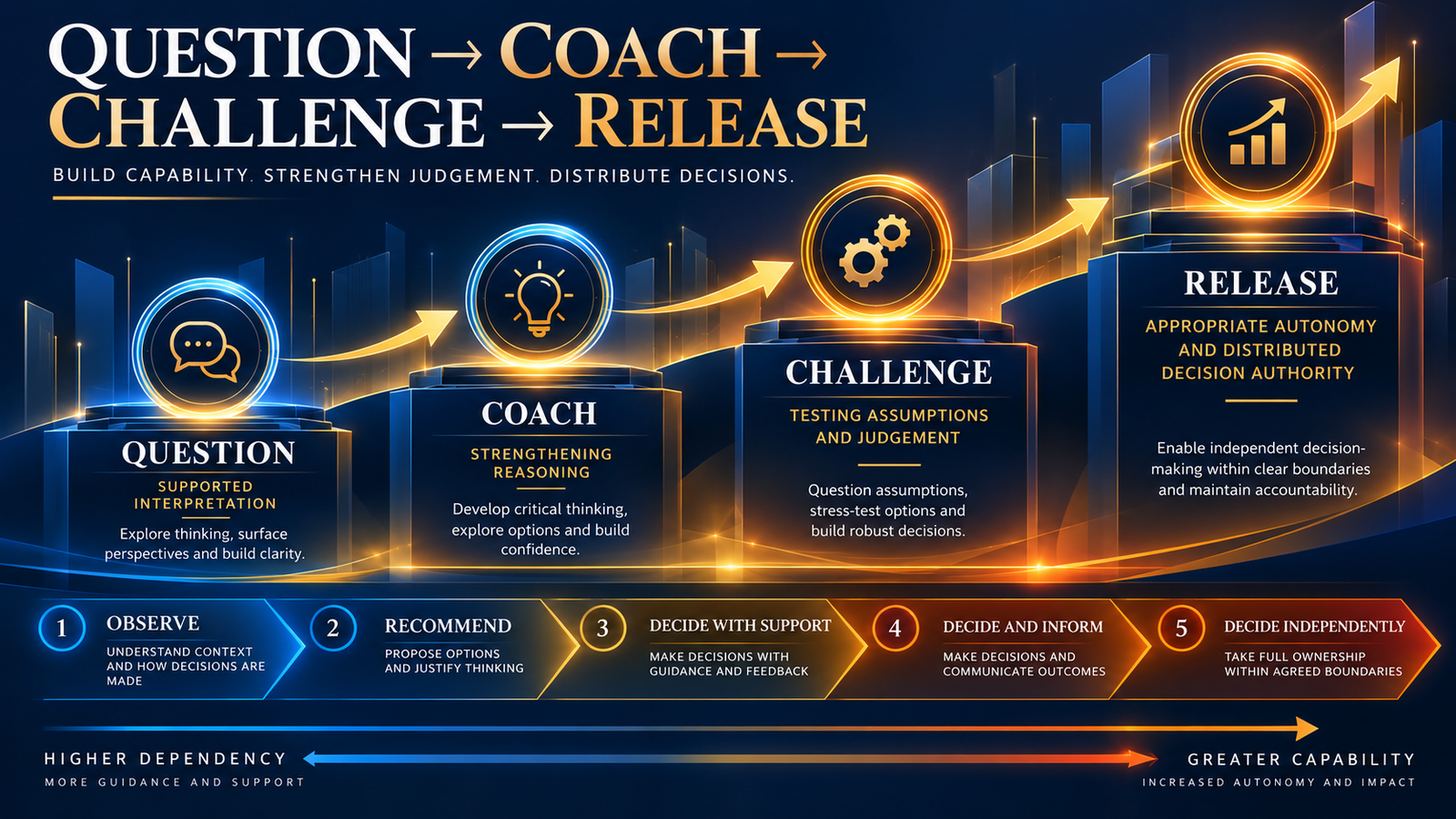
The Question–Coach–Challenge–Release Model™
If constructivist leadership is intended to build independent judgement, leaders need more than a collection of good questions. They need a developmental pathway.
People rarely move directly from dependence to complete autonomy. Capability develops through experience, feedback, reflection and progressively greater responsibility.
The Burn Bright Question–Coach–Challenge–Release Model™ provides a practical structure for that progression:
The objective is simple: gradually reduce unnecessary dependence on the leader while increasing the individual’s capacity to think and act effectively.
Stage 1
Question
Begin by resisting the instinct to solve. When someone brings you a problem, ask them to interpret it first. Instead of “Here’s what you need to do,” try:
- “What do you think is happening?”
- “What options have you considered?”
- “What outcome are you trying to achieve?”
- “What would you recommend?”
This small behavioural shift changes the intellectual ownership of the conversation. The problem remains theirs to think about. The leader becomes a resource for improving the thinking rather than replacing it.
This stage is particularly important when a team has become accustomed to highly directive leadership. People may initially respond: “I don’t know. That’s why I’m asking you.” That does not necessarily indicate an absence of capability. It may indicate a learned pattern. If the organisation has historically rewarded escalation, employees will understandably escalate. Constructivist leadership gradually changes that expectation.
Stage 2
Coach
Questioning reveals how someone is thinking. Coaching helps strengthen that thinking.
The leader might notice that the employee has considered operational consequences but overlooked stakeholders. Or perhaps they have identified the immediate problem but not its underlying cause. The leader can then provide prompts:
- “Who else will be affected?”
- “What happened the last time we tried something similar?”
- “What constraint are you treating as fixed?”
- “What data would help you make this decision?”
The objective is not to demonstrate superior knowledge. It is to make the person’s reasoning more sophisticated. Good coaching therefore develops mental processes, not merely correct answers.
That distinction matters because tomorrow’s problem may look completely different. If people only learn the solution to yesterday’s problem, development remains narrow. If they learn how to investigate, interpret and reason, their capability becomes transferable.
Stage 3
Challenge
As capability increases, so should intellectual challenge. Constructivist leaders do not create psychologically safe environments by removing disagreement. They create environments where disagreement can improve thinking without becoming interpersonal threat.
- “You’re confident this is the right option. What evidence could prove you wrong?”
- “What assumption is your recommendation dependent upon?”
- “If we couldn’t use this solution, what would your second option be?”
- “How would someone from another function challenge this?”
- “What unintended consequence could emerge?”
Challenge matters because experience can create confidence faster than judgement. The purpose is not to undermine confidence. It is to develop calibrated confidence: the ability to act decisively while remaining open to evidence that an interpretation may be incomplete.
That capability becomes increasingly important as leaders move into positions where decisions involve ambiguity rather than certainty.
Stage 4
Release
Development ultimately requires real authority. At some point, leaders must allow people to exercise the judgement they have been developing. That means releasing appropriate decisions rather than indefinitely retaining approval.
The transition might move through several levels: Observe → Recommend → Decide with support → Decide and inform → Decide independently.
The level should reflect competence, risk and context. A new manager handling a sensitive employee matter may initially need close support. The same manager, after repeated experience and demonstrated judgement, should not require the same level of approval forever.
Without release, coaching becomes performative. The leader appears to develop people while continuing to control every meaningful decision.
Constructivist leadership therefore asks a difficult question:
Constructivist Leadership Across Sectors
The principles remain consistent across organisations, but their application changes according to context.
🏢 Business Growth Intelligence™
Consider a growing company whose founder remains involved in every significant commercial decision. During the startup phase, this may have been essential. But growth changes the equation. If every pricing decision, partnership proposal and customer exception still requires founder approval, the organisation’s decision capacity does not scale with its revenue. A constructivist founder asks managers to present the evidence, the commercial assumptions, the risks, the alternatives and their recommended decision. Over time, decision rights can move outward. The founder’s expertise has not disappeared; it has become a developmental resource. That is a more scalable form of leadership.
🏫 School Leadership Intelligence™
Experienced principals can easily become the default solution to difficult problems: declining attainment, a behavioural challenge, a difficult parent complaint. Immediately prescribing the response can unintentionally prevent other leaders from developing. A constructivist principal might instead ask: “What evidence are you using? What have you already tried? What might the student or parent be experiencing differently? What options are available? What do you recommend?” The principal still maintains responsibility for standards and safeguarding, but everyday problems become opportunities for leadership development rather than automatic escalation. The result is greater leadership capacity across the school.
🏥 Healthcare Leadership Intelligence™
Healthcare illustrates why constructivism must always operate alongside professional expertise and appropriate authority. Clinical protocols, safety requirements and professional standards cannot simply become matters of collective preference. Yet healthcare organisations depend on people being willing to question assumptions and surface information: a nurse noticing an emerging risk, a multidisciplinary team examining a patient-safety event, a clinical leader reviewing an unsuccessful intervention. Constructivist leadership complements rather than replaces clinical knowledge. It asks: how do we create environments where expertise can interact, concerns can surface and experience can improve future practice?
🏛️ Public Service Leadership Intelligence™
Public-service leaders often operate within significant policy, regulatory and accountability constraints. Yet implementation occurs in complex communities where centrally designed solutions encounter local realities. Constructivist leadership creates structured mechanisms through which frontline experience can inform organisational understanding. The question is not whether policy requirements should be ignored whenever employees disagree. It is whether leaders can distinguish between legitimate requirements and assumptions about how those requirements must be implemented. That distinction creates room for learning while preserving accountability.
👥 HR & People Leadership Intelligence™
People professionals routinely encounter problems for which policy alone cannot provide a complete answer. Constructivist HR leadership moves beyond positioning HR as the department that provides managers with answers. Rather than simply telling a manager how to conduct a difficult conversation, the HR leader can explore: What outcome are you seeking? What behaviour have you observed? What assumptions are you making about the employee’s intentions? What evidence supports your conclusion? How might the employee understand the situation? What would a fair process require? The immediate issue still receives attention, and the manager becomes better equipped for the next one.
🚀 Entrepreneur Performance Intelligence™
Entrepreneurs face a distinctive constructivist challenge because their businesses frequently originate from their personal knowledge, judgement and energy. That creates strength early and dependency later. If the entrepreneur remains the chief salesperson, strategist, problem solver, relationship holder and decision-maker, growth increases personal workload faster than organisational capability. The challenge is not merely learning to delegate. It is learning to externalise judgement: making previously intuitive decision criteria visible, and allowing someone to reach a different conclusion without automatically assuming yours is superior. These questions transform entrepreneurial expertise into organisational capability.
Collaboration Does Not Mean Consensus
One misunderstanding deserves particular attention. Constructivist leadership does not require every decision to be made collectively. Nor does it require consensus.
Consultation and decision authority are different things. A leader can genuinely seek multiple interpretations, examine evidence and challenge assumptions before ultimately making the decision themselves. In fact, complex organisations sometimes require exactly that.
The important distinction is between “I listened, therefore everyone must agree” and “I listened because different perspectives can improve the quality of my judgement.”
A mature constructivist culture allows leaders to say:
That is not a failure of collaboration. It is accountable leadership.
The danger arises when participation is presented as meaningful while the outcome was predetermined. People quickly recognise performative consultation. Repeated often enough, it teaches them that contributing their thinking is pointless.
Constructivist leadership therefore requires integrity about decision rights.
When Constructivist Leadership Goes Wrong
Every leadership capability has risks when poorly applied. Constructivism is no exception.
Constructivism therefore connects strongly with Emotional Intelligence™, Professionalism Intelligence™ and Ethics Intelligence™. How leaders respond when challenged determines whether people will challenge them again.
From Leadership Development to a Leadership Development System™
Traditional leadership development is frequently separated from work. People attend a programme, complete a workshop, read a book or receive coaching, then return to the organisation.
These interventions can be valuable. But Constructivism Intelligence™ suggests that leadership development should also occur continuously through work itself.
A difficult decision becomes development.
A failed project becomes development.
A customer complaint becomes development.
A disagreement becomes development.
A successful innovation becomes development.
A meeting becomes development.
The question is whether the organisation possesses the reflective structures required to turn experience into learning.
This is the difference between providing leadership development activities and building a Leadership Development System™. A system connects:
Learning is no longer something that periodically interrupts work. Learning becomes part of how work is performed.
Constructivism Intelligence™ and the Leadership Intelligence Compass™
Constructivism Intelligence™ also demonstrates why leadership capabilities should not be treated in isolation.
- To question assumptions constructively requires Reflective Practice Intelligence™.
- To hear disagreement without becoming defensive requires Emotional Intelligence™.
- To determine which perspectives should influence a decision requires Professionalism Intelligence™ and Ethics Intelligence™.
- To revise thinking as conditions change requires Adaptability Intelligence™.
- To connect learning with future direction requires Visionary Leadership Intelligence™.
- To convert experience into institutional knowledge requires Knowledge Development Intelligence™.
- And to distribute thinking rather than accumulating every decision at the top supports Leadership Sustainability™.
This interconnectedness is fundamental to the Burn Bright Advisory™ approach to Leadership Performance Intelligence™.
Leadership performance is rarely explained by one behaviour. It emerges from the interaction between capabilities, context, workload, systems, relationships and organisational conditions.
Leadership Reflection Questions
- When people bring me problems, do I usually develop their thinking or replace it with mine?
- Which decisions are repeatedly escalated to me that could potentially be made elsewhere?
- Have people around me learned how I think, or merely learned to ask me?
- When was the last time someone changed my interpretation of an important issue?
- How do I respond when someone challenges my assumptions?
- Where has my previous success become an unquestioned mental model?
- Which team members are ready for greater decision authority?
- Do our meetings primarily exchange information, seek approval or construct understanding?
- What happens in my organisation when an intelligent experiment fails?
- If I disappeared for four weeks, where would decision-making slow down?
The final question is particularly revealing. It exposes where leadership capability has been distributed and where it remains concentrated.
Action Steps: Your Next 30 Days
Over the next 30 days, leaders can begin strengthening Constructivism Intelligence™ without launching another major initiative.
Replace one answer each day with a developmental question
When someone asks what they should do, first ask what they recommend.
Audit recurring escalations
Identify decisions repeatedly arriving at your level and determine whether the issue is capability, authority, confidence or habit.
Make reasoning visible
When you do make an important decision, explain the evidence, assumptions and trade-offs behind it.
Introduce constructive challenge
Before significant decisions, deliberately ask what evidence might contradict the preferred interpretation.
Review experience, not just outcomes
After projects or decisions, ask what the organisation learned and what assumptions changed.
Release one appropriate decision
Give a capable colleague genuine authority over something that no longer requires your direct control.
Small behavioural changes can gradually alter the knowledge architecture of an organisation.
Conclusion: Your Leadership Is Not Measured by How Much People Need You
Many leaders spend years becoming indispensable. They accumulate knowledge, relationships, judgement and organisational memory. People trust them because they can solve problems.
That capability deserves respect. But mature leadership asks a harder question:
- Are they more capable of thinking?
- More confident exercising judgement?
- Better able to challenge assumptions?
- More willing to examine evidence?
- More capable of learning from experience?
- Can the organisation make good decisions when you are not in the room?
Leadership Performance Intelligence™ shifts attention from the leader’s individual performance to the conditions that enable sustainable performance throughout the system. Constructivism Intelligence™ is central to that shift.
The strongest leader is not necessarily the person who provides the greatest number of answers. It may be the leader who creates an organisation increasingly capable of finding, testing and constructing better answers without depending upon them.
That is not a reduction in leadership.
It is leadership multiplied.
For organisations seeking to embed Leadership Performance Intelligence™ systematically, explore Burn Bright Advisory’s leadership workshops or take the Leadership Intelligence Assessment™ for a broader picture of capability across the Compass.
FAQ: Constructivist Leadership
What is constructivist leadership?
Constructivist leadership is an approach in which leaders help people develop understanding through experience, questioning, reflection, dialogue and the examination of different perspectives. Rather than positioning the leader as the permanent source of answers, it develops the ability of individuals and teams to interpret evidence, challenge assumptions, exercise judgement and construct increasingly sophisticated responses themselves. Within Burn Bright Advisory™, these capabilities sit within Constructivism Intelligence™, a domain of the Leadership Intelligence Compass™ and the wider concept of Leadership Performance Intelligence™.
Why is constructivism important in leadership?
Modern organisations operate in environments where knowledge is distributed. Senior leaders may understand strategy while frontline employees understand implementation. Customers understand their experience. Specialists possess technical expertise. Managers understand operational constraints. Data reveals patterns that individual experience may miss. Constructivism helps organisations bring these different forms of knowledge together. The objective is not collaboration for its own sake. It is better organisational understanding, stronger judgement and more intelligent action.
Does constructivist leadership mean leaders should stop giving answers?
No. There are circumstances where clear direction is necessary, particularly where safety, ethics, regulation, urgency or limited experience require it. The more useful distinction is between directing and developing. Constructivist leaders judge when an immediate answer is required and when the situation provides an opportunity to develop another person’s judgement. Effective leadership requires both capabilities.
How does constructivist leadership improve decision-making?
It improves decision-making by exposing assumptions and incorporating multiple relevant perspectives before conclusions become fixed. Leaders can ask:
- What evidence supports our interpretation?
- What might we be assuming?
- Whose perspective is missing?
- What alternative explanation could exist?
- What evidence would cause us to change our minds?
These questions reduce the risk that authority, habit or previous success becomes a substitute for careful thinking.
What is the difference between constructivist leadership and collaborative leadership?
Collaboration describes people working together. Constructivism goes further by examining how understanding is created through that interaction. A team can collaborate while continuing to reinforce the same assumptions. Constructivist leadership deliberately uses dialogue, evidence, reflection and challenge to improve how people understand a problem. Collaboration is one mechanism through which constructivist leadership can operate, but collaboration alone does not guarantee learning.
How can leaders use constructivism without slowing decisions down?
Not every decision requires extensive collective exploration. Leaders should match the depth of inquiry to the complexity, consequences and uncertainty of the decision. Routine decisions may require established processes. High-risk emergencies may require immediate authority. Complex strategic problems may justify deeper exploration. The objective is not maximum discussion. It is sufficient thinking for the decision being made.
How does constructivism develop future leaders?
Future leaders need more than knowledge of existing procedures. They need the judgement to respond when existing procedures no longer provide an obvious answer. Constructivist development strengthens this capability by asking emerging leaders to interpret situations, examine evidence, generate options, justify recommendations, act and reflect on consequences. The leader progressively moves from Question → Coach → Challenge → Release, allowing greater autonomy as judgement develops.
How does constructivist leadership support leadership sustainability?
When one leader remains the primary source of decisions, expertise and problem-solving, organisational capacity becomes concentrated. That increases dependency and can increase the leader’s workload. Constructivist leadership distributes thinking capability. As more people become able to make appropriate decisions independently, unnecessary escalation can decline and leadership capacity can expand. This creates an important connection between Constructivism Intelligence™, Leadership Capacity™, Leadership Workload™ and Leadership Sustainability™.
Can constructivist leadership work in highly regulated environments?
Yes, but regulatory and professional boundaries remain important. Constructivism does not mean established standards become optional. Instead, leaders can create learning around how requirements are interpreted and implemented, where professional judgement remains appropriate, what experience reveals about the system, and how practice can improve while remaining within necessary boundaries.
How can I start practising constructivist leadership?
Begin with one simple behavioural change. The next time a capable colleague brings you a problem, resist immediately providing the answer. Ask: “What do you recommend, and what led you to that conclusion?” Listen carefully to the reasoning. Then decide whether the situation requires an answer, coaching, challenge or greater decision authority. Repeated consistently, this small change can begin moving a team from answer dependency toward independent judgement.
See Where Leadership Capacity Is Concentrated
The Burn Bright Full Diagnostic™ maps where decisions, workload and dependency are building up across your leadership system, so you can distribute capability deliberately.
Are You Your Organisation’s Thinking Bottleneck?
Leaders who carry every answer carry every decision. Find out how your current workload and leadership patterns are affecting your capacity and sustainability.
Free Leadership Intelligence
Get Weekly Leadership Insights
Join thousands of leaders receiving practical strategies on burnout prevention, workload design, and sustainable performance every week.