Quick Answer
Key Takeaways
- Adapting successfully and constantly responding to change are not the same thing — a leader who absorbs every new demand may look adaptable while leadership capacity quietly deteriorates.
- Adaptability Intelligence™ goes beyond flexibility: it asks whether an adjustment is necessary, what evidence supports it, how it affects priorities and whether resources exist to deliver it.
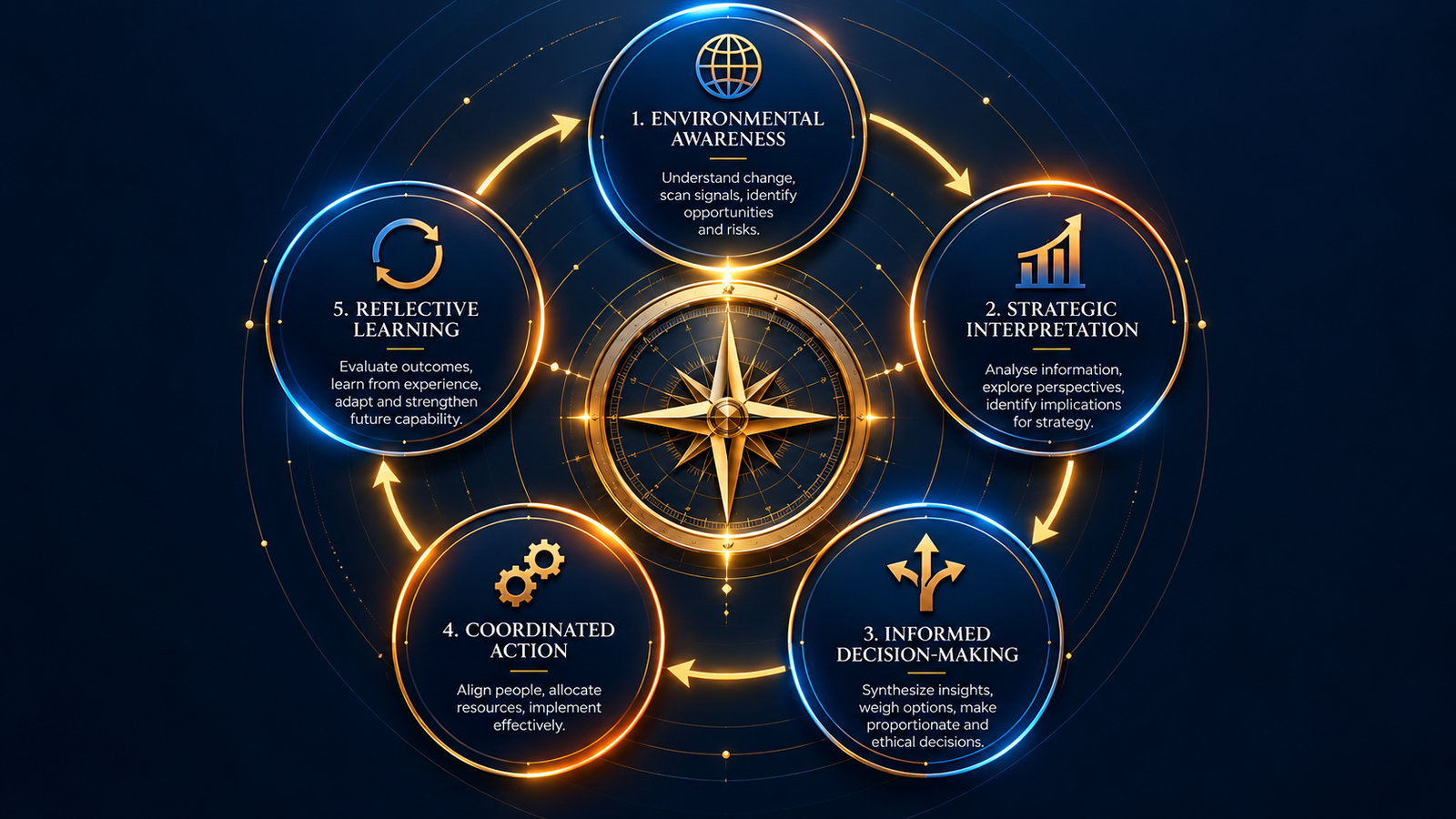
- Five interconnected stages structure the capability: environmental awareness, strategic interpretation, informed decision-making, coordinated action and reflective learning.
- Adaptability Intelligence™ shapes how leaders respond to change; Leadership Capacity™ determines whether those responses can be implemented and sustained.
- Reactive adaptation carries three hidden risks: strategic fragmentation, leadership dependency and capacity depletion.
- Sustainable adaptability means making purposeful adjustments while protecting the organisational capacity required for future challenges.
Adaptability Intelligence™: How Leaders Build the Capacity to Navigate Change Without Sacrificing Performance
Burn Bright Advisory™ | Leadership Performance Intelligence™

Introduction: The Hidden Complexity of Adaptive Leadership
Change has become a defining condition of contemporary organisational leadership.
Technological developments reshape established operating models. Workforce expectations challenge traditional management practices. Economic uncertainty complicates strategic planning, while organisations face increasing pressure to demonstrate performance, accountability and sustainability.
Consequently, adaptability has become an important consideration in leadership development. Yet there is a significant difference between adapting successfully and constantly responding to change.
Consider a senior leader managing several simultaneous organisational transitions. A new technology platform requires implementation. Financial constraints demand operational restructuring. Employees need additional support, while senior stakeholders expect existing performance targets to remain unchanged.
The leader responds by extending working hours, accelerating decisions, absorbing additional responsibilities and continuously adjusting operational priorities.
From an external perspective, this behaviour may demonstrate considerable adaptability. However, beneath the apparent responsiveness, a different pattern may be developing.
Strategic thinking becomes increasingly fragmented.
Important decisions receive insufficient consideration.
Team members become dependent on the leader’s constant intervention.
The organisation gradually loses the capacity to anticipate future challenges.
This distinction raises an important question: how can leaders develop the capacity to respond effectively to change without sacrificing the conditions necessary for sustained performance?
Burn Bright Advisory™ approaches this challenge through Adaptability Intelligence™, an interconnected domain within the Leadership Intelligence Compass™. Rather than treating adaptability as an isolated personal attribute, this perspective examines the relationship between environmental awareness, strategic judgement, organisational capacity, reflective learning and leadership sustainability. It positions adaptability within the wider discipline of Leadership Performance Intelligence™.
The objective is not simply to help leaders become more comfortable with change. It is to strengthen their ability to understand change, make informed adjustments and maintain leadership effectiveness over time.
Absorbing every change yourself? See how sustainable your current leadership load really is.
What Is Adaptability Intelligence™?
Featured Snippet
Adaptability Intelligence™ involves more than flexibility. Flexibility describes the willingness or ability to adjust an approach. Adaptability Intelligence™ introduces additional considerations: whether an adjustment is necessary, what evidence supports it, how it affects organisational priorities and whether the required resources are available.
This distinction matters because not every organisational change requires an immediate response. Some developments demand decisive intervention. Others require observation, consultation or further investigation.
Effective leadership therefore involves determining when to adapt, how extensively to adapt and which established practices should remain unchanged.
How Adaptability Intelligence™ Connects Across the Compass
Within the Leadership Intelligence Compass™, Adaptability Intelligence™ connects several complementary leadership capabilities.
Connected Domain
Reflective Practice Intelligence™
Supports the examination of existing assumptions and previous decisions.
Connected Domain
Knowledge Development Intelligence™
Strengthens the ability to acquire, evaluate and apply new information.
Connected Domain
Visionary Leadership Intelligence™
Provides strategic direction, helping leaders distinguish meaningful adaptation from reactive organisational activity.
Connected Domain
Leadership Sustainability™
Considers whether the demands associated with adaptation can be maintained without progressively exhausting leadership capacity.
Together, these domains support a more comprehensive understanding of adaptive leadership.
Adaptability Is Not the Same as Constant Change
One of the most important distinctions in leadership development concerns the relationship between adaptability and organisational stability.
Leaders are sometimes encouraged to demonstrate adaptability through frequent changes in direction, rapid implementation and continuous operational transformation. However, excessive change can introduce additional complexity.
- Employees may struggle to understand shifting priorities.
- Established processes may be abandoned before their effectiveness has been evaluated.
- Resources can become fragmented across competing initiatives.
Adaptability Intelligence™ requires leaders to exercise judgement about the necessity, timing and consequences of change. In some circumstances, effective adaptation involves introducing a new approach. In others, it involves protecting an established practice from unnecessary disruption.
| Reactive Adaptation | Adaptability Intelligence™ |
|---|---|
| Responding to every emerging development | Distinguishing meaningful change from temporary fluctuation |
| Implementing solutions before the problem is defined | Interpreting underlying conditions before acting |
| Change for its own sake | Purposeful decisions — including preserving what works |
| Leaders absorbing responsibilities the system cannot sustain | Implementation aligned with available capacity |
| Repeating ineffective responses to similar challenges | Structured reflection that strengthens future decisions |
| Measured by speed and frequency of response | Measured by informed, sustainable adjustment |
The Five Stages of Adaptability Intelligence™
Adaptability Intelligence™ can be understood through five interconnected leadership activities: environmental awareness, strategic interpretation, informed decision-making, coordinated action and reflective learning.
This proposed Burn Bright Advisory™ framework provides a practical structure for examining how leaders respond to changing organisational conditions. The five stages should not be interpreted as a rigid sequence. Leadership environments are dynamic, and leaders may need to revisit earlier stages as new information emerges.
The framework is intended as a developmental model rather than a scientifically validated measurement instrument.
Stage 1 Environmental Awareness — Recognising Meaningful Change
Adaptive leadership begins with the ability to recognise developments that may influence organisational performance. These can emerge internally through workforce challenges, operational inefficiencies and changing organisational capabilities. They can also arise externally through technological innovation, regulatory developments, economic conditions and changing stakeholder expectations.
However, environmental awareness involves more than collecting information. Leaders must distinguish between developments that require strategic attention and those that represent temporary operational fluctuations.
For example, a healthcare leader may observe increasing administrative demands, emerging digital technologies and changing patient expectations. Rather than responding to every development independently, the leader examines how these conditions interact and identifies their implications for service delivery, workforce capacity and organisational sustainability.
Environmental awareness therefore requires systematic observation, reliable information and an understanding of the organisation’s operating environment.
Stage 2 Strategic Interpretation — Understanding the Implications
Recognising change does not automatically produce an effective leadership response. Leaders must interpret available information, examine competing explanations and consider potential consequences.
Strategic interpretation involves questioning established assumptions and evaluating whether existing organisational approaches remain appropriate. This stage connects Adaptability Intelligence™ with Reflective Practice Intelligence™.
A school leader experiencing declining staff engagement, for example, might initially attribute the problem to resistance to organisational change. However, further investigation may reveal excessive workload, insufficient consultation or competing operational priorities.
The appropriate response depends on understanding the underlying conditions rather than reacting to the most visible symptoms. Strategic interpretation helps leaders avoid implementing solutions before adequately defining the problem.
Stage 3 Informed Decision-Making — Selecting an Appropriate Response
Once leaders understand the implications of changing conditions, they must determine an appropriate course of action. This involves evaluating available options against organisational objectives, resource constraints, stakeholder needs and potential risks.
Importantly, adaptive decision-making does not always require immediate transformation. A leader may decide to introduce a new approach, modify an existing process, delay implementation or preserve established practices.
The quality of the decision depends on the available evidence, the assumptions being made and the leader’s ability to consider alternative outcomes. Adaptability Intelligence™ therefore supports purposeful decision-making rather than change for its own sake.
Stage 4 Coordinated Action — Translating Decisions Into Practice
Even well-informed decisions can fail when implementation exceeds organisational capacity. Coordinated action requires leaders to establish clear priorities, communicate expectations and align available resources with the intended change.
Responsibilities must be appropriately distributed, implementation requirements understood and competing demands addressed. This stage highlights the relationship between adaptability and Leadership Capacity™.
An organisation may identify a necessary strategic adjustment but lack the workforce, financial resources or operational infrastructure required to implement it successfully. Effective adaptation involves recognising these constraints and adjusting implementation accordingly.
Leadership responsiveness should not depend indefinitely on individuals absorbing responsibilities that the organisational system cannot sustainably accommodate.
Stage 5 Reflective Learning — Strengthening Future Adaptability
The final stage involves evaluating the effectiveness of the leadership response. Leaders examine whether the intended outcomes were achieved, which assumptions proved accurate and what unintended consequences emerged. They also consider how the adaptation affected employees, organisational processes and available leadership capacity.
This connects Adaptability Intelligence™ with Knowledge Development Intelligence™ and Reflective Practice Intelligence™. Reflective learning transforms individual organisational experiences into opportunities for institutional development.
Without reflection, organisations risk repeating ineffective responses whenever similar challenges emerge. With structured reflection, leaders can strengthen future decision-making and develop more sustainable approaches to organisational change.
The Relationship Between Adaptability Intelligence™ and Leadership Capacity™
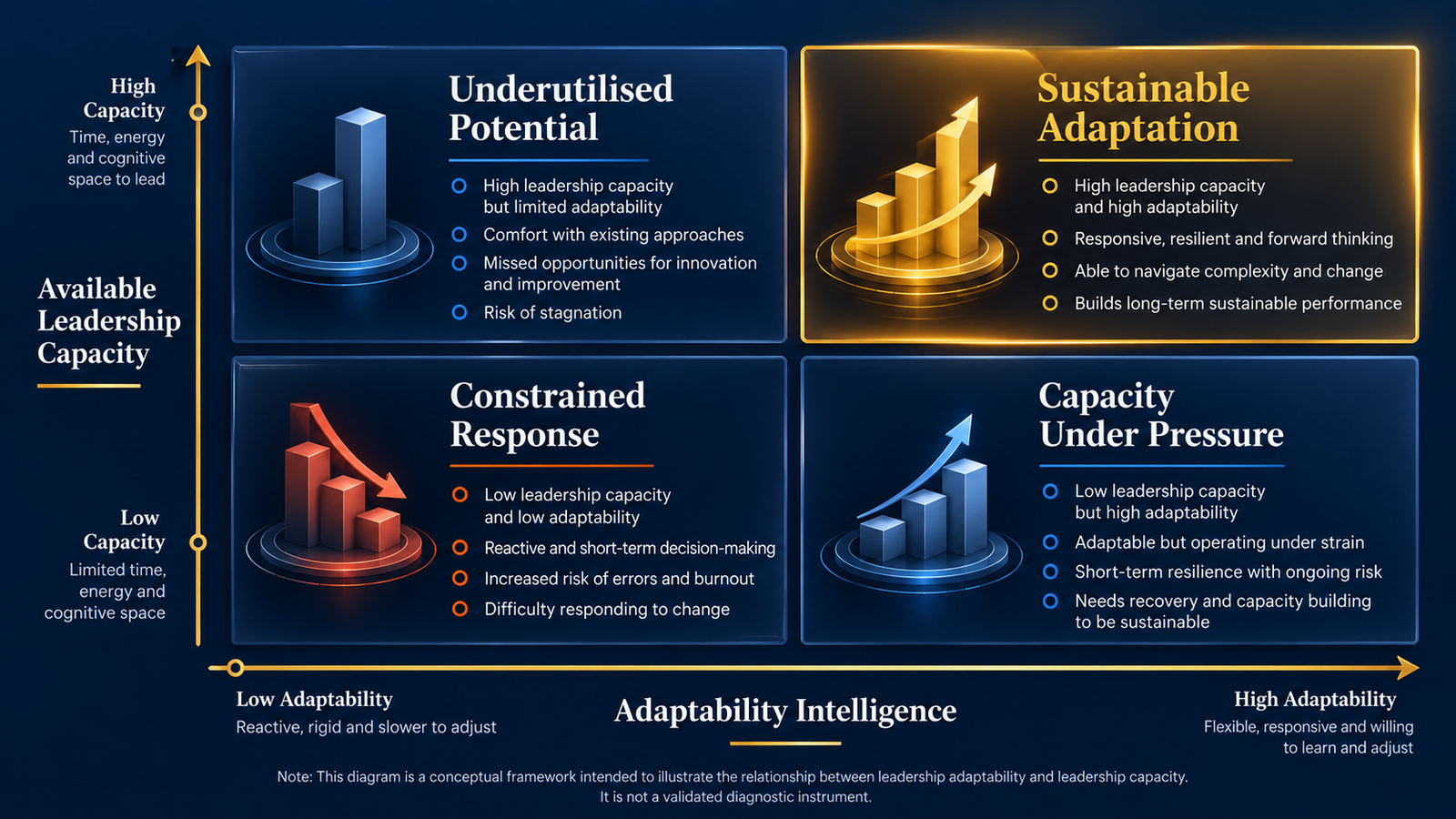
One of the most significant challenges in contemporary leadership is the assumption that greater adaptability automatically produces better performance. In practice, the relationship is more complex.
Leaders operate within finite limits of time, attention, resources and decision-making capacity. When organisational demands increase, leaders may initially respond by working longer hours, accepting additional responsibilities or accelerating operational decisions.
Although these responses may provide temporary relief, they do not necessarily strengthen the organisation’s underlying capacity to manage change.
Leadership Capacity™ provides an important complementary perspective. Within Burn Bright Advisory’s Leadership Performance Intelligence™ approach, Leadership Capacity™ concerns the resources and conditions available to meet leadership responsibilities effectively. These include individual capabilities, organisational support, decision-making structures, workload distribution and opportunities for recovery and development.
Consider an organisation introducing several major initiatives simultaneously. Its leadership team may possess the knowledge and willingness required to implement each initiative. However, the combined demands may exceed available organisational capacity.
Without examining this imbalance, the organisation risks confusing leadership commitment with operational feasibility.
A more sustainable approach involves assessing existing commitments, identifying competing priorities and determining which activities should be modified, postponed or discontinued.
This is where Adaptability Intelligence™ becomes particularly valuable. It enables leaders to consider not only how an organisation should change but also whether its leadership system can support the proposed transformation.
The Hidden Risks of Reactive Adaptation
Adaptability becomes problematic when responsiveness replaces strategic judgement.
Reactive adaptation occurs when leaders repeatedly adjust their behaviour or organisational priorities in response to immediate pressures without adequately examining their longer-term implications. Three risks deserve particular attention.
These risks demonstrate why adaptability should not be evaluated solely through the speed or frequency of organisational responses.
A leader who responds immediately to every emerging demand may appear exceptionally flexible while inadvertently creating an increasingly fragile operating environment.
Adaptability Intelligence™ introduces a different perspective. It encourages leaders to evaluate the necessity of change, understand its implications and consider the capacity required to sustain an appropriate response. The objective is to develop organisations that can respond effectively to changing conditions without becoming dependent on continuous crisis management.
Applying Adaptability Intelligence™ Across Leadership Sectors

Adaptability Intelligence™ is relevant across leadership environments, but its application depends on the operational demands, stakeholder expectations and institutional responsibilities associated with each sector. A universal leadership framework must therefore accommodate different organisational contexts rather than prescribe identical responses.
The following examples illustrate how adaptability can support leadership performance across six sectors. They are illustrative applications rather than documented organisational case studies.
🏢 Business Growth Intelligence™: Balancing Innovation and Operational Stability
Business leaders frequently navigate technological disruption, changing customer expectations and competitive uncertainty. However, responding to every emerging market development can fragment organisational resources and weaken strategic direction.
Consider a growing business evaluating the introduction of artificial intelligence across several operational functions. An exclusively reactive approach might involve implementing multiple technologies simultaneously to demonstrate organisational innovation.
An Adaptability Intelligence™ approach would begin by examining operational requirements, workforce capabilities, financial implications and strategic objectives. Leadership would then identify where technological adaptation could deliver meaningful organisational value while preserving the capacity required for implementation.
The distinction is between adopting change and developing the organisational intelligence to manage it.
🏫 School Leadership Intelligence™: Managing Change Without Overloading Educators
School leaders operate within environments shaped by educational policy, curriculum development, workforce pressures and community expectations. New initiatives frequently introduce additional responsibilities without automatically removing existing demands.
A principal introducing a revised assessment framework must consider its implications for teaching practices, professional development, administrative workload and student learning. Adaptability Intelligence™ encourages school leaders to evaluate implementation requirements before introducing additional expectations.
Through Reflective Practice Intelligence™, leaders can examine existing initiatives, identify overlapping responsibilities and determine which activities should be retained, modified or discontinued. This supports an approach to educational improvement that considers both institutional objectives and the professional capacity of educators.
🏥 Healthcare Leadership Intelligence™: Adapting Within Complex Systems
Healthcare leaders face changing clinical requirements, workforce constraints, technological developments and demanding operational environments. Adaptability in healthcare requires particular attention to professional accountability, established safety procedures and the consequences of organisational decisions.
For example, a healthcare department introducing a new digital documentation system must evaluate its effects on clinical workflows, staff training and service continuity. Rapid implementation without adequate consultation or preparation may create additional operational pressures.
An Adaptability Intelligence™ approach incorporates environmental awareness, multidisciplinary consultation, capacity assessment and structured implementation. This enables leaders to distinguish necessary operational changes from adjustments that require additional preparation or resources.
🏛️ Public Service Leadership Intelligence™: Maintaining Continuity During Change
Public service leaders must respond to evolving community needs, institutional requirements, resource limitations and changing operational priorities. Unlike some commercial environments, public service organisations frequently operate within statutory responsibilities and established accountability structures.
Adaptability Intelligence™ can help leaders distinguish between operational flexibility and responsibilities that must remain consistent. For example, a public service department experiencing increased demand may need to redesign service delivery processes.
Effective adaptation requires examining service priorities, workforce capacity, accessibility and accountability before implementing significant changes. The objective is to strengthen responsiveness while maintaining institutional reliability.
👥 HR & People Leadership Intelligence™: Supporting Workforce Adaptability
HR and people leaders play an important role in developing the organisational conditions that support adaptability — including workforce planning, professional development, communication, employee participation and organisational learning.
However, adaptability should not become an expectation that employees continuously absorb additional responsibilities.
People leaders can apply Adaptability Intelligence™ by examining the relationship between changing organisational requirements and available workforce capacity. They can also support managers in identifying emerging capability gaps and designing appropriate development opportunities. This connects adaptability with Leadership Benchmarking™, Leadership Workload™ and Leadership Sustainability™.
🚀 Entrepreneur Performance Intelligence™: Adapting Without Losing Strategic Direction
Entrepreneurs frequently operate in environments characterised by limited resources, changing customer requirements and uncertain commercial conditions. Their ability to adapt can influence organisational survival and growth.
However, constant changes in products, services or business models may also consume resources and prevent effective execution.
Adaptability Intelligence™ encourages entrepreneurs to distinguish meaningful market evidence from temporary uncertainty. By combining strategic interpretation with capacity assessment, entrepreneurial leaders can make informed adjustments without abandoning organisational direction whenever new challenges emerge.
Leadership Reflection™: Evaluating Your Adaptability Intelligence

Leadership Reflection™ provides a structured opportunity to examine how existing leadership practices influence organisational adaptability.
Rather than evaluating adaptability solely through successful outcomes, leaders should consider the quality of their decision-making processes and the sustainability of their responses. The following questions can support individual reflection, leadership development discussions and organisational planning.
Leadership Reflection Questions
- How do I currently distinguish between organisational developments that require immediate intervention and those that require further investigation?
- Which assumptions influence my responses to uncertainty, and how frequently do I examine them?
- When organisational priorities change, do I evaluate the implications for existing responsibilities and available leadership capacity?
- How effectively do I involve colleagues in interpreting complex challenges and developing appropriate responses?
- Does my current leadership approach strengthen my team’s capacity to manage future changes independently?
- What evidence would indicate that my current approach to adaptability is becoming unsustainable?
These questions are intended to encourage structured reflection rather than produce a diagnostic score. Leaders seeking a more comprehensive developmental perspective can explore the Leadership Intelligence Compass™ and relevant resources within the Leadership Intelligence Library™.
Five Practical Actions for Developing Adaptability Intelligence™
Developing adaptability requires deliberate attention to leadership thinking, organisational processes and available resources. The following actions translate the five-stage framework into practical leadership development activities.
1. Establish a Structured Environmental Review
Identify the internal and external developments most relevant to your organisation. Examine emerging opportunities, operational constraints and stakeholder expectations. Avoid treating every development as equally important.
2. Introduce Deliberate Strategic Interpretation
Before implementing significant changes, examine the evidence supporting the proposed response. Invite alternative perspectives and identify assumptions that require further investigation.
3. Evaluate Leadership Capacity Before Implementation
Assess the resources, responsibilities and operational demands associated with proposed changes. Identify which existing activities may need to be modified, postponed or discontinued.
4. Distribute Responsibility for Adaptation
Strengthen team members’ ability to interpret changing circumstances and make appropriate decisions within their responsibilities. Reduce unnecessary dependence on individual leadership intervention.
5. Establish a Reflective Learning Process
Review significant organisational adaptations after implementation. Examine intended outcomes, unintended consequences, resource implications and opportunities for future improvement.
These activities can form the foundation of a structured leadership development plan. They also provide opportunities to connect Adaptability Intelligence™ with other domains of the Leadership Intelligence Compass™, particularly Reflective Practice Intelligence™, Knowledge Development Intelligence™ and Leadership Sustainability™.
Conclusion: From Reactive Leadership to Sustainable Adaptability
Adaptability is an important leadership capability, but responsiveness alone does not guarantee organisational effectiveness.
Leaders must distinguish between meaningful change and unnecessary disruption, evaluate competing priorities and recognise the capacity required to implement strategic adjustments.
Within Burn Bright Advisory’s Leadership Performance Intelligence™ approach, Adaptability Intelligence™ provides a structured perspective on these responsibilities. Its relationship with Leadership Capacity™, Leadership Reflection™ and Leadership Sustainability™ reinforces an important principle: leadership development should strengthen not only immediate performance but also the conditions required to sustain that performance.
Organisations benefit when leaders develop the intelligence to recognise change, interpret uncertainty, make informed decisions and learn from experience. However, these capabilities must be supported by appropriate resources, effective organisational systems and realistic expectations.
Sustainable adaptability is not demonstrated by a leader’s willingness to absorb unlimited demands.
It is demonstrated through the ability to make purposeful adjustments while protecting the organisational capacity required for future challenges.
Continue Your Leadership Development
- Explore the Leadership Intelligence Assessment™ to understand the interconnected capabilities of the Leadership Intelligence Compass™ that contribute to Leadership Performance Intelligence™.
- Use the Leadership Intelligence Library™ to examine related concepts, including Leadership Capacity™, Leadership Reflection™, Leadership Workload™ and Leadership Sustainability™.
- For a more structured developmental approach, explore the Leadership Diagnostic Platform and available leadership workshops.
Frequently Asked Questions
What is Adaptability Intelligence™?
Adaptability Intelligence™ is the capacity to recognise changing conditions, reassess assumptions, make informed decisions and adjust leadership approaches while maintaining strategic direction and sustainable performance. Within Burn Bright Advisory’s Leadership Intelligence Compass™, it connects environmental awareness, reflective practice, leadership capacity and strategic responsiveness.
How is Adaptability Intelligence™ different from flexibility?
Flexibility describes the willingness or ability to adjust an approach. Adaptability Intelligence™ adds judgement: whether an adjustment is necessary, what evidence supports it, how it affects organisational priorities and whether the required resources are available. Sometimes the most adaptive decision is to protect an established practice from unnecessary disruption.
What are the five stages of Adaptability Intelligence™?
The five stages are environmental awareness, strategic interpretation, informed decision-making, coordinated action and reflective learning. They are not a rigid sequence — leaders may revisit earlier stages as new information emerges. The framework is a developmental model rather than a scientifically validated measurement instrument.
How does Adaptability Intelligence™ relate to Leadership Capacity™?
Adaptability Intelligence™ influences how leaders respond to changing conditions, while Leadership Capacity™ influences whether those responses can be implemented and sustained. Without examining capacity, organisations risk confusing leadership commitment with operational feasibility.
What are the risks of reactive adaptation?
Reactive adaptation occurs when responsiveness replaces strategic judgement. It carries three main risks: strategic fragmentation, where teams can no longer distinguish enduring priorities from temporary demands; leadership dependency, where employees rely on the leader to resolve every problem; and capacity depletion, where continuous adaptation gradually erodes the capacity needed for future challenges.
Can a highly adaptable leader still be at risk of burnout?
Yes. A leader who continuously adjusts priorities, accepts additional responsibilities and responds to every emerging problem may appear highly adaptable while strategic attention fragments and leadership capacity deteriorates. Sustainable adaptability should never depend on individuals absorbing responsibilities that the organisational system cannot sustainably accommodate.
How can leaders develop Adaptability Intelligence™?
Leaders can establish a structured environmental review, introduce deliberate strategic interpretation before major changes, evaluate leadership capacity before implementation, distribute responsibility for adaptation across their teams and establish a reflective learning process after significant changes.
Go deeper than a self-check: a full diagnostic of your leadership capacity, workload and performance conditions — Burn Bright Full Diagnostic™, £144.
Are You Adapting — or Just Absorbing?
When every change lands on the leader, capacity quietly erodes. Take the free self-assessment to see whether your current approach to change is sustainable.
Free Leadership Intelligence
Get Weekly Leadership Insights
Join thousands of leaders receiving practical strategies on burnout prevention, workload design, and sustainable performance every week.