Quick Answer
Key Takeaways
- Protect no-meeting time as seriously as you protect important meetings.
- Use protected time for thinking, decisions and high-value work, not catching up on email.
- Design team rules that make interruptions exceptional rather than normal.
- Audit recurring meetings before simply adding more focus blocks.
- Treat leadership time as a finite organisational resource, not unlimited capacity.
No Meeting Time for Leaders: Protect Your Focus
No meeting time for leaders is becoming essential because the modern leadership calendar has stopped leaving enough room to lead.
Look at your diary.
You may see one-to-ones, operational reviews, project updates, performance meetings, stakeholder calls, recruitment interviews and management meetings. Then there are the unscheduled conversations, Teams messages, emails and urgent requests sitting between them.
The calendar looks productive.
But where is the thinking?
Where do you analyse a difficult problem, prepare for an important decision or consider what your organisation needs six months from now?
For many leaders, that work starts after the meetings finish.
Burn Bright’s framework identifies meeting culture as one of five root causes of burnout, alongside scope creep, communication chaos, decision overload and perfectionism culture. It places Workload Architecture™ and Time Architecture™ at the centre of structural transformation.
Protecting no-meeting time therefore isn’t about hiding from colleagues. It is about redesigning leadership capacity.
The following framework shows the shift.
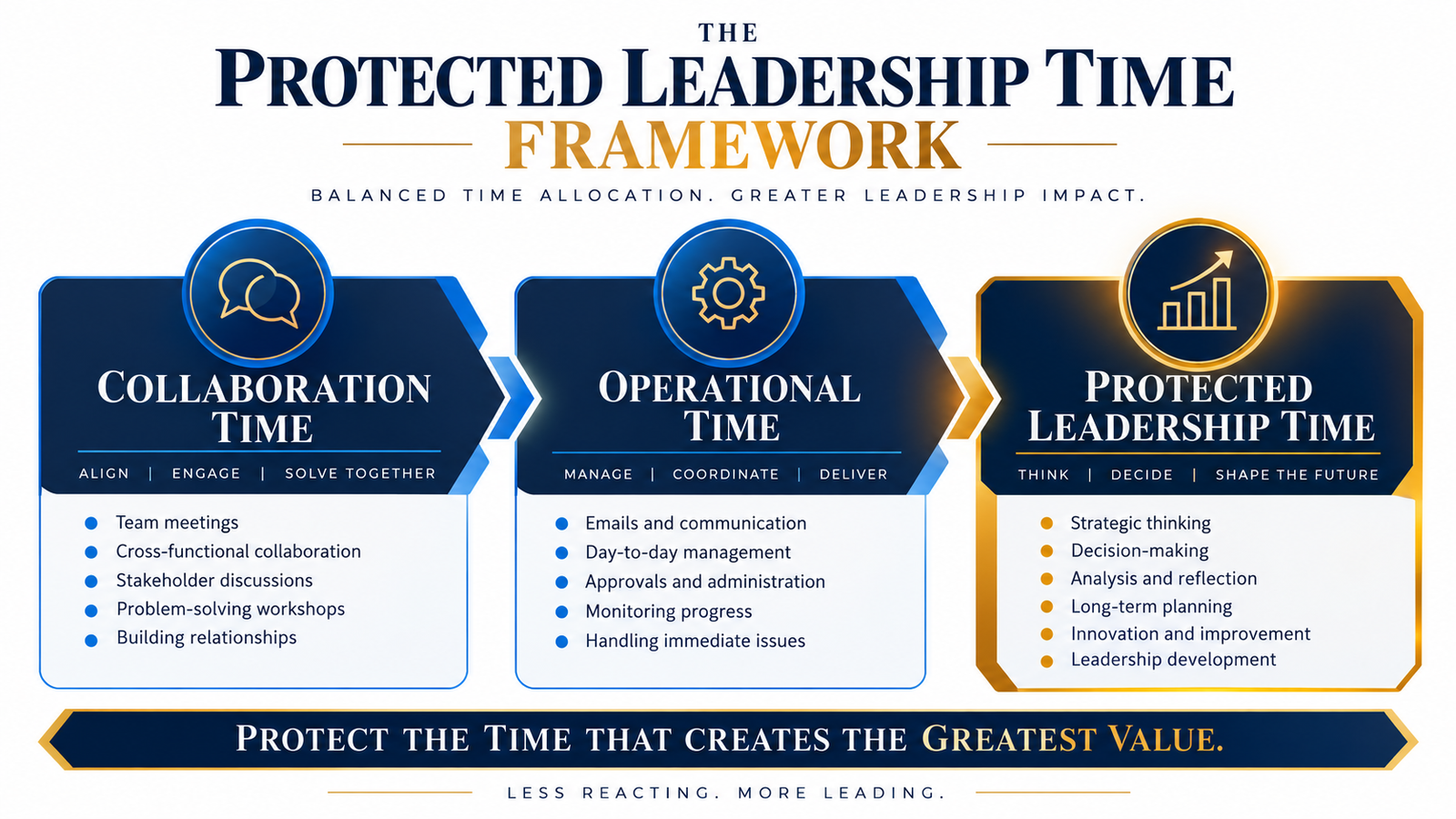
Interpretation: A sustainable calendar must create room for collaboration and concentration. If every available hour can be booked, strategic work will always lose to immediate work.
Featured Snippet
Why Do Leaders Need No Meeting Time?
Because being available is not the same as being effective.
Modern organisations have become extraordinarily good at creating opportunities to communicate. That does not mean they have become equally good at creating opportunities to think.
Microsoft’s analysis of workplace activity found that employees in the highest-volume group can receive interruptions from meetings, emails or chats as often as every two minutes. It also found 60% of meetings in that group were unscheduled or ad hoc.
Earlier Microsoft research found 68% of respondents said they lacked sufficient uninterrupted focus time. The same analysis found people were spending 57% of their Microsoft 365 time communicating and 43% creating.
This matters particularly for leaders. Leadership contains work that cannot simply be squeezed between calls.
You need time to recognise patterns.
You need time to question assumptions.
You need time to prepare for consequential conversations.
You need time to distinguish a genuine emergency from organisational noise.
And you need time to think before making decisions that affect other people.
Gallup’s 2026 global data shows managers remain under particular pressure: 45% of managers experienced significant stress during much of the previous day, compared with 39% of individual contributors.
That gap should concern organisations.
A manager is not simply another employee with additional meetings. Managers are multipliers. Their judgement influences workloads, priorities, decisions, conflict, communication and the working conditions of others.
When leadership capacity deteriorates, the effects travel downstream.
Burn Bright’s philosophy is straightforward:
If leaders need uninterrupted cognitive capacity to perform their role, that capacity has to be designed into the system. It cannot depend on whether they happen to get a quiet Thursday afternoon.
How Does Meeting Overload Contribute to Burnout?
Burnout does not happen because somebody attended one meeting too many. The problem is cumulative.
The World Health Organization defines burnout as resulting from chronic workplace stress that has not been successfully managed, characterised by exhaustion, increased mental distance or cynicism, and reduced professional efficacy.
Notice the phrase workplace stress. This matters. Burnout is an occupational phenomenon, not evidence that someone has failed to organise themselves properly.
WHO guidance on psychosocial risks also identifies factors including time pressure, long working hours, lack of control and poor work organisation. Its organisational recommendations include workload reduction, schedule changes, better communication and greater autonomy.
Meeting overload can interact with several of these risks simultaneously.
A leader may technically have an eight-hour working day. But if six hours are occupied by meetings, the remaining work does not disappear.
The strategy paper still needs writing.
The performance problem still needs addressing.
The budget still needs reviewing.
Tomorrow’s presentation still needs preparing.
So the working day expands.
Microsoft’s 2025 data illustrates how far that expansion can go. It found after-hours chats had increased 15% year over year, while meetings beginning after 8 p.m. had risen 16%.
That is the hidden architecture of overload.
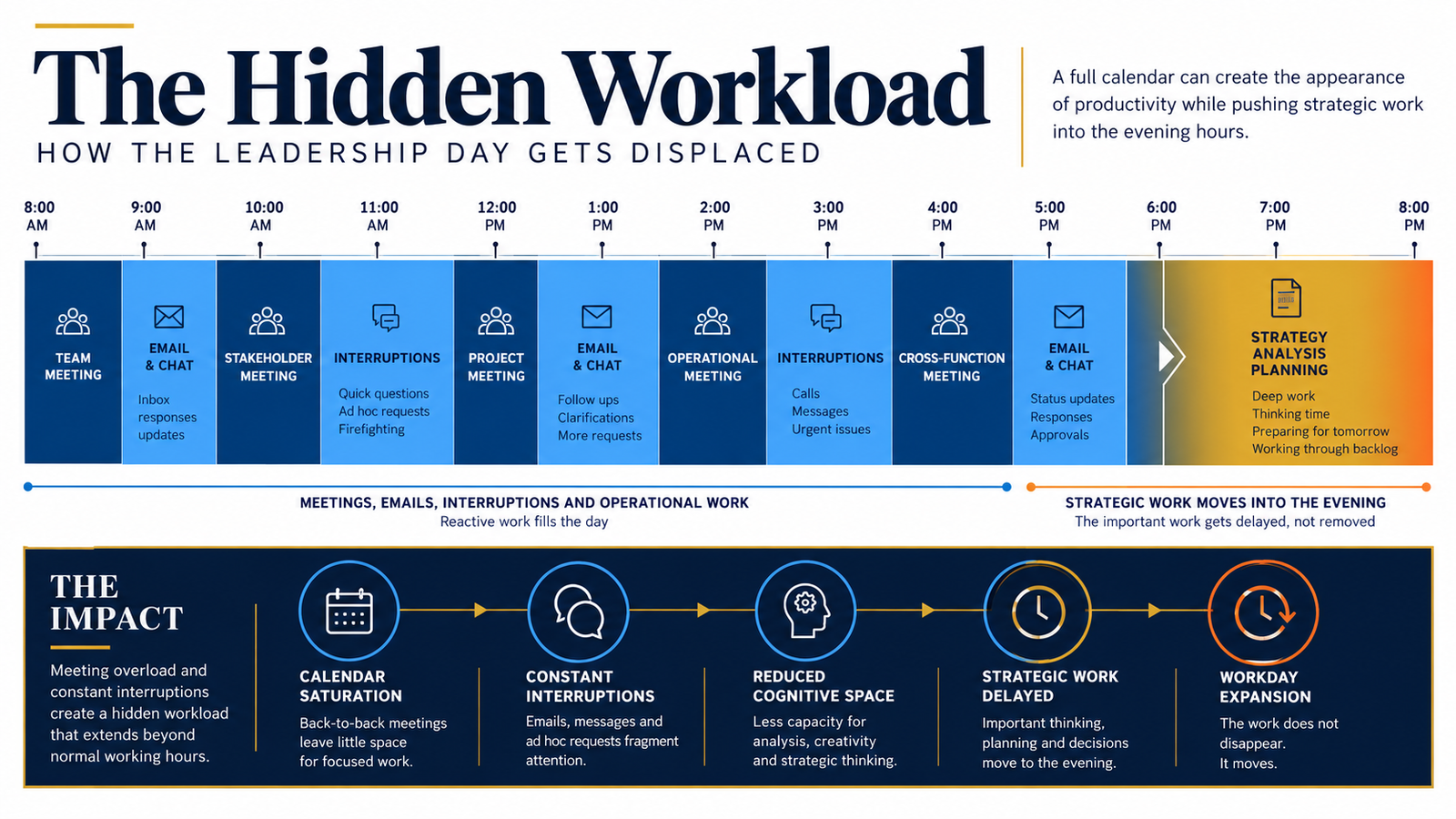
Interpretation: The visible calendar shows meetings. It often does not show the displaced work those meetings create. That invisible workload is where depletion accumulates.
The Burn Bright diagnosis is therefore structural, not motivational. The brand framework explicitly treats meeting culture and Workload Architecture™ as organisational issues rather than asking leaders simply to become more resilient.
Protecting focus is one part of fixing that structure.
What Should Leaders Actually Do During Protected Time?
This is where no-meeting initiatives frequently go wrong.
A leader blocks Thursday morning as focus time.
Thursday arrives.
They open Outlook.
Two hours disappear.
That is not protected leadership time. It is email with the door closed.
The purpose of protected time should be to create space for work requiring sustained cognitive attention. Depending on the role, that may include strategy, complex problem-solving, preparation for difficult conversations, writing, analysis, organisational design or major decisions.
One useful test is:
If yes, it belongs in protected time.
Routine approvals generally do not.
Expense claims do not.
Inbox clearing does not.
Reading 17 FYI messages does not.
McKinsey has reported that executives spend almost 40% of their time making decisions and that 60% say decision-making time is poorly used.
More recent McKinsey analysis also highlights the danger of cognitive overload: fatigue and distraction can make people more reliant on mental shortcuts precisely when thoughtful judgement is required.
This is why no-meeting time should be connected to decision quality, not merely productivity.
Try dividing leadership work into three categories:
Category 1 Collaboration Work
Requires other people. Meetings may be appropriate.
Category 2 Operational Work
Keeps the system functioning. Much of it can be delegated, standardised or completed asynchronously.
Category 3 Cognitive Leadership Work
Requires judgement, synthesis, creativity and concentration.
The third category is usually the least visible. It is also the easiest to sacrifice.
A diary with no protected space effectively makes an organisational decision: immediate access to the leader is more valuable than the leader’s capacity to think.
That is rarely a sensible trade.
How Much No Meeting Time Should Leaders Protect?
There is no universal number. A school principal, hospital director, CEO and operations manager face different levels of unpredictability.
The principle matters more than an arbitrary target.
For some leaders, two 90-minute blocks each week may be transformative. Others may benefit from a half-day. Executive teams could designate one morning organisation-wide where internal meetings are strongly discouraged.
Start with the work rather than the calendar. Ask:
Leadership Reflection Questions
- What leadership work is currently being pushed into evenings?
- What strategic work keeps being postponed?
- Which decisions am I making while distracted?
- Which problems am I repeatedly reacting to because I never have time to address their cause?
Those questions reveal the capacity deficit.
McKinsey has long argued that leadership time should be treated as an organisational resource. Its work on effective meetings recommends reviewing standing meetings and questioning those that continue largely through habit.
That is crucial. Do not simply squeeze focus blocks into an already overloaded calendar.
Remove something.
This is Workload Architecture™.
You are deciding how finite leadership capacity should be allocated.
Burn Bright’s broader framework makes the same distinction: leaders cannot outwork broken systems. Sustainable performance comes from redesigning the architecture around workload, decisions and recovery rather than continuously increasing individual effort.
The objective is not an empty diary. The objective is an intentional diary.
Your calendar should tell you what the organisation considers valuable. If it says meetings matter but thinking does not, redesign it.
How Can Leaders Protect No Meeting Time Without Becoming Unavailable?
Protected time fails when it is implemented as isolation.
A leader announces: “Nobody can contact me on Wednesdays.”
That creates frustration rather than sustainability. The better approach is to build clear access rules.
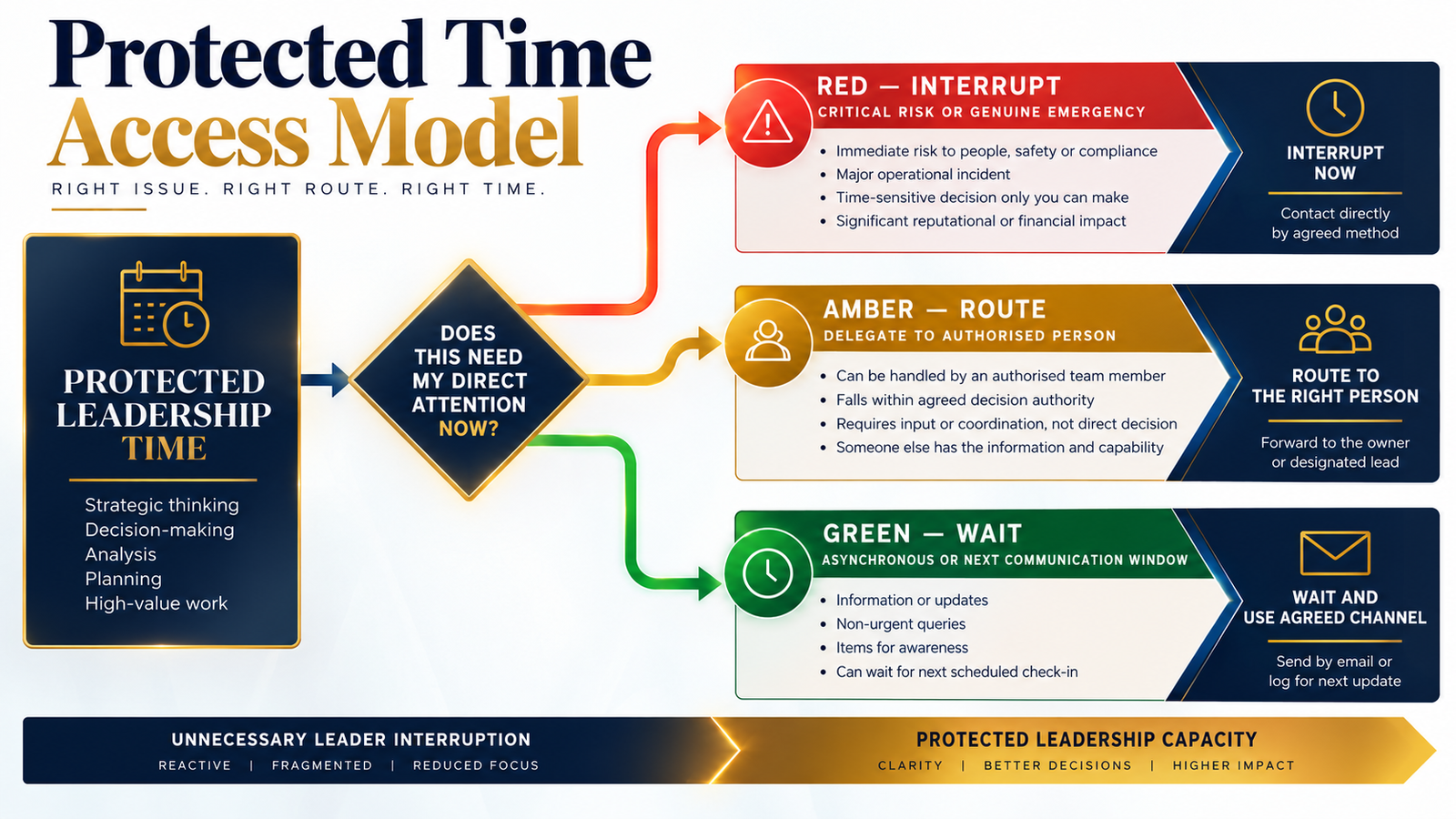
Interpretation: Sustainable leadership does not require permanent availability. It requires clarity about when access is necessary, who has decision authority and what constitutes genuine escalation.
A simple framework is:
Red Interrupt
Safety incidents, serious customer problems, safeguarding issues, critical operational failures or genuinely time-sensitive risks.
Amber Route
Someone else has the authority and capability to respond. The issue should not automatically escalate to the leader.
Green Wait
Routine updates, FYIs, non-urgent questions and matters that can be handled during normal communication windows.
This is where protected time connects to delegation.
McKinsey’s work on decision rights describes precisely this type of escalation problem: decisions can migrate unnecessarily upwards when people lack clarity or authority.
The Burn Bright framework therefore connects Workload Architecture™ with delegation and decision authority rather than treating them as separate productivity techniques.
This is also why leaders should consider a broader leadership burnout self-assessment when meeting overload is only one symptom.
A full calendar may be telling you something about the organisation itself.
What Is the Difference Between a Busy Calendar and a Sustainable Leadership Calendar?
The distinction is not the number of coloured boxes. It is whether the calendar supports the work the role exists to perform.
| Traditional Meeting-Heavy Leadership | Sustainable Leadership |
|---|---|
| Availability is treated as effectiveness | Effectiveness determines availability |
| Calendar fills automatically | Time is deliberately allocated |
| Thinking happens after hours | Thinking is part of working hours |
| Every stakeholder can create meetings | Access follows agreed rules |
| Updates default to meetings | Updates default to asynchronous communication where appropriate |
| Leader becomes the decision bottleneck | Decision authority is distributed |
| Focus time is optional | Focus time is protected |
| Recovery happens when work stops | Recovery is designed into the system |
| More effort compensates for bad structure | Structure reduces unnecessary effort |
This distinction goes beyond productivity. It changes how leadership itself is understood.
Sustainable leaders do not prove their commitment by being continuously accessible. They build systems that do not require continuous access.
That philosophy is consistent with the wider Burn Bright approach: systems thinking over individual heroics, long-term effectiveness over short-term achievement, and sustainable capacity over permanent sacrifice.
It also matters culturally. Your diary teaches people what leadership looks like.
If junior managers see senior leaders accepting back-to-back meetings, replying throughout the evening and doing strategic work at weekends, they learn that depletion is part of advancement.
Then the organisation reproduces the behaviour.
Deloitte’s 2025 research found only around one in three workers said their wellbeing had improved over the previous year. It also found only 28% of managers felt fully empowered and equipped to support employee wellbeing, while 66% reported at least one organisational barrier preventing them from doing more.
Culture is built through operating conditions.
Change the conditions.
How Can You Introduce No Meeting Time This Week?
Do not start with a grand organisational announcement. Start with diagnosis.
Review the previous four weeks of your calendar. Mark every meeting as one of four things:
Keep
It creates clear value and requires synchronous conversation.
Shorten
It matters, but not for 60 minutes.
Replace
The information could be communicated asynchronously.
Remove
Nobody can explain why the meeting still exists.
Then calculate what remains. Look for one recurring block of at least 90 minutes that can become protected leadership time.
Next, define its purpose. Do not label it “Focus.” Be specific:
- Strategic Review — Protected
- Decision Preparation — Protected
- Organisational Design — Protected
This makes the block psychologically and operationally harder to surrender.
Then establish your interruption rules. Tell your immediate team what genuinely warrants interruption and who holds authority while you are unavailable.
Finally, review the experiment after four weeks. Measure more than hours saved:
- Ask whether decisions improved.
- Ask whether strategic work moved forward.
- Ask whether evening work decreased.
- Ask whether your team made more decisions without you.
- Ask whether you became more proactive and less reactive.
This is not about becoming harder to reach. It is about becoming more useful when leadership is actually required.
For a broader structural approach, the Leadership Burnout Reset explores how leaders can move beyond symptom management and begin redesigning the conditions producing overload.
The principle remains simple:
Frequently Asked Questions
What is no meeting time for leaders?
No meeting time for leaders is deliberately protected calendar space where routine meetings and interruptions are restricted. The time is reserved for strategic thinking, analysis, planning, complex decisions and other work requiring sustained concentration.
How many hours of no meeting time should a leader have?
There is no universal target. Start by identifying how much high-value leadership work is currently being postponed or pushed outside working hours. For many leaders, two protected 90-minute blocks each week provide a practical starting experiment.
Should leaders have a full no-meeting day?
Sometimes. A full day can work where operational demands permit it, but it should not become a rigid rule that prevents essential collaboration. The aim is protected cognitive capacity, not avoiding colleagues.
Does no meeting time improve productivity?
It can, particularly when it replaces low-value meetings and protects high-concentration work. Microsoft research shows many workers struggle to find uninterrupted focus time, while McKinsey’s research has highlighted substantial dissatisfaction with how executive decision-making time is used.
What should leaders do during no meeting time?
Use it for work that benefits from uninterrupted thought: strategy, analysis, writing, complex problem-solving, decision preparation and organisational design. Avoid turning protected time into an extended inbox-clearing session.
What if my organisation has too many emergencies for protected time?
First determine whether they are genuine emergencies or routine problems being escalated because decision authority is unclear. Repeated interruption can indicate deeper problems in delegation, processes, staffing or decision rights.
Can no meeting time help prevent leadership burnout?
It can address one structural contributor, particularly when meeting overload is displacing essential work into evenings and increasing cognitive fragmentation. But no-meeting time cannot compensate for fundamentally excessive workload, poor staffing or unclear responsibilities. Burnout prevention requires wider organisational redesign.
Conclusion
No meeting time for leaders should not be viewed as a diary trick. It is a statement about how leadership capacity is valued.
Meetings matter. Collaboration matters. Availability sometimes matters enormously. But thinking matters too.
If leaders spend every working hour responding to other people’s agendas, their own high-value work does not disappear. It migrates into early mornings, evenings and weekends.
That is how overloaded systems disguise themselves as dedicated leadership.
The solution is not to become better at enduring the calendar. Redesign it.
Audit meetings. Clarify decision authority. Replace unnecessary synchronous communication. Protect cognitive space. Make interruptions exceptional. Measure whether leadership quality improves.
Burnout is a system failure.
And meeting overload is often one visible symptom of that system.
Sustainable leadership begins when organisations stop assuming that leadership capacity is infinite.
Go Deeper Than the Calendar
For a fuller structural picture of what is driving your leadership workload, explore the Burn Bright Full Diagnostic™ — £144.
Take the Leadership Burnout Self-Assessment
If your calendar is permanently full and your important work keeps moving into evenings and weekends, meeting overload may be only one part of the problem. Identify the structural pressures driving your workload with the free Burn Bright assessment.
Free Leadership Intelligence
Get Weekly Leadership Insights
Join thousands of leaders receiving practical strategies on burnout prevention, workload design, and sustainable performance every week.