Quick Answer
Key Takeaways
- The most dangerous plan may be the one that used to work. Strategic attachment, not poor execution, is often the real risk.
- Adaptation is not abandonment. Today’s decision should reflect today’s evidence.
- Protect purpose, values, ethical standards and critical outcomes. Keep methods, processes, priorities and timelines open to revision.
- Intelligent adaptability combines high strategic clarity with high responsiveness. It avoids rigidity, strategic inertia and reactivity.
- Failing to adapt creates workload. Before asking people to be more productive, ask whether the work still deserves to exist.
Adaptability Leadership: How to Lead When the Plan Stops Working
Executive Summary
Most leadership plans are created under conditions that eventually cease to exist.
A strategy may have been sensible when it was approved. A staffing model may have matched demand when it was designed. A transformation programme may have been built on assumptions that were reasonable six months earlier. A leader may have made the right decision with the information available at the time.
Then conditions change.
The market moves. Technology alters what is possible. Regulation changes. Employee expectations shift. Demand accelerates or contracts. A competitor acts unexpectedly. Resources disappear. A crisis emerges. New evidence contradicts an old assumption.
The leadership challenge is no longer simply executing the plan.
It is recognising when continuing to execute it has become the greater risk.
This is where Adaptability Intelligence™, within Burn Bright Advisory’s Leadership Intelligence Compass™, becomes critical. Adaptability Intelligence™ concerns a leader’s capacity to interpret changing conditions, question assumptions, revise decisions and redirect resources while maintaining strategic coherence.
That distinction matters.
Adaptable leadership is sometimes misunderstood as flexibility: being open-minded, comfortable with change or willing to try something different. Those qualities can help, but they do not constitute leadership intelligence on their own.
Leaders can change too quickly. They can overreact to incomplete information, abandon priorities prematurely, chase emerging trends, repeatedly reorganise teams and create instability while believing they are demonstrating agility.
Equally, leaders can adapt too slowly. Previous success can become an argument for maintaining approaches long after the conditions that made them successful have disappeared.
The central question is therefore not “Are we willing to change?” It is:
Adaptability Intelligence™ provides the judgement required to answer that question.

The Most Dangerous Plan May Be the One That Used to Work
Leadership is frequently described as the ability to create direction. Less attention is given to what happens when that direction was based on assumptions that no longer hold.
Consider a leadership team halfway through implementing an important three-year strategy. Considerable work has already been completed. Budgets have been allocated. Teams have been reorganised. Leaders have publicly committed themselves to the plan. Performance measures have been built around it.
Then the environment changes.
- New technology dramatically alters customer behaviour.
- A healthcare organisation experiences a sustained change in demand.
- A school discovers that an improvement strategy is producing administrative compliance without improving learning.
- A public-service organisation faces a new policy environment.
- An HR function discovers that its workforce model no longer reflects how critical talent expects to work.
- An entrepreneur discovers that the market is responding enthusiastically—but to a different proposition from the one originally designed.
At this point, leadership becomes psychologically difficult.
Changing direction can feel like admitting the original strategy was wrong.
Continuing can feel safer.
There is already investment in the existing approach. Senior leaders may have attached their credibility to it. Teams have spent months implementing it. Boards or stakeholders have been told what will happen next.
And so organisations sometimes continue executing increasingly outdated plans with remarkable discipline.
Effective leadership therefore requires more than the ability to formulate and execute plans. It requires the intelligence to recognise when the relationship between the plan and reality has changed.
That is the territory of Adaptability Intelligence™.
What Is Adaptability Intelligence™?
Featured Snippet
Three elements of that definition are particularly important.
Element 1
Adaptability begins with interpretation
A leader cannot respond intelligently to change without first understanding what has actually changed. Signals must be distinguished from noise. Temporary disruption must be separated from structural change. Evidence must be considered rather than merely noticed.
Element 2
Adaptability requires deliberate adjustment
Changing something is not automatically adaptive. A leader who repeatedly changes priorities in response to whichever stakeholder spoke most recently may be responsive, but they are not necessarily demonstrating Adaptability Intelligence™.
Element 3
Adaptability requires strategic coherence
The strongest adaptive leaders do not abandon everything when circumstances shift. They distinguish between elements that should remain stable and elements that have become negotiable.
Purpose may remain stable while strategy changes.
Values may remain stable while processes change.
Critical outcomes may remain stable while timelines change.
Ethical standards may remain stable while operating models change.
The route changes.
The destination may not.
This is why adaptability should not be confused with instability.

The Five Decisions Behind Intelligent Adaptation
Adaptability becomes practical when leaders can move through five distinct stages:
Each stage protects against a different leadership failure.
1. Notice: What Has Actually Changed?
The first challenge is surprisingly difficult.
Leaders rarely operate with perfect information. Change usually appears initially through weak signals: an unexpected performance trend, repeated employee feedback, customer behaviour, declining participation, increasing workload, changing stakeholder questions or results that no longer correspond with expectations.
Adaptability therefore begins with attention. The leader asks:
- What are we seeing now that we were not seeing before?
- What has changed in the operating environment?
- Where are expected results diverging from actual results?
- Which assumptions deserve to be revisited?
The difficulty is that leaders are not neutral observers.
Once people have invested heavily in a strategy, they naturally become more likely to interpret information through that strategy. Evidence supporting the existing direction is reassuring. Contradictory evidence is easier to classify as temporary, exceptional or irrelevant.
Adaptability Intelligence™ therefore depends partly on Reflective Practice Intelligence™. A leader must be capable of examining not only the external situation but also their own interpretation of it.
This connection across the Leadership Intelligence Compass™ matters. Leadership capabilities do not operate independently.
Adaptability without reflection can become impulsiveness.
Reflection without adaptability can become sophisticated observation without action.
Leadership Performance Intelligence™ emerges through the interaction between capabilities.
2. Interpret: What Does the Change Mean?
Not every change deserves a strategic response.
- A single poor month does not necessarily invalidate a business model.
- One difficult employee survey does not necessarily require organisational restructuring.
- One unsuccessful lesson observation does not prove that an educational strategy has failed.
- One operational incident does not automatically justify redesigning an entire healthcare process.
Leaders therefore need to move beyond detecting change to interpreting its significance. A useful distinction is between events, patterns and structural shifts.
Event May require a response
An event may require a response but not a strategic change.
Pattern Something persistent
A pattern suggests that something more persistent may be happening.
Structural shift Assumptions in question
A structural shift means that assumptions underpinning existing decisions may no longer be reliable.
This distinction prevents leaders from confusing responsiveness with adaptability. Strong adaptive leadership asks:
That question creates intellectual discipline between stimulus and action.
Why Successful Leaders Can Struggle Most With Adaptation
Paradoxically, previous success can make adaptation harder.
Successful leaders accumulate experience. Experience produces pattern recognition, judgement and confidence. Those are valuable leadership assets.
But success can also strengthen attachment to the methods that produced it. A leader may gradually move from:
“This worked.”
to: “This is how we work.”
and eventually: “This is the right way to work.”
The distinction is significant. The first statement describes evidence. The second describes identity. The third can become dogma.
This dynamic appears across sectors.
- A business leader continues relying on a commercial model that created years of growth even as customer behaviour changes.
- A school leader protects an improvement process that once generated strong outcomes but has gradually become compliance-heavy.
- A healthcare leader maintains a staffing arrangement designed for a different pattern of patient demand.
- A public-service leader preserves an administrative system because it has survived multiple leadership cycles.
- An entrepreneur refuses to alter the original proposition because changing it feels like betraying the founding idea.
Past success becomes a form of organisational gravity.
The stronger the history, the harder it becomes to move.
This is why Adaptability Intelligence™ is not primarily about enthusiasm for novelty. It is about the quality of leadership judgement when evidence begins challenging established assumptions.
The Critical Distinction: Adaptation Is Not Abandonment
One reason leaders resist adaptation is that changing course is frequently framed as failure. That interpretation is too simplistic.
A decision can have been reasonable when it was made and still require revision later.
The important question is not whether today’s decision contradicts yesterday’s plan. The question is whether today’s decision reflects today’s evidence.
Leaders who understand this distinction create healthier learning cultures because they remove an unnecessary choice between consistency and intelligence.
Consistency should apply most strongly to purpose, values and ethical commitments. It should not automatically apply to every method used to pursue them.
This connects Adaptability Intelligence™ with Ethics Intelligence™ and Visionary Leadership Intelligence™ within the Leadership Intelligence Compass™.
- Vision helps leaders understand the direction of travel.
- Ethics establishes boundaries around how that direction is pursued.
- Adaptability allows methods to evolve as reality changes.
Together, they answer three different questions:
- Where are we going?
- What will we refuse to compromise in getting there?
- What must we change as conditions evolve?
Without vision, adaptation becomes directionless.
Without ethics, adaptation can become opportunism.
Without adaptability, vision can become rigidity.
That interdependence is central to Leadership Performance Intelligence™.
Adaptability Is Not Reactivity
One of the most important distinctions in adaptability leadership is also one of the easiest to miss.
- A leader who changes direction frequently is not necessarily adaptable.
- A leadership team that responds rapidly to every new development is not necessarily agile.
- An organisation that repeatedly restructures itself is not necessarily capable of adaptation.
Sometimes these behaviours indicate the opposite: an organisation reacting to pressure without sufficient interpretation, strategic clarity or organisational learning.
This distinction matters because the language of adaptability can legitimise poor leadership.
None of these represents Adaptability Intelligence™. Intelligent adaptation combines responsiveness with strategic clarity.
The question is not simply “How quickly can we change?” It is:

The Adaptability vs Reactivity Matrix
A useful way to understand this distinction is to consider leadership behaviour across two dimensions:
- Strategic clarity — how clearly leaders understand the purpose, values and outcomes they are trying to protect.
- Responsiveness — how effectively leaders adjust decisions and actions when circumstances change.
Together, these dimensions create four different leadership conditions.
Rigidity: Low Strategic Clarity, Low Responsiveness
Rigidity occurs when organisations continue established behaviours despite evidence that those behaviours are no longer producing the required results.
The organisation does not adapt, but neither is its resistance necessarily anchored in a clear strategic rationale. The underlying logic becomes: “This is how we have always done it.”
Processes survive because they already exist.
Meetings continue because they are on the calendar.
Reporting requirements remain because nobody has questioned them.
Leadership practices continue because they are familiar.
The danger is that familiarity can be mistaken for stability. It is not.
An organisation can remain extremely busy while becoming progressively less relevant to the environment around it.
Strategic Inertia: High Strategic Clarity, Low Responsiveness
Strategic inertia is more subtle.
Here, leaders may understand their purpose extremely well. They may have strong values, sophisticated strategies and clear organisational ambitions. What they lack is sufficient capacity or willingness to translate changing conditions into changed behaviour.
They know the environment has moved. They know existing processes are becoming less effective. They may even discuss the need for transformation repeatedly. But meaningful adaptation remains slow.
This can happen because of bureaucracy, risk aversion, internal politics, legacy systems, resource constraints or leadership attachment to existing approaches.
The organisation knows where it wants to go but cannot alter the way it is travelling.
This is particularly dangerous because strategic sophistication can disguise operational immobility. Leaders may have excellent conversations about change while continuing to operate almost exactly as before.
Reactivity: Low Strategic Clarity, High Responsiveness
Reactivity sits at the opposite extreme. The organisation changes constantly.
Priorities move.
Projects are launched and abandoned.
Structures are redesigned.
New technologies are introduced.
Targets change.
Teams receive new instructions before previous initiatives have had sufficient time to produce evidence.
From the outside, this can look dynamic. Inside the organisation, it often feels exhausting.
The fundamental problem is not the amount of change. It is the absence of a sufficiently stable logic governing that change.
Without strategic clarity, responsiveness becomes movement without direction. Leaders begin solving whichever problem is most visible rather than determining which problem is most consequential.
The result can be organisational whiplash. Employees become reluctant to invest deeply in new initiatives because they expect another priority to replace them shortly.
Eventually, people learn an unintended lesson: wait long enough and the latest leadership priority will probably disappear.
That is not an adaptability culture. It is a credibility problem.
Intelligent Adaptability: High Strategic Clarity, High Responsiveness
Adaptability Intelligence™ occupies the fourth quadrant.
Here, leaders retain clarity about purpose while remaining capable of changing the route. They do not preserve methods merely because those methods are familiar. Neither do they abandon methods merely because something new has appeared.
They evaluate evidence.
They distinguish signal from noise.
They understand what should remain stable.
They identify what has become negotiable.
Then they act.
This is why intelligent adaptability is best understood as disciplined responsiveness. The adaptive leader can say:
That sentence captures one of the central capabilities of adaptability leadership.
What Should Leaders Protect—and What Should They Change?
When disruption occurs, leaders often move too quickly to the question “What should we change?” There is an earlier question: “What must we protect?”
This distinction prevents adaptation from becoming indiscriminate. Within the Adaptability Intelligence™ framework, leaders can separate organisational reality into two categories.
Protect
A high threshold for change
These elements provide continuity. They create the stable centre from which intelligent adaptation can occur.
- Purpose. Why does the organisation, team or initiative exist?
- Values. What principles should continue shaping behaviour?
- Ethical standards. What will the organisation refuse to compromise even under pressure?
- Critical outcomes. What ultimately needs to be achieved?
Adapt
Open to revision
These elements should remain much more open to revision.
- Methods. How is the work currently being done?
- Processes. Are established workflows still serving their intended purpose?
- Assumptions. What did we believe when the plan was created, and does the evidence still support those beliefs?
- Priorities. Has the relative importance of different demands changed?
- Resource allocation. Are time, money, people and attention still being directed toward the areas of greatest value?
- Timelines. Are original deadlines still realistic or strategically sensible?
- Structures. Does the current organisational configuration still support the work required?
This creates an important principle for adaptability leadership:
The distinction sounds simple. In practice, it requires considerable judgement.
The Leadership Cost of Changing Too Late
Much leadership literature celebrates decisive change. Far less attention is given to the period before the decision—the weeks, months or sometimes years during which evidence accumulates but action remains limited.
This is where adaptability failures often become expensive. The costs are not only financial.
Teams may spend enormous amounts of leadership capacity maintaining systems everyone privately recognises are no longer working.
- Employees develop workarounds.
- Managers compensate manually for flawed processes.
- Additional meetings are created to manage problems caused by existing meetings.
- Reporting systems expand because leaders do not trust the information produced by previous reporting systems.
- People work harder to preserve a model that should have been reconsidered.
This has a direct relationship with Leadership Capacity™ and Leadership Workload™.
Burn Bright’s broader Leadership Performance Intelligence™ perspective is important here because poor adaptability does not remain confined to strategy. It creates workload.
Every outdated process requires human effort to sustain it.
Every unresolved structural problem generates additional coordination.
Every decision leaders postpone eventually appears somewhere else in the organisation as friction.
Over time, leadership capacity is consumed not only by the work that matters but by the accumulated cost of failing to adapt.
This is one reason Leadership Sustainability™ and Adaptability Intelligence™ are closely connected. Sustainable leadership is not simply about individual resilience. It also requires leaders to stop organisations from repeatedly demanding human effort to compensate for systems that no longer fit reality.
The Opposite Risk: Changing Too Quickly
There is, however, an equally important danger. Leaders can become so determined to demonstrate adaptability that they create unnecessary instability.
- A new piece of technology appears, so the organisation immediately redesigns its operating model.
- A competitor announces a strategy, so leadership launches a response.
- Employee feedback identifies dissatisfaction, so structures are changed before the underlying cause is properly understood.
- A performance indicator falls, so targets and responsibilities are redesigned.
This is not necessarily adaptability. Sometimes the most intelligent adaptive decision is:
Leaders need enough confidence to remain responsive without becoming restless. That requires tolerance for uncertainty. It also requires the ability to gather evidence before converting anxiety into organisational activity.
This is where Emotional Intelligence™ interacts with Adaptability Intelligence™.
Leadership responses to change are never entirely analytical. Uncertainty produces emotion.
- Executives may fear losing market position.
- School leaders may fear declining outcomes.
- Healthcare leaders may fear operational or clinical consequences.
- Public-service leaders may experience political and stakeholder pressure.
- Entrepreneurs may fear missing a narrow opportunity.
- HR leaders may fear losing critical talent.
These concerns may be legitimate. But urgency can narrow judgement.
Emotionally intelligent leaders recognise the pressure without allowing the pressure alone to determine the response. They create enough cognitive distance to ask:
That is an important expression of Leadership Performance Intelligence™.
Adaptability Intelligence™ Across Leadership Contexts
Adaptability leadership is universal, but it does not look identical in every environment. Different sectors experience different forms of uncertainty, different stakeholder pressures and different consequences when leaders misread change. Explore the Burn Bright sector hubs for sector-specific resources.

Business Growth Intelligence™: Adapt Before the Market Forces You To
In business, adaptability is frequently associated with market disruption. But the deeper challenge is often assumption decay.
Customer expectations change gradually.
A profitable product becomes less differentiated.
A distribution model becomes less effective.
A competitor introduces a different value proposition.
Technology changes the economics of an established process.
None of these necessarily arrives with an announcement saying your strategy is now obsolete. The evidence often accumulates slowly.
Adaptable business leaders therefore examine the assumptions beneath performance, not merely performance itself. They ask:
- Are customers buying for the reasons we think they are?
- Where is demand changing?
- Which parts of our model depend on conditions that may be disappearing?
- What would we redesign today if we were not emotionally or financially attached to the existing model?
This is where Business Growth Intelligence™ and Adaptability Intelligence™ intersect. Growth requires more than expansion. Sometimes sustainable growth depends on recognising what the organisation must stop doing.
School Leadership Intelligence™: Adapt the Method Without Losing the Educational Purpose
Educational leadership presents a different challenge. Schools operate amid policy changes, curriculum requirements, technological development, workforce pressures, changing learner needs and community expectations.
The danger is adaptation overload. Every emerging challenge can generate another initiative, another programme, another reporting requirement, another intervention, another platform, another meeting.
Adaptability Intelligence™ asks school leaders to distinguish genuine improvement from accumulated activity.
If a strategy is not improving teaching, learning, inclusion, professional capacity or student outcomes, its continuation should not be justified simply because considerable effort has already been invested.
The educational purpose remains stable. The method should remain open to examination. That is adaptive leadership.
Healthcare Leadership Intelligence™: Adaptation With Consequence
Healthcare environments make the relationship between adaptability and judgement particularly visible. Demand changes. Evidence develops. Technology advances. Workforce capacity fluctuates. Patient needs evolve.
Yet healthcare leaders cannot simply experiment with every emerging idea without considering safety, evidence, regulation and clinical consequence. Adaptability therefore requires both responsiveness and restraint. The leadership question becomes:
Here, Adaptability Intelligence™ must operate alongside Ethics Intelligence™, Professionalism Intelligence™ and Knowledge Development Intelligence™.
Change without evidence can be dangerous. But refusing to change despite evidence can be equally dangerous.
Public Service Leadership Intelligence™: Adapting Within Multiple Constraints
Public-service leaders frequently operate in systems where authority, accountability and resources are distributed across multiple stakeholders.
Policy may change faster than infrastructure. Public expectations may change faster than formal processes. Leaders may recognise the need for adaptation while operating within legislation, budgets, political priorities and established governance structures.
Adaptability here is rarely unrestricted agility. It is the ability to identify the areas where movement is possible, prioritise them intelligently and avoid allowing constraints in one part of the system to become an excuse for immobility everywhere else.
HR & People Leadership Intelligence™: Stop Designing for a Workforce That No Longer Exists
People leadership provides another important application. Workforce expectations continue to evolve. Skills become obsolete or scarce. New technologies alter role design. Different generations may approach careers, flexibility, learning and leadership differently.
Organisations can respond by continually adding benefits, programmes and policies. But Adaptability Intelligence™ demands a deeper question:
Sometimes the adaptive response is not another programme. It is redesigning work itself.
Entrepreneur Performance Intelligence™: Know When to Pivot—and When Not To
Entrepreneurs live particularly close to the tension between persistence and adaptation.
Persistence is celebrated for good reason. Many worthwhile ideas require time, repeated experimentation and resilience before producing results. But persistence becomes expensive when it protects an assumption that the market has repeatedly disproved.
Conversely, constant pivoting can prevent an idea from ever receiving enough sustained effort to work.
The entrepreneur therefore faces one of adaptability leadership’s hardest questions:
That question extends far beyond entrepreneurship. It belongs in every leadership context.
Adaptability Is a Leadership System, Not a Personality Trait
Some people naturally enjoy novelty. Others prefer predictability. Neither preference determines whether someone can become an adaptable leader.
Adaptability Intelligence™ should not be reduced to personality.
An energetic leader who enjoys change may still make poor adaptive decisions. A cautious leader who prefers stability may demonstrate exceptional adaptability because they examine evidence carefully and change course when the evidence requires it.
The objective is therefore not to create leaders who constantly seek change. It is to build a Leadership Development System™ that strengthens the capabilities required to respond intelligently when change occurs. That includes:
- noticing changing conditions;
- testing assumptions;
- seeking perspectives beyond one’s existing interpretation;
- distinguishing temporary events from structural shifts;
- evaluating risks and consequences;
- preserving ethical and strategic anchors;
- reallocating resources when priorities change;
- communicating why adaptation is necessary;
- monitoring the consequences of changed decisions; and
- reflecting on what the organisation has learned.
This moves adaptability away from vague advice about “embracing change” and toward a capability that can be examined, developed and ultimately benchmarked.
That is also why Leadership Benchmarking™ matters. The useful question is not “Do our leaders say they are adaptable?” It is:
One measures identity.
The other begins to measure leadership capability.
And that distinction lies at the heart of Leadership Performance Intelligence™.
| Common Assumption | Adaptability Intelligence™ View |
|---|---|
| Adaptability means flexibility and openness to change | Adaptability is disciplined judgement about what should change and what should not |
| Changing course means the original plan was a failure | Today’s decision should reflect today’s evidence |
| Changing direction often shows agility | Responsiveness without strategic clarity is reactivity |
| Adaptability is a personality trait | Adaptability is a leadership capability that can be developed and benchmarked |
| Familiar processes provide stability | Familiarity can be mistaken for stability |
| Heavy workload is a time-management problem | Workload can be an adaptability problem |
| Adaptability is an argument against planning | Plans are informed commitments, not permanent truths |
From Adaptation to Organisational Learning
Changing course is not the final stage of adaptability leadership. Learning is.
Organisations frequently make changes without establishing whether those changes actually improved performance. A new process replaces an old one. A structure is redesigned. Resources move. Responsibilities change. Attention then shifts to the next priority.
The organisation has changed, but it has not necessarily learned.
Adaptability Intelligence™ requires leaders to close the loop. After adapting, leaders should ask:
- What happened as a result?
- What improved?
- What became more difficult?
- Which assumption was confirmed or challenged?
- What should we retain, refine or reverse?
This converts adaptation from an isolated response into organisational intelligence. It also connects Adaptability Intelligence™ with Knowledge Development Intelligence™ and Reflective Practice Intelligence™ within the Leadership Intelligence Compass™.
Experience alone does not guarantee learning. An organisation can experience the same category of problem repeatedly without becoming significantly better at handling it.
Learning requires interpretation. Leaders must convert experience into insight, insight into changed behaviour and changed behaviour into improved organisational capability.
That is the difference between an organisation that merely survives disruption and one that becomes more capable because of it.
The Adaptability Intelligence™ Check
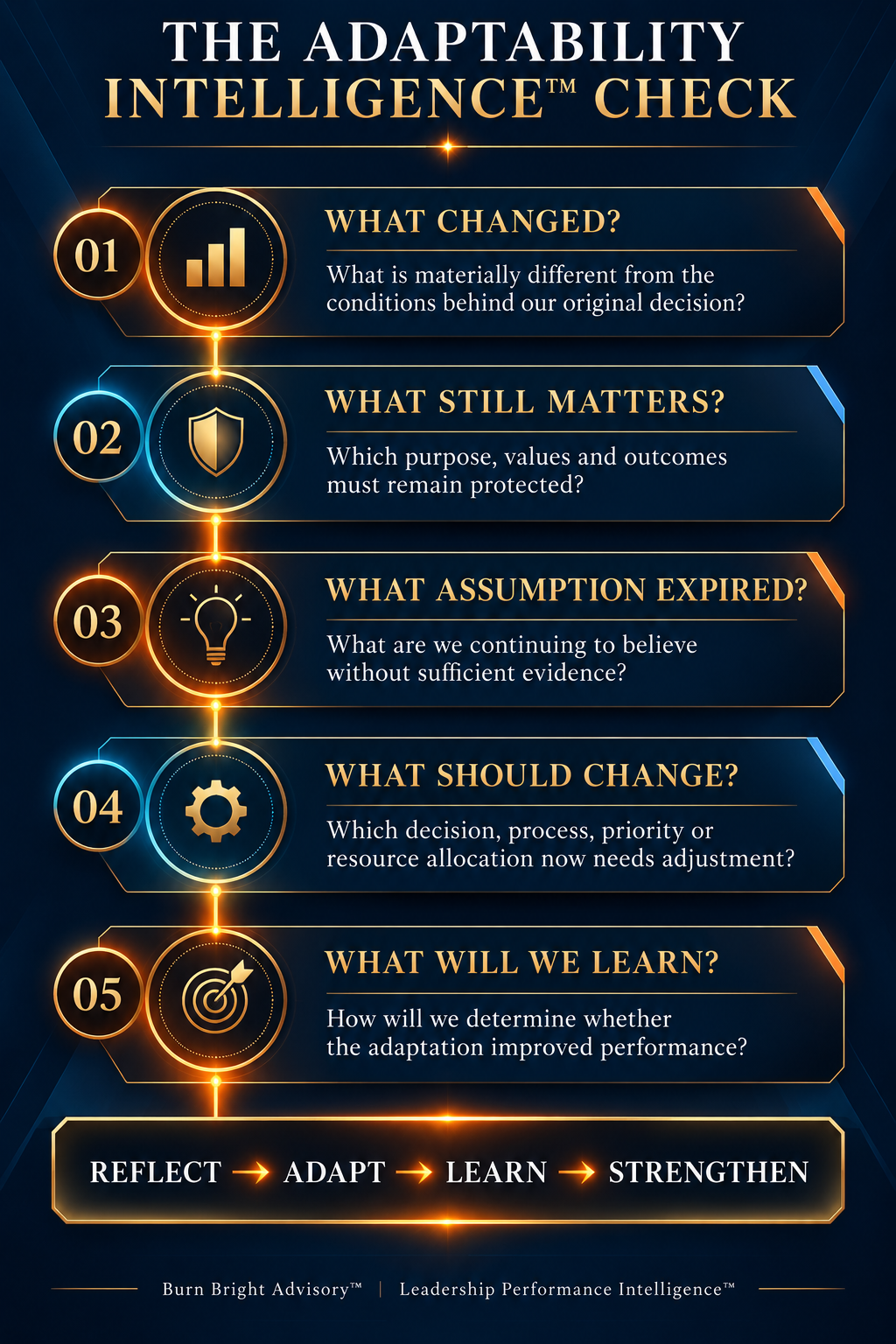
When circumstances change, leaders do not always need a complicated transformation methodology. Sometimes they need five disciplined questions.
Question 1 What Changed?
Begin with reality rather than response. What is materially different from the conditions under which the original decision was made? Avoid vague statements such as “the environment has changed.” Identify the actual change.
- Has demand shifted?
- Has new evidence emerged?
- Has workforce capacity changed?
- Has technology altered what is possible?
- Has stakeholder behaviour changed?
- Has a critical assumption proved unreliable?
Precision matters because vague diagnoses produce vague responses.
Question 2 What Still Matters?
Next, identify what should remain stable. What purpose are you trying to protect? Which outcomes remain important? Which values remain non-negotiable? Which professional or ethical standards must continue to govern the response?
This establishes the stable centre of adaptation. Without it, leaders risk confusing change with progress.
Question 3 What Assumption Has Expired?
Most plans contain assumptions. Some are explicit. Many are not.
- A workforce plan may assume certain skills will remain available.
- A growth strategy may assume customers will continue behaving in familiar ways.
- A school improvement strategy may assume a particular intervention addresses the real cause of underperformance.
- A healthcare process may assume demand will remain within established patterns.
- A public-service programme may assume stakeholder needs remain relatively stable.
- An entrepreneurial strategy may assume the problem customers describe is the problem they will actually pay to solve.
When reality changes, these assumptions need examination. Ask: What are we continuing to believe because it used to be true? This may be one of the most valuable questions in adaptability leadership.
Question 4 What Should Change?
Only now does the leader move toward action. The answer does not always require a major transformation.
Sometimes adaptation means changing a meeting. Sometimes it means reallocating a budget, stopping an initiative, changing a deadline, redesigning a role or learning a new capability. And sometimes it means fundamentally reconsidering strategy.
The scale of the response should reflect the scale of the evidence. That principle protects organisations from both inertia and overreaction.
Question 5 What Will We Learn?
Finally, establish how the organisation will know whether the adaptation worked. What evidence will be monitored? When will the decision be reviewed? What would indicate that further adaptation is necessary? What would cause the organisation to reverse the decision?
This creates a learning loop:
The objective is not to make one perfect adaptive decision. It is to develop an organisation increasingly capable of making better adaptive decisions over time.
Building Adaptability Into Leadership Capacity™
Adaptability becomes more sustainable when it is embedded into leadership systems rather than activated only during crises.
This matters because waiting for disruption before developing adaptability is equivalent to waiting for an emergency before developing emergency capability.
Leaders can build adaptability into normal organisational practice.
- Strategy reviews can examine assumptions as well as performance.
- Team meetings can include emerging signals rather than focusing exclusively on current tasks.
- Leadership development can assess how managers respond when evidence contradicts existing plans.
- Project reviews can capture learning rather than merely record completion.
- Workload discussions can identify processes that no longer justify the capacity they consume.
- Leadership diagnostics can examine whether decision-making behaviours encourage reflection, challenge and adjustment.
- Planning tools can include explicit review points at which leaders ask whether assumptions remain valid.
This is where Adaptability Intelligence™ becomes part of a broader Leadership Development System™.
The objective is not to train leaders to predict every change. That is impossible. The objective is to develop leaders who are better equipped to recognise, interpret and respond when predictions fail.
Adaptability and Leadership Sustainability™
There is another reason this capability matters. Poor adaptability is exhausting.
When systems no longer fit reality, people compensate.
They work longer.
They create workarounds.
They attend additional meetings.
They manually reconcile information.
They absorb conflicting priorities.
They solve recurring problems that should have been designed out of the system.
Eventually, organisations can mistake human endurance for operational effectiveness.
This is where Leadership Sustainability™ becomes essential. Sustainable leadership cannot depend indefinitely on leaders and teams using additional personal capacity to compensate for outdated organisational assumptions.
Sometimes workload is not primarily a time-management problem. It is an adaptability problem.
- A process has outlived its usefulness.
- A structure has become inefficient.
- A responsibility has expanded without being redesigned.
- An old priority remains active after a new priority has been added.
- A temporary response has quietly become permanent.
Leadership Workload™ therefore deserves to be examined through an adaptability lens.
That is a fundamentally different leadership question. And it can release capacity that no productivity technique can create.
Leadership Reflection Questions
- Which current strategy, process or leadership practice are we maintaining primarily because it has worked before?
- What evidence would cause us to reconsider it?
- Where are changing conditions already visible but not yet reflected in our decisions?
- Which assumptions underpin our most important current priorities?
- When did we last deliberately test those assumptions?
- Where might previous success be making us resistant to new evidence?
- Are we currently experiencing rigidity, strategic inertia, reactivity or intelligent adaptability?
- What must remain stable if circumstances change further?
- What are we treating as non-negotiable that is actually only a method, process or tradition?
- What organisational workload exists because people are compensating for something that should have been redesigned?
- How psychologically safe is it for someone to tell senior leaders that an established strategy may no longer be working?
- What have our most recent adaptations actually taught us?
Use these questions individually, with a leadership team or as part of a strategic review. They are particularly useful when combined with Leadership Reflection™, Leadership Benchmarking™ and the wider Leadership Intelligence Compass™.
Action Steps: Strengthening Adaptability Intelligence™
Leaders can begin strengthening adaptability without launching another organisational initiative. Start with the decisions already being made.
Audit one major assumption
Choose an important strategy, project or operating model. Identify the assumptions on which it depends and determine whether current evidence still supports them.
Create an adaptation threshold
Define in advance what evidence would justify reconsidering an important decision. This reduces the risk that ego, sunk costs or organisational politics will prevent necessary change.
Separate anchors from methods
Explicitly identify what must remain stable—purpose, values, ethical standards and critical outcomes—and what can change.
Look for compensating workload
Ask teams where they are using additional effort to make an ineffective process work. Repeated workarounds are often signals that adaptation is overdue.
Invite contradictory evidence
Ask someone to construct the strongest evidence-based argument against the current strategy. The objective is not automatic reversal. It is better judgement.
Slow down reactive decisions
When urgency rises, distinguish between situations requiring immediate action and those requiring rapid interpretation before action.
Review adaptations
Do not simply implement change and move on. Establish a point at which results will be examined and learning captured.
Develop adaptability collectively
A genuinely adaptive organisation cannot depend on one senior leader noticing every change. Build the capacity to interpret emerging conditions throughout the leadership system.
Adaptability Is the Discipline of Remaining Relevant
Leadership has always involved uncertainty. What has changed is the speed with which assumptions can become outdated.
Strategies still matter.
Planning still matters.
Consistency still matters.
Expertise still matters.
But none should become an excuse for ignoring reality.
Adaptability leadership is therefore not an argument against planning. It is an argument for treating plans as informed commitments rather than permanent truths.
The strongest leaders can hold two ideas simultaneously:
We need sufficient conviction to act.
And: we need sufficient humility to change when the evidence changes.
That combination is difficult. Too much conviction without reflection creates rigidity. Too much flexibility without direction creates reactivity.
Adaptability Intelligence™ sits between them. It enables leaders to preserve what matters while reconsidering what no longer works.
Within Burn Bright Advisory’s Leadership Intelligence Compass™, that capability interacts with Reflective Practice Intelligence™, Knowledge Development Intelligence™, Ethics Intelligence™, Emotional Intelligence™, Visionary Leadership Intelligence™ and Leadership Sustainability™.
Together, these capabilities contribute to a broader objective: Leadership Performance Intelligence™ — understanding not simply whether leadership activity is occurring, but whether leadership capability is producing sustainable performance under real conditions.
The future will not belong to leaders who correctly predict every disruption. No leader can.
It will belong to leaders and organisations capable of recognising when reality has changed, learning faster than outdated assumptions can constrain them, and adapting without losing sight of what matters.
The plan will sometimes stop working.
That is not necessarily the leadership failure.
Frequently Asked Questions
What is adaptability leadership?
Adaptability leadership is the capacity to recognise significant changes in circumstances and deliberately adjust decisions, priorities, behaviours or methods while maintaining clarity about purpose, values and important outcomes. It combines responsiveness with strategic judgement.
Why is adaptability important in leadership?
Leadership decisions are made using assumptions about customers, employees, resources, technology, policy, stakeholders and operating conditions. Those assumptions can change. Adaptability enables leaders to reconsider decisions when reality no longer matches the conditions on which those decisions were based.
What is Adaptability Intelligence™?
Adaptability Intelligence™ is a domain within Burn Bright Advisory’s Leadership Intelligence Compass™. It focuses on a leader’s capacity to interpret changing conditions, examine assumptions, determine what should remain stable and intelligently adjust decisions and action when circumstances require it.
What is the difference between adaptability and reactivity?
Adaptability combines responsiveness with strategic clarity. Reactivity involves changing rapidly in response to pressure or emerging events without sufficient interpretation or connection to longer-term purpose. Adaptive leaders ask not only whether they can change, but whether change is justified.
Can a leader be too adaptable?
Yes. Constantly changing priorities, structures or strategies can create confusion, fatigue and loss of trust. Adaptability does not mean continuous change. It means making proportionate changes when evidence indicates that existing assumptions or methods are no longer appropriate.
What should remain stable during organisational change?
Although circumstances differ, leaders will often seek greater stability around organisational purpose, core values, ethical standards and critical outcomes while allowing greater flexibility around processes, methods, priorities, structures, timelines and resource allocation.
How can leaders become more adaptable?
Leaders can strengthen adaptability by testing assumptions, seeking contradictory evidence, reflecting on changing conditions, distinguishing temporary events from structural changes, reviewing the effects of previous decisions and creating regular opportunities for organisational learning.
How does adaptability affect leadership sustainability?
When organisations fail to adapt, people frequently compensate for outdated systems through additional effort, workarounds and coordination. This increases Leadership Workload™ and consumes Leadership Capacity™. Intelligent adaptation can therefore contribute directly to Leadership Sustainability™.
How can organisations measure leadership adaptability?
Leadership adaptability should be assessed through observable behaviours rather than self-description alone. Useful indicators include how leaders respond to contradictory evidence, whether assumptions are reviewed, how effectively resources are redirected, whether unnecessary instability is avoided and whether lessons from previous adaptations influence future decisions.
Is adaptability the same as resilience?
No. The capabilities overlap but are different. Resilience generally concerns maintaining or recovering functioning under difficulty. Adaptability concerns changing thinking or action in response to changed conditions. A leader may endure disruption without adapting to it. Sustainable leadership frequently requires both.
How Adaptable Is Your Leadership System?
Explore the Leadership Intelligence Compass™ to understand how Adaptability Intelligence™ interacts with the wider capabilities required for sustainable leadership performance.
Continue your development through the Leadership Intelligence Library™, diagnostics and planning tools, workshops and the Leadership Intelligence Assessment™ to move from leadership insight to measurable development.
See What Your Plan Is Costing Your People
For a fuller structural picture of the pressures shaping your leadership capacity, explore the Burn Bright Full Diagnostic™ — £144.
Is Your Team Compensating for a Plan That Stopped Working?
When systems no longer fit reality, people absorb the cost through longer hours and workarounds. Identify the structural pressures affecting your leadership with the free Burn Bright assessment.
Free Leadership Intelligence
Get Weekly Leadership Insights
Join thousands of leaders receiving practical strategies on burnout prevention, workload design, and sustainable performance every week.