Quick Answer
Key Takeaways
- Responding to one crisis through extraordinary effort demonstrates effort, not adaptive capacity.
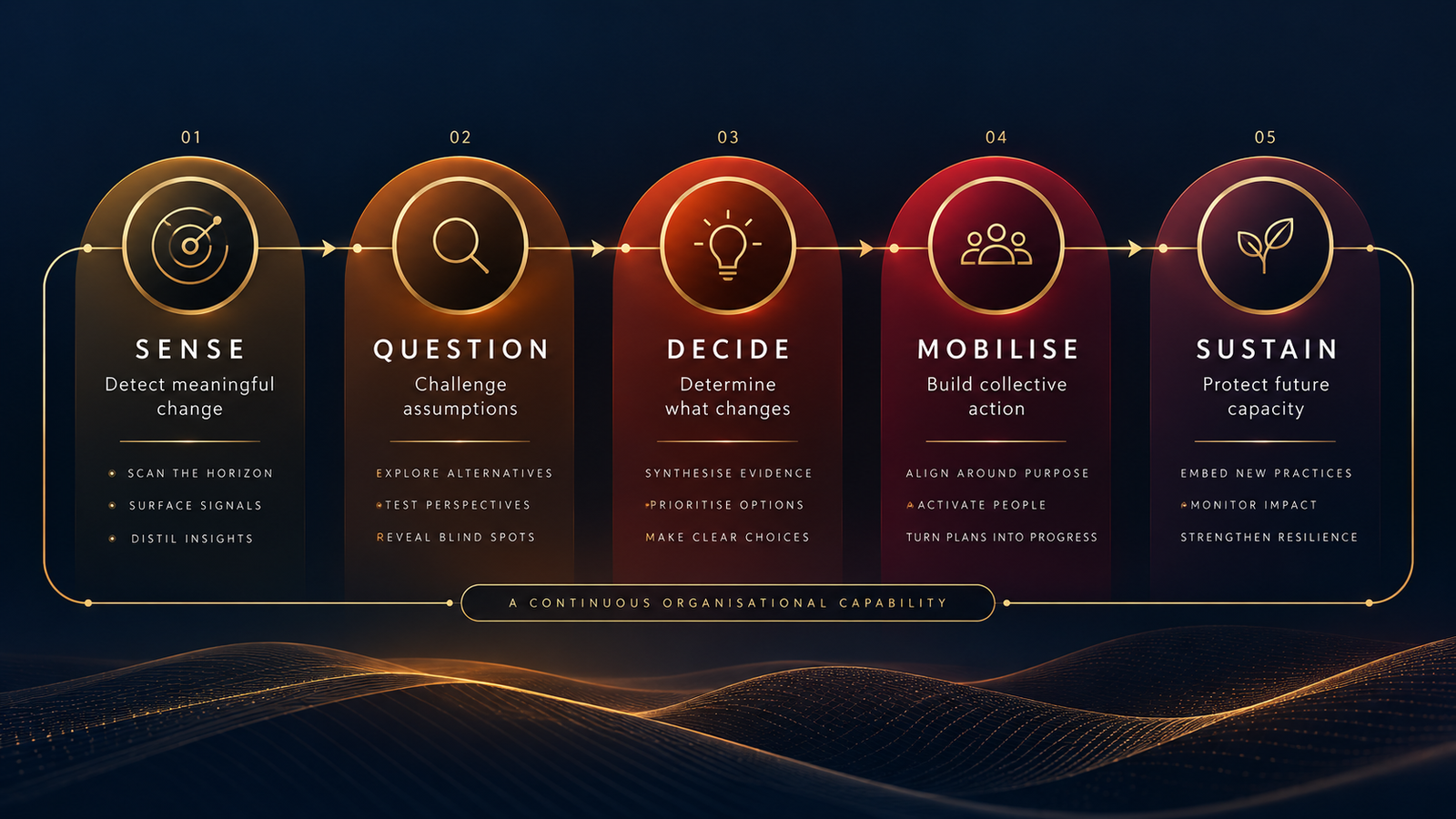
- The Adaptive Capacity Framework™ moves through five dimensions: Sense → Question → Decide → Mobilise → Sustain.
- Strong adaptive leaders separate adaptive variables from leadership anchors such as purpose, ethics and professional standards.
- Leadership overload can produce rigidity. Leadership Capacity™ must be treated as a strategic resource.
- For every significant new initiative, decide what should stop, reduce or be redesigned to create capacity for it.
Building Adaptive Capacity in Practice
If Adaptability Intelligence™ is the intelligence required to interpret and respond effectively to changing conditions, adaptive capacity is the practical ability to keep doing so over time.
That distinction matters.
A leader may respond successfully to one crisis through extraordinary effort. They may work longer hours, personally solve emerging problems and temporarily compensate for weaknesses in the system.
That demonstrates effort.
It does not necessarily demonstrate adaptive capacity.
Burn Bright Advisory’s broader approach to Leadership Sustainability™ reinforces this distinction. Leadership becomes vulnerable when expanding responsibilities, competing demands and constant disruption are absorbed primarily through the personal capacity of individual leaders. Sustainable performance requires systems, boundaries and collective capability rather than an assumption that leaders can simply continue absorbing more.

Featured Snippet
The Adaptive Capacity Framework™
The Adaptive Capacity Framework™ can be understood through five interconnected dimensions:
Each represents a different leadership requirement.
1. Sense: Detect What Is Changing
Adaptation begins with awareness. Leaders cannot respond intelligently to conditions they have failed to notice.
Yet sensing is more sophisticated than collecting information. Modern leaders rarely suffer from a shortage of information. More often, they face an excess of signals competing for attention.
The leadership challenge is determining which signals matter. A useful sensing discipline asks:
- What are we seeing that we did not see six months ago?
- Which assumptions are becoming less reliable?
- Where are stakeholders behaving differently?
- What pressures are repeatedly appearing?
- What information contradicts our current strategy?
- What are frontline employees seeing before senior leaders see it?
The last question is particularly important. Hierarchy can distort organisational intelligence.
Senior leaders often receive information after it has been interpreted, summarised and sometimes softened as it travels upwards. Adaptive leaders deliberately create mechanisms through which weak signals can reach decision-makers before they become major problems.
This is one reason psychological safety matters to adaptability. People must be able to communicate inconvenient information.
2. Question: Challenge the Existing Interpretation
Once leaders detect change, they need to question their interpretation of it. This requires Reflective Practice Intelligence™.
Consider an organisation experiencing declining performance. One interpretation might be: “Our people need to work harder.” Another might be: “Our operating model no longer matches current conditions.”
Those interpretations produce radically different leadership responses.
The first increases pressure.
The second investigates the system.
Adaptive leadership requires leaders to resist premature certainty. Three questions are particularly useful:
- What do we think is happening?
- What evidence supports that interpretation?
- What else could explain what we are seeing?
These questions appear simple, but they challenge one of the strongest forces operating in leadership: the desire to reach certainty quickly.
In uncertain environments, however, premature certainty can be more dangerous than temporary ambiguity.
The adaptable leader does not remain indecisive indefinitely. They create enough intellectual space to improve the quality of the decision.
3. Decide: Determine What Must Change—and What Must Not
Adaptability is sometimes presented as an endless willingness to change. That is a mistake.
Leadership requires anchors. Purpose, ethics, professional standards and critical organisational commitments should not disappear simply because circumstances become difficult.
The adaptive question is therefore not “How quickly can we change?” It is:
This creates a useful distinction between adaptive variables and leadership anchors.
Adaptive variables
Open to change
Processes, structures, technologies, roles, timelines, communication methods and resource allocation.
Leadership anchors
Held stable
Purpose, ethical principles, safety standards, professional obligations and core commitments to stakeholders.
Strong adaptive leaders know the difference.
Without adaptability, organisations become rigid.
Without anchors, they become unstable.
Leadership requires both.
4. Mobilise: Turn Adaptation Into Collective Capability
Recognising the need for change is not the same as creating change. Leaders must mobilise people.
This is where adaptability intersects with Emotional Intelligence™, Constructivism Intelligence™ and Visionary Leadership Intelligence™.
People rarely experience organisational change as an abstract strategic concept. They experience it personally. They wonder:
- What does this mean for my role?
- Will I still be competent?
- What will I lose?
- Will expectations change again?
- Does leadership actually know where this is going?
These are not necessarily signs of resistance. They are often rational responses to uncertainty.
Adaptive leaders therefore do more than announce new direction. They help people make sense of changing circumstances.
They explain what is known.
They acknowledge what remains uncertain.
They identify what is staying stable.
They involve people in solving problems where appropriate.
And they create feedback mechanisms through which implementation can itself become a source of learning.
This approach reflects an important principle within Burn Bright’s leadership thinking: leaders become more effective when they create conditions in which intelligence can emerge from others rather than assuming leadership requires possessing every answer.
5. Sustain: Protect the Capacity to Keep Adapting
The final dimension is frequently neglected. Can the organisation sustain the adaptation?
A transformation that succeeds for three months by exhausting everyone involved is not necessarily successful.
A leader who personally carries a change programme by working unsustainable hours has not built adaptive capacity. They have temporarily substituted personal capacity for organisational capacity.
This is where Leadership Sustainability™ becomes fundamental. Every significant change creates a capacity equation:
If they do not, something must change.
- That might mean stopping lower-value activity.
- It might mean extending a deadline.
- It might require additional resources.
- It might involve simplifying a process.
- It might require acknowledging that two strategically desirable initiatives cannot responsibly be pursued simultaneously.
This is not a failure of ambition.
It is intelligent leadership.
Adaptability Across Different Leadership Environments
Adaptability looks different depending on context. The underlying intelligence remains consistent, but its application changes according to sector, stakeholder expectations, risk and purpose. Explore the Burn Bright sector hubs for sector-specific resources.
Business Growth Intelligence™: When the Strategy Stops Matching the Market
Imagine a growing professional-services company whose growth strategy has worked successfully for five years. Its reputation is strong. Client retention is healthy. Revenue has increased steadily.
Then buying behaviour changes. Clients begin expecting faster delivery, more digital interaction and different forms of value.
- A rigid organisation interprets the change as temporary and continues executing the existing model harder.
- A reactive organisation abandons its strategy and pursues every emerging trend.
- An adaptive organisation investigates.
It asks:
- What has genuinely changed in customer expectations?
- Which elements of our existing value proposition remain strong?
- Where is technology altering the economics of delivery?
- Which capabilities will matter in three years?
- What should we experiment with before making large-scale commitments?
This is Business Growth Intelligence™ informed by Adaptability Intelligence™. The organisation neither protects the past blindly nor abandons it recklessly. It learns.
School Leadership Intelligence™: Adaptation Without Initiative Overload
School leadership provides an especially useful example because educational leaders frequently operate in environments of continual reform.
New curricula.
New assessment requirements.
New technologies.
New safeguarding expectations.
New accountability frameworks.
New parental expectations.
The danger is that adaptability becomes synonymous with implementation. Every new development generates another initiative. Nothing disappears. Leadership workload expands. Teacher capacity contracts.
Eventually, the school may technically be implementing change while losing the organisational capacity required to make any of it meaningful.
Adaptive school leadership asks a different question:
- If a new priority enters the system, what should leave?
- If teachers need to develop new capability, where will learning time come from?
- If technology is introduced, what existing process does it replace?
- If leadership expectations expand, how will leadership workload be redesigned?
This is the connection between School Leadership Intelligence™, Adaptability Intelligence™ and Leadership Sustainability™. Change must be absorbed intelligently rather than accumulated indiscriminately.
Healthcare Leadership Intelligence™: Adapting Where Reliability Matters
Healthcare illustrates another important principle: some environments require adaptability and consistency simultaneously.
Clinical teams must respond to new evidence, changing technologies, workforce pressures and evolving patient needs. Yet they cannot treat safety protocols as optional simply because circumstances are changing.
Adaptive healthcare leadership therefore depends on distinguishing between what must remain reliable and what must remain adaptable.
A workflow may change.
A communication process may change.
Technology may change.
Staffing models may change.
But patient safety, professional accountability and evidence-based standards remain anchors.
This demonstrates why Adaptability Intelligence™ cannot operate independently from Professionalism Intelligence™ and Ethics Intelligence™.
Public Service Leadership Intelligence™: Adapting Under Multiple Accountabilities
Public-sector leaders face a different adaptive challenge. They must frequently respond to changing political priorities, public expectations, legislation, budgets and operational demands while maintaining institutional continuity.
The temptation can be either excessive rigidity or excessive responsiveness.
- Rigidity protects existing processes even when circumstances have changed.
- Excessive responsiveness creates continual redirection in which teams struggle to complete one priority before another arrives.
Adaptive public-service leadership requires the ability to translate changing external expectations into coherent internal priorities. That means asking:
- What has actually changed?
- What is legally or strategically required?
- What can the organisation realistically absorb?
- What existing work must be deprioritised?
- What institutional knowledge must be preserved?
Adaptability becomes an exercise in intelligent translation rather than constant organisational motion.
HR & People Leadership Intelligence™: From Change Management to Change Capacity
People functions have traditionally been asked to support change initiatives. But the emerging challenge is larger. Organisations increasingly need HR and people leaders to understand change capacity.
Two organisations may have identical strategies and very different capacities to execute them.
- One may have stable teams, strong managers, manageable workloads and high trust.
- Another may be experiencing turnover, leadership fatigue, capability gaps and unresolved cultural problems.
Applying the same transformation timetable to both organisations would make little sense. Adaptive people leadership therefore asks:
That question should become a central part of workforce strategy.
Entrepreneur Performance Intelligence™: Adaptability Without Strategic Drift
Entrepreneurs are often celebrated for adaptability. Yet entrepreneurship reveals the opposite risk: too much adaptation.
Founders may continually change products, positioning, priorities and strategies in response to every new piece of feedback. The organisation becomes agile in theory but confused in practice.
- Employees struggle to understand what matters.
- Resources are spread across experiments.
- Long-term capability never develops because priorities change before learning can mature.
Adaptive entrepreneurship requires a balance between experimentation and commitment. The founder must know when to pivot. But they must also know when to persist long enough to generate meaningful evidence.
That requires Entrepreneur Performance Intelligence™ supported by reflection, disciplined experimentation and strategic clarity.
The Hidden Enemy of Adaptability: Leadership Overload
There is a final issue organisations cannot afford to ignore. Leaders themselves have finite adaptive capacity.
Every difficult decision consumes cognitive resources.
Every unresolved conflict consumes emotional resources.
Every transformation initiative creates coordination demands.
Every new responsibility occupies attention.
Eventually, leaders can reach a point at which their ability to adapt begins to deteriorate precisely because they have been adapting continuously.
Burn Bright’s work on leadership burnout highlights the consequences of expanding management responsibilities, competing stakeholder demands and leadership roles that become structurally unsustainable.
Under sustained overload, leaders may become:
This is why Leadership Capacity™ must be treated as a strategic resource. The question is not simply “Can this leader deliver the change?” It is also:
That is a fundamentally different way of thinking about leadership performance. It moves the conversation from short-term execution toward Leadership Sustainability™.
From Reactive Leadership to Adaptive Leadership
The practical shift can be summarised simply.
| Reactive Leaders | Adaptive Leaders |
|---|---|
| Respond to pressure | Interpret pressure |
| Add activity | Reconsider priorities |
| Seek certainty | Seek sufficient evidence |
| Protect previous decisions | Protect purpose while questioning methods |
| Carry change personally | Build collective capability |
| Ask “How do we get through this?” | Ask “What must we learn and change so that we are better equipped for what comes next?” |

That is the deeper purpose of Adaptability Intelligence™. It is not simply the capacity to survive disruption.
The Leadership Adaptability Diagnostic™
Understanding adaptability intellectually is useful. Knowing whether it exists in your own leadership practice is more valuable.
Adaptability often becomes visible at the moment expectations collide with reality. A strategy stops producing the expected result. A team cannot absorb another priority. A previously reliable process begins creating problems. New evidence challenges an established assumption.
The critical leadership question is what happens next.
- Does the leader defend the existing approach?
- Do they immediately change direction?
- Do they gather more information but postpone the decision indefinitely?
- Or can they interpret what has changed, reconsider assumptions and make a proportionate adjustment while protecting the organisation’s essential purpose?
A practical Leadership Adaptability Diagnostic™ can begin with five dimensions drawn from the Adaptive Capacity Framework™.
Dimension 1 Sensing Intelligence
Ask: How quickly do I notice meaningful changes in the environment around me?
Strong sensing does not mean following every trend. It means maintaining enough connection with employees, stakeholders, evidence and the external environment to recognise when assumptions need revisiting. Warning signs include:
- repeatedly being surprised by developments others anticipated;
- receiving heavily filtered information;
- relying primarily on senior-level perspectives;
- dismissing inconvenient evidence;
- assuming previous patterns will continue automatically.
A useful leadership practice is to create a regular signal review. Instead of asking only “How are we performing?”, ask: “What are we seeing now that could change how we need to perform next?” That shifts leadership attention from retrospective measurement towards anticipatory intelligence.
Dimension 2 Questioning Intelligence
Ask: How willing am I to reconsider an interpretation I have already formed?
This is where adaptability becomes personally demanding. Changing strategy is relatively easy compared with changing one’s mind about why a problem exists. Leaders can become attached to explanations:
- “The team lacks accountability.”
- “Customers are becoming unreasonable.”
- “Employees resist change.”
- “The strategy is sound; execution is the problem.”
Any of those statements could be correct. They could also prevent further investigation. Adaptive leaders treat explanations as hypotheses rather than identities. They ask: What evidence would cause me to change my view?
That is a powerful test. If the answer is “nothing”, the leader is no longer evaluating evidence. They are defending a position. This is where Reflective Practice Intelligence™ strengthens Adaptability Intelligence™: reflection enables leaders to examine not only what they think, but how they reached that conclusion.
Dimension 3 Decision Intelligence
Ask: Can I change direction without losing strategic coherence?
Some leaders struggle to adapt because they delay decisions. Others create the opposite problem: continual change. Every new signal generates another priority. Every challenge creates another initiative. Every stakeholder concern produces another adjustment.
Teams eventually stop treating priorities seriously because experience tells them another priority will soon replace the current one. Adaptive decision-making requires proportion.
Leaders need to distinguish among five responses:
Monitor
The signal matters, but action is not yet required.
Experiment
Uncertainty is high enough that a limited test is appropriate.
Adapt
Evidence supports a meaningful change.
Stop
The existing approach is no longer justified.
Protect
The surrounding environment may be changing, but this principle, standard or priority should remain stable.
This creates a more sophisticated response than the binary choice between “change” and “don’t change”. It also protects organisations from strategic drift.
Dimension 4 Mobilisation Intelligence
Ask: Can people around me understand and act on the adaptation?
A leadership decision does not become organisational adaptation simply because it appeared in a presentation. People must translate the change into behaviour. That requires clarity. Employees need to understand:
- Why is change necessary?
- What evidence informed the decision?
- What exactly is changing?
- What is not changing?
- What does this mean for my work?
- What decisions can I make?
- What support will be available?
- How will we know whether the new approach is working?
When leaders leave these questions unanswered, people create their own explanations. Rumour fills information gaps. Anxiety fills certainty gaps. Informal behaviour fills process gaps.
Effective mobilisation therefore requires more than communication frequency. It requires sense-making. This is where Emotional Intelligence™, Constructivism Intelligence™ and Visionary Leadership Intelligence™ interact with adaptability. People need both direction and enough psychological space to process what the direction means.
Dimension 5 Sustainability Intelligence
Ask: Can we sustain this adaptation without damaging the capacity required for the next challenge?
This may be the most neglected question of all. Leadership performance is often measured at the point of delivery. Was the project completed? Was the transformation launched? Was the deadline achieved? Were the targets met?
But sustainable leadership requires another measurement: what condition were the leader and team in after delivering it?
If a successful transformation leaves managers exhausted, key employees considering departure and essential work accumulating elsewhere, the organisation has borrowed performance from the future. That is not sustainable adaptability.
Burn Bright’s existing work on leadership workload argues that sustainable leadership requires systems that distribute demands rather than relying indefinitely on personal sacrifice and individual heroics. This is why Leadership Sustainability™, Leadership Capacity™ and Leadership Workload™ belong inside the adaptability conversation.
The organisation must retain enough capacity to respond to what happens next.
The Adaptability Intelligence™ Matrix
Leaders can use two questions to understand their current adaptive position:
- How strong is our ability to change?
- How strong is our clarity about what should remain stable?
These create four broad conditions.
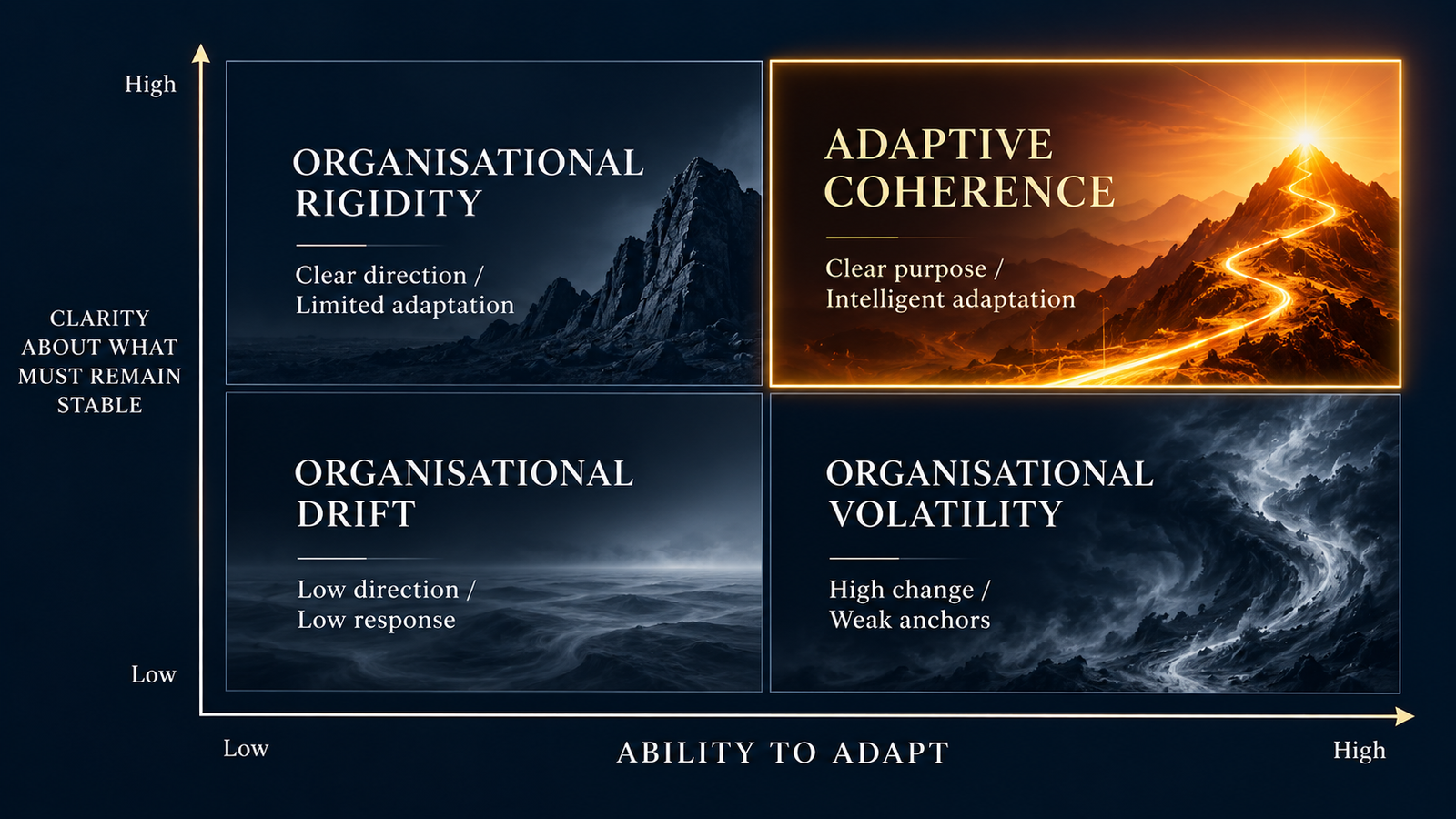
Low adaptability + low clarity Organisational Drift
The organisation lacks both direction and responsiveness. Leaders may recognise that existing approaches are failing but remain unclear about alternatives. Teams experience uncertainty without meaningful adaptation.
Leadership priority: sense-making and strategic clarification.
Low adaptability + high clarity Organisational Rigidity
The organisation knows what it wants but has difficulty changing how it pursues it. Previous success can reinforce this condition. Leaders may protect established methods because those methods once produced strong outcomes.
Leadership priority: experimentation and learning.
High adaptability + low clarity Organisational Volatility
The organisation changes frequently but lacks sufficient anchors. Priorities move rapidly. Teams become uncertain about what matters.
Leadership priority: purpose, prioritisation and decision discipline.
High adaptability + high clarity Adaptive Coherence
This is the desired position. The organisation understands what it is trying to protect and achieve while remaining willing to reconsider how it gets there.
- Purpose is stable.
- Methods can evolve.
- Evidence informs decisions.
- Learning influences future action.
- Capacity is monitored.
Adaptation becomes disciplined rather than chaotic.
That is Adaptability Intelligence™ in practice.
Seven Questions Before Making a Major Adaptation
Before introducing a significant organisational change, leaders can use a short decision discipline.
- What has materially changed? Separate observable change from assumption, noise and temporary disruption.
- What evidence tells us our current response is no longer sufficient? Avoid changing direction merely because pressure is increasing.
- What must remain stable? Identify purpose, ethical obligations, professional standards and strategic commitments that should anchor the response.
- What specifically needs to change? Define whether adaptation concerns priorities, behaviours, systems, structures, resources or capability.
- What are we assuming? Surface the beliefs underpinning the proposed response.
- What capacity will this adaptation require? Consider workload, attention, learning, emotional energy, resources and leadership bandwidth.
- How will we learn whether the adaptation is working? Identify evidence that will confirm, challenge or refine the decision.
These questions slow thinking sufficiently to improve judgement without turning reflection into paralysis.
Leadership Reflection Questions
- Where am I currently relying on experience that may no longer match present conditions?
- Which organisational assumptions have not been seriously questioned recently?
- What evidence would cause me to reconsider an important leadership decision?
- Where are employees adapting informally because formal systems have not kept pace?
- Which current initiatives exist primarily because nobody has decided to stop them?
- What information might people hesitate to tell me?
- Where has flexibility become inconsistency?
- Where has consistency become rigidity?
- What elements of our purpose or professional standards should remain non-negotiable during change?
- How much additional change can my team realistically absorb?
- Which part of my own workload is reducing my ability to think adaptively?
- What are we learning from our most recent adaptation?
Use these questions individually, with a leadership team, or alongside the Leadership Intelligence Assessment™. They turn adaptability from an abstract leadership characteristic into an observable practice.
Action Steps: Building Adaptability Intelligence™
Adaptability develops through repeated leadership behaviour.
Conduct a monthly signal review
Create dedicated time to examine emerging changes rather than discussing only current performance. Ask what is changing across customers, employees, technology, regulation, competitors, communities and the wider operating environment. The purpose is not prediction. It is preparedness.
Identify one protected assumption
Every leadership team has beliefs that rarely get questioned. Choose one—for example, “Our customers value this”, “This process is necessary”, “This role must operate this way”, “Our employees prefer this arrangement” or “This meeting is essential”. Then ask what evidence actually supports the belief.
Create an adaptation portfolio
Separate proposed changes into three categories: Monitor. Test. Commit. Not every idea deserves immediate implementation. Small experiments can generate evidence before substantial organisational capacity is committed.
Introduce a stop decision
For every significant new initiative, explicitly consider: what should stop, reduce or be redesigned to create capacity for this? This prevents adaptation from becoming accumulation.
Protect Leadership Reflection™
Reflection should not be treated as something leaders do after “real work” is complete. Reflection is leadership work. Protect regular time to examine decisions, assumptions, patterns and emerging evidence.
Measure capacity alongside progress
Project dashboards frequently track delivery while ignoring human capacity. Add questions such as: Are workloads sustainable? Where are bottlenecks developing? Which leaders are carrying disproportionate responsibility? What new capabilities are required? Where is change fatigue emerging? This connects adaptability directly with Leadership Benchmarking™ and Leadership Sustainability™.
Build distributed adaptability
Do not make senior leaders the only people permitted to interpret change. Create mechanisms through which teams can identify emerging problems, experiment appropriately and escalate learning. Adaptive organisations distribute intelligence.
Frequently Asked Questions
What is adaptability leadership?
Adaptability leadership is the ability to adjust leadership thinking, behaviour, priorities and organisational responses when circumstances change while maintaining clarity of purpose. It combines learning, judgement, reflection and action rather than simply responding quickly.
Why is adaptability important in leadership?
Leadership takes place in changing environments. Strategies, technologies, workforce expectations, stakeholder needs and external conditions evolve. Leaders who cannot reconsider assumptions risk applying yesterday’s solutions to today’s problems.
Is adaptability the same as flexibility?
No. Flexibility describes willingness or ability to change. Adaptability requires judgement about whether, when and how change should occur. A leader can be highly flexible but strategically inconsistent.
Can a leader become too adaptable?
Yes. Constantly changing priorities can create instability, confusion and change fatigue. Effective adaptability combines responsiveness with clear organisational anchors.
How does Adaptability Intelligence™ relate to Leadership Performance Intelligence™?
Adaptability Intelligence™ is one domain contributing to the wider Leadership Performance Intelligence™ system. Leadership performance depends not merely on responding to change but on combining adaptability with ethical judgement, professionalism, emotional intelligence, reflection, vision, knowledge development and sustainability.
What prevents leaders from adapting?
Common barriers include attachment to previous success, confirmation bias, fear of appearing inconsistent, excessive workload, weak feedback systems, organisational politics and cultures in which challenging senior thinking feels unsafe.
How can organisations develop adaptive leaders?
Organisations can strengthen adaptability by creating reflective leadership practices, improving feedback flows, encouraging disciplined experimentation, developing psychological safety, reviewing assumptions and measuring organisational capacity alongside delivery.
How does adaptability relate to leadership resilience?
Resilience helps leaders recover and continue functioning through difficulty. Adaptability enables them to learn from changing conditions and modify their response. Resilience without adaptation can result in repeatedly enduring a system that needs redesigning.
What is the relationship between adaptability and Leadership Sustainability™?
Adaptation consumes capacity. Sustainable leaders consider workload, energy, resources and learning requirements when implementing change. An adaptation that delivers short-term results by exhausting the people responsible for it may weaken long-term leadership performance.
How can I assess my own adaptability as a leader?
Begin by examining five areas: how effectively you sense change, question assumptions, make proportionate decisions, mobilise others and preserve capacity. The wider Leadership Intelligence Assessment™ can then help place adaptability within a broader picture of leadership capability.
Conclusion: Adaptability Is Intelligent Change
The future will not reward leaders simply because they change quickly. Nor will it reward leaders who preserve familiar practices long after the environment has changed.
The stronger leadership position lies between those extremes. It requires leaders capable of maintaining purpose while reconsidering method.
Leaders who can remain confident without becoming certain.
Leaders who can use experience without becoming imprisoned by it.
Leaders who can respond to new evidence without chasing every new trend.
And leaders who understand that adaptation must strengthen future capacity rather than consume it.
This is why Adaptability Intelligence™ belongs within the Leadership Intelligence Compass™. It does not stand alone.

- It works alongside Reflective Practice Intelligence™ to challenge assumptions.
- It works alongside Knowledge Development Intelligence™ to convert experience into learning.
- It works alongside Emotional Intelligence™ to understand the human consequences of change.
- It works alongside Visionary Leadership Intelligence™ to maintain direction.
- It works alongside Ethics Intelligence™ and Professionalism Intelligence™ to establish boundaries around responsible adaptation.
- And it works alongside Leadership Sustainability™ to ensure today’s response does not destroy tomorrow’s capacity.
That integration is central to Leadership Performance Intelligence™.
Because the real test of leadership is not whether a leader can perform when circumstances remain favourable and familiar. It is whether they can continue to observe, interpret, reflect, learn and lead when those circumstances change.
Adaptability, understood this way, is not about becoming comfortable with chaos.
And that is becoming one of the defining capabilities of contemporary leadership.
How Adaptable Is Your Leadership System?
The question is not simply whether you personally cope well with change. The more important question is whether your leadership system can detect change, challenge assumptions, make intelligent adjustments and preserve the capacity required to keep performing.
Explore the Leadership Intelligence Compass™ to understand how Adaptability Intelligence™ interacts with the wider capabilities required for sustainable leadership performance. Use the Leadership Intelligence Assessment™ to examine strengths and development priorities across the wider leadership system, and the Leadership Diagnostic platform to identify capability gaps.
Continue into the Leadership Intelligence Library™ to deepen your understanding of Leadership Performance Intelligence™, Leadership Sustainability™, Leadership Capacity™ and the other domains that shape effective leadership. For team and organisational development, explore Burn Bright’s leadership workshops.
Because sustainable leadership is not about predicting every change that comes next.
It is about developing the intelligence to respond well when it arrives.
Measure the Capacity Behind Your Adaptation
For a fuller structural picture of the pressures shaping your leadership capacity, explore the Burn Bright Full Diagnostic™ — £144.
Is Constant Adaptation Borrowing From Your Future?
A transformation carried by unsustainable hours has not built adaptive capacity. Identify the structural pressures affecting your leadership with the free Burn Bright assessment.
Free Leadership Intelligence
Get Weekly Leadership Insights
Join thousands of leaders receiving practical strategies on burnout prevention, workload design, and sustainable performance every week.