Quick Answer
Key Takeaways
- Treat your calendar as leadership infrastructure, not a booking system.
- Protect strategic thinking before accepting routine meetings.
- Audit recurring meetings for purpose, ownership and decision value.
- Group communication and decision-making to reduce cognitive switching.
- Preserve deliberate capacity for unexpected leadership demands rather than scheduling yourself to 100%.
Executive Calendar Redesign: Reclaim Strategic Time
Executive calendar redesign starts with a difficult question: does your calendar reflect your leadership priorities, or everybody else’s demands?
For many senior leaders, the answer is uncomfortable.
Their diary is full. Their working day is fragmented into 30-minute and 60-minute blocks. Meetings run into meetings. Emails are handled between calls. Strategic thinking is pushed into evenings, weekends or the increasingly mythical quiet Friday afternoon.
The leader appears busy.
But being fully booked is not the same as being effective.
Microsoft’s Work Trend Index found that 68% of people said they lacked enough uninterrupted focus time during their working day. It also found that the average employee using Microsoft 365 spent 57% of their time communicating and 43% creating. Inefficient meetings ranked as the biggest reported productivity disruptor.
For leaders, the consequences are particularly serious. Strategic thinking, difficult decisions, coaching and organisational design all require cognitive space.
When the calendar removes that space, leadership becomes increasingly reactive.
The answer is not another productivity technique.
It is architectural redesign.
The visual below shows the fundamental shift.
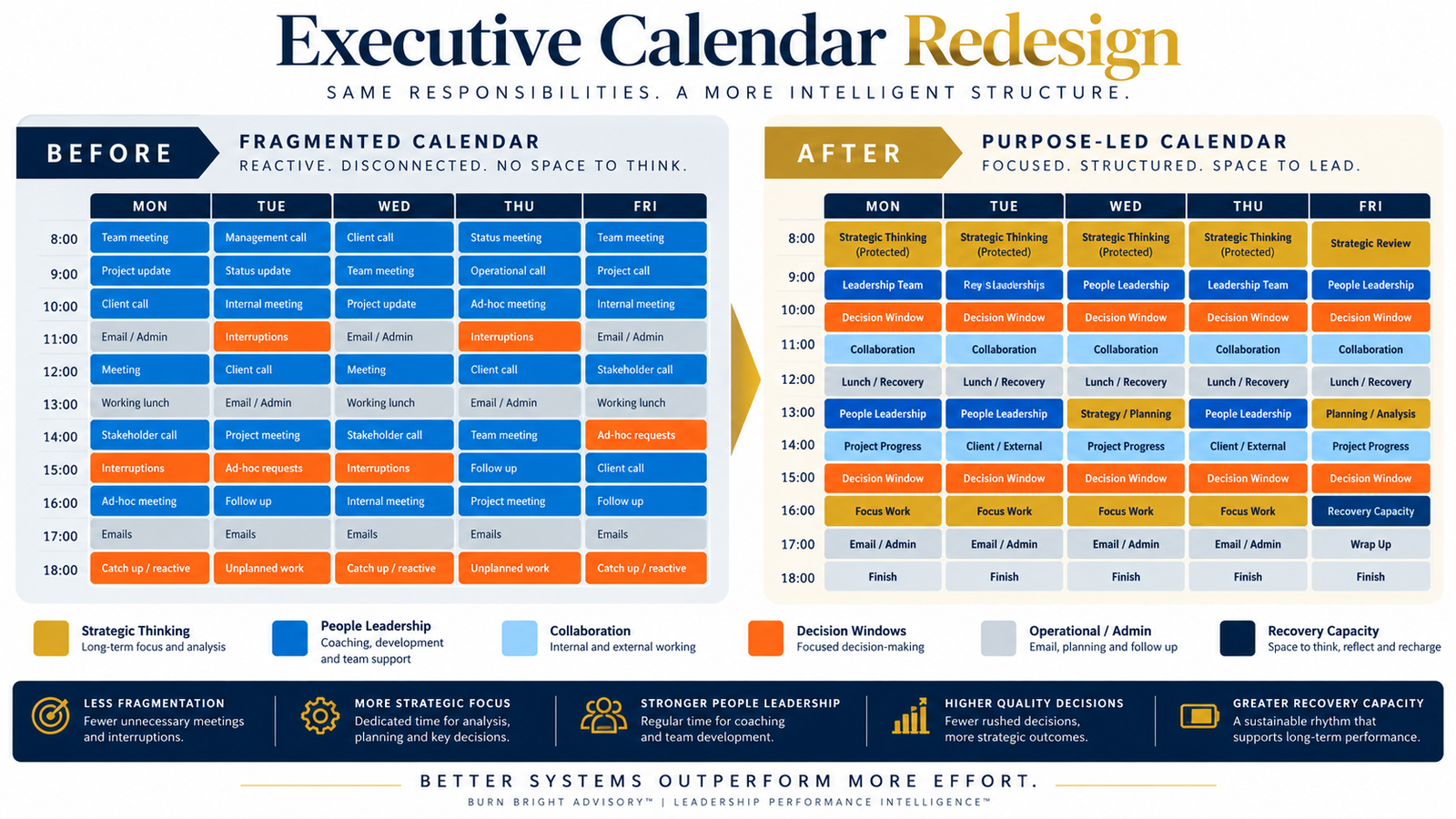
The distinction matters. A sustainable calendar does not simply contain fewer meetings. It allocates leadership capacity deliberately.
Featured Snippet
Why Do Executive Calendars Become Overloaded?
Most leaders do not deliberately create overloaded calendars. The overload accumulates.
A weekly meeting is added because a project needs attention. A steering committee appears because governance needs strengthening. One-to-ones multiply as the team grows. A temporary transformation meeting becomes permanent.
Nothing is removed.
This is calendar scope creep.
It mirrors one of the five root causes identified in the Burn Bright Not Out Framework™: scope creep. Meeting culture then compounds the problem.
Every additional responsibility creates communication around the responsibility. More projects create more updates. More stakeholders create more coordination. More uncertainty creates more meetings.
Eventually, the calendar becomes an archive of organisational complexity.
The problem is that every meeting has an opportunity cost. An hour in a low-value meeting is not merely an hour lost. It may remove the only uninterrupted hour available to think through a major decision.
Deloitte describes organisational capacity being consumed by complexity, including meeting overload in which people spend large portions of their day discussing work rather than doing the work.
The World Health Organization also defines burnout as resulting from chronic workplace stress that has not been successfully managed. Its occupational guidance identifies factors including excessive demands, limited control and poor work organisation.
That matters because calendar overload is not simply inconvenient. It can become a structural source of chronic workplace stress.
The day becomes reactive:
9:00 — operational meeting.
10:00 — project update.
11:00 — stakeholder call.
12:00 — working lunch.
1:00 — one-to-one.
2:00 — steering group.
3:30 — another update.
5:00 — finally begin the work that required concentration.
This is not a personal productivity failure.
The architecture is wrong.
The calendar is asking the leader to perform strategic work inside a system designed almost entirely for communication.
That principle applies to calendars as much as it applies to workload.
What Does Meeting Overload Do to Leadership Performance?
Meeting overload creates more than lost time. It fragments cognition.
Every time leaders switch between a budget discussion, personnel issue, operational problem and strategic project, the brain has to reorient.
The calendar may show four one-hour meetings.
The cognitive cost is larger.
Preparation happens before the meeting. Mental residue remains afterwards. Decisions generate follow-up. Messages accumulate while the leader is unavailable.
The result is a day divided into fragments too small for serious thinking.
Microsoft’s research provides useful context. Its 2023 Work Trend Index found that people were attending three times as many Teams meetings and calls per week as they had in February 2020. Only 35% said they believed they would be missed from the majority of their meetings.
That should concern every executive team.
Gallup’s research makes the leadership implications even clearer. Managers account for approximately 70% of the variance in team engagement. In Gallup’s 2025 World Poll data, only 22% of managers were engaged at work.
The people responsible for creating clarity are themselves operating under significant pressure.
Calendar design therefore affects more than personal productivity. It affects leadership quality.
When leaders lack thinking space, predictable patterns emerge:
- decisions become reactive;
- difficult issues are postponed;
- delegation decreases;
- strategic work gets displaced;
- communication becomes rushed;
- minor problems become crises;
- leaders take unfinished cognitive work home.
That final point matters.
A badly designed calendar often creates the illusion that work has been completed because the meeting day has ended. But the thinking work has simply moved.
It moves to 7:30 pm.
Or 10:00 pm.
Or Saturday morning.
The organisation has not eliminated the workload. It has exported it into the leader’s recovery time.
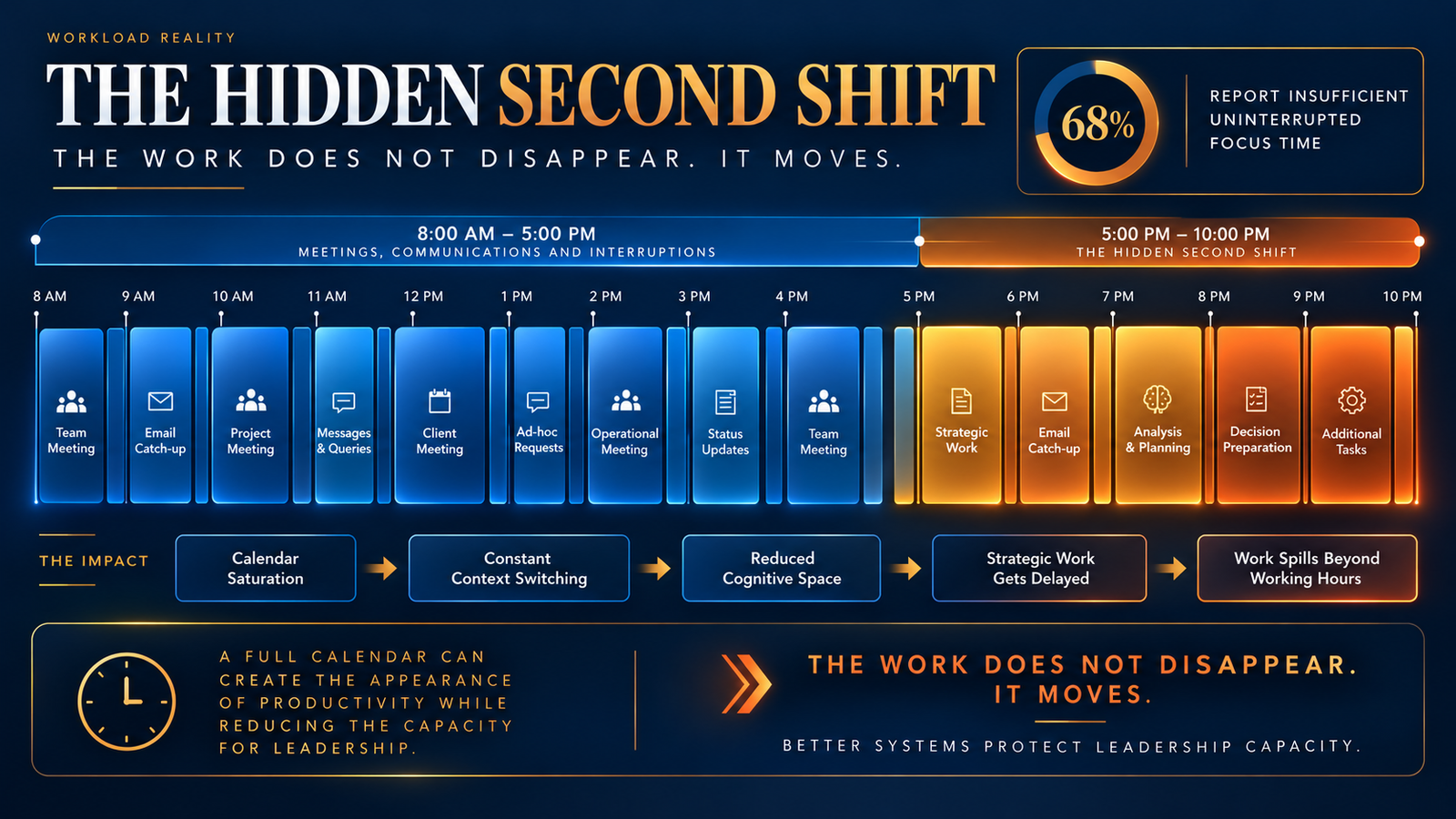
Interpretation: calendar overload converts visible collaboration into invisible work.
That is why reducing meeting overload is not about avoiding collaboration. It is about restoring the capacity required for leadership.
How Should Leaders Conduct an Executive Calendar Redesign?
An effective executive calendar redesign begins with diagnosis rather than deletion.
Do not open Monday morning and randomly cancel half your meetings. Audit the system first.
Take the previous four weeks of your calendar and classify every significant block into five categories:
Category 1 Strategic Leadership
Work involving direction, organisational design, long-term planning, major priorities and future capability.
Category 2 Decisions
Activities where your authority or judgement was genuinely required.
Category 3 People Leadership
Coaching, performance conversations, talent decisions and essential relationship-building.
Category 4 Operational Coordination
Updates, routine problem-solving and implementation activity.
Category 5 Administrative or Low-Value Activity
Work that could potentially be delegated, automated, combined, handled asynchronously or eliminated.
Then calculate the approximate proportion of your working week occupied by each category.
Do not judge it yet.
Look at the evidence.
A chief executive who says strategy is their priority but spends 6% of their calendar on strategy has discovered an architectural mismatch.
A director who wants empowered managers but personally attends every operational review has found another.
Now interrogate recurring meetings using four questions:
Does this meeting require my authority?
If not, why are you attending?
Does it require synchronous discussion?
An information update may be better handled asynchronously.
Does it produce a decision, action or meaningful change?
If nobody can explain what changes because the meeting exists, its value should be questioned.
What happens if we stop it for 30 days?
This question exposes meetings maintained through habit rather than necessity.
The goal is not to achieve a particular meeting percentage. Roles differ. A chief executive, headteacher, hospital leader and operational director have different requirements.
The goal is alignment.
Your calendar should provide sufficient capacity for the responsibilities that carry the greatest strategic value and cannot reasonably be performed by somebody else.
What Should a Sustainable Executive Calendar Look Like?
A sustainable executive calendar needs structure without becoming rigid. I use four principles.
Principle 1
Protect strategic capacity first
Most leaders schedule meetings first and hope thinking time survives. Reverse the sequence. Put strategic work into the calendar before routine demand consumes the week.
This might mean two 90-minute protected blocks or several shorter periods depending on the role. The principle matters more than the format.
Strategic work requires an appointment with the calendar because otherwise urgent operational work will repeatedly defeat important long-term work.
Principle 2
Create decision windows
Decision overload is another root cause of leadership burnout. Instead of allowing routine decisions to arrive continuously through the day, group appropriate decisions into defined windows.
This creates two benefits. First, it reduces interruption. Second, it reveals decisions that should never have reached the executive in the first place.
If every operational decision requires senior approval, the calendar is not the only problem. Decision authority needs redesign.
Principle 3
Cluster collaboration
Where possible, place similar meetings together. Moving from strategic planning to a disciplinary conversation, then finance, then recruitment, then technology and back to strategy creates unnecessary cognitive switching.
Clustering cannot remove every transition, but it can reduce fragmentation.
Principle 4
Leave capacity unallocated
This is where many executives struggle. They see an empty hour and assume it is available. It is not necessarily available. Some capacity must exist for the unpredictable work inherent in leadership.
A diary scheduled to 100% assumes nothing unexpected will happen. That is not planning. It is wishful thinking.
A school leader will face unexpected safeguarding issues. A hospital executive will encounter operational pressure. A business leader will receive urgent client, financial or people problems.
If no capacity exists, every unexpected event creates calendar debt.
One delay causes another.
Lunch disappears.
Strategic work moves into the evening.
Recovery is sacrificed.
A sustainable calendar therefore contains deliberate margin.
Not because the leader has nothing to do.
Because the leader understands the role.
Traditional Calendar Management vs Executive Calendar Redesign
| Traditional Calendar Management | Executive Calendar Redesign |
|---|---|
| Fills available space | Protects leadership capacity |
| Meetings accepted by default | Meetings must justify their value |
| Strategy fits around operations | Strategic time is protected first |
| Availability signals commitment | Outcomes signal effectiveness |
| Decisions arrive continuously | Decisions are distributed or grouped |
| Empty space is considered waste | Margin is treated as operational capacity |
| Leader attends for visibility | Leader attends where authority adds value |
| Focus time moves to evenings | Focus time sits inside the working day |
| Recovery happens if time remains | Recovery Rhythms™ are designed |
| Individual works harder | System is redesigned |
The difference is not cosmetic.
Traditional calendar management asks: How do I fit everything in?
Executive calendar redesign asks:
Those are fundamentally different questions. The first assumes every existing demand is legitimate. The second forces prioritisation.
How Can Leaders Protect Strategic Time Without Becoming Unavailable?
This is the objection I hear most frequently: “If I protect my calendar, won’t I become inaccessible?”
No.
Not if the system is designed properly.
Availability and accessibility are not the same thing.
A leader who is permanently available may actually become less useful because constant interruption reduces the quality of their attention and decisions.
The alternative is structured accessibility.
- Define when people can reliably reach you.
- Clarify which issues genuinely require escalation.
- Create decision rights so managers know what they can resolve independently.
- Establish communication expectations.
- Use office hours, escalation windows or agreed urgent channels where appropriate.
The objective is not to construct a wall around senior leadership. It is to stop every issue being treated as equally urgent.
This is where calendar architecture connects directly with delegation.
The calendar becomes diagnostic.
It shows you how the organisation actually works.
Not how the organisational chart says it works.
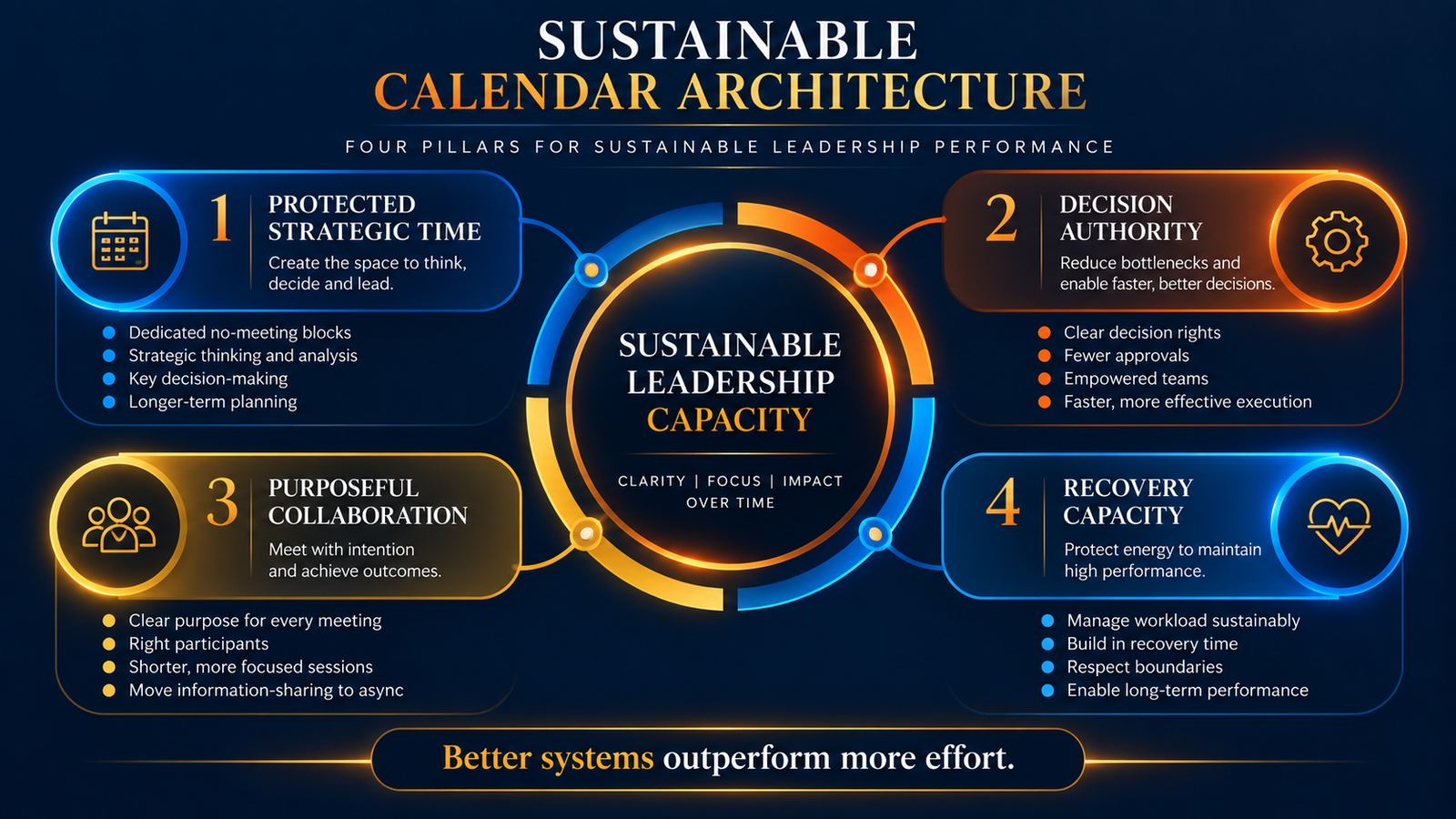
The framework should create four outcomes:
- Clarity: people know when senior leadership input is required.
- Authority: appropriate decisions happen at the correct level.
- Capacity: leaders retain time for high-value thinking.
- Recovery: every working day does not require a second shift at home.
That is sustainable leadership.
It does not reduce accountability.
It makes accountability clearer.
How Do You Make Executive Calendar Redesign Stick?
The hardest part is not redesigning next week. It is stopping the old system from returning next month.
Calendars drift. New projects appear. Temporary meetings become permanent. People discover protected gaps and request them.
Without governance, the calendar slowly returns to its previous state. So create rules.
Start with a 30-day calendar reset. During those 30 days:
Remove meetings that cannot show value
Reduce or remove recurring meetings that cannot demonstrate clear value.
Require agendas or outcomes
Require agendas or explicit outcomes for significant meetings.
Default to asynchronous updates
Default information-sharing to asynchronous communication where appropriate.
Protect strategic blocks
Protect strategic blocks as firmly as external appointments.
Clarify delegation
Clarify which decisions should be delegated.
Review weekly
Review the calendar weekly.
Then measure what changed. Do not measure success by counting cancelled meetings alone. Measure whether the redesign improved leadership.
Leadership Reflection Questions
- Did major decisions receive better thinking?
- Did strategic priorities receive more attention?
- Did fewer routine decisions escalate upwards?
- Did evening work decrease?
- Did the team experience clearer leadership?
- Did you create genuine recovery between high-intensity periods?
Gallup’s findings reinforce why this matters. Managers have an outsized influence on engagement, while its more recent leadership data shows significant pressure on managers themselves.
You cannot separate leadership capacity from organisational performance. The leader who is permanently depleted cannot indefinitely compensate through effort.
This is also why recovery belongs inside the leadership system rather than outside it.
Recovery is not the reward you receive when all work is finished.
Leadership work is rarely finished.
Recovery protects the capacity required to continue doing it well.
That principle sits at the centre of the Burn Bright approach.
The organisation does not need leaders who repeatedly rescue overloaded systems through personal sacrifice. It needs systems that require less rescuing.
Frequently Asked Questions
What is executive calendar redesign?
Executive calendar redesign is the structural reorganisation of a leader’s diary around strategic work, decisions, people leadership, purposeful collaboration and recovery. Instead of allowing meetings to occupy all available space, leaders intentionally allocate their finite attention to work where their involvement creates the greatest value.
How much time should executives spend in meetings?
There is no universal percentage because leadership roles differ. The better question is whether meetings are preventing strategic thinking, important decisions or core leadership responsibilities. If essential work routinely moves into evenings because normal working hours are dominated by meetings, the calendar requires redesign.
How often should leaders review recurring meetings?
A quarterly audit is a sensible minimum, with a lighter review each month. Every recurring meeting should have a clear purpose, appropriate attendees and defined value. Temporary project meetings should also have review or expiry dates so they do not quietly become permanent calendar commitments.
Should leaders schedule thinking time?
Yes. Strategic thinking should be treated as leadership work rather than optional downtime. If focused thinking is not deliberately protected, immediate operational demands will usually consume the available capacity. The specific amount will vary, but important thinking should happen during the working day rather than routinely being displaced into evenings.
Does cancelling meetings improve productivity?
Only when the underlying work is redesigned. Cancelling a meeting but replacing it with dozens of messages simply moves the burden. Effective redesign asks whether the meeting should be eliminated, shortened, delegated, combined, made asynchronous or replaced with clearer decision authority.
Can executive calendar redesign reduce burnout?
It can reduce structural conditions associated with burnout, particularly overload, lack of control, constant interruption and insufficient recovery. It is not a standalone treatment for burnout. Its value comes from redesigning how work reaches the leader and protecting capacity rather than simply asking the leader to cope better.
Conclusion: Redesign the System, Not Your Stamina
Executive calendar redesign is not about squeezing another 10% of productivity from an already overloaded leader. It is about questioning why the calendar became overloaded in the first place.
Meetings are rarely the entire problem. They are often evidence of deeper structural issues: unclear decision rights, excessive escalation, weak delegation, communication chaos, scope creep and cultures that confuse availability with commitment.
That is why simply becoming faster at managing your diary will not solve the underlying problem.
Fix the architecture.
Protect strategic thinking.
Move decisions to the appropriate level.
Challenge recurring meetings.
Create genuine capacity for unexpected work.
Protect recovery before exhaustion forces it upon you.
Your calendar is one of the clearest records of how you actually lead. If your stated priorities and your diary bear little resemblance to each other, believe the diary.
Burnout is a system failure.
Better systems outperform more effort.
And sometimes the first system a leader needs to redesign is the one sitting on their screen every morning.
See What Is Really Filling Your Calendar
For a fuller structural picture of the pressures shaping your leadership workload, explore the Burn Bright Full Diagnostic™ — £144.
Diagnose the Pressure Before You Redesign It
If your calendar is permanently full, strategic work keeps moving into evenings, or you are no longer sure whether the problem is workload, meetings, decisions or boundaries, start with a structural diagnosis.
Free Leadership Intelligence
Get Weekly Leadership Insights
Join thousands of leaders receiving practical strategies on burnout prevention, workload design, and sustainable performance every week.