Quick Answer
Key Takeaways
- Audit your calendar before introducing another productivity technique.
- Assess meetings by their contribution to decisions, coordination and measurable outcomes.
- Remove unnecessary attendance and replace routine updates with asynchronous communication.
- Protect strategic thinking and recovery time through deliberate calendar design.
- Review meeting effectiveness every 30 days to prevent overload returning.
Meeting Audit Process: Reclaim Leadership Time
Introduction: Why Leaders Need a Meeting Audit Process
A meeting audit process reveals one of the most overlooked causes of leadership burnout: the gradual loss of control over how working time is allocated.
Many senior leaders begin their day with a full calendar and finish it with their actual work still waiting.
They move between operational updates, project reviews, stakeholder conversations and urgent discussions. Each meeting may appear reasonable. Collectively, they consume the capacity required for strategic leadership.
The result is predictable.
Decisions get delayed.
Emails move into evenings.
Preparation happens at weekends.
Leaders become increasingly available to everyone except themselves.
This is not simply a time management problem.
Across more than 30 years of leadership experience, I have seen how organisations can confuse constant collaboration with genuine effectiveness. A full diary becomes evidence of importance rather than a warning that leadership capacity is being misallocated.
The solution is not to become better at surviving meetings. It is to redesign the meeting system.
This article explains how to diagnose meeting overload, conduct a practical audit, challenge unnecessary meetings, recover strategic capacity and prevent the problem from returning.
Free Assessment
Is your calendar consuming your leadership capacity? Find out where the pressure is coming from.
The first step is to understand where meetings sit within the wider system of leadership burnout.
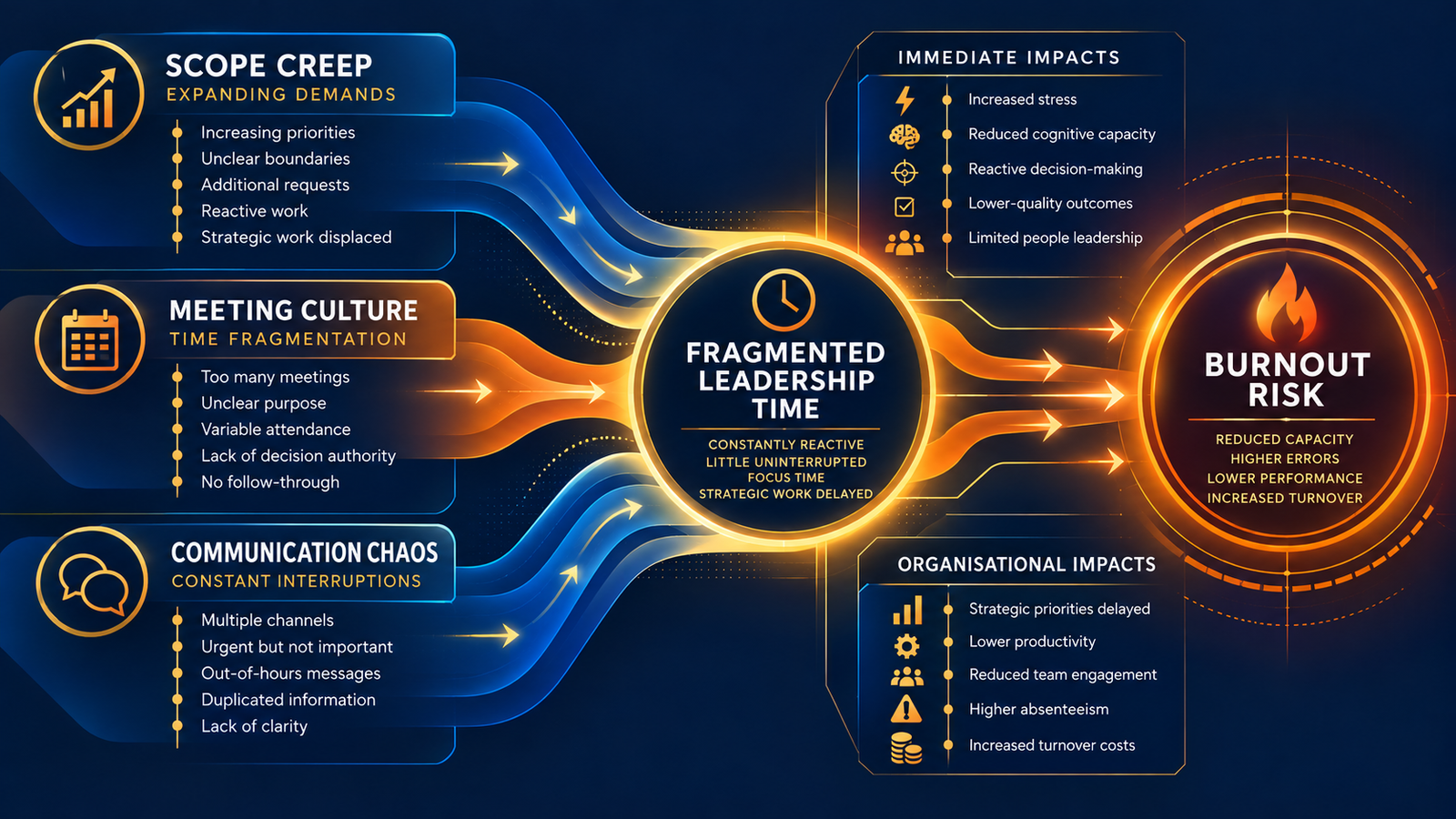
Meeting overload rarely operates alone. It interacts with scope creep, communication chaos, decision overload and perfectionism culture.
These are the five root causes identified in the Burn Bright Not Out Framework™. Addressing meetings is therefore one part of a wider structural redesign.
Featured Snippet
1. Why Does Meeting Overload Cause Leadership Burnout?
Meeting overload becomes dangerous when the time required for coordination exceeds the time available to complete meaningful work.
Consider a department director managing a team of 40 people.
Monday begins with a senior leadership briefing. Tuesday includes departmental updates. Wednesday brings project reviews. Thursday is filled with stakeholder meetings. Friday involves performance discussions and planning.
By the end of the week, the director has spent 27 hours in meetings.
That leaves 13 hours of a conventional 40-hour week for preparation, decisions, staff support, reporting and strategic work.
The work does not disappear. It moves outside normal hours.
The hidden costs of constant meetings
There are three particularly damaging consequences.
The World Health Organization describes burnout as an occupational phenomenon resulting from chronic workplace stress that has not been successfully managed. Its three dimensions are exhaustion, increased mental distance or cynicism towards work, and reduced professional efficacy.
Meeting overload is not itself a diagnosis of burnout. However, persistent meeting demands can contribute to the unmanaged workplace stress described by WHO.
Research from Microsoft also illustrates the scale of the challenge. Its 2023 Work Trend Index reported that 68% of surveyed people lacked sufficient uninterrupted focus time during the working day.
That finding matters because leadership requires more than availability. It requires the cognitive capacity to think, judge, plan and respond effectively.
A calendar that provides no uninterrupted time undermines those functions.
The question is not whether your meetings are individually worthwhile.
It is whether their combined demands leave enough capacity for the leadership work only you can perform.
For a wider examination of this problem, see Burn Bright’s leadership research and practical articles.
2. What Should a Meeting Audit Process Measure?
A useful meeting audit process measures value, not simply duration.
Counting meeting hours is a starting point. It does not explain whether those hours are necessary, whether the right people attend or whether meetings produce decisions.
A 15-minute meeting without purpose can be wasteful. A 90-minute discussion that resolves a major organisational risk may be valuable.
Five questions for every recurring meeting
For each meeting, ask:
- Purpose: What specific outcome must this meeting produce?
- Necessity: Does that outcome require a live discussion?
- Attendance: Who genuinely needs to contribute or decide?
- Frequency: How often must this conversation happen?
- Accountability: What decisions or actions result?
If the meeting cannot answer these questions, its design needs attention.
This approach connects directly to the Burn Bright Workload Architecture™ framework.
Framework Workload Architecture™
Workload Architecture™ examines how responsibilities are distributed, how capacity is protected and whether work is aligned with available resources.
Meetings should be assessed as part of that workload, not treated as a separate administrative concern.
Measure the full meeting cost
Imagine a weekly project meeting lasting 60 minutes with eight attendees.
That represents eight person-hours of organisational capacity each week.
Across 46 working weeks, it consumes 368 person-hours before preparation and follow-up are included.
If the same outcome could be achieved through a 20-minute decision meeting involving four people, the direct attendance cost would fall to approximately 61 person-hours annually.
That is a potential reduction of around 307 person-hours for one recurring meeting.
These are illustrative calculations, not measured organisational savings. The actual benefit depends on what replaces the meeting and how recovered time is used.
| Meeting cost calculator | Value |
|---|---|
| Attendees | 8 |
| Meeting duration | 60 minutes |
| Meetings per year | 46 |
| Annual attendance capacity consumed | 368 person-hours |
Excludes preparation and follow-up. Assumes each meeting has the same attendance and duration.
This calculation reveals why meeting audits should concern chief executives, finance directors and HR leaders, not only individual managers.
Meetings consume organisational capacity. That capacity has an opportunity cost.
The next step is to make it visible.
3. How Do You Conduct a Meeting Audit Process?
A meeting audit process should be straightforward enough to complete without becoming another administrative burden.
I recommend a five-stage audit conducted over ten working days.
Stage 1: Capture the evidence
Export or review the previous two weeks of calendar activity. Record meeting duration, frequency, attendees, purpose and outcomes. Include unscheduled conversations that repeatedly interrupt planned work. Do not begin by deleting meetings. First establish what is happening.
Stage 2: Classify the meetings
Place every meeting into one of four categories:
- Decision meetings resolve issues requiring clear authority.
- Collaboration meetings bring people together to solve problems that genuinely benefit from discussion.
- Information meetings primarily distribute updates.
- Habit meetings continue because they have always existed.
The final two categories often contain the greatest redesign opportunities.
Stage 3: Apply the IMPACT Matrix™
The Burn Bright framework includes the IMPACT Matrix™ as a method for evaluating work against its contribution and demands. For meeting audits, use a practical adaptation: compare the value created by a meeting with the time and attention it consumes. High-value meetings deserve protection and improvement. Low-value, high-cost meetings should be the first candidates for elimination or redesign.
Stage 4: Redesign rather than simply cancel
For every meeting, select one action: retain, shorten, reduce frequency, delegate attendance, replace with an asynchronous update or eliminate. Be deliberate. Removing a meeting without clarifying how decisions will happen can create new communication problems.
Stage 5: Measure the change
After 30 days, assess whether the changes have improved decision speed, workload capacity and leadership effectiveness. Do not judge success solely by fewer calendar entries. Judge whether work is being completed more effectively.
The following illustration shows the capacity that can be recovered from one redesigned recurring meeting.

The important result is not a theoretical saving of 307 hours.
It is what those hours make possible: better planning, more timely decisions, meaningful staff support and less work displaced into evenings.
4. Which Meetings Should Leaders Eliminate or Redesign?
Not all meetings should disappear.
Leadership depends on communication, collaboration and collective judgement. The problem arises when meetings become the default response to every organisational need.
A useful audit separates meetings that create value from meetings that simply demonstrate activity.
Traditional meeting culture versus sustainable meeting design
| Traditional meeting culture | Sustainable meeting design |
|---|---|
| Standing meetings continue indefinitely | Every recurring meeting has a review date |
| Everyone attends for visibility | Attendance follows decision authority |
| Updates are delivered verbally | Routine updates are shared asynchronously |
| Meetings default to 60 minutes | Duration reflects the required outcome |
| Decisions remain unclear | Every decision has an accountable owner |
| Full calendars signal commitment | Protected capacity signals good design |
| Meetings generate more meetings | Meetings resolve work and reduce friction |
The principle is simple.
Use decision authority to reduce attendance
One reason meetings grow is uncertainty about who has permission to decide.
When decision rights are unclear, organisations invite more people to reduce perceived risk.
The result is a room full of participants but no clear decision-maker.
The Burn Bright RACI Delegation Framework™ offers a structural response.
Framework RACI Delegation Framework™
RACI distinguishes who is Responsible, Accountable, Consulted and Informed.
Applied to meetings, this means identifying who must make the decision, who must contribute and who only needs to receive the outcome. People who only need to be informed do not necessarily need to attend.
For example, a school leadership team reviewing timetable adjustments may need the timetable coordinator, the accountable senior leader and representatives directly affected by the decision.
It does not automatically need every department head.
A concise written decision record can inform the wider group.
This reduces attendance while protecting transparency.
Replace status meetings with structured updates
A recurring meeting used solely to report progress may be better handled through a shared dashboard.
Each owner provides a brief update covering progress, risks, decisions required and next steps.
A live meeting takes place only when a decision, conflict or complex problem genuinely requires discussion.
This is not an argument against human connection.
It is an argument for protecting human interaction where it adds the most value.
Organisations seeking broader structural improvement can explore the Leadership Burnout Course, which develops sustainable approaches to workload and leadership effectiveness.
5. How Can Leaders Protect Time Recovered from Meetings?
Removing meetings is only half the work.
Without clear boundaries, the recovered time will quickly be filled by new demands.
This is why meeting audits must connect to Time Architecture™ and Recovery by Design.
Time Architecture™ treats the calendar as a deliberate allocation of organisational capacity rather than an open invitation for other people’s priorities.
Create three types of protected time
Protected Time 1
Strategic time
Reserved for analysis, planning, problem-solving and decisions requiring sustained concentration.
Protected Time 2
Operational time
Supports the routine management activities necessary to keep the organisation functioning.
Protected Time 3
Recovery time
Provides genuine opportunities to pause between demanding periods, take breaks and maintain sustainable performance.
These are different functions. They should not compete for the same unprotected space.
Consider a leader who recovers five hours each week through a meeting audit.
Those five hours should not simply become five additional hours of availability.
A more effective allocation might be three hours for strategic work, one hour for staff development and one hour of protected capacity for preparation and recovery.
The exact balance will depend on the role.
Set organisational rules
A practical meeting policy might establish that recurring meetings require a defined purpose, that decisions have named owners and that invitations include the expected outcome.
Teams could also adopt protected periods when routine meetings are not scheduled.
These rules must apply to senior leaders as well as their teams.
Otherwise, calendar protection becomes a privilege available only to people with enough authority to defend it.
The 2024 Gallup State of the Global Workplace report found that 41% of employees globally reported experiencing a lot of stress the previous day.
That statistic does not isolate meetings as the cause. It does demonstrate why workplace stress deserves serious organisational attention.
Similarly, WHO and the International Labour Organization estimated that depression and anxiety contribute to approximately 12 billion lost working days globally each year, costing around US$1 trillion in lost productivity.
These estimates cover mental health more broadly, not meeting overload specifically. Their relevance is the substantial human and economic cost of failing to manage psychosocial risks.
A well-designed calendar is one practical element of a healthier work system.
Recovered time becomes sustainable only when the organisation protects it through clear operating rules.
From meeting overload to sustainable capacity
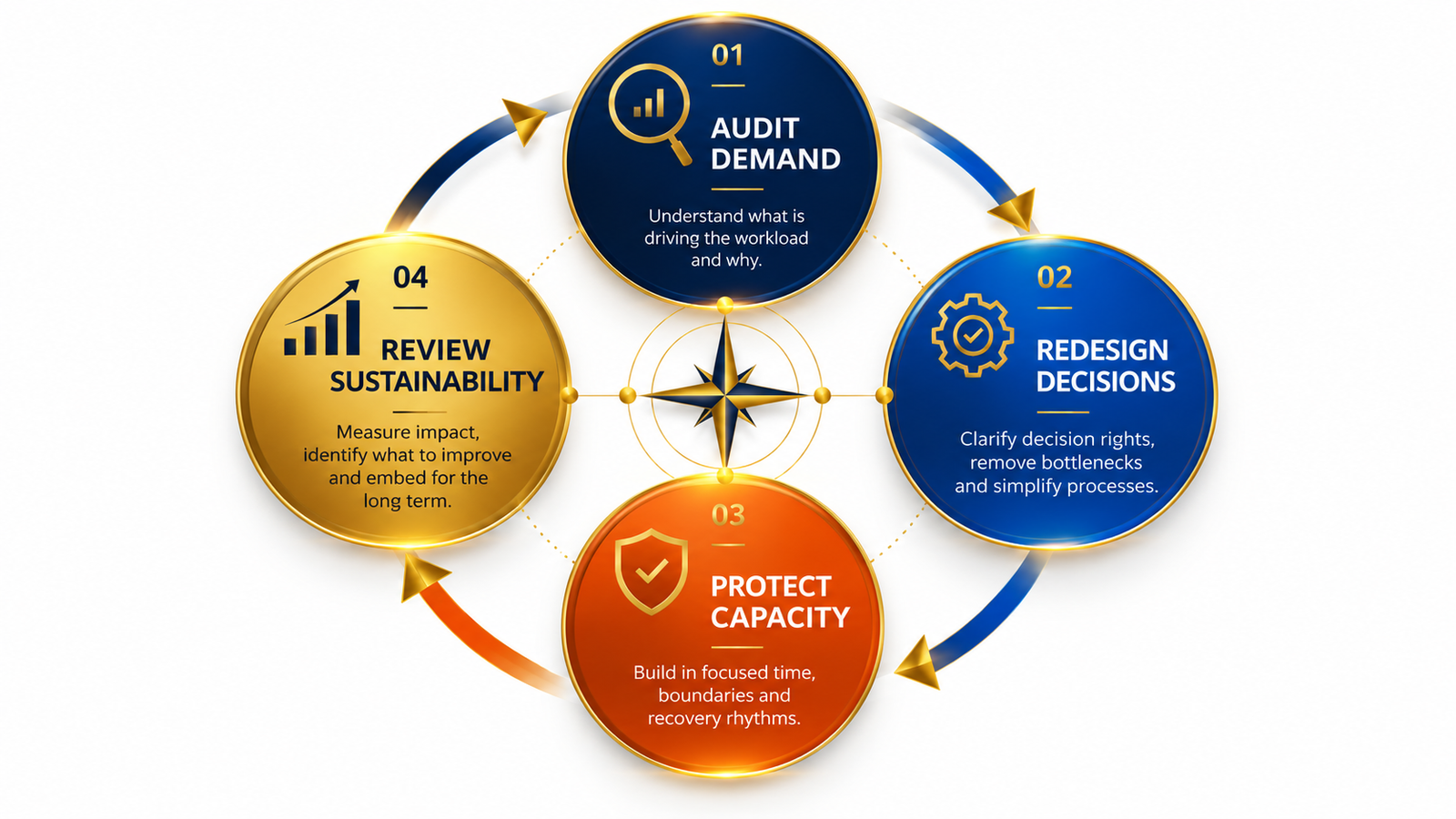
This approach also connects with the Leadership Burnout Reset, which focuses on rebuilding sustainable working structures rather than relying on additional personal effort.
6. How Do You Prevent Meeting Overload from Returning?
A successful meeting audit is not a one-off calendar clean-up.
Meeting overload tends to return because the underlying habits remain unchanged.
New projects create new committees.
New risks generate new reporting requirements.
New leaders introduce new review meetings.
Each addition appears reasonable in isolation.
Over time, the calendar becomes overloaded again.
Establish a 30-60-90 day review cycle
Days 1–30: Diagnose and simplify
Complete the audit. Remove obvious duplication. Clarify meeting ownership. Establish a baseline for hours spent in meetings and decisions completed.
Days 31–60: Redesign the operating system
Introduce meeting standards, asynchronous updates and clear decision rights. Protect strategic time and assess whether the changes are working.
Days 61–90: Embed accountability
Review the calendar again. Compare meeting hours, decision speed, workload pressure and staff feedback against the original baseline. Identify where meeting demands have started growing.
This cycle reflects the Burn Bright 30-60-90 Day Plan: diagnose the system, implement structural improvements and embed sustainable practices.
Measure outcomes, not just attendance
A strong meeting audit should monitor four indicators:
- Total recurring meeting hours per leader.
- Percentage of meetings producing documented decisions or actions.
- Time available for uninterrupted strategic work.
- Staff perceptions of workload and meeting effectiveness.
These measures provide a more useful picture than calendar occupancy alone.
A leader with fewer meetings but slower decisions has not necessarily improved the system.
A leader with fewer unnecessary meetings, clearer accountability and better strategic capacity probably has.
Make senior leaders accountable
Meeting culture is shaped by those with the greatest organisational authority.
When executives routinely schedule meetings without purpose, invite unnecessary participants or disregard protected time, those behaviours become organisational norms.
When they demonstrate disciplined meeting design, the opposite becomes possible.
This is sustainable leadership in practice.
It replaces the expectation of endless availability with clear priorities, appropriate decision authority and realistic capacity.
For leaders examining how technology might support better operating systems, Burn Bright also provides advanced AI tools for leadership. Technology should reduce unnecessary work, however, not introduce another layer of reporting and digital demands.
The standard remains unchanged.
Frequently Asked Questions
What is a meeting audit process?
A meeting audit process is a structured evaluation of recurring and ad hoc meetings to determine whether they are necessary, effective and appropriately designed. It examines purpose, duration, frequency, attendance and outcomes. The aim is to remove unnecessary activity while improving decision-making, collaboration and leadership capacity.
How often should organisations audit meetings?
Organisations should conduct a substantial meeting audit at least quarterly, supported by shorter monthly reviews. Fast-changing teams may need more frequent checks. New recurring meetings should have an agreed review date so that temporary coordination arrangements do not become permanent calendar commitments without evidence of continuing value.
How can leaders reduce meetings without damaging communication?
Leaders can replace routine updates with written reports, shared dashboards or asynchronous communication. Live meetings should remain available for complex decisions, sensitive conversations and genuine collaboration. Clear decision ownership and written action records help preserve transparency while reducing the number of people required to attend.
Can too many meetings contribute to burnout?
Yes. Excessive meetings can contribute to chronic workplace stress by increasing workload, fragmenting attention and reducing control over working time. Meeting overload alone does not establish a burnout diagnosis, but it can form part of an unsustainable work system. Prevention requires addressing the underlying demands rather than only improving personal time management.
What is the best way to measure meeting effectiveness?
Measure whether meetings produce decisions, resolve problems and improve coordination relative to the capacity they consume. Useful indicators include attendance hours, documented outcomes, decision speed, follow-up workload and participant feedback. A shorter meeting is not automatically better. The test is whether it creates sufficient organisational value.
Who should be responsible for a meeting audit?
Senior leaders should sponsor the audit, while individual meeting owners provide information and implement changes. HR, operations and executive support teams can assist with data and coordination. Accountability should remain with the leaders who control meeting expectations, decision authority and workload allocation across the organisation.
Conclusion: Make the Meeting Audit Process a Leadership Discipline
A meeting audit process is not about making leaders more efficient at managing overloaded calendars.
It is about questioning why those calendars became overloaded in the first place.
When meetings consume the capacity needed for decisions, planning, staff development and recovery, the organisation has a structural problem.
Another productivity technique will not resolve it.
Leaders need to examine the purpose of meetings, remove unnecessary attendance, clarify decision authority and protect the time required for meaningful work.
They also need to prevent meeting overload from returning through regular reviews and clear organisational standards.
This is the difference between managing symptoms and redesigning the system.
A full calendar is not evidence of effective leadership. A sustainable operating system is.
Start by understanding the pressures already affecting your leadership capacity. Then use that diagnosis to identify the structural changes that will make the greatest difference.
Go Deeper
Burn Bright Full Diagnostic™ — £144. A complete structural picture of the pressures on your leadership capacity.
Take the Leadership Burnout Self-Assessment
If your calendar is permanently full and meaningful work keeps moving into evenings and weekends, the first step is to understand the wider pattern. Identify the pressures behind your leadership workload.
Free Leadership Intelligence
Get Weekly Leadership Insights
Join thousands of leaders receiving practical strategies on burnout prevention, workload design, and sustainable performance every week.