Quick Answer
Key Takeaways
- Organisations rarely fail to prepare for the future because leaders cannot imagine change. They struggle because their leadership systems are designed to preserve what already exists.
- Past success can become a competency trap: familiar capabilities keep being rewarded even as conditions favour different approaches.
- Visionary leaders create strategic options, investing in capabilities that expand future choices across several plausible futures.
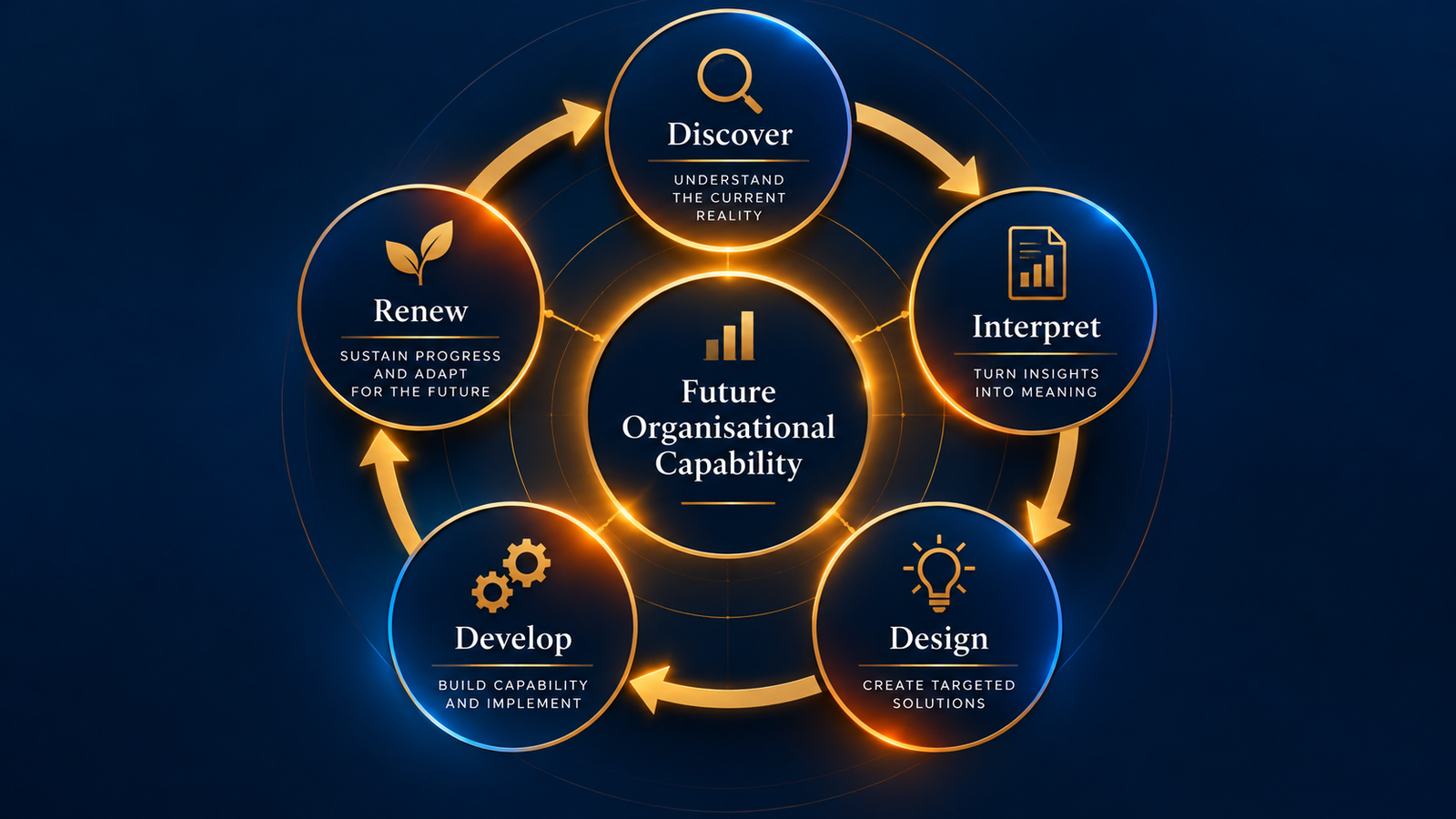
- The Future Capability Architecture™ has five iterative stages: Discover, Interpret, Design, Develop and Renew.
- Future readiness should be evaluated through a balanced set of evidence, not a single numerical score.
- If a transformation can succeed only because people continually exceed reasonable capacity, its operating model is not sustainable.
Visionary Leadership: The Strategic Discipline of Building What Does Not Yet Exist
Organisations rarely fail to prepare for the future because their leaders are incapable of imagining change. More often, they struggle because their leadership systems are designed to preserve what already exists.
Annual budgets reinforce established priorities. Performance measures reward familiar outcomes. Decision-making structures favour proven approaches. Leadership development programmes prepare individuals to manage existing responsibilities rather than create capabilities for emerging organisational realities.
These mechanisms provide stability, but they can also create strategic inertia.
Visionary leadership challenges this tendency.
It asks leaders to move beyond protecting existing performance and examine what their organisations must learn, develop, redesign or relinquish to remain effective in changing circumstances.
Within Burn Bright Advisory’s Leadership Performance Intelligence™ approach, Visionary Leadership Intelligence™ concerns the relationship between future possibilities, leadership judgement and the deliberate creation of organisational capability. Its central proposition is that the future is not simply something leaders anticipate; it is something their present decisions help to shape.
- A business that recognises technological disruption but does not develop its workforce remains vulnerable.
- A school that acknowledges changing educational needs but retains outdated professional learning structures may struggle to respond.
- A healthcare organisation that invests in advanced systems without developing the leadership capacity required to implement them may create additional operational complexity.
In each case, awareness of the future is insufficient. Leaders must convert emerging possibilities into institutional capability.
The essential leadership question is not merely, “What will the future look like?” It is:
The Future Is Already Influencing Today’s Decisions
Every organisation operates between two realities.
The first is the organisation that currently exists. It has established structures, familiar processes, measurable outcomes, defined responsibilities and a history of decisions that explain how it arrived at its present position.
The second is the organisation it may need to become. That organisation is less certain. Its capabilities may not yet exist. Its future stakeholders may have different expectations. Its workforce may require knowledge that is currently scarce. Its operating model may depend on technologies, partnerships or professional practices that remain under development.
Leadership operates at the intersection of these realities.
The difficulty is that organisational systems tend to make the present more visible than the future. Executives receive detailed reports about current performance: expenditure, staffing levels, service delivery, financial results and progress against operational objectives. Far fewer receive equally meaningful information about the capabilities their organisation has not yet developed.
This imbalance matters because some of the most consequential strategic weaknesses remain invisible until circumstances expose them.
- A company may appear commercially successful while becoming increasingly dependent on a declining business model.
- A school may maintain acceptable inspection outcomes while failing to develop the professional knowledge required for emerging educational challenges.
- A public service organisation may meet current delivery expectations while accumulating technological and workforce vulnerabilities that restrict future service improvement.
Leaders must make decisions about future organisational requirements before those requirements become fully measurable. That responsibility cannot be fulfilled through conventional performance management alone. It requires a different form of leadership intelligence.

Why Visionary Leadership Is Not the Same as Having a Vision
The language of vision is deeply embedded in contemporary management. Organisations publish vision statements. Executives communicate strategic aspirations. Leadership programmes encourage participants to become more visionary. Yet the presence of a vision does not necessarily demonstrate visionary leadership.
Featured Snippet
The distinction is particularly important because compelling communication can sometimes conceal weak strategic foundations.
- A leader may speak convincingly about innovation without understanding the organisational barriers that prevent experimentation.
- Another may promise transformation without examining whether the workforce possesses the knowledge, capacity or support required to implement it.
- A third may describe an ambitious future while continuing to allocate resources almost entirely towards preserving established practices.
These leaders may possess vision.
Whether they demonstrate effective visionary leadership is a different question.
The Difference Between Aspiration and Strategic Possibility
An aspiration expresses what an organisation hopes to achieve. A strategic possibility identifies a future condition that could become achievable through deliberate choices and capability development.
For example, an educational organisation may aspire to become internationally recognised for innovative teaching. That ambition becomes strategically meaningful only when leaders examine the professional learning, curriculum development, evidence, technology, partnerships and organisational culture required to support it.
Similarly, a healthcare provider may aspire to deliver more personalised care. The leadership challenge is to determine what clinical capabilities, information systems, ethical safeguards and operational changes would make that ambition achievable.
Visionary Leadership Intelligence™ therefore requires leaders to move between three questions:
- What future could create meaningful value?
- What must change for that future to become possible?
- What leadership decisions should begin that change?
These questions transform visionary leadership from an exercise in organisational storytelling into a discipline of strategic development.
They also introduce an important constraint. Not every imaginable future is desirable, achievable or ethically defensible. Effective visionary leaders must distinguish between attractive possibilities and responsible strategic choices. That judgement requires evidence, professional accountability and an understanding of the organisation’s purpose.
The Hidden Barrier to Visionary Leadership: Institutional Inertia
One of the greatest obstacles to visionary leadership is not resistance from individuals. It is the accumulated influence of organisational decisions that were previously successful.
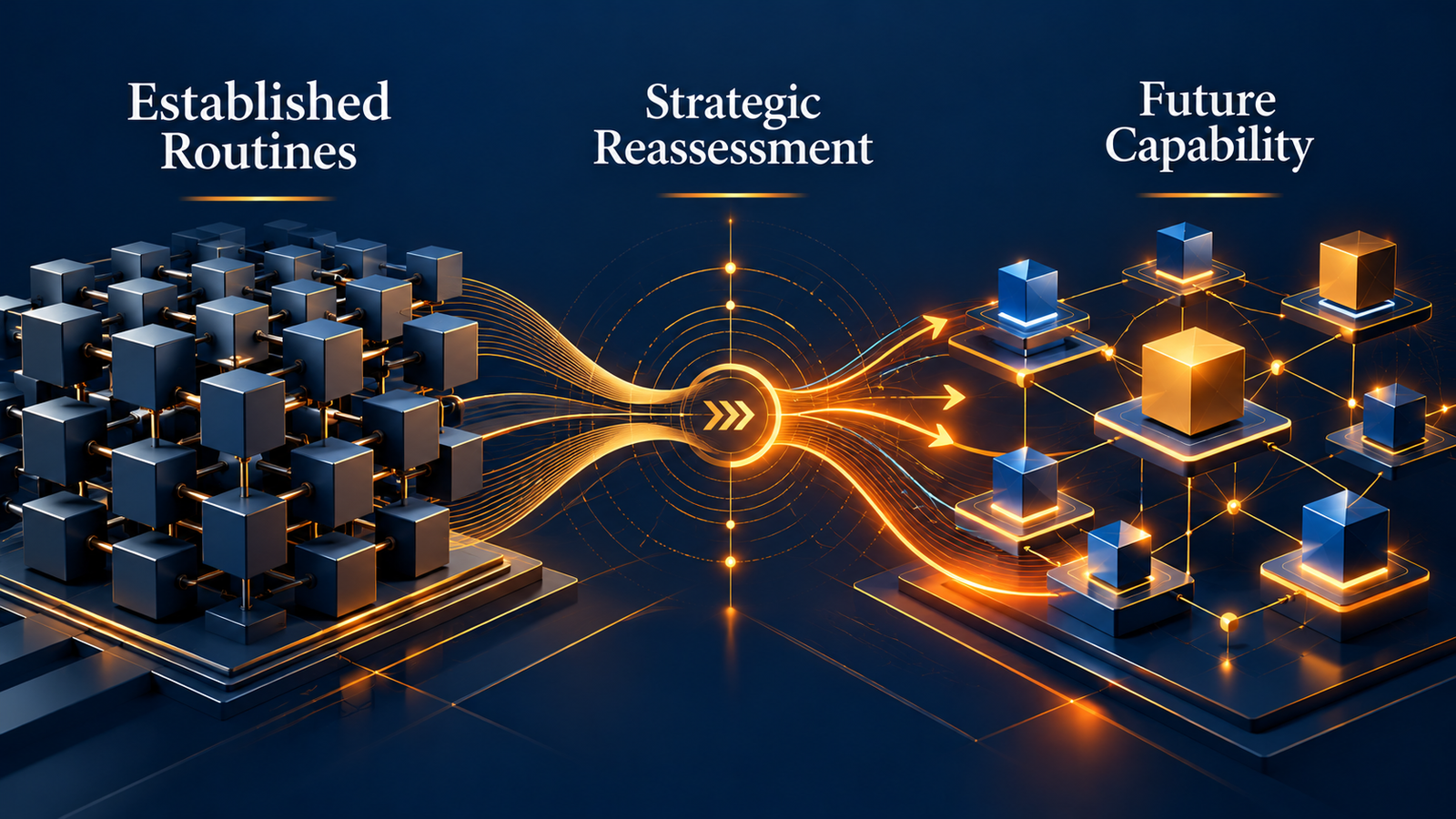
Over time, organisations develop routines, systems and assumptions that reinforce established ways of working. These arrangements often emerge for legitimate reasons. They create consistency, reduce uncertainty, support accountability and enable organisations to coordinate complex activities. However, the same structures can make alternative approaches difficult to recognise or implement.
Organisational scholars describe related dynamics through concepts such as path dependence, organisational routines and competency traps. A competency trap occurs when an organisation continues relying on familiar capabilities because they have produced successful results, even when changing conditions increasingly favour different approaches.
When Success Restricts Strategic Imagination
Consider an established professional services business. Its reputation has been built through technical expertise, strong client relationships and consistent service delivery. These strengths have supported years of commercial success.
However, emerging technologies begin changing how clients access information, evaluate professional advice and purchase services. The organisation’s leadership team recognises these developments but continues prioritising established revenue streams and familiar delivery models. Investment in new capabilities remains limited because the immediate financial returns are uncertain.
The business is not necessarily making irrational decisions. It is responding to incentives that favour measurable present performance over less certain future value. Yet the cumulative effect may be a widening gap between what the organisation does well and what its future environment will require.
Visionary leadership demands the ability to identify this gap before it becomes a crisis. It also requires the courage to question successful practices without dismissing the experience and knowledge that created them.
This is where Reflective Practice Intelligence™ becomes particularly important. Leaders must examine not only whether their strategies are working, but also the assumptions that explain why they believe those strategies will continue working.
The Leadership Cost of Protecting Established Assumptions
Institutional inertia can influence leadership behaviour in subtle ways.
Over time, the organisation can become increasingly efficient at delivering an operating model that is gradually losing relevance.
The role of visionary leadership is not to reject organisational history. It is to determine which elements of that history should be preserved, which require adaptation and which may need to be deliberately replaced. This requires a combination of three Compass domains:
- Professionalism Intelligence™ preserves appropriate standards and accountability.
- Adaptability Intelligence™ supports the reconsideration of established practices.
- Knowledge Development Intelligence™ enables the organisation to acquire capabilities that its existing experience cannot provide.
Together, these domains help leaders navigate the tension between organisational continuity and strategic renewal.
Visionary Leadership as the Creation of Strategic Options
A useful way to understand visionary leadership is through the concept of strategic options. An option creates the possibility of taking a future course of action without necessarily requiring an immediate commitment to it.
Organisations develop strategic options when they invest in capabilities, relationships, knowledge or systems that expand what they may be able to do later.
- Developing emerging leaders creates future succession options.
- Building digital capability creates opportunities to redesign services.
- Establishing cross-sector partnerships may enable responses to challenges that cannot be addressed through existing organisational resources.
- Investing in organisational learning can improve the capacity to adopt technologies and practices that have not yet become mainstream.
These investments may not produce immediate performance improvements. Their strategic value lies partly in increasing the organisation’s future choices.
This perspective changes how leaders evaluate development. Rather than asking only whether an investment will generate a measurable short-term return, leaders also consider whether it expands the organisation’s ability to respond to plausible future conditions.
The Importance of Preserving Choice
Under uncertainty, committing too early to a single future can create substantial risk. An organisation that assumes one technological development will dominate its sector may invest heavily in capabilities that later prove less valuable than anticipated. An organisation that refuses to invest until uncertainty disappears may find itself unable to respond when change accelerates.
Visionary leadership requires a disciplined balance. Leaders must identify areas where decisive commitment is justified while preserving flexibility in areas where future conditions remain uncertain.
This is not indecision.
It is strategic judgement.
The objective is to build capabilities that create value across several plausible futures rather than depending entirely on one prediction being correct.
For Burn Bright Advisory™, this provides an important connection between Visionary Leadership Intelligence™ and Leadership Performance Intelligence™. Future-oriented leadership performance should be examined not only through the achievement of a predetermined strategic vision, but also through the quality of the organisational options leaders create.
A leader who develops adaptable teams, strong succession arrangements, transferable knowledge and responsible innovation processes may be strengthening organisational performance even before the full benefits become visible in conventional reporting. That contribution deserves greater attention in how leadership capability is developed and evaluated.
The Strategic Tension Between Imagination and Evidence
Visionary leadership requires imagination, but imagination alone is an unreliable basis for organisational decisions. Leaders must be capable of considering futures that existing data cannot fully describe. At the same time, they must resist the temptation to treat attractive possibilities as inevitable outcomes.
Evidence provides insight into established patterns, current capabilities and observable developments. Imagination enables leaders to consider how those patterns might change, combine or become less relevant. Neither is sufficient independently.
- An organisation governed entirely by historical evidence may struggle to recognise opportunities that fall outside its existing experience.
- An organisation driven predominantly by executive imagination may pursue ambitious initiatives without adequate consideration of feasibility, consequences or organisational readiness.
Why Historical Performance Cannot Explain Every Future Possibility
Organisational performance data is necessarily retrospective. It describes outcomes generated under particular conditions, using particular capabilities and operating assumptions. That information remains valuable. However, its relevance may diminish when the environment changes substantially.
For example, a business may use historical customer behaviour to determine future service investments. Yet those patterns may not adequately capture how emerging technologies could transform customer expectations. Similarly, workforce planning based exclusively on current job descriptions may overlook capabilities required by future operating models.
Visionary leaders therefore examine evidence through two complementary questions:
- What does our current evidence tell us?
- What might our current evidence be unable to reveal?
The second question does not justify abandoning evidence. It encourages leaders to recognise its boundaries. Strategic foresight becomes more effective when organisations combine performance analysis with environmental scanning, stakeholder insight, scenario exploration and structured professional judgement.
The Discipline of Distinguishing Possibility from Probability
Not every possible future deserves equal strategic investment. Leaders must distinguish between developments that are conceivable, those that are plausible and those sufficiently likely or consequential to justify action.
A low-probability development may warrant preparation if its consequences would be severe. A highly plausible development may require only limited intervention if the organisation already possesses adequate capability.
The relevant leadership responsibility is therefore not simply to identify future possibilities. It is to evaluate their significance. This requires attention to the quality of available evidence, the consequences of being unprepared, the reversibility of decisions and the resources required to respond.
Within the Leadership Intelligence Compass™, Ethics Intelligence™ is especially relevant because strategic possibilities must also be assessed against their potential consequences for employees, service users, communities and other stakeholders.
A future may be commercially attractive without being professionally or ethically appropriate.
Visionary leadership must recognise that distinction.
Constructive Challenge: Why the Best Strategic Ideas Need Opposition
One of the greatest risks associated with visionary leadership is the assumption that a compelling vision should generate immediate agreement. In practice, effective strategic development often requires disagreement.
A leadership team that consistently supports the preferences of its most senior member may appear aligned while failing to examine significant weaknesses in its reasoning. The danger becomes greater when visionary leadership is associated with personal charisma. Confident communication can encourage commitment, but it can also discourage questions about feasibility, risk and unintended consequences.
A strategically capable organisation must therefore distinguish between commitment to a shared purpose and unquestioning acceptance of a particular proposal.
Constructive Challenge as a Leadership Capability
Constructive challenge involves testing ideas through informed questioning without undermining professional respect or organisational purpose. It requires leaders to create conditions in which colleagues can examine strategic assumptions, identify overlooked risks and propose alternative interpretations.
Consider an executive team evaluating the introduction of an AI-enabled service:
- The technology director may emphasise operational efficiency.
- The finance director may focus on investment and financial exposure.
- The HR director may identify workforce development requirements.
- The professional or clinical lead may raise questions about accountability, service quality and ethical safeguards.
These perspectives may initially appear to compete. However, when integrated effectively, they provide a more complete understanding of the decision.
This connects Visionary Leadership Intelligence™ with three further domains. Constructivism Intelligence™ supports the development of shared understanding through dialogue. Emotional Intelligence™ helps leaders respond to challenge without becoming defensive. Professionalism Intelligence™ reinforces the responsibility to evaluate consequential decisions rigorously.
Three Questions That Strengthen Strategic Challenge
Before committing to a major future-oriented initiative, executive teams should ask:
- What would need to be true for this strategy to succeed?
- What evidence or development would cause us to reconsider our position?
- Whose perspective is missing from this discussion?
These questions help prevent strategic ambition from becoming detached from organisational reality. They also support a culture in which changing a decision in response to better evidence is understood as sound leadership rather than weakness.
The Burn Bright Future Capability Architecture™
A practical challenge for visionary leaders is converting emerging possibilities into organisational capabilities before those capabilities become urgently necessary.
To support this process, Burn Bright Advisory™ frames visionary leadership through the Future Capability Architecture™, a proposed five-stage strategic development model. It is designed as a leadership planning framework, not a validated diagnostic or psychometric instrument. Its purpose is to help leaders move systematically from future-oriented thinking to organisational development.
Stage 1 Discover emerging possibilities
Identify developments that may create future opportunities, obligations or vulnerabilities. Leaders should look beyond familiar sources of organisational information. Relevant insights may emerge from employees, customers, professional networks, research institutions, regulatory developments or changing community expectations.
Discovery requires intellectual openness. It also requires recognising that important developments may initially appear peripheral to the organisation’s existing priorities.
Stage 2 Interpret strategic significance
Not every emerging development should become a strategic priority. Leaders must evaluate its relevance, potential consequences and relationship to organisational purpose. This stage involves examining available evidence, identifying assumptions and considering alternative future conditions.
Ethical responsibility is integral to interpretation. A proposed opportunity should be assessed not only for potential benefits but also for the risks and obligations it creates.
Stage 3 Design the required capabilities
Once a future possibility has been evaluated, leaders must determine what the organisation would need to become capable of doing. This may involve developing professional knowledge, redesigning processes, strengthening partnerships, introducing technology or changing decision-making structures.
The focus shifts from describing the future to identifying the organisational foundations required to make it achievable.
Stage 4 Develop through deliberate action
Future capabilities rarely emerge through strategic statements alone. They require investment, learning, experimentation and sustained leadership attention. Development should be appropriately staged: small-scale pilots may provide valuable evidence before substantial organisational commitments are made.
Leadership Development Planning™ can help connect capability requirements with individual and collective development priorities.
Stage 5 Renew through learning
Future capability development is not a linear process. Conditions change. Assumptions require revision. Some investments will prove more valuable than others. Leaders must therefore establish opportunities to review progress, learn from implementation and adapt strategic priorities.
Leadership Sustainability™ is essential at this stage. Organisational renewal should strengthen long-term capacity rather than depend on continually increasing demands on employees and leaders.
The architecture is iterative: evidence gained through development and renewal should inform further discovery and interpretation.
From Framework to Practice: A School Leadership Example
Consider a school leadership team examining how emerging technologies may influence teaching, assessment and professional learning. A conventional response might focus on purchasing software or introducing a new digital strategy. The Future Capability Architecture™ encourages a broader examination.
🎓 The architecture applied in a school
Discover: leaders identify developments in educational technology, teacher workload, student learning needs and professional expectations.
Interpret: they evaluate the educational value, limitations, safeguarding implications and potential inequalities associated with different approaches.
Design: they identify the professional knowledge, governance arrangements and instructional practices required for responsible implementation.
Develop: they establish focused professional learning opportunities and evaluate carefully selected applications.
Renew: they examine evidence of educational benefit, staff experience and unintended consequences before expanding or modifying the approach.
This illustrative scenario demonstrates how visionary leadership can be translated into a disciplined process. The objective is not simply technological adoption. It is the development of educational capability consistent with professional responsibility and sustainable organisational performance.
The same logic can be applied within Business Growth Intelligence™, Healthcare Leadership Intelligence™, Public Service Leadership Intelligence™ and HR & People Leadership Intelligence™. Across these sectors, the essential principle remains consistent:
The Investment Dilemma: Funding the Future While Delivering the Present
Visionary leadership becomes most consequential when organisations must allocate scarce resources between immediate operational requirements and capabilities whose future value remains uncertain.
Every organisation faces competing investment demands. Existing services require maintenance. Employees need development. Infrastructure must remain reliable. Regulatory obligations must be met. Financial commitments constrain discretionary expenditure. Against these immediate responsibilities, leaders must consider investments in capabilities that may not produce measurable returns for several years.
This creates a strategic dilemma: how much should an organisation invest in a future it cannot fully predict while remaining accountable for the performance it must deliver today?
The answer cannot be found through ambition alone. It requires disciplined resource allocation, explicit consideration of uncertainty and an understanding of the organisational consequences of postponing development.
Distinguishing Operational Expenditure from Capability Investment
Traditional investment decisions often favour initiatives with identifiable short-term outcomes. A system upgrade that reduces processing costs may be easier to justify than a leadership development programme intended to strengthen future succession.
Yet the absence of immediate financial returns does not necessarily indicate limited strategic value. Some investments create organisational capabilities whose benefits emerge indirectly or over extended periods. These may include:
- Developing leadership succession and institutional knowledge.
- Strengthening digital and analytical capabilities.
- Establishing cross-sector partnerships.
- Improving organisational learning and reflective practice.
- Building workforce adaptability and professional development systems.
The challenge is to evaluate these investments without treating speculative benefits as guaranteed outcomes. Visionary Leadership Intelligence™ encourages leaders to distinguish between the expected benefits of an investment, the uncertainty surrounding those benefits and the strategic consequences of failing to act.
A capability investment may be justified because it reduces future vulnerability, expands organisational choices or strengthens the ability to respond to changing conditions. However, those reasons must be made explicit.
The Cost of Delayed Capability Development
Delaying investment can appear financially prudent. In some circumstances, it is. Waiting may allow an organisation to gather better evidence, avoid premature technological commitments or preserve resources for more urgent priorities.
But delay also carries potential costs. Leadership succession cannot always be developed rapidly when an experienced executive leaves. Professional expertise may require years of learning and application. Organisational trust, collaborative relationships and knowledge-sharing cultures cannot reliably be established through emergency initiatives.
Consequently, visionary leaders must consider not only the cost of investing too early but also the consequences of beginning too late. This is particularly important when capability development involves long lead times. The strategic question becomes:
These capabilities deserve particular attention in long-term organisational planning.
Measuring Future Readiness Without Pretending to Predict the Future
An important challenge for visionary leadership is determining whether an organisation is becoming more prepared for emerging conditions. Conventional performance indicators are designed primarily to assess progress against established objectives. Future readiness is different. It concerns organisational capabilities, strategic flexibility and the ability to respond to developments that may not yet be fully understood.
This makes measurement more difficult, but not impossible. The solution is to avoid treating future readiness as a single numerical score. Instead, leaders should examine a balanced collection of indicators that provide evidence of organisational capability.
The Future-Readiness Evidence Framework
Dimension 1
Strategic awareness
Evidence that emerging developments and assumptions are reviewed systematically.
Dimension 2
Capability development
Progress in building knowledge, skills and systems linked to future needs.
Dimension 3
Leadership continuity
Succession coverage, knowledge transfer and development of emerging leaders.
Dimension 4
Organisational adaptability
Evidence that learning influences decisions, priorities and operating practices.
Dimension 5
Sustainable capacity
Whether implementation demands remain proportionate to available resources.
Illustrative leadership evaluation dimensions, not a validated assessment scale.

These dimensions provide a basis for structured leadership discussion. For example, an organisation may track whether critical roles have credible succession arrangements, whether strategic projects include documented capability requirements and whether lessons from experimentation influence subsequent decisions.
Such evidence does not prove that the organisation will succeed under every future condition. It provides a more defensible basis for evaluating preparedness than relying exclusively on confidence in an executive vision.
Avoiding the Illusion of Precision
Leadership Benchmarking™ can contribute to future-readiness evaluation when its measures are clearly defined and interpreted appropriately. However, organisations should be cautious about assigning precise numerical values to complex leadership capabilities without a validated methodology. A future-readiness score may create an appearance of certainty that the underlying evidence cannot support.
The purpose of evaluation should be to improve decisions and identify development needs, not merely to produce an attractive dashboard.
Within Burn Bright Advisory’s Leadership Development System™, the Leadership Intelligence Assessment™ can serve as a developmental entry point. Assessment findings should be considered alongside organisational evidence, stakeholder perspectives and reflective professional judgement.
Leadership Capacity: The Constraint That Visionary Strategies Cannot Ignore
An organisation may identify a valuable future opportunity, establish a credible strategy and secure the necessary investment. Yet implementation may still fail because leadership capacity is insufficient. This is a critical consideration within Leadership Performance Intelligence™.
Strategic programmes are frequently added to existing operational responsibilities without a corresponding reduction in workload. Senior leaders must maintain current performance while directing transformation. Middle managers are expected to support new initiatives while continuing to meet established service and workforce expectations. Employees are asked to learn new systems while maintaining existing productivity.
The cumulative effect can be a widening imbalance between organisational ambition and available capacity.
The Relationship Between Capacity and Strategic Execution
- Leadership Capacity™ concerns the practical resources and capabilities available to fulfil leadership responsibilities.
- Leadership Workload™ concerns the demands placed upon those resources.
- Leadership Sustainability™ examines whether the relationship between demands and capacity can support continued effectiveness.
These concepts are particularly important in visionary leadership because future-oriented initiatives often require substantial organisational change. A strategy may be intellectually compelling but operationally unrealistic. Leaders should therefore examine implementation capacity before approving major strategic commitments. Relevant questions include:
- What additional leadership responsibilities will this initiative create?
- Which existing activities can be reduced, redesigned or discontinued?
- What new knowledge and decision-making authority will be required?
- Where are the organisation’s most significant capacity constraints?
- How will implementation affect the sustainability of existing services?
These questions are not arguments against transformation.
They are necessary conditions for responsible transformation.
Why Overextension Is Not Evidence of Strategic Commitment
Organisations sometimes interpret extraordinary individual effort as proof of commitment to a strategic vision. Leaders who work excessive hours, absorb additional responsibilities or repeatedly compensate for inadequate systems may be praised for their dedication.
However, sustained dependence on exceptional effort can conceal weaknesses in organisational design.
Visionary Leadership Intelligence™ requires leaders to recognise this distinction. The objective is not to build an organisation that survives through permanent overextension. It is to develop systems, capabilities and leadership arrangements that enable future performance without progressively exhausting the people responsible for delivering it.
This connects visionary leadership directly with Burn Bright Advisory’s wider emphasis on Leadership Sustainability™. Future readiness must include the capacity to remain effective throughout the process of change.
Cross-Sector Applications: What Future Capability Looks Like in Practice
The principles of visionary leadership are transferable, but the capabilities required for future performance differ across sectors. These examples are illustrative scenarios rather than claims about documented organisational outcomes.
🏢 Business Growth Intelligence™: Investing beyond the current business model
Consider a medium-sized professional services firm whose revenue depends heavily on established expertise and long-standing client relationships. Its leaders recognise that emerging technologies may change how clients purchase and evaluate services.
Rather than immediately abandoning its existing model, the organisation develops strategic options. It invests in digital capability, examines new service propositions, strengthens management succession and creates opportunities for controlled experimentation. The objective is not to predict a single commercial future. It is to expand the organisation’s capacity to respond to several plausible developments.
🏥 Healthcare Leadership Intelligence™: Innovation within clinical responsibility
A healthcare organisation considering new digital services must balance potential innovation with clinical safety, professional accountability and workforce capacity. Visionary leadership requires more than selecting technology.
Leaders must examine whether staff possess the necessary competencies, whether governance arrangements are appropriate and whether the proposed operating model supports safe care. They must also assess how implementation affects existing services. A technically promising innovation may require redesign if its introduction creates unacceptable operational or clinical risks.
🏛️ Public Service Leadership Intelligence™: Developing long-term institutional capability
Public service organisations often face changing population needs, resource constraints and complex accountability arrangements. A visionary public service leader may identify opportunities to redesign services through collaboration, digital infrastructure or more integrated provision.
However, meaningful change requires attention to institutional knowledge, public trust, workforce capability and equitable access. Strategic success cannot be defined solely through efficiency gains. It must also consider service quality, accessibility and the sustainability of public value.
👥 HR & People Leadership Intelligence™: Preparing for capabilities not yet demanded
HR and people leaders play a central role in organisational future readiness. Workforce planning should extend beyond filling current vacancies. It should examine emerging capability requirements, succession vulnerabilities, professional development pathways and the changing relationship between people and technology.
For example, an organisation anticipating increased use of automation may need to develop analytical judgement, ethical oversight, collaborative problem-solving and change leadership. The most important workforce question may not be how many people the organisation will need. It may be what those people will need to know, understand and be capable of doing.
Explore sector-specific leadership resources in the Leadership by Sector hubs.
The Strategic Test: Does the Vision Strengthen the Organisation?
Visionary leadership should ultimately be evaluated through the organisational consequences of strategic decisions. An ambitious initiative may create visibility, enthusiasm and a sense of progress. But these characteristics do not necessarily demonstrate lasting value.
Leaders must examine whether their choices develop transferable knowledge, improve strategic flexibility, strengthen leadership continuity and preserve organisational capacity.
The most useful test is therefore not whether a strategy appears transformative.
It is whether the organisation becomes more capable as a result of pursuing it.
This requires ongoing Leadership Reflection™. Leaders should be willing to reconsider initiatives that consume substantial resources without producing meaningful capability development. They should also recognise investments whose value may not yet be reflected in conventional performance indicators.
The essential responsibility is to distinguish between activity that creates the appearance of progress and development that increases the organisation’s future possibilities.
Executive Reflection Questions: Are You Building Future Capability?
- Future possibilities: Which emerging developments could fundamentally change the value our organisation provides?
- Strategic assumptions: What are we currently treating as permanent that may prove temporary?
- Organisational inertia: Which successful practices might be preventing us from exploring more effective alternatives?
- Strategic options: What capabilities are we developing that will expand our future choices?
- Constructive challenge: Can colleagues openly question our preferred strategic direction without experiencing professional consequences?
- Investment decisions: Are we allocating sufficient resources to capabilities whose benefits may not become visible immediately?
- Leadership continuity: Could our organisation sustain its strategic direction if several experienced leaders departed?
- Leadership sustainability: Are our transformation ambitions proportionate to the capacity available for implementation?
- Evidence and learning: What information would cause us to reconsider a major strategic commitment?
- Long-term value: Will our current strategy leave the organisation more capable, adaptable and responsible than it is today?
These questions can support Leadership Reflection™, executive coaching, board discussions and strategic planning. They should not be treated as a validated assessment instrument. Their value lies in stimulating informed discussion, revealing strategic assumptions and identifying areas for further development.
A 90-Day Future Capability Development Plan
Visionary Leadership Intelligence™ becomes operationally meaningful when leaders establish a deliberate process for developing capabilities before they become urgent requirements. The following plan translates the Future Capability Architecture™ into a practical executive development sequence.
| Period | Strategic Priority | Leadership Action | Expected Output |
|---|---|---|---|
| Days 1–15 | Discover | Identify emerging developments, unmet needs and potential disruptions | Future opportunity and risk register |
| Days 16–30 | Interpret | Test assumptions, evaluate evidence and invite constructive challenge | Prioritised strategic possibilities |
| Days 31–45 | Design | Identify future knowledge, systems, partnerships and leadership capabilities | Future capability map |
| Days 46–60 | Develop | Select limited experiments and allocate appropriate resources | Capability development initiatives |
| Days 61–75 | Evaluate | Review learning, workload implications and early evidence | Strategic learning report |
| Days 76–90 | Renew | Adjust investment priorities and establish ongoing review arrangements | Updated capability development plan |
Three Implementation Principles
1. Begin with capability rather than technology
A new technology may enable strategic change, but organisational benefit depends on the professional knowledge, governance and operating practices required to use it effectively.
2. Preserve the ability to change direction
Where uncertainty remains significant, staged investment and controlled experimentation may be preferable to large irreversible commitments.
3. Include leadership capacity in every major decision
Development programmes should identify what resources are needed, which existing responsibilities must change and how implementation demands will be managed.

A practical next step is to connect the resulting capability map with the Leadership Intelligence Compass™, relevant Leadership Intelligence Library™ resources and the organisation’s Leadership Development Planning™ process.
Frequently Asked Questions
What is visionary leadership?
Visionary leadership is the ability to recognise emerging possibilities, establish a credible future direction and develop the organisational capabilities required to pursue it. It combines strategic imagination with evidence, judgement, implementation and accountability.
What is the difference between visionary leadership and strategic planning?
Strategic planning establishes priorities, resources and actions for achieving defined objectives. Visionary leadership also examines possibilities that may require the organisation to reconsider its objectives, operating assumptions and future capabilities. The two approaches complement each other.
What is Visionary Leadership Intelligence™?
Visionary Leadership Intelligence™ is a domain within Burn Bright Advisory’s Leadership Intelligence Compass™ concerned with future-oriented judgement, strategic possibilities and the development of sustainable organisational capability.
Can visionary leadership be learned?
Yes. Leaders can develop relevant capabilities through strategic foresight, scenario analysis, reflective practice, constructive challenge, organisational learning and experience with responsible strategic experimentation.
Why do successful organisations sometimes struggle with visionary leadership?
Successful organisations may become highly dependent on established capabilities, operating models and performance measures. These arrangements can discourage investment in unfamiliar approaches even when emerging conditions suggest that adaptation will be necessary.
How can organisations measure future readiness?
Organisations can examine capability development, succession arrangements, strategic learning, adaptability and leadership sustainability. These indicators should be interpreted together rather than reduced to an unsupported numerical prediction of future success.
What are the main risks of visionary leadership?
Risks include excessive confidence, premature investment, inadequate evidence, weak implementation planning, insufficient stakeholder involvement and unsustainable demands on organisational capacity. Structured challenge and staged investment can help mitigate them.
How does visionary leadership relate to leadership sustainability?
Visionary leadership establishes future direction, while Leadership Sustainability™ considers whether people, systems and resources can support the journey. A strategy that consistently exceeds available capacity may undermine the future performance it seeks to create.
What is the Future Capability Architecture™?
The Burn Bright Future Capability Architecture™ is a proposed five-stage planning framework: Discover, Interpret, Design, Develop and Renew. It helps leaders connect emerging possibilities with organisational capability development. It is not presented as a validated diagnostic instrument.
What should leaders do first to become more visionary?
Begin by identifying one emerging development that could substantially change the organisation’s future requirements. Examine the assumptions surrounding it, identify potential capability gaps and determine a proportionate first step towards developing the organisation’s response.
Conclusion: Visionary Leadership Is the Responsibility to Create Possibility
The defining contribution of visionary leadership is not the ability to describe a compelling future. It is the capacity to create the organisational conditions through which valuable futures become possible.
This requires leaders to recognise the limitations of existing assumptions, examine emerging opportunities, invest in capabilities whose benefits may not be immediately visible and establish systems that support learning and adaptation.
It also requires restraint.
Not every innovation deserves investment.
Not every strategic ambition is responsible.
Not every opportunity justifies the demands it places on organisational resources.
Effective visionary leadership therefore combines imagination with evidence, ambition with accountability and development with sustainability.
Within Burn Bright Advisory’s Leadership Performance Intelligence™ approach, Visionary Leadership Intelligence™ is inseparable from Reflective Practice Intelligence™, Knowledge Development Intelligence™, Adaptability Intelligence™, Ethics Intelligence™ and Leadership Sustainability™. Together, these capabilities help leaders move beyond protecting existing performance towards developing the organisational intelligence required for enduring effectiveness.
The challenge for executives is not to know exactly what the future will bring. It is to ensure that their organisations are progressively developing the knowledge, judgement, relationships and capacity needed to respond.
Explore the Leadership Intelligence Compass™, the Leadership Intelligence Library™ and wider leadership development resources, including workshops.
Go Deeper with the Burn Bright Full Diagnostic™
A comprehensive analysis of your leadership capacity, workload and sustainability — so the future you are building rests on capacity you can actually sustain.
Is Your Leadership Capacity Ready for What Comes Next?
Transformation fails when the people leading it are already stretched beyond capacity. Find out where your leadership capacity stands in a few minutes.
Free Leadership Intelligence
Get Weekly Leadership Insights
Join thousands of leaders receiving practical strategies on burnout prevention, workload design, and sustainable performance every week.