Quick Answer
Key Takeaways
- Leadership blind spots are gaps between how leaders understand their own behaviour and how that behaviour is experienced by others.
- Blind spots become more dangerous as responsibility increases, because authority can reduce access to candid feedback.
- Three types of blind spot (behavioural, interpretive and systemic) each require different forms of evidence.
- Self-assessment alone can reproduce the assumptions that created a blind spot. Reflection must be combined with external evidence.
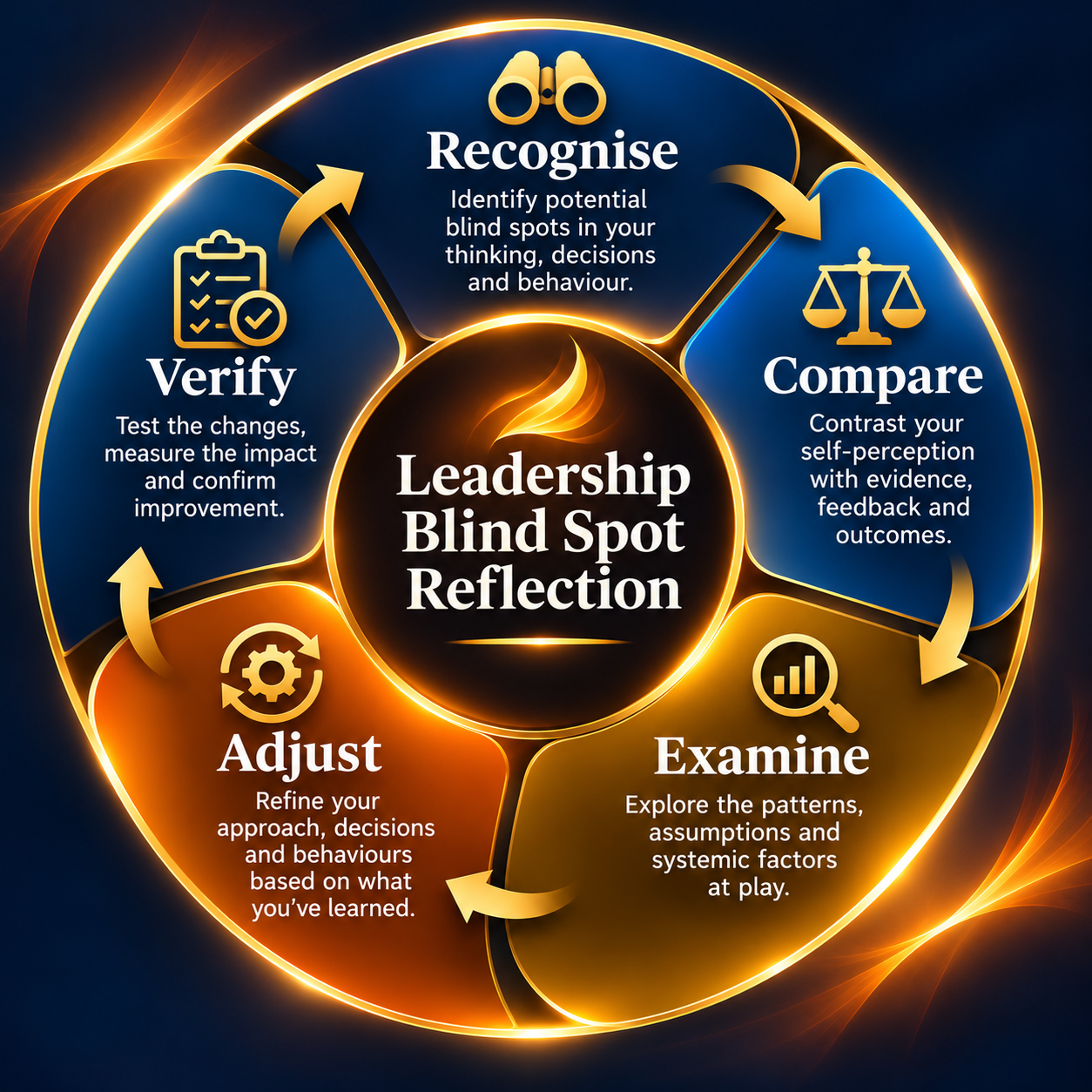
- The five-stage Blind Spot Reflection Framework (Recognise, Compare, Examine, Adjust, Verify) turns reflection into measured behavioural change.
- A reflective leader can recognise an unsustainable workload, but only appropriate organisational action can address its structural causes.
Leadership Intelligence Library™ | Reflective Practice Intelligence™
Reflective Leadership and the Hidden Cost of Leadership Blind Spots
Introduction: The Difference Between Leadership Intention and Leadership Impact
A senior executive concludes a leadership meeting feeling satisfied.
The agenda was completed, decisions were made and the team appeared aligned. Nobody openly challenged the proposed strategy. From the executive’s perspective, the meeting demonstrated decisive leadership and organisational clarity.
Yet several members of the leadership team leave with a different interpretation.
They believe important risks were overlooked. Two managers had concerns but decided not to raise them after the executive dismissed an earlier question. Another understood the final decision differently from the rest of the group.
The executive sees agreement.
The team experiences constrained participation.
This discrepancy illustrates one of the most important challenges in leadership development: the distance between how leaders understand their own behaviour and how that behaviour is experienced by others.
Leadership blind spots rarely emerge because individuals deliberately choose to misunderstand their impact. They can develop through habit, professional identity, organisational culture, cognitive bias and the unequal distribution of authority. Over time, these blind spots can become embedded in everyday leadership practice.
A leader who sees themselves as supportive may unintentionally discourage independence. A leader who values transparency may communicate only after decisions have effectively been finalised. A leader who believes they are protecting quality may create unnecessary approval bottlenecks.
These patterns matter because leadership performance is determined by more than intention.
It is shaped by behaviour, context, relationships and consequences.
Reflective leadership provides a way to examine these relationships systematically.

What Are Leadership Blind Spots?
Featured Snippet
Could unrecognised workload patterns be affecting your leadership? Find out in a few minutes.
Three Types of Leadership Blind Spots
Type 1 Behavioural blind spots
These arise when leaders do not accurately recognise how they act. For example, a manager may describe their approach as collaborative while frequently answering questions before colleagues have finished speaking.
Behavioural patterns may be identified through observation.
Type 2 Interpretive blind spots
These concern how leaders explain situations. A department head may attribute declining engagement to employee attitudes without examining workload, decision autonomy or inconsistent expectations.
Interpretive patterns may require examining assumptions and competing explanations.
Type 3 Systemic blind spots
These arise when leaders overlook the organisational conditions created or reinforced by their decisions. A chief executive may consider themselves an effective problem-solver while failing to recognise that repeated personal intervention prevents managers from developing independent judgement.
Systemic patterns may require reviewing decision rights, workload, communication processes and organisational outcomes.
Why Leadership Blind Spots Become More Dangerous as Responsibility Increases
Senior leadership brings greater influence over resources, priorities and organisational expectations. It can also reduce the frequency of direct challenge.
Employees may hesitate to disagree with someone who controls performance evaluations, promotion opportunities or strategic decisions. Even where leaders explicitly invite feedback, colleagues may consider the personal or professional consequences of providing it.
This creates an information problem. The leader receives an incomplete picture of how their decisions are understood and experienced.
The Authority–Feedback Gap
As authority increases, leaders may become more dependent on information filtered through organisational hierarchies. Reports become shorter. Difficult messages may be softened. Concerns may be resolved informally before reaching senior decision-makers.
These practices are not always harmful. Organisations need efficient reporting and appropriate escalation. However, when information is consistently filtered to protect the leader’s confidence or preserve apparent alignment, decision quality may suffer.
Reflective leadership helps leaders question whether the information reaching them is sufficiently complete.
The Experience Trap
Experienced leaders often develop reliable patterns of judgement. Those patterns can improve speed and consistency, particularly in familiar environments.
However, experience can also create excessive confidence in previously successful approaches. A leader who successfully managed a crisis through directive decision-making may continue using the same style when collaboration would produce better results.
The original behaviour was not necessarily wrong.
The blind spot emerges when the leader fails to recognise that the context has changed.
The Intention–Impact Gap
Leaders naturally understand their own intentions. They know why they introduced a new process, challenged an employee or intervened in a difficult decision. Other people experience the behaviour and its consequences rather than the leader’s internal reasoning.
A manager may intend to demonstrate commitment by attending every project meeting. Employees may interpret the same behaviour as a lack of trust.
Neither perspective should automatically be treated as complete.
Reflective leadership examines the difference.

The Five Common Blind Spots That Undermine Leadership Performance
Blind Spot 1
Confusing control with accountability
Leaders are accountable for outcomes, but accountability does not require personal involvement in every decision. A leader who approves all significant operational choices may initially reduce inconsistency. Over time, the same arrangement can delay decisions, weaken management confidence and increase executive workload.
The reflective question is whether personal control is genuinely improving performance or compensating for insufficient delegation structures.
Blind Spot 2
Mistaking silence for agreement
Meetings can appear harmonious even when participants hold substantial concerns. Silence may reflect agreement, uncertainty, fatigue, cultural expectations or a perceived lack of psychological safety.
Leaders who interpret silence as endorsement risk overlooking relevant information. Reflective leaders examine participation patterns and create credible opportunities for alternative views.
Blind Spot 3
Overestimating communication clarity
Leaders frequently communicate within a context that others do not share. An executive may have spent weeks discussing a strategic decision with senior colleagues before announcing it to the wider organisation. What feels obvious to the executive may be unfamiliar to employees.
A reflective approach examines what was actually understood, rather than assuming communication was effective because information was distributed.
Blind Spot 4
Underestimating the impact of emotional responses
A leader may believe that occasional impatience is inconsequential. However, employees can adapt their behaviour to anticipated reactions. They may avoid raising problems, delay escalation or present information more cautiously.
The relevant issue is not whether the leader intended to intimidate. It is whether their responses have influenced the team’s willingness to communicate openly.
Blind Spot 5
Normalising unsustainable leadership workload
Some leaders interpret constant availability as evidence of professional commitment. They may overlook how this expectation affects colleagues, decision-making and their own long-term effectiveness. When leaders repeatedly work beyond sustainable limits, they can unintentionally establish those practices as organisational norms.
Reflective leadership connects this blind spot with Leadership Workload™, Leadership Capacity™ and Leadership Sustainability™.
Reflective Practice Intelligence™: The Capability to Examine Leadership Impact
Within Burn Bright Advisory’s Leadership Intelligence Compass™, Reflective Practice Intelligence™ concerns the disciplined examination of leadership experience, assumptions, decisions and behaviours.
Its significance extends beyond individual self-awareness. It provides a mechanism for examining how leadership capabilities operate together.
A leader may demonstrate strong technical knowledge but limited adaptability. Another may communicate professionally under normal conditions but struggle to regulate emotional responses during conflict. A third may have a clear strategic vision while overlooking the ethical implications of implementation decisions.
Reflective Practice Intelligence™ supports the examination of these interactions. It helps leaders identify where established strengths are effective, where they are being overused and where additional capabilities are required.
Connecting Reflection With the Leadership Intelligence Compass™
| Compass domain | Blind spot reflection can reveal |
|---|---|
| Professionalism Intelligence™ | Inconsistency between expected standards and actual conduct |
| Ethics Intelligence™ | Unexamined fairness or accountability implications |
| Constructivism Intelligence™ | Failure to consider how others interpret shared experiences |
| Adaptability Intelligence™ | Excessive reliance on previously successful approaches |
| Visionary Leadership Intelligence™ | Strategic ambition disconnected from operational reality |
| Emotional Intelligence™ | Underestimated effects of emotional responses |
| Knowledge Development Intelligence™ | Resistance to contradictory evidence or new learning |
| Leadership Sustainability™ | Normalised workload and capacity risks |
This approach moves leadership development beyond isolated personality traits. It examines the relationships between leadership capability, behaviour and organisational conditions.
The Burn Bright Leadership Blind Spot Reflection Framework
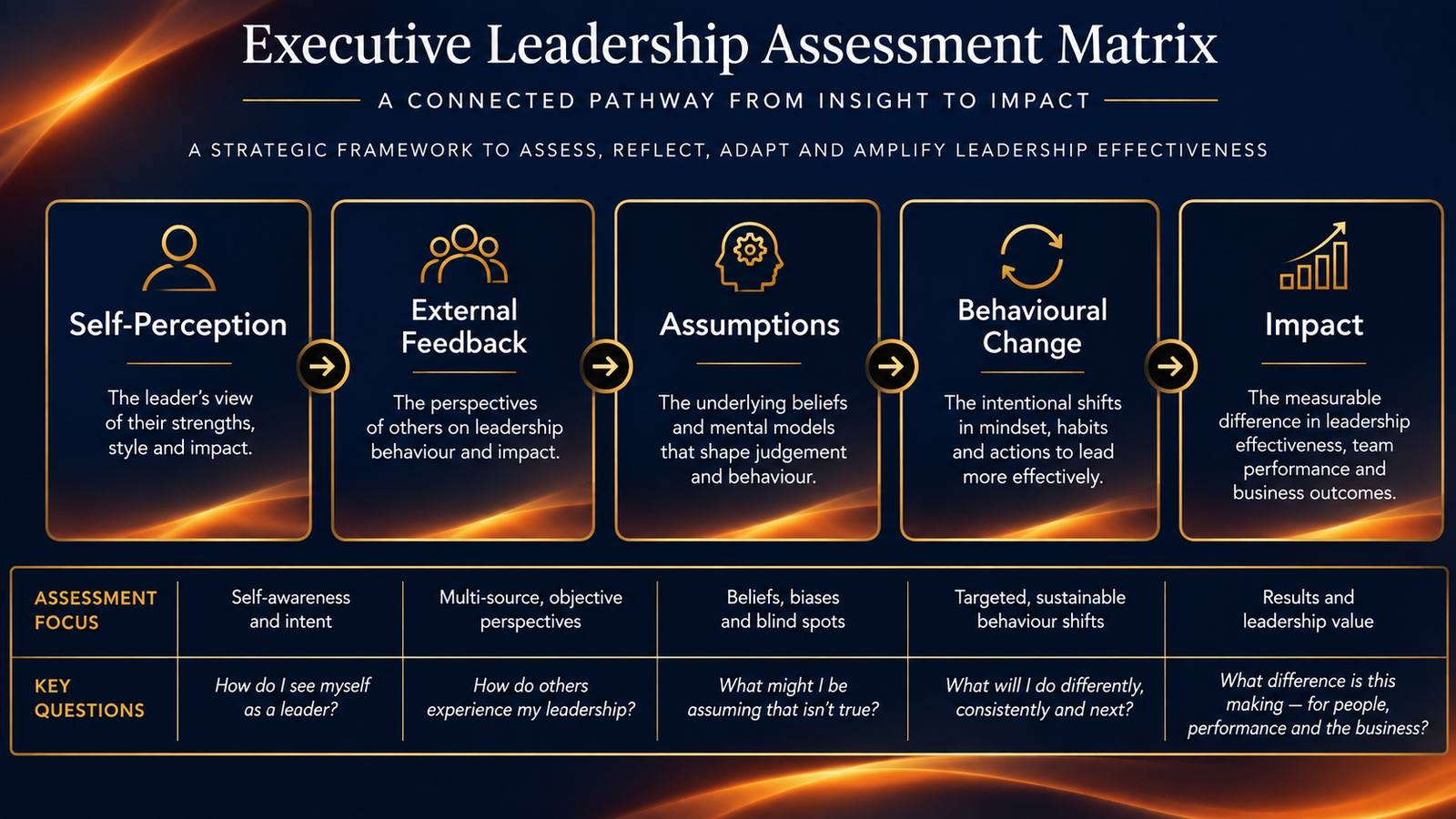
Recognising a blind spot requires more than asking leaders to become self-aware. Self-assessment can reproduce the same assumptions that created the blind spot. A stronger process combines internal reflection with external evidence.
The following five-stage framework is a proposed developmental application of Leadership Performance Intelligence™. It is not presented as a validated diagnostic instrument.
Stage 1: Recognise — Identify a Possible Discrepancy
Reflection begins when leaders notice that their understanding of a situation may be incomplete. This might arise through unexpected feedback, recurring conflict, inconsistent performance or an organisational outcome that contradicts expectations. For example, a manager who believes they delegate effectively may discover that employees still seek approval for routine decisions. The first task is to recognise the discrepancy without immediately explaining it away.
Stage 2: Compare — Gather Evidence From Different Perspectives
The leader compares personal interpretations with credible external information. Evidence may include structured feedback, team discussions, decision records, workload patterns or observations from trusted colleagues. The purpose is not to establish which person is right. It is to understand whether the leader’s existing interpretation adequately explains the situation. Feedback must be gathered in ways that protect confidentiality and minimise pressure on employees.
Stage 3: Examine — Challenge the Underlying Assumptions
Once a discrepancy is identified, the leader examines the beliefs that may have contributed to it. Why did I assume the team agreed? Why do I believe this decision requires my approval? What evidence supports my explanation? This stage is particularly important because changing a behaviour without examining the underlying assumption may produce only temporary improvement.
Stage 4: Adjust — Introduce a Specific Behavioural Change
Reflection becomes useful when it changes practice. A leader might introduce structured opportunities for dissent, clarify delegated authority, change their approach to feedback or reduce unnecessary meeting attendance. The adjustment should be observable and proportionate to the problem.
Stage 5: Verify — Evaluate Whether the Change Improved Outcomes
The final stage considers whether the change produced the intended effect. A leader who introduces a new feedback process should examine whether employees are actually more willing to raise concerns. A manager who delegates decisions should assess whether decision quality and turnaround improve. Verification prevents reflection from becoming a purely internal exercise.
Sector Applications: How Blind Spots Affect Organisational Performance
Leadership blind spots are not confined to senior executives or commercial organisations. They appear wherever individuals exercise influence over decisions, resources, relationships and professional expectations.
The following scenarios are illustrative examples rather than verified case studies.
🏢 Business Growth Intelligence™: When a Founder Becomes the Constraint
A successful founder has built a business through personal involvement in almost every important decision. As the organisation expands, additional managers are appointed. However, growth begins to slow. The founder believes the new management team lacks initiative. Managers report a different experience: important decisions are regularly reconsidered or reversed by the founder, creating uncertainty about their authority.
The founder’s blind spot is not a lack of strategic ability. It is the assumption that the leadership behaviour responsible for early success remains appropriate at a larger organisational scale. A reflective review identifies the need for clearer decision rights, agreed escalation criteria and greater management autonomy. The proposed changes are evaluated through decision turnaround, repeated escalations and management feedback.
The broader lesson is that leadership strengths can become constraints when they are applied without sufficient consideration of context.
🎓 School Leadership Intelligence™: When Support Is Experienced as Surveillance
A school principal introduces frequent classroom visits to strengthen teaching quality, intending to provide professional support and identify opportunities for development. Teachers increasingly describe the visits as monitoring rather than coaching. Some become less willing to discuss difficulties because they believe every observation may influence their performance evaluation.
The principal initially interprets this response as discomfort with accountability. Structured reflection reveals a more complex problem: the purpose of visits has not been clearly distinguished from formal performance management. The principal responds by clarifying expectations, separating developmental conversations from evaluation processes and inviting teachers to contribute to the observation framework.
The reflection is not about removing accountability. It is about ensuring that the leadership process produces the intended professional learning.
🏥 Healthcare Leadership Intelligence™: When Expertise Discourages Challenge
A highly experienced clinical leader is recognised for rapid decision-making and technical competence. During multidisciplinary discussions, junior professionals rarely challenge the leader’s recommendations. The leader assumes this reflects confidence in their expertise. A team review suggests that some colleagues are uncertain about when disagreement is appropriate.
The leader introduces explicit opportunities for questions, reinforces escalation expectations and examines their own responses when concerns are raised.
Clinical safety remains governed by professional standards and formal procedures. Reflective leadership contributes by examining whether everyday leadership behaviour supports the open communication those systems require.
🏛️ Public Service Leadership Intelligence™: When Procedural Compliance Replaces Learning
A public service director reports consistently high compliance with internal procedures. Yet service users continue to experience delays. The director’s initial response is to strengthen procedural monitoring.
A reflective review reveals that staff are following established processes, but several approval stages no longer contribute meaningful value. The leadership blind spot is an assumption that procedural compliance necessarily indicates service effectiveness. The organisation responds by examining process design alongside compliance requirements.
This demonstrates the importance of distinguishing operational activity from public value.

Explore sector-specific leadership resources through the Burn Bright sector hubs.
How Leadership Blind Spots Influence Team Culture
Leadership behaviour establishes informal expectations that may be more influential than written policies.
An organisation may publicly value innovation while rewarding employees who avoid disagreement.
It may promote accountability while discouraging people from acknowledging mistakes.
It may advocate employee wellbeing while celebrating leaders who remain permanently available.
These contradictions can persist because senior leaders evaluate organisational culture primarily through formal statements and intended values. Reflective leadership asks whether those values are visible in everyday experience.
Psychological Safety and Honest Feedback
Psychological safety concerns whether individuals believe they can take interpersonal risks, such as asking questions, acknowledging mistakes or challenging assumptions, without being humiliated or punished.
It does not mean eliminating performance standards or avoiding difficult conversations. Instead, it supports the communication required for learning and accountability. Research by Amy Edmondson has helped establish psychological safety as an important concept in organisational learning and team effectiveness.
For reflective leaders, the practical implication is that feedback systems must be credible. Employees should not be expected to provide candid assessments of leadership behaviour when doing so could expose them to retaliation.
The Problem With Performative Openness
Some leaders regularly announce that their door is always open. However, an invitation to speak does not establish that speaking is safe or useful.
Employees evaluate leadership openness through experience. Do leaders listen without immediate defensiveness? Are concerns considered fairly? Are people treated consistently when they disagree?
Reflective leadership requires examining these behaviours rather than relying on declarations of accessibility.
When Feedback Becomes a Leadership Development Resource
Feedback is most valuable when it identifies specific behaviours and consequences. Statements such as “communicate better” provide limited developmental guidance.
More useful feedback identifies an observable pattern: “During project reviews, decisions are often announced before alternative proposals are discussed.” This creates a clear opportunity for reflection and adjustment.
Leaders should also distinguish between isolated perceptions and recurring evidence. One person’s interpretation may be incomplete. Repeated patterns across different sources warrant closer examination.
Measuring Leadership Blind Spots Without Creating Another Compliance Exercise
Organisations sometimes respond to leadership development challenges by introducing additional surveys, reporting requirements and assessment processes. These mechanisms can provide useful information. However, measurement becomes counterproductive when it generates administrative activity without influencing leadership behaviour.
Burn Bright’s Leadership Benchmarking™ concept can be applied by examining defined leadership expectations alongside evidence of actual practice. A proportionate approach considers four dimensions.
| Dimension | Developmental question | Possible evidence |
|---|---|---|
| Self-awareness | Does the leader recognise important behavioural patterns? | Reflective reviews and feedback discussions |
| Feedback openness | Can others challenge the leader constructively? | Participation patterns and confidential feedback |
| Behavioural adaptation | Does the leader respond to credible evidence? | Documented changes in leadership practice |
| Organisational impact | Do changes improve relevant outcomes? | Decision quality, workload, trust and team effectiveness |
These measures should be interpreted together. A leader may receive positive feedback while still making poor strategic decisions. Another may make necessary but unpopular changes while demonstrating strong ethical judgement and accountability.
Connecting Leadership Reflection With Sustainable Performance
An important but frequently overlooked blind spot concerns the leader’s own capacity.
Leaders may recognise that colleagues are overwhelmed while failing to examine the workload expectations they personally model. They may understand the value of delegation while continuing to absorb responsibilities that should be distributed. They may encourage work-life boundaries while communicating expectations through late-night messages and constant availability.
This is where Reflective Practice Intelligence™ connects with Leadership Sustainability™. Reflection helps leaders examine whether their own habits create conditions that are difficult to sustain.
Yet sustainable leadership cannot depend exclusively on individual behavioural change. Organisations must also consider staffing, resources, role design, decision authority and competing priorities.
A reflective leader can recognise an unsustainable workload.
Only appropriate organisational action can address its structural causes.
This distinction is central to Leadership Performance Intelligence™. Leadership effectiveness should not be evaluated independently of the conditions under which performance is expected.
From Leadership Blind Spots to a Leadership Development System™
Addressing blind spots should not depend on a single workshop or annual assessment. The strongest developmental approach connects reflection with regular leadership practice.
Within Burn Bright Advisory’s wider platform, several components can contribute to this process:
- The Leadership Intelligence Compass™ provides a structure for considering different dimensions of leadership capability.
- The Leadership Intelligence Assessment™ can support structured reflection on strengths and development needs, subject to the assessment’s actual design and evidence base.
- Leadership Reflection™ helps leaders examine particular experiences, decisions and behaviours.
- Leadership Planning Tools can translate identified development priorities into specific actions.
- Leadership Benchmarking™ can support comparison against clearly defined expectations.
- The Leadership Intelligence Library™ provides concepts and frameworks that leaders can revisit as their responsibilities evolve.
- Workshops and certification pathways can support deeper learning where appropriate.
These components form part of a wider Leadership Development System™ when they are connected through meaningful developmental objectives.
The Risks of Reflective Leadership
Reflective leadership has limitations when applied without appropriate judgement.
Excessive reflection can delay necessary decisions. Repeated self-examination can become unproductive rumination. Feedback can be biased, incomplete or shaped by organisational politics. Leaders may also overcorrect in response to criticism, abandoning effective practices because they are unpopular.
Reflection therefore requires balance.
It should be evidence-informed without becoming indecisive.
It should invite challenge without treating every opinion as equally reliable.
It should encourage accountability without assuming leaders are personally responsible for every organisational difficulty.
Most importantly, reflection should lead to proportionate action. The purpose is not to make leaders constantly question their legitimacy. It is to strengthen their ability to recognise when existing assumptions require reconsideration.
Conclusion: Leadership Maturity Requires the Courage to Examine Impact
Leadership blind spots are an inevitable possibility wherever people exercise authority under conditions of uncertainty.
Experience, expertise and professional confidence do not eliminate them. Indeed, these strengths can sometimes make blind spots more difficult to recognise.
Reflective leadership offers a disciplined means of examining the difference between intention and impact. By combining self-awareness with credible feedback, critical reflection, behavioural adaptation and evaluation, leaders can identify patterns that would otherwise remain hidden.
Within Leadership Performance Intelligence™, this process contributes to stronger judgement, more effective relationships and sustainable organisational performance.
The most important leadership question is therefore not simply whether a leader believes they are effective. It is whether they are willing to examine the evidence that might challenge that belief.
Leadership Reflection Questions
- Where might my understanding of my leadership differ from the experiences of colleagues?
- Which aspects of my behaviour are least likely to receive candid feedback?
- When was the last time credible evidence caused me to change an established leadership assumption?
- Do I interpret silence as agreement without verifying understanding?
- Where might my personal involvement be reducing the autonomy of others?
- How do my emotional responses influence the information people are willing to share?
- Which leadership behaviours do I defend primarily because they contributed to previous success?
- What evidence would demonstrate that I have meaningfully addressed a blind spot?
A 30-Day Leadership Blind Spot Review
Week 1: Identify the discrepancy
Select one recurring leadership difficulty. Record your current explanation and the evidence supporting it.
Week 2: Seek alternative perspectives
Invite specific, confidential feedback from people affected by the behaviour or decision.
Week 3: Introduce a behavioural adjustment
Choose one observable change, define the intended effect and communicate expectations appropriately.
Week 4: Evaluate the impact
Review feedback and relevant outcomes. Decide whether to retain, modify or discontinue the change.
The value of the review lies in the quality of the evidence and the behavioural changes it produces, rather than completion of the checklist itself.
Frequently Asked Questions
What are leadership blind spots?
Leadership blind spots are gaps between how leaders understand their own behaviour, assumptions or impact and what available evidence suggests about their actual leadership practice.
How does reflective leadership help identify blind spots?
Reflective leadership combines structured self-examination, feedback, alternative perspectives and evaluation of outcomes to identify discrepancies that leaders might otherwise overlook.
Why do experienced leaders develop blind spots?
Experience can reinforce established assumptions and successful habits. Increasing authority may also reduce access to candid feedback, making it harder to recognise when circumstances require a different approach.
What is the difference between self-awareness and reflective leadership?
Self-awareness involves recognising personal characteristics and behavioural tendencies. Reflective leadership applies that understanding to specific decisions, relationships and organisational outcomes.
Can leadership blind spots affect organisational performance?
Yes. Unrecognised leadership patterns can contribute to poor communication, unnecessary decision delays, reduced employee autonomy and missed organisational risks.
How can leaders receive more honest feedback?
Leaders can establish confidential feedback channels, ask behaviour-specific questions, demonstrate constructive responses to disagreement and ensure employees are not penalised for raising legitimate concerns.
Can leadership blind spots be measured?
Specific discrepancies can be examined through behavioural observation, structured feedback, decision reviews and organisational indicators. These should not be treated as a single definitive measure of leadership effectiveness.
How does Reflective Practice Intelligence™ support leadership development?
It provides a structured way to examine assumptions, experiences and behaviours, enabling leaders to identify development priorities and evaluate changes in practice.
How are leadership blind spots connected to burnout?
Leaders may overlook workload patterns, unnecessary personal involvement and expectations of constant availability. Reflection can reveal these issues, although organisational changes may be necessary to resolve them.
How can organisations reduce leadership blind spots?
Organisations can integrate structured reflection, credible feedback, leadership assessment, coaching and behavioural evaluation into a coherent Leadership Development System™.
See What Self-Assessment Alone Can Miss
A structured diagnostic that compares your leadership patterns against evidence on workload, decision authority and sustainability. £144.
Is Your Workload a Blind Spot?
Find out whether the workload expectations you carry and model are sustainable, and where structural pressures may be affecting your effectiveness.
Free Leadership Intelligence
Get Weekly Leadership Insights
Join thousands of leaders receiving practical strategies on burnout prevention, workload design, and sustainable performance every week.