Quick Answer
Key Takeaways
- Burnout in first-time managers is usually caused by organisational design rather than individual resilience.
- New managers often inherit expanded responsibilities without sufficient authority or support.
- Decision overload and communication complexity create hidden workloads that quickly become unsustainable.
- Early intervention prevents burnout from spreading throughout entire teams.
- Sustainable leadership depends on better systems, clearer priorities, and healthier workload architecture.
Introduction
Burnout in first-time managers is becoming one of the fastest-growing leadership challenges across every sector. Promotion into management is often viewed as a reward for excellent individual performance, yet many new managers discover that leadership requires an entirely different set of skills, expectations, and pressures.
The transition can feel overwhelming. Yesterday you were responsible for delivering your own work. Today you are expected to motivate others, resolve conflict, make difficult decisions, manage competing priorities, report upwards, protect your team’s wellbeing, and still achieve your own objectives.
Many organisations mistake this struggle for an experience gap. The reality is far more complex.
At Burn Bright Advisory, we see burnout as a system failure rather than a personal failure. First-time managers rarely fail because they lack commitment. They fail because organisations expand responsibility far faster than they redesign support systems.
This article explores why burnout develops so quickly in new managers, how to recognise the warning signs, and what organisations can do to create sustainable leadership from day one.

Featured Snippet
Why Do First-Time Managers Burn Out So Quickly?
The transition into management represents one of the largest role changes in any career.
Most professionals earn promotion because they excelled as individual contributors. Their technical expertise, reliability, and productivity are rewarded with greater responsibility.
Unfortunately, management requires an entirely different operating system.
Instead of producing work, managers coordinate work.
Instead of solving problems themselves, they solve problems through others.
Instead of measuring success by personal output, success depends on the performance of an entire team.
This shift creates immediate overload.
Research consistently shows that new managers receive little formal preparation before entering leadership positions. Many organisations assume management skills develop naturally through experience. In reality, leadership involves entirely new competencies including coaching, delegation, conflict resolution, communication, workload planning, and strategic decision-making.
The Burn Bright framework identifies five structural drivers that commonly accelerate burnout:
- Scope creep
- Meeting culture
- Communication chaos
- Decision overload
- Perfectionism culture
These five forces steadily expand leadership workloads without increasing available capacity.
Consider a newly promoted department manager. Their calendar immediately fills with recurring meetings. Their inbox triples. Former colleagues now expect leadership. Senior leaders expect strategic thinking. HR expects compliance. Their team expects coaching. Customers expect responsiveness. Meanwhile, their previous workload rarely disappears.
This creates an impossible equation. Rather than removing responsibilities, organisations simply add new ones.
The result is predictable.
Exhaustion becomes normal.
Innovation declines.
Decision quality falls.
Leadership confidence erodes.
Eventually burnout becomes inevitable.
Why Does Management Feel So Different from Technical Work?
One of the biggest surprises for first-time managers is the invisible nature of leadership work.
Technical work usually produces tangible outputs.
Leadership work produces conversations.
Judgement.
Relationships.
Alignment.
Decision-making.
These activities consume enormous cognitive energy despite appearing invisible on workload reports.
Modern managers rarely complete one task before moving to another. Instead they continually switch between meetings, emails, Teams messages, performance discussions, project updates, stakeholder requests and unexpected crises.
Research discussed in Burn Bright Not Out argues that technology has increased communication complexity rather than reducing workload. Instead of eliminating work, digital platforms have multiplied interruptions and fragmented attention.
Every interruption creates a hidden cost.
Context switching.
Decision fatigue.
Reduced focus.
Slower thinking.
More mistakes.
For first-time managers, this environment feels overwhelming because they have not yet developed systems for filtering demands. Many respond by working longer hours. Unfortunately, longer hours rarely solve structural overload. They simply delay exhaustion.
The sustainable alternative is redesigning workload architecture so managers spend more time leading and less time reacting.
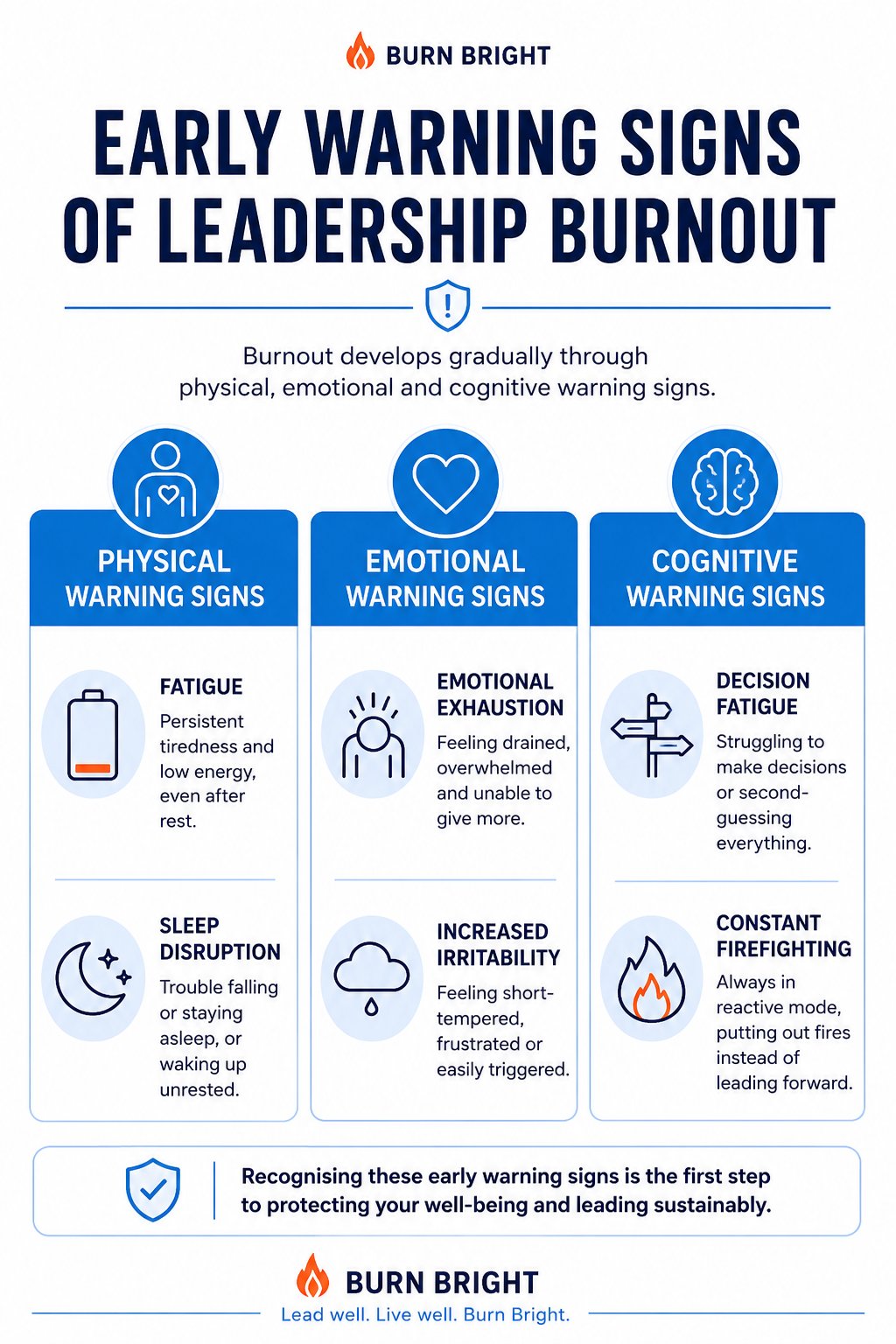
What Are the Early Warning Signs of Burnout in First-Time Managers?
Burnout rarely arrives suddenly. It develops gradually through small compromises that eventually become permanent working habits.
The challenge is that many first-time managers interpret these warning signs as evidence they simply need to work harder. In reality, the opposite is usually true — they need to redesign how work flows through their role.
Research from the World Health Organization recognises burnout as an occupational phenomenon characterised by three dimensions:
- Persistent exhaustion
- Increased mental distance or cynicism towards work
- Reduced professional effectiveness
These symptoms are particularly common during the first two years of management. Some of the earliest indicators include:
Constant Mental Fatigue
The manager never truly switches off. Work follows them home. Even during evenings or weekends they continue thinking about unresolved conversations, staffing issues or tomorrow’s meetings. This is not simply “being busy.” It is cognitive overload.
Decision Fatigue
Leadership is largely a decision-making role. Small decisions accumulate rapidly. Who needs support? Should this meeting happen? Can this deadline move? Should I intervene? Should I delegate?
By the afternoon many first-time managers have already made hundreds of decisions. As cognitive resources decline, decision quality follows. Simple choices begin feeling unusually difficult. Avoidance increases. Confidence falls.
The Burn Bright Framework identifies Decision Overload as one of the five structural causes of leadership burnout because organisations often underestimate the mental cost of continuous judgement.
Working Longer Without Producing More
Many new managers attempt to compensate by extending their working day. They arrive earlier. Stay later. Answer emails after dinner. Work through weekends. Initially this appears productive. Eventually it simply increases fatigue while reducing effectiveness.
Gallup research consistently shows that burned-out managers have lower engagement, and this decline quickly spreads to their teams through reduced communication, slower decisions and lower morale.
Emotional Detachment
Leadership depends upon emotional energy. When exhaustion grows, empathy becomes harder. Managers become shorter in conversations. Feedback becomes transactional. Coaching disappears. The leader is physically present but mentally absent. This often damages trust long before performance metrics reveal a problem.
Constant Firefighting
Every day feels reactive. There is never time for planning. No opportunity for strategic thinking. Every task feels urgent. The calendar controls the manager instead of the manager controlling the calendar. When firefighting becomes normal, burnout is rarely far behind.
Is Burnout Caused by the Manager or the Organisation?
This is perhaps the most important question. Traditional leadership development assumes burnout reflects individual weakness. Modern evidence suggests something very different.
Burnout develops when the demands of the role consistently exceed the resources available.
Instead of asking: “Why isn’t this manager coping?”
Organisations should ask: “Why was this role designed this way?”
The Personal Failure Model
Many organisations still rely upon what Burn Bright describes as the heroic leadership model. Managers are expected to:
- absorb additional work
- remain permanently available
- solve every problem
- protect everyone else
- never appear overwhelmed
Eventually this creates impossible jobs. Leaders become trapped between competing expectations with no realistic way of succeeding.
The organisation blames resilience.
The manager blames themselves.
Nothing changes.
The Systems Model
The Burn Bright philosophy offers a different diagnosis. Burnout is a system failure. When leaders consistently experience overload, the problem usually lies within organisational architecture rather than individual capability. Examples include:
- unclear accountability
- duplicated meetings
- poor delegation structures
- excessive reporting
- fragmented communication
- unrealistic workloads
- unclear authority
- constant organisational change
No resilience programme can permanently solve these problems. Neither can another wellbeing workshop. Structural problems require structural solutions.
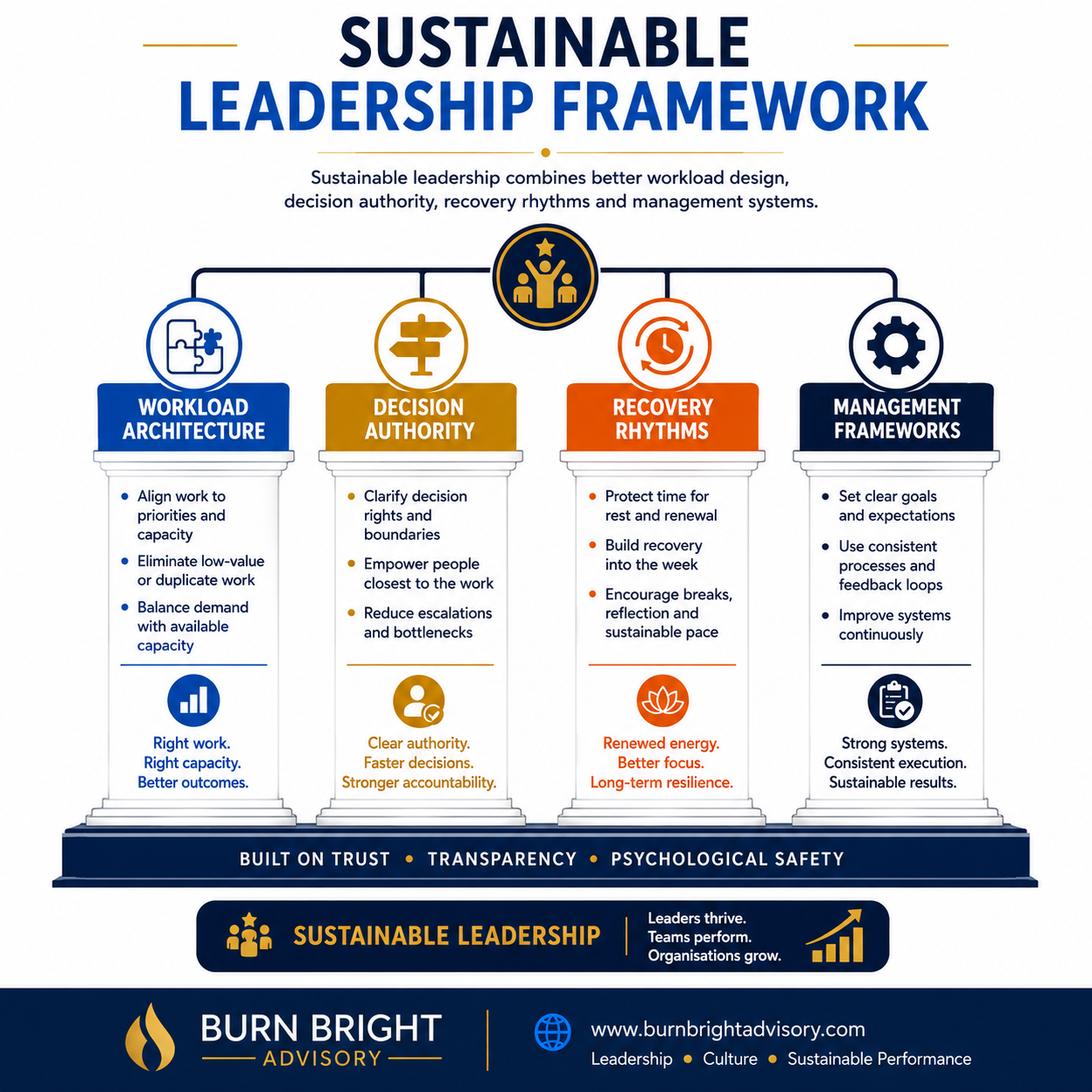
This is why Burn Bright’s Four-Pillar Structural Transformation Framework focuses on:
- Workload Architecture
- Decision Authority
- Recovery Rhythms
- Management Frameworks
These four pillars shift the conversation from coping to redesigning work itself.
Traditional Management Versus Sustainable Leadership
| Traditional Management | Sustainable Leadership |
|---|---|
| Work harder | Design better systems |
| Heroic leadership | Shared leadership |
| More meetings | Better communication architecture |
| Constant availability | Protected strategic time |
| Individual resilience | Organisational resilience |
| Busy calendars | Clear priorities |
| Reactive decisions | Structured decision-making |
| Burnout treated individually | Burnout prevented structurally |
The organisations attracting and retaining exceptional leaders increasingly invest in sustainable leadership rather than expecting unlimited capacity. Research demonstrates that replacing experienced managers is expensive. Burn Bright estimates replacement costs at approximately £75,000 for middle managers and more than £500,000 for senior leaders, without including the hidden cultural and productivity costs that follow leadership turnover.
How Can Organisations Prevent Burnout in First-Time Managers?
Preventing burnout starts before promotion. Too many organisations celebrate career progression without redesigning the role itself. A promotion should not simply increase responsibility. It should increase support.
Effective organisations build structured transitions into leadership. These include:
Clear Workload Architecture
Instead of inheriting every responsibility, new managers receive carefully prioritised workloads. Responsibilities are removed before new ones are added. Capacity becomes measurable rather than assumed.
Defined Decision Authority
Many first-time managers burn out because they remain accountable without possessing genuine authority. Every decision requires multiple approvals. Every conversation needs senior sign-off. Decision bottlenecks increase frustration while slowing organisational performance. Clear authority reduces unnecessary cognitive load.
Leadership Frameworks
Frameworks reduce uncertainty. Instead of making every decision from scratch, managers use repeatable systems. Burn Bright recommends structured approaches including:
- RACI Delegation Framework
- IMPACT Matrix
- Decision Fatigue Management
- Recovery by Design
- 30-60-90 Day Leadership Plan
These frameworks reduce mental effort while improving consistency.
Protected Recovery
Recovery is not the reward for finishing work. Recovery is part of sustainable performance. High-performing organisations deliberately protect thinking time, focus time and genuine recovery rhythms. Without recovery, performance inevitably declines regardless of talent.
What Should First-Time Managers Do When Burnout Starts?
Recognising burnout is only the first step. The next challenge is responding before exhaustion becomes chronic.
Many first-time managers wait until they are completely overwhelmed before making changes. By that point, recovery is far more difficult. Sustainable leadership depends on making small structural adjustments early rather than dramatic interventions later.
Audit Your Workload
Start by identifying everything that currently demands your attention. Most managers are surprised by how much invisible work they carry. Consider every area of responsibility:
- Scheduled meetings
- One-to-one conversations
- Email management
- Instant messaging
- Project oversight
- Performance management
- Administrative tasks
- Reporting
- Stakeholder communication
- Crisis management
Once everything is visible, ask three questions:
- Does this activity require my involvement?
- Does it create measurable value?
- Can it be delegated, automated or eliminated?
This simple exercise often reveals that 20–30% of a manager’s workload adds little strategic value.
Stop Confusing Activity With Leadership
Busy managers often believe productivity equals effectiveness. It doesn’t. Leadership is measured by outcomes, not by calendar density. The most effective leaders are not those attending the most meetings. They are the ones creating clarity.
That means protecting time for strategic thinking, coaching conversations, decision-making, relationship building, and organisational improvement. These activities rarely feel urgent. Yet they produce the greatest long-term value.
Learn to Delegate Properly
Delegation is one of the biggest challenges for first-time managers. Many continue completing work they performed before promotion because it feels faster than teaching someone else. Unfortunately, every task they keep becomes another task they cannot lead.
Burn Bright recommends structured delegation using the RACI Framework, which clearly defines responsibility, accountability, consultation and information sharing. This removes confusion while building capability across the team.
Delegation is not losing control.
It is creating capacity.
Build Recovery Into the Week
Recovery should never depend upon annual leave. Small recovery periods throughout each week protect decision quality and emotional resilience. Examples include:
- protected focus blocks
- meeting-free periods
- uninterrupted lunch breaks
- finishing on time at least several days each week
- limiting out-of-hours communication
Why Sustainable Leadership Benefits Everyone
Burnout is often discussed as an individual wellbeing issue. It is much larger than that.
When first-time managers become exhausted, the consequences spread rapidly. Teams receive less coaching. Feedback becomes inconsistent. Innovation slows. Decision-making becomes reactive. Employee engagement declines. Turnover increases. Customers notice.
Organisations pay what Burn Bright calls the Culture Tax—the hidden financial cost of burnout, disengagement and unnecessary turnover created by broken systems rather than poor people.
Supporting first-time managers therefore creates value in several ways:
- higher engagement
- stronger retention
- better decision-making
- healthier workplace culture
- improved organisational performance
The goal is not to create leaders who can tolerate more pressure. The goal is to design organisations that require less unnecessary pressure in the first place.
Frequently Asked Questions
What causes burnout in first-time managers?
Burnout usually develops when leadership responsibilities increase faster than organisational support. Excessive workload, decision overload, communication complexity, unclear authority and poor organisational systems combine to create unsustainable pressure.
How long does it take for burnout to develop?
There is no fixed timeline. Some managers experience symptoms within a few months of promotion, while others gradually develop burnout over several years. Early warning signs often appear long before performance visibly declines.
Is burnout a personal weakness?
No. Research increasingly recognises burnout as an occupational phenomenon created by chronic workplace stress. Burn Bright views burnout as a structural issue caused by organisational design rather than individual resilience.
Can first-time managers prevent burnout?
Yes. Building clear priorities, protecting recovery time, improving delegation, reducing unnecessary meetings and redesigning workload architecture significantly reduce burnout risk.
Why do promoted employees struggle so much?
Most promotions reward technical expertise rather than leadership capability. New managers suddenly inherit responsibility for people, strategy and organisational coordination without equivalent preparation or structural support.
Conclusion
Burnout in first-time managers is not an inevitable part of leadership. It is a predictable consequence of placing talented people into roles that have expanded faster than the systems designed to support them.
When organisations mistake exhaustion for commitment, they create a cycle where capable leaders become overwhelmed, confidence declines, and teams ultimately suffer.
The solution is not to encourage new managers to become more resilient or to simply manage their time better. Sustainable leadership starts by redesigning the role itself—creating realistic workload architecture, clarifying decision authority, reducing unnecessary complexity, and building recovery into the way leadership operates.
At Burn Bright Advisory, we believe burnout is a system failure, not a personal failure. Leaders cannot outwork broken systems, and organisations cannot expect sustainable performance from unsustainable roles.
The transition into management should mark the beginning of a successful leadership career—not the beginning of chronic exhaustion. Sustainable leadership is not about doing more. It is about designing better systems that allow people and organisations to thrive together.
Discover Your Leadership Burnout Risk
If you’re a new or aspiring manager, understanding your current level of leadership fatigue is the first step towards sustainable performance.
Free Leadership Intelligence
Get Weekly Leadership Insights
Join thousands of leaders receiving practical strategies on burnout prevention, workload design, and sustainable performance every week.