Executive Summary
Introduction
Leadership is often mistaken for position.
People assume that promotions create leaders, titles create influence, and authority creates commitment. Reality tells a very different story.
Every organisation has individuals with impressive job titles who struggle to inspire confidence, while others without formal authority consistently influence behaviour, shape culture, and elevate performance.
The difference lies in foundations.
Just as no architect would design a skyscraper on unstable ground, sustainable leadership cannot be built upon technical expertise alone. Strong leadership begins with internal capabilities before external achievements.
Across business, education, healthcare, government, and the third sector, organisations face increasing complexity. Leaders must manage technological disruption, hybrid working, rising expectations, workforce wellbeing, economic uncertainty, and constant change — often simultaneously.
These challenges cannot be solved through charisma or productivity hacks alone. They require leaders who possess deep internal stability.
The most effective leaders understand that every decision they make sends signals about trust, integrity, accountability, and purpose. Their behaviour shapes organisational culture long before strategy documents or annual reports do.
Leadership therefore becomes less about controlling people
and more about creating environments where people
can consistently perform at their best.
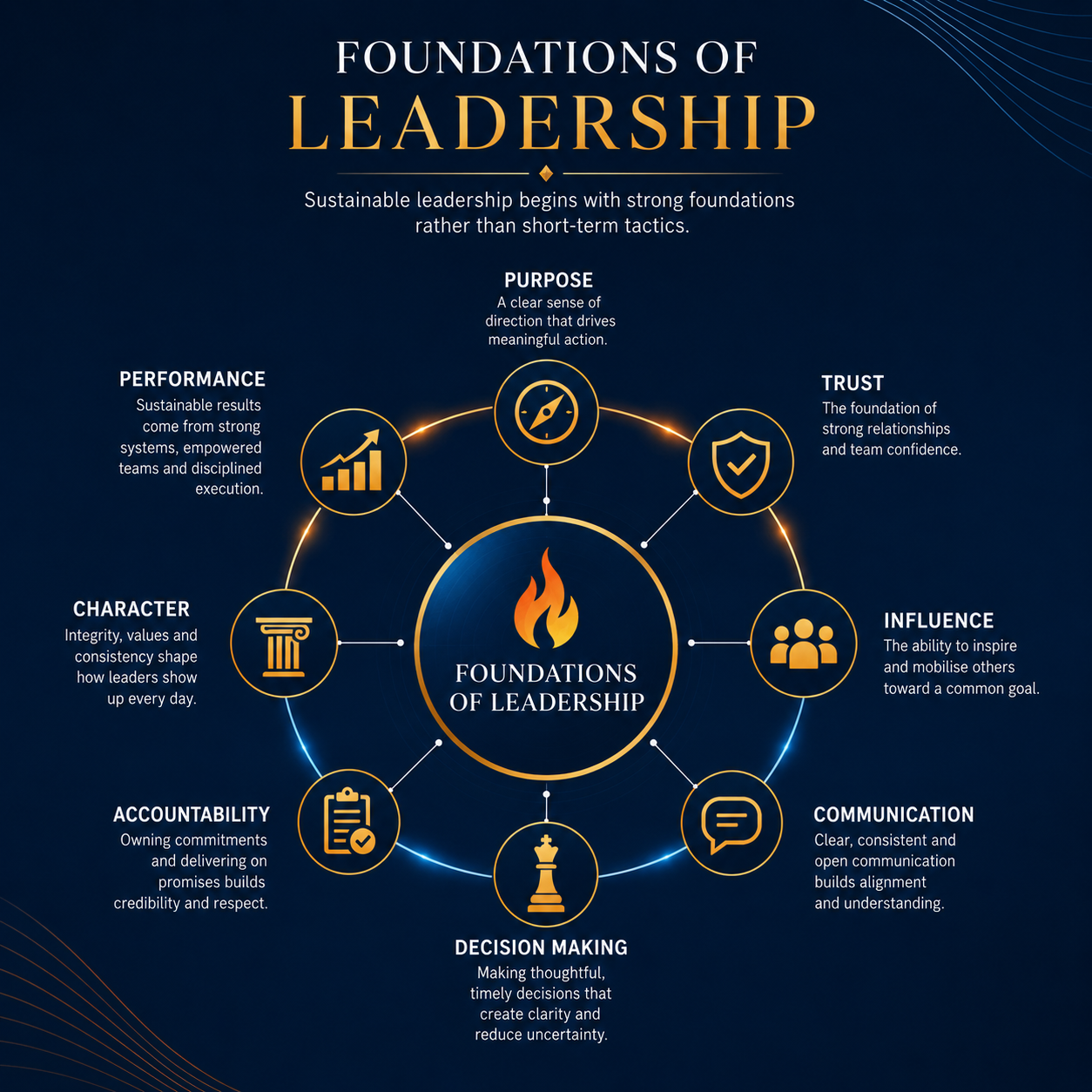
The Leadership Foundation Pyramid
Leadership development often begins at the wrong place. Many programmes focus first on communication techniques, strategic planning, financial management, or operational excellence. While all are important, they sit much higher up the leadership pyramid.
Without strong foundations, these advanced skills become unstable.
The Leadership Performance Intelligence model begins with four essential layers:
Foundation 1
Character Before Competence
Competence earns opportunities. Character earns trust. People will often forgive mistakes made by leaders they trust. They rarely forgive competence without integrity. Character is demonstrated through consistency between words and actions — in difficult conversations, ethical decisions, and moments when nobody is watching. Modern leadership demands credibility more than perfection.
Foundation 2
Self-Leadership Before Leading Others
Every organisation reflects its leadership. Leaders who cannot manage their emotions, priorities, resilience, or behaviour eventually transfer that instability throughout their teams. Self-leadership includes emotional regulation, continuous learning, personal accountability, energy management, reflective practice, and a growth mindset. Leadership begins in the mirror before it reaches the boardroom.
Foundation 3
Trust Before Performance
High-performing teams are built upon psychological safety and trust. When trust exists, people contribute ideas, problems surface earlier, innovation increases, accountability improves, and collaboration becomes natural. Without trust, organisations compensate with bureaucracy, excessive reporting, unnecessary meetings, and micromanagement. Trust reduces organisational friction.
Foundation 4
Purpose Before Productivity
Busy organisations are not always effective organisations. Leaders who create clarity around purpose help people understand not simply what they are doing, but why it matters. Purpose improves motivation, decision-making, engagement, innovation, and organisational resilience. When purpose becomes clear, performance becomes more sustainable.

Why Strong Foundations Matter More Than Ever
Modern leaders are operating within an environment that changes faster than organisational structures can adapt. Artificial intelligence is reshaping work. Economic uncertainty demands constant agility. Employees increasingly seek purpose, flexibility, wellbeing, and meaningful leadership rather than simply competitive salaries.
Technical expertise remains valuable, but technical knowledge alone no longer differentiates exceptional leaders. Instead, organisations increasingly reward leaders who can:
- Build trust during uncertainty
- Maintain composure under pressure
- Navigate competing priorities
- Develop high-performing cultures
- Enable continuous learning
- Lead change without creating unnecessary resistance
These capabilities all originate from strong leadership foundations. Leaders who invest in these foundations become more adaptable because they respond to changing circumstances from stable principles rather than reactive habits.
In contrast, leaders who neglect these fundamentals often rely on control, urgency, or positional authority when pressure increases — approaches that may deliver short-term compliance but rarely create long-term commitment.
Building Leadership That Endures
Strong leadership foundations become visible not when everything is going well, but when organisations experience uncertainty, disruption, and pressure. Anyone can lead when conditions are predictable. Exceptional leaders demonstrate their capability when information is incomplete, priorities compete, and difficult decisions must still be made.
The organisations that consistently outperform their competitors rarely have fewer problems. Instead, they possess leaders who respond differently to those problems. Their leadership behaviours become organisational habits.
The Five Pillars of Leadership Performance Intelligence
Leadership Performance Intelligence provides a practical framework for understanding how exceptional leadership translates into sustainable organisational success. Rather than viewing leadership as a collection of isolated competencies, the model recognises leadership as an interconnected system where every capability strengthens the next.
Pillar 1 — Self-Awareness
Every leadership journey begins with understanding yourself. Leaders often spend significant time analysing markets, customers, competitors, budgets, and operational risks while investing remarkably little time understanding their own behavioural patterns. Yet every leadership decision passes through personal beliefs, biases, emotional responses, and previous experiences.
Self-aware leaders regularly ask:
- How do I respond under pressure?
- What assumptions am I making?
- Which conversations do I tend to avoid?
- How does my behaviour influence others?
- What feedback am I not hearing?
These questions create reflective leaders rather than reactive ones. The result is better judgement, improved emotional intelligence, and greater credibility.
Pillar 2 — Purpose and Direction
People rarely become inspired by targets. They become inspired by meaning. High-performing organisations consistently connect everyday activities with a broader purpose.
Purpose answers questions such as: Why does our organisation exist? What difference are we trying to make? How does each individual contribute? What values guide our decisions?
Purpose creates alignment.
Alignment reduces confusion.
Reduced confusion improves execution.
When leaders continually reinforce purpose, people make better decisions without requiring constant supervision.
Pillar 3 — Trust and Relationships
Trust is leadership’s greatest accelerator. Without trust, organisations become slower. Meetings become longer. Approvals multiply. Communication becomes defensive. Innovation decreases because people avoid taking calculated risks.
Conversely, when trust exists, collaboration increases, feedback improves, problems surface earlier, accountability becomes shared, and learning accelerates.
Trust cannot be demanded. It must be demonstrated consistently through transparency, competence, fairness, and integrity. The strongest cultures are built one trustworthy interaction at a time.

Pillar 4 — Decision Excellence
Leadership is ultimately expressed through decisions. Every decision communicates priorities. Some decisions influence budgets. Others influence culture. Many shape both.
Exceptional leaders resist making decisions purely from urgency. Instead, they ask:
- Does this align with our purpose?
- Who needs to be involved?
- What unintended consequences could emerge?
- What information is missing?
- Will this still be the right decision six months from now?
Decision quality improves when leaders balance data with judgement, courage with humility, and confidence with curiosity. The objective is not perfect decisions — it is consistently sound decisions made with integrity.
Pillar 5 — Continuous Growth
The most successful leaders remain students. They understand that leadership is never mastered. Every experience provides another opportunity to learn.
Growth-oriented leaders seek feedback, reflect regularly, invest in learning, encourage experimentation, learn openly from mistakes, and celebrate progress as much as outcomes. This creates cultures where learning becomes everyone’s responsibility rather than the exclusive responsibility of training departments.
Leadership Across Every Sector
Although leadership challenges differ across industries, the underlying foundations remain remarkably consistent.
🏢 Business
Commercial organisations increasingly compete through adaptability rather than size alone. Leaders who create psychologically safe, innovative environments outperform those relying solely on hierarchical authority. Employees today contribute discretionary effort when they trust leadership. That trust becomes a strategic advantage.
🏥 Healthcare
Healthcare leaders operate where decisions directly affect lives. Clinical expertise remains essential, but compassionate communication, multidisciplinary collaboration, and emotional resilience determine whether healthcare systems flourish under pressure. Sustainable healthcare leadership requires balancing performance expectations with staff wellbeing.
🎓 Education
Schools and universities exist to develop people. Leadership therefore extends beyond operational management. Educational leaders shape learning cultures where curiosity, accountability, collaboration, and growth become everyday experiences. Students ultimately experience the quality of leadership through the quality of teaching.
🏛️ Public and Third Sector
Public service leaders face unique complexity. Resources remain constrained while expectations continue to rise. Leadership therefore depends upon transparency, stakeholder engagement, ethical decision-making, and maintaining public trust. Purpose becomes especially important when financial rewards are not the primary motivator.
Leadership Is Multiplication, Not Accumulation
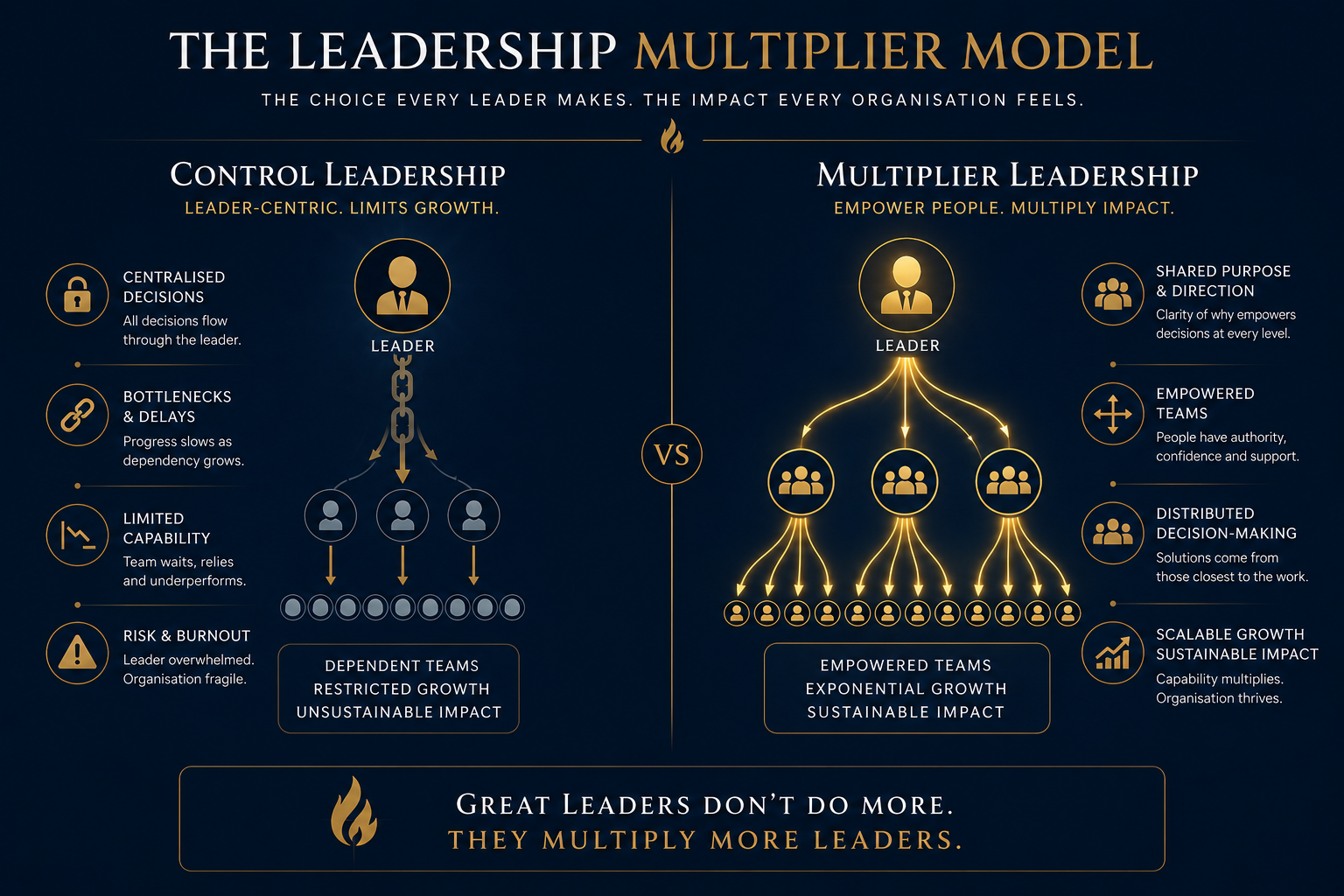
Many leaders unknowingly attempt to become indispensable. They solve every problem. Approve every decision. Attend every meeting. Answer every question. Initially this appears productive. Eventually it becomes the organisation’s greatest limitation.
Managers create dependency.
Leaders create capacity.
True leadership multiplies capability. Rather than becoming the smartest person in every room, effective leaders build rooms filled with capable people who solve problems together. When leaders deliberately develop others, organisational capability expands far beyond individual performance.
The legacy of leadership is measured not by personal achievements, but by how many others become successful because of your influence.
Culture Always Mirrors Leadership
Culture is often described as “how we do things around here.” More accurately, culture is what leaders consistently reward, tolerate, and model. Mission statements may define aspirations. Leadership behaviour defines reality.
Employees observe how leaders respond to mistakes, how conflict is handled, whether feedback is welcomed, how success is recognised, and whether values influence difficult decisions. These observations shape culture far more powerfully than formal policies.
Every conversation strengthens or weakens organisational culture.
Every decision reinforces or undermines trust.
Every interaction teaches people what leadership truly values.
The most effective leaders recognise this invisible influence and intentionally lead through example rather than instruction.
Embedding Leadership Foundations Into Daily Practice
Leadership is not built through occasional moments of excellence. It is built through consistent habits repeated every day. The strongest leaders are rarely remembered for one inspiring speech or one transformational decision. They are remembered because people consistently experienced clarity, integrity, encouragement, accountability, and trust whenever they interacted with them.

Leadership Reflection Questions
- What behaviours do people consistently experience when they work with me?
- Which leadership strengths create the greatest value for my team?
- Where might my leadership unintentionally create confusion or dependency?
- How effectively do I communicate purpose rather than simply tasks?
- When was the last time I actively sought constructive feedback?
- Do my daily decisions consistently reflect the values I expect from others?
- What legacy am I building through the way I lead today?
Practical Action Steps
Leadership improvement begins with small, intentional actions. This week, commit to implementing the following:
1. Conduct a Leadership Reflection
Schedule thirty uninterrupted minutes to evaluate your leadership against the four foundations — Character, Self-Leadership, Trust, and Purpose. Identify one practical improvement in each area.
2. Ask One Powerful Question
Instead of immediately providing answers during your next meeting, ask: “What do you think is the best approach?” Empowering others develops capability far more effectively than solving every problem yourself.
3. Build Trust Deliberately
Identify one conversation you’ve been postponing. Approach it with honesty, empathy and curiosity rather than assumptions. Trust grows through courageous conversations.
4. Connect Daily Work to Purpose
During team meetings, explain not only what needs to happen, but why it matters. Purpose transforms activity into contribution.
5. Schedule Weekly Reflection
Reserve fifteen minutes every Friday to consider: What went well? What challenged me? What did I learn? What will I improve next week? Leadership grows through reflection more than repetition.
Frequently Asked Questions
What are the foundations of leadership?
Leadership foundations are the core principles that enable leaders to create sustainable influence. They include character, self-leadership, trust, purpose, effective communication, sound decision-making, and continuous learning.
Why are leadership foundations important?
Strong foundations improve decision quality, employee engagement, organisational culture, innovation, and long-term performance. Without them, even highly skilled leaders often struggle to sustain success.
Can leadership foundations be learned?
Yes. While personality influences leadership style, the behaviours associated with effective leadership can be intentionally developed through reflection, coaching, practice, and feedback.
How long does it take to become an effective leader?
Leadership development is a continuous journey rather than a destination. Meaningful improvements often become noticeable within months, while mastery develops through years of consistent practice and experience.
Is leadership different from management?
Management focuses primarily on planning, organising and controlling work. Leadership focuses on influencing people, creating vision, building trust, and enabling sustainable performance. Both are essential, but leadership provides the direction that management executes.
What is Leadership Performance Intelligence?
Leadership Performance Intelligence is Burn Bright Advisory’s integrated framework that connects self-awareness, purpose, trust, decision-making and continuous growth to create sustainable leadership effectiveness. Rather than treating leadership as isolated skills, it views leadership as an interconnected system that strengthens organisational performance over time.
How can organisations strengthen leadership foundations?
Organisations can invest in leadership development, encourage coaching and mentoring, build psychologically safe cultures, promote reflective leadership, align performance measures with organisational values, and reward behaviours that reinforce trust and collaboration.
Conclusion
Leadership will always evolve. Technology will change. Markets will shift. Organisational structures will continue adapting. Human nature, however, remains remarkably consistent.
People still want to trust those who lead them. They still seek purpose in their work. They still perform best when they feel valued, respected, challenged, and supported.
That is why leadership foundations matter.
The most successful leaders understand that sustainable performance is never created through authority alone.
Character before competence.
Self-leadership before organisational leadership.
Trust before control.
Purpose before productivity.
These principles form the foundation of Leadership Performance Intelligence and provide leaders with a practical roadmap for navigating an increasingly complex world.
Leadership is not about becoming indispensable. It is about helping others become exceptional. When leaders strengthen their own foundations, they strengthen every person, every team, and every organisation they influence.
Discover Your Leadership Burnout Risk
Understanding your current leadership foundations is the first step towards sustainable performance. Take the free assessment to identify where you’re strongest and where to focus next.
Free Leadership Intelligence
Get Weekly Leadership Insights
Join thousands of leaders receiving practical strategies on burnout prevention, workload design, and sustainable performance every week.