Quick Answer
Key Takeaways
- CEO burnout is a structural problem, not a personal weakness.
- Modern CEOs face unprecedented decision overload and organisational complexity.
- Burnout reduces strategic thinking long before physical exhaustion becomes obvious.
- Sustainable leadership depends on better systems rather than greater effort.
- Organisations that redesign leadership architecture outperform those relying on executive heroics.
Introduction
CEO burnout has become one of the greatest hidden risks facing modern organisations. While many executives continue to deliver impressive financial results, increasing numbers are doing so at an unsustainable personal cost.
The modern CEO is expected to lead strategy, drive innovation, manage investors, inspire culture, oversee digital transformation, navigate economic uncertainty and remain constantly available. Every year new responsibilities are added to the role, yet very few are removed. Eventually the workload exceeds human capacity.
Burn Bright Advisory takes a different view from traditional leadership development. Burnout is not a resilience problem. It is a system failure. Leaders cannot outwork broken organisational structures, and expecting them to do so creates long-term damage for both individuals and businesses.
This article explores why CEO burnout is increasing, how organisational systems create executive overload, the warning signs leaders should recognise and the structural changes that build sustainable leadership.
Featured Snippet
Why Is CEO Burnout Increasing?
The role of the Chief Executive Officer has changed more in the past decade than at any other point in modern business history.
Once focused primarily on strategy, growth and governance, today’s CEOs are expected to lead organisations through constant disruption while simultaneously managing stakeholders, technology, regulation, workforce wellbeing, cybersecurity, artificial intelligence and public reputation.
Every new responsibility appears reasonable in isolation. Collectively, they have transformed executive leadership into one of the most cognitively demanding roles in any profession.
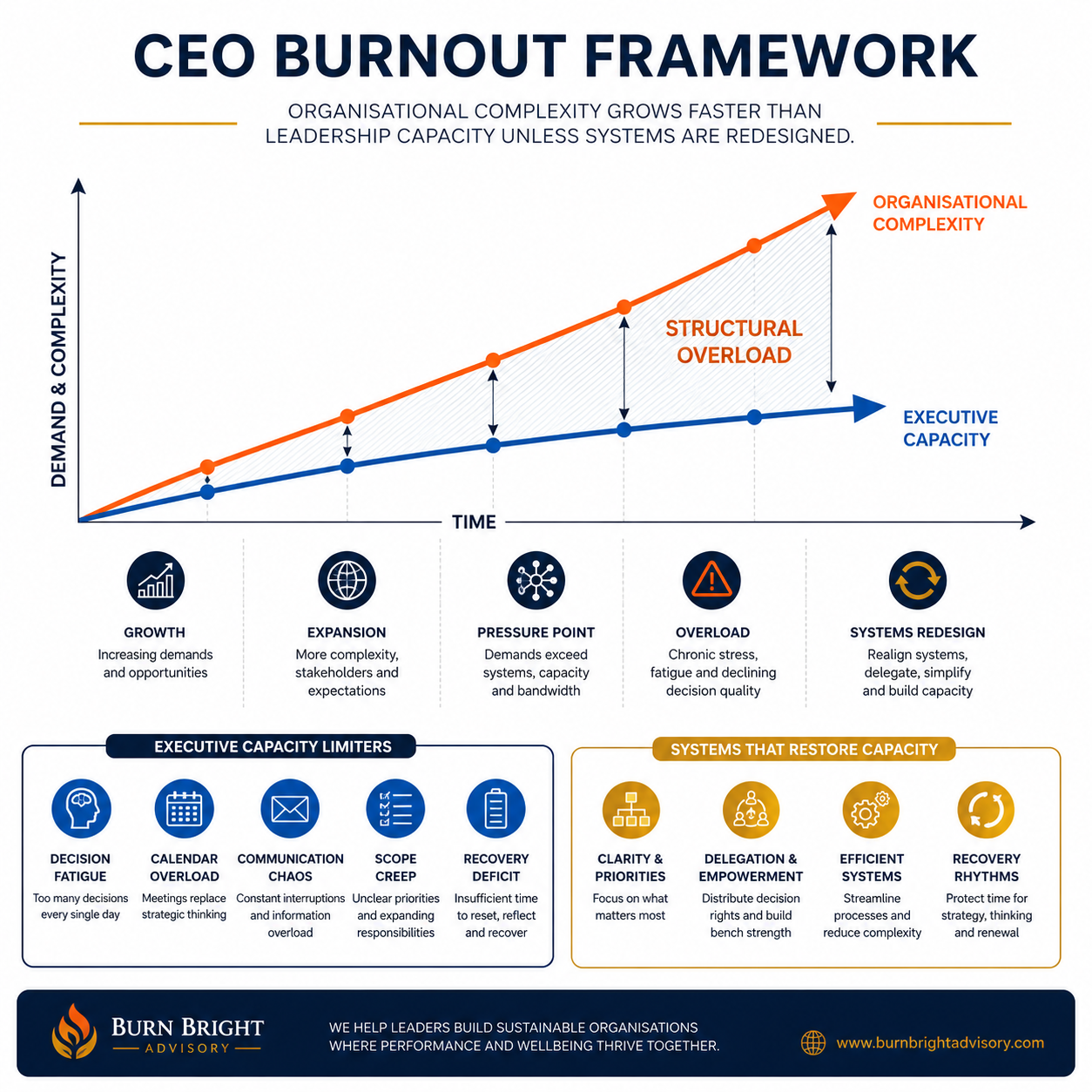
The result is an expanding gap between organisational expectations and human capacity. Burn Bright Advisory describes this as structural overload. The issue is not that CEOs have become less capable. Organisations have become dramatically more complex while leadership roles have remained largely unchanged.
Research consistently demonstrates that leadership demands continue to increase across sectors. Executive roles now require continuous decision-making, rapid adaptation and constant availability, creating sustained cognitive load that cannot simply be solved through better productivity habits.
Traditional advice typically recommends improved time management, greater resilience or stronger personal habits. These approaches may provide temporary relief. They rarely address the underlying structural problem.
The Burn Bright Framework identifies five structural drivers behind leadership burnout:
- Scope creep
- Meeting culture
- Communication chaos
- Decision overload
- Perfectionism culture
Why Are CEOs More Vulnerable to Burnout Than Ever?
The title may say Chief Executive Officer, but the reality often feels closer to Chief Everything Officer.
Today’s CEOs are expected to lead strategy, drive growth, manage investors, oversee governance, navigate artificial intelligence, respond to geopolitical uncertainty, protect cybersecurity, shape organisational culture and remain permanently available. Every responsibility added to the role increases cognitive demand, yet very few responsibilities are ever removed.
This is not simply a workload problem. It is a design problem. Burn Bright Advisory argues that burnout is a system failure rather than a personal failure. The issue is not whether the CEO is resilient enough. The issue is whether the organisation has created a leadership role that any human being could sustain over the long term.
The Executive Capacity Gap
Leadership capacity is finite. Organisational complexity is not. Over the last decade, most organisations have expanded through digital transformation, hybrid working, increased regulation and global competition. These developments have multiplied the number of decisions requiring executive attention.
A typical CEO now manages:
- Long-term strategic planning
- Investor and board relationships
- Artificial intelligence adoption
- Cybersecurity oversight
- Talent attraction and retention
- Organisational culture
- Regulatory compliance
- Reputation management
- Business transformation
- Crisis response
Each responsibility appears manageable when viewed individually. Collectively they create continuous cognitive demand. The Burn Bright Framework identifies this as Scope Creep, where responsibilities accumulate faster than organisations redesign leadership structures to accommodate them.
Decision Fatigue Is Quietly Reducing Executive Performance
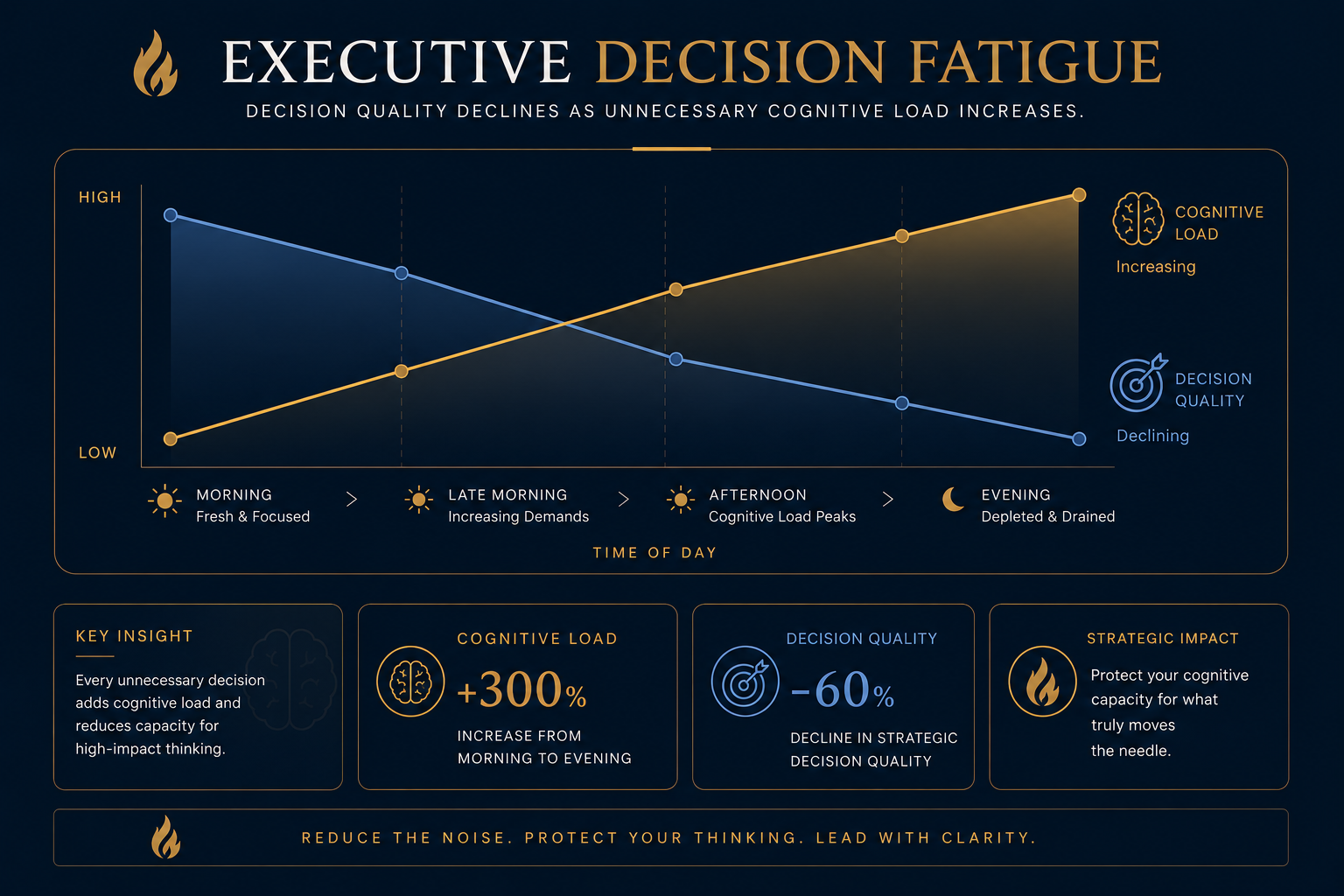
Every decision consumes cognitive energy. For CEOs, decision-making is continuous. From investment priorities and strategic partnerships to staffing decisions and operational risks, executives make hundreds of decisions every week.
Over time, this produces decision fatigue. Decision fatigue affects leaders long before they recognise physical exhaustion. Common symptoms include:
- Delaying important decisions
- Avoiding complex conversations
- Becoming increasingly risk-averse
- Micromanaging operational detail
- Defaulting to familiar solutions
- Losing strategic perspective
These behaviours are often interpreted as declining leadership performance. In many cases they are symptoms of cognitive depletion. Protecting executive decision-making capacity is therefore not a wellbeing initiative. It is a strategic business priority.
How Does CEO Burnout Affect the Entire Organisation?
CEO burnout is never confined to the executive office. Leadership behaviour shapes organisational behaviour. When leaders operate from depletion rather than clarity, the effects ripple through every level of the business.
Strategic Thinking Declines
Burned-out CEOs naturally spend more time responding to urgent issues and less time creating future direction. Innovation slows. Transformation projects stall. Long-term planning gives way to short-term firefighting. Organisations become reactive rather than strategic.
Communication Quality Falls
Executive communication often changes before performance indicators reveal a problem. Leaders become less visible, more transactional, less patient, less collaborative and more reactive. Employees quickly notice these shifts. Uncertainty increases. Rumours replace clarity. Trust gradually declines.
Organisational Culture Mirrors Executive Behaviour
Culture is shaped far more by what leaders do than by what organisations say. When CEOs regularly work late into the evening, respond to emails overnight and remain permanently available, employees interpret those behaviours as expectations rather than choices. Burnout becomes culturally normalised.
Over time this creates what Burn Bright Advisory calls the Culture Tax — the hidden financial and operational cost created by turnover, disengagement, reduced innovation and declining productivity when organisations reward unsustainable working practices.
The Financial Cost Is Significant
The cost of CEO burnout extends well beyond individual wellbeing. Leadership fatigue affects succession planning, organisational confidence and business performance.
| Organisational Cost | Estimated Impact |
|---|---|
| Replacing a senior leader | £500,000+ |
| Productivity loss during leadership transition | 34% |
| Replacing a middle manager | £75,000+ |
These figures exclude the less visible costs of lost institutional knowledge, weakened culture, delayed strategic initiatives and reduced employee engagement. Preventing burnout is therefore not simply a wellbeing initiative. It is an investment in organisational performance.
Traditional Leadership vs Sustainable Leadership
| Traditional Leadership | Sustainable Leadership |
|---|---|
| Heroic leadership | Sustainable leadership |
| CEO solves every problem | Systems solve recurring problems |
| Long hours demonstrate commitment | Recovery protects performance |
| Constant availability | Protected strategic thinking time |
| Individual resilience | Structural resilience |
| Firefighting | Prevention by design |
| More effort | Better organisational architecture |
| Busyness equals productivity | Clarity drives performance |
The highest-performing organisations do not depend on extraordinary leaders doing extraordinary hours. They build systems that allow capable leaders to focus on the work only they can do. That is the difference between surviving executive leadership and sustaining it over the long term.
How Can CEOs Prevent Burnout?
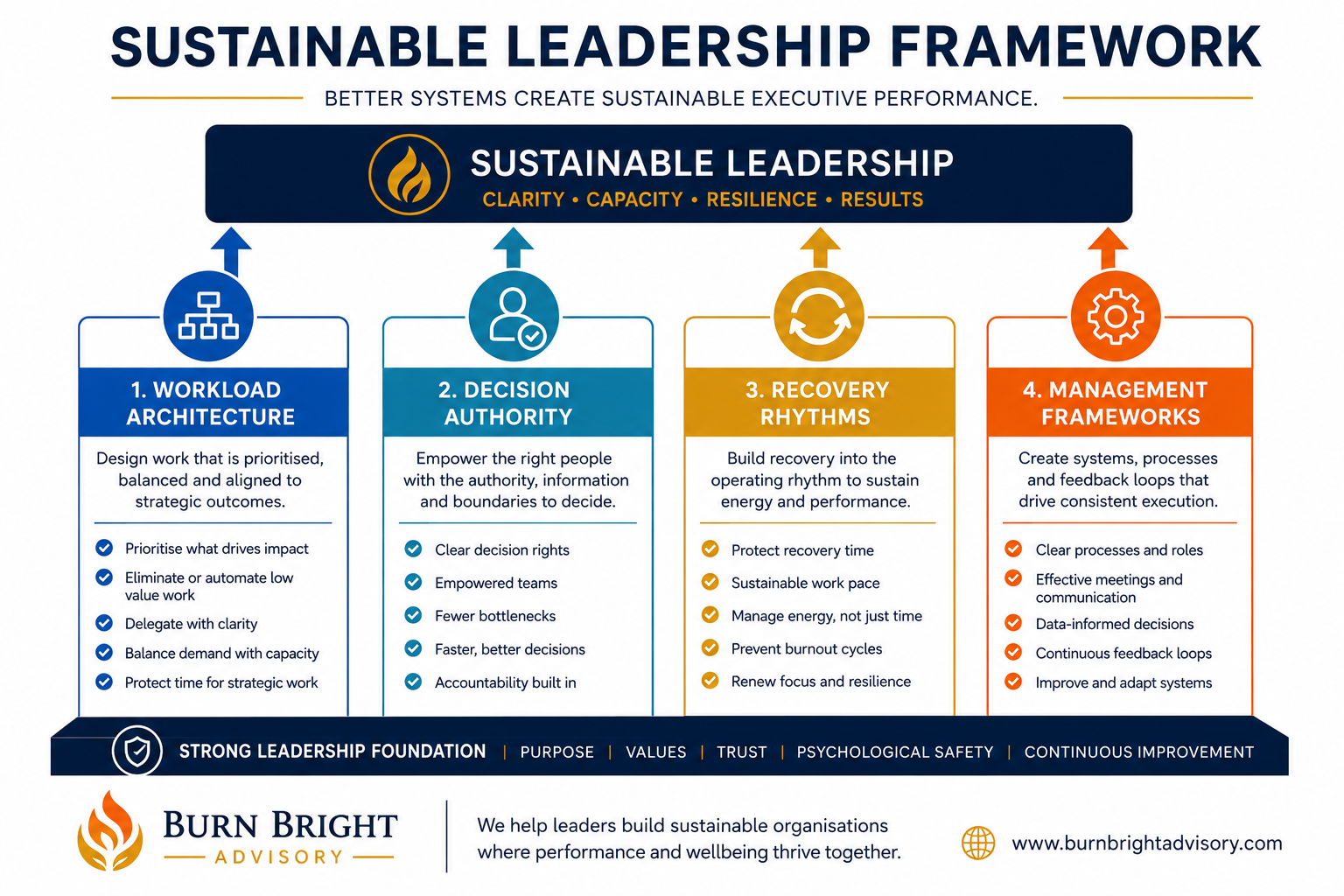
Preventing CEO burnout is not about becoming tougher. It is about redesigning leadership so that exceptional performance is sustainable rather than exhausting. The Burn Bright Framework is built around four structural pillars that help organisations reduce executive overload while improving long-term effectiveness.
Pillar 1
Redesign Workload Architecture
Most CEOs carry work that should never reach the executive office. Routine approvals, operational firefighting and repeated decision-making consume capacity that should be reserved for strategic leadership. A workload audit should identify:
- Decisions that can be delegated
- Meetings that add little strategic value
- Reports that no longer influence decisions
- Activities that duplicate work elsewhere in the organisation
Pillar 2
Strengthen Decision Authority
Every decision does not require CEO involvement. Organisations with clear decision rights move faster, empower leaders and reduce executive bottlenecks. A practical question for every recurring decision is: “What is the lowest appropriate level in the organisation that can make this decision confidently?” Increasing decision authority throughout the organisation protects executive cognitive capacity while accelerating organisational performance.
Pillar 3
Protect Recovery Rhythms
Recovery is often misunderstood as time away from work. In reality, recovery is part of high performance. Sustainable CEOs deliberately schedule strategic thinking time, protected focus blocks, meeting-free periods, annual recovery planning and boundaries around communication.
Pillar 4
Replace Heroic Leadership with Better Systems
The highest-performing organisations rarely depend on exceptional individuals constantly rescuing the business. Instead they build systems that reduce complexity before it reaches senior leadership — better governance, clear accountability, effective delegation, simplified communication and standardised operational frameworks. Leaders become architects rather than firefighters.
What Should Boards Do About CEO Burnout?
Boards play a critical role in preventing executive burnout. Too often, boards measure organisational performance while overlooking leadership sustainability. A healthy organisation requires both.
Boards should regularly review:
- Executive workload and role design
- Decision-making responsibilities
- Organisational complexity
- Leadership succession planning
- Executive recovery and sustainability
The most successful organisations recognise that protecting executive capacity is a governance responsibility rather than a personal issue. Burnout should be viewed as an early warning indicator of structural weakness. When leaders consistently operate beyond sustainable capacity, the organisation itself requires redesign.
Frequently Asked Questions
What causes CEO burnout?
CEO burnout is usually caused by sustained organisational overload rather than personal weakness. Excessive decision-making, expanding responsibilities, constant availability and poorly designed leadership systems gradually exceed human capacity.
Can resilient CEOs still experience burnout?
Yes. Resilience improves coping capacity but cannot compensate indefinitely for unsustainable workloads or ineffective organisational design. Even highly capable leaders eventually experience cognitive and emotional depletion when systems remain broken.
What are the first signs of CEO burnout?
Common warning signs include decision fatigue, reduced strategic thinking, emotional exhaustion, irritability, declining creativity, difficulty switching off from work and increasing reliance on reactive rather than proactive leadership.
How does CEO burnout affect employees?
Employees often experience reduced communication, slower decision-making, greater uncertainty and declining organisational trust. Leadership behaviour influences workplace culture, meaning executive burnout frequently spreads throughout the organisation.
Is CEO burnout preventable?
Yes. Organisations can significantly reduce burnout by redesigning workload architecture, strengthening delegation, clarifying decision authority, simplifying communication and protecting executive recovery as part of organisational strategy.
Conclusion
CEO burnout is not an inevitable consequence of leadership. It is the predictable outcome of organisations that continually increase complexity without redesigning executive roles.
The strongest leaders are not those who work the longest hours.
They are those who build systems that make sustainable performance possible.
When organisations shift from heroic leadership to structural leadership, executives regain the clarity needed to make better decisions, lead more effectively and build healthier organisations.
Discover Your Burnout Risk
Understand whether your workload is sustainable. The Leadership Burnout Self-Assessment identifies the structural factors most likely to be driving executive overload and provides practical recommendations.
Free Leadership Intelligence
Get Weekly Leadership Insights
Join thousands of leaders receiving practical strategies on burnout prevention, workload design, and sustainable performance every week.