Quick Answer
Key Takeaways
- Burnout is a system failure, not a personal failure.
- High-performing leaders often burn out first because organisations reward unsustainable behaviour.
- Resilience cannot compensate for broken organisational systems.
- Sustainable leadership depends on workload architecture rather than working harder.
- Organisations that redesign work outperform those that simply encourage wellbeing initiatives.
Introduction
Leadership burnout myths have become one of the biggest barriers to healthier organisations. They sound logical. They appear in management books, conference presentations and workplace conversations every day. Unfortunately, most of them are wrong.
Many leaders still believe burnout happens because someone cannot cope with pressure. Others assume resilient leaders never burn out. Some think a holiday, a mindfulness course or better time management will solve the problem.
The evidence tells a different story.
The World Health Organization recognises burnout as an occupational phenomenon resulting from chronic workplace stress that has not been successfully managed. Gallup continues to report that managers experience significantly higher stress than many other employee groups, while McKinsey research repeatedly highlights the growing complexity facing modern leadership roles.
Burnout is rarely created by one difficult week.
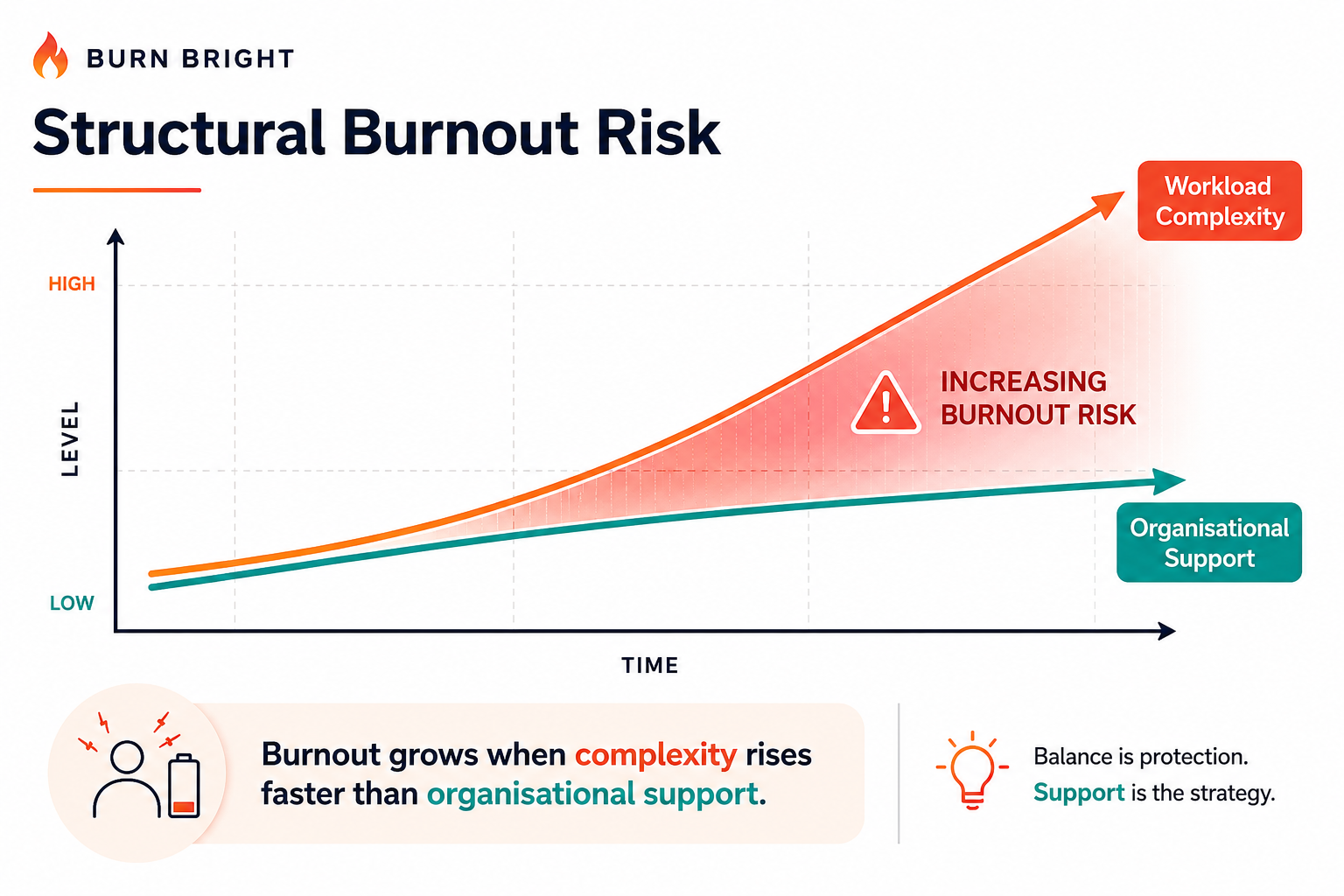
It develops when organisational systems continually demand more than people can sustainably deliver.
That distinction changes everything. Throughout this article you’ll discover the most common leadership burnout myths, why they persist, what the research actually says and how organisations can replace outdated thinking with sustainable leadership systems.
Understanding the Difference Between Myths and Reality
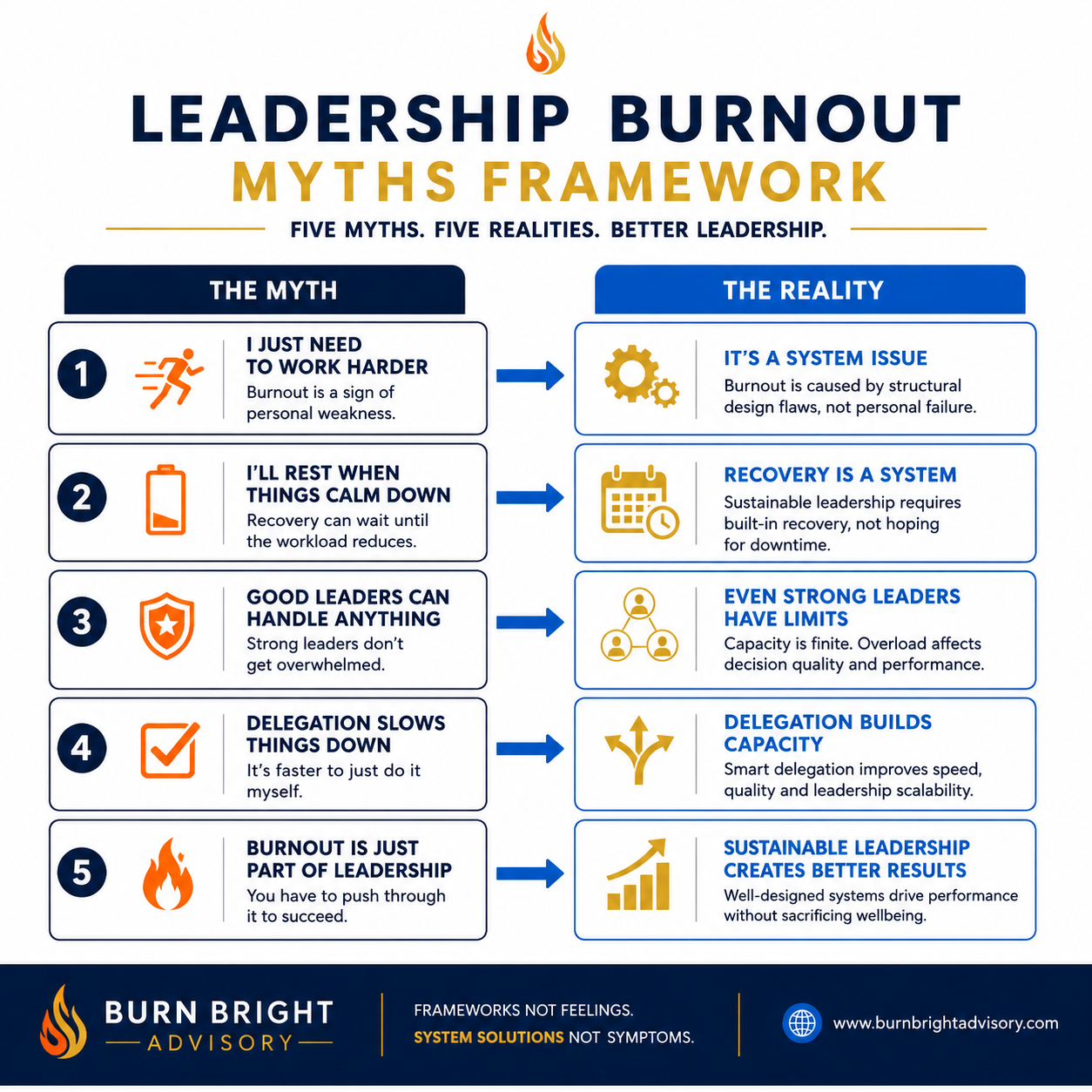
Featured Snippet
Why Do Leadership Burnout Myths Continue to Exist?
Many workplace myths survive because they contain a small amount of truth wrapped inside an incomplete explanation.
For decades leadership has been associated with sacrifice.
Work longer.
Be available.
Carry the pressure.
Never complain.
The leader who stayed latest in the office became the role model. The leader who cancelled holidays became committed. The leader who answered emails at midnight became dedicated.
Eventually these behaviours stopped looking exceptional and became normal.
The problem is that organisations confused visible effort with effective leadership.
Research consistently shows that productivity declines sharply when excessive working hours become routine. Long hours increase errors, reduce creativity and weaken decision quality rather than improving performance.
Yet many organisations continue rewarding availability instead of effectiveness.
This creates a dangerous cycle.
Leaders work harder.
Performance declines.
Organisations respond by demanding even more effort.
Burnout becomes inevitable.
Within the Burn Bright framework, this represents Scope Creep, Decision Overload and Communication Chaos—three of the primary structural drivers of leadership burnout.
The myth survives because individuals occasionally succeed despite broken systems. People remember the exceptional survivor. They ignore the thousands who quietly leave leadership altogether.
Burnout therefore appears to be an individual problem when it is actually a design problem.
Myth 1: Strong Leaders Never Burn Out
This may be the most damaging myth in modern leadership.
It suggests burnout is evidence of weakness. It implies effective leaders simply need greater resilience. Neither is supported by evidence.
Many of history’s highest-performing leaders have openly spoken about exhaustion, decision fatigue and the limits of sustained pressure.
The modern leadership role has expanded dramatically. Today’s leaders manage hybrid teams. Digital communication never stops. Stakeholder expectations continue growing. Decision volumes have increased significantly. Meanwhile resources rarely increase at the same pace.
The result is exactly what Vincent Walters describes throughout the Burn Bright methodology—a leadership system asking human beings to perform superhuman workloads.
Strong leaders are often the first to burn out because they:
- accept additional responsibilities
- protect their teams by absorbing pressure
- delay asking for help
- continue delivering despite exhaustion
- become organisational problem-solvers
Eventually capacity reaches its limit.
Strength delays burnout.
It does not prevent it.
This distinction matters because organisations frequently promote their most capable people while simultaneously giving them the largest workloads. Instead of rewarding leadership capability, they unintentionally punish it.
Burnout Does Not Reflect Character
Burnout reflects system capacity. If demand continually exceeds available resources, burnout becomes an operational outcome rather than a personal failing.
This is why Burn Bright consistently argues: Fix the system—not the person.
Leadership Capability Versus Leadership Capacity
Many organisations confuse capability with capacity.
Capability answers: “Can this leader perform?”
Capacity asks: “Can this leader continue performing sustainably?”
Those are entirely different questions. Sustainable leadership measures both.
Evidence Over Opinion
Gallup research consistently links manager wellbeing with employee engagement. McKinsey has demonstrated that increasing organisational complexity significantly raises managerial workload. WHO identifies chronic unmanaged workplace stress—not personal weakness—as the defining feature of burnout.
Together they all point towards one conclusion:
Burnout is structural.
Not personal.
One Leader Can Change a Team. One System Can Change an Organisation.
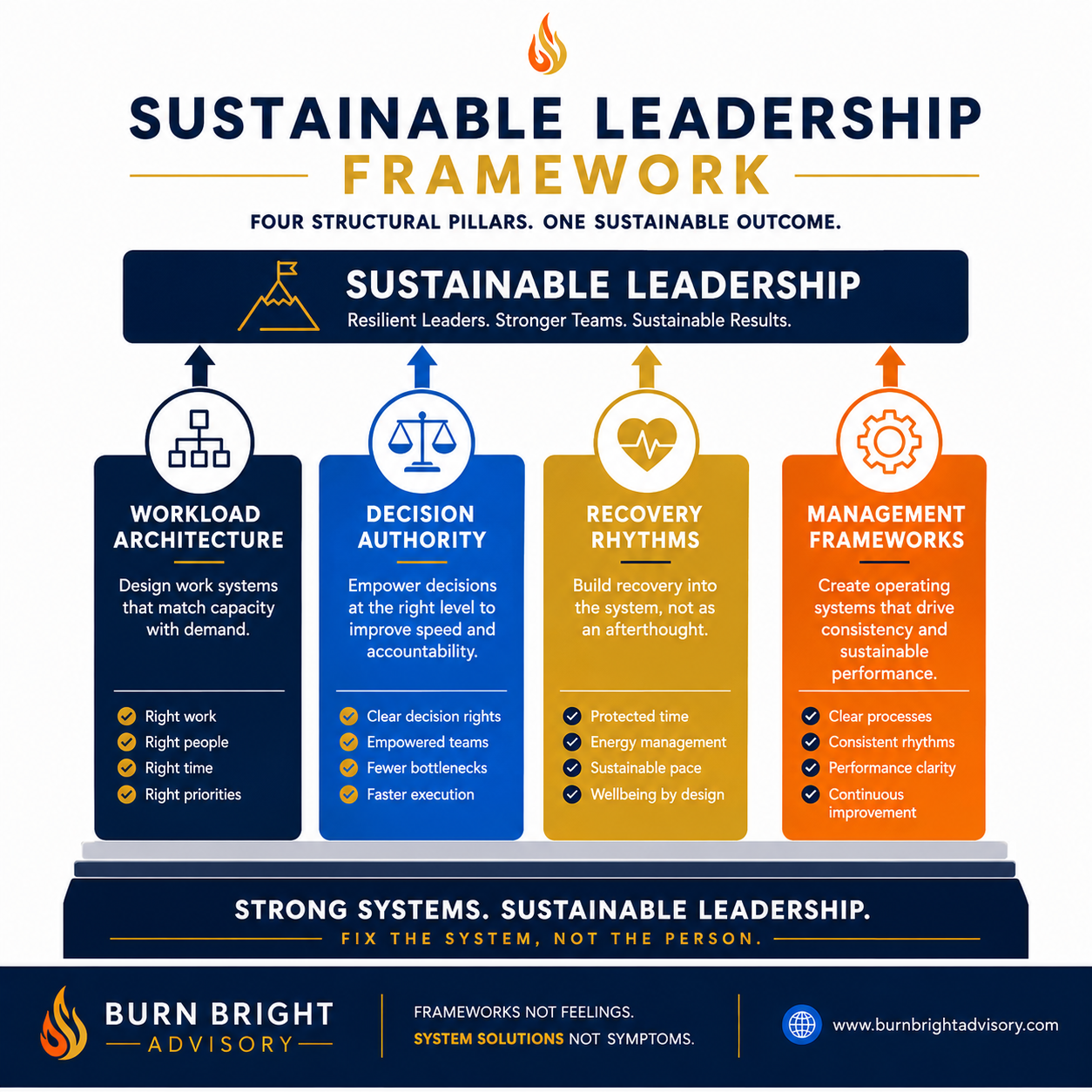
When organisations redesign workload architecture, decision authority and communication systems, leaders stop relying on heroics. They begin relying on better structures.
That is where sustainable performance begins.
Visualising Structural Burnout
Myth 2: Burnout Is Simply Poor Time Management
Whenever burnout appears, somebody usually recommends better calendars. Or time blocking. Or inbox zero.
Those tools have value. They simply cannot solve structural overload.
Time management assumes the workload is reasonable. Many leadership roles no longer meet that assumption.
Modern managers spend much of their day switching between meetings, instant messaging, strategic planning, operational issues, employee wellbeing conversations, compliance reporting and customer demands.
The problem is not poor scheduling. The problem is too many competing demands arriving simultaneously.
Burn Bright identifies this through its Workload Architecture Framework, recognising that workload must be redesigned before productivity techniques become effective.
Teaching overwhelmed leaders another productivity technique without reducing systemic overload resembles giving a larger bucket to someone standing beneath a waterfall.
The bucket was never the problem.
The volume of water was.
Effective organisations therefore ask different questions:
- Which work should stop?
- Which decisions should move closer to the frontline?
- Which meetings no longer create value?
- Which approvals create unnecessary delay?
- Which communications interrupt productive work?
Those questions redesign work itself. That is where sustainable leadership begins.
Myth 3: Resilience Is the Cure for Burnout
Resilience is valuable. Every leader benefits from emotional regulation, adaptability and the ability to recover from setbacks.
The mistake is believing resilience can compensate for poor organisational design.
This is where many organisations unintentionally waste significant amounts of money. They invest in resilience workshops, wellbeing seminars and mindfulness apps while leaving excessive workloads, fragmented communication and unclear priorities untouched.
The result is predictable. Leaders return from resilience training to exactly the same environment that exhausted them in the first place.
The symptoms briefly improve.
The causes remain.
It is the organisational equivalent of repainting a building with structural cracks. The appearance changes. The foundations do not.
Research from the World Health Organization and workplace studies consistently shows that burnout develops when chronic workplace stress is not successfully managed. That places responsibility on organisational systems as well as individuals—not on resilience alone.
Burn Bright describes this as moving from motivational solutions to structural solutions. The framework focuses on redesigning workload architecture, decision authority, recovery rhythms and management systems before asking leaders to become more resilient.
A resilient leader working inside a broken system will usually last longer than everyone else. They will not remain immune forever.
Myth 4: Leaders Should Always Be Available
Many executives wear availability like a badge of honour. They answer emails during holidays. Respond to messages late at night. Attend every meeting. Accept every request.
The intention is admirable. The outcome is damaging.
Constant availability trains an organisation to become dependent rather than capable. Every unnecessary interruption creates another decision. Every decision consumes cognitive energy. Eventually leaders spend their entire day reacting instead of leading.
Modern organisations often confuse responsiveness with effectiveness. They reward whoever replies first rather than whoever thinks most clearly. That culture slowly removes the time required for strategic thinking.
Burn Bright identifies communication chaos and decision overload as two of the major structural drivers of leadership burnout. Constant interruptions destroy deep work and encourage firefighting instead of thoughtful leadership.
Sustainable organisations deliberately protect strategic thinking time. They establish:
- protected focus periods
- decision-making boundaries
- clear escalation processes
- communication expectations
- recovery time after periods of intense demand
Leaders who establish boundaries are not less committed. They are creating conditions for better decisions.
Ultimately, organisations benefit more from thoughtful leadership than permanently available leadership.
Building Sustainable Leadership Systems
Myth 5: Burnout Is an Individual Problem
Perhaps the biggest myth of all is believing burnout belongs solely to the individual experiencing it.
If several leaders burn out within the same organisation, the probability that they all possess identical personal weaknesses is extremely low. The more likely explanation is structural failure.
Organisations create burnout through cumulative design choices. Examples include:
- expanding responsibilities without removing existing work
- unclear decision authority
- excessive reporting requirements
- meeting overload
- fragmented communication
- chronic understaffing
- unrealistic performance expectations
- rewarding busyness instead of outcomes
Vincent Walters refers to the hidden financial impact as the Culture Tax—the enormous organisational cost created when burnout, disengagement and turnover become normal rather than exceptional.
Replacing a middle manager can cost approximately £75,000, while replacing a senior leader may exceed £500,000, before considering lost expertise, disruption and declining team performance.
Burnout therefore represents more than a wellbeing issue. It becomes an organisational performance issue.
The organisations attracting and retaining exceptional leaders over the next decade will not simply provide wellbeing programmes. They will build better systems.
Leadership Burnout Myths: Comparison Table
| Traditional Myth | Sustainable Leadership Reality |
|---|---|
| Burnout is personal weakness | Burnout is chronic organisational stress |
| Strong leaders never burn out | High performers often burn out first |
| Better resilience solves burnout | Better systems reduce burnout |
| Time management fixes overload | Workload architecture prevents overload |
| Leaders should always be available | Leaders need protected strategic capacity |
| Wellbeing is an employee issue | Leadership sustainability is an organisational responsibility |
Frequently Asked Questions
What is the biggest leadership burnout myth?
The biggest myth is that burnout reflects personal weakness. Evidence consistently shows burnout develops when workplace demands exceed sustainable capacity over prolonged periods. The issue is structural, not personal.
Can resilient leaders still burn out?
Yes. Resilience helps leaders cope with pressure, but it cannot permanently overcome excessive workload, fragmented communication and poor organisational design.
Does time management prevent burnout?
Good time management improves organisation but cannot solve excessive workload. Sustainable leadership requires redesigning work itself rather than simply organising impossible demands more efficiently.
Why do organisations continue believing burnout myths?
Many myths reward visible effort. Working longer hours often appears productive, even when decision quality, creativity and long-term performance are declining.
What is the first step towards preventing leadership burnout?
Begin by examining organisational systems rather than individual behaviours. Review workload, meetings, communication, decision-making processes and leadership capacity before recommending personal resilience strategies.
Conclusion
Leadership burnout myths continue to shape management practices that no longer reflect the realities of modern leadership.
The evidence is becoming increasingly clear.
Burnout is rarely caused by a lack of commitment.
It is rarely solved by another resilience workshop.
It is almost never prevented by asking leaders to work harder.
Instead, burnout emerges when organisations repeatedly place greater demands on leaders without redesigning the systems that support them.
Sustainable leadership requires a different philosophy.
Better workload architecture.
Clearer decision authority.
Healthier communication.
Intentional recovery.
Leadership capacity becomes a strategic organisational asset rather than an unlimited resource.
Burn Bright exists to help organisations make that transition. Because better systems will always outperform greater effort.
Discover Your Leadership Burnout Risk
Understand whether your current workload is sustainable by completing the Leadership Burnout Self-Assessment.
Free Leadership Intelligence
Get Weekly Leadership Insights
Join thousands of leaders receiving practical strategies on burnout prevention, workload design, and sustainable performance every week.