Quick Answer
Key Takeaways
- Leadership foundations are the mental models that shape every decision a leader makes.
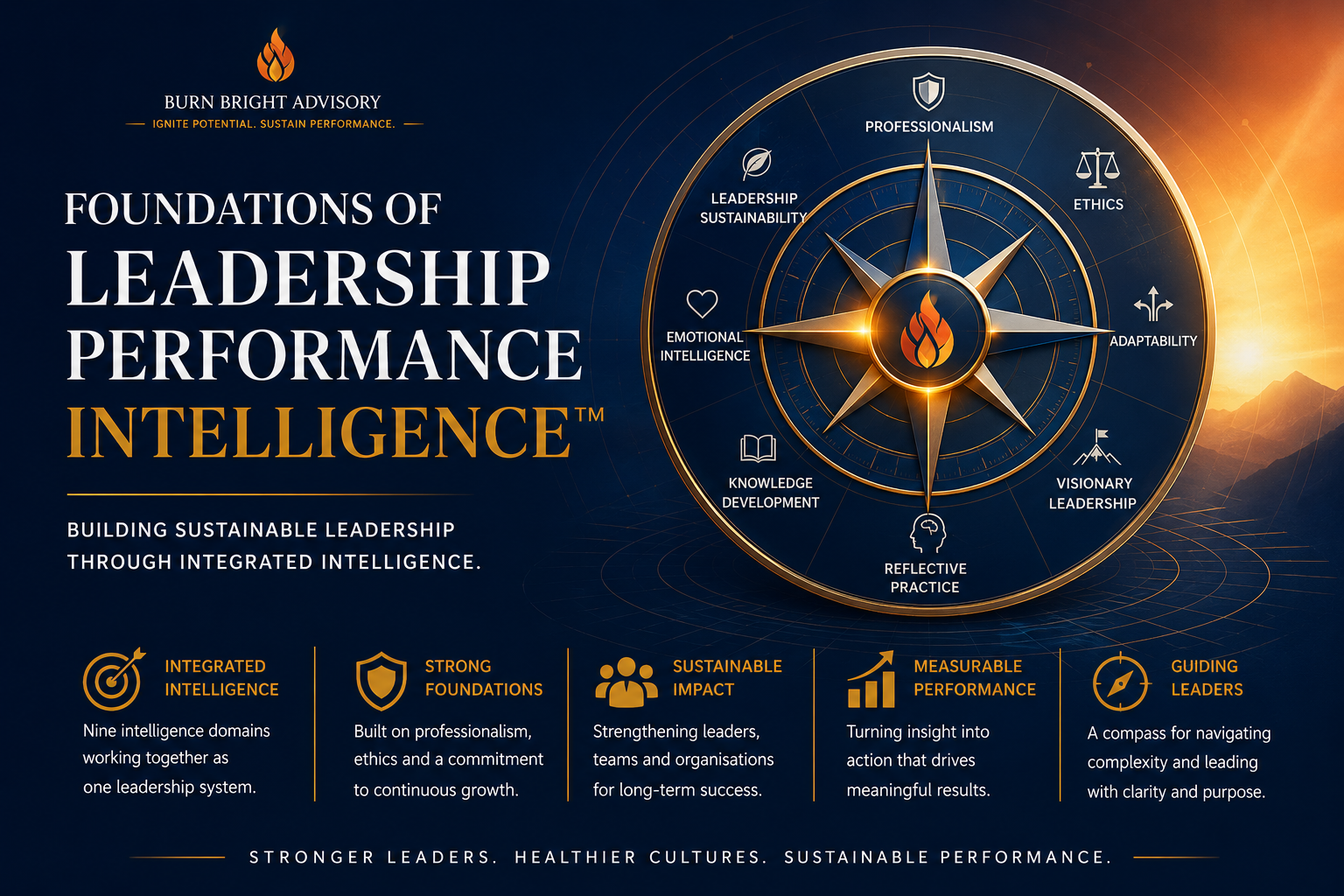
- Leadership Performance Intelligence™ integrates professionalism, ethics, adaptability, reflection, emotional intelligence, knowledge development, and sustainability into one system.
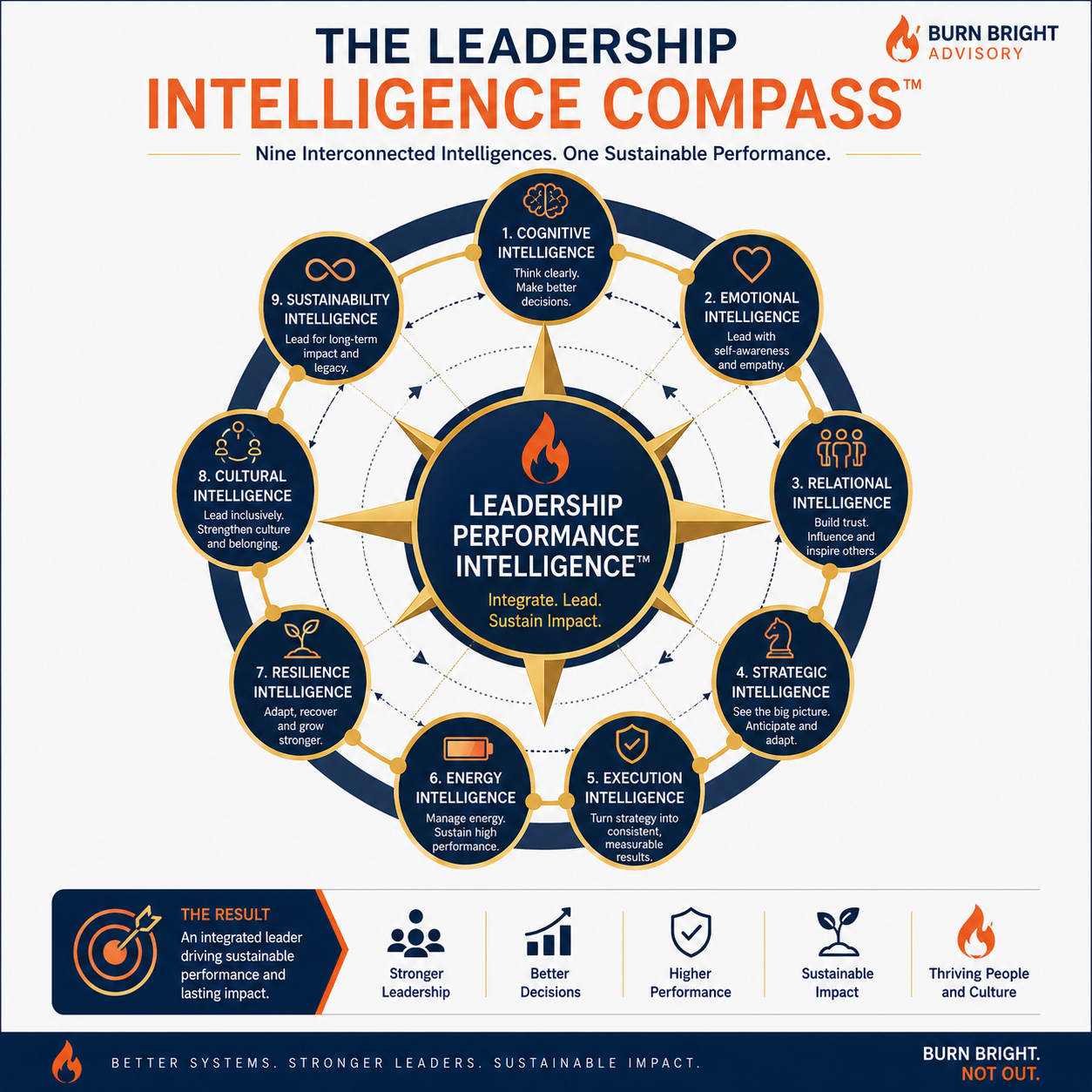
- The Leadership Intelligence Compass™ maps the interconnected domains high-performing leaders rely on.
- Leadership sustainability protects capacity rather than demanding constant personal sacrifice.
- Leadership capability should be distributed across an organisation, not concentrated in one individual.
Foundations of Leadership: Why Leadership Performance Intelligence™ Is the Future of Sustainable Leadership
Introduction
Leadership has always mattered. What has changed is the environment in which leadership operates.
Modern leaders are expected to navigate unprecedented complexity. They balance competing stakeholder expectations, technological disruption, workforce shortages, economic uncertainty, regulatory change, and growing demands for ethical, transparent, and sustainable decision-making. At the same time, organisations expect leaders to deliver exceptional performance while fostering cultures of wellbeing, innovation, and continuous improvement.
Many leadership models were developed for environments that were significantly more stable than today’s reality. They often emphasised authority, operational efficiency, or individual competence. While these remain valuable, they are no longer sufficient on their own.
The future belongs to leaders who can integrate multiple forms of intelligence into their everyday practice.
Burn Bright Advisory refers to this integrated capability as Leadership Performance Intelligence™ — a whole-system approach to leadership that combines technical competence with reflective judgement, ethical decision-making, emotional awareness, adaptability, and long-term sustainability.
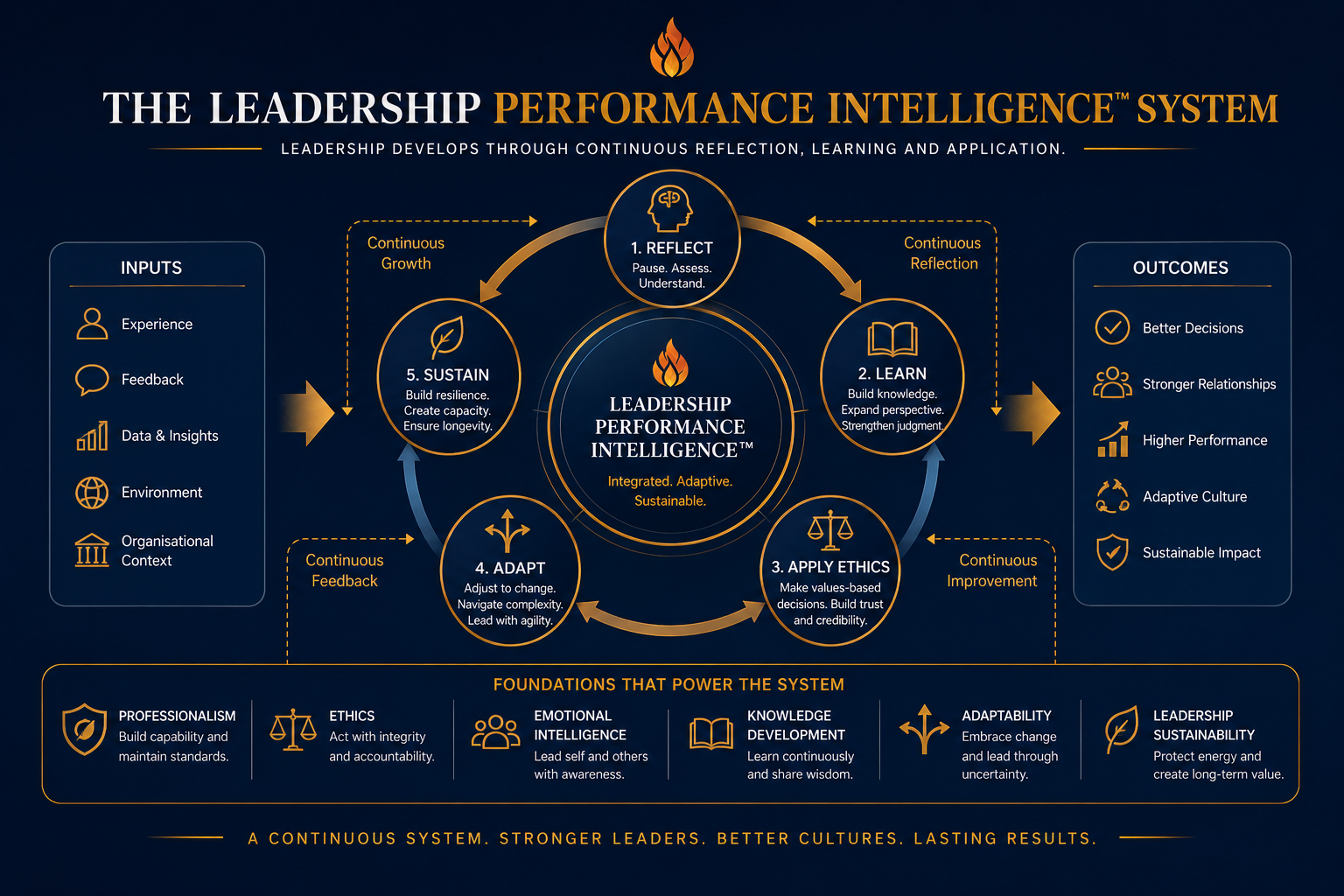
Rather than treating leadership as a collection of disconnected skills, Leadership Performance Intelligence™ recognises leadership as an evolving capability that influences every aspect of organisational performance.
Whether leading a multinational organisation, a school, a hospital department, a government agency, or a growing business, the quality of leadership ultimately determines the quality of organisational outcomes. This article explores the foundations required for leaders to remain effective, resilient, and sustainable in an increasingly complex world.
Featured Snippet
Why Leadership Foundations Matter More Than Ever
Many organisations invest heavily in leadership development, yet leadership capability often fails to keep pace with organisational complexity.
The reason is simple.
Most development programmes focus on teaching leaders what to do rather than helping them understand how to think. Leadership foundations provide the mental models that shape every decision a leader makes.
Strong foundations influence:
- Decision quality
- Professional judgement
- Organisational culture
- Employee engagement
- Ethical behaviour
- Innovation
- Resilience
- Long-term organisational performance
Weak foundations, by contrast, often produce reactive leadership. Leaders become trapped in operational firefighting rather than strategic thinking. Short-term performance replaces sustainable progress. Immediate pressure overrides thoughtful decision-making.
This pattern contributes directly to many of today’s organisational challenges, including:
- Leadership burnout
- Declining employee engagement
- Reduced innovation
- Poor organisational trust
- Increasing workforce turnover
- Inconsistent decision-making
From Traditional Leadership to Leadership Performance Intelligence™
Traditional leadership development frequently separates leadership into isolated competencies — communication, delegation, motivation, strategic planning, emotional intelligence, and conflict management. Each competency is valuable. However, leadership rarely presents problems that exist in isolation.
Consider a school principal managing declining student outcomes. The challenge is not simply instructional leadership. It also involves ethical judgement, political awareness, emotional intelligence, stakeholder communication, organisational culture, workforce wellbeing, resource management, adaptability, and professional credibility.
Similarly, a healthcare executive responding to workforce shortages must simultaneously balance patient safety, financial sustainability, staff wellbeing, regulatory compliance, and long-term organisational strategy.
Leadership problems are systems problems.
This is why Burn Bright Advisory developed Leadership Performance Intelligence™. Rather than asking, “Which leadership skill is required?” the better question becomes: “Which combination of leadership intelligences is required?”
This shift fundamentally changes leadership development. Instead of building isolated competencies, leaders strengthen an integrated capability that improves decision-making across every leadership context.
The Leadership Intelligence Compass™
At the centre of Leadership Performance Intelligence™ sits the Leadership Intelligence Compass™. The Compass provides an integrated framework that enables leaders to navigate increasingly complex organisational environments. Each domain contributes a distinct capability while reinforcing the others.
Domain 1
Professionalism Intelligence™
Professionalism creates credibility. It shapes how leaders communicate, maintain standards, build trust, demonstrate accountability, and influence organisational culture.
- Communicate with consistency
- Maintain professional standards
- Build trust through reliability
- Demonstrate accountability
Domain 2
Ethics Intelligence™
Ethics extends beyond compliance. It enables leaders to make principled decisions when no perfect solution exists.
- Strengthens organisational trust
- Supports transparency and fairness
- Reinforces governance and psychological safety
- Builds public confidence
Domain 3
Constructivism Intelligence™
High-performing organisations learn continuously. This domain encourages leaders to create environments where learning is shared rather than controlled — turning organisations into collaborative learning systems that increase innovation while strengthening capability.
Domain 4
Adaptability Intelligence™
Today’s leaders rarely face stable environments. Markets evolve, technology changes, regulations shift, and community expectations increase. This domain enables leaders to respond without becoming reactive, building organisational resilience through flexibility, experimentation, and continuous learning.
Domain 5
Visionary Leadership Intelligence™
Leadership requires direction. Vision provides purpose. Visionary leaders connect everyday activities with long-term organisational outcomes, helping people understand where the organisation is going, why change matters, and how individual contributions create collective success.
Domain 6
Reflective Practice Intelligence™
Reflection is one of the least developed yet most valuable leadership capabilities. Reflective leaders regularly examine decisions, assumptions, behaviours, organisational outcomes, and unintended consequences — converting experience into wisdom.
Domain 7
Knowledge Development Intelligence™
Knowledge has become one of every organisation’s greatest strategic assets. Leaders who continuously develop organisational knowledge improve innovation, capability, succession planning, problem-solving, and organisational resilience.
Domain 8
Emotional Intelligence™
Leadership remains fundamentally human. This domain enables leaders to build relationships, manage conflict, understand motivation, influence behaviour, and create psychologically safe workplaces — becoming more valuable as technology becomes more sophisticated.
Domain 9
Leadership Sustainability™
Perhaps the defining leadership challenge of this decade. Many organisations unintentionally reward unsustainable behaviours — constant availability, excessive workload, continuous urgency, reactive decision-making, and heroic individual performance — that produce short-term results while steadily reducing leadership capacity.
Leadership Performance Intelligence™ in Practice
Leadership Performance Intelligence™ is not another leadership theory to admire from a distance. It is intended to shape daily leadership decisions, behaviours, and organisational systems.
The framework asks leaders to move beyond a simple question — “How do I become a better leader?” — and instead encourages a more meaningful one: “How can I improve the performance of the entire leadership system?”
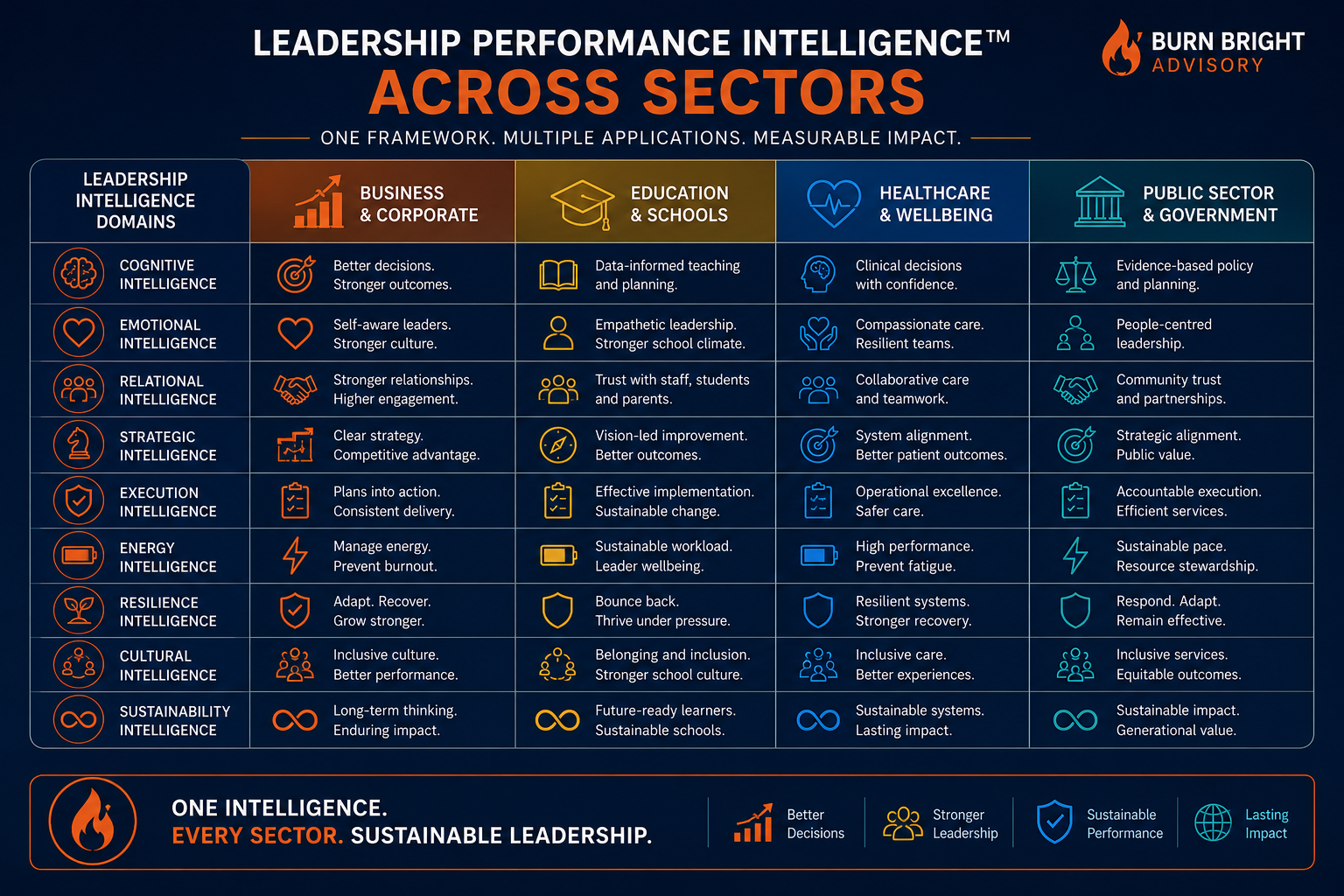
This shift changes everything. Leadership becomes less about personal achievement and more about creating environments where people, teams, and organisations consistently perform at their best. Below are examples of how Leadership Performance Intelligence™ applies across different sectors.
Business Growth Intelligence™
Business leaders operate within highly competitive environments where change has become continuous rather than occasional. Traditional leadership often focuses on growth through increased sales, operational efficiency, cost reduction, and market expansion. While these remain important, sustainable growth requires much more.
Leadership Performance Intelligence™ encourages business leaders to ask whether they are developing future leaders, making ethical commercial decisions, improving organisational learning, creating resilient teams, and whether their current leadership approach can sustain long-term growth.
Organisations that invest in leadership capability frequently report stronger employee engagement, improved innovation, better customer experiences, lower staff turnover, greater organisational agility, and stronger succession planning. Growth becomes sustainable because leadership capacity grows alongside organisational complexity.
School Leadership Intelligence™
Educational leaders shape far more than academic performance. They influence school culture, teacher wellbeing, professional learning, safeguarding, community confidence, and student outcomes.
The most effective school leaders understand that sustainable improvement cannot rely on constant pressure. Instead, they build professional cultures where learning becomes everyone’s responsibility, supported by reflective practice, distributed leadership, ethical decision-making, collaborative improvement, evidence-informed innovation, and professional trust. When leadership capacity expands across an entire school community, improvement becomes more resilient and less dependent upon individual leaders.
Healthcare Leadership Intelligence™
Healthcare presents one of the most demanding leadership environments in modern society. Leaders must simultaneously balance patient safety, workforce shortages, financial pressures, regulatory requirements, clinical governance, staff wellbeing, and technological innovation.
Leadership Performance Intelligence™ helps healthcare organisations avoid reactive leadership by strengthening system thinking — examining workforce sustainability, organisational learning, leadership succession, psychological safety, cross-disciplinary collaboration, and continuous improvement. Healthcare outcomes improve when leadership systems become healthier.
Public Service Leadership Intelligence™
Public service leaders frequently operate under intense public scrutiny, managing competing political priorities while maintaining accountability to communities, regulators, employees, and elected representatives.
Leadership Performance Intelligence™ strengthens public service leadership through ethical governance, transparent decision-making, adaptive leadership, collaborative partnerships, community engagement, and reflective policy development. Rather than focusing solely on compliance, leaders strengthen organisational legitimacy through professionalism and trust.
HR & People Leadership Intelligence™
Human Resources has evolved significantly. Modern HR leaders no longer manage people processes alone — they influence organisational capability.
Leadership Performance Intelligence™ enables HR professionals to become strategic partners by improving leadership development, organisational culture, capability planning, workforce wellbeing, leadership sustainability, succession planning, and organisational learning. Rather than responding only to workforce issues, HR becomes central to organisational performance.
Entrepreneur Performance Intelligence™
Entrepreneurs often possess exceptional vision and determination. However, many organisations eventually outgrow founder-led leadership.
Leadership Performance Intelligence™ helps entrepreneurs transition from doing everything themselves to building sustainable organisations — developing delegation capability, reflective leadership, strategic thinking, leadership succession, organisational learning, and scalable systems. Entrepreneurial success ultimately depends not on working harder but on developing leadership systems capable of supporting future growth.
Leadership Sustainability™: The Missing Foundation
One of the greatest misconceptions in leadership is the belief that high performance requires continuous personal sacrifice. Many leaders quietly accept excessive workloads, permanent availability, emotional exhaustion, decision fatigue, and chronic stress as unavoidable aspects of leadership.
Yet research consistently demonstrates the opposite.
Exhausted leaders make poorer decisions.
They communicate less effectively.
Innovation declines.
Relationships weaken.
Trust deteriorates.
Eventually organisational performance follows. Leadership Sustainability™ challenges this assumption. Rather than asking, “How much more can I do?” leaders begin asking, “How can I preserve the capacity to lead well tomorrow?”
This simple shift changes leadership behaviour. Sustainable leaders prioritise reflection, delegation, recovery, continuous learning, workload management, leadership development, and organisational capability. Their organisations become stronger because leadership itself becomes more sustainable.
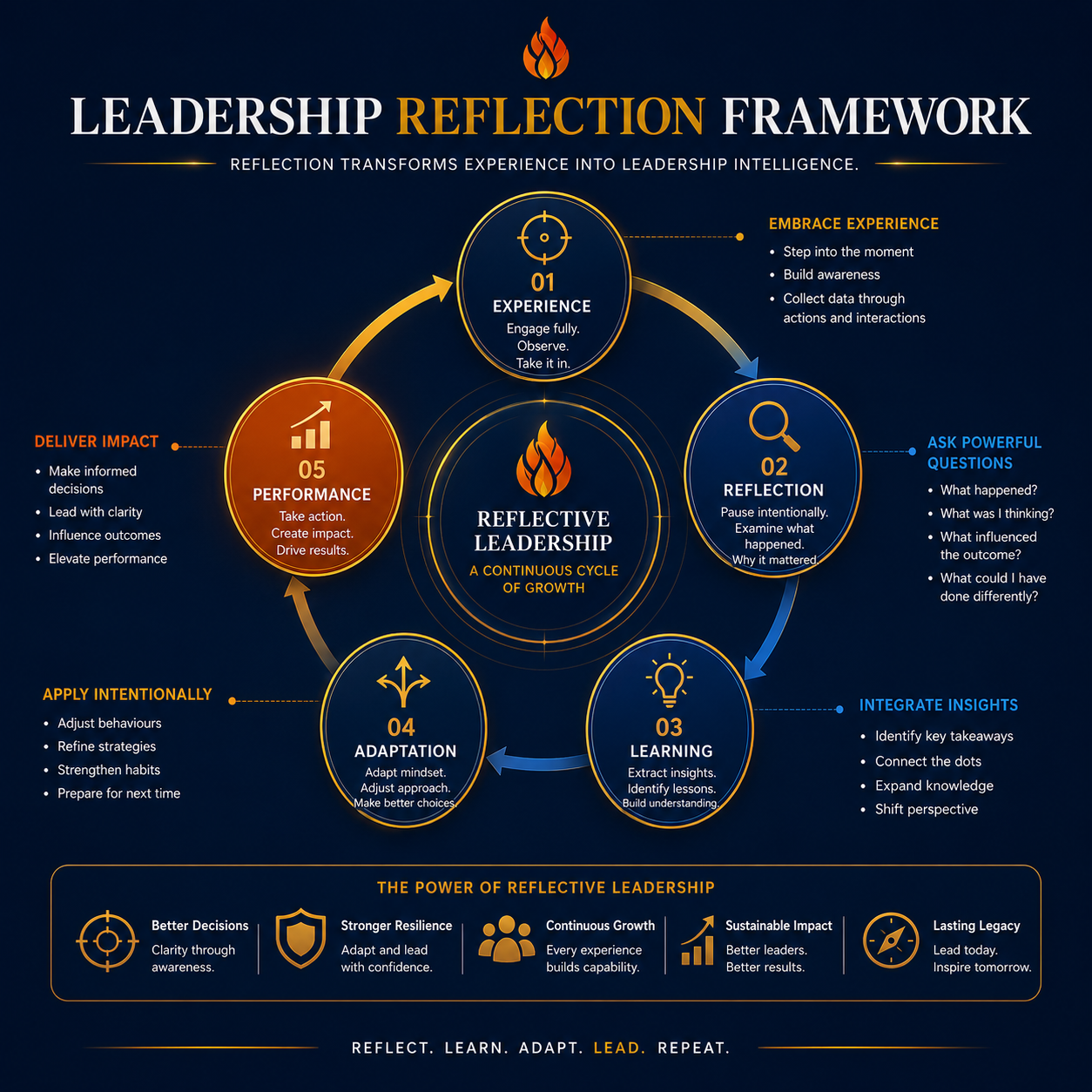
Leadership Reflection™: Turning Experience into Intelligence
Experience alone does not produce better leaders. Reflection does. Many experienced leaders repeat similar patterns for decades without significantly improving their judgement.
Leadership Reflection™ converts experience into organisational intelligence. Reflective leaders regularly consider what happened, why it happened, what assumptions influenced their decision, what evidence they overlooked, what they have learned, and what should change next time.
Reflection strengthens every domain within the Leadership Intelligence Compass™, improving ethical judgement, adaptability, emotional intelligence, professionalism, knowledge development, and strategic thinking. Most importantly, reflection prevents leaders from confusing experience with expertise.
Leadership Capacity™: Building Capability Instead of Dependency
Many organisations unintentionally create leadership dependency. Every important decision flows through one individual. Progress slows. Innovation declines. Teams become hesitant.
Eventually the organisation reaches capacity — not because people lack talent, but because leadership has become a bottleneck.
Leadership Capacity™ focuses on expanding leadership throughout the organisation. Rather than concentrating leadership authority, high-performing organisations distribute leadership capability through shared ownership, collaborative decision-making, coaching, mentoring, knowledge sharing, and succession planning.
Leadership Benchmarking™: Measuring What Matters
Many organisations measure leadership using activity — number of meetings, emails sent, projects completed, hours worked.
Leadership Performance Intelligence™ encourages organisations to measure outcomes instead. Useful leadership indicators include employee engagement, psychological safety, innovation rates, leadership readiness, succession strength, organisational learning, decision quality, stakeholder trust, and workforce sustainability.
These measures provide a far more accurate picture of leadership effectiveness than activity alone. Leadership becomes measurable not by how busy leaders appear but by the capability they create within others.
Implementing Leadership Performance Intelligence™
Leadership transformation does not begin with a new organisational chart, a revised strategy document, or another leadership programme. It begins with leaders making different decisions.
Leadership Performance Intelligence™ develops over time through deliberate practice rather than isolated training events. Burn Bright Advisory recommends leaders focus on five implementation phases.
Phase 1 Assess Current Leadership Capability
Before improvement comes understanding. Leaders should evaluate:
- Leadership strengths
- Capability gaps
- Decision-making quality
- Organisational culture
- Leadership sustainability
- Team capacity
- Professional behaviours
The Leadership Intelligence Assessment™ provides a structured baseline for future development.
Phase 2 Strengthen Leadership Reflection™
Reflection should become a routine leadership discipline rather than an occasional activity. Effective leaders schedule time to consider:
- Recent decisions
- Organisational outcomes
- Stakeholder feedback
- Emerging risks
- Lessons learned
Phase 3 Build Leadership Capacity™
Rather than becoming indispensable, sustainable leaders deliberately develop others. Practical actions include:
- Coaching future leaders
- Sharing decision-making authority
- Encouraging collaborative problem-solving
- Creating mentoring opportunities
- Supporting continuous professional learning
Phase 4 Embed Leadership Sustainability™
High-performing organisations protect leadership capacity by reviewing:
- Workload expectations
- Meeting culture
- Decision-making processes
- Leadership wellbeing
- Recovery opportunities
- Organisational priorities
Phase 5 Create Continuous Leadership Development
Leadership is never finished. Organisations should develop systems that encourage:
- Continuous learning
- Benchmarking
- Reflective practice
- Professional dialogue
- Capability reviews
- Leadership innovation
Leadership Foundations Self-Reflection
Effective leadership begins with thoughtful reflection. Consider the following questions.
Reflection Questions
- Which leadership decisions consume most of my energy?
- Which Leadership Intelligence Compass™ domains represent my greatest strengths?
- Which capability requires the greatest development?
- How sustainable is my current leadership approach?
- Do my daily behaviours reflect my leadership values?
- How effectively am I developing future leaders?
- What assumptions influence my decision-making?
- Where does my organisation rely too heavily on individual leaders?
- How effectively do we learn from experience?
- What leadership legacy am I creating?
Practical Action Steps
Over the next thirty days, leaders should consider implementing the following actions.
Week One
- Complete a leadership capability review.
- Identify one recurring leadership challenge.
- Begin a weekly reflection journal.
Week Two
- Review delegation practices.
- Identify opportunities to build team capability.
- Schedule protected thinking time.
Week Three
- Seek structured feedback from colleagues.
- Review organisational decision-making processes.
- Identify unnecessary workload pressures.
Week Four
- Create a personal leadership development plan.
- Establish ongoing reflection routines.
- Commit to continuous improvement through Leadership Performance Intelligence™.
What is Leadership Performance Intelligence™?
Leadership Performance Intelligence™ is Burn Bright Advisory’s integrated framework that combines leadership capability, ethical judgement, reflective practice, emotional intelligence, adaptability, professionalism, knowledge development, and sustainability into one leadership system.
How is it different from traditional leadership models?
Traditional leadership often develops isolated competencies. Leadership Performance Intelligence™ integrates these competencies into one interconnected leadership framework that improves long-term organisational performance.
Who should use the Leadership Intelligence Compass™?
The framework is suitable for senior executives, middle leaders, school leaders, healthcare leaders, HR professionals, entrepreneurs, public service leaders, and emerging leaders.
Why is leadership sustainability important?
Unsustainable leadership reduces decision quality, increases burnout, weakens organisational culture, and ultimately limits long-term organisational performance.
Can Leadership Performance Intelligence™ be measured?
Yes. Using the Leadership Intelligence Assessment™, Leadership Benchmarking™, organisational diagnostics, and capability reviews, leaders can monitor development over time.
How long does leadership development take?
Leadership development is continuous. While improvements can occur within weeks, developing Leadership Performance Intelligence™ requires consistent reflection, learning, and practical application throughout a leadership career.
Conclusion
Leadership is entering a new era. The complexity of modern organisations means that technical competence alone is no longer enough. Leaders must integrate professionalism, ethics, adaptability, reflection, emotional intelligence, knowledge development, and sustainability into every decision they make.
Leadership Performance Intelligence™ provides this integrated foundation. Rather than focusing solely on individual success, it strengthens organisational capability. Rather than encouraging heroic leadership, it develops sustainable leadership systems. Rather than viewing leadership as a position, it recognises leadership as a continuously evolving practice.
The organisations that thrive over the next decade are unlikely to be those with the most charismatic leaders. They will be those that consistently develop leaders capable of thinking systemically, acting ethically, learning continuously, and building leadership capacity in others.
How Strong Are Your Leadership Foundations?
Complete the Leadership Burnout Self-Assessment to identify where your current leadership approach is sustainable — and where it may be quietly costing you capacity.
Free Leadership Intelligence
Get Weekly Leadership Insights
Join thousands of leaders receiving practical strategies on burnout prevention, workload design, and sustainable performance every week.