Quick Answer
Key Takeaways
- Sustainable leaders redesign work before they redesign themselves.
- Workload should be managed as a system, not as a diary.
- Better delegation increases leadership capacity without reducing accountability.
- Decision overload is one of the biggest hidden causes of burnout.
- Sustainable workload design improves both wellbeing and organisational performance.
How Leaders Redesign Workload Without Burning Out
Introduction
How leaders redesign workload has become one of the defining leadership questions of the modern workplace.
Across every sector, leaders are expected to deliver more with fewer resources, respond instantly to constant communication, and make increasingly complex decisions without additional capacity. The result is predictable. Leaders become overwhelmed, organisations lose effectiveness, and burnout becomes accepted as the cost of responsibility.
The problem is not a lack of commitment.
It is a structural problem.
At Burn Bright Advisory, we describe burnout as a system failure rather than a personal failure. When workload grows faster than capacity, even exceptional leaders eventually reach depletion. Adding another productivity app or another time-management technique rarely solves the problem because the architecture of work remains unchanged.
This article explores how sustainable leaders redesign workload using practical frameworks that reduce unnecessary pressure while improving long-term organisational performance.
Featured Snippet
Why Does Leadership Workload Keep Growing?
Most leaders believe workload increases because organisations simply demand more.
That is only partly true.
The deeper issue is that work expands without anything ever being removed.
Every new initiative, reporting requirement, digital platform, compliance process or meeting becomes another permanent responsibility. Few organisations systematically eliminate outdated work when new expectations are introduced.
Research consistently shows that managers now spend far more time coordinating work than completing strategic work. Collaboration tools promised efficiency, yet many leaders now manage continuous streams of emails, Teams messages, Slack notifications and meetings while attempting to perform the same core responsibilities they held a decade ago.
Technology increased communication.
It also increased complexity.
The result is what many leaders describe as feeling permanently behind despite working harder than ever.
What Does Sustainable Workload Design Look Like?
Traditional leadership asks: “How can I fit more into my day?”
Sustainable leadership asks: “Should this work exist at all?”
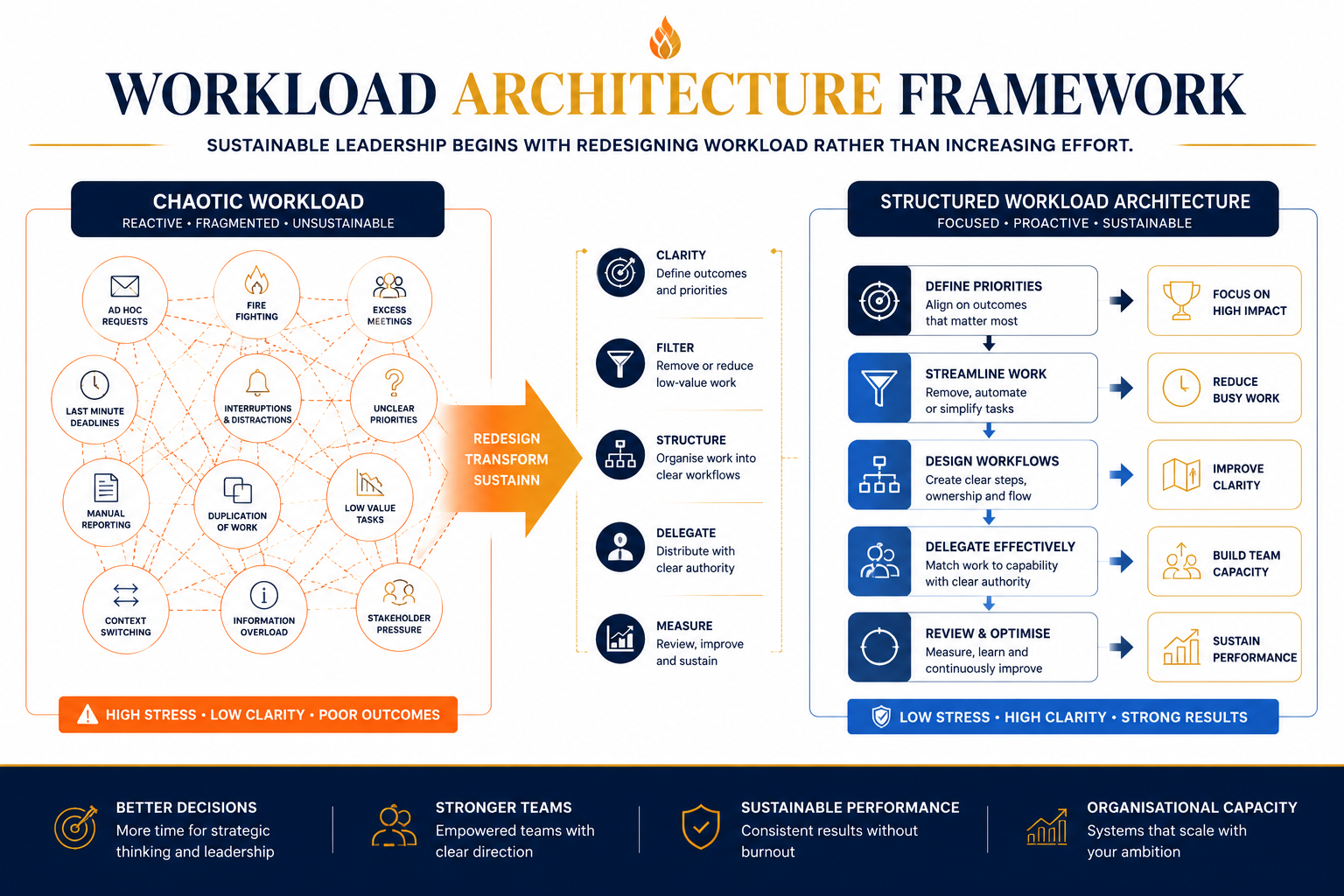
That single shift changes everything. The Burn Bright Framework identifies four structural pillars that transform leadership workload.
| Traditional Approach | Sustainable Workload Design |
|---|---|
| Manage time | Design workload |
| Solve every problem personally | Build decision ownership |
| Attend every meeting | Protect strategic thinking time |
| React constantly | Create structured work systems |
| Individual resilience | Organisational architecture |
These four pillars underpin sustainable leadership:
Pillar 1
Workload Architecture
Every responsibility should have a clear purpose, owner and outcome. If work has no measurable value, redesign it or remove it.
Pillar 2
Decision Authority
Not every decision belongs with the leader. Reducing unnecessary approvals dramatically increases leadership capacity while improving team ownership.
Pillar 3
Recovery Rhythms
Recovery is not a reward for finishing work. It is part of the operating system that allows leaders to sustain high performance over time.
Pillar 4
Management Frameworks
Frameworks reduce repeated decision-making. When expectations become standardised, leaders spend less energy solving the same problems repeatedly and more energy focusing on strategic priorities.
These four structural pillars form the foundation of the Burn Bright Not Out Framework for sustainable leadership.
How Can Leaders Reduce Decision Overload?
Decision fatigue is one of the least visible causes of leadership burnout.
Leaders rarely burn out because of one major decision. They burn out because they make hundreds of small decisions every day.
Every approval request.
Every interruption.
Every email asking, “Can you quickly decide…”
Every one of these consumes cognitive capacity.
Research consistently demonstrates that cognitive performance declines as decision volume increases. By afternoon, many leaders are making lower-quality decisions — not because they lack ability, but because they have exhausted their mental resources.
Rather than asking, “How do I make better decisions?” ask, “Why am I making this decision at all?”
High-performing organisations redesign decision authority by:
- Defining clear decision ownership.
- Using delegated authority levels.
- Creating standard operating frameworks.
- Removing unnecessary approvals.
- Escalating only genuinely strategic decisions.
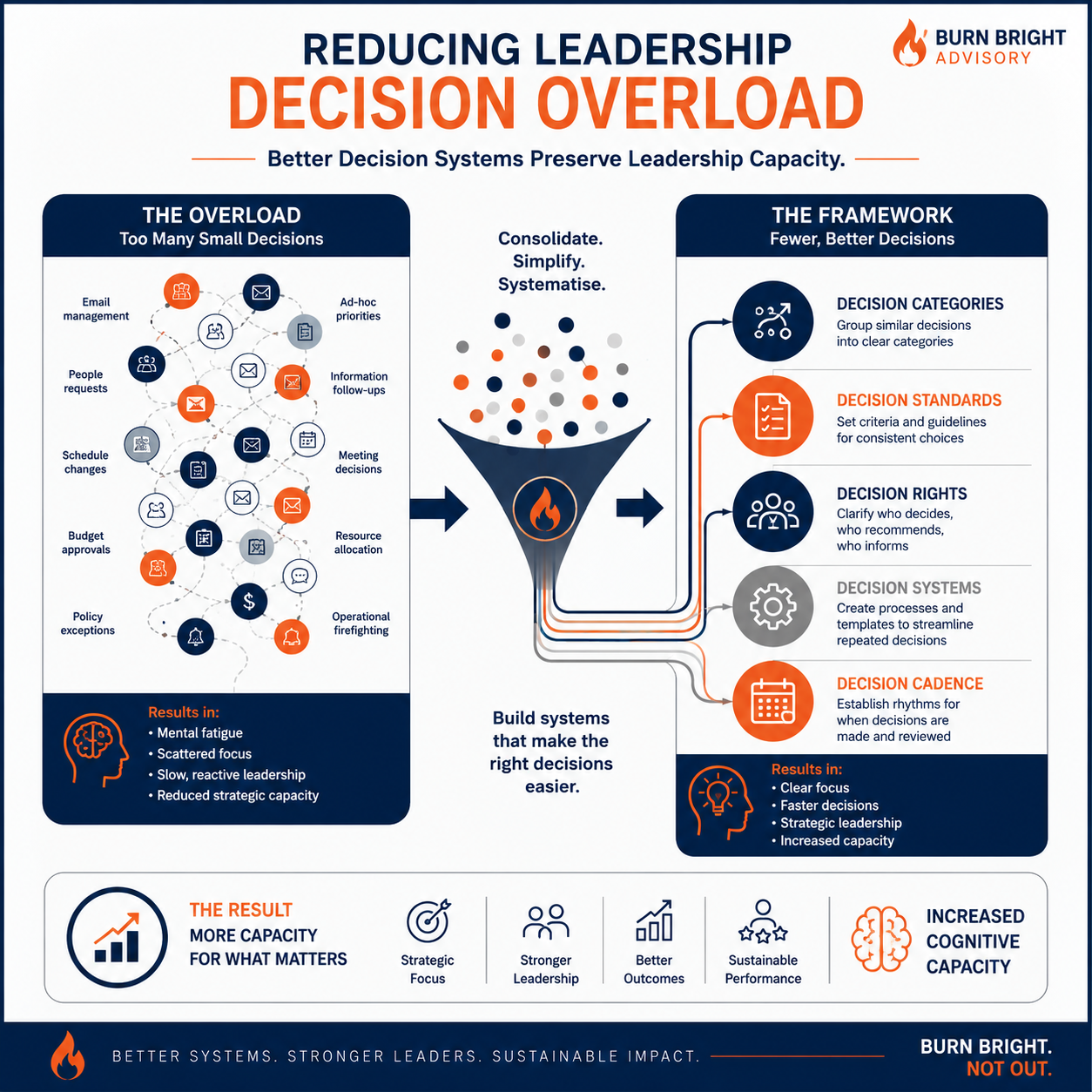
Instead of becoming the bottleneck, leaders become architects of better decision systems.
Why Is Delegation About System Design Rather Than Trust?
Delegation is often misunderstood.
Many leaders believe they delegate poorly because they struggle to let go. In reality, organisations frequently fail to define accountability clearly enough for effective delegation.
The Burn Bright Framework recommends structured delegation using defined ownership, agreed outcomes and clear decision authority rather than vague instructions.
Framework Effective Delegation Answers Four Questions
- Who owns the outcome?
- Who provides expertise?
- Who must be consulted?
- Who simply needs to be informed?
When these questions remain unclear, work flows back to the leader. This creates reverse delegation. The leader gradually becomes responsible for everything.
Delegation therefore becomes a structural capability rather than a personal skill. The result is greater organisational resilience because responsibility is distributed rather than concentrated around one individual.
How Do Sustainable Leaders Protect Strategic Capacity?
Many executives protect their calendar. Far fewer protect their thinking.
Strategic leadership requires uninterrupted time for planning, reflection and decision-making. Yet these activities are often sacrificed first when workload increases.
The irony is striking.
The more senior the role, the less time leaders spend doing genuinely strategic work. Instead they become trapped in operational coordination.
Burn Bright recommends protecting strategic capacity through deliberate workload architecture:
Schedule Protected Strategic Thinking Time
Block uninterrupted time for planning and reflection before the calendar fills with reactive work.
Audit Recurring Meetings Quarterly
Review standing meetings regularly and remove those that no longer add clear value.
Remove Low-Value Reporting
Eliminate reporting requirements that consume time without informing meaningful decisions.
Batch Operational Decisions
Group routine decisions into set windows rather than resolving them as constant interruptions.
Build Recovery Into Weekly Planning
Treat recovery as a scheduled part of the week rather than something that happens only if time remains.
Recovery deserves particular attention.
Recovery is not inactivity.
Recovery restores judgement.
Without recovery, every future decision becomes more difficult. High-performing leaders therefore protect recovery as deliberately as they protect meetings because sustainable performance depends on both.
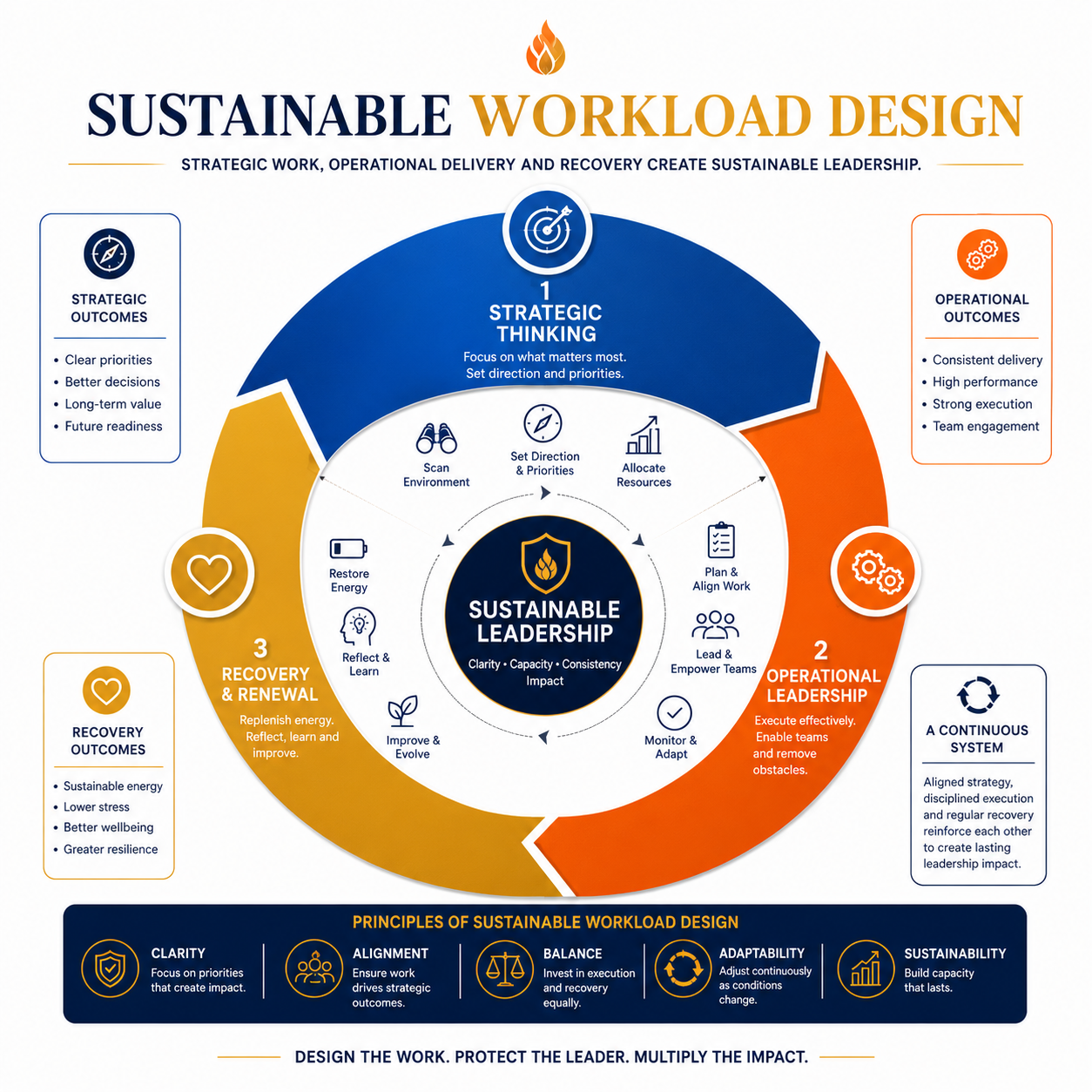
When recovery becomes part of the system, leaders preserve the capacity needed for consistent high performance.
| Traditional Leadership | Sustainable Leadership |
|---|---|
| Work harder | Redesign work |
| Measure activity | Measure value |
| Centralise decisions | Distribute authority |
| Attend every meeting | Protect strategic time |
| Constant availability | Structured communication |
| Individual resilience | Organisational resilience |
| Burnout treated personally | Burnout treated structurally |
Leadership Reflection Questions
- Which of your current responsibilities has no clear purpose, owner or measurable outcome?
- How many decisions cross your desk each week that could be delegated with clearer authority?
- When did you last protect a block of uninterrupted strategic thinking time?
- Is recovery scheduled into your week, or does it only happen if time remains?
- If you redesigned your workload architecture today, what would you remove first?
How do leaders redesign workload without reducing performance?
Effective leaders redesign unnecessary work rather than reducing valuable work. They simplify decision-making, improve delegation, remove duplication and protect strategic capacity. Performance often improves because leaders spend more time on high-value activities.
What is workload architecture?
Workload architecture is the intentional design of responsibilities, communication, priorities and decision-making so work remains sustainable over time. It focuses on improving how work flows rather than increasing individual effort.
Why doesn’t better time management solve burnout?
Time management improves personal efficiency but cannot fix excessive workload, poor organisational design or unclear decision authority. Burnout usually reflects structural problems rather than scheduling problems.
What causes leadership workload to become unsustainable?
Scope creep, communication overload, excessive meetings, decision fatigue and perfectionist cultures gradually increase workload without removing existing responsibilities. Over time, leaders absorb more work than any individual can sustainably manage.
How can organisations redesign leadership roles?
Organisations should regularly review leadership responsibilities, remove unnecessary work, clarify decision ownership, improve delegation and build recovery into leadership expectations rather than relying solely on individual resilience.
Conclusion
Understanding how leaders redesign workload changes the conversation about burnout.
The question is no longer how leaders can become tougher. The better question is whether leadership work has been designed to be sustainable.
Burnout is rarely the result of personal weakness. It is usually the predictable outcome of workload that has expanded beyond human capacity.
When organisations redesign workload architecture, clarify decision authority, improve delegation and protect recovery, leadership becomes more effective — not less.
Is Your Workload Structurally Sustainable?
Complete the Leadership Burnout Self-Assessment to identify the hidden system pressures affecting your leadership and discover practical opportunities to redesign your workload.
Free Leadership Intelligence
Get Weekly Leadership Insights
Join thousands of leaders receiving practical strategies on burnout prevention, workload design, and sustainable performance every week.