Quick Answer
Key Takeaways
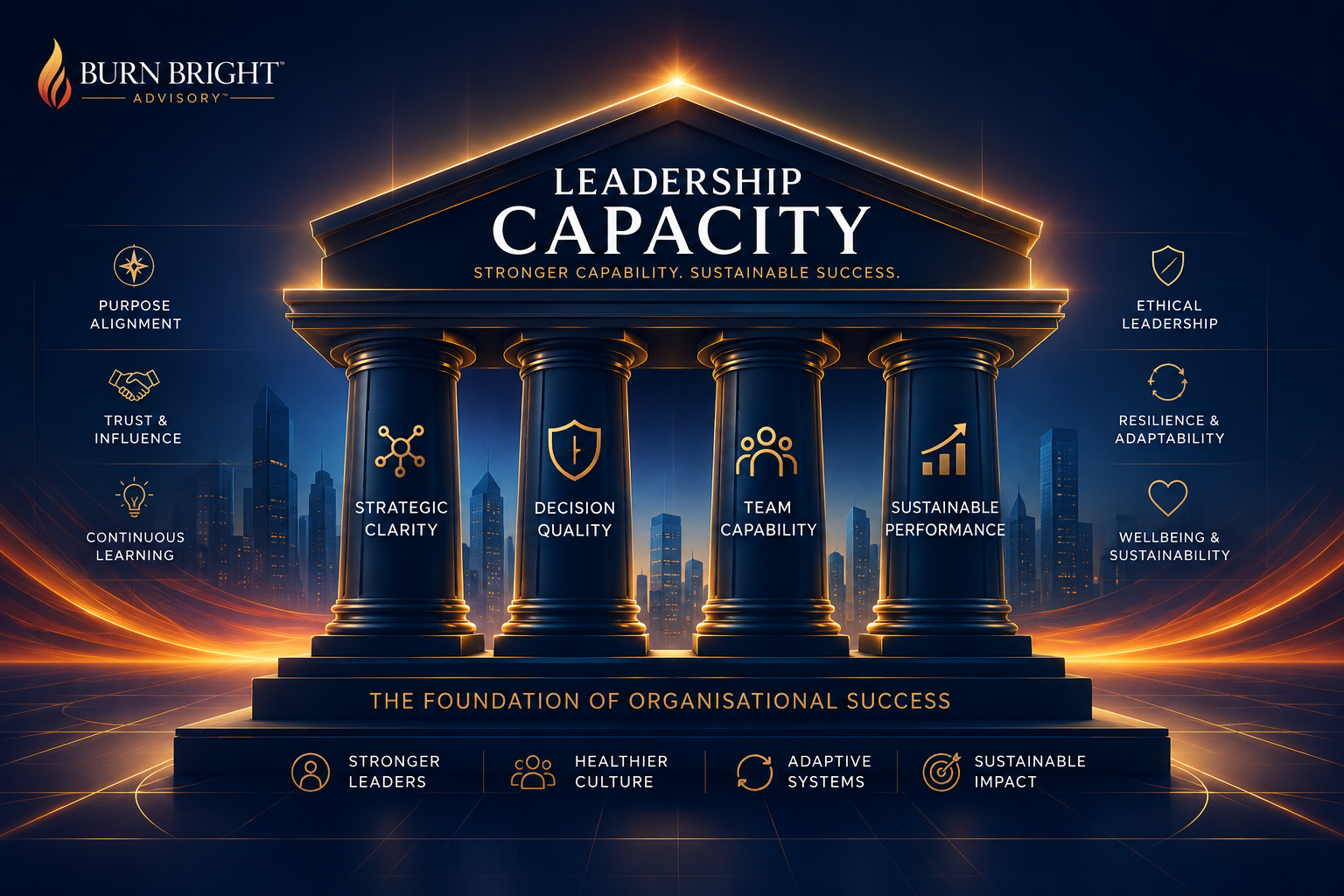
- Leadership Capacity, not raw effort, determines whether success can be sustained as complexity grows.
- It has five interconnected dimensions: cognitive, emotional, relational, strategic and sustainable.
- Capacity expands through systems, delegation and reflection — never through personal sacrifice.
- Leadership Performance Intelligence™ depends on capacity to apply every other intelligence domain effectively.
- High-capacity leaders multiply organisational capability instead of concentrating it in themselves.
- Capacity can be measured and deliberately developed through structured, repeatable practices.
Leadership Capacity: The Foundation of Sustainable Organisational Success
Leadership today is often measured by visible achievement — targets met, projects delivered, budgets balanced, problems solved. Yet beneath every successful organisation lies a less visible factor that ultimately determines whether that success can be maintained: Leadership Capacity.
Featured Snippet
Many talented leaders reach positions of responsibility because they possess technical expertise, professional credibility or operational excellence. However, increasing responsibility does not automatically increase leadership capacity. As organisations grow more complex, many leaders find themselves making more decisions, attending more meetings, managing more stakeholders and carrying greater emotional responsibility — without developing the capability required to sustain those demands.
Eventually, performance plateaus.
Decision quality declines.
Innovation slows.
Relationships become transactional.
Burnout emerges.
Leadership Capacity is therefore not simply about working harder. It is about increasing a leader’s ability to think strategically, manage complexity, develop others and sustain high performance over time. Within Burn Bright Advisory™ this forms a central component of Leadership Performance Intelligence™ and supports the broader Leadership Intelligence Compass™ framework.
This article explores what Leadership Capacity really means, why it matters more than ever, and how leaders can deliberately build greater capability for themselves and the organisations they serve.
Leadership Capacity: The Missing Foundation in Leadership Development
Modern organisations invest enormous resources in developing leaders — executive coaching, leadership programmes, management qualifications, professional certifications, communication training, strategic planning workshops. Despite this investment, organisations continue to experience increasing levels of leadership fatigue, disengagement and capability shortages.
The issue is rarely motivation. Nor is it intelligence. The challenge is capacity.
Leadership Capacity represents the ability to effectively manage increasing levels of responsibility without compromising judgement, relationships or organisational performance. This distinction is important. Many leaders become more productive. Few become significantly more capable.
Why Leadership Capacity Matters
Organisations rarely fail because leaders stop working. They fail because leaders eventually exceed their capacity. As responsibilities expand, leaders begin experiencing common symptoms:
- Decision fatigue
- Constant firefighting
- Reduced strategic thinking
- Emotional exhaustion
- Ineffective delegation
- Declining innovation
- Slower organisational learning
These symptoms often appear gradually, and initially they may even resemble commitment. The leader works longer hours, answers more emails, attends more meetings, and becomes increasingly involved in operational decisions. From the outside this appears admirable. Internally, it often signals that leadership capacity has reached its limit.
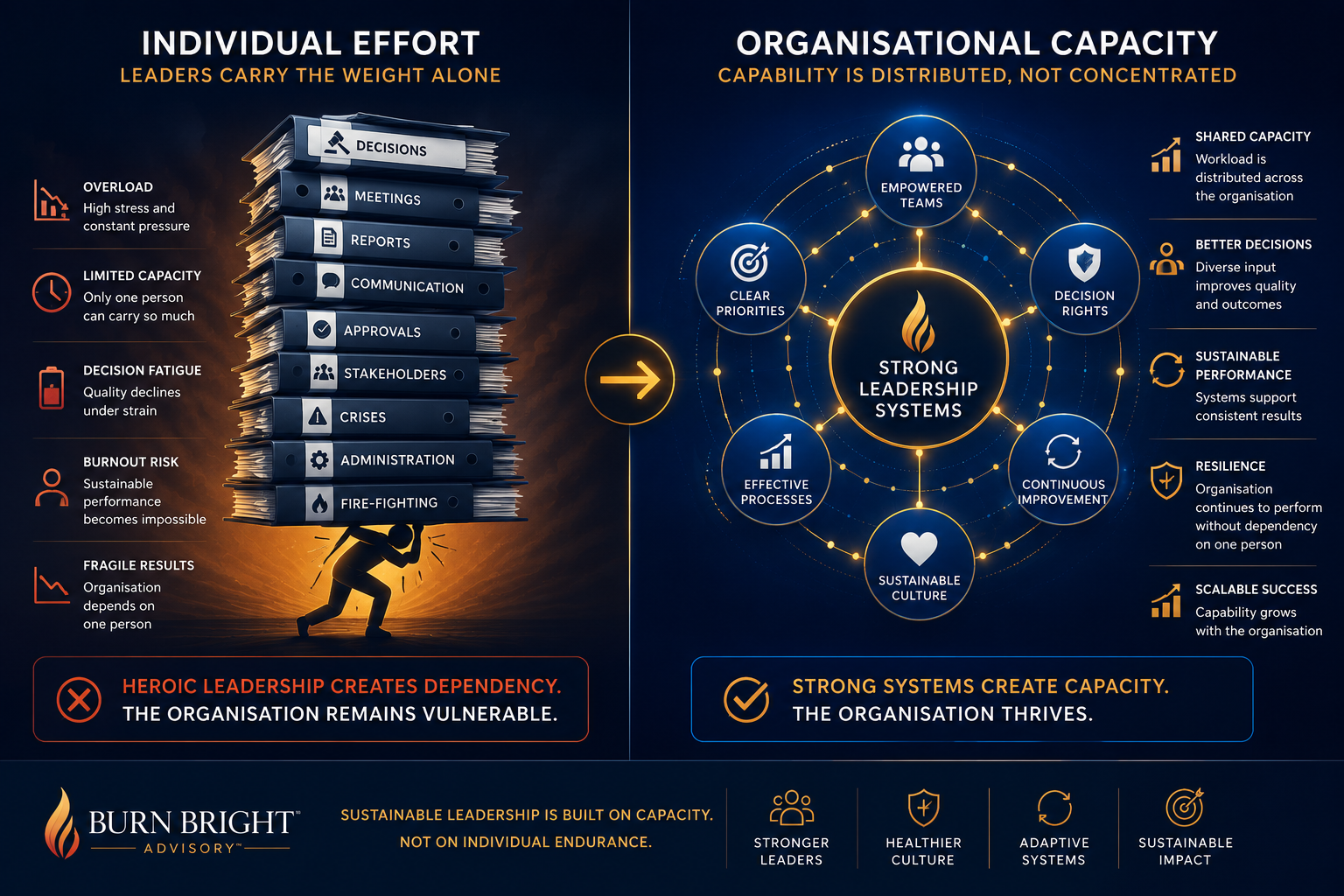
When leaders become the solution to every organisational problem, they unintentionally become the organisation’s greatest constraint. High-capacity leadership is different — rather than absorbing more work, high-capacity leaders increase the organisation’s ability to solve problems independently.
Leadership Capacity Is More Than Time Management
One of the most common misconceptions is that capacity can be improved simply through better organisation. Certainly, effective planning, prioritisation and time management matter. However, none of these fundamentally increases leadership capacity. A calendar can become more organised. It cannot become more intelligent.
Leadership Capacity grows through the development of judgement rather than scheduling. It involves increasing the ability to:
- Interpret complexity
- Anticipate challenges
- Make balanced decisions
- Empower others
- Sustain wellbeing
- Maintain strategic focus during uncertainty
These capabilities cannot be downloaded through productivity software. They develop through deliberate practice, reflection and continuous learning.
Leadership Capacity and Leadership Performance Intelligence™
Burn Bright Advisory™ defines Leadership Performance Intelligence™ as the integration of multiple leadership capabilities that enable sustainable organisational performance. Leadership Capacity sits at the centre of this framework — it enables leaders to apply every other intelligence domain effectively.
Professionalism without capacity creates rigid compliance. Vision without capacity creates unrealistic ambition. Emotional Intelligence without capacity leads to emotional exhaustion. Adaptability without capacity produces continual change without meaningful progress.
Capacity provides the stability required for intelligent leadership. It allows leaders to balance competing priorities while remaining thoughtful, ethical and resilient.
Capacity Expands Through Systems Rather Than Sacrifice
Many leaders mistakenly believe that increasing capacity requires greater personal sacrifice — working longer, sleeping less, remaining constantly available, solving every problem personally. History repeatedly demonstrates the opposite.
The world’s most effective leaders build systems that multiply leadership rather than concentrating it. They create:
- Capable teams
- Clear decision-making frameworks
- Shared accountability
- Learning cultures
- Sustainable workloads
- Future leaders
Capacity therefore becomes organisational rather than individual. Instead of becoming indispensable, high-capacity leaders become exceptional at making others successful. Leadership is no longer measured by how much one person can carry — it is measured by how much capability they create throughout the organisation.
Expanding Leadership Capacity Through the Leadership Intelligence Compass™
Leadership Capacity Is Built, Not Born
Leadership Capacity is often misunderstood as an inherent trait. Some leaders appear naturally calm under pressure. Others seem able to inspire people effortlessly or make complex decisions with confidence. While personality and experience undoubtedly influence leadership, sustained capacity is not determined by natural ability alone.
Leadership Capacity is developed. It grows through intentional learning, reflective practice, structured development and repeated experience across increasingly complex situations. This is encouraging because it means leadership is not limited to a select few — every leader has the potential to expand their capacity through deliberate investment in the capabilities that underpin Leadership Performance Intelligence™.
The Five Dimensions of Leadership Capacity
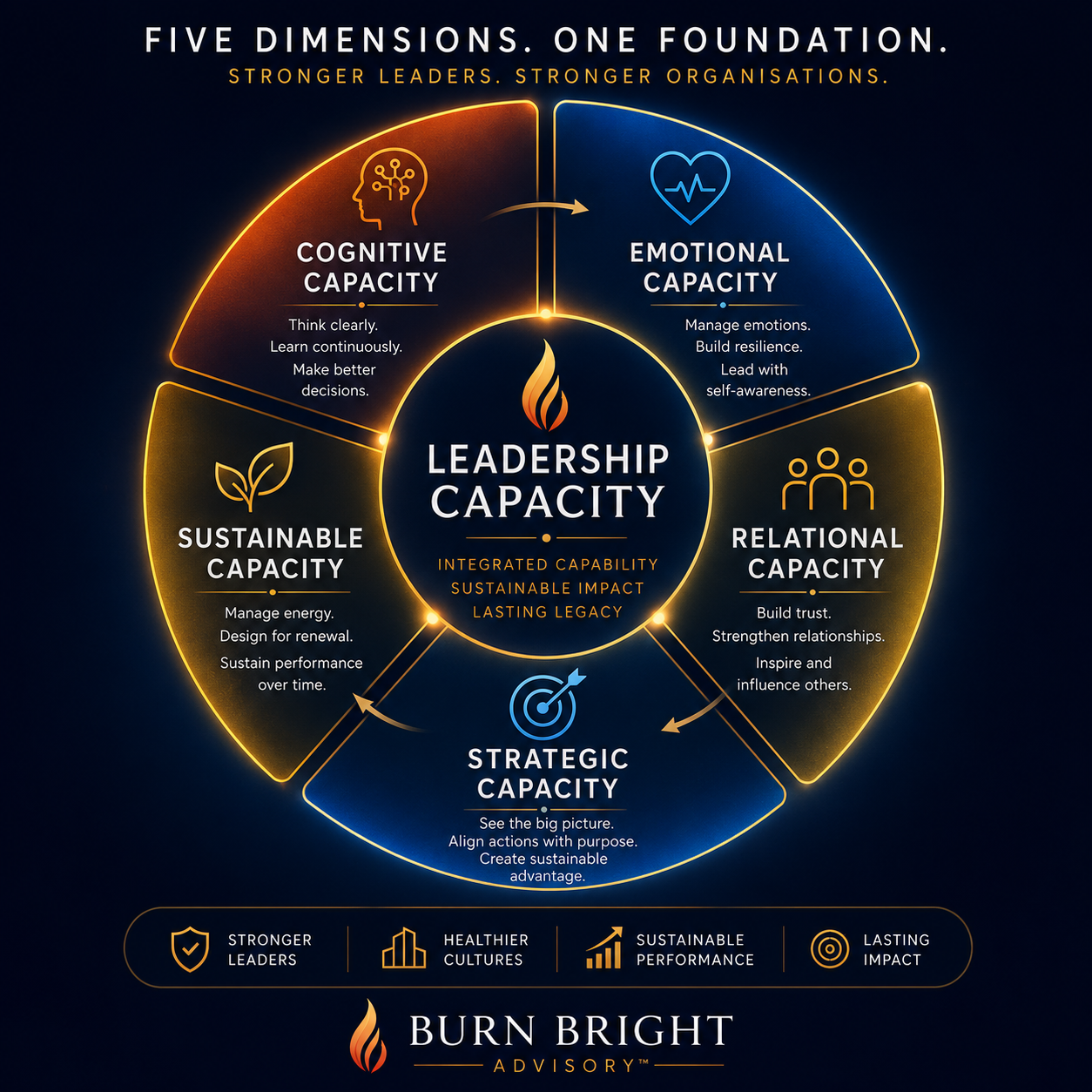
Burn Bright Advisory™ identifies five interconnected dimensions that influence a leader’s overall capacity. Each contributes to sustainable leadership performance.
Dimension 1
Cognitive Capacity
Leaders are required to process increasing volumes of information while making decisions with incomplete evidence and competing priorities. High cognitive capacity enables leaders to:
- Identify patterns rather than isolated events
- Distinguish symptoms from root causes
- Anticipate future challenges
- Evaluate evidence critically
- Make decisions despite uncertainty
Dimension 2
Emotional Capacity
Leadership is emotionally demanding — every decision influences people, every organisational change creates uncertainty, and every difficult conversation requires emotional energy. Leaders with strong emotional capacity:
- Remain composed during conflict
- Regulate their own emotions
- Demonstrate empathy without becoming overwhelmed
- Maintain optimism during adversity
- Build psychological safety
Dimension 3
Relational Capacity
Leadership is fundamentally relational. Even the strongest strategy fails if people do not trust the individual leading it. Relational capacity includes the ability to:
- Develop trust
- Influence without authority
- Communicate clearly
- Collaborate across teams
- Manage conflict constructively
- Coach and develop others
Dimension 4
Strategic Capacity
Many leaders become trapped by operational demands, where meetings replace thinking and urgency replaces importance. Strategic capacity enables leaders to maintain perspective despite operational pressure by consistently asking:
- What matters most?
- What will matter next year?
- What should we stop doing?
- What capability must we build now?
Dimension 5
Sustainable Capacity
The final dimension integrates all the others, reflecting the ability to maintain leadership effectiveness over time. It includes:
- Workload management
- Reflective practice
- Continuous learning
- Physical wellbeing
- Psychological resilience and recovery
- Succession planning
How the Leadership Intelligence Compass™ Strengthens Capacity
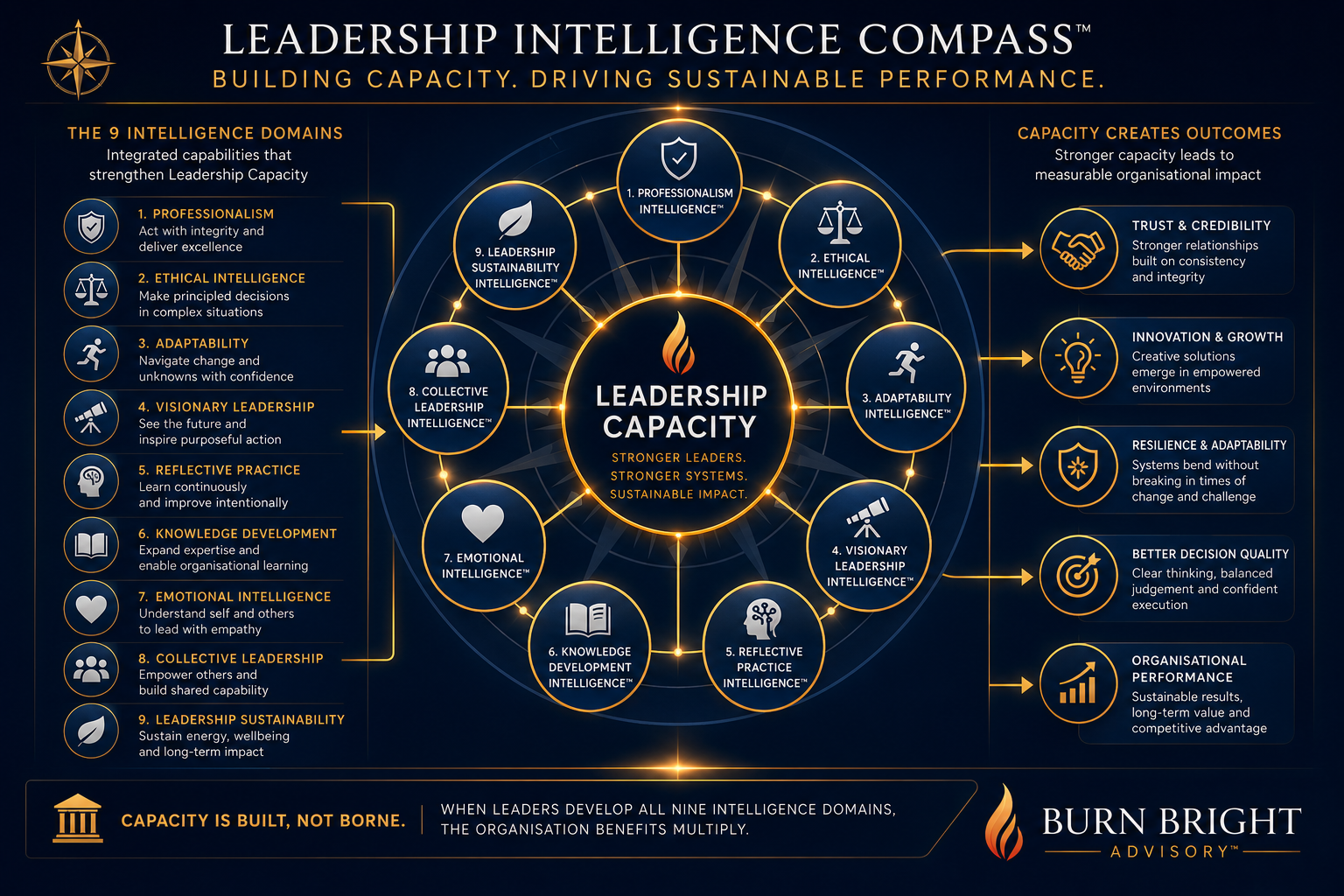
Each Leadership Intelligence Compass™ domain contributes directly to expanding leadership capacity. Rather than functioning independently, the domains reinforce one another to create sustainable leadership capability.
Domain 1 Professionalism Intelligence™
Professional standards reduce unnecessary complexity. Consistency creates trust, and trust reduces organisational friction.
Domain 2 Ethics Intelligence™
Ethical clarity simplifies difficult decisions. Leaders with strong ethical frameworks spend less energy managing the consequences of poor judgement.
Domain 3 Constructivism Intelligence™
Developing others increases organisational capability. Every employee who becomes more capable expands leadership capacity throughout the organisation.
Domain 4 Adaptability Intelligence™
Adaptable leaders recover faster from disruption. Rather than resisting change, they build organisations capable of evolving continuously.
Domain 5 Visionary Leadership Intelligence™
Clear vision aligns effort. Alignment reduces wasted energy and conflicting priorities.
Domain 6 Reflective Practice Intelligence™
Reflection transforms experience into improved judgement. Without reflection, leaders repeat mistakes; with it, every challenge becomes an investment in future capability.
Domain 7 Knowledge Development Intelligence™
Learning increases organisational intelligence. Knowledge sharing multiplies leadership capacity across teams.
Domain 8 Emotional Intelligence™
Healthy relationships reduce conflict, improve collaboration and strengthen organisational resilience.
Domain 9 Leadership Sustainability™
This domain protects the entire system. Without sustainability, every other intelligence domain gradually deteriorates — Leadership Performance Intelligence™ therefore depends upon protecting leadership capacity over time.
Sector Examples
Although the principles remain universal, Leadership Capacity appears differently across sectors.
Business Growth Intelligence™
A chief executive leading rapid expansion cannot personally approve every decision. Instead, they increase organisational capacity by developing autonomous leaders, strengthening governance systems and creating clear strategic priorities — so growth becomes scalable because leadership capability is distributed rather than concentrated.
School Leadership Intelligence™
A school principal attempting to solve every operational problem eventually becomes overwhelmed. By developing middle leaders, empowering teachers and encouraging collaborative decision-making, leadership capacity expands across the entire school and student outcomes improve.
Healthcare Leadership Intelligence™
Clinical leaders constantly balance patient safety, workforce wellbeing and operational efficiency. High-capacity healthcare leaders establish multidisciplinary decision-making, encourage reflective practice and strengthen learning cultures — improving patient care alongside healthier clinical teams.
Public Service Leadership Intelligence™
Public sector organisations often operate within significant resource constraints. Leadership Capacity enables leaders to achieve greater impact through collaboration, innovation and ethical decision-making rather than simply increasing workload.
Entrepreneur Performance Intelligence™
Entrepreneurs frequently become organisational bottlenecks during growth. Leadership Capacity allows founders to transition from technical experts into organisational architects — building systems capable of solving problems independently, often determining whether businesses remain small or successfully scale.
Capacity Multiplies Organisational Capability
Perhaps the greatest misconception about leadership is that stronger leaders simply work harder. Research and organisational experience consistently suggest the opposite: exceptional leaders increase organisational capability by increasing the capability of others.
Leadership Capacity therefore becomes exponential rather than linear. One capable leader develops five capable managers. Those managers develop fifty capable employees. Those employees improve customer outcomes, innovation and organisational performance. Leadership becomes a multiplying force rather than an individual effort.
This is why Leadership Capacity represents one of the foundational principles of Leadership Performance Intelligence™. The objective is not to create indispensable leaders — it is to create indispensable organisations that continue thriving because leadership capability exists at every level.
Measuring and Developing Leadership Capacity
Leadership Capacity Can Be Measured
One of the greatest misconceptions in leadership development is that capacity cannot be measured. Organisations frequently evaluate performance, competence and results, yet rarely assess the underlying capability that enables leaders to sustain those results over time.
Leadership Capacity is measurable because it is reflected in consistent patterns of behaviour, judgement and organisational impact. Rather than relying solely on annual performance reviews, Burn Bright Advisory™ recommends assessing Leadership Capacity across multiple dimensions that provide a more complete picture of leadership effectiveness — combining quantitative indicators with qualitative evidence gathered through reflection, observation and organisational feedback.
The goal is not to create another compliance exercise. The goal is to understand whether leadership capability is growing alongside organisational complexity.
Indicators of High Leadership Capacity
High-capacity leaders consistently demonstrate behaviours that strengthen organisations rather than creating dependency.
Decision Quality
High-capacity leaders make decisions that remain effective over time. They balance evidence with judgement, involve appropriate stakeholders and consider both immediate and long-term consequences. Instead of making every decision themselves, they develop clear decision-making frameworks that enable others to act with confidence.
Leadership Multiplication
One of the clearest signs of expanding capacity is the development of future leaders. Are more people taking ownership? Are decisions being made confidently at different organisational levels? Is leadership capability spreading throughout the organisation? Leadership Capacity increases when responsibility is distributed rather than concentrated.
Strategic Focus
High-capacity leaders spend increasing amounts of time thinking strategically instead of reacting operationally, deliberately creating space for reflection, innovation, organisational learning, future planning and relationship development. The more capacity leaders build, the less they become trapped in perpetual crisis management.
Organisational Resilience
Strong leadership creates resilient organisations. Evidence may include improved employee engagement, lower staff turnover, greater collaboration, increased innovation, faster organisational learning and a healthier workplace culture. These outcomes rarely result from isolated leadership behaviours — they emerge through sustained leadership capability.
Leadership Sustainability™
Perhaps the most important indicator is whether leadership effectiveness can be maintained without continual personal sacrifice. Can this leader sustain their current workload? Are healthy boundaries maintained? Is recovery prioritised? Does the organisation rely excessively on one individual? Sustainable leadership is a strategic advantage rather than a personal luxury.
Practical Strategies for Increasing Leadership Capacity
Leadership Capacity does not expand accidentally. It grows through deliberate habits that gradually strengthen leadership capability over time.
Develop Reflective Practice
After important decisions, ask what worked well, what assumptions influenced your thinking, what evidence you overlooked, and what you would approach differently next time. Reflection transforms experience into wisdom — without it, experience simply becomes repetition.
Delegate Decisions, Not Just Tasks
Many leaders delegate work while retaining every important decision, which limits organisational capacity. Instead, develop decision-making capability within teams by providing clear expectations, appropriate authority, supportive coaching and constructive feedback. As confidence grows, organisational capacity expands naturally.
Protect Thinking Time
Leadership requires uninterrupted thinking, yet calendars often become dominated by meetings and operational activity. High-capacity leaders intentionally schedule time for strategic reflection, reading, planning, professional learning and organisational analysis. Thinking is productive work — without it, organisations become increasingly reactive.
Invest in Leadership Development Systems™
Leadership development should not occur only when problems arise. Build systems that continually strengthen leadership capability through mentoring, coaching, peer learning, reflective conversations, leadership assessments and succession planning. Sustainable organisations continually develop leaders before they are urgently needed.
Measure What Matters
Move beyond measuring activity. Instead, evaluate whether leadership is improving decision quality, organisational capability, team confidence, leadership succession, employee wellbeing and organisational resilience. What organisations measure influences what leaders prioritise.
Leadership Reflection Questions
- What currently consumes most of my leadership energy?
- Am I solving problems that someone else could learn to solve?
- Which Leadership Intelligence™ domain would most increase my capacity if strengthened?
- How much time do I spend working strategically compared with operationally?
- What leadership capability have I developed in others during the past six months?
- Would my organisation continue functioning effectively if I were absent for several weeks?
- Which organisational systems depend too heavily on my personal involvement?
Practical Action Plan
Week One
Conduct a Leadership Capacity self-assessment. Identify areas where workload consistently exceeds sustainable capability.
Week Two
Review your calendar. Identify activities that could be delegated, redesigned or eliminated, and create additional time for strategic thinking.
Week Three
Choose one Leadership Intelligence Compass™ domain for focused development. Develop one practical behaviour that strengthens this capability each day.
Week Four
Evaluate your leadership impact. Rather than asking “How much did I achieve?”, ask “How much organisational capability did I create?” — a question that fundamentally changes how leadership success is defined.
Conclusion
Leadership has entered a new era. The challenges facing today’s organisations cannot be solved simply by asking leaders to work harder, respond faster or carry greater responsibility. Instead, sustainable success depends upon expanding Leadership Capacity.
Leaders who deliberately strengthen their thinking, judgement, emotional resilience and ability to develop others create organisations that remain effective long after individual leaders move on. Leadership Capacity is therefore not an optional leadership competency — it is the foundation upon which Leadership Performance Intelligence™ is built.
When organisations intentionally develop Leadership Capacity through the Leadership Intelligence Compass™, they create more than capable leaders. They build resilient cultures, stronger teams and sustainable organisational performance. The future of leadership belongs to organisations that measure not only what leaders achieve today, but also the capability they create for tomorrow.
What is Leadership Capacity?
Leadership Capacity is a leader’s ability to sustain effective decision-making, develop others, manage increasing organisational complexity and maintain long-term performance without compromising wellbeing or organisational health.
How is Leadership Capacity different from productivity?
Productivity measures how much work is completed. Leadership Capacity measures a leader’s ability to increase organisational capability, improve judgement and sustain effectiveness over time.
Can Leadership Capacity be developed?
Yes. Leadership Capacity grows through structured development, reflective practice, continuous learning, delegation and the intentional development of others.
Why is Leadership Capacity important?
Organisations become limited by the capacity of their leaders. Expanding Leadership Capacity enables organisations to innovate, adapt and grow sustainably.
How does Leadership Capacity relate to Leadership Performance Intelligence™?
Leadership Capacity forms a core element of Leadership Performance Intelligence™ by enabling leaders to apply Professionalism Intelligence™, Ethics Intelligence™, Adaptability Intelligence™, Emotional Intelligence™ and the other Leadership Intelligence Compass™ domains effectively under pressure.
What is the first step organisations should take?
Begin by assessing current leadership capability rather than focusing solely on performance outcomes. Understanding existing capacity provides the foundation for sustainable leadership development.
How Much Leadership Capacity Do You Have?
Take the free Leadership Burnout Self-Assessment to understand where your capacity is being stretched — and where your leadership systems need to change.
Free Leadership Intelligence
Get Weekly Leadership Insights
Join thousands of leaders receiving practical strategies on burnout prevention, workload design, and sustainable performance every week.