Quick Answer
Key Takeaways
- Sustainable workload design focuses on redesigning work, not increasing individual effort.
- Burnout is usually caused by structural overload rather than poor personal resilience.
- Workload architecture is more effective than traditional time management.
- Sustainable organisations produce better long-term performance than organisations built on constant urgency.
- Leaders who redesign systems create healthier teams and stronger organisational outcomes.
Sustainable Workload Design: Why Leadership Overload Is a System Failure, Not a Personal One
Introduction
Sustainable workload design has become one of the most important leadership capabilities of the modern workplace. Leaders everywhere are working harder than ever, yet many feel permanently behind. Longer hours, constant meetings, endless emails and increasing expectations have become normal across every sector.
The instinctive response is usually personal. Work faster. Become more productive. Improve time management. Download another productivity app.
Unfortunately, none of these solve the real problem.
At Burn Bright Advisory, we view burnout differently. Burnout is rarely caused by individual weakness. It is usually the result of organisational systems that demand more than any person can sustainably deliver. As outlined in the Burn Bright Not Out Framework, structural issues such as scope creep, communication chaos, decision overload and poor workload architecture create conditions where even exceptional leaders eventually struggle.
This article explores why sustainable workload design has become essential for modern leadership, what distinguishes it from traditional workload management, and how leaders can redesign work to improve both wellbeing and organisational performance.
Before examining practical solutions, it helps to understand how workload has fundamentally changed.
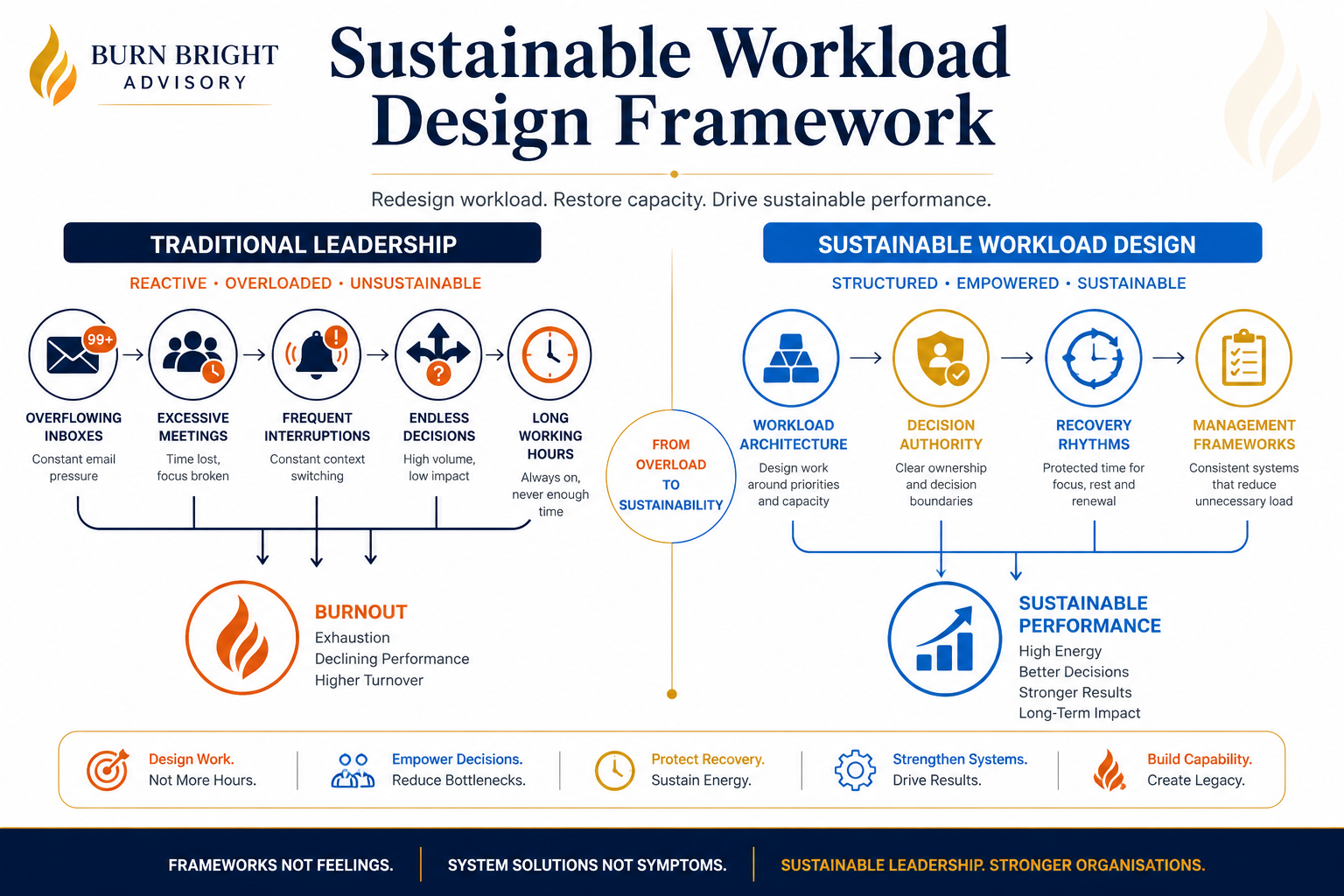
Modern leadership has evolved from managing tasks to managing continuous complexity. Sustainable workload design restores clarity by redesigning how work flows through an organisation rather than expecting leaders to absorb ever-increasing demands.
Featured Snippet
Why Is Leadership Workload No Longer Sustainable?
Leadership has changed dramatically over the past decade.
Managers are no longer responsible only for supervising people and delivering results. They now manage hybrid teams, multiple digital platforms, constant communication, organisational change, compliance requirements, employee wellbeing, stakeholder expectations and continuous innovation — all simultaneously.
The result is not simply “more work.”
It is more complexity.
Research consistently demonstrates this expansion of leadership responsibilities. Gallup reports that over half of managers experience burnout, while organisations continue expanding leadership responsibilities without increasing capacity. Similar trends have been observed across healthcare, education, business and government, where leaders increasingly operate in environments characterised by competing priorities and fragmented workloads.
Traditional leadership roles were largely sequential.
Today’s leadership roles are continuous.
Instead of completing one responsibility before moving to another, leaders constantly switch between strategic decisions, operational issues, people management, meetings, digital communication and crisis management.
Every interruption creates cognitive switching costs.
Every new platform creates another communication channel.
Every additional responsibility expands workload without removing previous expectations.
The Burn Bright Framework identifies five structural causes behind this pattern:
These five systemic pressures steadily increase workload until leaders begin operating beyond sustainable capacity. This explains why so many experienced leaders feel permanently behind despite becoming more efficient.
Traditional organisations often respond by asking leaders to become more resilient. Sustainable organisations redesign the work itself. That distinction changes everything.
How Does Sustainable Workload Design Differ from Time Management?
Most leadership development still focuses on time management.
Block your diary.
Prioritise more effectively.
Delegate more.
Use a better productivity app.
While these techniques can improve personal efficiency, they rarely solve chronic overload because they assume the workload itself is reasonable.
That assumption is increasingly false.
If a leader receives 250 emails every day, attends seven hours of meetings and is responsible for strategic planning, operational delivery, coaching staff and managing crises, no productivity system can create enough capacity.
The issue is structural.
Sustainable workload design begins with a different question. Instead of asking, “How can I fit more work into my day?” it asks, “Why has this work accumulated in the first place?”
This shift from individual optimisation to structural diagnosis is one of the defining principles of the Burn Bright approach. Burnout should be treated as a systems issue rather than a personal failure requiring greater resilience.
Leaders often discover that excessive workload is created by organisational habits rather than essential work. Common examples include:
- Meetings without clear decisions.
- Duplicate reporting.
- Excessive approval processes.
- Constant digital interruptions.
- Poor delegation structures.
- Lack of decision ownership.
- Reactive rather than planned work.
Removing these structural inefficiencies often creates far more capacity than simply working faster.
Sustainable workload design also recognises that different work creates different cognitive demands. A one-hour strategy session is not equivalent to one hour of email administration. Leading a difficult performance conversation requires significantly more mental energy than reviewing routine reports.
Traditional calendars treat every hour equally. Sustainable workload architecture recognises that energy — not simply time — is the real leadership constraint.
Framework Four Structural Pillars
The Burn Bright Framework recommends designing workload around four structural pillars:
- Workload Architecture
- Decision Authority
- Recovery Rhythms
- Management Frameworks
Together these create leadership systems capable of sustaining high performance over many years rather than short bursts of heroic effort.
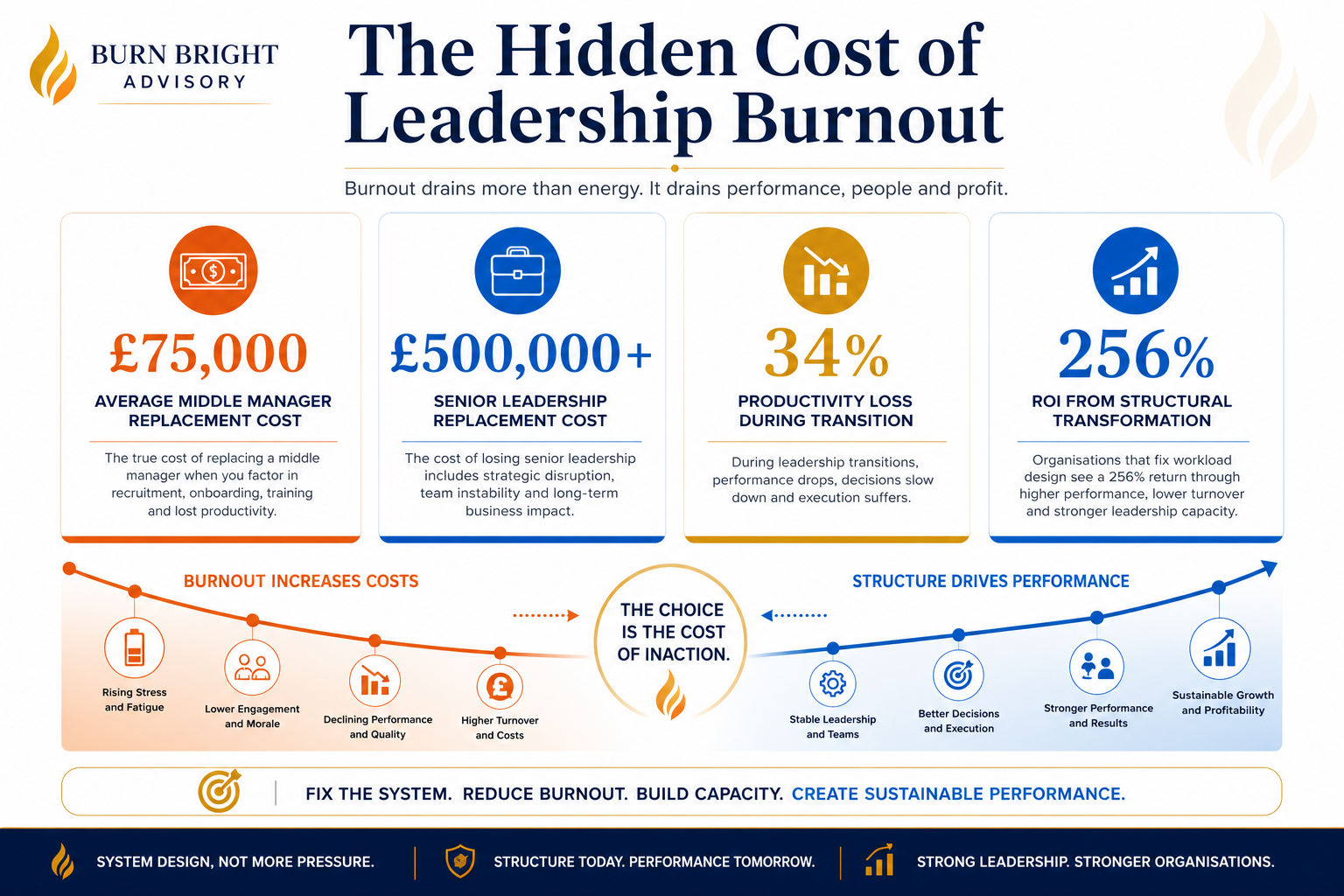
Burnout affects far more than individual wellbeing. Turnover, lost productivity, poor decisions and leadership vacancies create substantial financial costs that are largely preventable through better workload design.
What Does Sustainable Workload Design Look Like in Practice?
Designing sustainable work does not mean lowering standards. It means eliminating unnecessary demands while protecting work that genuinely creates value.
One useful way to think about workload is through the concept of workload architecture. Just as architects design buildings to carry weight safely over decades, leaders must design work that organisations can sustain indefinitely. Poor architecture eventually collapses. The same applies to leadership systems.
Design Around Outcomes Rather Than Activity
Many organisations reward visible busyness instead of meaningful contribution. High-performing organisations deliberately reduce unnecessary work so people can focus on the decisions that genuinely create value.
Reduce Unnecessary Decisions
Decision overload quietly consumes enormous leadership capacity. Rather than expecting leaders to make every decision, sustainable organisations increase decision authority throughout teams and establish clear accountability frameworks.
Protect Strategic Thinking Time
Many leaders spend almost every hour reacting to meetings, emails, messages and unexpected issues. Protecting uninterrupted thinking time allows leaders to anticipate problems before they become crises.
Design Communication Deliberately
Email, Teams, Slack, WhatsApp and phone calls each appear individually manageable but collectively create constant cognitive fragmentation. Redesigning communication norms recovers significant productive time without reducing responsiveness.
Build Recovery Into Leadership
Recovery is not something that happens after burnout — it is part of leadership itself. Just as elite athletes programme recovery between training sessions, sustainable leaders deliberately schedule reflection, planning, breaks and cognitive renewal.
| Traditional Workload Management | Sustainable Workload Design |
|---|---|
| Focuses on managing more work | Focuses on redesigning work |
| Measures hours worked | Measures sustainable outcomes |
| Individual responsibility | Shared organisational responsibility |
| More meetings | Better decision architecture |
| Constant availability | Protected strategic capacity |
| Productivity through effort | Performance through systems |
| Burnout treated as personal weakness | Burnout treated as system failure |
| Reactive leadership | Proactive leadership |
The contrast is clear. Traditional approaches ask leaders to carry increasing organisational complexity alone. Sustainable workload design changes the environment so leaders can perform consistently without exhausting themselves.
Why Does Sustainable Workload Design Improve Organisational Performance?
Many organisations worry that reducing workload will reduce productivity.
The evidence suggests the opposite.
When leaders spend less time managing unnecessary complexity, they have more capacity for strategy, innovation and developing their people. This creates a multiplier effect across the organisation.
Gallup consistently reports that managers account for a significant proportion of team engagement, while organisations with healthy leadership practices experience stronger retention, productivity and performance outcomes. Similarly, McKinsey has found that leaders operating with clear priorities and reduced organisational friction make better decisions and deliver more consistent results.
Burn Bright describes another hidden organisational cost known as the Culture Tax — the cumulative financial impact of burnout, disengagement, absenteeism, poor decision-making and leadership turnover. Many organisations unknowingly pay this cost every year because they focus on treating symptoms instead of redesigning systems.
Leadership turnover alone creates substantial organisational disruption. According to the Burn Bright Framework:
- Replacing a middle manager typically costs around £75,000.
- Replacing a senior leader can exceed £500,000.
- Leadership transitions reduce productivity by approximately 34%.
These costs extend well beyond recruitment. Teams lose experience, projects slow, confidence declines and organisational momentum suffers.
Organisations that redesign workload experience improvements across multiple areas:
- Better decision quality.
- Reduced absenteeism.
- Lower staff turnover.
- Increased employee engagement.
- Greater innovation.
- Improved leadership retention.
These results reinforce a simple principle. Better systems consistently outperform greater effort.
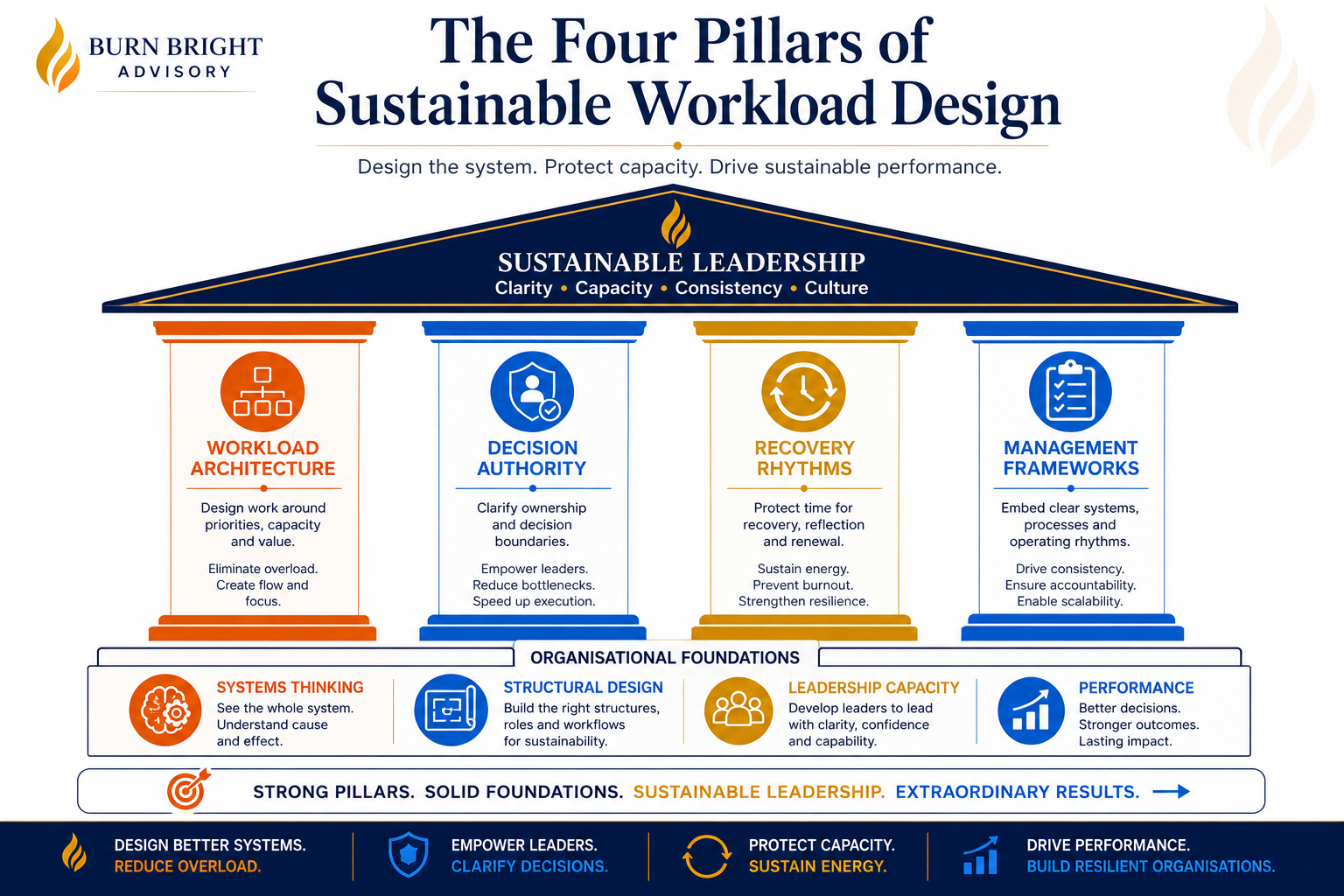
Sustainable leadership is built on structural foundations rather than personal endurance. By redesigning workload, decision authority, recovery and management systems together, organisations create leadership roles that remain effective over the long term.
What is sustainable workload design?
Sustainable workload design is the process of organising work so leaders can consistently perform at a high level without chronic overload. It focuses on improving organisational systems, decision-making, communication and workload architecture rather than expecting individuals to simply work harder.
How is sustainable workload design different from time management?
Time management helps people organise their day more effectively. Sustainable workload design goes further by reducing unnecessary work, clarifying decision ownership, redesigning communication and creating systems that prevent overload before it occurs.
Can sustainable workload design reduce burnout?
Yes. While burnout has multiple causes, redesigning workload addresses many of the structural factors that create chronic exhaustion. Organisations that improve workload architecture often experience lower turnover, stronger engagement and healthier leadership teams.
What causes unsustainable workloads?
Common causes include scope creep, excessive meetings, communication overload, unclear accountability, decision fatigue and perfectionism cultures. These issues gradually expand leadership roles beyond what any individual can sustain.
Why should organisations redesign workload instead of offering resilience training?
Resilience training may help individuals cope temporarily, but it cannot solve structural overload. If systems continue generating excessive work, burnout will return. Sustainable workload design addresses the underlying organisational causes rather than treating the symptoms.
Conclusion
Sustainable workload design represents a fundamental shift in how organisations think about leadership.
For too long, leaders have been encouraged to solve systemic problems through greater personal effort. The result has been rising burnout, declining engagement and increasing leadership turnover.
There is another way.
When organisations redesign workload instead of expecting individual heroics, leaders gain the capacity to think strategically, make better decisions and support their teams more effectively.
At Burn Bright Advisory, we believe burnout is rarely the result of personal weakness. It is usually evidence that organisational systems have exceeded human capacity. Sustainable leadership begins by redesigning those systems.
Ready to Redesign Your Workload Before Burnout Redesigns Your Career?
Take the Leadership Burnout Self-Assessment to identify the structural pressures affecting your leadership and discover where sustainable workload design can have the greatest impact.
Free Leadership Intelligence
Get Weekly Leadership Insights
Join thousands of leaders receiving practical strategies on burnout prevention, workload design, and sustainable performance every week.