Quick Answer
Key Takeaways
- Invisible workload often causes more burnout than visible tasks.
- Leadership overload is usually created by systems, not individual weakness.
- Hidden work includes decisions, emotional labour, interruptions and communication management.
- Redesigning workload architecture reduces burnout more effectively than productivity hacks.
- Sustainable organisations measure leadership capacity, not simply output.
Invisible Workload Overload: The Hidden Cause of Leadership Burnout
Introduction
Invisible workload overload is one of the biggest reasons capable leaders reach exhaustion without understanding why. Their calendar may look manageable. Their task list may even appear under control. Yet every day feels heavier than the last.
The reason is simple.
Much of modern leadership happens outside the diary.
Managing conflict. Making hundreds of decisions. Responding to constant digital interruptions. Carrying organisational uncertainty. Supporting struggling colleagues. Holding information for multiple stakeholders. None of this appears as a scheduled meeting, yet every element consumes cognitive capacity.
This hidden work has expanded dramatically over the past decade as organisations have become more complex. Technology promised efficiency, but in many organisations it delivered continuous communication, fragmented attention and increasing expectations instead. Research discussed throughout the Burn Bright Advisory™ framework identifies structural overload—not personal weakness—as the real driver of burnout.
If leaders continue measuring only visible work, they will continue underestimating the true demands being placed upon them.
Understanding the Hidden Leadership Iceberg
The work most organisations measure is only a fraction of what leaders actually do.
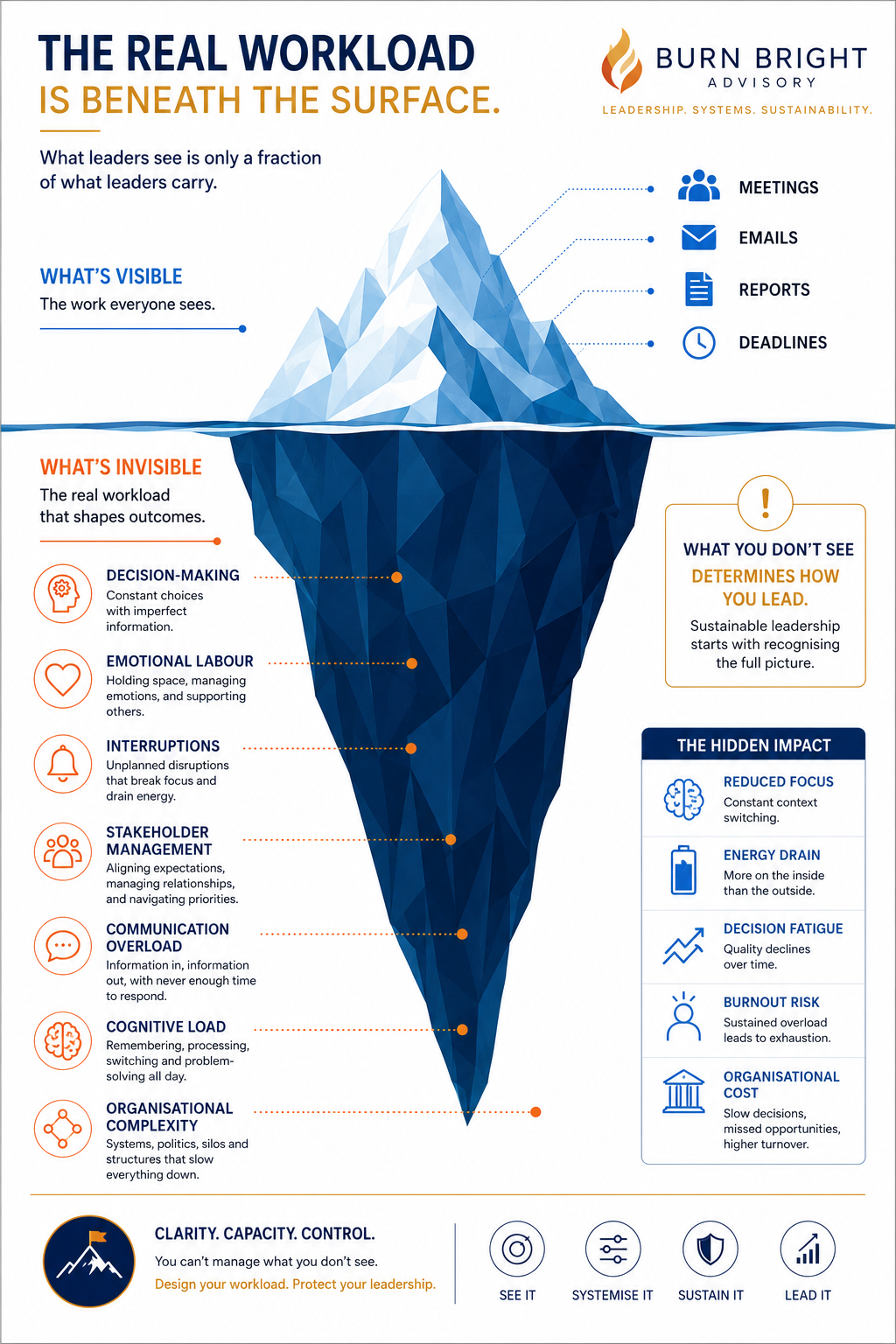
Like an iceberg, meetings, reports and deadlines sit above the surface. Beneath them lies the invisible workload that quietly drains attention, judgement and emotional energy every day. Sustainable leadership requires organisations to measure both.
Featured Snippet
Why Is Invisible Workload Increasing?
Modern leadership has changed more in the last decade than many organisations have acknowledged. The traditional manager largely coordinated work. Today’s leader coordinates work, people, technology, culture, communication, wellbeing, compliance, change, performance and continuous organisational uncertainty simultaneously.
This expansion rarely happens through a single dramatic change. It happens gradually.
A new reporting system.
Another communication platform.
An additional weekly meeting.
A larger team.
More compliance requirements.
Extra stakeholder expectations.
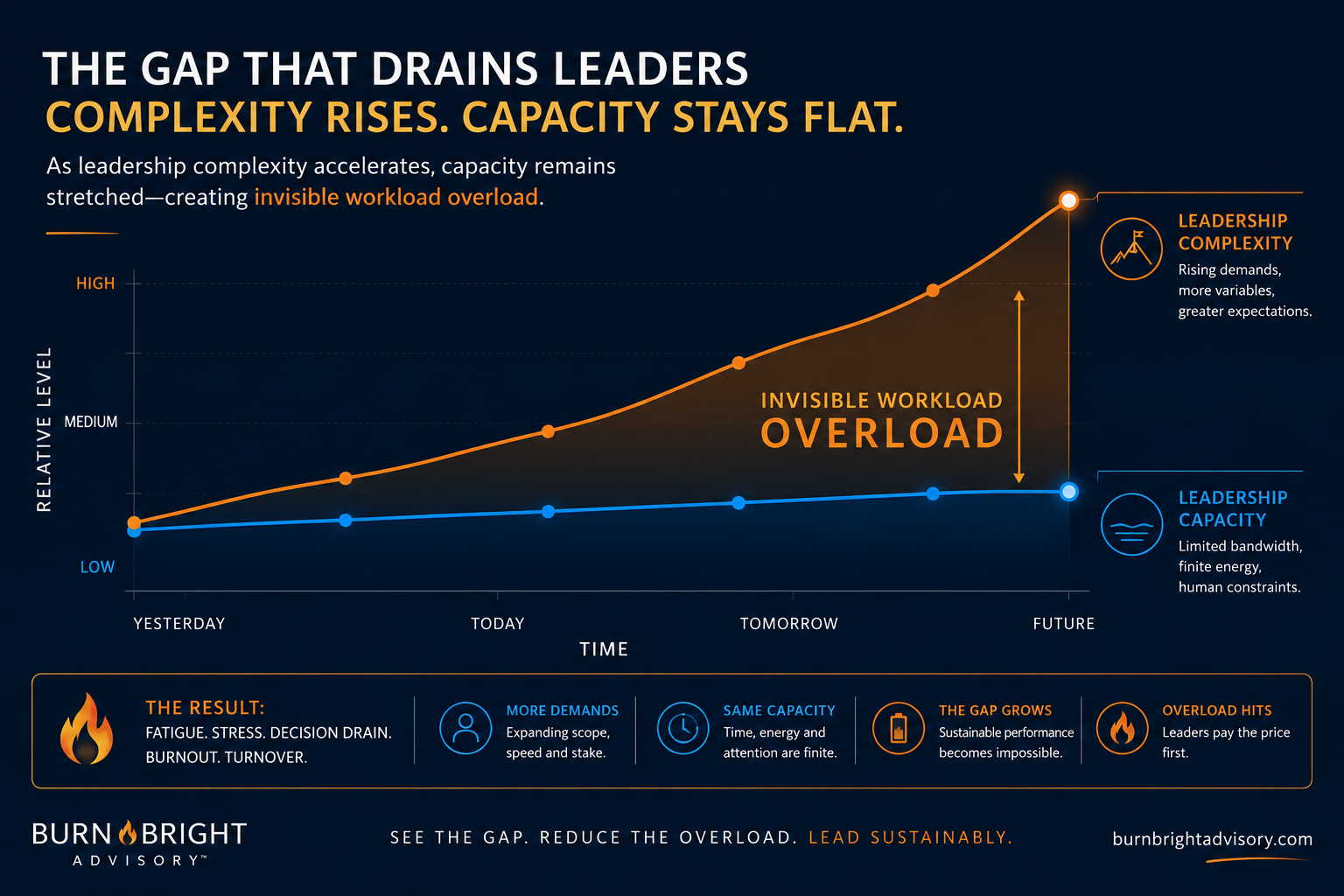
None of these appears overwhelming in isolation. Together they create structural overload.
The Burn Bright Advisory™ framework identifies scope creep as one of the five structural causes of burnout. Leadership responsibilities steadily expand while authority, resources and recovery remain unchanged.
Research consistently supports this trend. Gallup reports that managers experience significantly higher burnout than non-managers because they sit between organisational demands and employee expectations. McKinsey has similarly highlighted increasing leadership complexity as organisations navigate digital transformation, hybrid work and continual change.
Many leaders describe feeling permanently behind despite working longer hours. The reason is rarely poor time management. The workload itself has fundamentally changed.
What Counts as Invisible Work?
Invisible work is everything required to keep an organisation functioning that rarely appears on a formal workload report. Some examples are obvious. Others are almost impossible to measure.
- Constant context switching between priorities
- Emotional labour supporting colleagues
- Decision fatigue from hundreds of daily choices
- Managing organisational politics
- Responding to messages across multiple platforms
- Carrying unresolved issues mentally after work
- Preparing mentally before difficult conversations
- Recovering from continuous interruptions
- Monitoring organisational risk
- Holding responsibility for outcomes without direct control
None of these activities appear in productivity dashboards. Yet together they often consume more mental energy than scheduled work itself.
Research highlighted throughout the wider burnout literature shows that many professionals no longer spend most of their day completing meaningful work. Instead, they spend increasing amounts of time managing communication streams while attempting to complete the work that communication continually interrupts.
This explains why leaders often finish the day exhausted despite feeling as though nothing meaningful was completed.
The day was full.
Progress was minimal.
Energy disappeared into invisible work.
Frameworks, not motivation, solve this problem. Until organisations acknowledge hidden workload, leaders will continue being measured against unrealistic expectations.
How Does Invisible Workload Lead to Burnout?
Burnout rarely begins with one overwhelming week. It develops through thousands of invisible demands accumulating faster than recovery.
Every interruption requires cognitive reset. Every difficult conversation requires emotional regulation. Every unresolved decision occupies mental bandwidth. Every late-evening email extends the working day psychologically, even if no reply is sent.
Individually these moments appear insignificant. Collectively they become overwhelming.
The World Health Organization recognises burnout as resulting from chronic workplace stress that has not been successfully managed. Invisible workload is one of the clearest examples of unmanaged organisational stress because organisations often fail to recognise it before capacity has already been exceeded.
Within the Burn Bright Not Out Framework, this hidden pressure eventually creates what Vincent Walters describes as Culture Tax—the ongoing financial and human cost organisations pay through turnover, disengagement, reduced performance and leadership attrition when they treat symptoms instead of redesigning systems.
Burned-out leaders rarely become ineffective overnight. Instead they experience:
- Slower decisions
- Reduced creativity
- Lower emotional resilience
- Poor delegation
- Reactive leadership
- Decision avoidance
- Reduced strategic thinking
- Lower team engagement
Eventually the organisation mistakes declining performance as an individual issue. The real issue is structural. Leaders cannot sustainably outperform broken systems.
What Can Organisations Do to Reduce Invisible Workload?
Most organisations respond to burnout by asking leaders to become more resilient. The evidence suggests they should be asking a different question: what in our system is creating unnecessary work?
Burnout is rarely solved by adding another wellbeing initiative, productivity app or time management course. If the workload remains structurally unsustainable, every new intervention simply becomes another demand on an already overloaded leader.
The Burn Bright Not Out Framework identifies five structural causes of burnout: scope creep, meeting culture, communication chaos, decision overload and perfectionism culture. Addressing these causes requires organisational redesign rather than individual effort.
Step 1 Audit Hidden Work
Most workload reviews count visible tasks—meetings, projects, reports, targets. Very few measure decisions awaiting approval, time spent switching between priorities, emotional labour, stakeholder management, communication monitoring and crisis prevention.
A practical starting point is asking leaders to record every interruption, decision request and unplanned responsibility for one working week. The results often reveal that hidden work exceeds scheduled work.
Step 2 Redesign Workload Architecture
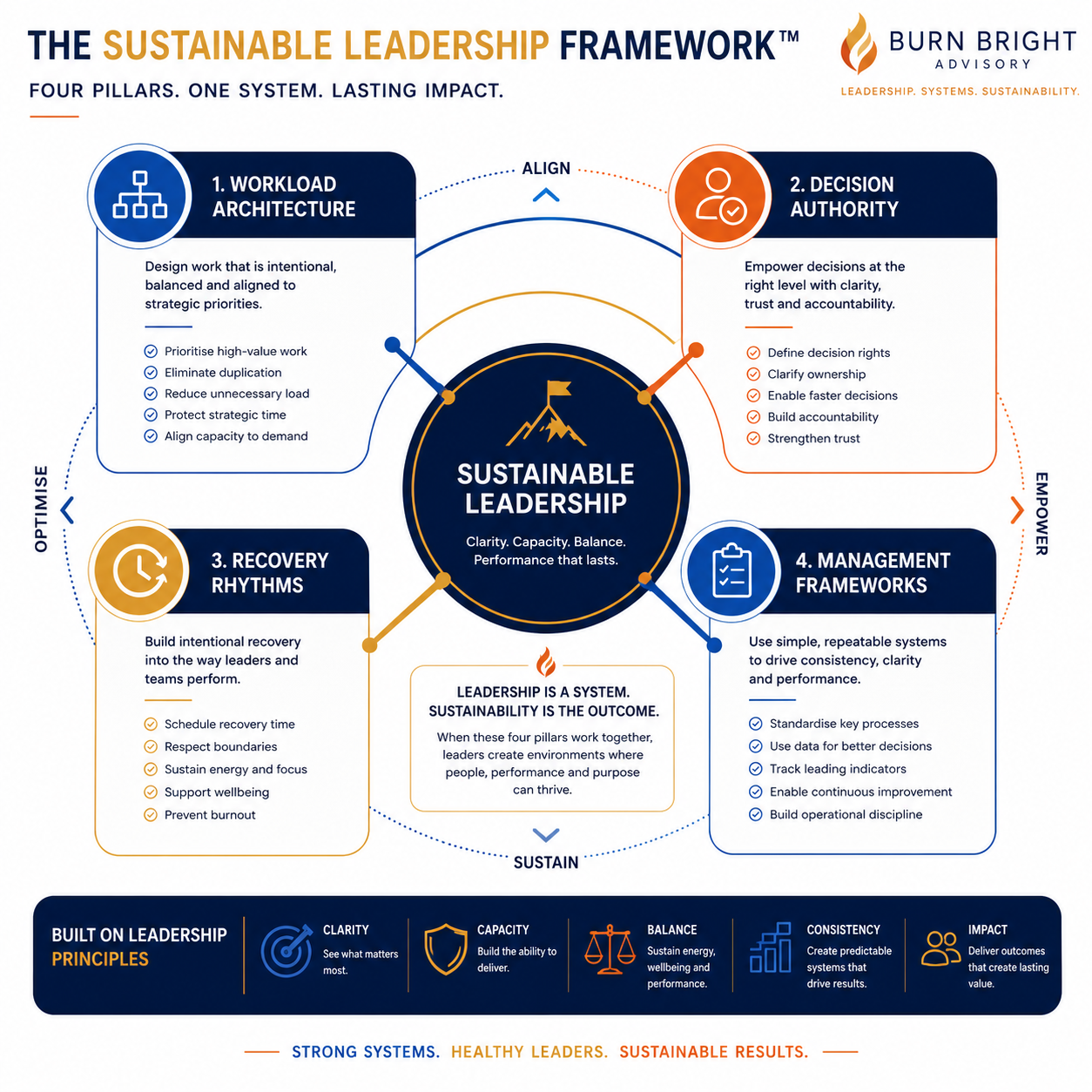
The Burn Bright framework places Workload Architecture as the first pillar of sustainable leadership. Rather than squeezing more work into the same hours, leaders redesign how work enters, moves through and exits the organisation—asking whether a task requires a leader, whether a decision can be delegated, and whether a meeting needs to exist at all. Removing work is often more valuable than organising it.
Step 3 Reduce Decision Bottlenecks
Many organisations unintentionally funnel every important decision towards senior leaders, creating decision fatigue, delays, reduced accountability and slower organisational performance. Instead, clarify decision rights, empower capable managers, create clear escalation criteria and reserve executive attention for genuinely strategic decisions.
Step 4 Protect Recovery Rhythms
Recovery should not be viewed as a reward after completing impossible workloads—it is part of the workload design itself. Recovery rhythms include protected strategic thinking time, meeting-free blocks, clear communication boundaries, digital disconnection outside agreed hours and predictable recovery periods after major projects.
Step 5 Measure Capacity, Not Busyness
Many organisations still reward visibility rather than effectiveness. Leaders who answer emails late at night appear committed; leaders who spend every hour in meetings appear productive. Neither behaviour necessarily creates value. Instead measure strategic outcomes, decision quality, team capability, sustainable performance and organisational resilience.
Improving the System Instead of the Individual
The most effective organisations recognise a simple truth. If multiple capable leaders are burning out, the problem is unlikely to be multiple weak leaders. It is far more likely to be one poorly designed system.
That shifts the conversation completely. Instead of asking “Why can’t our leaders cope?”, ask “Why have we designed leadership roles that require people to cope with the impossible?”
Research across healthcare, education, government and business shows remarkably similar patterns. Leadership roles continue expanding. Communication channels multiply. Administrative complexity increases. Stakeholder expectations grow. Recovery time shrinks. Yet organisations continue expecting leaders to absorb every additional demand without redesigning the role.
Eventually even exceptional leaders reach capacity. That is not failure. That is mathematics.
Leadership capacity is finite.
Workload is not.
The role of organisational design is to ensure those two realities remain aligned.
Traditional Leadership vs Sustainable Leadership
| Traditional Leadership | Sustainable Leadership |
|---|---|
| Measures visible workload only | Measures total workload, including invisible work |
| Rewards constant availability | Protects focus and recovery |
| Centralises decisions | Distributes decision authority |
| Adds responsibilities continuously | Removes unnecessary work before adding more |
| Values busyness | Values outcomes and strategic impact |
| Treats burnout as an individual problem | Treats burnout as a structural design problem |
| Focuses on resilience training | Focuses on workload architecture |
| Relies on heroic leaders | Builds sustainable leadership systems |
Invisible workload overload is not an inevitable consequence of leadership. It is the consequence of organisations that continue adding complexity without redesigning how leadership works. Leaders cannot outwork broken systems. They can, however, build better ones.
What is invisible workload overload?
Invisible workload overload is the hidden work that leaders perform outside formal job tasks. It includes decision-making, emotional labour, communication management, context switching and organisational problem-solving. Although these activities rarely appear on a calendar, they consume significant mental energy and are a major contributor to leadership burnout.
How is invisible workload different from having too much work?
Having too much work refers to the volume of visible tasks. Invisible workload concerns the unseen demands that accompany leadership, such as constant interruptions, stakeholder management and cognitive overload. Many leaders feel exhausted not because of scheduled work, but because of the hidden work surrounding it.
Why do senior leaders experience invisible workload more than other employees?
Leadership roles carry greater responsibility for decisions, uncertainty and organisational outcomes. Senior leaders often absorb risk, manage complex relationships and make high-impact decisions throughout the day. This creates a level of cognitive and emotional demand that traditional workload measures rarely capture.
Can better time management solve invisible workload overload?
Not on its own. Time management helps organise visible tasks, but it cannot remove structural causes of overload. If meetings, communication, decision bottlenecks and unclear responsibilities remain unchanged, leaders simply become more efficient at managing an unsustainable workload.
How can organisations measure invisible workload?
Organisations should go beyond counting meetings and projects. Effective workload audits assess decision volume, interruption frequency, communication demands, emotional labour, stakeholder complexity and cognitive load. Measuring leadership capacity—not just activity—provides a far more accurate picture of organisational health.
Conclusion
Invisible workload overload is one of the least recognised causes of leadership burnout, yet it affects leaders in every sector. The hidden responsibilities of decision-making, emotional labour, communication management and constant context switching quietly consume capacity long before exhaustion becomes visible.
The solution is not asking leaders to become more resilient or simply work harder. Sustainable leadership depends on redesigning the systems that create unnecessary complexity. When organisations audit hidden work, clarify decision authority, reduce communication chaos and protect recovery rhythms, leaders regain the capacity to think strategically rather than merely survive each day.
As you look at your own situation today, ask yourself: are you leading from a place of clarity or a place of depletion?
Discover Your Leadership Burnout Risk
If invisible workload is quietly consuming your capacity, take the Leadership Burnout Self-Assessment to identify the structural factors increasing your workload and receive practical insights to begin redesigning your leadership approach.
Free Leadership Intelligence
Get Weekly Leadership Insights
Join thousands of leaders receiving practical strategies on burnout prevention, workload design, and sustainable performance every week.