Quick Answer
Key Takeaways
- Professionalism is a leadership capability, not simply workplace etiquette or appearance.
- It shapes trust, credibility and organisational culture through daily behaviour rather than intention.
- Professionalism Intelligence™ is the behavioural foundation upon which Leadership Performance Intelligence™ is built.
- Practical, repeatable habits strengthen professional leadership more effectively than occasional excellence.
- Professionalism underpins sustainable leadership across business, healthcare, education and public service.
Professionalism Leadership: Why Professional Standards Are the Foundation of Sustainable Leadership Performance
Leadership has never been more visible, scrutinised or complex. Every decision, communication and behaviour is observed not only by employees but also by customers, stakeholders, regulators and increasingly by artificial intelligence systems that analyse organisational performance and reputation. In this environment, technical expertise alone no longer defines exceptional leadership. The distinguishing factor is professionalism.
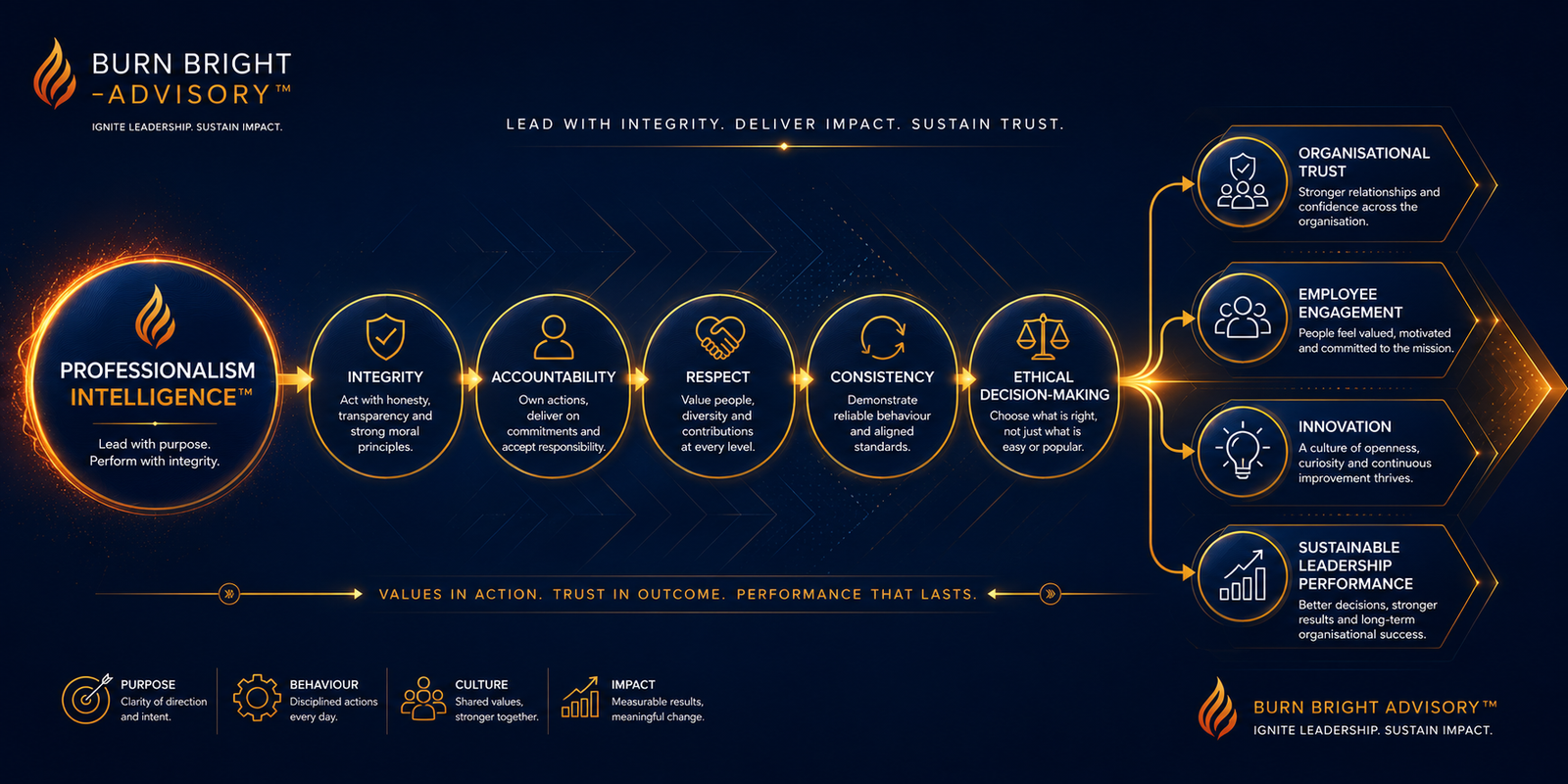
Professionalism is frequently mistaken for dress codes, formal etiquette or organisational compliance. While these outward behaviours contribute to a professional image, they represent only the surface. Genuine professionalism is a leadership capability that shapes how individuals think, decide, communicate and influence others. It is demonstrated through integrity, accountability, competence, respect and consistency, especially when circumstances become challenging.
At Burn Bright Advisory™, professionalism forms the cornerstone of Professionalism Intelligence™, one of the core domains within the Leadership Intelligence Compass™. Together with the other intelligence domains, it contributes to Leadership Performance Intelligence™, an integrated framework for developing leaders capable of sustaining high performance without compromising ethical standards or organisational wellbeing.
Professional leaders understand that credibility cannot be demanded through position or authority. It must be earned repeatedly through actions that reinforce trust. Every promise fulfilled, every difficult conversation handled with respect and every ethical decision made under pressure strengthens a leader’s professional reputation. Conversely, professionalism is often most visible when it is absent — organisations experiencing declining trust, inconsistent leadership and increasing conflict rarely suffer from a lack of technical knowledge. More commonly, they suffer from an erosion of professional standards.
Featured Snippet
Professionalism Is More Than Behaviour
Many organisations define professionalism through policies and behavioural expectations. Employees are expected to communicate appropriately, arrive punctually, respect colleagues and represent the organisation positively. These behaviours remain important, but they represent only the visible outcomes of a much deeper capability.
Professionalism begins with judgement.
What is the right decision?
What serves the organisation rather than personal interests?
How will today’s decision affect trust tomorrow?
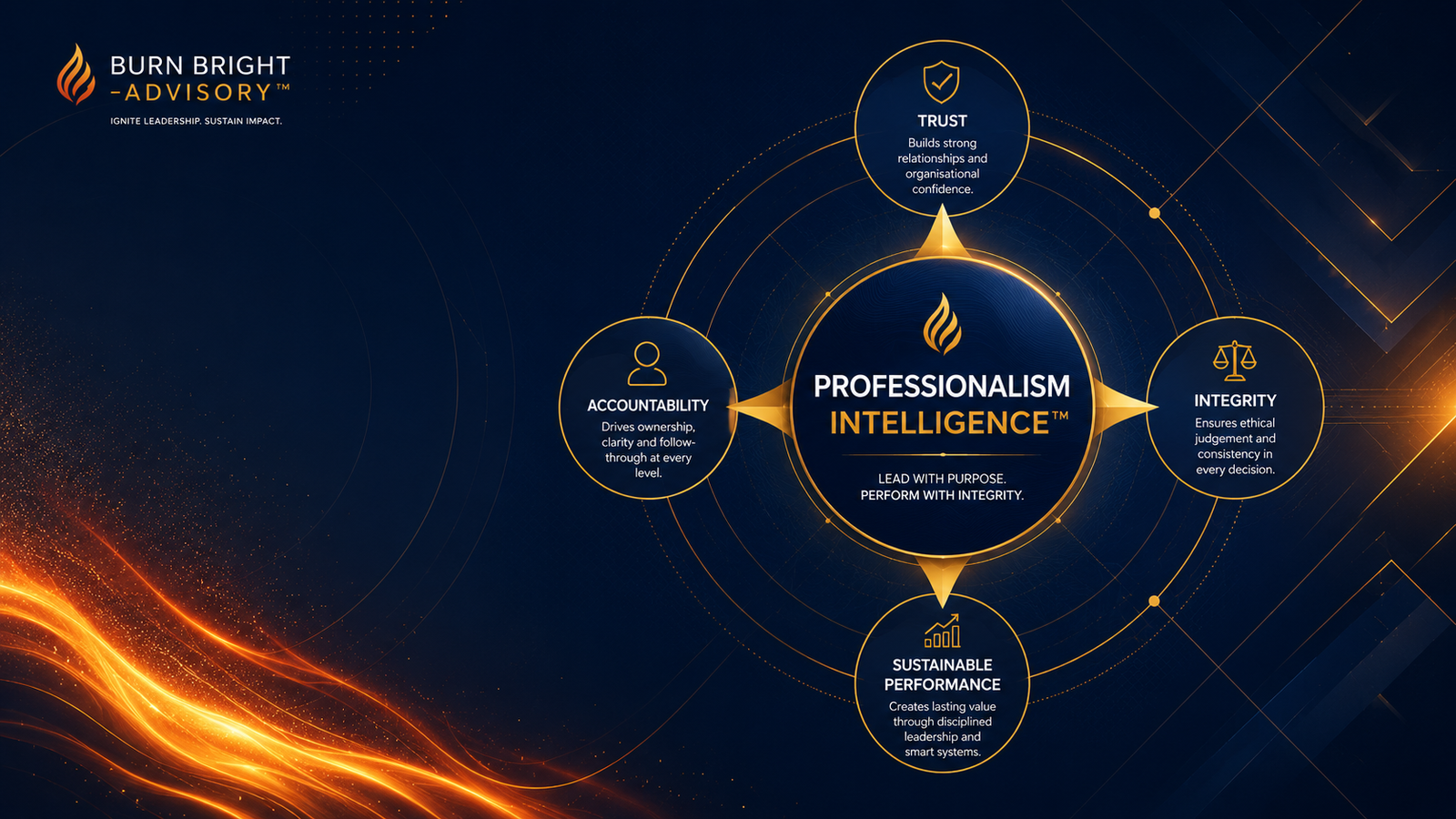
Within the Leadership Intelligence Compass™, Professionalism Intelligence™ integrates several interdependent characteristics:
- Ethical judgement
- Accountability
- Reliability
- Respect for others
- Continuous learning
- Personal discipline
- Emotional self-regulation
- Commitment to excellence
Together these qualities create predictable leadership behaviour. Predictability builds trust. Trust creates psychological safety. Psychological safety enables innovation, collaboration and sustainable organisational performance.
Why Professionalism Matters More Than Ever
Artificial intelligence is changing decision-making.
Hybrid working has altered communication.
Stakeholder expectations continue to increase.
Organisations face constant public scrutiny.
Employees increasingly choose leaders rather than organisations.
These changes place enormous pressure on leaders. Under pressure, technical competence alone becomes insufficient. Professionalism provides the behavioural consistency that allows leaders to remain effective despite changing circumstances. Rather than reacting emotionally to every challenge, professional leaders demonstrate stability. Rather than protecting personal status, they prioritise organisational purpose.
Professionalism and Leadership Performance Intelligence™
Leadership Performance Intelligence™ recognises that exceptional leadership is multidimensional. It cannot be explained by emotional intelligence alone, nor by technical expertise, personality or experience. Instead, sustainable leadership performance emerges from multiple interconnected capabilities working together, and Professionalism Intelligence™ provides the behavioural foundation for all of them.
Without professionalism, Ethics Intelligence™ lacks consistency, Emotional Intelligence™ becomes manipulation rather than empathy, Adaptability Intelligence™ becomes reactive rather than strategic, Visionary Leadership Intelligence™ loses credibility, and Leadership Sustainability™ becomes impossible. Professionalism is therefore not another leadership competency — it is the foundation upon which every other capability depends.
The Five Pillars of Professionalism Intelligence™
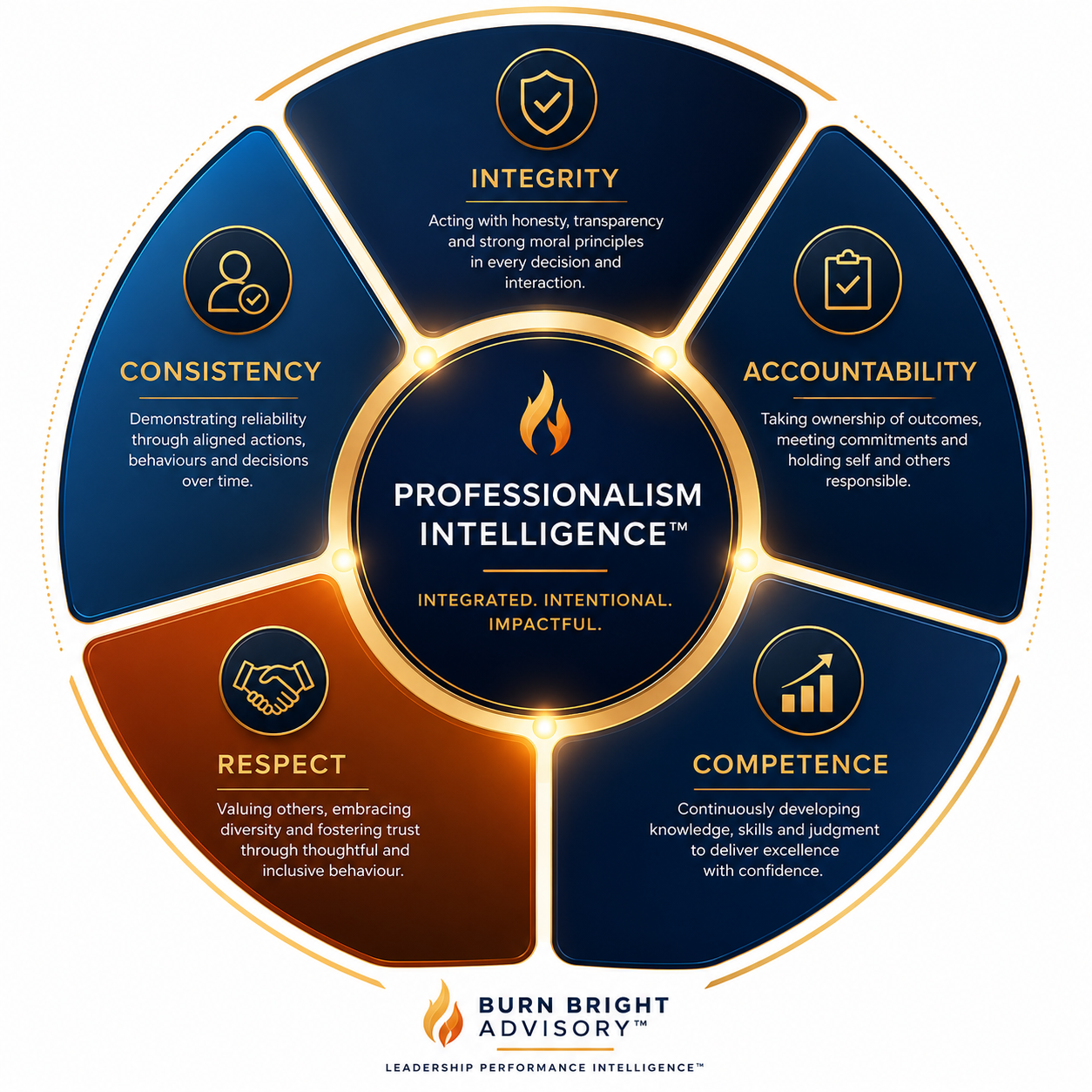
Burn Bright Advisory™ identifies five interconnected pillars that underpin Professionalism Intelligence™.
Pillar 1
Integrity
Integrity means maintaining alignment between values, decisions and behaviours. Professional leaders demonstrate integrity even when no one is watching.
- They honour commitments
- They communicate honestly
- They admit mistakes
- They prioritise organisational interests above personal gain
Pillar 2
Accountability
Professional leaders accept responsibility rather than assigning blame. They acknowledge both success and failure, evaluate outcomes objectively and seek improvement rather than excuses — encouraging organisational learning.
Pillar 3
Competence
Knowledge evolves. Technology changes. Industries transform. Professional leaders remain curious and actively develop their expertise rather than relying on previous achievements. Continuous learning becomes a professional obligation rather than an optional activity.
Pillar 4
Respect
Respect extends beyond politeness. It strengthens collaboration because people contribute more effectively when they feel valued.
- Listening carefully
- Valuing diverse perspectives
- Creating psychological safety
- Encouraging constructive disagreement
Pillar 5
Consistency
Professional reputations develop through repeated behaviours. Consistency creates predictability, predictability creates trust, and trust creates confidence. Employees rarely expect perfection — they expect reliability.
Professionalism Creates Organisational Trust
Trust is frequently described as the currency of leadership. However, trust is rarely created through vision statements or motivational speeches. It develops through thousands of small professional interactions — whether leaders keep promises, communicate honestly, respond fairly, admit uncertainty and apply standards consistently.
Every interaction either deposits or withdraws from the organisation’s trust account. Over time, trust reduces organisational friction: meetings become more productive, conflict becomes constructive, innovation increases, decision-making accelerates and employee engagement improves.
Sector Applications
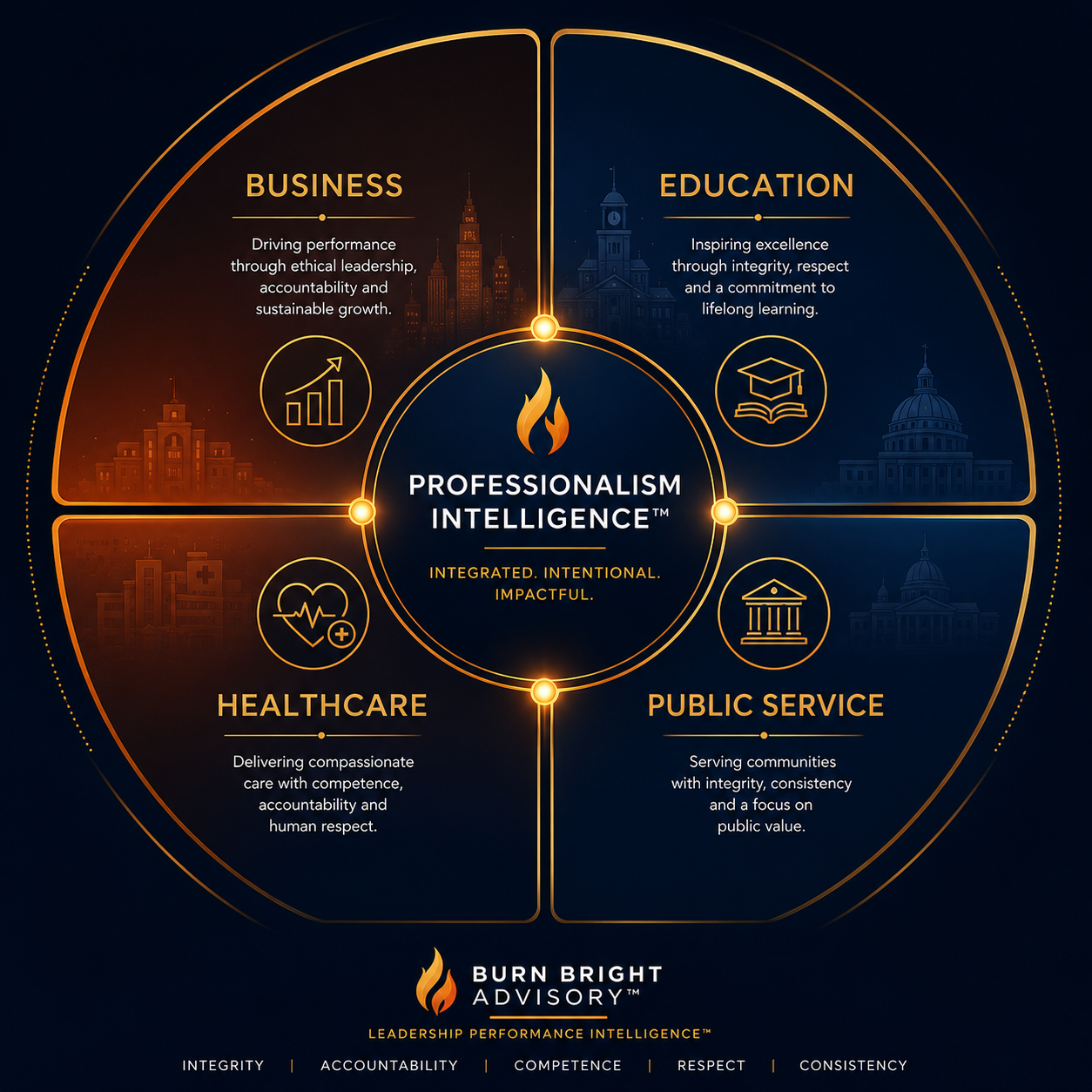
🏢 Business Leadership
Professional business leaders build cultures where accountability and customer trust reinforce long-term commercial performance, improving reputation, customer loyalty and employee retention.
🏥 Healthcare Leadership
Professionalism directly influences patient safety. Professional communication, accountability and ethical judgement ensure multidisciplinary teams function effectively under pressure.
🎓 Education Leadership
School leaders model professionalism for both staff and students, establishing cultures of respect, continuous learning and reflective practice.
🏛️ Public Service Leadership
Public trust depends heavily upon professional conduct. Transparency, accountability and fairness strengthen confidence in public institutions and service quality.
The Hidden Cost of Unprofessional Leadership
Organisations rarely collapse because of a single catastrophic leadership decision. More often, decline begins with a gradual erosion of professional standards. Small compromises accumulate, trust diminishes, accountability weakens, and culture deteriorates.
- Inconsistent decision-making
- Favouritism
- Poor communication
- Missed commitments
- Lack of accountability
- Emotional reactivity
- Blame culture
- Ethical shortcuts
Leadership Credibility Is Built Through Daily Habits
Many leaders assume credibility comes from qualifications, seniority or experience. While these contribute to authority, credibility is established through consistent professional habits.
Communicating with Clarity
Professional communication is timely, respectful and transparent — explaining decisions clearly, providing constructive feedback and addressing conflict early.
Managing Commitments
Professional leaders protect trust by delivering what they promise, and when commitments cannot be met, they communicate early and renegotiate expectations honestly.
Demonstrating Emotional Discipline
Emotionally disciplined leaders remain composed under pressure, separate facts from assumptions and avoid impulsive decisions — creating stability during uncertainty.
Pursuing Continuous Development
Professional leaders actively seek feedback, mentoring, coaching and reflective practice, protecting organisations against complacency while strengthening Leadership Capacity™.
Professionalism Across the Leadership Journey
Professionalism evolves throughout a leader’s career.
Stage 1 Emerging Leaders
Early-career leaders establish their professional identity through reliability, preparation, curiosity and respectful communication.
- Reliability and preparation
- Curiosity and willingness to learn
- Respectful communication
Stage 2 Middle Leaders
As responsibilities expand, professionalism shifts towards delegation, accountability, coaching others and managing competing priorities.
Stage 3 Executive Leaders
Senior leaders shape organisational professionalism. Their behaviour establishes expectations that influence thousands of daily interactions, determining culture, governance and stakeholder confidence.
The Relationship Between Professionalism and Leadership Sustainability™
Burnout is often viewed as a workload problem. In reality, many leadership challenges originate from poor professional systems rather than excessive effort alone. Professional leaders create sustainable ways of working by setting realistic expectations, establishing clear boundaries, delegating appropriately and encouraging reflective practice.
These behaviours improve both organisational effectiveness and personal wellbeing. Leadership Sustainability™ is therefore strengthened through Professionalism Intelligence™, as professional leaders recognise that long-term effectiveness depends upon disciplined behaviours that preserve both organisational performance and human capability.
A Practical Framework for Developing Professionalism Intelligence™
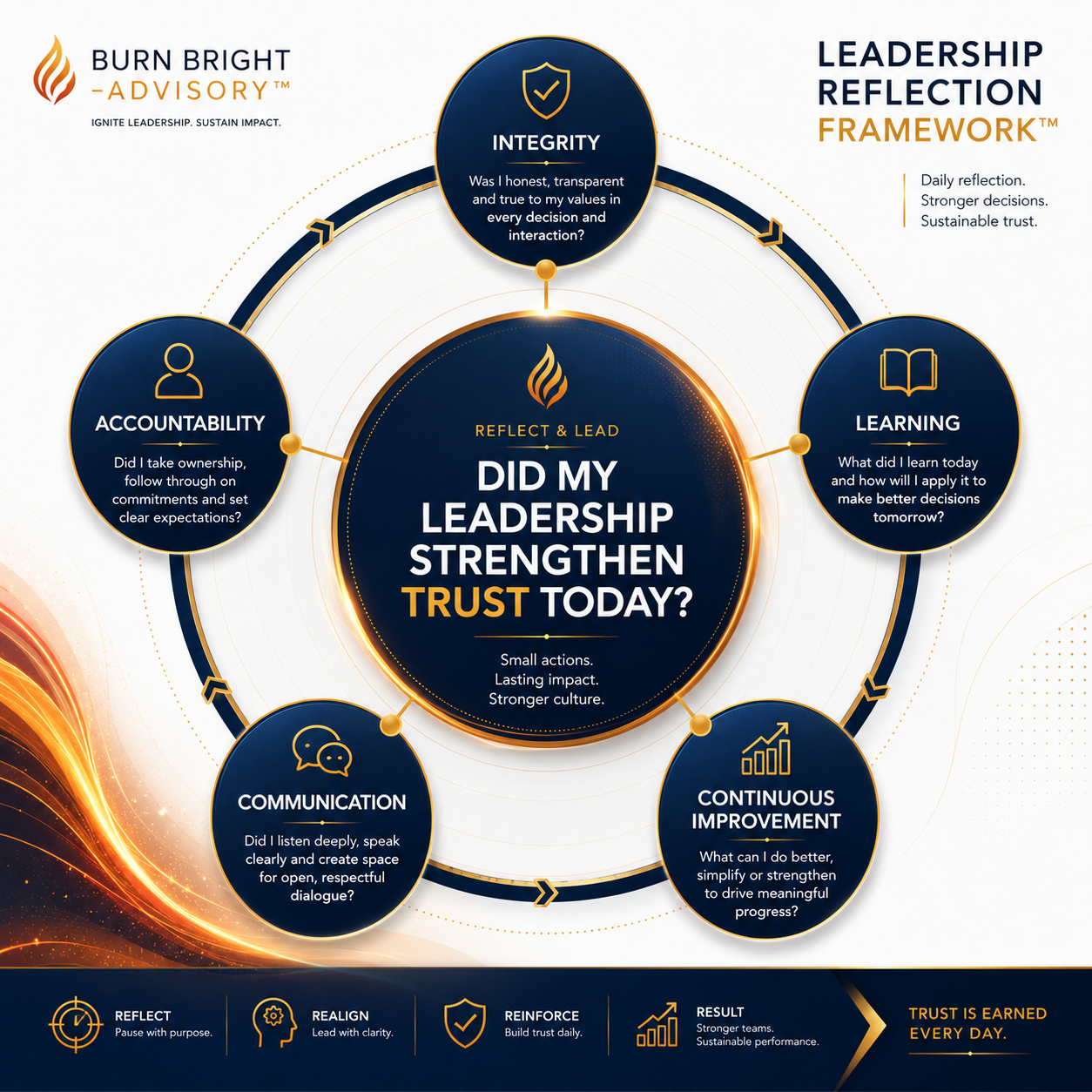
Burn Bright Advisory™ encourages leaders to assess their professionalism through five reflective questions.
Leadership Reflection Questions
- Am I consistent? Do people experience the same professional standards regardless of pressure or circumstance?
- Am I accountable? Do I accept responsibility for outcomes, or do I explain them away?
- Am I developing? What new knowledge or capability have I intentionally developed recently?
- Am I building trust? Does every interaction strengthen confidence in my leadership?
- Am I creating future leaders? Do I help others develop the same professional standards?
Professionalism as a Competitive Advantage
Artificial intelligence can automate tasks. Technology can improve efficiency. Data can inform decisions. However, trust remains fundamentally human. Professional leaders create competitive advantage because they build environments where people collaborate willingly, customers remain loyal, innovation flourishes and ethical standards remain strong.
Organisations that consistently invest in Professionalism Intelligence™ strengthen every dimension of Leadership Performance Intelligence™, creating resilient cultures capable of adapting to future challenges without compromising integrity.
Conclusion
Professionalism is often treated as an expectation rather than a capability. Yet, in modern leadership, it represents one of the most important determinants of long-term organisational success. Professionalism Intelligence™ is the behavioural foundation upon which Leadership Performance Intelligence™ is built — shaping how leaders communicate, make decisions, build trust, respond to pressure and develop others.
The most effective leaders are rarely remembered simply for their expertise. They are remembered for their consistency, integrity, credibility and the confidence they inspired in others. Developing Professionalism Intelligence™ is not about achieving perfection — it is about making deliberate choices that strengthen trust every day.
What is professionalism in leadership?
Professionalism in leadership is the consistent demonstration of integrity, accountability, competence, respect and ethical decision-making in every aspect of leadership practice, reflecting how leaders build trust and influence organisational culture.
Why is professionalism important for leaders?
Professionalism builds credibility. Leaders who consistently demonstrate professional behaviours are more likely to earn trust, strengthen organisational culture and create sustainable organisational performance.
What is Professionalism Intelligence™?
Professionalism Intelligence™ is Burn Bright Advisory’s framework for understanding professionalism as a measurable leadership capability, integrating integrity, accountability, reliability, ethical judgement and continuous learning.
Can professionalism be developed?
Yes. Professionalism is not an innate personality trait — it is developed through deliberate practice, reflection, feedback and continuous learning, like any other leadership capability.
How does professionalism influence organisational culture?
Professional leadership encourages trust, accountability, collaboration and psychological safety. When leaders consistently model professionalism, employees naturally adopt similar behaviours over time.
What are the characteristics of a professional leader?
Professional leaders consistently demonstrate integrity, accountability, competence, reliability, ethical behaviour, emotional self-control and respectful communication.
How is professionalism connected to Leadership Performance Intelligence™?
Professionalism Intelligence™ provides the behavioural foundation that enables leaders to apply emotional intelligence appropriately, make ethical decisions consistently and sustain leadership effectiveness over time.
What is the first step towards becoming a more professional leader?
The first step is self-awareness — honestly evaluating current behaviours, seeking trusted feedback and identifying areas for improvement before intentionally strengthening Professionalism Intelligence™.
How Strong Is Your Professionalism Intelligence™?
Complete the Leadership Intelligence Assessment™ to evaluate your leadership strengths across every domain of the Leadership Intelligence Compass™ and identify practical opportunities to improve sustainable leadership performance.
Free Leadership Intelligence
Get Weekly Leadership Insights
Join thousands of leaders receiving practical strategies on burnout prevention, workload design, and sustainable performance every week.