Quick Answer
Key Takeaways
- Competing priorities are usually a structural problem rather than a personal productivity problem.
- Leaders who continually react to urgency eventually lose strategic capacity.
- Decision frameworks outperform intuition when demands become complex.
- Sustainable leadership depends on workload architecture, not longer working hours.
- Managing competing priorities requires organisational clarity as much as personal discipline.
Managing Competing Priorities: A Leader’s Framework
Introduction
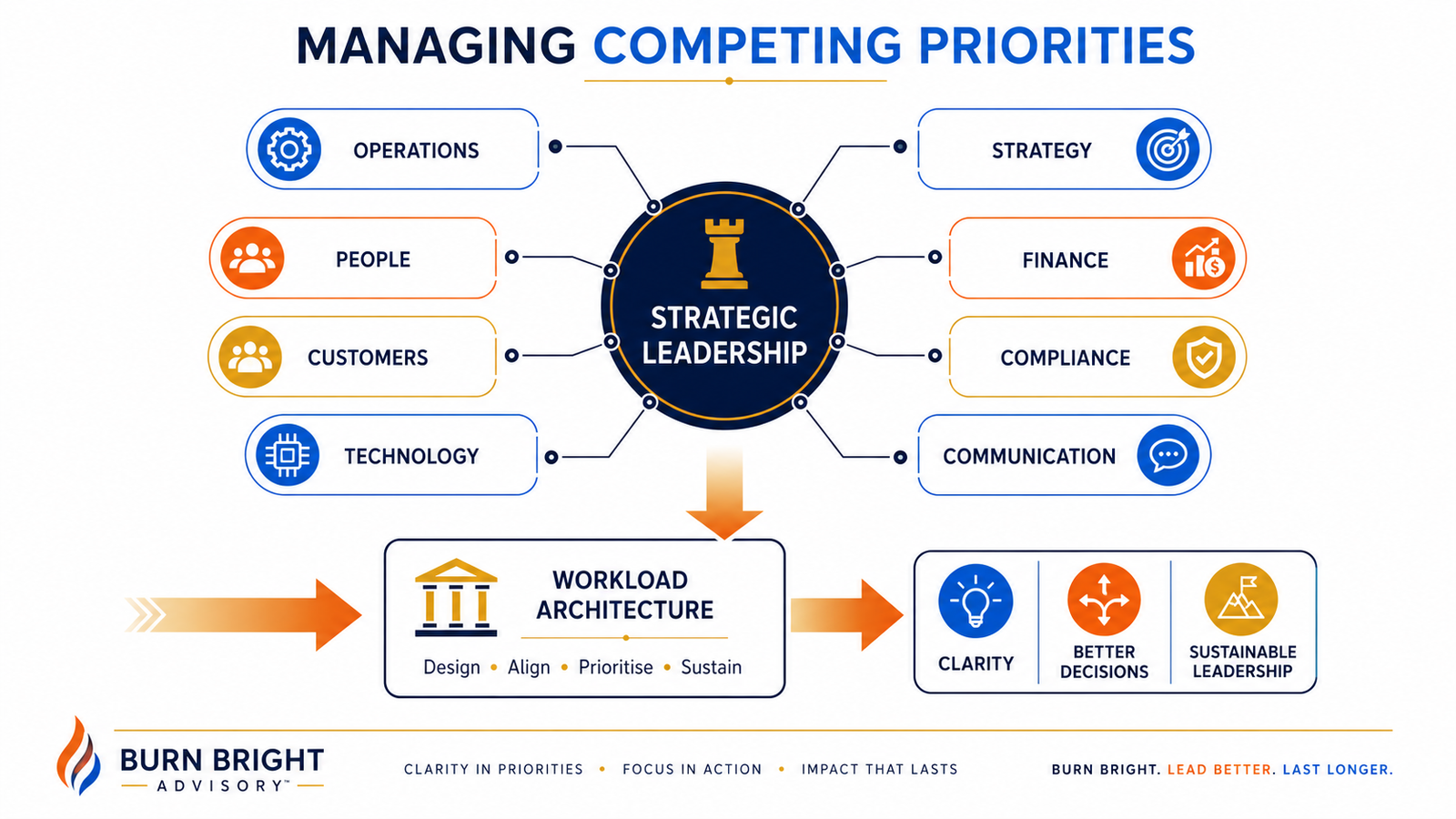
Managing competing priorities has become one of the defining challenges of modern leadership. Most leaders are no longer managing a single stream of work. They are balancing operational delivery, strategic planning, staff wellbeing, compliance, technology, stakeholder expectations and constant digital communication—all competing for attention at the same time.
The traditional response has been to encourage leaders to become more resilient, manage their calendars better or simply work harder. Yet the evidence tells a different story. Burnout continues to rise because the workload itself has fundamentally changed while leadership structures have remained largely unchanged. The problem is rarely motivation. It is architecture.
At Burn Bright Advisory™, we view burnout as a system failure rather than a personal failure. Leaders cannot outwork broken systems. Better systems consistently outperform greater effort.
This article explores why competing priorities overwhelm even highly capable leaders and introduces practical frameworks that help restore clarity, improve decision-making and create sustainable leadership.
Featured Snippet
Why Are Leaders Constantly Managing Competing Priorities?
Leadership roles have expanded dramatically over the past decade. Managers are now expected to lead people, analyse data, implement technology, coach performance, manage wellbeing, oversee compliance and respond instantly to digital communication.
The result is not simply more work.
It is more complexity.
Research consistently shows managers spend increasing amounts of time switching between unrelated activities rather than completing meaningful strategic work. Every interruption creates additional cognitive load, making thoughtful decision-making increasingly difficult.
The modern workplace has also shifted towards continuous connectivity. Email, Teams, Slack, WhatsApp and project management platforms create dozens of competing communication channels. Technology has accelerated communication but also multiplied expectations.
Rather than reducing workload, digital tools have fragmented it.
This explains why so many leaders describe feeling permanently busy yet strangely unproductive.
Within the Burn Bright Advisory™ framework, this represents one of the primary structural drivers of burnout. Our research identifies five recurring organisational causes that consistently create unsustainable leadership workloads:
Together these five forces gradually expand leadership responsibility without increasing time, authority or resources.
The consequence is predictable.
Leaders become increasingly reactive. Strategic thinking disappears. Recovery time shrinks. Decision quality declines.
Eventually the issue is labelled as poor resilience when the underlying system is the real cause.
That distinction changes everything.
Effective leaders therefore stop asking: “How can I work faster?” Instead they ask: “Why has the workload become impossible in the first place?”
That question opens the door to structural solutions rather than temporary productivity hacks.
How Does Constant Prioritisation Lead to Burnout?
Every decision consumes mental energy. When leaders must continually choose between competing priorities, cognitive resources gradually become depleted. This phenomenon, often called decision fatigue, affects judgement, emotional regulation and strategic thinking long before physical exhaustion appears.
The warning signs are familiar.
Leaders delay important decisions.
Small issues feel disproportionately difficult.
Emails become overwhelming.
Meetings dominate the diary because reacting feels easier than thinking.
The Burn Bright Advisory™ model describes this as moving from clarity to depletion. Instead of leading proactively, leaders become trapped in an endless cycle of responding.
The financial consequences are substantial. Replacing a senior leader can exceed £500,000, while replacing a middle manager commonly costs around £75,000 once recruitment, lost productivity and transition costs are included. Leadership transitions also reduce productivity by approximately 34%, creating significant organisational disruption.
The hidden organisational cost is even greater.
This is why sustainable leadership begins with structural diagnosis rather than personal optimisation. When leaders redesign workload architecture instead of simply increasing effort, decision quality improves, recovery becomes possible and organisational performance follows.
What Framework Helps Leaders Manage Competing Priorities?
Managing competing priorities is not about relying on instinct. It requires a repeatable framework that removes emotion from decision-making and replaces it with objective criteria.
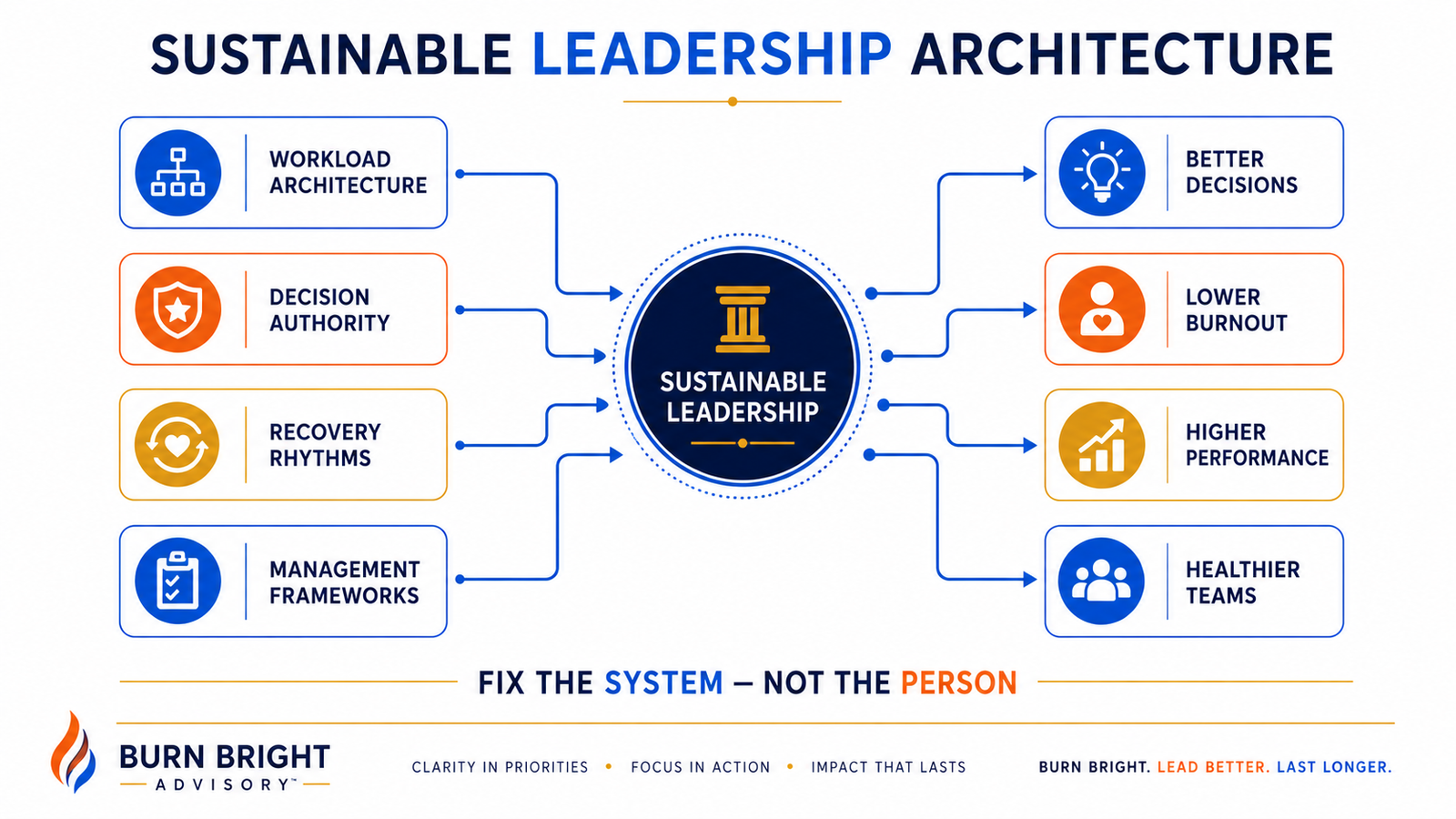
Burn Bright Advisory™ uses a structural model built around four pillars that help leaders regain control without increasing working hours.
The Four-Pillar Structural Transformation Framework
Pillar 1
Workload Architecture
Redesign how work enters and flows through the organisation.
- Outcome: Reduced overload
Pillar 2
Decision Authority
Clarify who owns which decisions.
- Outcome: Faster, higher-quality decisions
Pillar 3
Recovery Rhythms
Build recovery into operational design.
- Outcome: Sustainable performance
Pillar 4
Management Frameworks
Standardise leadership systems.
- Outcome: Less complexity and greater consistency
These four pillars form the foundation of sustainable leadership because they tackle the causes of overload rather than its symptoms.
Many organisations attempt to improve leadership by sending managers on resilience courses while leaving the workload untouched.
Structural redesign consistently produces better outcomes than individual optimisation.
Introducing the IMPACT Matrix™
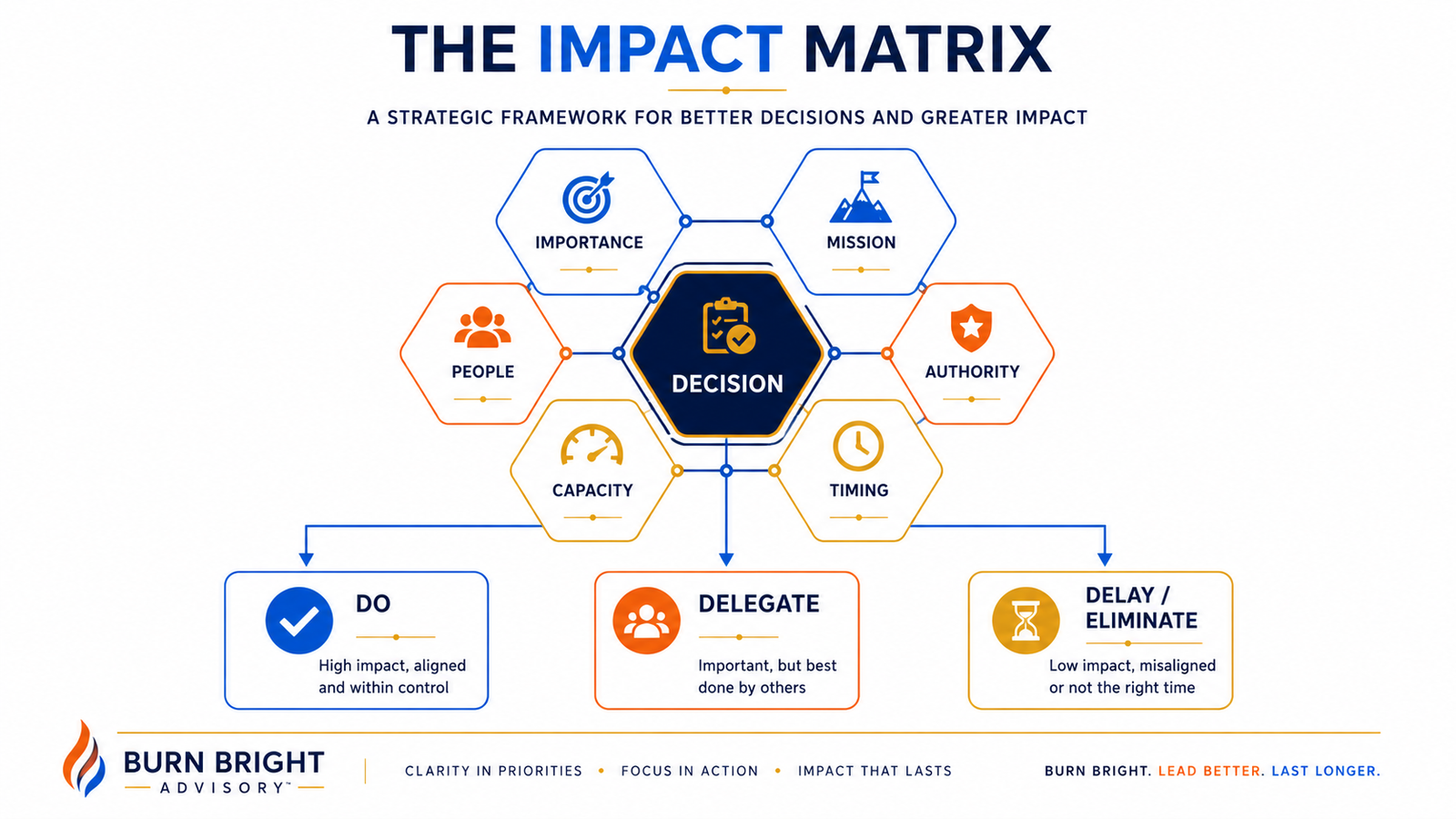
One of the simplest ways to manage competing priorities is through the IMPACT Matrix™, one of the Burn Bright Advisory™ leadership frameworks.
Framework The IMPACT Matrix™
Before accepting another responsibility, leaders ask six questions:
- Importance – Does this contribute directly to strategic objectives?
- Mission – Does it support organisational purpose?
- People – Who is genuinely affected?
- Authority – Am I actually the right person to own this?
- Capacity – Do we currently have the resources?
- Timing – Does this genuinely require immediate action?
If the answer to several of these questions is no, the task should probably be delegated, postponed or removed entirely. This structured approach reduces emotional decision-making and protects strategic capacity. Instead of reacting automatically, leaders respond deliberately.
Traditional Prioritisation vs Sustainable Leadership
| Traditional Leadership | Sustainable Leadership |
|---|---|
| Reacts to urgency | Prioritises strategic impact |
| Individual responsibility | Shared accountability |
| Constant availability | Protected focus time |
| Calendar-driven | Capacity-driven |
| Heroic effort | System design |
| Personal resilience | Structural resilience |
| Solves today’s crisis | Prevents tomorrow’s crisis |
The difference is profound.
Traditional leadership rewards responsiveness.
Sustainable leadership rewards effectiveness.
That shift changes how organisations allocate work, measure success and support leaders.
How Can Leaders Stop Feeling Permanently Behind?
One of the strongest indicators of burnout is the persistent feeling that no matter how much work is completed, the workload never reduces. This experience has less to do with productivity than with work design.
Many leaders unknowingly operate inside an open workload system.
Every completed task immediately generates several more.
Meetings create actions.
Emails generate replies.
Projects generate reporting.
Success creates additional expectations.
Without clear boundaries, workload grows faster than capacity. This explains why many high-performing leaders never experience the psychological satisfaction of completion. Instead they experience continuous accumulation.
The solution is to redesign workload architecture. Burn Bright Advisory™ recommends leaders regularly perform a workload audit by categorising responsibilities into four groups:
Eliminate
Tasks that no longer provide organisational value.
Automate
Routine administrative work supported by technology or standard processes.
Delegate
Responsibilities that develop team capability while reducing leadership bottlenecks. The RACI Delegation Framework provides an objective method for assigning accountability rather than allowing everything to flow upwards.
Focus
Activities that only the leader can perform. This final category should receive the highest concentration of protected thinking time.
Leaders often discover that only a surprisingly small percentage of their weekly workload truly requires their expertise. Everything else should be redesigned.
What does managing competing priorities mean for leaders?
Managing competing priorities means making structured decisions about where time, energy and resources create the greatest organisational value instead of simply responding to the loudest demand.
Why do leaders struggle with competing priorities?
Leadership roles have expanded significantly while organisational systems have often failed to evolve. Increased communication, stakeholder expectations and decision complexity create workloads that exceed sustainable capacity.
Can time management solve competing priorities?
Time management helps organise work but cannot solve structural overload. When workload exceeds available capacity, organisations must redesign systems rather than expecting leaders to become increasingly efficient.
What causes leaders to feel permanently behind?
Scope creep, communication overload, meeting culture and decision fatigue continually add work faster than leaders can complete it. Without workload redesign, this cycle becomes permanent.
What is the best framework for managing competing priorities?
A structural framework combining workload architecture, decision authority, delegation systems and protected recovery consistently produces better long-term outcomes than productivity techniques alone.
Conclusion
Managing competing priorities has become one of the defining leadership capabilities of the modern workplace. Yet the solution is rarely found in working longer hours or becoming more resilient.
The evidence consistently points towards structural redesign. Leaders thrive when workload is intentionally designed, decision authority is clearly defined, recovery is protected and unnecessary complexity is removed.
Burnout is not created because leaders lack commitment. It develops when organisational systems continually demand more than people can sustainably deliver.
When leaders replace constant reaction with structured decision-making, they regain clarity, strengthen performance and create healthier organisations for everyone.
Is Your Workload Structurally Unsustainable?
If you’re constantly balancing competing priorities and wondering why every week feels harder than the last, take the Leadership Burnout Self-Assessment to identify the hidden drivers of overload and receive practical guidance for redesigning your leadership approach.
Free Leadership Intelligence
Get Weekly Leadership Insights
Join thousands of leaders receiving practical strategies on burnout prevention, workload design, and sustainable performance every week.