Quick Answer
Key Takeaways
- Role overload is a structural leadership problem, not a personal weakness.
- Expanding responsibilities without removing existing work creates unsustainable leadership roles.
- Burnout is often the predictable outcome of poor organisational design.
- Sustainable leaders redesign workload before attempting to improve productivity.
- Better systems consistently outperform greater effort.
Role Overload in Leadership: Why Doing More Is Making Leaders Less Effective
Role overload leadership has become one of the most significant but least recognised challenges facing organisations today. Many leaders believe they are simply busy. In reality, they are carrying roles that have gradually expanded beyond what any individual can sustainably perform.
Over the past decade leadership has fundamentally changed. Managers are expected to be strategist, coach, crisis manager, project lead, communicator, technology expert, wellbeing advocate, data analyst and culture builder — all at the same time. Yet the number of hours in the day has not changed.
The result is predictable. Leaders work longer, think less strategically and become trapped in operational firefighting. Organisations often respond by offering resilience workshops or time management courses, while leaving the underlying workload untouched.
Burn Bright Advisory™ takes a different view.
Burnout is not caused by weak leaders.
It is caused by systems that demand more than any leader can sustainably deliver.
This article explores why role overload develops, how it damages leadership effectiveness, and the practical structural changes organisations can make to create sustainable leadership roles. This perspective aligns with the Burn Bright Not Out Framework, which treats burnout as a structural issue requiring systemic redesign rather than individual coping strategies.
Featured Snippet
Modern leadership has become increasingly complex. The framework below illustrates how role expansion gradually becomes structural overload.
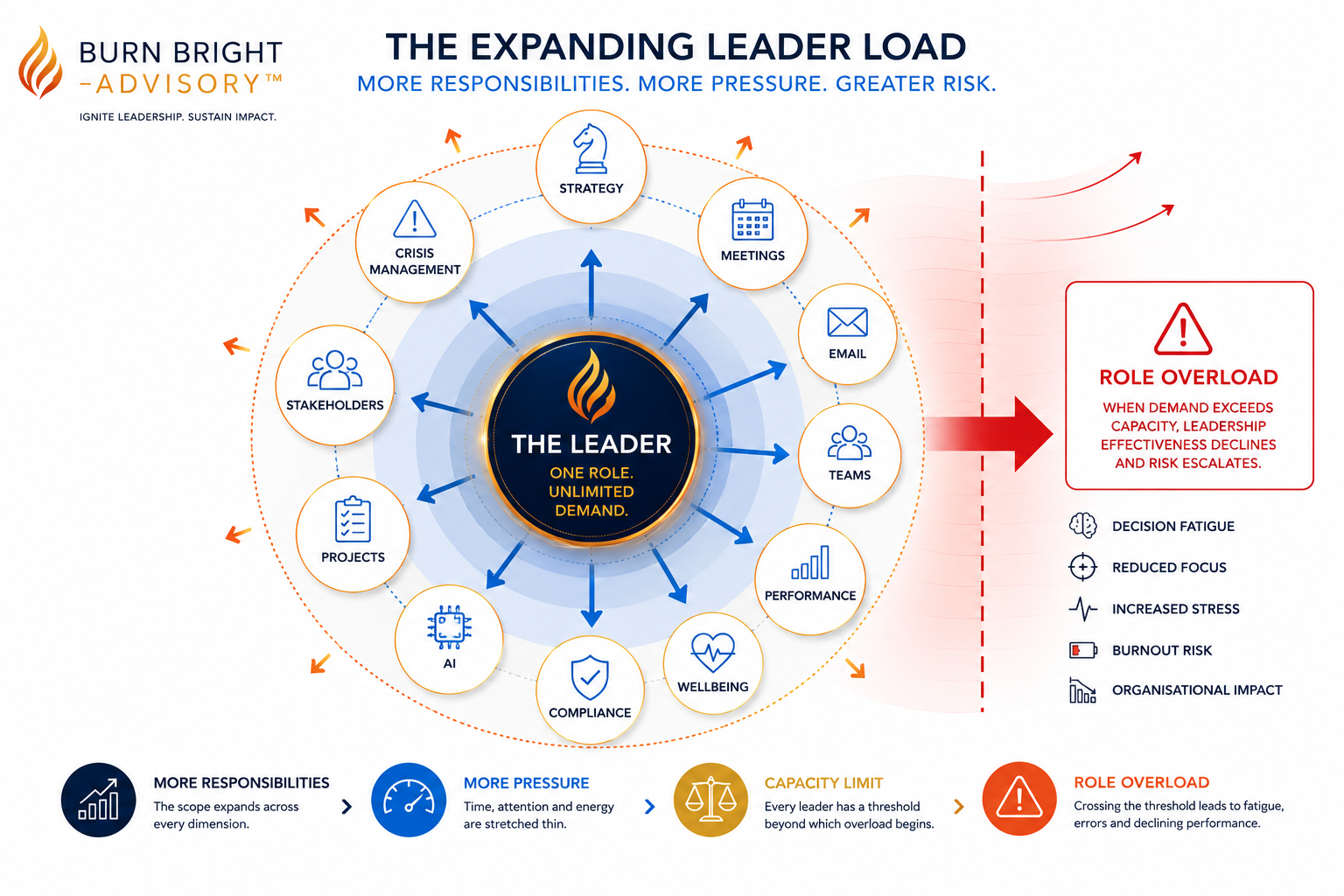
Most leaders do not suddenly become overwhelmed. Their workload expands gradually through additional projects, new reporting requirements, digital communication demands and increasing organisational complexity. Eventually the role itself becomes unsustainable.
Why Is Role Overload Becoming So Common?
Leadership roles have never been broader than they are today.
Research consistently shows that managers are now expected to perform significantly more responsibilities than leaders were expected to handle even a decade ago. Technology has increased communication speed, but it has also multiplied interruptions, stakeholder expectations and administrative workload.
A modern leader may begin the morning reviewing overnight messages, attend multiple virtual meetings across different departments, resolve staffing issues, analyse performance dashboards, manage customer escalations and complete mandatory compliance reporting — all before finding time for strategic thinking.
The problem is not simply volume.
It is the accumulation of responsibilities that were never removed as new ones were introduced.
Burn Bright Advisory™ describes this as Scope Creep, one of the five structural causes of burnout. Rather than replacing obsolete work, organisations continually layer new responsibilities onto existing roles until leaders become the bottleneck for everything important.
Typical examples include:
- New reporting requirements
- Additional meetings
- Increased digital communication
- Greater people management responsibilities
- AI implementation oversight
- Employee wellbeing initiatives
- Continuous organisational change
Individually, each addition appears reasonable.
Collectively, they create impossible jobs.
Gallup research has shown that more than half of managers report experiencing burnout, demonstrating that leadership exhaustion is now widespread rather than exceptional. The Burn Bright Advisory™ materials similarly highlight that approximately 53% of professionals are experiencing burnout, reinforcing that this is a systemic pattern rather than an individual failing.
The consequence is predictable.
Leaders stop leading.
Instead, they spend their days reacting.
Strategic thinking disappears.
Innovation slows.
Decision quality declines.
Eventually burnout becomes almost inevitable — not because leaders lack resilience, but because the role itself has become structurally unsustainable.
How Does Role Overload Affect Leadership Performance?
Many organisations assume hardworking leaders simply need better productivity systems. Evidence suggests otherwise.
When workload consistently exceeds cognitive capacity, the brain begins protecting itself. Leaders experience what Burn Bright Advisory™ describes as Decision Overload, where mental energy becomes depleted long before the working day ends. This reduces judgement, creativity and the ability to think strategically.
Common symptoms include:
- Slower decision-making
- Reduced concentration
- Constant firefighting
- Emotional exhaustion
- Reduced confidence
- Increased mistakes
- Difficulty delegating
- Loss of strategic perspective
Rather than focusing on future direction, leaders become trapped managing today’s problems.
Research into burnout consistently identifies three defining characteristics:
- Emotional exhaustion
- Increasing detachment or cynicism
- Reduced professional effectiveness
The impact quickly spreads beyond the individual leader. Teams receive less coaching. Communication becomes reactive. Innovation slows. Employee engagement falls. Turnover increases.
Burn Bright Advisory™ estimates that replacing a senior leader can exceed £500,000, while replacing a middle manager can cost approximately £75,000, before accounting for lost productivity and organisational knowledge.
Role overload therefore becomes far more than a wellbeing issue.
It becomes an organisational performance issue.
Why Working Harder Never Solves Role Overload
Most leaders respond to increasing workload in exactly the same way. They work longer hours.
Initially this appears effective. Emails are answered. Projects move forward. Problems are solved. Unfortunately, this creates a dangerous illusion.
Every additional hour spent compensating for structural overload convinces the organisation that the workload is manageable. Instead of redesigning the role, the organisation often adds even more responsibility.
This is the beginning of what Burn Bright Advisory™ calls the Culture Tax — the hidden organisational cost paid through burnout, declining engagement, poor decisions, high turnover and lost productivity. Rather than investing in better systems, organisations unknowingly spend far more replacing exhausted leaders and repairing the consequences of unsustainable workloads.
The cycle typically follows five predictable stages:
- The leader accepts additional responsibilities.
- Working hours increase to compensate.
- Recovery time gradually disappears.
- Decision quality declines.
- Performance falls despite increased effort.
At this point many organisations reach the wrong conclusion. They assume the leader needs resilience training, coaching or better time management. Yet the workload has not changed.
This explains why many experienced leaders eventually feel permanently behind despite working harder than ever before.
The issue is not commitment.
The issue is architecture.
The diagram below illustrates how excessive workload gradually reduces leadership effectiveness while increasing burnout risk.
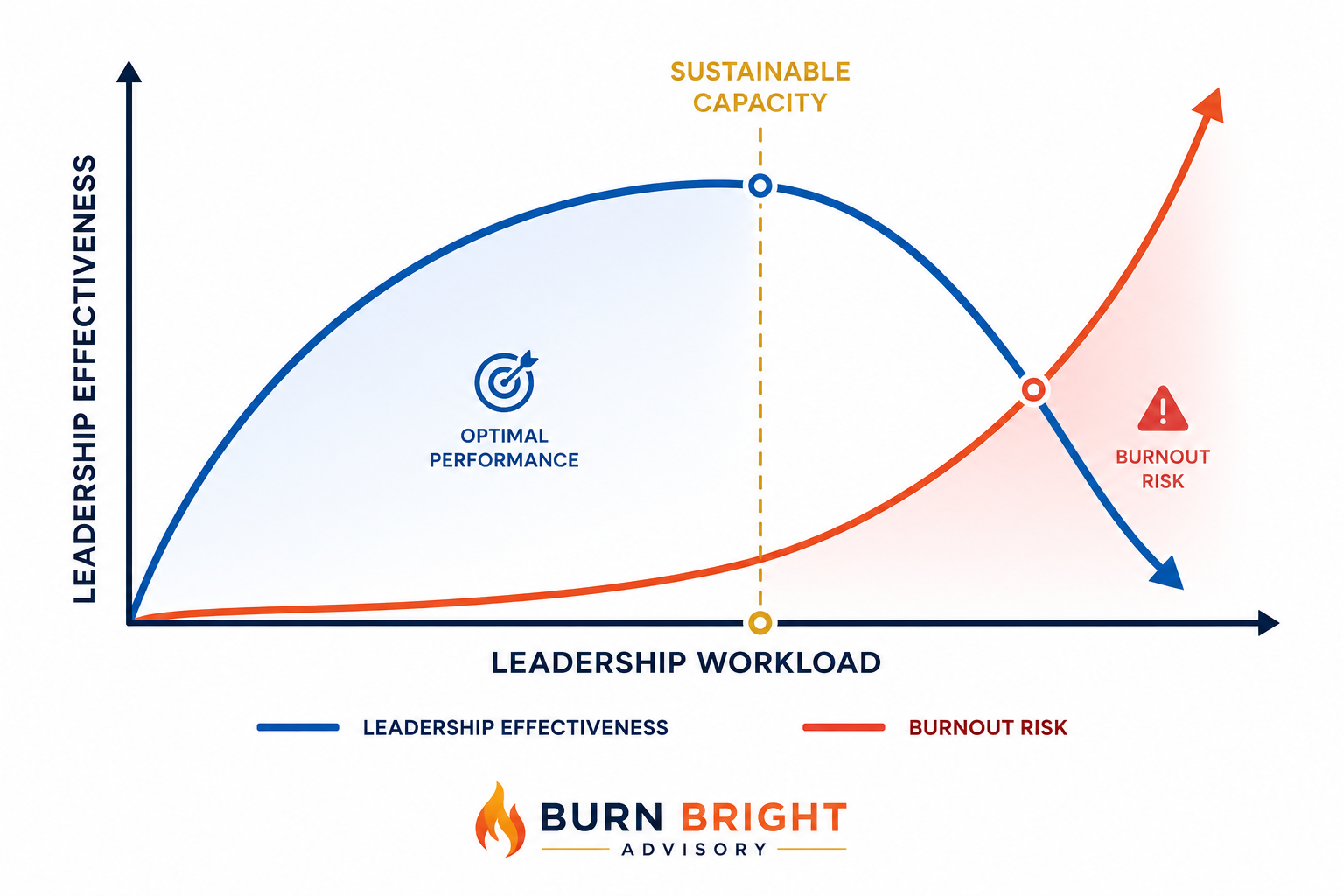
Beyond a certain point, adding more work produces diminishing returns. Performance begins to decline while exhaustion accelerates, creating a cycle that cannot be solved through greater effort alone.
How Can Leaders Redesign Role Overload?
Sustainable leadership begins by redesigning work rather than redesigning people. Burn Bright Advisory™ identifies four structural pillars that transform leadership from reactive overload into sustainable performance.
Pillar 1
Workload Architecture
Every responsibility should be examined using one question: does this genuinely require the leader? Many recurring activities remain with senior leaders simply because they have never been challenged.
A workload audit frequently identifies tasks that can be:
- Eliminated
- Automated
- Delegated
- Shared
- Simplified
Removing low-value work creates capacity for genuinely strategic leadership.
Pillar 2
Decision Authority
Many organisations unintentionally create decision bottlenecks. Every minor approval, operational query and routine escalation flows upwards until leaders spend their day making decisions others could confidently make.
Clarifying decision ownership allows teams to solve problems faster while reducing cognitive overload for leaders. Delegation is not about relinquishing accountability — it is about placing decisions at the appropriate level.
Pillar 3
Recovery Rhythms
Recovery is frequently misunderstood as a reward earned after work is complete. Sustainable leadership treats recovery as an operational requirement. Without deliberate recovery periods, cognitive performance steadily declines throughout the day.
Examples include:
- Protected strategic thinking time
- Meeting-free focus blocks
- Email boundaries
- Decision batching
- Planned recovery between high-demand activities
Recovery protects performance. It is not separate from performance.
Pillar 4
Management Frameworks
Frameworks reduce unnecessary mental effort. Rather than making every decision from scratch, leaders rely on consistent processes.
Examples within the Burn Bright Not Out Framework include:
- Workload Architecture
- Time Architecture
- RACI Delegation Framework
- IMPACT Matrix
- Decision Fatigue Management
- Recovery by Design
- Upward Advocacy Framework
- 30-60-90 Day Plan
Together these frameworks reduce complexity while improving consistency across leadership teams.
The framework below demonstrates how redesigning work — not increasing effort — creates sustainable leadership.
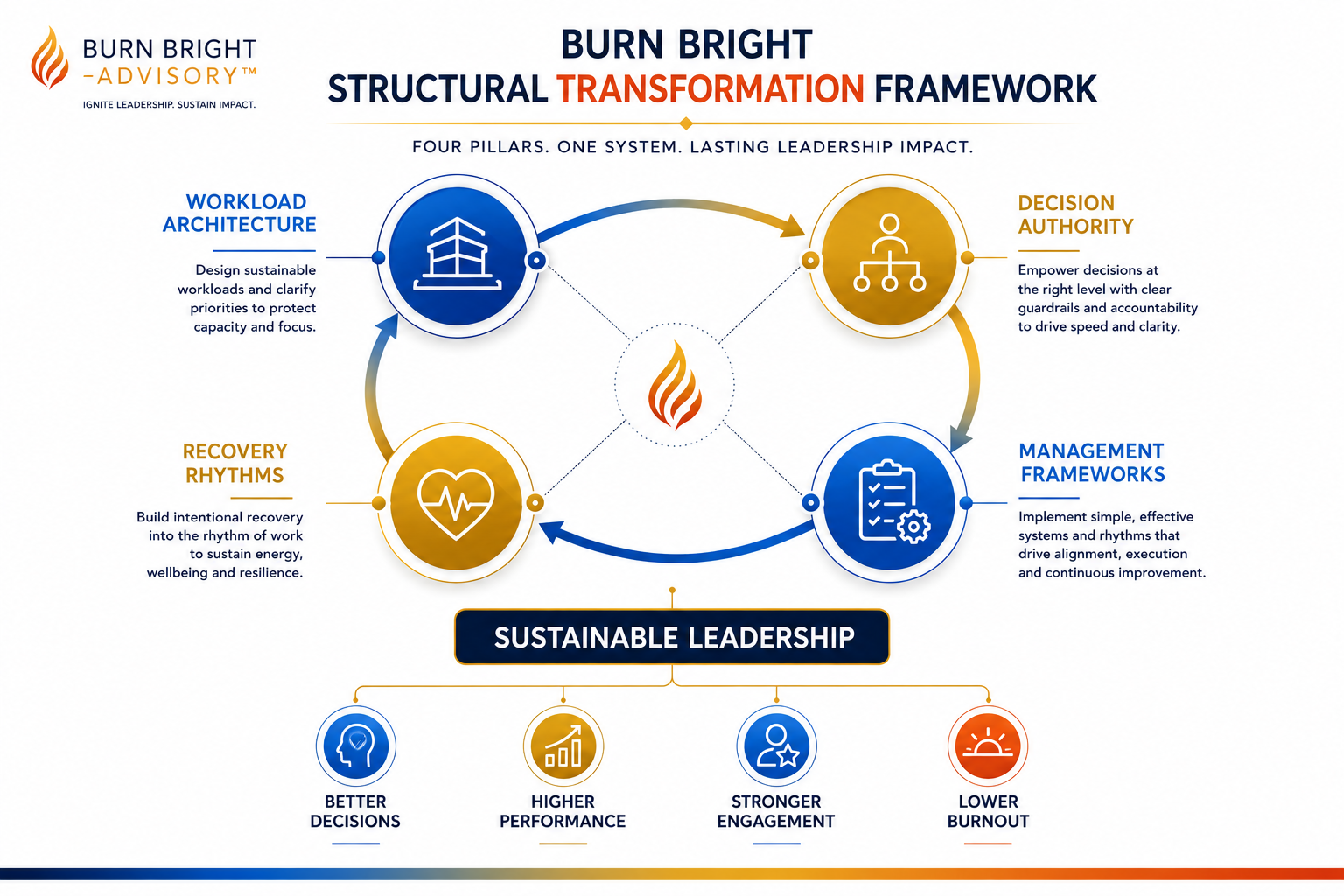
Sustainable leadership is achieved through better organisational design. When workload, decision-making, recovery and management systems are intentionally redesigned, leaders regain the capacity to think strategically and perform consistently.
Traditional Leadership vs Sustainable Leadership
| Traditional Leadership | Sustainable Leadership |
|---|---|
| More effort solves every problem | Better systems solve recurring problems |
| Leaders carry increasing responsibilities | Roles are regularly redesigned |
| Long hours demonstrate commitment | Capacity is protected intentionally |
| Decisions flow upwards | Decision authority is distributed |
| Burnout is viewed as personal weakness | Burnout is recognised as system failure |
| Productivity is measured by activity | Performance is measured by sustainable outcomes |
What is role overload in leadership?
Role overload occurs when leadership responsibilities exceed the available time, resources and mental capacity needed to perform them effectively. It develops gradually as responsibilities accumulate without corresponding structural support.
Can good leaders still experience role overload?
Yes. High-performing leaders are often most vulnerable because they consistently accept additional responsibilities. Their competence masks structural problems until exhaustion eventually affects performance.
Is role overload the same as burnout?
No. Role overload is one of the major structural causes of burnout. Burnout develops when prolonged overload continues without sufficient recovery or organisational redesign.
Can better time management solve role overload?
Time management can improve efficiency, but it cannot solve a workload that fundamentally exceeds available capacity. Structural redesign is usually required.
How can organisations reduce role overload?
Organisations should regularly review leadership responsibilities, eliminate unnecessary work, improve delegation, clarify decision ownership and build recovery into leadership roles rather than relying on individual resilience alone.
Conclusion
Role overload leadership is not simply about having too much to do. It reflects a deeper organisational problem where responsibilities expand faster than leadership capacity.
The most effective organisations understand that sustainable leadership is built through intentional design rather than individual sacrifice. Instead of rewarding constant availability and heroic effort, they redesign workload, distribute decision-making and protect the thinking time leaders need to perform at their best.
Burnout is rarely the result of weak leadership.
More often, it is the predictable outcome of roles that have outgrown the systems designed to support them.
Burn Bright Advisory™ believes the future belongs to organisations that stop asking leaders to carry impossible workloads and start building leadership structures that are sustainable by design.
Discover Your Leadership Burnout Risk
If role overload has become your normal, the first step is understanding where your workload is creating unnecessary pressure. Take the assessment to identify the structural risks affecting your leadership and receive practical guidance on building a more sustainable approach.
Free Leadership Intelligence
Get Weekly Leadership Insights
Join thousands of leaders receiving practical strategies on burnout prevention, workload design, and sustainable performance every week.