Quick Answer
Key Takeaways
- Professionalism is a measurable leadership capability, not a matter of dress code or etiquette.
- Professionalism Intelligence™ is a core domain of the Leadership Intelligence Compass™ and strengthens every other domain.
- Credibility is built through repeated, consistent behaviour — not single exceptional decisions.
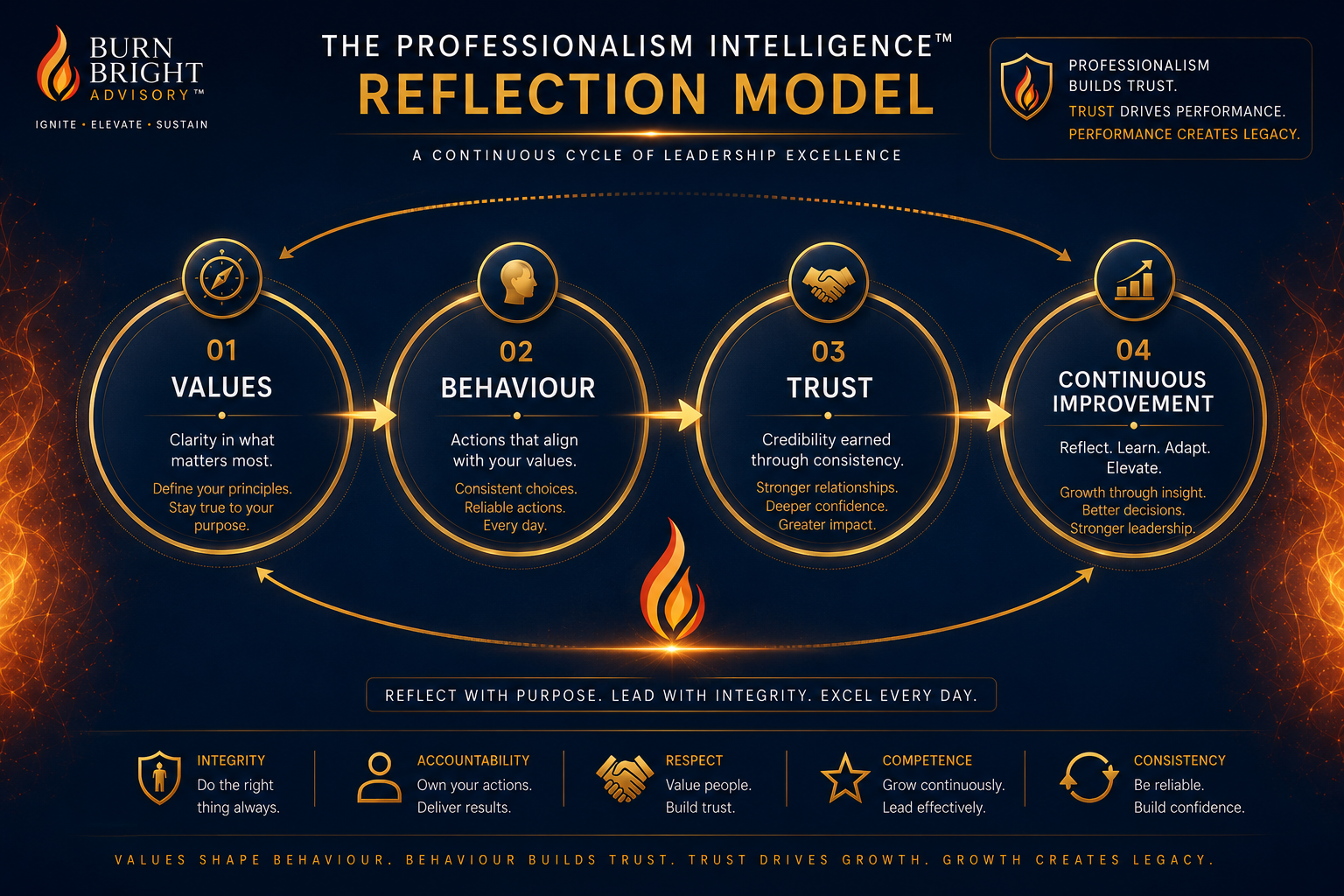
- Professionalism creates the psychological safety that innovation, learning and collaboration depend on.
- Five interconnected pillars define it: integrity, accountability, respect, competence and consistency.
- Professionalism supports Leadership Sustainability™ by encouraging healthy boundaries rather than constant availability.
Professionalism Leadership: The Leadership Capability That Builds Trust, Performance and Sustainable Influence
Many organisations still view professionalism as appearance, etiquette or compliance with workplace expectations. While these elements remain important, they no longer define professional leadership in today’s complex and rapidly changing environment.
Modern leaders operate in environments characterised by uncertainty, increased accountability, digital transparency and constant stakeholder scrutiny. Under these conditions, professionalism becomes far more than a behavioural expectation — it becomes a strategic leadership capability.
At Burn Bright Advisory™, professionalism is viewed through the lens of Leadership Performance Intelligence™, where sustainable leadership depends on developing measurable capabilities rather than relying on personality or position. Within the Leadership Intelligence Compass™, Professionalism Intelligence™ provides the behavioural foundation upon which ethical judgement, reflective practice, adaptability and visionary leadership can flourish.
This article explores why professionalism remains one of the most underestimated predictors of leadership effectiveness, how organisations can develop Professionalism Intelligence™, and why leaders who consistently model professionalism create stronger cultures, higher trust and more sustainable performance.
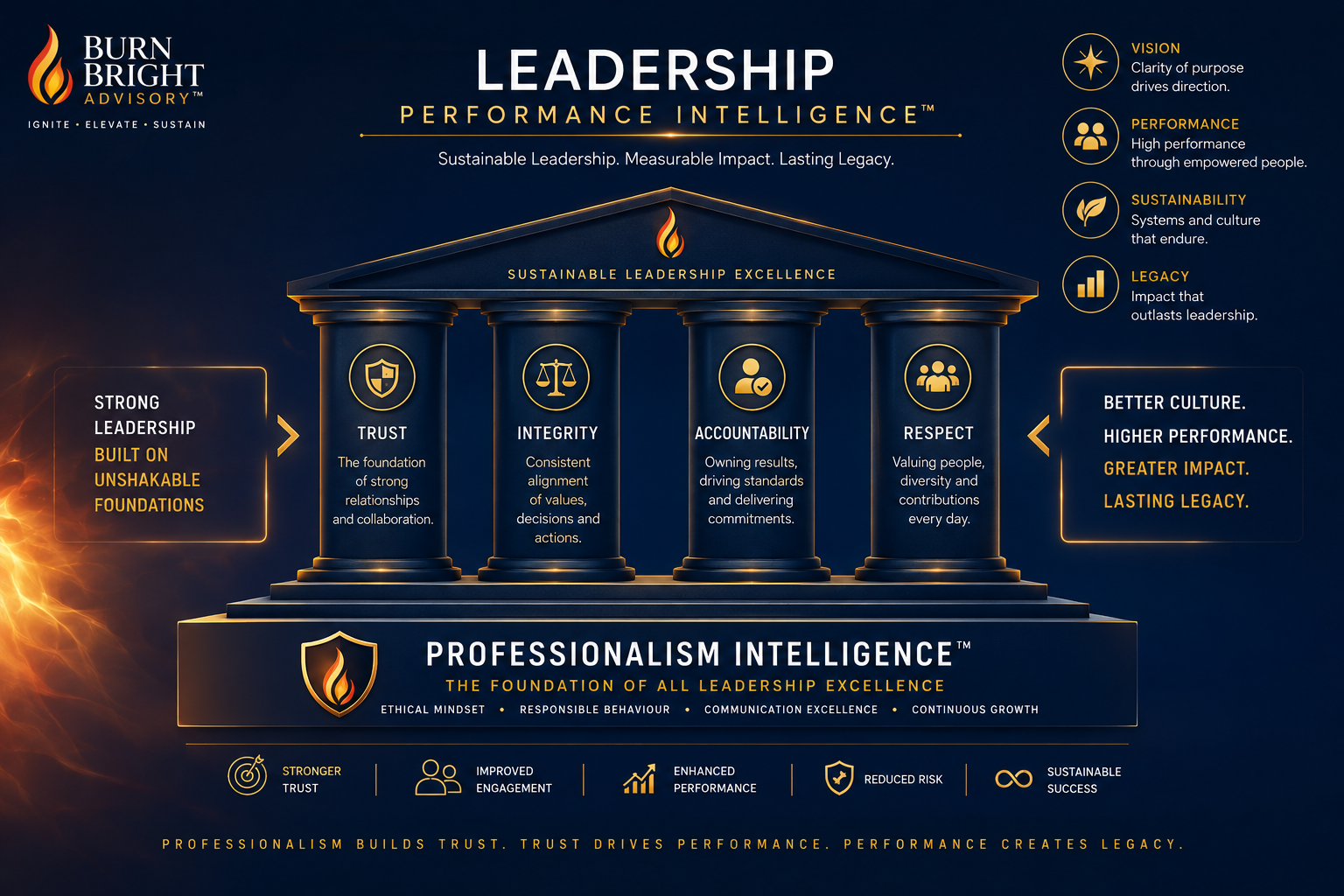
Professionalism Leadership: The Foundation of Leadership Performance Intelligence™
Leadership conversations often focus on innovation, strategy, emotional intelligence or organisational transformation. These are undeniably important capabilities, yet many organisations overlook the capability that enables all of them to function effectively.
Professionalism.
Not professionalism as dress codes, corporate etiquette or organisational compliance.
Rather, professionalism as an integrated leadership capability that shapes every interaction, every decision and every relationship.
The most respected leaders are rarely remembered simply because they possessed technical expertise. They are remembered because people trusted them.
They consistently demonstrated sound judgement.
They acted with integrity.
They communicated clearly.
They accepted accountability.
They maintained composure during uncertainty.
Most importantly, they created confidence in others.
Featured Snippet
Within the Burn Bright Advisory™ framework, professionalism is not a soft skill. It is a measurable component of Leadership Performance Intelligence™ that directly influences leadership credibility, organisational culture and long-term performance.
Why Professionalism Matters More Than Ever
Leadership has fundamentally changed. Organisations now operate in environments where information travels instantly, reputations can change overnight and employees increasingly expect authenticity, transparency and ethical behaviour from leaders.
At the same time, stakeholders are evaluating leadership through multiple dimensions:
- Trust
- Consistency
- Accountability
- Ethical behaviour
- Communication
- Emotional maturity
- Decision quality
- Organisational impact
These expectations extend across every sector. Business leaders manage investor confidence while supporting employee wellbeing. School leaders balance educational outcomes with increasing community expectations. Healthcare executives make decisions where professionalism directly influences patient confidence and organisational safety. Public sector leaders must demonstrate transparency while maintaining public trust. Entrepreneurs build personal brands where leadership reputation becomes inseparable from business performance.
Across every environment, professionalism has become a strategic asset rather than merely a behavioural expectation.
Moving Beyond Traditional Definitions
Traditional leadership development often defines professionalism using observable behaviours: punctuality, reliability, appearance, communication and organisational policies. These remain important. However, they represent only the visible expression of professionalism rather than its underlying capability.
Leadership Performance Intelligence™ expands this understanding considerably. Professionalism emerges from an internal leadership architecture consisting of:
- Values
- Judgement
- Reflective practice
- Emotional regulation
- Ethical reasoning
- Accountability
- Commitment to continuous development
Observable behaviours simply become evidence of these deeper capabilities. This distinction is significant. Two leaders may display identical behaviours during a meeting. One demonstrates professionalism because they genuinely value respect, integrity and collaboration. The other behaves professionally only because organisational rules require it.
Professionalism Intelligence™ within the Leadership Intelligence Compass™
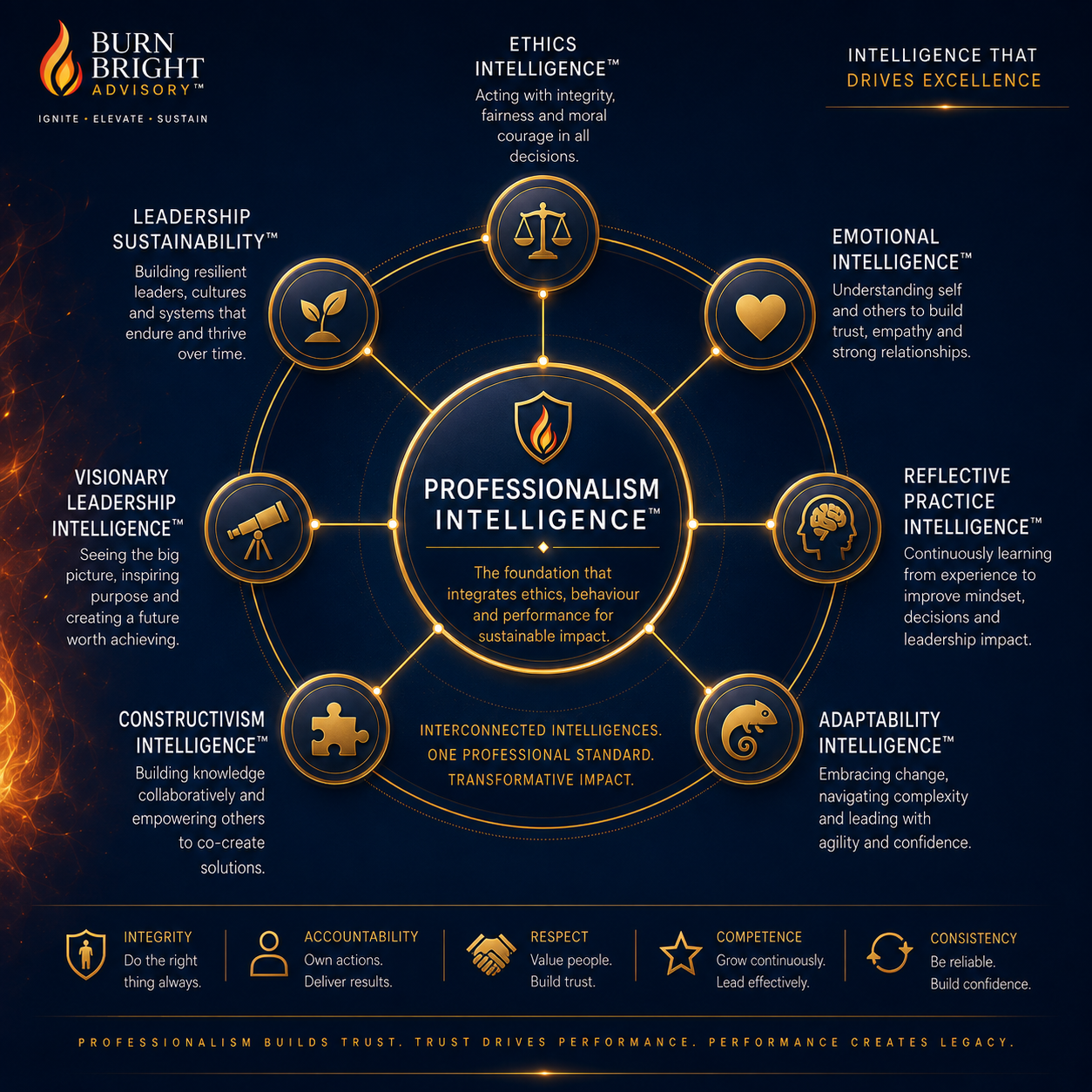
Burn Bright Advisory™ positions Professionalism Intelligence™ as one of the core domains within the Leadership Intelligence Compass™. Rather than existing independently, Professionalism Intelligence™ strengthens every other leadership capability.
| Compass Domain | Relationship with Professionalism |
|---|---|
| Ethics Intelligence™ | Professionalism creates consistency between values and behaviour. |
| Emotional Intelligence™ | Professionalism enables emotional regulation under pressure. |
| Constructivism Intelligence™ | Professional dialogue encourages learning rather than blame. |
| Reflective Practice Intelligence™ | Continuous improvement requires professional self-awareness. |
| Adaptability Intelligence™ | Professional leaders remain credible during organisational change. |
| Visionary Leadership Intelligence™ | Long-term influence depends upon sustained professional credibility. |
| Leadership Sustainability™ | Professional boundaries reduce burnout while improving long-term effectiveness. |
Professionalism therefore becomes the behavioural bridge connecting leadership intention with organisational outcomes.
Leadership Credibility Begins with Professional Consistency
Leadership credibility is rarely established through one exceptional decision. Instead, credibility develops through repeated demonstrations of professional behaviour over time.
Employees observe:
- Whether leaders keep promises
- Whether decisions remain consistent
- Whether difficult conversations are handled respectfully
- Whether accountability applies equally to everyone
- Whether leaders admit mistakes
- Whether organisational values are reflected in everyday decisions
Every interaction either strengthens or weakens credibility. Professionalism creates consistency between what leaders say and what they actually do. Without this consistency, trust deteriorates. Without trust, leadership influence declines regardless of expertise or organisational authority.
Professionalism Creates Psychological Safety
High-performing organisations consistently demonstrate one common characteristic: people feel safe to contribute.
Professional leadership encourages environments where individuals can ask questions, acknowledge uncertainty, admit mistakes, challenge assumptions respectfully, contribute new ideas and learn from failure. These behaviours require psychological safety.
Professionalism creates this safety because leaders model respectful communication, fairness and consistent behaviour. When professionalism declines, psychological safety quickly deteriorates. Employees begin protecting themselves rather than contributing their best thinking.
Innovation slows.
Learning decreases.
Collaboration weakens.
Trust erodes.
Ultimately, organisational performance follows.
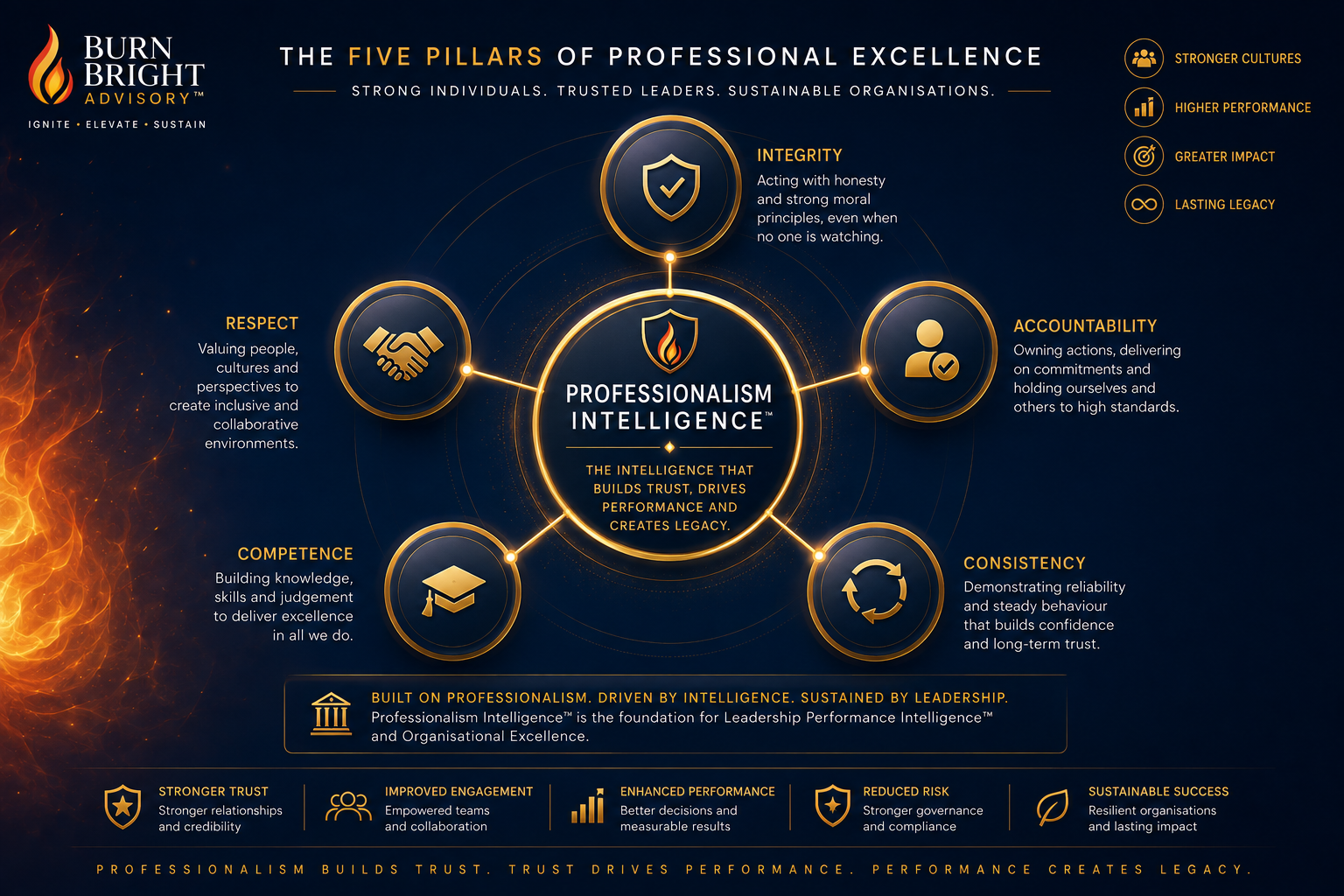
Professionalism Leadership in Practice
Professionalism is often described as a leadership quality, but it becomes truly valuable only when it influences daily organisational practice. Leaders who consistently demonstrate professionalism create environments where expectations are clear, accountability is shared, and trust becomes embedded within organisational culture.
Professionalism is therefore not an isolated behaviour — it becomes a leadership system. Within the Burn Bright Advisory™ framework, this system is reinforced through Leadership Performance Intelligence™, where sustainable leadership depends upon consistent capability rather than occasional excellence.
The Five Pillars of Professionalism Leadership
Professionalism Leadership can be understood through five interconnected pillars.
Pillar 1
Integrity
Integrity is the alignment between values, decisions and behaviour. Professional leaders demonstrate consistency regardless of audience or circumstance.
- Doing what is right when it is inconvenient
- Honouring commitments
- Making transparent decisions
- Admitting mistakes quickly
- Avoiding selective accountability
Without integrity, professionalism becomes performance rather than character.
Pillar 2
Accountability
Professional leaders accept responsibility before assigning it elsewhere. Rather than searching for blame, they seek understanding and improvement.
- Owning outcomes
- Recognising mistakes
- Encouraging learning
- Measuring improvement
- Establishing clear expectations
Accountability creates confidence because people know decisions will be examined fairly.
Pillar 3
Respect
Respect extends beyond politeness. Professional leaders value diverse perspectives while maintaining high standards.
- Active listening
- Inclusive decision making
- Constructive feedback
- Recognising contribution
- Maintaining dignity during disagreement
Professionalism allows difficult conversations without damaging relationships.
Pillar 4
Competence
Professional credibility requires continual learning. Leadership capability is never static.
- Knowledge development
- Evidence-informed decision making
- Reflective practice
- Professional reading
- Leadership development
Continuous learning signals humility rather than weakness.
Pillar 5
Consistency
Consistency is the characteristic that transforms occasional excellence into trusted leadership. Employees quickly recognise whether leaders behave consistently during organisational change, conflict, pressure, success and failure.
Professional consistency creates organisational stability.
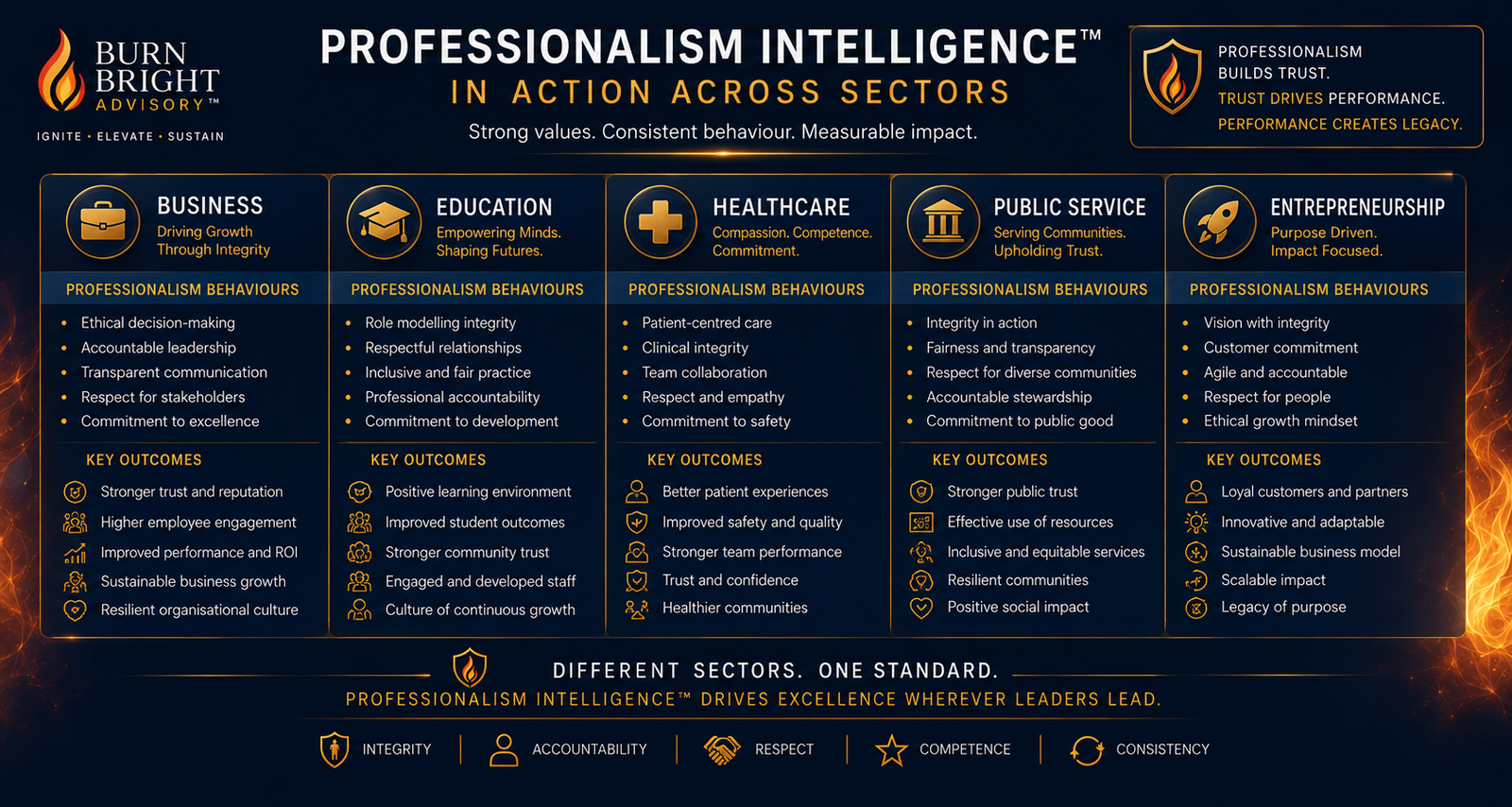
Professionalism Across Every Sector
Although professionalism is universal, its practical application varies across sectors.
Business Leadership
Professional business leaders build cultures where commercial performance and ethical behaviour reinforce one another. Rather than pursuing short-term gains at any cost, they recognise that long-term organisational success depends upon credibility — through transparent communication with investors, fair performance management, ethical customer relationships, responsible innovation and accountable governance. These organisations often experience stronger employee engagement because professionalism becomes visible rather than aspirational.
School Leadership
Educational leaders influence far more than operational performance — professionalism shapes learning cultures. School leaders demonstrate Professionalism Intelligence™ by maintaining consistency, supporting teacher development, communicating openly with parents, modelling lifelong learning and placing students at the centre of decision making. Professionalism becomes part of the school’s identity.
Healthcare Leadership
Healthcare environments illustrate professionalism at its highest level. Leadership decisions directly influence patient confidence, staff wellbeing, clinical safety, multidisciplinary collaboration and organisational resilience. Professional healthcare leaders understand that trust is both a clinical and organisational outcome.
Public Service Leadership
Public confidence depends upon visible professionalism. Public leaders strengthen trust by demonstrating impartial decision making, transparency, accountability, ethical governance and responsible stewardship of resources. Professionalism therefore supports democratic confidence as much as operational effectiveness.
Entrepreneurial Leadership
Entrepreneurs often underestimate professionalism because organisations initially rely heavily upon founder personality. However, sustainable growth requires systems rather than individual charisma. Professional founders develop governance, accountability, strategic communication, organisational values and leadership capability beyond themselves — allowing organisations to scale successfully.
Professionalism and Leadership Sustainability™
Burn Bright Advisory™ views professionalism as an essential contributor to Leadership Sustainability™. Many leaders assume professionalism requires constant availability, perfection or excessive workload. The opposite is true.
Professional leaders establish healthy boundaries because they understand sustainability improves long-term performance. Leadership Sustainability™ includes:
- Appropriate delegation
- Reflective practice
- Workload management
- Ethical decision making
- Personal wellbeing
- Continuous development
Professional boundaries protect both leaders and organisations from burnout.
Measuring Professionalism Leadership
Professionalism should be measurable rather than assumed. Traditional leadership evaluations often rely upon subjective perceptions. Leadership Performance Intelligence™ encourages organisations to measure professionalism through observable leadership capability.
| Capability | Observable Evidence |
|---|---|
| Integrity | Decisions align with stated values. |
| Accountability | Leaders accept responsibility for outcomes. |
| Communication | Information is timely, respectful and transparent. |
| Trust | Employees demonstrate confidence in leadership. |
| Reflection | Leaders actively seek feedback and improve practice. |
| Professional Development | Continuous learning is evident. |
| Collaboration | Cross-functional relationships remain constructive. |
| Ethical Decision Making | Decisions consider long-term organisational impact. |
These indicators move professionalism beyond opinion into measurable leadership practice.
Leadership Reflection Questions
- How consistently do my actions reflect my stated leadership values?
- What behaviours build trust within my team?
- Where does my professionalism become inconsistent under pressure?
- How effectively do I balance accountability with empathy?
- What professional capability should I deliberately strengthen during the next six months?
- How does my behaviour influence the professionalism of others?
- What evidence would demonstrate that I am developing Professionalism Intelligence™?
Action Steps
1. Conduct a personal audit
Carry out a personal Professionalism Leadership audit against the five pillars.
2. Seek structured feedback
Gather structured feedback from colleagues and stakeholders.
3. Identify a trust-building behaviour
Identify one behaviour that consistently strengthens trust.
4. Establish reflective practice
Build regular reflective practice into your leadership routine.
5. Develop measurable objectives
Set measurable professionalism objectives alongside operational goals.
6. Embed expectations in development conversations
Make professionalism part of team development conversations.
7. Review decisions against values
Check leadership decisions against organisational values before implementation.
8. Commit to continuous learning
Invest in continuous professional learning through reading, mentoring and leadership development.
What is professionalism leadership?
Professionalism leadership is the consistent demonstration of competence, integrity, accountability and ethical behaviour that builds trust, credibility and sustainable organisational performance.
Why is professionalism important in leadership?
Professionalism strengthens trust, improves decision-making, enhances organisational culture and supports long-term leadership effectiveness.
How does Professionalism Intelligence™ differ from professionalism?
Professionalism refers to observable behaviours. Professionalism Intelligence™ describes the deeper leadership capability that consistently produces those behaviours across different contexts.
Can professionalism be measured?
Yes. Professionalism can be assessed through behavioural indicators such as accountability, communication, ethical decision-making, reflective practice, trust and consistency.
Is professionalism only relevant for senior leaders?
No. Professionalism influences leadership effectiveness at every organisational level, regardless of formal position.
How does professionalism support Leadership Sustainability™?
Professionalism encourages healthy boundaries, reflective practice, ethical decision-making and continuous development, reducing burnout while improving long-term leadership capacity.
Conclusion
Professionalism remains one of the most influential yet frequently underestimated leadership capabilities. It is not defined by appearance, status or organisational hierarchy. Instead, it is demonstrated through the consistent alignment of values, behaviours and decisions that foster trust, credibility and sustainable performance.
Within Burn Bright Advisory™’s Leadership Performance Intelligence™ framework, Professionalism Intelligence™ serves as the behavioural foundation upon which other leadership capabilities are built. It strengthens ethical judgement, enhances reflective practice, supports adaptability and enables leaders to create cultures where accountability, learning and trust can flourish.
How Strong Is Your Professionalism Intelligence™?
Take the free Leadership Burnout Self-Assessment to understand where your leadership capability is strong, where it’s under strain, and what to build next.
Free Leadership Intelligence
Get Weekly Leadership Insights
Join thousands of leaders receiving practical strategies on burnout prevention, workload design, and sustainable performance every week.