Quick Answer
Key Takeaways
- Scope creep develops gradually, making it difficult for leaders to recognise until overload becomes normal.
- More responsibility without structural redesign inevitably reduces leadership effectiveness.
- Burnout is a symptom of organisational design rather than personal weakness.
- Sustainable organisations regularly review executive workload before adding new responsibilities.
- The solution is structural redesign, not simply encouraging leaders to become more resilient.
Scope Creep in Executive Roles: The Silent Cause of Leadership Burnout
Scope creep in executive roles has become one of the most overlooked causes of leadership burnout.
Few executives wake up one morning to discover they have twice the workload they had a year ago. Instead, responsibility accumulates one request at a time.
A new committee.
Another project.
Additional reporting.
Extra compliance.
More meetings.
A larger team.
None of these additions appear unreasonable on their own. Together, however, they fundamentally change the role.
Modern executives are expected to lead strategy, manage culture, coach teams, embrace digital transformation, oversee wellbeing initiatives, interpret data, respond instantly to stakeholders and remain constantly available. The role has expanded dramatically while the working week has remained stubbornly fixed.
This gradual expansion is what Burn Bright describes as scope creep — the silent growth of leadership responsibility without equivalent increases in capacity, authority or support. Rather than asking why leaders are burning out, organisations should ask a different question: why have leadership roles become impossible to perform sustainably?
Throughout this article you’ll learn how scope creep develops, why it damages organisations as much as individuals, and how sustainable leadership begins with redesigning work instead of demanding ever greater personal sacrifice. This perspective aligns with the Burn Bright Not Out Framework, which identifies scope creep as the first of the five structural causes of burnout.
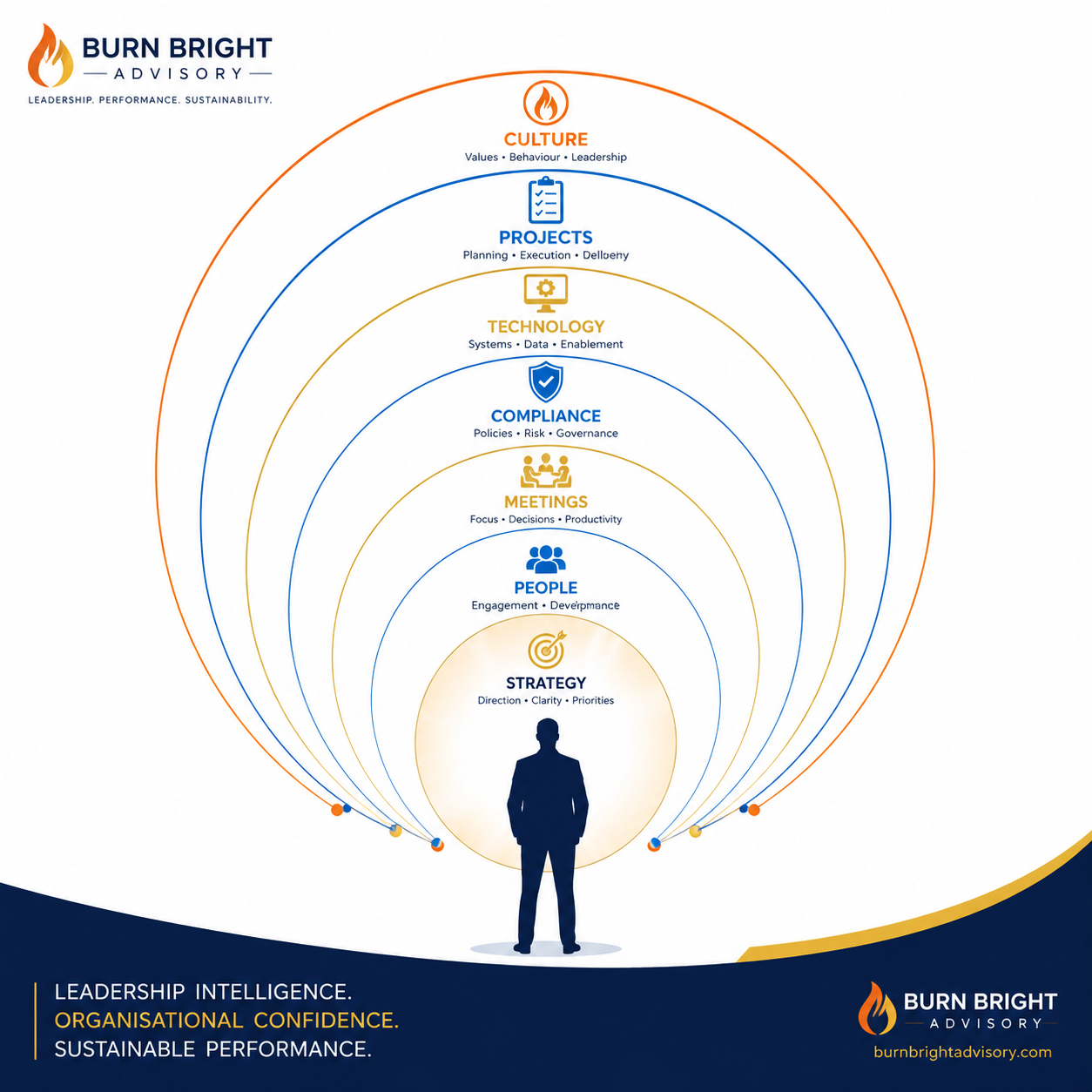
Most leadership burnout begins long before exhaustion appears. Every additional responsibility increases complexity. Eventually the executive spends more time managing work than leading people or shaping strategy.
Featured Snippet
Why Is Scope Creep Becoming So Common in Executive Roles?
Leadership has changed dramatically over the past decade. Executives once focused primarily on strategic planning, operational oversight and people leadership. Today those same leaders are expected to become experts across an expanding landscape of responsibilities. Many now oversee:
- Hybrid working
- Artificial intelligence implementation
- Cybersecurity awareness
- Employee wellbeing
- Diversity initiatives
- Regulatory compliance
- Digital transformation
- Stakeholder communication
- Financial uncertainty
- Constant organisational change
None of these responsibilities replaced existing work. They were simply added. This creates what the Burn Bright framework calls structural overload. Leaders are attempting to manage a 2026 organisation using leadership structures designed for a much simpler workplace.
Technology has also unintentionally accelerated scope creep. Email became instant messaging. Meetings became virtual. Virtual meetings became permanent. Communication platforms multiplied. Instead of simplifying leadership, technology dramatically increased the number of interactions executives manage every day.
Leaders begin spending their days responding rather than thinking. That shift fundamentally changes the quality of leadership.
How Does Scope Creep Lead to Leadership Burnout?
Burnout rarely begins with exhaustion. It begins with impossible expectations. Every additional responsibility consumes four finite leadership resources:
- Time
- Attention
- Cognitive capacity
- Decision-making energy
Unlike financial budgets, these resources cannot simply be expanded. When organisations continually add responsibilities without removing others, executives compensate personally.
They work earlier.
Stay later.
Skip breaks.
Cancel holidays.
Reduce recovery.
Eventually they become permanently available.
At first, performance appears unaffected. In reality, leaders are using tomorrow’s energy to solve today’s problems. This creates what Burn Bright calls the depletion cycle. The executive remains productive externally while capacity quietly declines internally.
The consequences appear gradually: strategic thinking disappears, decision quality declines, innovation slows, delegation reduces, emotional resilience weakens, and firefighting replaces planning. Many executives interpret these symptoms as personal failure. They are not — they are predictable consequences of structural overload.
The Burn Bright philosophy rejects the idea that leaders simply need greater resilience. Instead, it argues that leaders cannot sustainably outperform poorly designed systems. Sustainable leadership starts by redesigning workload rather than increasing individual effort.
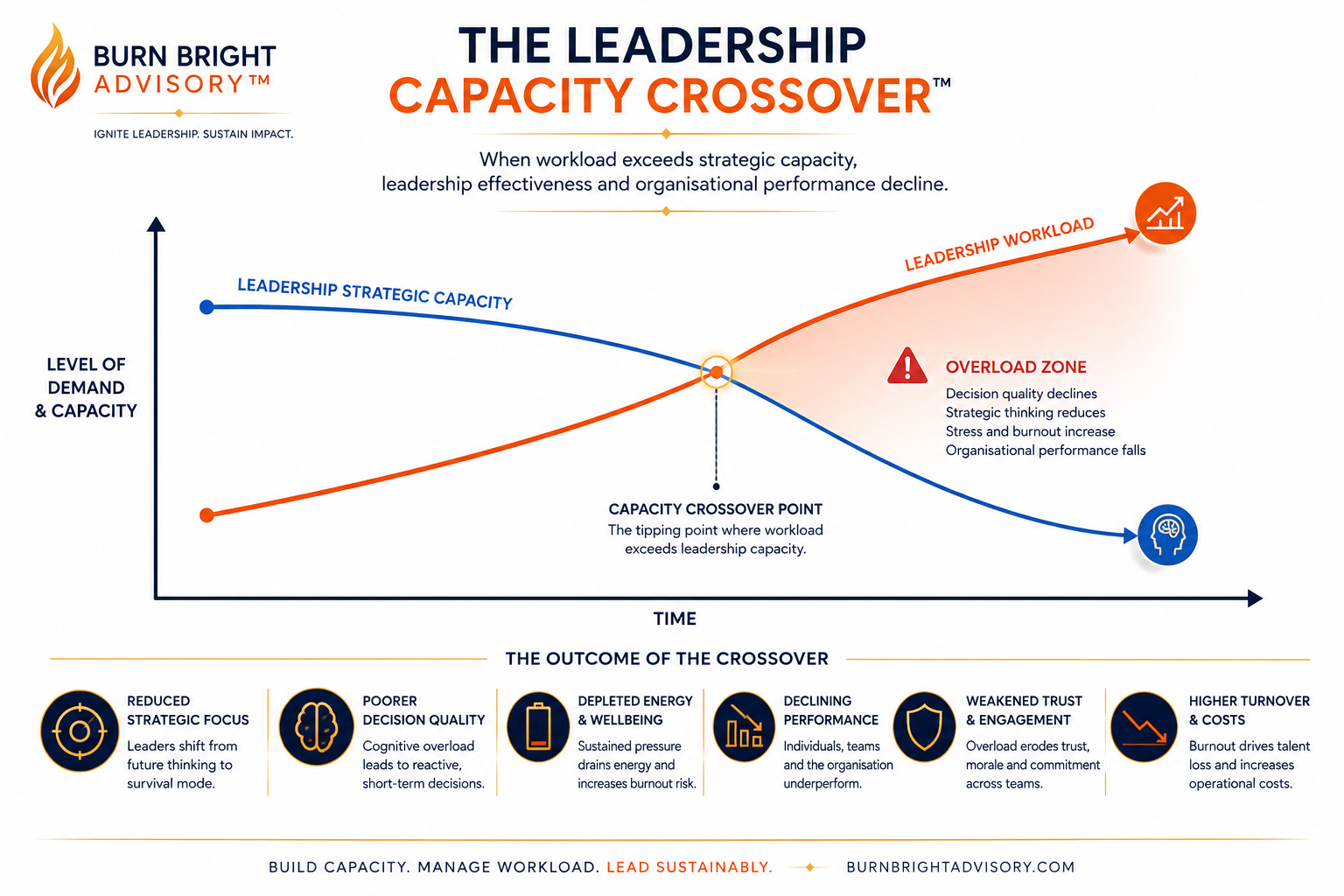
Most organisations measure growing responsibility but rarely measure declining leadership capacity. The imbalance eventually produces burnout, slower decision-making and weaker organisational performance.
What Are the Early Warning Signs of Executive Scope Creep?
Scope creep is dangerous because it feels normal. Executives rarely notice it while it is happening. Instead, they adapt, then adapt again. Eventually overload becomes the new baseline.
None of these indicators reflects poor leadership. Each signals a leadership system operating beyond its designed capacity. Burn Bright identifies this progression as a predictable structural pattern rather than an individual weakness.
| Traditional Leadership Thinking | Sustainable Leadership Thinking |
|---|---|
| Add more responsibilities | Redesign workload before expanding scope |
| Reward availability | Protect strategic thinking time |
| Measure hours worked | Measure leadership impact |
| Expect resilience | Build sustainable systems |
| Solve burnout individually | Diagnose organisational design |
| More effort creates better leaders | Better systems create better leaders |
Why Does Scope Creep Damage Organisational Performance?
Many organisations view scope creep as a leadership problem. It is actually an organisational performance problem. When executives become overloaded, the impact extends far beyond the individual. Burn Bright argues that burnout is a structural issue that spreads through teams and systems rather than remaining isolated to one leader.
The First Casualty: Decision Quality
Exhausted leaders become slower to process information. Decisions that once took minutes now take days. Strategic opportunities are delayed while operational issues consume increasing amounts of attention.
The Second Casualty: Innovation
Innovation requires thinking space. Scope creep removes thinking space. When calendars become permanently full, executives default to maintaining existing systems rather than improving them.
The Third Casualty: People
Leadership is relational. Burned-out executives have less emotional capacity for coaching, mentoring and developing others. Team conversations become transactional rather than developmental.
Eventually, organisational culture begins to shift. Employees observe leaders working evenings, responding to emails at midnight and never disconnecting. Those behaviours become normalised. The organisation quietly teaches that exhaustion equals commitment.
Burn Bright describes this as the beginning of the Culture Tax — the hidden organisational cost of burnout that appears through turnover, disengagement, absenteeism, slower decision-making and declining productivity. Rather than investing in structural redesign, organisations repeatedly pay the financial cost of replacing experienced leaders.
Research cited throughout the Burn Bright framework highlights senior leader replacement costs exceeding £500,000, middle manager replacement costs around £75,000, and approximately 34% productivity loss during leadership transitions. These costs rarely appear on burnout reports. They appear elsewhere in organisational performance — and by then, the damage has already occurred.
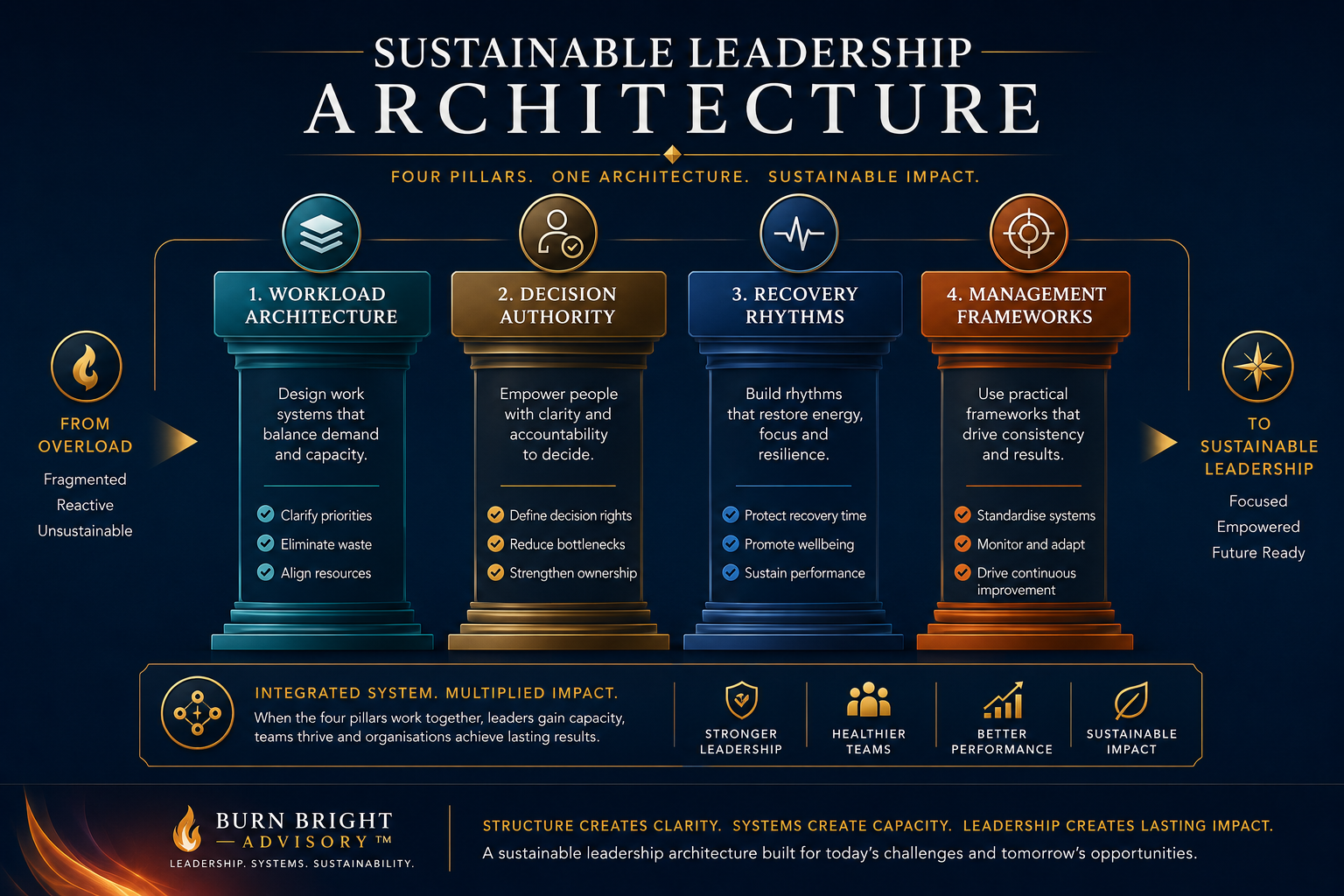
The objective is not to make leaders more resilient to impossible workloads. It is to redesign work so leadership remains effective over the long term.
How Can Organisations Prevent Scope Creep?
Preventing scope creep requires leaders to stop asking “How can executives cope with more?” and instead ask “Should this responsibility exist in the executive role at all?” Burn Bright recommends four structural interventions.
Intervention 1 Audit Executive Workload Regularly
Most organisations conduct financial audits. Very few audit leadership workload. Every new responsibility should trigger two questions: what responsibility is being removed, and who is best placed to own this work? If neither question has an answer, scope creep has already begun.
Intervention 2 Redesign Decision Authority
Executives often become organisational bottlenecks because every decision flows upwards. The Burn Bright framework advocates clearer decision ownership so operational decisions remain closer to operational teams, reducing decision fatigue while increasing organisational agility.
Intervention 3 Protect Strategic Thinking
Strategic leadership requires uninterrupted cognitive space. Protecting strategic time should become an organisational expectation rather than a personal preference, with calendars containing deliberate thinking blocks that cannot be filled by routine meetings.
Intervention 4 Measure Leadership Sustainability
Traditional organisations measure activity. Sustainable organisations measure capacity — decision turnaround, meeting hours, recovery time, strategic work completed, delegation effectiveness and executive wellbeing trends. When these measures begin to deteriorate, leaders require structural redesign, not another resilience workshop.
Sustainable Leadership Requires Better Systems, Not Better Endurance
For decades leadership has rewarded endurance.
Stay longer.
Work harder.
Carry more.
Respond faster.
The evidence suggests this model is reaching its limit. Leadership effectiveness is no longer constrained by motivation. It is constrained by system design. Burn Bright’s Burn Bright Not Out Framework identifies five structural causes of burnout.
Structural Cause 1
Scope Creep
The gradual accumulation of responsibility without additional time, authority or resources.
Structural Cause 2
Meeting Culture
Calendars saturated with meetings that displace the time required for strategic thinking.
Structural Cause 3
Communication Chaos
Fragmented, constant communication that turns leadership days into continuous response cycles.
Structural Cause 4
Decision Overload
Excessive decision volume that exhausts cognitive capacity and slows organisational agility.
Structural Cause 5
Perfectionism Culture
Standards that demand flawless execution at the cost of sustainable pace and recovery.
These are organisational design challenges rather than personal shortcomings. Sustainable leadership emerges when organisations redesign workload architecture, clarify decision authority, build recovery rhythms and implement practical management frameworks.
Conclusion
Scope creep in executive roles has become one of the defining leadership challenges of modern organisations. It develops quietly.
One responsibility becomes two.
Two become ten.
Eventually, leaders spend more time managing complexity than creating value. The answer is not greater resilience or longer hours. The answer is structural redesign.
Burn Bright’s philosophy remains consistent: burnout is a system failure, not a personal failure. When organisations redesign leadership architecture instead of expecting limitless endurance, executives regain the space to think strategically, lead effectively and sustain high performance over time.
Better leadership does not come from asking people to carry more. It comes from building systems that require less unnecessary load.
What is scope creep in executive roles?
Scope creep in executive roles is the gradual accumulation of additional responsibilities without equivalent increases in resources, authority or time. Over time this creates unsustainable leadership workloads and increases burnout risk.
Why is scope creep different from a busy period?
Busy periods are temporary. Scope creep becomes permanent — new responsibilities remain while existing ones rarely disappear, gradually redefining the executive role.
Can resilient leaders avoid scope creep?
Resilience helps leaders recover from pressure, but it cannot compensate indefinitely for structurally overloaded roles. Even highly capable leaders eventually reach capacity when workload continually expands.
How does scope creep affect organisations?
Scope creep reduces decision quality, slows innovation, increases turnover, weakens employee engagement and raises recruitment costs. It becomes an organisational performance issue rather than simply an individual wellbeing concern.
What is the best way to prevent executive scope creep?
The most effective solution is regular workload redesign. Organisations should review responsibilities, clarify decision ownership, protect strategic thinking time and remove outdated tasks before adding new expectations.
Discover Your Leadership Burnout Risk
If you’re beginning to recognise the signs of scope creep in your own role, take the Leadership Burnout Self-Assessment to identify the structural factors increasing your workload and receive practical recommendations for building sustainable leadership.
Free Leadership Intelligence
Get Weekly Leadership Insights
Join thousands of leaders receiving practical strategies on burnout prevention, workload design, and sustainable performance every week.