Quick Answer
Key Takeaways
- Professionalism is a strategic leadership capability, not a soft skill or a matter of appearance.
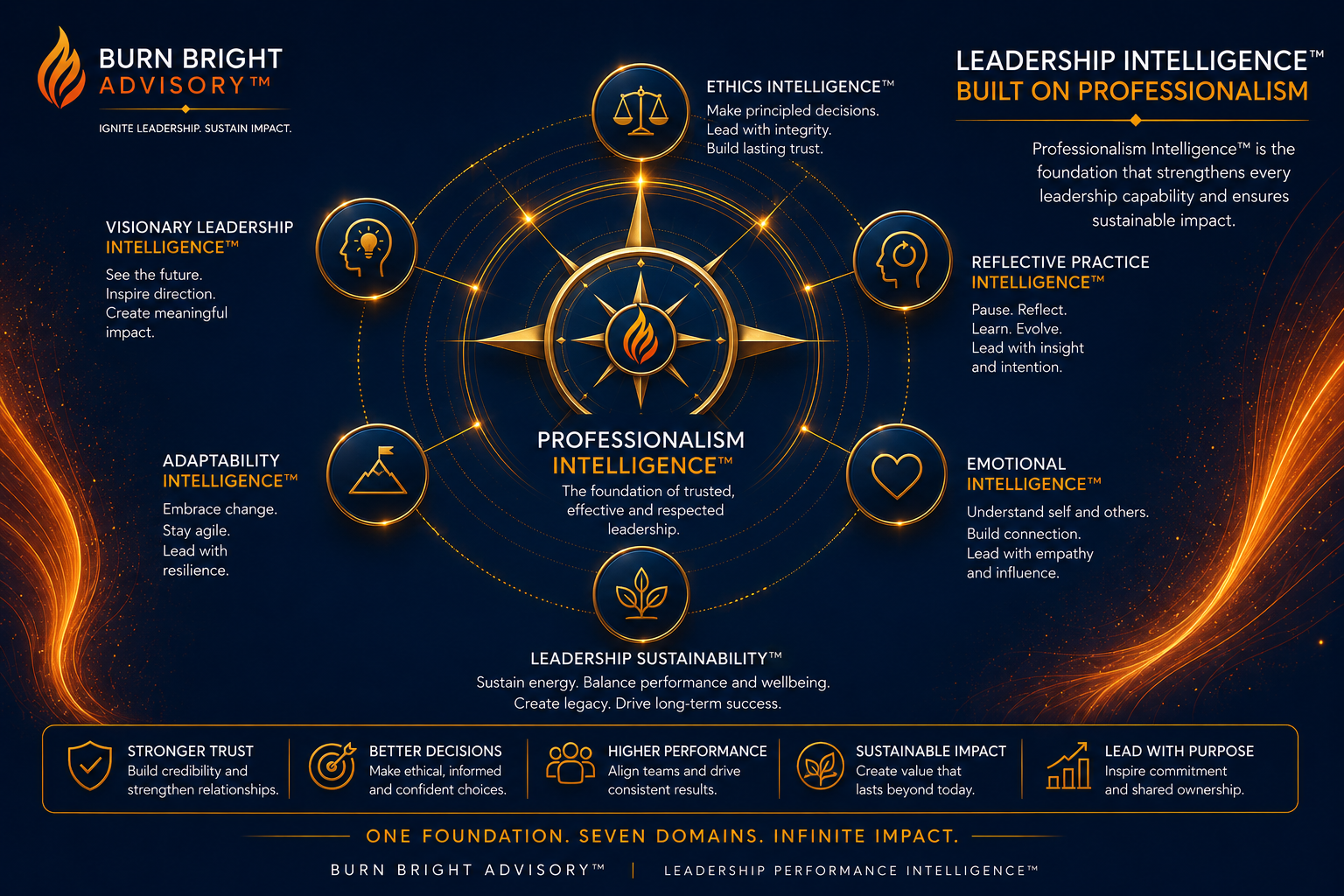
- Professionalism Intelligence™ reinforces every other domain of the Leadership Intelligence Compass™, from Ethics Intelligence™ to Leadership Sustainability™.
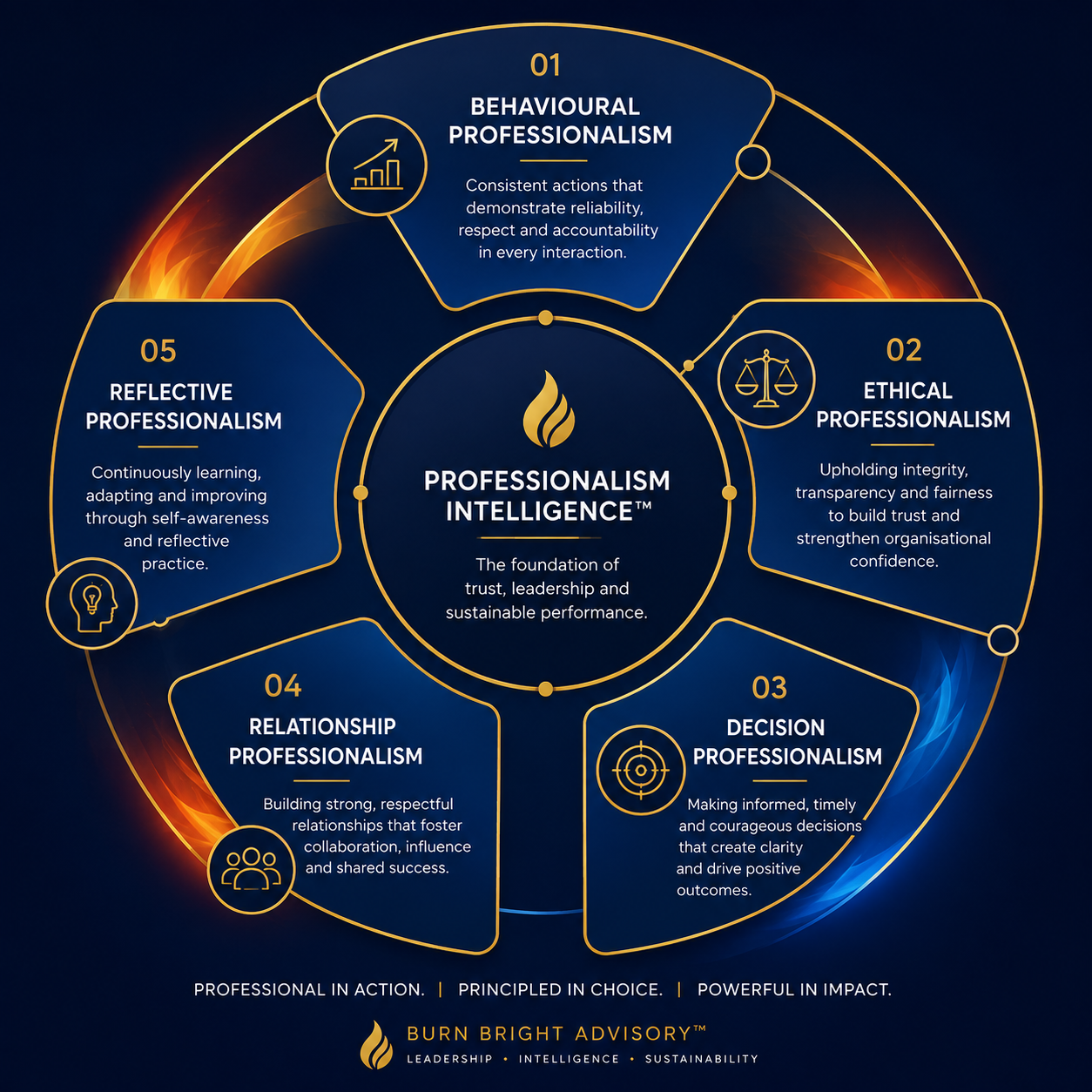
- Five dimensions define Professionalism Intelligence™: behavioural, ethical, decision, relationship and reflective professionalism.
- Culture is shaped by what leaders repeatedly do, not by what organisations state in policy.
- Professionalism reduces decision fatigue and cognitive load, directly supporting Leadership Sustainability™.
- Professionalism Intelligence™ develops through intentional practice — it can be measured, coached and strengthened.
Professionalism Leadership: The Foundation of Sustainable Leadership Performance
Professionalism is often misunderstood as appearance, etiquette or workplace behaviour. While these visible characteristics matter, they represent only a small part of what enables effective leadership.
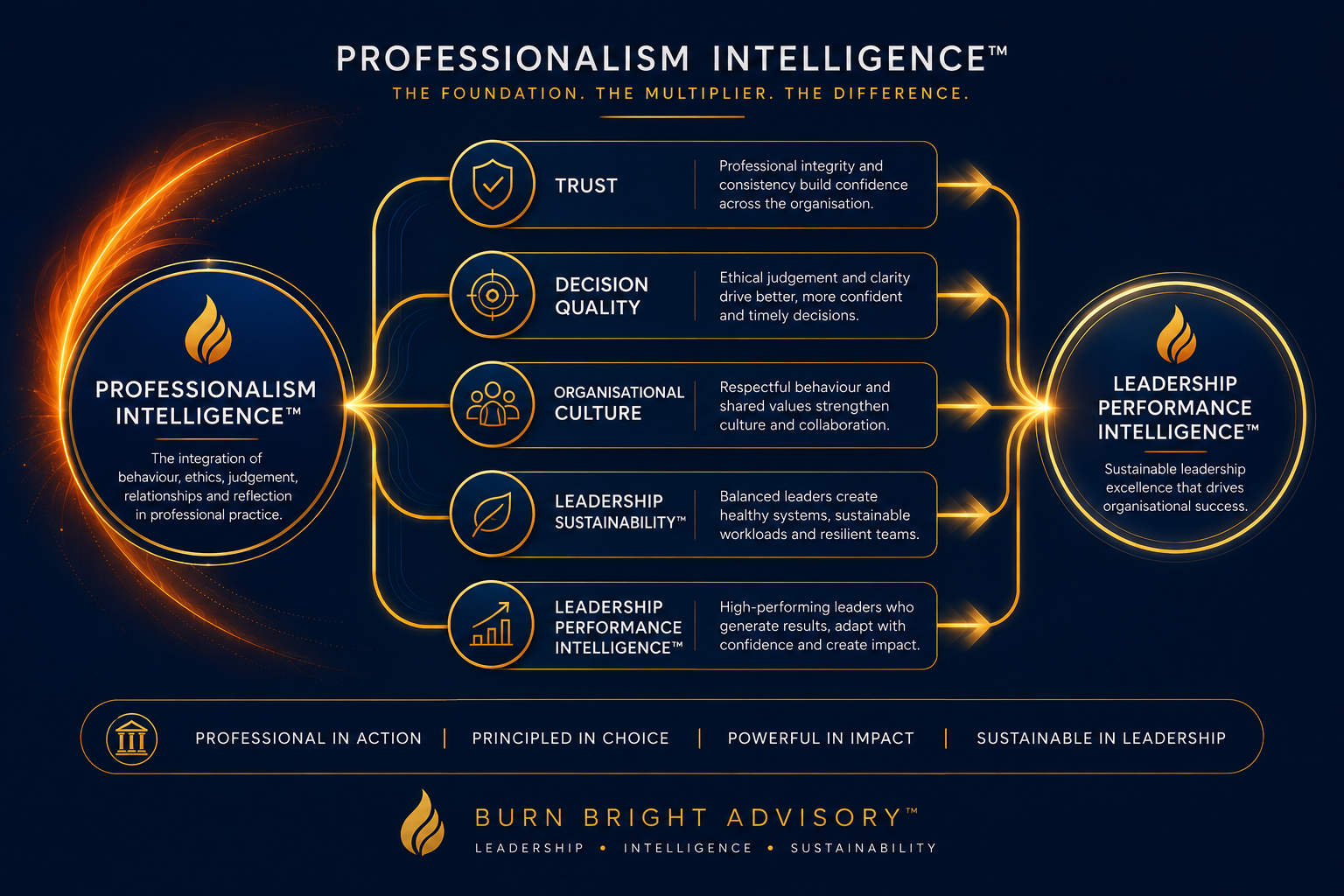
Within the Burn Bright Advisory™ Leadership Performance Intelligence™ framework, Professionalism Intelligence™ is the capability that enables leaders to consistently align competence, ethics, accountability, communication and decision-making with organisational purpose.
Professional leaders create environments where people know what standards look like because they experience those standards every day.
When professionalism becomes embedded in leadership practice:
- trust becomes predictable
- decision-making becomes consistent
- cultures become psychologically safer
- accountability improves
- organisational credibility increases
- leadership becomes sustainable rather than personality dependent
This article explores why professionalism is not a soft skill but a strategic leadership capability, and explains how Professionalism Intelligence™ strengthens every other dimension of the Leadership Intelligence Compass™.
Professionalism Leadership Is More Than Being Professional
Many organisations still define professionalism using observable behaviours: arriving on time, dressing appropriately, communicating respectfully, meeting deadlines and maintaining workplace etiquette. While important, these behaviours only describe the visible surface.
Professionalism leadership extends much further. It influences how leaders make decisions under pressure, manage competing priorities, communicate difficult messages, accept responsibility, respond to uncertainty, model organisational values, and maintain consistency despite changing circumstances.
This distinction is significant because employees rarely judge leaders by isolated actions. They judge leaders by patterns. Professionalism therefore becomes a leadership identity rather than a collection of behaviours.
Featured Snippet
Why Professionalism Has Become a Strategic Leadership Capability
Modern leadership operates in an environment characterised by continuous change, hybrid working, increased public scrutiny, rapid technological development, workforce diversity, higher employee expectations and greater organisational transparency.
These conditions have changed what employees expect from leaders. Technical expertise alone is no longer sufficient. Employees increasingly ask: can I trust this leader? Will this leader make fair decisions? Will they remain consistent under pressure? Will they protect the organisation’s values?
Professionalism answers each of these questions. Rather than being an administrative expectation, professionalism becomes the mechanism through which leaders reduce uncertainty.
The organisations that consistently outperform competitors often demonstrate remarkably similar leadership characteristics. Their leaders communicate clearly, establish predictable standards, manage conflict professionally, demonstrate emotional maturity, remain accountable and maintain credibility during difficult periods.
These behaviours create organisational stability.
Stability creates confidence.
Confidence creates performance.
Professionalism therefore becomes one of the strongest predictors of long-term organisational resilience.
The Relationship Between Professionalism Intelligence™ and Leadership Performance Intelligence™
Leadership Performance Intelligence™ recognises that leadership effectiveness is multidimensional. No single capability creates exceptional leadership. Instead, leadership performance emerges from the interaction of multiple intelligences working together.
Professionalism Intelligence™ serves as one of the central stabilising capabilities within this model. Without professionalism, ethical judgement weakens, communication becomes inconsistent, trust declines, accountability becomes selective and organisational culture deteriorates.
Professionalism therefore reinforces every other leadership capability:
Connection Professionalism + Ethics Intelligence™
Professionalism ensures ethical principles become visible behaviours rather than abstract values.
Connection Professionalism + Emotional Intelligence™
Self-awareness without professional discipline rarely produces consistent leadership. Professionalism converts emotional awareness into observable behaviour.
Connection Professionalism + Adaptability Intelligence™
Change requires flexibility. Professionalism ensures flexibility never becomes inconsistency.
Connection Professionalism + Visionary Leadership Intelligence™
Vision creates direction. Professionalism creates confidence that the vision will be implemented responsibly.
Connection Professionalism + Leadership Sustainability™
Professional standards reduce reactive leadership. This enables leaders to conserve cognitive capacity, make better decisions and maintain performance over extended periods.
Professionalism therefore acts as the operating system through which many other leadership capabilities become visible.
Five Dimensions of Professionalism Intelligence™
Burn Bright Advisory™ defines Professionalism Intelligence™ through five interconnected dimensions.
Dimension 1
Behavioural Professionalism
The visible leadership behaviours people experience daily.
- Reliability and punctuality
- Respectful communication
- Preparation and consistency
- Professionalism under pressure
Dimension 2
Ethical Professionalism
Professional leaders make decisions that remain aligned with organisational values even when shortcuts appear attractive.
- Transparency and fairness
- Honesty and accountability
- Responsible use of authority
Dimension 3
Decision Professionalism
Professional decision-makers gather evidence, seek multiple perspectives, evaluate consequences, communicate rationale and review outcomes. This becomes particularly important during crises when employees look for calm, credible leadership.
Dimension 4
Relationship Professionalism
Leadership ultimately operates through relationships.
- Respectful disagreement and constructive feedback
- Active listening and collaborative problem-solving
- Maintaining boundaries and recognising contribution
Dimension 5
Reflective Professionalism
Professional leaders continuously evaluate their own leadership — what worked, what created unnecessary friction, which assumptions influenced a decision, and what can improve next time. Reflection transforms experience into leadership capability.
How Professionalism Leadership Shapes Organisational Culture
Leadership culture is rarely created by vision statements alone. It is created through repeated behaviours that employees observe, interpret and ultimately replicate. Every interaction between a leader and their team reinforces an unwritten message about what is acceptable, what is rewarded and what is expected.
Leaders often believe that organisational culture is influenced primarily through strategy, policies or values. While these mechanisms provide important structure, culture is ultimately shaped by behaviour. Employees pay close attention to how leaders respond when deadlines are missed, conflicts emerge, mistakes occur or difficult decisions need to be made.
When leaders remain respectful during disagreement, employees learn that respectful challenge is valued. When leaders accept responsibility for mistakes, accountability becomes normal rather than exceptional. When leaders communicate honestly during uncertainty, trust grows instead of speculation.
Conversely, inconsistent professionalism quickly creates cultural confusion. Employees begin asking which standards really matter, whether organisational values actually guide decisions, whether accountability is applied fairly, and whether respect depends on status.
Professionalism therefore becomes a strategic investment in organisational capability rather than an individual leadership characteristic.
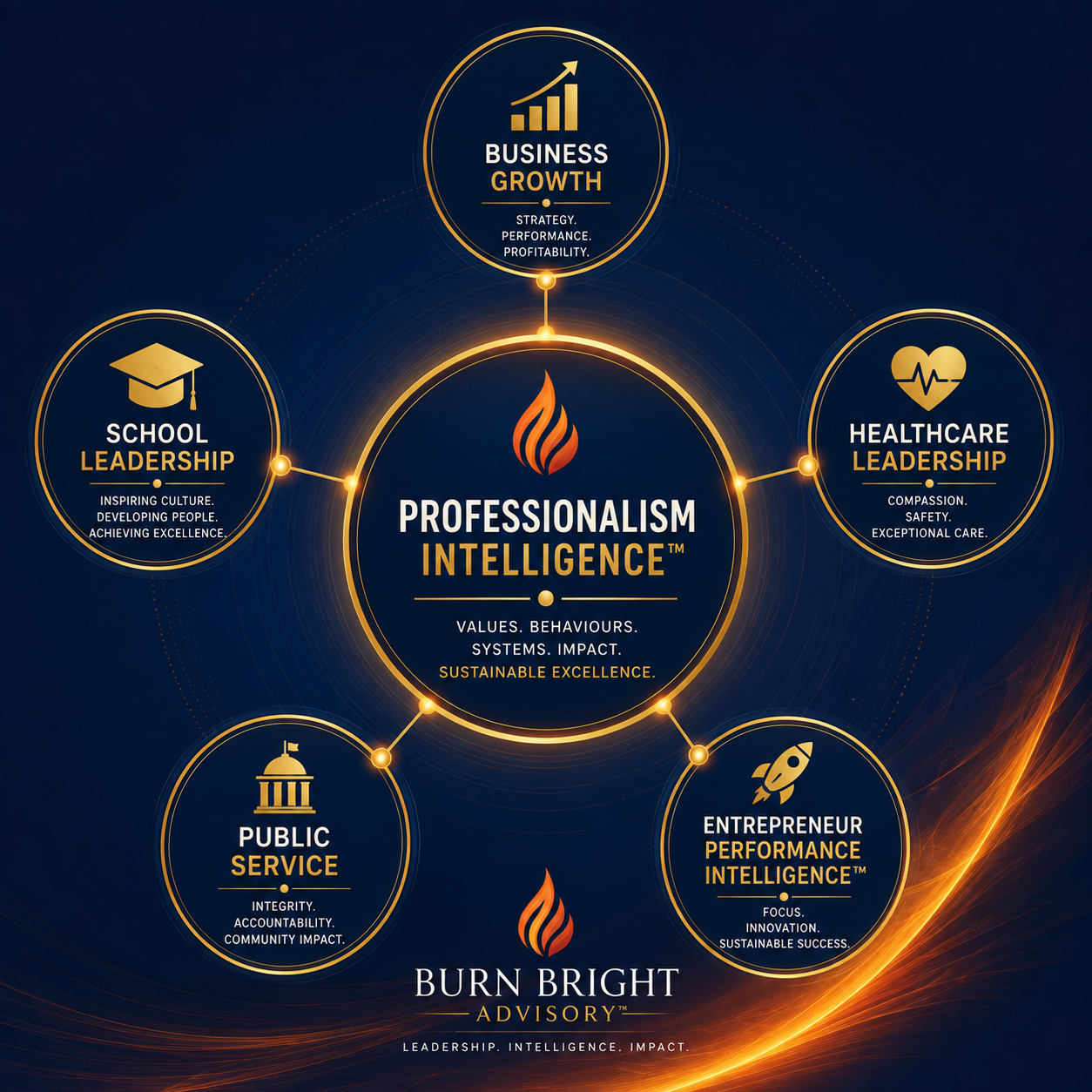
Sector Applications of Professionalism Intelligence™
Professionalism is universal, but its expression varies across sectors.
Business Leadership
Professional leaders avoid allowing short-term commercial pressures to compromise organisational credibility — communicating transparently during restructuring, treating suppliers fairly, maintaining ethical procurement and protecting confidential information. Businesses with highly professional leadership teams often experience stronger customer confidence, improved retention and greater resilience during disruption.
School Leadership
Educational leaders shape professional standards for teachers while modelling behaviours for students, through consistent safeguarding practices, fair performance management, evidence-informed decisions and respectful communication with parents. Professionalism becomes an educational resource rather than simply an administrative expectation.
Healthcare Leadership
Clinical expertise alone cannot compensate for inconsistent professional behaviour. Healthcare leaders must consistently demonstrate ethical decision making, patient-centred communication, multidisciplinary collaboration, accountability for clinical standards and calm leadership during emergencies. In healthcare, professionalism protects both people and outcomes.
Public Service Leadership
Public sector organisations operate under constant public scrutiny. Professionalism strengthens public confidence through transparency, procedural fairness, evidence-based policy implementation, responsible stewardship of public resources and impartial leadership. Credibility is built slowly but can be lost rapidly through inconsistent behaviour.
Entrepreneur Performance Intelligence™
Entrepreneurs frequently work in environments characterised by uncertainty, rapid decision-making and resource constraints. Founders who demonstrate professionalism through clear communication, reliable commitments and ethical growth practices often establish stronger investor confidence and healthier organisational cultures.
Why Professionalism Strengthens Leadership Sustainability™
Leadership is not measured by how effectively someone performs for six months. It is measured by how consistently they perform across years of increasing complexity. This distinction introduces one of Burn Bright Advisory™’s central concepts: Leadership Sustainability™.
Many leadership failures are not caused by a lack of intelligence. They result from accumulated inconsistency — reactive decision-making, poor emotional regulation, ethical drift, relationship fatigue and communication breakdown. These challenges gradually reduce leadership capacity.
Professionalism helps prevent this decline by providing stable behavioural standards that remain consistent regardless of changing circumstances. Professional leaders develop routines rather than relying solely on motivation, establish decision frameworks instead of making reactive choices, and create predictable communication patterns rather than responding emotionally to every situation.
Over time, these practices reduce unnecessary cognitive load, preserving energy for strategic thinking, innovation and people development.
Common Barriers to Professionalism Leadership
Although most leaders value professionalism, maintaining consistently professional behaviour becomes increasingly difficult as complexity grows.
Developing Professionalism Intelligence™
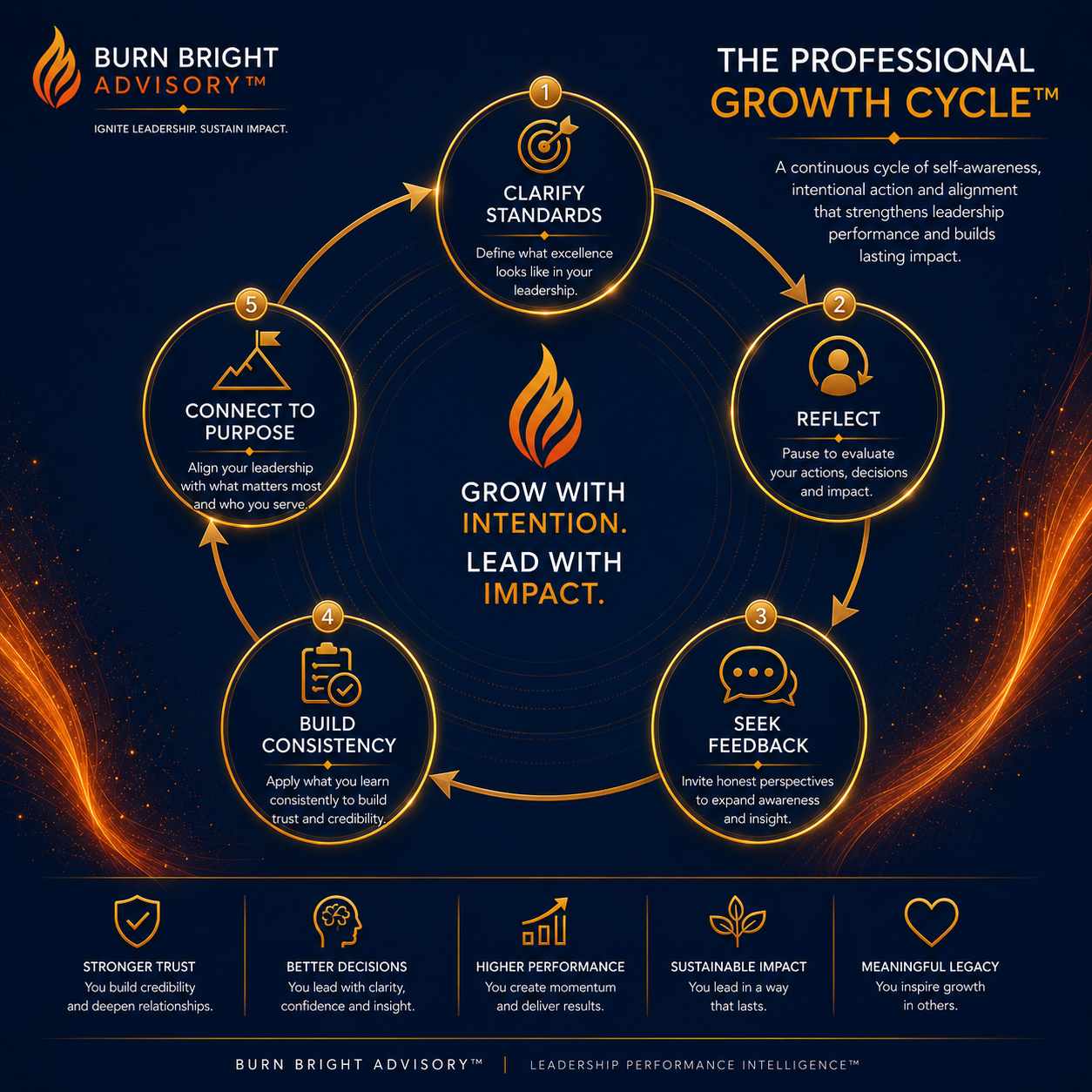
Professionalism is not a personality trait. It is a capability that develops through intentional practice. Burn Bright Advisory™ recommends five practical disciplines for strengthening Professionalism Intelligence™.
1. Clarify Your Professional Standards
Identify the leadership behaviours that define professionalism within your context. Ask what behaviours build trust, what behaviours damage credibility, and what standards should remain non-negotiable regardless of pressure. Clarity precedes consistency.
2. Increase Reflective Practice
Professional leaders routinely review both outcomes and behaviours. Reflection should become part of leadership rather than something reserved for annual reviews.
3. Seek Constructive Feedback
Professional leaders actively invite challenge. Feedback identifies blind spots before they become cultural problems. Professionalism grows through curiosity rather than defensiveness.
4. Build Behavioural Consistency
Employees trust predictable leaders. Professional leaders intentionally align behaviour across meetings, decisions, crises and everyday interactions. Consistency becomes a leadership signature.
5. Connect Professionalism to Purpose
Professional standards should never become performative. Their purpose is to improve leadership effectiveness, strengthen organisational trust and create sustainable performance.
Professionalism as a Competitive Advantage
Professionalism has often been viewed as an expectation rather than a strategic differentiator. Yet organisations that consistently outperform their peers frequently share one defining characteristic: they are trusted. Trust is not built through marketing campaigns or mission statements — it is built through professional leadership.
In today’s environment, where stakeholders can evaluate organisations instantly through digital channels, employee reviews and public accountability, professionalism has become a competitive advantage rather than simply an operational requirement.
Leaders who consistently demonstrate Professionalism Intelligence™ strengthen employee confidence, customer loyalty, stakeholder relationships, organisational reputation and long-term resilience.
Professionalism reduces uncertainty.
Uncertainty is expensive.
It slows decisions, weakens collaboration, increases turnover and damages organisational credibility.
Organisations therefore compete not only through products and services but through leadership credibility. Professionalism becomes part of organisational strategy.
Professionalism and the Future of Leadership
Artificial intelligence, automation and rapidly changing industries are transforming leadership faster than ever before. Technical knowledge will continue to evolve. Professional standards, however, remain timeless.
The future leader will not simply be recognised for possessing information. They will be recognised for demonstrating judgement, and judgement depends upon professionalism.
As routine decision-making becomes increasingly automated, leaders will spend more time navigating ethical dilemmas, stakeholder complexity, organisational ambiguity, cultural transformation, innovation and trust. These challenges cannot be solved solely through technology — they require leaders who consistently demonstrate integrity, accountability and credibility.
Leadership Performance Intelligence™ recognises that future-ready leaders combine technological capability with deeply human leadership qualities. Professionalism ensures that innovation never outpaces responsibility, and that organisational progress remains aligned with organisational values.
Leadership Reflection Questions
- How consistently do my behaviours align with the professional standards I expect from others?
- When under pressure, which aspects of my professionalism become most difficult to maintain?
- What behaviours have strengthened trust within my team?
- Which behaviours may unintentionally reduce my credibility?
- How effectively do I balance professionalism with authenticity?
- Does my communication create clarity or confusion?
- Are my decisions consistently aligned with organisational values?
- How frequently do I seek constructive feedback about my leadership behaviours?
- What would colleagues identify as my most professional leadership characteristic?
- Which aspect of Professionalism Intelligence™ should I intentionally develop over the next twelve months?
Practical Action Steps
Professionalism develops through deliberate, consistent action rather than occasional effort.
Immediate Actions (Next Seven Days)
- Define five professional leadership standards you will consistently model.
- Review recent leadership decisions for consistency and fairness.
- Ask one trusted colleague for honest feedback about your professional behaviours.
- Identify one communication habit that could improve organisational trust.
Short-Term Actions (Next 30 Days)
- Introduce regular reflective leadership reviews.
- Develop clearer behavioural expectations within your team.
- Improve decision transparency by explaining the rationale behind key decisions.
- Recognise examples of professionalism demonstrated by others.
Long-Term Actions (Next 90 Days)
- Complete a Leadership Intelligence Assessment™ to identify development priorities.
- Embed Professionalism Intelligence™ into team development conversations.
- Align performance discussions with professional standards rather than solely with outcomes.
- Review organisational systems to ensure they reinforce professional leadership behaviours.
Professionalism is strengthened through repetition. Small, consistent improvements accumulate into lasting leadership credibility.
Conclusion
Professionalism is frequently described as an expectation of leadership. Within the Leadership Performance Intelligence™ framework, it is considerably more than that — it is the behavioural expression of leadership capability.
It transforms values into observable actions.
It converts knowledge into consistent judgement.
It strengthens trust through reliability.
It reinforces accountability through integrity.
Professionalism Intelligence™ connects directly with Ethics Intelligence™, Emotional Intelligence™, Adaptability Intelligence™, Reflective Practice Intelligence™, Knowledge Development Intelligence™ and Leadership Sustainability™. Together, these capabilities enable leaders to move beyond managing tasks and towards building organisations characterised by trust, learning, resilience and sustainable performance.
The leaders who will define the future will not necessarily be those with the loudest voices or the most impressive titles. They will be those whose professionalism inspires confidence, whose decisions reflect integrity and whose leadership consistently enables others to perform at their best.
What is professionalism leadership?
Professionalism leadership is the consistent demonstration of ethical behaviour, accountability, competence, respect and sound judgement that enables leaders to build trust, strengthen organisational culture and improve long-term performance. Within Burn Bright Advisory™, this capability is described as Professionalism Intelligence™, forming a core domain of the Leadership Intelligence Compass™.
Why is professionalism important in leadership?
Professionalism creates predictability and trust. Employees are more likely to engage, collaborate and perform effectively when leaders consistently demonstrate fairness, reliability, integrity and respectful communication. Professionalism also reduces organisational risk by improving decision quality and strengthening accountability.
How does Professionalism Intelligence™ differ from technical competence?
Technical competence focuses on what leaders know. Professionalism Intelligence™ focuses on how leaders consistently apply that knowledge through ethical judgement, communication, accountability and behaviour. Technical expertise may gain credibility initially; professionalism sustains credibility over time.
Can professionalism be developed?
Yes. Professionalism is not a personality trait. It develops through reflective practice, continuous learning, constructive feedback, ethical decision-making, behavioural consistency, leadership coaching and deliberate self-awareness.
How does professionalism influence organisational culture?
Leaders establish cultural expectations through their behaviour. When professionalism is consistently demonstrated, organisations typically experience greater trust, improved collaboration, stronger accountability, higher engagement, healthier workplace relationships and increased organisational resilience.
How does professionalism support Leadership Sustainability™?
Professional leaders rely on clear standards rather than emotional reactions. This reduces decision fatigue, unnecessary conflict, leadership inconsistency and cognitive overload — preserving leadership capacity over the long term and supporting sustainable high performance.
Which sectors benefit most from Professionalism Intelligence™?
Professionalism is essential across every sector, including business, school leadership, healthcare, public service, HR and people leadership, and entrepreneurship. Although contexts differ, professionalism consistently strengthens leadership credibility and organisational effectiveness.
How does Professionalism Intelligence™ connect with the Leadership Intelligence Compass™?
Professionalism Intelligence™ reinforces every other leadership capability by providing behavioural consistency. It strengthens Ethics Intelligence™, Emotional Intelligence™, Constructivism Intelligence™, Adaptability Intelligence™, Reflective Practice Intelligence™, Knowledge Development Intelligence™ and Leadership Sustainability™ — together forming Leadership Performance Intelligence™.
How Strong Is Your Professionalism Intelligence™?
Take the free Leadership Burnout Self-Assessment to see how your professionalism, workload and leadership capacity are holding up under pressure.
Free Leadership Intelligence
Get Weekly Leadership Insights
Join thousands of leaders receiving practical strategies on burnout prevention, workload design, and sustainable performance every week.