Quick Answer
Key Takeaways
- Professionalism is a form of leadership intelligence, not a basic expectation — it determines whether standards survive pressure.
- Professionalism Intelligence™ spans five dimensions: Personal, Relational, Organisational, Strategic and Adaptive.
- Professional behaviour follows a performance chain from principles through to sustainable organisational performance.
- Professionalism is not perfectionism — it means handling uncertainty and mistakes responsibly, not appearing infallible.
- Leadership Sustainability™ protects the capacity leaders need to behave professionally under sustained pressure.
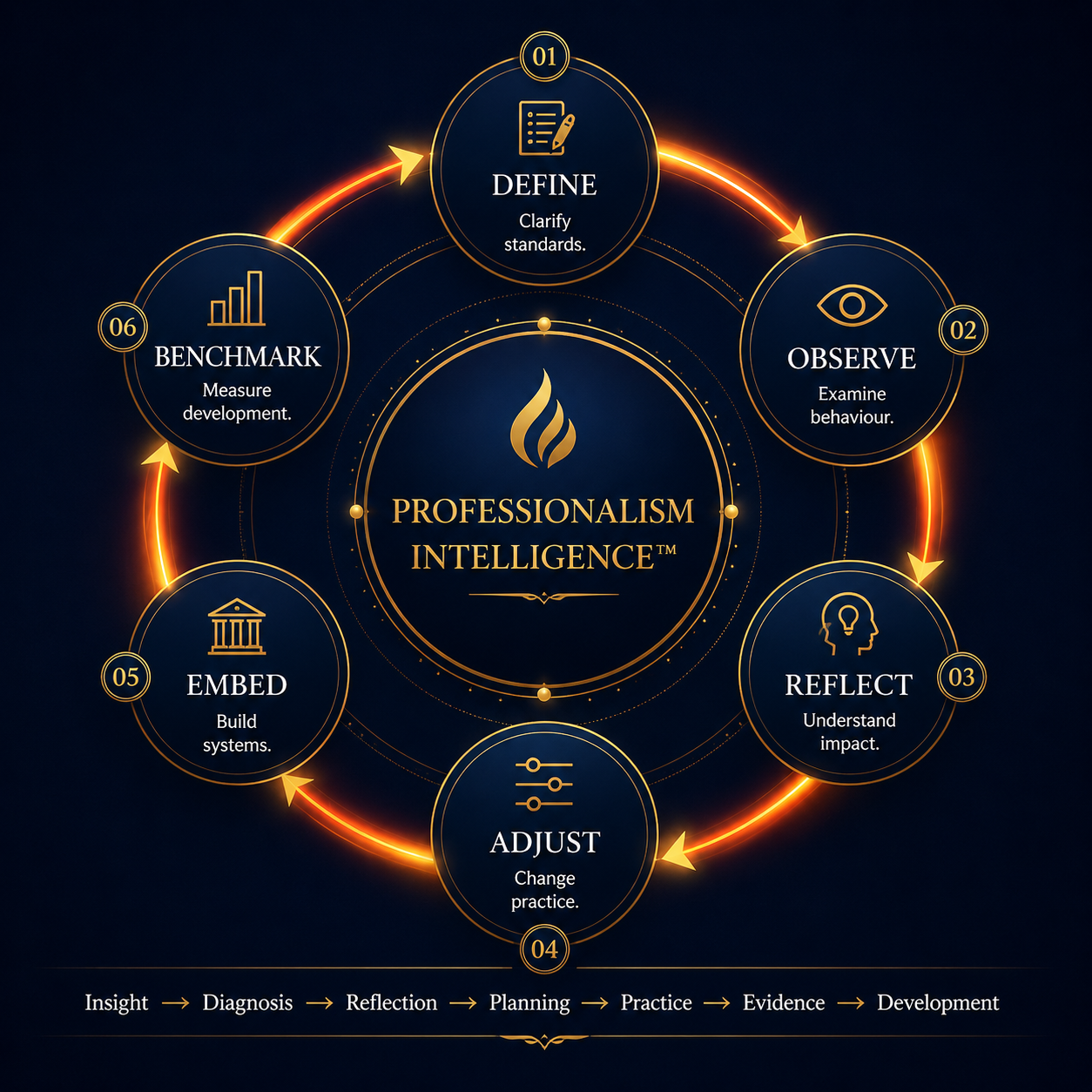
- Professionalism develops through a deliberate cycle: Define, Observe, Reflect, Adjust, Embed, Benchmark.
Professionalism in Leadership: The Intelligence That Builds Trust and Sustainable Performance
Leadership is often evaluated through visible outcomes. Did performance improve? Was the strategy delivered? Were targets achieved? Did the organisation grow?
These questions matter. But they do not tell us everything we need to know about leadership quality.
A leader can deliver a result while weakening trust. A target can be achieved through unsustainable pressure. A project can succeed while relationships deteriorate. A difficult decision can be commercially correct while being communicated so poorly that organisational confidence collapses.
Leadership performance therefore cannot be evaluated solely by asking what the leader achieved. We must also ask how the leader led while achieving it. That question takes us directly into professionalism.
Professionalism in leadership is sometimes reduced to presentation, etiquette, qualifications, appropriate communication or adherence to organisational rules. Those things have value. But they represent only the visible surface of something much deeper.
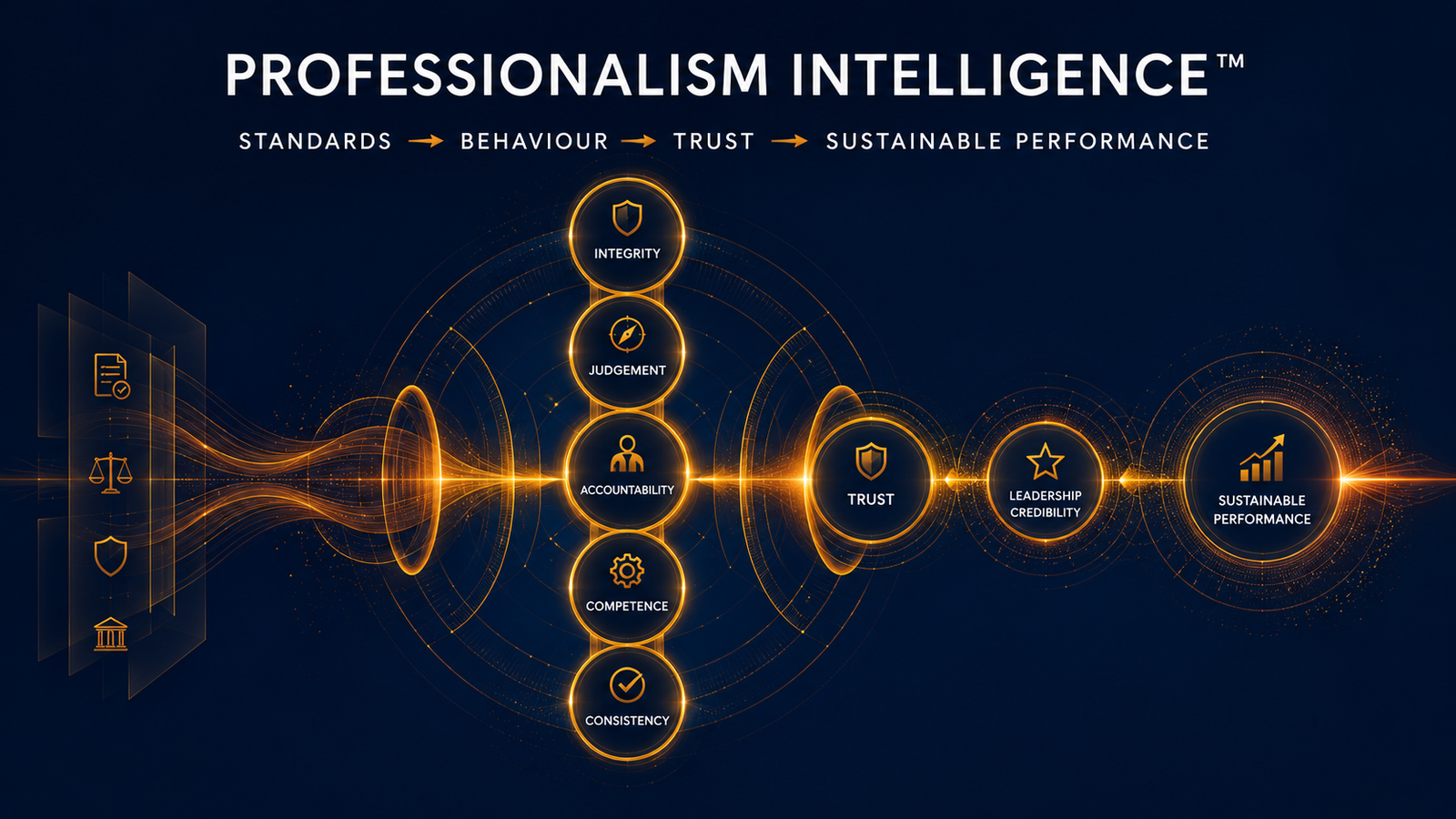
Professionalism is the disciplined translation of standards, values, judgement and responsibility into behaviour. It is demonstrated when the circumstances are inconvenient, when pressure rises, when information is incomplete, when relationships become difficult, when mistakes occur, when nobody is watching — and particularly when taking the professionally responsible course of action is harder than taking the easiest one.
This is why Burn Bright Advisory™ positions Professionalism Intelligence™ as a foundational domain within the Leadership Intelligence Compass™. Professionalism is not simply something leaders demonstrate. It is something leaders must learn to think through, practise, evaluate and continuously strengthen.
What Is Professionalism in Leadership?
Featured Snippet
Consider a senior leader receiving unexpected criticism. A professional response does not require agreement with the criticism, nor emotional detachment. It requires the capacity to hear the information, regulate the immediate response, assess the evidence, determine what requires action and communicate appropriately.
Consider a manager discovering that a major project is behind schedule. Professionalism does not mean pretending everything is fine. It means addressing the performance problem without turning accountability into humiliation.
Consider a school leader facing an angry parent, a healthcare executive responding to a clinical concern, a business leader confronting poor financial results or a public-service leader facing scrutiny. The contexts differ. The underlying leadership requirement does not: the leader must remain capable of acting according to standards rather than being governed entirely by circumstances. That is professional intelligence in practice.
Professionalism Is More Than Professional Appearance
There is an important distinction between looking professional and leading professionally. A leader may be articulate, well presented and highly polished while simultaneously behaving inconsistently, withholding information, avoiding accountability or treating people poorly. Conversely, another leader may have a less formal style while demonstrating exceptional integrity, judgement, competence and reliability.
Professionalism therefore cannot be judged by style alone. It must be evaluated through patterns of behaviour.
Leadership trust is built through accumulated evidence. One meeting rarely determines whether a leader is trusted. One email rarely establishes credibility. One decision rarely defines professional reputation. Trust develops through repeated interactions in which people gradually learn what to expect — and over time, these experiences become organisational evidence. That evidence becomes reputation.
Professionalism Intelligence™: Moving Beyond Compliance
Traditional approaches to professionalism often emphasise compliance: follow the policy, observe the code, meet the standard, complete the required training, avoid misconduct. These are necessary foundations, but they are insufficient for complex leadership.
Leadership regularly involves situations where policies cannot provide the complete answer. A restructuring decision may comply with organisational policy while still requiring careful judgement about communication, timing and human impact. A healthcare leader may comply with regulation while still needing to decide how competing operational pressures should be balanced. A school leader may follow formal procedures while still needing to determine what fairness means in a complex situation involving pupils, staff and parents.
Burn Bright Advisory™ uses the concept of Professionalism Intelligence™ to describe the leader’s capacity to interpret professional standards intelligently and translate them into appropriate action. This involves knowing:
- What standards apply and why they matter
- How they should influence behaviour
- When competing responsibilities require judgement
- How decisions will affect different stakeholders
- When personal preferences must be separated from professional obligations
- How accountability should operate after the decision has been made
Professionalism Intelligence™ transforms professionalism from a checklist into a leadership capability.
The Five Dimensions of Professionalism Intelligence™
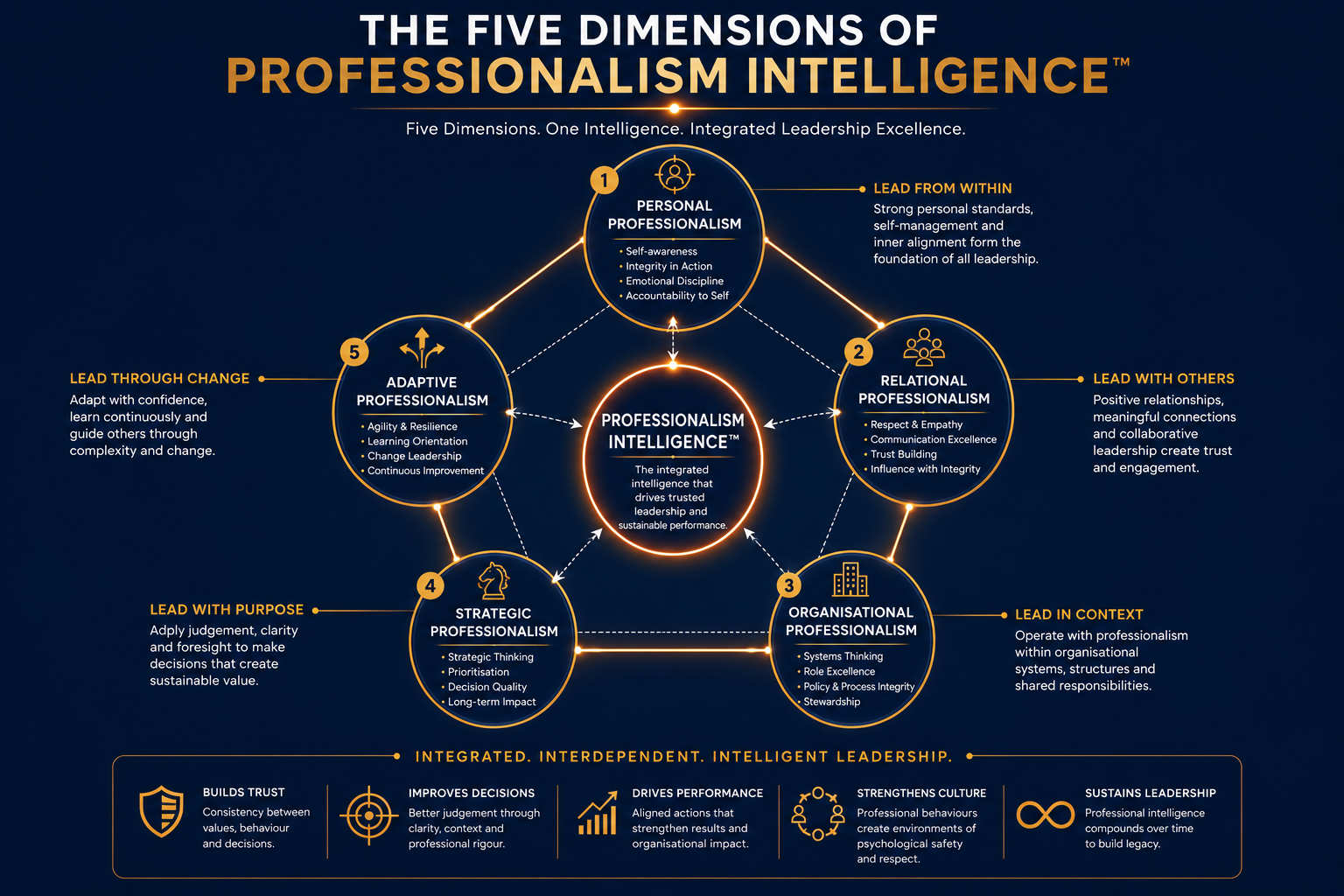
Professionalism becomes particularly useful when leaders can examine it through distinct but connected dimensions. Burn Bright Advisory™ conceptualises Professionalism Intelligence™ through five dimensions.
Dimension 1
Personal Professionalism
The leader’s capacity to lead themselves — asking whether they can be trusted to govern their own conduct before attempting to govern the work of others.
- Integrity and self-discipline
- Reliability and preparation
- Self-awareness and emotional regulation
- Consistency between stated values and actual behaviour
Leadership authority magnifies personal behaviour. A leader who expects accountability but becomes defensive when challenged weakens the standard. Leadership culture notices contradictions quickly — professionalism begins by reducing them.
Dimension 2
Relational Professionalism
How leaders interact with colleagues, employees, partners, customers, patients, students, families and communities.
- Respect and appropriate boundaries
- Listening and constructive challenge
- Confidentiality and fairness
- Responsible use of authority
Professional relationships do not require leaders to agree with everyone, or to avoid difficult conversations. The distinction lies in how those conversations are conducted. Relational professionalism converts authority into trust.
Dimension 3
Organisational Professionalism
Leaders represent systems. Their behaviour influences what the organisation considers normal — whether expectations are clear, standards applied consistently and accountability operates upward as well as downward.
A code of conduct is not a culture. A policy is not a behaviour. A value printed on a wall is not organisational evidence. Standards become meaningful only when leadership behaviour repeatedly reinforces them.
Dimension 4
Strategic Professionalism
Senior leaders routinely make decisions with incomplete information, competing interests and uncertain outcomes. Strategic professionalism brings disciplined judgement to those decisions — evidence-informed thinking, appropriate consultation, responsible risk-taking and alignment between decisions and organisational purpose.
Strategic intelligence without professionalism can become dangerous. Professionalism introduces a broader question: not only can we do this, but should we — and what responsibilities follow if we do?
Dimension 5
Adaptive Professionalism
Professional standards cannot become an excuse for rigidity. The environment, technology, social expectations and professional knowledge all change. Adaptive professionalism means preserving principles while adapting practice.
The professionally intelligent leader does not defend an outdated practice simply because “this is how we have always done it.” Neither do they chase every new trend. They evaluate change intelligently.
The Professionalism Intelligence™ Performance Chain
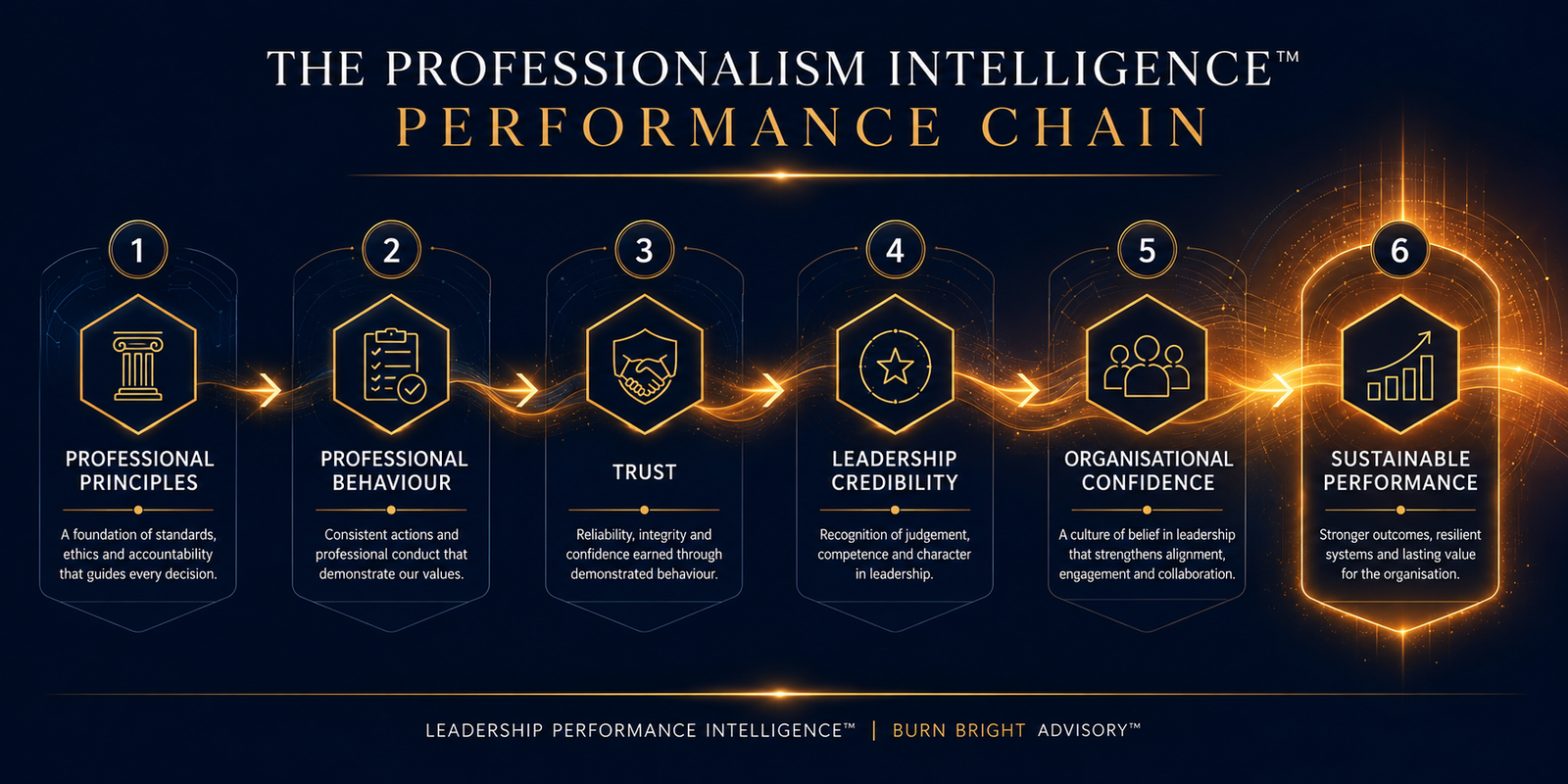
Professionalism matters because its effects travel through organisations. Burn Bright Advisory™ describes this relationship through a simple performance chain:
Professional Principles
→ Professional Behaviour
→ Trust
→ Leadership Credibility
→ Organisational Confidence
→ Sustainable Performance
Stage 1 Professional Principles
Leadership begins with standards — organisational expectations, professional codes, ethical principles, personal values, legal obligations and sector requirements. Principles alone do not produce performance; they must become behaviour.
Stage 2 Professional Behaviour
Behaviour converts abstract expectations into observable leadership — communicating clearly, keeping commitments, preparing properly, taking responsibility, treating people consistently and applying standards fairly.
Stage 3 Trust and Leadership Credibility
Repeated professional behaviour creates evidence of reliability, and trust accumulated over time becomes credibility. Teams are more likely to follow difficult decisions when previous experience suggests leadership judgement is responsible and trustworthy.
Stage 4 Organisational Confidence and Sustainable Performance
When professionalism exists across leadership levels, confidence expands beyond individual relationships. Trust reduces unnecessary friction, clear standards reduce ambiguity, and reliable systems reduce dependence on individual heroics — making organisations more dependable, not simply more polite.
Why Professionalism Builds Leadership Trust
Trust is one of leadership’s most valuable forms of organisational capital. Yet leaders sometimes approach trust as though it were created primarily through personality — be approachable, be authentic, communicate more, build relationships. All useful. But trust has a deeper structural component: people trust leaders when evidence suggests those leaders are likely to behave appropriately in situations that matter. That evidence is built through professionalism.
Consider two leaders. The first is charismatic, energetic and highly personable, but deadlines are frequently missed and decisions change depending on who last spoke to them. The second is less charismatic but prepares carefully, communicates decisions clearly, acknowledges uncertainty and addresses problems consistently. Usually, the second becomes easier to trust — because trust requires more than warmth. It requires reliability.
Trust Is Built in Small Leadership Moments
Major crises reveal leadership character. But ordinary moments build it — the meeting a leader starts on time, the commitment they remember, the mistake they acknowledge, the confidential information they protect, the standard they apply to themselves. None of these actions appears transformational in isolation. Collectively, they create leadership reputation. This is why professionalism should be viewed not as occasional exemplary behaviour, but as a pattern. And patterns become culture.
Professionalism Under Pressure
The strongest test of professionalism occurs when professional behaviour becomes difficult. When deadlines compress, leaders can become abrupt. When performance falls, they can become controlling. When challenged, they can become defensive. Pressure reveals the maturity of Professionalism Intelligence™ — the question is not whether a leader experiences stress, but whether stress changes the quality of their leadership behaviour.
This connects professionalism directly with Leadership Sustainability™. An exhausted leader may still possess strong professional values, but depleted capacity makes those values harder to translate consistently into behaviour. Sustainable leadership requires systems, boundaries and workload management rather than continual personal heroics — professionalism therefore includes protecting sufficient Leadership Capacity™ to exercise sound judgement.
When Professionalism Breaks Down
Professionalism rarely collapses in one dramatic event. More often, it erodes — one-to-ones get cancelled, feedback becomes rushed, decisions are made without sufficient consultation, and people stop raising concerns because they cannot predict the response. Eventually the organisation describes the problem as “culture.” But culture may be the downstream consequence; the earlier warning sign was deteriorating leadership practice.
This is why Professionalism Intelligence™ should be assessed before serious behavioural failure occurs. Professional development should not begin only after misconduct — it should strengthen the everyday capabilities that prevent deterioration.
The Professionalism Intelligence™ Reflection Test
Leaders can begin with five questions.
Behaviour
Would I consider my own recent leadership behaviour professionally exemplary if I observed it in another leader?
Consistency
Do people receive approximately the same standard of leadership from me when I am under pressure as when conditions are comfortable?
Accountability
Do I apply expectations to myself as consistently as I apply them to others?
Relationships
Can people challenge my thinking without fearing an unprofessional response?
Reflection
When my impact differs from my intention, which one am I willing to examine first?
The final question is especially important. Leaders naturally judge themselves partly through intention. Other people experience leadership through impact. Professional growth occurs when leaders develop the reflective capacity to examine the gap between the two. Professionalism is therefore not defensiveness about one’s reputation — it is responsibility for one’s impact.
Professionalism Intelligence™ Across Leadership Sectors
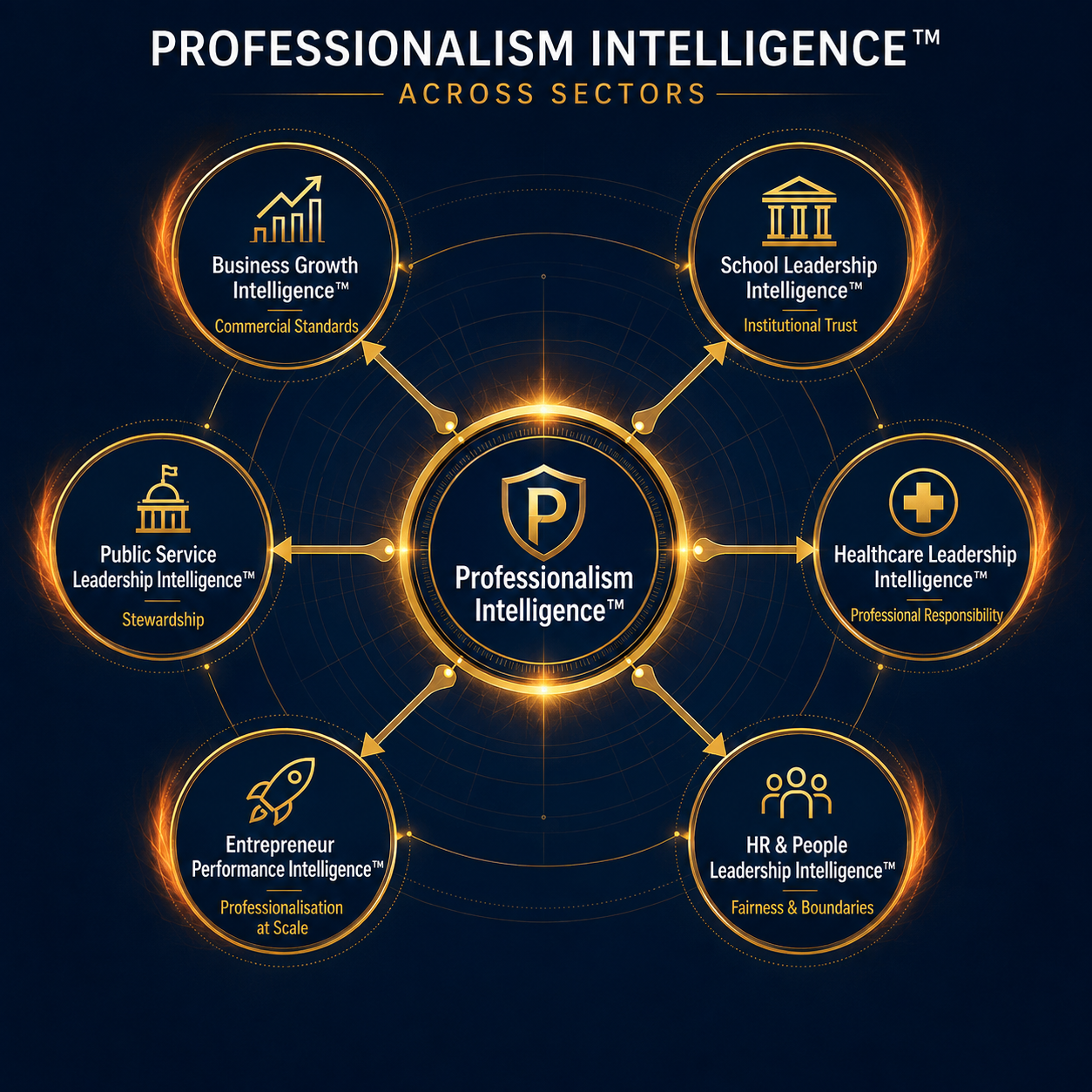
Professionalism has universal foundations, but it does not look identical in every leadership environment. Leadership Performance Intelligence™ must connect universal leadership capability with contextual intelligence — Professionalism Intelligence™ provides the foundation, and sector context determines how that intelligence must be applied.
Business Growth Intelligence™
Under commercial pressure, professionalism reduces the organisational friction created by ambiguity and inconsistency. A professionally intelligent leader keeps performance expectations high while keeping standards visible — targets are explained, accountability stays consistent and ethical boundaries are maintained. Sustainable growth needs capability, but it also needs credibility.
School Leadership Intelligence™
Schools are highly relational organisations, so professionalism becomes part of institutional trust. A professionally intelligent school leader gathers evidence, follows appropriate processes, communicates carefully and maintains the dignity of the individual while protecting institutional standards — rather than confusing compassion with avoidance or accountability with aggression.
Healthcare Leadership Intelligence™
In healthcare, professionalism must coexist with urgency. A professionally intelligent leader examines workload, listens to frontline information, escalates concerns appropriately and avoids creating a culture in which exhaustion becomes evidence of commitment — recognising when the system itself is creating risk rather than silently absorbing it.
Public Service Leadership Intelligence™
Public-service leaders are stewards of public resources, confidence and institutional legitimacy. Professionalism Intelligence™ helps them separate personal emotion from professional responsibility when political, organisational and public pressures collide, asking what responsible stewardship requires at each moment.
HR & People Leadership Intelligence™
People leaders sit at the intersection of organisational performance and human experience, so professionalism requires strong boundaries and consistency. Professionalism Intelligence™ and Ethics Intelligence™ work together here: professionalism establishes dependable practice, while ethics interrogates whether that practice is morally and organisationally responsible.
Entrepreneur Performance Intelligence™
Professionalism can be especially difficult for founders, because organisations often grow faster than their leadership systems. Professionalism Intelligence™ helps entrepreneurial leadership mature — identifying which informal practices now require systems, and which decisions need delegating, without becoming bureaucracy for its own sake.
Professionalism Is Not Perfectionism
One of the most damaging misunderstandings about professionalism is the belief that professional leaders should always know the answer, remain completely composed and avoid visible mistakes. That is not professionalism. It is performance — and when taken too far, it becomes perfectionism.
| Perfectionism Says | Professionalism Says |
|---|---|
| I cannot be seen not knowing | I will prepare responsibly |
| I must prevent others from seeing that I make mistakes | I will take responsibility for mistakes |
| My authority depends on appearing to possess all the expertise | I will seek expertise where necessary |
Professionalism creates learning. Perfectionism can create defensiveness. A professional leader can say “I don’t know yet,” “I was wrong,” or “What am I missing?” — these statements do not automatically weaken authority. Used appropriately, they strengthen credibility because they demonstrate intellectual honesty. The professionally intelligent leader does not pretend to be infallible; they demonstrate that uncertainty will be handled responsibly.
Professionalism and Psychological Safety
Psychological safety is sometimes misunderstood as creating environments where people are always comfortable. That is not its purpose. It allows people to raise questions, identify risks and challenge assumptions without unnecessary interpersonal threat — and professionalism is one of the conditions that makes this possible.
People are more likely to speak when they can reasonably predict how leadership will respond. If disagreement results in humiliation, silence becomes rational. If mistakes are punished inconsistently, people hide mistakes. Professionalism provides behavioural stability: a leader can still disagree, reject a proposal or make an unpopular decision. Psychological safety does not remove leadership authority — professionalism determines how that authority is exercised.
Professionalism in Hybrid and Digital Leadership
Modern professionalism is increasingly digital, experienced through email, messaging platforms, video meetings and shared documents. A leader who would never interrupt an employee repeatedly in person may send messages late into the evening and unintentionally establish an expectation of constant availability. Digital speed can encourage leaders to respond before they have reflected.
Professionalism Intelligence™ therefore requires digital judgement: is this the correct channel, could this message be misunderstood, and should this conversation happen verbally rather than through text? Digital professionalism is leadership judgement applied to technology-mediated relationships.
Professionalism in the Age of Artificial Intelligence
Leaders increasingly have access to systems that can summarise information, generate recommendations and accelerate analysis. These capabilities are valuable, but the existence of a technological capability does not remove professional responsibility. Professionalism Intelligence™ asks what information is appropriate to provide to an AI system, what requires human verification, and who remains accountable for the final decision.
The answer to that final question should rarely be ambiguous. Leadership remains accountable. Technology may inform judgement — it does not eliminate responsibility for it.
Seven Risks When Professionalism Deteriorates
The Professionalism Intelligence™ Maturity Model
Professionalism should not be treated as a binary condition. Leaders and organisations develop through stages. Burn Bright Advisory™ evaluates Professionalism Intelligence™ across five maturity levels.
| Level | Leadership Pattern | Typical Characteristics |
|---|---|---|
| 1. Reactive | Professionalism depends on circumstances | Inconsistent behaviour, defensive responses, unclear standards, personality-led decisions |
| 2. Compliant | Professionalism is understood mainly as following rules | Policies followed, minimum expectations met, limited reflection or contextual judgement |
| 3. Consistent | Professional standards become reliable behaviour | Clear expectations, dependable communication, accountability and behavioural consistency |
| 4. Reflective | Leaders examine impact and continuously improve practice | Feedback seeking, self-awareness, adaptive judgement, learning from mistakes |
| 5. Systemic | Professionalism becomes embedded in organisational leadership systems | Leadership modelling, diagnostics, development, accountability and benchmarking |
The objective is not to label leaders. It is to identify the next developmental move. A leader operating primarily at Level 2 does not need to become Level 5 tomorrow — they need to understand what would move their practice towards Level 3. Development becomes practical when the gap becomes visible.
Developing Professionalism Intelligence™
Professionalism develops through deliberate practice rather than aspiration. The Burn Bright development cycle runs: Define → Observe → Reflect → Adjust → Embed → Benchmark.
Define
Clarify what professional leadership means within the role. Don’t assume everyone shares the same interpretation of expected behaviours, non-negotiable standards and accountability.
Observe
Examine actual behaviour rather than intended behaviour — meeting conduct, decision processes, communication, follow-through and behaviour under pressure. This creates evidence.
Reflect
Ask what the evidence reveals. Where is behaviour aligned with professional expectations, and where are contradictions emerging? Reflection converts experience into intelligence.
Adjust
Choose specific behavioural changes — not “I need to become more professional,” but concrete commitments such as explaining the rationale behind significant decisions. Specificity makes development observable.
Embed
Individual behaviour becomes sustainable when supported by systems — leadership standards, meeting protocols, decision frameworks and structured reflection. This moves Professionalism Intelligence™ into the wider Leadership Development System™.
Benchmark
Leaders need to know whether improvement is occurring. Leadership Benchmarking™ examines self-assessment, team experience, stakeholder feedback and leadership sustainability indicators, transforming development from aspiration into an evidence-informed process.
Professionalism Intelligence™ and the Leadership Intelligence Compass™
Professionalism does not operate independently. The Leadership Intelligence Compass™ matters because complex leadership performance requires multiple forms of intelligence working together: Professionalism Intelligence™ establishes standards and dependable conduct, Ethics Intelligence™ helps leaders evaluate what is right, Adaptability Intelligence™ helps leaders respond when circumstances change, and Leadership Sustainability™ protects the capacity required to continue performing effectively over time.
Consider a difficult organisational restructuring. Professionalism Intelligence™ asks what standards should guide conduct. Ethics Intelligence™ asks what the responsible course of action is. Emotional Intelligence™ asks how people are experiencing the change. Leadership Sustainability™ asks whether the people responsible for delivering the change can sustain the required performance. Leadership Performance Intelligence™ integrates those questions — and that integration is what moves leadership development beyond isolated competencies.
From Professional Leader to Professional Leadership System
The ultimate goal is not simply to develop individual professional leaders. It is to build professional leadership systems. An organisation remains vulnerable if professionalism depends entirely on the character of whichever leader happens to occupy a role — professionalism must become transferable, visible, teachable, assessable, reflective and embedded.
This is why Burn Bright Advisory™ connects leadership insight with diagnostics, planning tools, workshops, assessments and development pathways, creating movement from Insight → Diagnosis → Reflection → Planning → Practice → Evidence → Benchmarking → Development.
Conclusion: Professionalism Is Leadership Made Visible
Professionalism is sometimes dismissed as conventional. In reality, it is one of leadership’s most practical forms of intelligence. It determines whether values survive pressure, whether authority is exercised responsibly, and whether trust accumulates or deteriorates.
It does not require perfection — it requires responsibility.
It does not require every answer — it requires professional handling of uncertainty.
It does not eliminate emotion — it prevents unmanaged emotion from controlling judgement.
It does not prevent mistakes — it determines what leaders do after mistakes occur.
Professionalism exists when leadership behaviour repeatedly provides evidence that authority can be trusted. That is why Professionalism Intelligence™ belongs at the heart of the Leadership Intelligence Compass™. Leadership Performance Intelligence™ is ultimately concerned with more than whether leaders can perform — it asks whether they can perform intelligently, responsibly and sustainably. Professionalism makes that intelligence visible.
Leadership Reflection Questions
- What evidence would people use to judge my professionalism as a leader?
- Which professional standards are most visible in my everyday behaviour?
- Where might there be a gap between my professional intentions and my actual impact?
- How does my behaviour change when workload or pressure increases?
- Do I apply the same standards to myself that I expect from others?
- How professionally do I respond when somebody challenges my judgement?
- Are people able to bring me difficult information safely?
- Where have informal habits replaced appropriate professional systems?
- Which aspects of my leadership depend too heavily on personal effort rather than sustainable processes?
- Which Leadership Intelligence Compass™ domain would most strengthen my Professionalism Intelligence™ now?
Action Steps
Within 24 Hours
Identify one recent leadership interaction and examine it through three questions: What did I intend? What did I actually do? What might other people have experienced? Begin by examining the behaviour, not defending it.
Within Seven Days
Ask one trusted colleague or team member: “What is one thing I could do more consistently that would strengthen your confidence in my leadership?” Listen before explaining.
Within 30 Days
Choose one Professionalism Intelligence™ behaviour to strengthen and make it observable and measurable — for example, improving decision communication, strengthening meeting discipline or addressing difficult conversations earlier.
Within 90 Days
Revisit the behaviour. Has team experience changed? Has your behaviour become more consistent? What still breaks down under pressure, and what system would help make the improvement sustainable?
Frequently Asked Questions
What is professionalism in leadership?
Professionalism in leadership is the consistent application of appropriate standards, integrity, competence, judgement and accountability to leadership behaviour and decisions. It is demonstrated through what leaders repeatedly do rather than simply through their title, qualifications or appearance.
Why is professionalism important for leaders?
Professionalism helps create predictability, trust and credibility. When employees and stakeholders know that leaders will communicate responsibly, maintain standards and exercise appropriate judgement, organisational confidence increases.
What is Professionalism Intelligence™?
Professionalism Intelligence™ is Burn Bright Advisory’s leadership concept describing the capacity to understand professional standards and translate them into consistent behaviour, sound judgement, responsible relationships and sustainable leadership practice. It forms part of the Leadership Intelligence Compass™.
What are examples of professional leadership behaviour?
Examples include keeping commitments, communicating decisions clearly, preparing appropriately, maintaining confidentiality, treating people respectfully, accepting accountability and responding constructively to challenge.
Is professionalism the same as ethics?
No. Ethics Intelligence™ focuses particularly on questions of right, responsibility and moral judgement. Professionalism Intelligence™ focuses on translating standards, responsibilities and judgement into dependable leadership practice. Effective leadership requires both.
Can a leader be professional without being formal?
Yes. Professionalism should not be confused with formality. Leadership style may be informal, warm or conversational while still demonstrating strong standards, appropriate boundaries, accountability and judgement.
How does professionalism build trust?
Professional behaviour provides repeated evidence of reliability. When leaders keep commitments, communicate responsibly, apply standards fairly and take responsibility for mistakes, people become more confident about how leadership will behave in future situations.
How can leaders improve professionalism?
Leaders can improve Professionalism Intelligence™ by defining expected standards, observing their actual behaviour, seeking feedback, reflecting on gaps between intention and impact, and embedding improvements through leadership systems.
What is the relationship between professionalism and leadership sustainability?
Professional behaviour requires sufficient cognitive and emotional capacity. Persistent overload can weaken judgement, communication, reflection and self-regulation, so Leadership Sustainability™ helps protect the capacity through which professional leadership can be maintained consistently.
How should organisations assess leadership professionalism?
Assessment should extend beyond policy compliance to examine leadership behaviour, stakeholder experience, decision-making, accountability, communication, consistency and sustainability. Burn Bright Advisory™ integrates these dimensions through its wider Leadership Performance Intelligence™ approach.
Where Does Your Professionalism Intelligence™ Stand?
Explore the Leadership Intelligence Compass™ and identify where your leadership capability is strongest — and where the next stage of development should begin.
Free Leadership Intelligence
Get Weekly Leadership Insights
Join thousands of leaders receiving practical strategies on burnout prevention, workload design, and sustainable performance every week.