Quick Answer
Key Takeaways
- Audit before you optimise. You cannot redesign a workload you have never properly examined.
- Look for scope creep. Many overloaded leaders are carrying responsibilities that accumulated gradually rather than being deliberately assigned.
- Separate accountability from execution. Being accountable for an outcome does not mean you must personally complete every task associated with it.
- Make trade-offs visible. When new work arrives, ask what will stop, move or receive fewer resources.
- Protect leadership capacity structurally. Sustainable leadership requires workload architecture, boundaries and decision clarity — not simply greater personal effort.
How to Stop Taking on Too Much as a Leader
Knowing how to stop taking on too much is one of the most important disciplines a leader can develop. Not because leaders should avoid responsibility. Because responsibility without limits eventually becomes overload.
The problem usually develops quietly. You solve a problem because nobody else can handle it. You cover a vacancy. You take ownership of a struggling project. A temporary responsibility becomes permanent. Nothing looks unreasonable in isolation, but the role expands while your capacity does not.
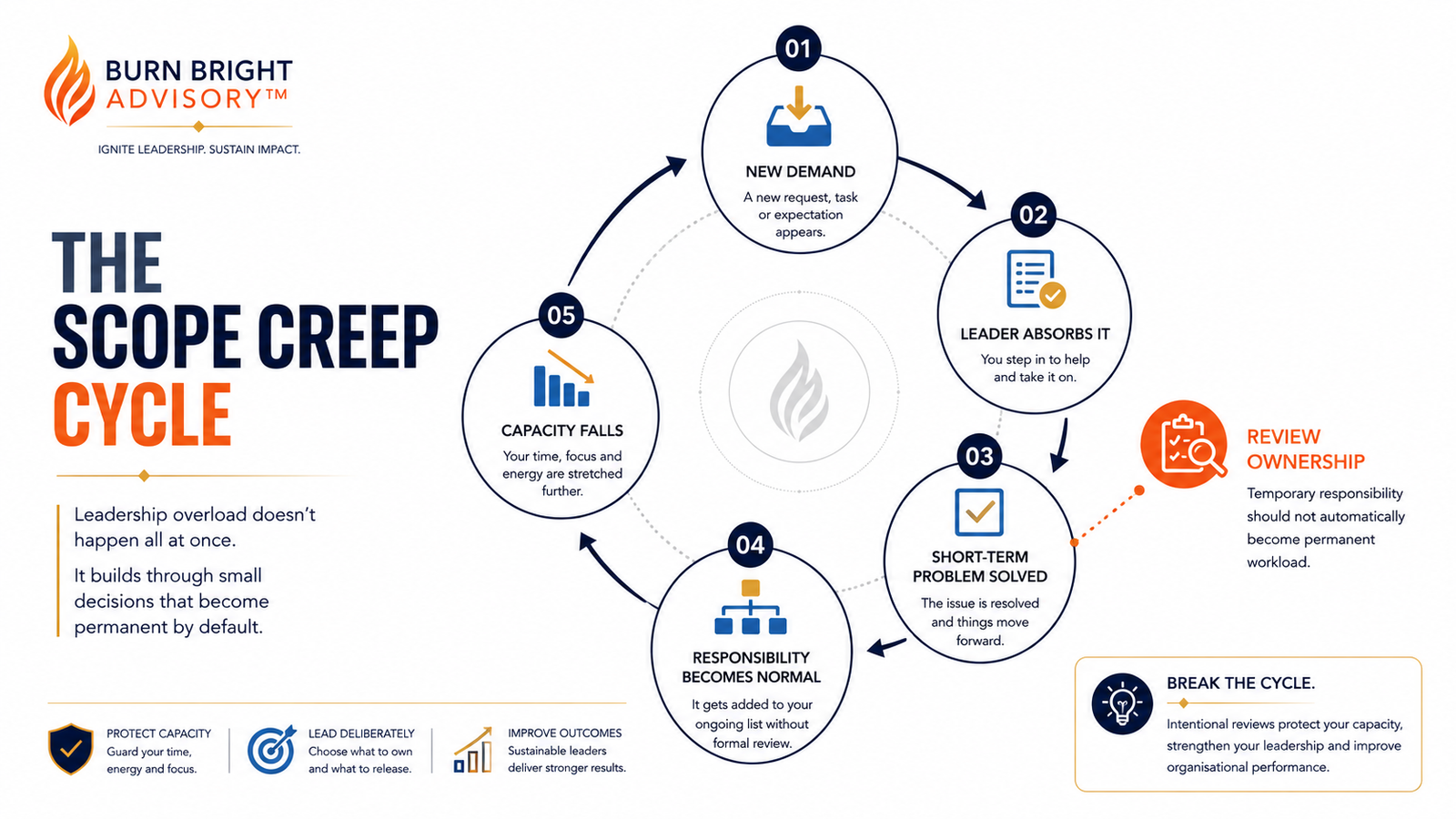
This is scope creep, one of the five root causes of burnout within the Burn Bright Not Out Framework. The other four are meeting culture, communication chaos, decision overload and perfectionism culture. Together, they help explain why highly capable leaders can become overwhelmed even when they are organised, experienced and committed.
The Burn Bright Not Out Framework therefore treats burnout structurally rather than motivationally, because if the workload itself is structurally unsustainable, another productivity technique will not solve it. You need to change the architecture of the work.
Featured Snippet
Why Taking on Too Much Is a Structural Problem
Modern leadership roles rarely become overloaded because somebody deliberately designed an impossible job. They become overloaded through accumulation — a crisis responsibility that never leaves, a colleague’s workload that stays after their replacement arrives, another reporting requirement, another meeting. Eventually the role a leader is performing is substantially larger than the role they originally accepted.
The result is a dangerous assumption: “I should be able to handle this.” That assumption turns a structural problem into a personal judgement. So the leader works harder — lunch disappears, strategic thinking time disappears, delegation declines because explaining the task feels slower than doing it personally. The system remains unchanged while the individual absorbs the difference.
The Scope Creep Cycle
New demand arrives.
The leader absorbs it.
The short-term problem is solved.
The responsibility becomes normal.
Capacity falls.
Another demand arrives.
The dangerous part is that the first decision can be entirely rational — taking responsibility during a crisis may be exactly what leadership requires. The problem comes later, when nobody asks: should this still belong to me? Without that question, temporary responsibilities become permanent workload.
Why Do Capable Leaders Keep Taking On Too Much?
One of the uncomfortable realities of leadership overload is that competence can make the problem worse. The more capable you are, the more likely people are to bring problems to you. In the short term, this looks like effective leadership. Over time, it can create dependency, as work begins flowing towards the person most capable of absorbing it rather than towards the place where it should structurally sit.
Strong workload boundaries do not require leaders to become unhelpful. They require leaders to make trade-offs explicit. Instead of “I can’t do that,” try: “I can take responsibility for this. Which existing priority should move to create the capacity?” That changes a personal refusal into an organisational decision.
How Can Leaders Identify Scope Creep?
You cannot fix scope creep by looking only at how busy you feel. You need evidence. The first question is not how much work you have — it is how the work got there. The Burn Bright Not Out Framework recommends looking backwards at workload evolution rather than treating today’s responsibilities as permanent facts.
Start by listing recurring responsibilities beyond your formal job description, then investigate the history of each: “I took this over when Sarah left.” “I’ve always done it.” “Nobody else knew how to do it.” Those answers show how your workload evolved — they do not prove the responsibility still belongs with you.
The Burn Bright Workload Audit
1. Why did this work enter my role?
Was it deliberately assigned, volunteered for, inherited, or created by a crisis or vacancy?
2. Does that reason still exist?
Circumstances change — teams develop, projects finish, crises end — but responsibilities often remain untouched.
3. Does this genuinely require my level of authority?
Some responsibilities need senior judgement. Others simply became attached to a senior person.
4. What happens if I stop doing it?
Sometimes the answer is nothing. Sometimes someone else would finally have to own it. That consequence tells you whether to retain, delegate or redesign it.
5. What is the opportunity cost of keeping it?
Every hour spent on one responsibility is unavailable for strategic thinking, coaching or decision-making that only you can provide.
What Should Leaders Stop, Delegate, Reassign or Renegotiate?
Once the workload is visible, do not immediately ask how to complete it faster. Classify it. A useful structural approach places each responsibility into one of five categories.
Category Keep
Does this genuinely require my judgement, authority or expertise? Example: strategic decisions, critical stakeholder relationships.
Category Delegate
Could someone else execute this with appropriate authority and support? Example: routine reporting, project coordination.
Category Reassign
Does this responsibility actually belong somewhere else? Example: work inherited from another function or vacancy.
Category Eliminate
Would anything meaningful happen if this stopped? Example: legacy reports, duplicated approvals, obsolete meetings.
Category Renegotiate
Is the work necessary but unrealistic under current capacity? Example: a new strategic priority without additional resources.
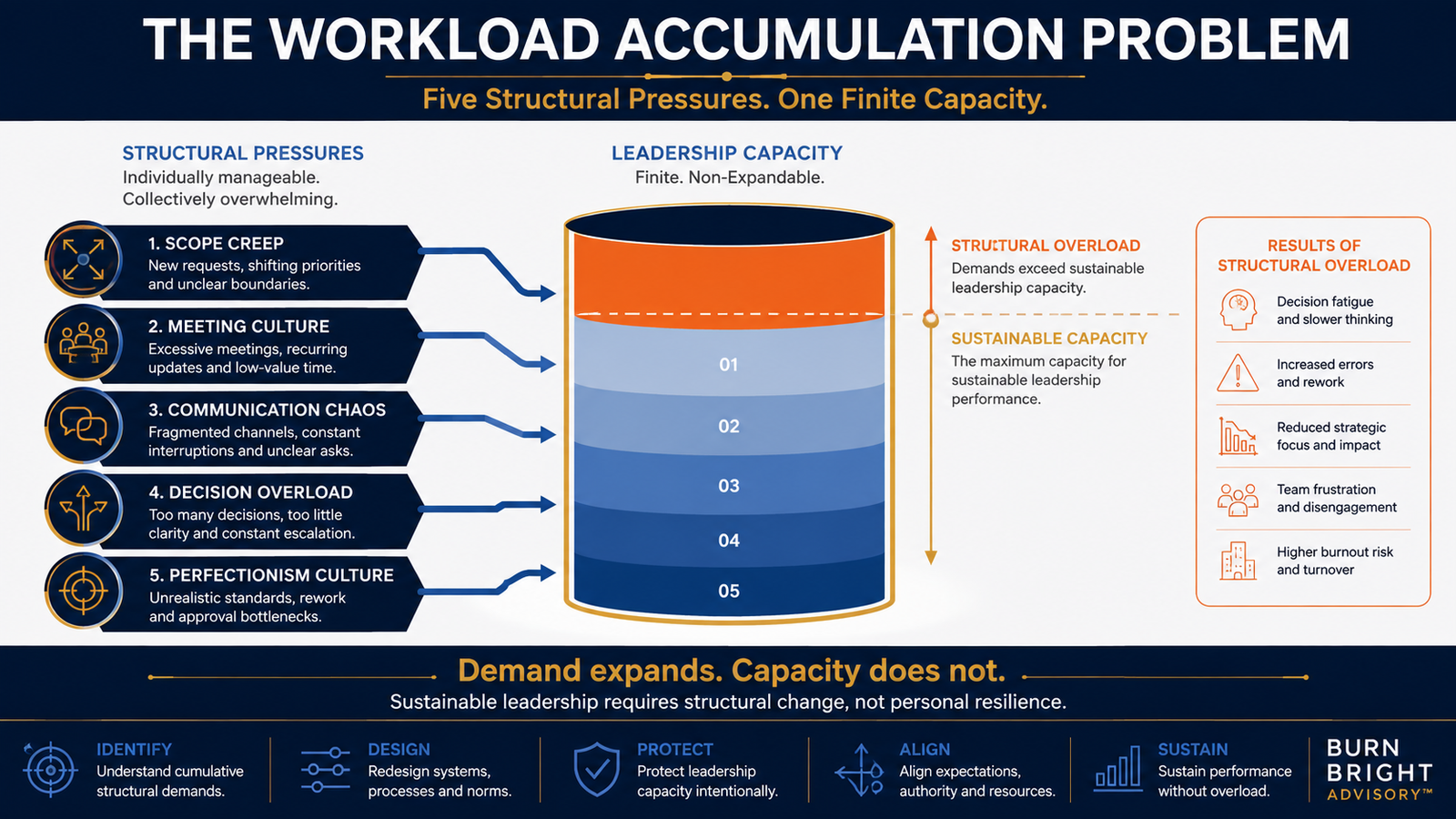
These causes rarely operate independently: scope creep increases responsibilities, more responsibilities create more meetings, fragmented time increases communication, and more communication produces more decisions. This is why the answer to how to stop taking on too much cannot simply be “say no more often.” The deeper requirement is to redesign how work enters the role in the first place.
How Should Leaders Respond When New Work Arrives?
The most effective workload audit is useless if the role immediately starts filling again. You therefore need an entry rule for new work: new priority = explicit trade-off. When a significant new responsibility arrives, one of five things should happen — another responsibility stops, is delegated, a deadline moves, additional capacity is provided, or the new work is declined or reduced.
What should not happen automatically is everything staying while new work is added. That is the operating model that creates chronic overload. A manufacturing plant would not indefinitely add production demand without examining equipment, labour and throughput — yet organisations routinely do exactly that with leadership capacity.
Stop Asking Whether You Can Do It
Highly capable leaders can usually do more — for a while. That is precisely why “Can I take this on?” is a dangerous question. Ask instead: “Can this responsibility be carried sustainably without degrading my existing priorities?” That is a leadership question rather than an endurance question.
How Can Leaders Redesign Their Workload?
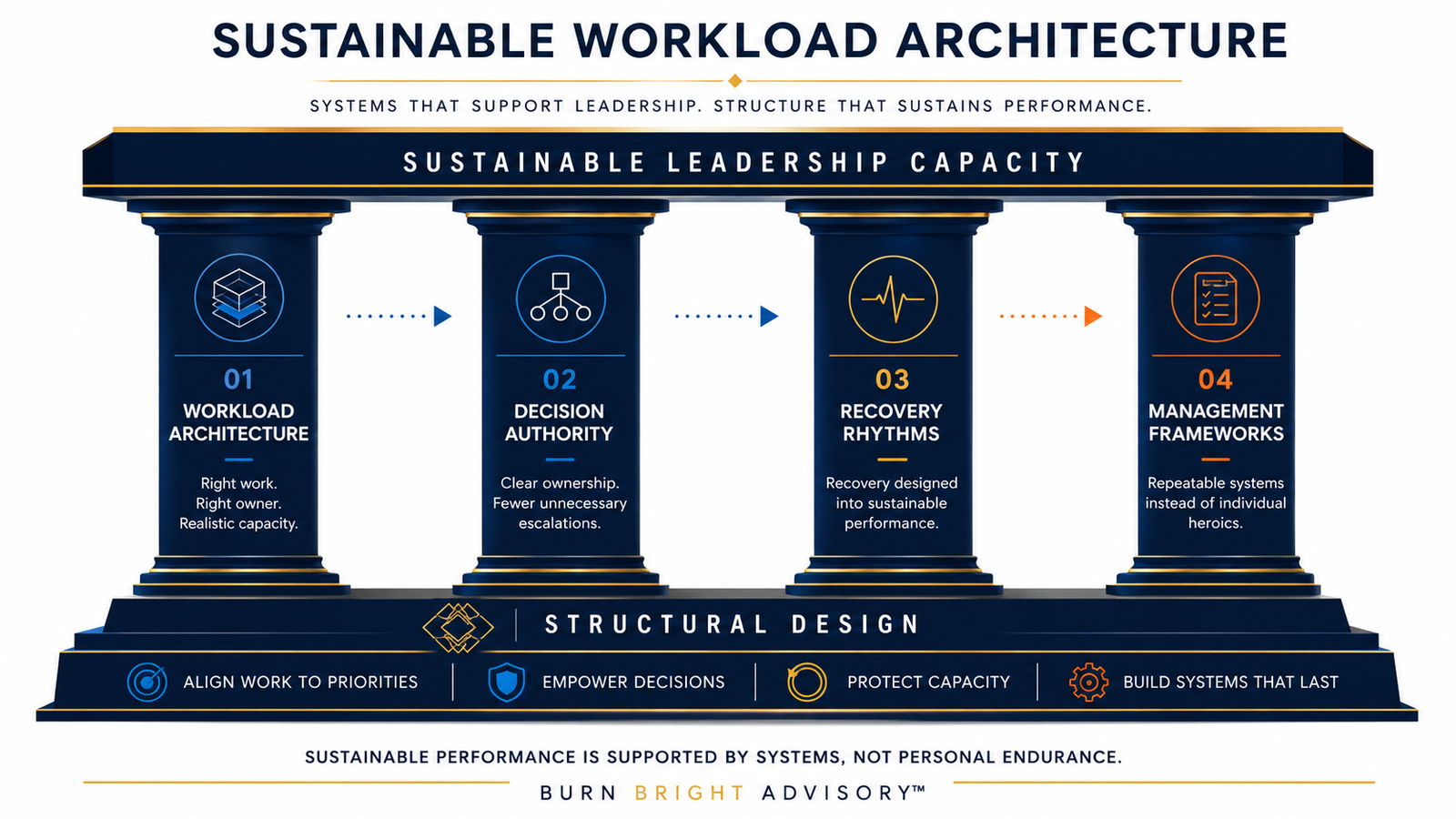
Once you know what should stay, move or stop, the next step is not better time management. It is workload architecture — deliberately designing where work sits, who owns it, what level of authority it requires and how much capacity exists to deliver it.
The Burn Bright Structural Transformation Framework places Workload Architecture alongside Decision Authority, Recovery Rhythms and Management Frameworks as four pillars. If the structure generating overload remains unchanged, personal productivity improvements can only provide temporary relief.
Start by asking what can only you do — setting strategic direction, making high-consequence decisions, managing critical stakeholder relationships, developing senior team members. This is your high-value leadership capacity. Protect it, then examine what else is competing for the same time.
How Can You Delegate Without Losing Control?
Telling overloaded leaders to “delegate more” is rarely enough, because the difficulty is often structural — leaders may not trust the quality of the outcome, or believe that remaining accountable means remaining involved in every stage. This creates a common pattern: the leader delegates the task but retains the decisions, and remains the bottleneck. That is task distribution, not genuine delegation.
Separate Four Different Roles
The Burn Bright Not Out Framework includes a RACI Delegation Framework that distinguishes between four relationships with work.
RACI Responsible
The person completing the work. Leadership question: who will actually do this?
RACI Accountable
The person ultimately answerable for the outcome. Leadership question: who owns the result?
RACI Consulted
People whose expertise or input is required. Leadership question: who needs to contribute before action?
RACI Informed
People who need visibility but not decision authority. Leadership question: who simply needs to know?
Overloaded leaders frequently place themselves in all four categories — executing, approving, advising and monitoring — then wonder why delegation has not reduced their workload. You do not need to disappear from delegated work. You need clarity about your role within it.
Delegate Authority With the Task
Consider a department head delegating a monthly performance report to a manager. If every decision — which data to include, whether to contact finance, whether to challenge a figure — still travels upwards, the task has moved but the cognitive workload has not. A stronger delegation conversation establishes the outcome, standard, authority, escalation threshold, deadline and review approach in advance, so that responsibility and authority move together.
Why Does Decision Authority Matter?
Sometimes the real reason leaders take on too much is not workload — it is decision architecture. Too many decisions travel upwards because nobody wants to make a decision outside their perceived authority, gradually creating a human bottleneck at the top. Decision Authority is one of the four structural transformation pillars, and the solution is to make authority explicit through defined decision thresholds.
Level 1 — Decide independently
Routine, reversible decisions within agreed boundaries. The team member acts without seeking permission.
Level 2 — Decide and inform
The team member makes the decision but informs the leader afterwards, preserving visibility without an approval bottleneck.
Level 3 — Escalate
High-risk, high-cost, irreversible or strategically significant decisions come to the leader, protecting attention for decisions that genuinely require senior judgement.
How Do You Make Leadership Capacity Visible?
One reason overload persists is that leadership capacity is often invisible. Projects, deadlines, targets and budgets are visible — the cognitive and temporal capacity required to deliver them often is not. This creates the illusion that another priority can simply be added, when in reality the work does not disappear. It migrates into early mornings, evenings, weekends and recovery time.
A simple leadership capacity dashboard can track core leadership work, operational work, meetings, reactive work, strategic capacity and recovery capacity. You do not need perfect data — you need enough visibility to expose the trade-offs. If your calendar is already at full capacity, adding another six-hour responsibility is not a motivational challenge. It is arithmetic.
What System Prevents Workload From Building Up Again?
Removing unnecessary work once is useful. Preventing it from returning is leadership discipline. Build a simple workload gate around your role, asking these questions before accepting a significant new responsibility.
1. Why does this need to happen?
First establish whether the work creates sufficient value to exist, before deciding who should do it.
2. Why does it need to sit with me?
Seniority, history or habit are not automatically reasons. Identify the authority, judgement or expertise genuinely required.
3. What level of involvement is actually required?
You may need to own the outcome without completing the work, or simply need visibility rather than accountability.
4. What will move if this enters?
A genuine priority should have consequences for existing priorities. If nothing moves, the organisation does not have priorities — it has accumulation.
5. When will we review ownership?
This prevents temporary work from becoming permanent — set the review date immediately, with an explicit transfer point.
Traditional Overload vs Sustainable Leadership
The difference between overloaded leadership and sustainable leadership is not ambition. It is architecture. Both leaders may care deeply about performance and work hard when circumstances require it — the difference is what happens when demand exceeds capacity.
| Traditional Overload | Sustainable Leadership |
|---|---|
| New work is automatically added | New work creates an explicit trade-off |
| The leader becomes the default problem-solver | Problems sit at the appropriate level |
| Accountability means personal execution | Accountability and execution are separated |
| Temporary responsibilities become permanent | Temporary ownership has a review date |
| Delegation moves tasks but not authority | Tasks and appropriate authority move together |
| Most uncertainty is escalated upwards | Clear decision thresholds reduce escalation |
| Long hours compensate for structural gaps | Capacity constraints trigger redesign |
| Strategic time becomes overflow capacity | Strategic capacity is deliberately protected |
| Recovery happens when work allows | Recovery is designed into sustainable performance |
| Success depends on individual heroics | Success depends on effective systems |
The second column is not a softer version of leadership. It is a more disciplined one — it forces leaders and organisations to confront trade-offs that are otherwise hidden by personal overwork. Eventually, capacity wins. The only question is whether you redesign the workload before depletion forces the decision for you.
How Do You Put This Into Practice This Week?
Understanding how to stop taking on too much is useful. Changing the structure of your workload is better. Start by making the invisible visible.
Step 1: Capture your real workload
For one week, record where your leadership capacity actually goes — scheduled and unscheduled work alike. Do not judge it yet. Capture it.
Step 2: Identify inherited responsibilities
Mark every responsibility that entered your role because somebody left, a crisis occurred, or you were simply the easiest person to ask. These are your primary scope-creep candidates.
Step 3: Find your leadership-only work
Identify the work genuinely requiring your authority, judgement or expertise, then compare it with your calendar. Your most important responsibilities may occupy the smallest proportion of your time.
Step 4: Apply the five workload decisions
Classify each significant responsibility as Keep, Delegate, Reassign, Eliminate or Renegotiate. Do not create a sixth category for avoiding the decision.
Step 5: Remove one responsibility
Choose one responsibility that no longer needs your personal involvement and stop it, delegate it properly, or renegotiate what is required.
Step 6: Install the workload gate
From this point onwards, every significant new responsibility should trigger the four workload-gate questions before it enters your role.
How do I stop taking on too much at work?
Start by auditing what you actually do rather than trying to become more efficient. Identify responsibilities that accumulated through vacancies, crises, poor delegation or habit, then classify each as keep, delegate, reassign, eliminate or renegotiate.
Why do I keep taking on too much responsibility?
Capable leaders often become default problem-solvers. Competence attracts work, and saying yes can avoid immediate conflict. Create clear rules governing how new responsibilities enter your role and what existing work must move when they do.
How do I say no to more work as a leader?
Avoid making the conversation about willingness. Make it about priorities and capacity: “I can take responsibility for this. Which existing priority should move so we have the capacity to deliver it properly?”
What is scope creep in leadership?
Scope creep occurs when a leadership role gradually accumulates responsibilities beyond its original or sustainable boundaries. Burn Bright identifies it as one of five root causes of burnout, alongside meeting culture, communication chaos, decision overload and perfectionism culture.
How do I know if my leadership workload is unsustainable?
Look beyond working hours. Warning signs include strategic work being repeatedly displaced by operational tasks, routine work spilling into evenings, constant escalation of decisions, and new priorities being added without anything stopping.
Should leaders simply delegate more?
Not necessarily. Poor delegation can move tasks without reducing leadership workload. Effective delegation transfers appropriate decision authority alongside defined outcomes, standards, escalation points and review mechanisms.
What should a leader never delegate?
Leaders should retain work where their specific authority, judgement or accountability is essential — major strategic decisions, significant risk decisions and critical stakeholder relationships — while distinguishing owning an outcome from completing every task behind it.
Take the Leadership Burnout Self-Assessment
If your workload keeps expanding despite working harder, start with diagnosis. Examine whether overload, scope creep and other structural pressures are pushing your leadership capacity towards depletion.
Free Leadership Intelligence
Get Weekly Leadership Insights
Join thousands of leaders receiving practical strategies on burnout prevention, workload design, and sustainable performance every week.