Quick Answer
Key Takeaways
- Professionalism is a leadership performance capability, not an etiquette requirement — it creates the consistency that builds credibility, trust and influence.
- Professionalism Intelligence™ integrates five dimensions: Behavioural, Ethical, Decision, Relationship and Reflective Professionalism.
- Authority does not eliminate accountability — professional leaders build mechanisms that improve judgement rather than simply exercising power.
- High standards can become unprofessional when they create dependency instead of capability, as the Amira case study illustrates.
- Professionalism connects directly to Leadership Sustainability™, since chronic overload degrades judgement, reflection and relationships.
Professionalism in Leadership: The Standard That Builds Trust, Credibility and Sustainable Performance
Leadership is observed long before it is formally evaluated. People notice whether a leader arrives prepared. They notice whether commitments are remembered. They notice what happens when somebody disagrees, whether standards change according to status, and whether a leader takes responsibility when a decision goes wrong.
These observations accumulate into a single, quiet judgement: can this leader be trusted? That question sits at the heart of professionalism in leadership — and it is why professionalism is far more significant than appearance, etiquette or workplace convention. At leadership level, professionalism becomes a signal of reliability, telling employees, boards, customers and communities what they can reasonably expect from someone entrusted with authority.
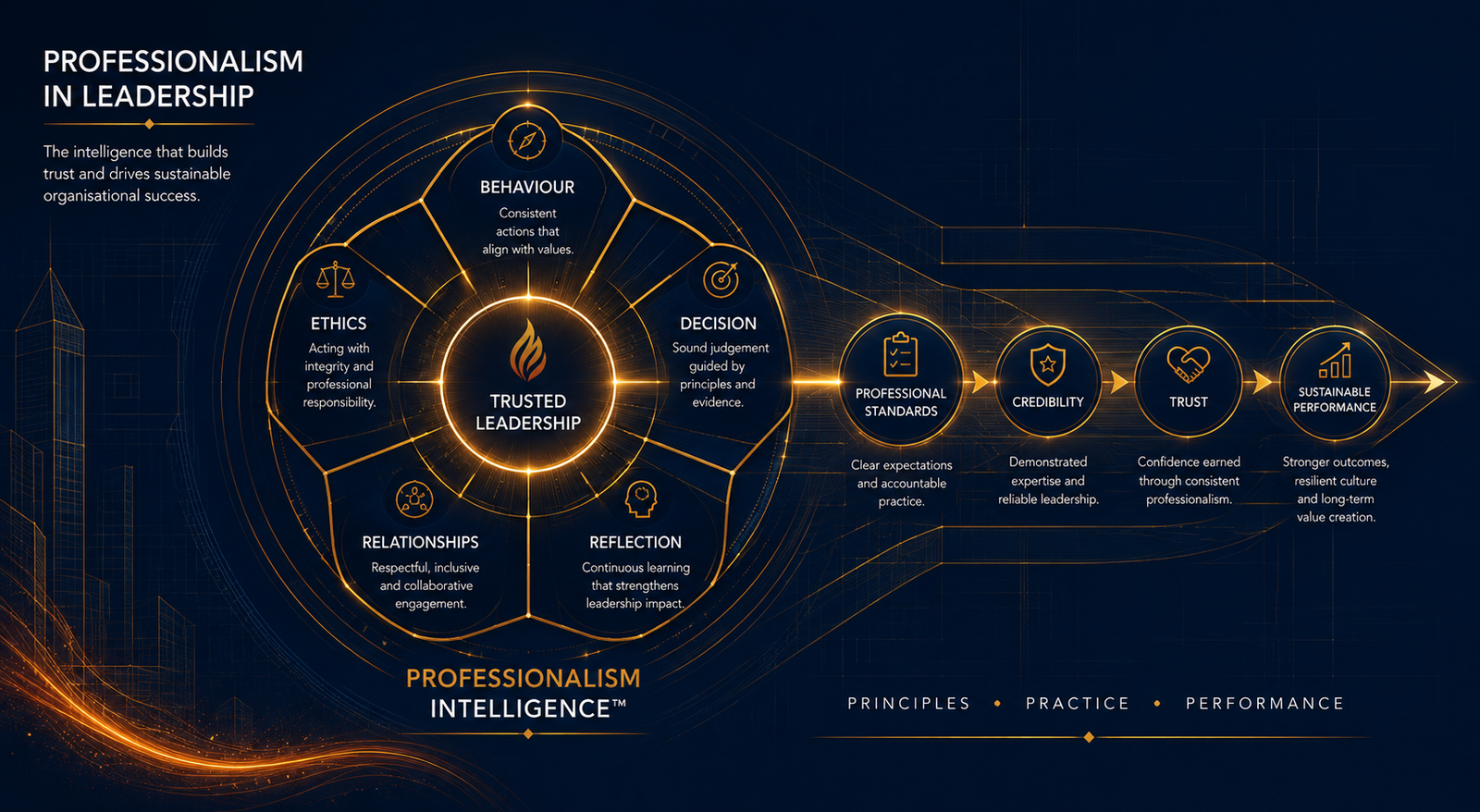
A technically brilliant leader who behaves unpredictably can weaken confidence. A charismatic leader who avoids accountability can weaken trust. A highly experienced leader who stops learning can gradually weaken competence. Professional leadership requires these tensions to be integrated — which is why Burn Bright Advisory™ positions Professionalism Intelligence™ as a foundational component of Leadership Performance Intelligence™.
Featured Snippet
Professionalism Intelligence™: Moving Beyond Professional Conduct
Traditional definitions of professionalism concentrate on conduct. Conduct matters, but leadership requires something deeper. A leader can follow organisational rules and still exercise poor judgement, communicate politely while avoiding difficult decisions, or maintain an impressive executive presence while creating an environment in which people are afraid to speak honestly.
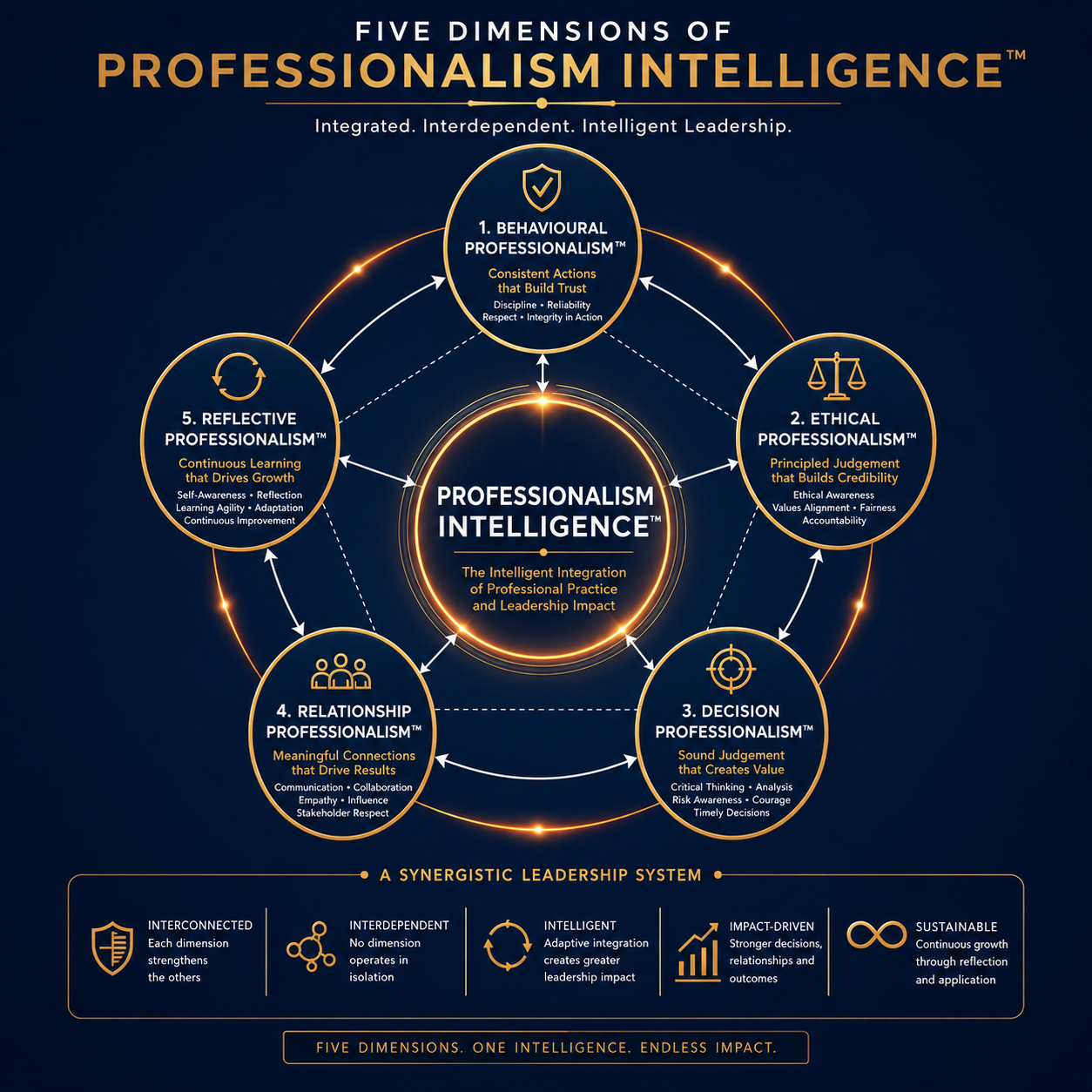
Within the Burn Bright Advisory™ leadership architecture, Professionalism Intelligence™ is understood as the integration of behaviour, ethics, judgement, relationships and reflection in professional practice — an active intelligence rather than a static standard, helping leaders interpret, apply, evaluate and continually strengthen professional standards across changing situations.
The Five Dimensions of Professionalism Intelligence™
Burn Bright Advisory™ examines Professionalism Intelligence™ through five interconnected dimensions. They should not be considered independently — a leader’s behaviour influences relationships, relationships influence the quality of information available for decisions, decisions create ethical consequences, and reflection allows the leader to learn from those consequences.
Dimension 1
Behavioural Professionalism™
Central question: Are my actions consistent with the standards I expect from others?
Dimension 2
Ethical Professionalism™
Central question: Are my choices grounded in integrity, fairness and responsibility?
Dimension 3
Decision Professionalism™
Central question: Am I exercising informed, timely and accountable judgement?
Dimension 4
Relationship Professionalism™
Central question: Does the way I use authority strengthen trust and respect?
Dimension 5
Reflective Professionalism™
Central question: Am I learning sufficiently to remain professionally effective?
1. Behavioural Professionalism: Making Standards Visible
Behavioural professionalism concerns what leaders actually do — reliability, preparation, communication, appropriate boundaries, consistency, responsibility and the disciplined fulfilment of commitments. These behaviours may appear ordinary, but their cumulative organisational effect is not.
Imagine two leaders with identical technical competence. One arrives late, changes priorities without explanation and expects deadlines from others that they routinely ignore themselves. The other communicates expectations clearly, follows through on commitments and acknowledges promptly when something cannot be delivered. Their teams will experience their leadership very differently — the difference is predictability, and predictability contributes directly to trust.
The Leadership Mirror Principle
If leaders interrupt, others learn that interruption is acceptable. If leaders arrive unprepared, preparation becomes negotiable. Conversely, when leaders demonstrate preparation, accountability and respect, they create behavioural evidence of the culture they claim to value.
2. Ethical Professionalism: What Happens When Nobody Can Make the Decision for You?
Professionalism concerns the standards governing how responsibility is exercised; ethics examines the principles informing what should be done. The two become inseparable when leadership choices carry consequences for other people.
Professionalism sometimes requires discomfort.
It can require saying no.
It can require challenging powerful stakeholders.
And it can require making a decision that is less convenient precisely because it is more responsible.
This is one reason Professionalism Intelligence™ and Ethics Intelligence™ are closely connected within the Leadership Intelligence Compass™. Professionalism provides the discipline through which ethical commitments become visible in practice; ethics gives professional behaviour its principled direction. Without professionalism, values can remain aspirational. Without ethics, professionalism risks becoming procedural compliance.
Professionalism Is a Form of Organisational Infrastructure
Every organisation depends on thousands of human judgements that cannot be completely controlled through policy. Someone decides whether to raise a concern, whether to share difficult information, whether a mistake should be disclosed. Professionalism influences the quality of those decisions — which is why it should not be relegated to induction programmes or codes of conduct. It is part of the organisation’s operating system.
When professional standards deteriorate, informal workarounds begin to replace formal expectations, exceptions multiply and trust becomes personalised rather than institutional. The organisation may still look functional from the outside, while confidence weakens inside.
3. Decision Professionalism: How Leaders Exercise Judgement Under Pressure
Decision professionalism is the capacity to make sufficiently informed, timely and accountable decisions while remaining conscious of their consequences. A leader can make decisions quickly and still make them poorly, just as a leader can analyse a problem extensively and still fail professionally by avoiding a decision that responsibility requires them to make.
Authority Does Not Eliminate Accountability
The question shifts from “Am I allowed to make this decision?” to “Am I exercising this authority responsibly?” Professional leaders create mechanisms that improve their judgement: they seek challenge before commitment, distinguish evidence from assumption, and are prepared to reconsider when evidence changes.
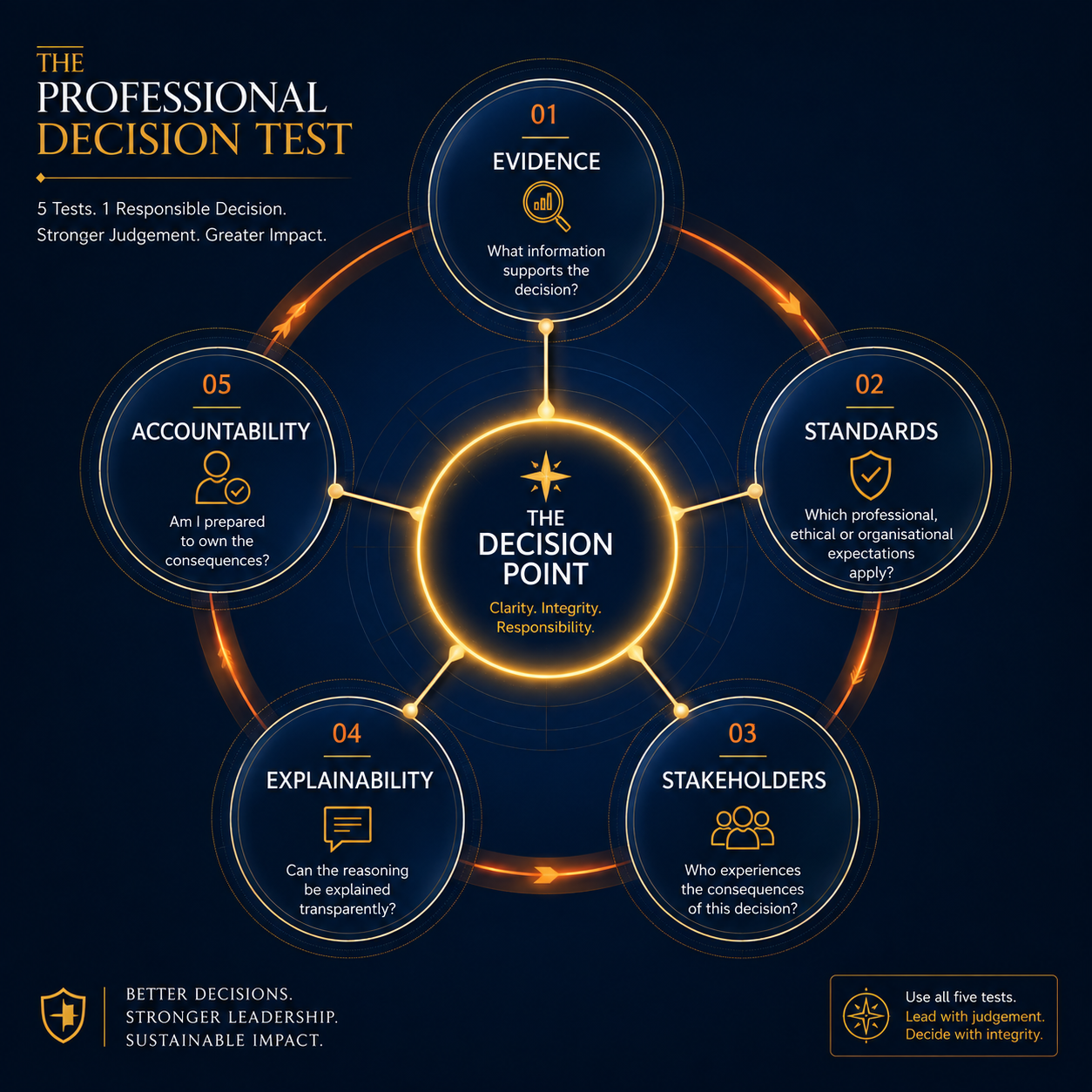
The Professional Decision Test
1. Evidence
What information supports this decision? Professional judgement begins with sufficient evidence, not certainty.
2. Standards
Which professional, ethical, legal or organisational expectations apply? Not every decision is simply a matter of preference.
3. Stakeholders
Who experiences the consequences? Deliberate attention is required for those who will live with the decision.
4. Explainability
Could I explain the reasoning transparently to the people affected? A decision that only survives through secrecy invites further scrutiny.
5. Accountability
Am I prepared to own the consequences? Professional leadership does not disappear when the outcome becomes inconvenient.
This framework connects Professionalism Intelligence™ with several other domains of the Leadership Intelligence Compass™: Ethics Intelligence™ strengthens consideration of principles and consequences, Knowledge Development Intelligence™ improves the quality of evidence available, Reflective Practice Intelligence™ allows leaders to examine assumptions, and Adaptability Intelligence™ supports intelligent revision when circumstances change.
4. Relationship Professionalism: How Authority Is Experienced by Others
Relationship professionalism concerns the disciplined use of power, communication, boundaries, respect and responsibility within leadership relationships. This does not mean leaders must avoid disagreement — a professional leader can challenge performance without humiliating the individual, disagree without becoming dismissive, and maintain boundaries without becoming inaccessible.
Leadership power changes the meaning of ordinary behaviour. A sarcastic remark from a colleague and the same remark from a chief executive do not necessarily carry the same organisational weight, because the person speaking may influence someone’s opportunities, workload or career.
Professionalism and Psychological Safety
Teams need to be able to raise concerns, question assumptions and acknowledge mistakes without unnecessary fear. In the Burn Bright book The Unguarded Leader, leadership is explored through vulnerability, curiosity, courage and psychological safety — the underlying principle being that authority should not prevent learning. When employees learn that uncomfortable information creates negative reactions, they begin editing what leaders hear, and the resulting silence can be mistaken for confidence.
Respect Is Not the Same as Agreement
Professional leadership requires clarity precisely because difficult situations cannot always produce universally satisfying outcomes. The professionalism lies in ensuring the person is treated with dignity, the reasoning is sufficiently clear, and disagreement does not become an excuse for disrespect.
5. Reflective Professionalism: Remaining Worthy of Responsibility
Professional competence has a shelf life. Markets, technology, evidence and regulation all change — and the responsibilities attached to leadership change with them. The professional leader does not ask only “Did we succeed?” but also “What does this experience teach us about how we lead?”
A successful outcome can conceal poor leadership — perhaps a team achieved a target only because employees worked unsustainable hours. This is where Professionalism Intelligence™ intersects directly with Reflective Practice Intelligence™ and Leadership Sustainability™.
Reflective Cycle From Experience to Intelligence
Experience alone does not guarantee development. Professional development occurs when experience is examined:
- Experience — What happened?
- Examination — What influenced my response?
- Insight — What have I learned about myself, the team or the system?
- Adjustment — What should change?
- Application — How will I behave differently next time?
The Professionalism → Trust → Performance Framework
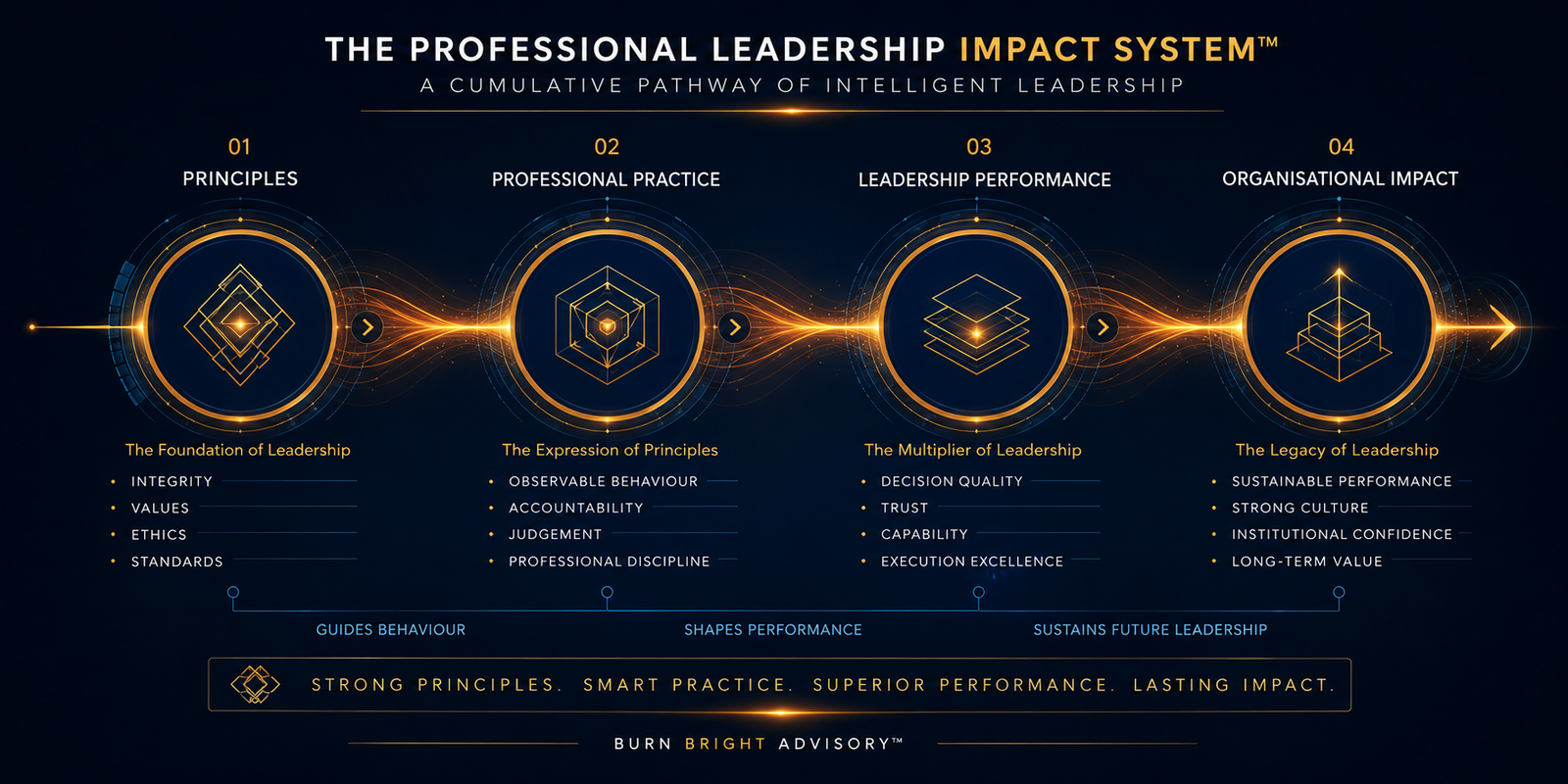
Burn Bright Advisory™ represents the strategic pathway as: Professional Standards → Consistent Behaviour → Credibility → Trust → Leadership Influence → Organisational Performance → Sustainable Leadership. This sequence explains why seemingly small professional behaviours can create disproportionately large organisational consequences.
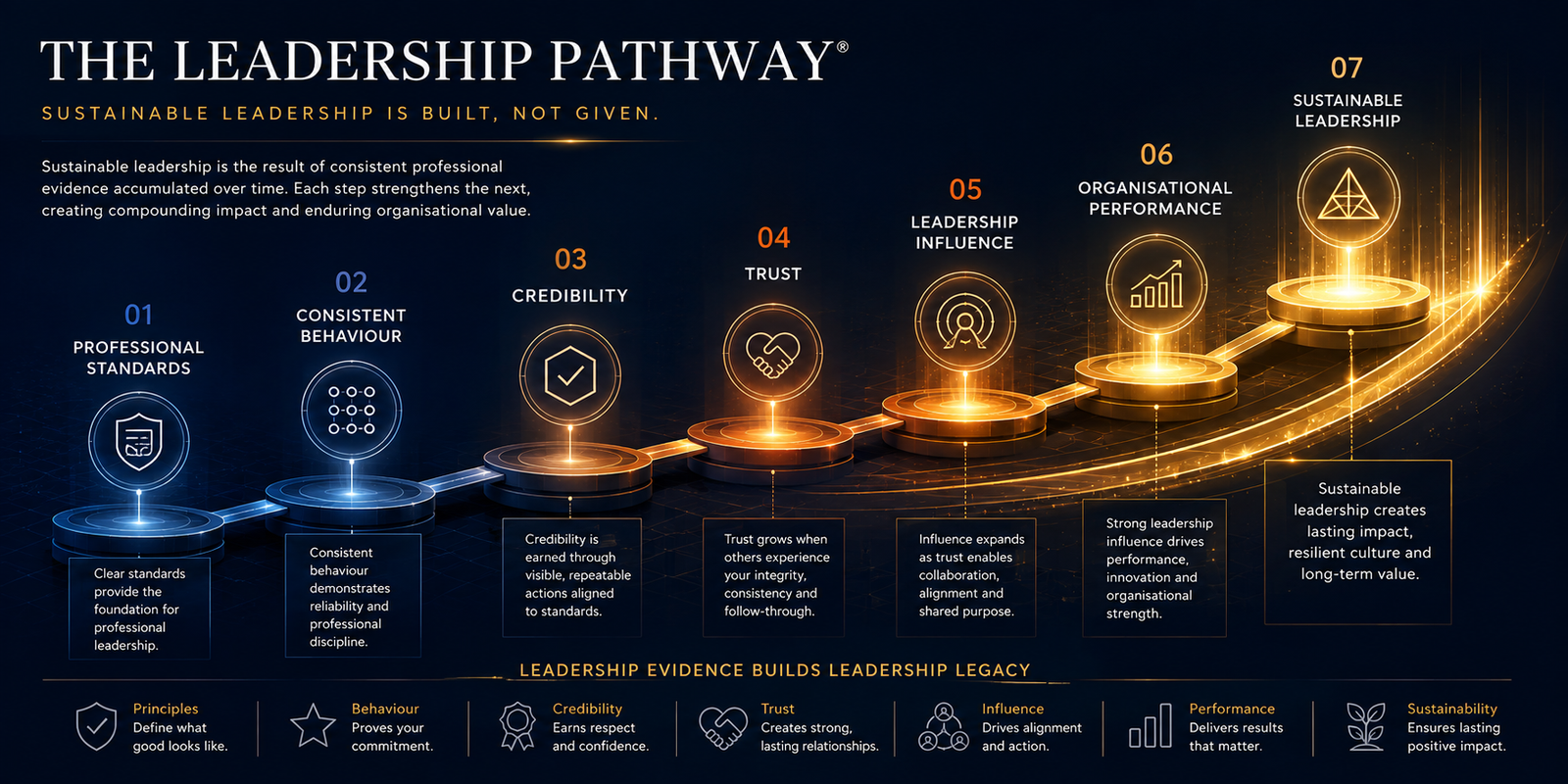
Stage 1 — Professional Standards
The organisation and leader establish clear expectations concerning behaviour, competence, ethics and accountability. Without standards, professionalism becomes subjective.
Stage 2 — Consistent Behaviour
Standards become observable through repeated actions. The leader does what they say, and problems are addressed rather than avoided.
Stage 3 — Credibility
Consistency allows people to make reliable predictions about leadership behaviour, and credibility begins to develop.
Stage 4 — Trust
Credibility accumulated over time contributes to trust, meaning stakeholders have sufficient confidence in the leader’s competence and reliability.
Stage 5 — Leadership Influence
Trusted leaders spend less energy overcoming unnecessary scepticism, and people are more willing to raise concerns and accept difficult decisions.
Stage 6 — Organisational Performance
Better information, clearer expectations and healthier relationships improve the conditions in which performance occurs.
Stage 7 — Sustainable Leadership
Burn Bright Advisory™ treats Leadership Sustainability™ as critical here, because leadership that repeatedly achieves results through exhaustion or fear creates future fragility.
Professionalism Across Leadership Sectors
Professionalism is universal, but its expression changes according to context. The Leadership Intelligence Compass™ provides a common architecture, while Burn Bright’s Sector Hubs allow that intelligence to be interpreted through different leadership environments.
🏢 Business Growth Intelligence™
Rapid growth increases the importance of professional standards because informal arrangements become harder to sustain as organisations expand. The leadership question becomes: are our professional standards developing at the same speed as our commercial ambitions?
🏫 School Leadership Intelligence™
School leaders operate under competing expectations from staff, students and families. Professionalism provides an anchor — inspection pressure does not justify abandoning sustainable leadership practice.
🏥 Healthcare Leadership Intelligence™
Leadership hierarchy can become dangerous when professional status prevents challenge. Professional healthcare leadership depends upon both expertise and openness, so that responsibility can move upward as well as downward.
🏛️ Public Service Leadership Intelligence™
Public service leadership operates within an additional layer of responsibility: stewardship. The critical question becomes — can this decision withstand appropriate professional and public scrutiny?
🤝 HR & People Leadership Intelligence™
HR professionalism cannot be reduced to process administration. Its credibility depends on whether people believe standards apply across organisational hierarchy — not only to junior employees.
🚀 Entrepreneur Performance Intelligence™
Entrepreneurs frequently operate without the professional infrastructure found in mature organisations, making the founder’s personal habits especially influential as the enterprise grows.
The Connection to Leadership Sustainability™
Professionalism protects leadership capacity. Organisations frequently depend on individual heroics rather than sustainable systems — leaders absorb excess work, remain permanently available, and postpone recovery until unsustainable behaviour becomes interpreted as commitment.
This is why Professionalism Intelligence™ connects directly to Leadership Sustainability™, Leadership Capacity™ and Leadership Workload™.
Case Study: When High Standards Become Unprofessional Leadership
Consider a fictional composite case drawn from recurring leadership patterns. Amira is an experienced divisional director, intelligent, highly committed and respected for her technical knowledge. She expects preparation, accuracy and personal accountability from her team — yet employee turnover has begun increasing, senior team members are becoming quieter in meetings, and managers now seek informal approval before making decisions formally within their authority.
Reflection eventually allows Amira to consider the opposite hypothesis: could closer management be contributing to declining confidence? Instead of increasing oversight, she begins strengthening decision boundaries, delaying her own opinion until others have contributed, and focusing discussion on reasoning and learning rather than blame. Over time, managers begin exercising authority again.
Professional leadership is not demonstrated by proving that the leader can produce the best answer personally. It is demonstrated by creating conditions in which professional judgement becomes stronger throughout the system.
The Burn Bright Professional Leadership Cycle™
Leaders can convert the concepts in this article into a repeatable development cycle: Standards → Awareness → Judgement → Action → Impact → Reflection.
Stage 1 Standards
Define the professional expectations relevant to the role, drawing on organisational values, codes and personal principles.
Stage 2 Awareness
Examine the leadership environment — what is actually happening, and where are expectations unclear?
Stage 3 Judgement
Interpret the evidence, consider competing perspectives, and identify professional and ethical implications.
Stage 4 Action
Professionalism must eventually become behaviour — communicate, decide, delegate, challenge, clarify.
Stage 5 Impact
Evaluate outcomes beyond immediate task completion — did trust strengthen, and did capability grow?
Stage 6 Reflection
Convert experience into learning, and identify what needs to become a new standard before the cycle begins again.
Professionalism Intelligence™ and Leadership Performance Intelligence™
Outcomes alone cannot explain leadership quality. Two leaders can achieve identical results through very different systems — one develops people and preserves organisational capacity, another relies on excessive personal effort and unsustainable workloads. Leadership Performance Intelligence™ asks a deeper question: what leadership conditions produced the performance?
Professionalism Intelligence™ interacts with Ethics Intelligence™, Constructivism Intelligence™, Adaptability Intelligence™, Visionary Leadership Intelligence™, Reflective Practice Intelligence™, Knowledge Development Intelligence™, Emotional Intelligence™ and Leadership Sustainability™ — the power of the Leadership Intelligence Compass™ lies in these relationships.
Leadership Reflection Questions
- What behaviours do people in my organisation currently interpret as evidence of my professionalism?
- Where is there a gap between the standards I expect and the standards I personally demonstrate?
- Which of my leadership behaviours changes most noticeably when I am under pressure?
- How safe is it for someone with less authority to disagree with me?
- When did I last acknowledge publicly that I had made the wrong decision?
- Are professional standards applied consistently regardless of seniority, status or performance?
- Which important decisions currently depend too heavily on my personal judgement?
- Where might my expertise be preventing me from listening to emerging knowledge?
- What leadership behaviour am I currently normalising for other people?
- What does my calendar reveal about my professional priorities?
- Does my current workload support or undermine professional judgement?
- Which leadership relationships require greater clarity or stronger boundaries?
- What difficult professional conversation am I currently avoiding?
- What information might people be reluctant to tell me?
- What evidence tells me that my leadership is developing capability rather than dependency?
- Where could short-term performance be concealing an unsustainable leadership practice?
- What have I learned about my leadership during the last six months?
- Which domain of the Leadership Intelligence Compass™ would most strengthen my professionalism if developed next?
Action Steps: Strengthening Professionalism Intelligence™
1. Define Your Five Non-Negotiable Professional Standards
Write down five behaviours that should remain visible regardless of pressure — make them behavioural rather than aspirational.
2. Complete a Professionalism Intelligence™ Self-Audit
Review the five dimensions and identify one strength and one development priority within each, rather than trying to improve everything at once.
3. Ask for One Piece of Difficult Feedback
Ask a trusted colleague or coach what one leadership behaviour you should examine more closely — then listen without defending immediately.
4. Audit Your Decision Environment
Choose three significant recent decisions and examine the evidence used, people consulted, and lessons learned.
5. Examine Your Leadership Workload™
Identify where overload may be reducing professionalism, and which responsibilities should be delegated.
6. Strengthen One Professional Relationship
Choose a relationship where communication or trust has weakened, and begin with clarity rather than proving who is correct.
7. Establish a Monthly Professional Reflection
Once each month, ask what your leadership taught the organisation — not what you told people, but what your behaviour taught them.
What is professionalism in leadership?
Professionalism in leadership is the consistent exercise of integrity, competence, accountability, respect and sound judgement when carrying leadership responsibility. Burn Bright Advisory™ describes the deeper capability behind these practices as Professionalism Intelligence™.
Why is professionalism important for leaders?
Professionalism contributes to credibility. When leaders behave consistently, fulfil commitments and accept accountability, stakeholders have stronger reasons to trust their leadership — which improves communication, challenge and willingness to participate in change.
What are the five dimensions of Professionalism Intelligence™?
Behavioural Professionalism™, Ethical Professionalism™, Decision Professionalism™, Relationship Professionalism™ and Reflective Professionalism™ — together they move professionalism beyond workplace etiquette and into leadership capability.
Can a leader be professional but ineffective?
Yes. A leader may demonstrate courteous behaviour while lacking the judgement or strategic capability required for effective leadership, which is why Professionalism Intelligence™ must interact with the other domains of the Leadership Intelligence Compass™.
What is the difference between professionalism and ethics in leadership?
Professionalism concerns the standards governing how leadership responsibility is exercised, while ethics concerns the principles used to judge what should be done. Ethics Intelligence™ gives professional practice principled direction.
How does professionalism build trust?
Trust develops through repeated evidence: Professional Standards → Consistent Behaviour → Credibility → Trust → Leadership Influence → Organisational Performance → Sustainable Leadership.
How can leaders improve their professionalism?
By clarifying professional standards, seeking meaningful feedback, auditing important decisions, strengthening boundaries and reflecting systematically on leadership impact. The objective is continuous development, not perfection.
How does leadership workload affect professionalism?
Excessive workload can reduce the capacity available for reflection, communication and considered judgement, which is why Burn Bright connects Professionalism Intelligence™ with Leadership Workload™ and Leadership Sustainability™.
Is professionalism different across sectors?
The underlying principles remain broadly applicable, but their expression changes by context — the Burn Bright Sector Hubs translate Leadership Performance Intelligence™ into these different professional environments.
How can an organisation measure leadership professionalism?
By combining multiple sources of evidence — self-assessment, behavioural feedback, decision quality, stakeholder experience and sustainability indicators — rather than relying on a single score.
Assess Your Professionalism Intelligence™
Move beyond assumption. Take the free Leadership Burnout Self-Assessment to examine your professional behaviour, judgement, accountability and reflective practice.
Free Leadership Intelligence
Get Weekly Leadership Insights
Join thousands of leaders receiving practical strategies on burnout prevention, workload design, and sustainable performance every week.