Quick Answer
Key Takeaways
- Professionalism is a strategic leadership capability within Leadership Performance Intelligence™, not workplace etiquette or appearance.
- Professionalism Intelligence™ is built on five interconnected pillars: integrity, accountability, respect, competence and reflective practice.
- Professionalism strengthens every other leadership capability by acting as an integrating force between technical skill, emotional intelligence and ethical judgement.
- Leadership fatigue and unhealthy organisational culture are the most common barriers to sustaining professional standards.
- Professionalism is a discipline built through thousands of daily decisions, not a single training programme.
Professionalism Leadership: The Foundation of Sustainable Leadership Performance
Professionalism is frequently reduced to workplace etiquette, appearance, or compliance with organisational policies. While these behaviours contribute to a professional image, they represent only a small part of what truly defines exceptional leadership.
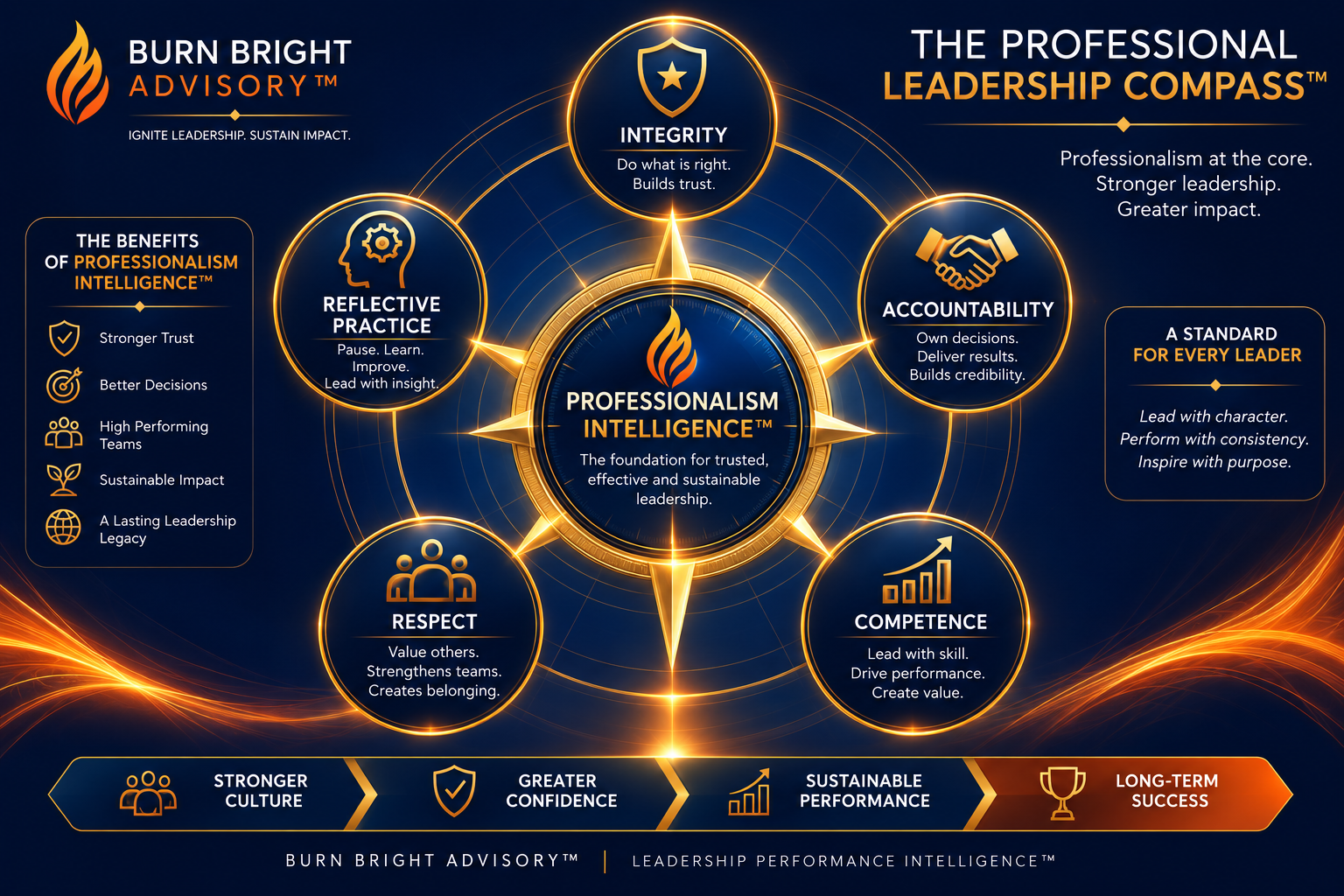
At Burn Bright Advisory™, professionalism is viewed through the lens of Leadership Performance Intelligence™. It is a strategic capability that influences how leaders think, decide, communicate, behave, and sustain high performance over time. Professional leaders consistently align their actions with their values, maintain integrity under pressure, demonstrate accountability, and create environments where trust and excellence flourish.
As organisations face increasing complexity, uncertainty, technological disruption, and changing workforce expectations, professionalism has evolved from a desirable leadership quality into a critical competitive advantage. Leaders who consistently demonstrate Professionalism Intelligence™ strengthen organisational culture, improve stakeholder confidence, increase employee engagement, and enhance long-term organisational resilience.
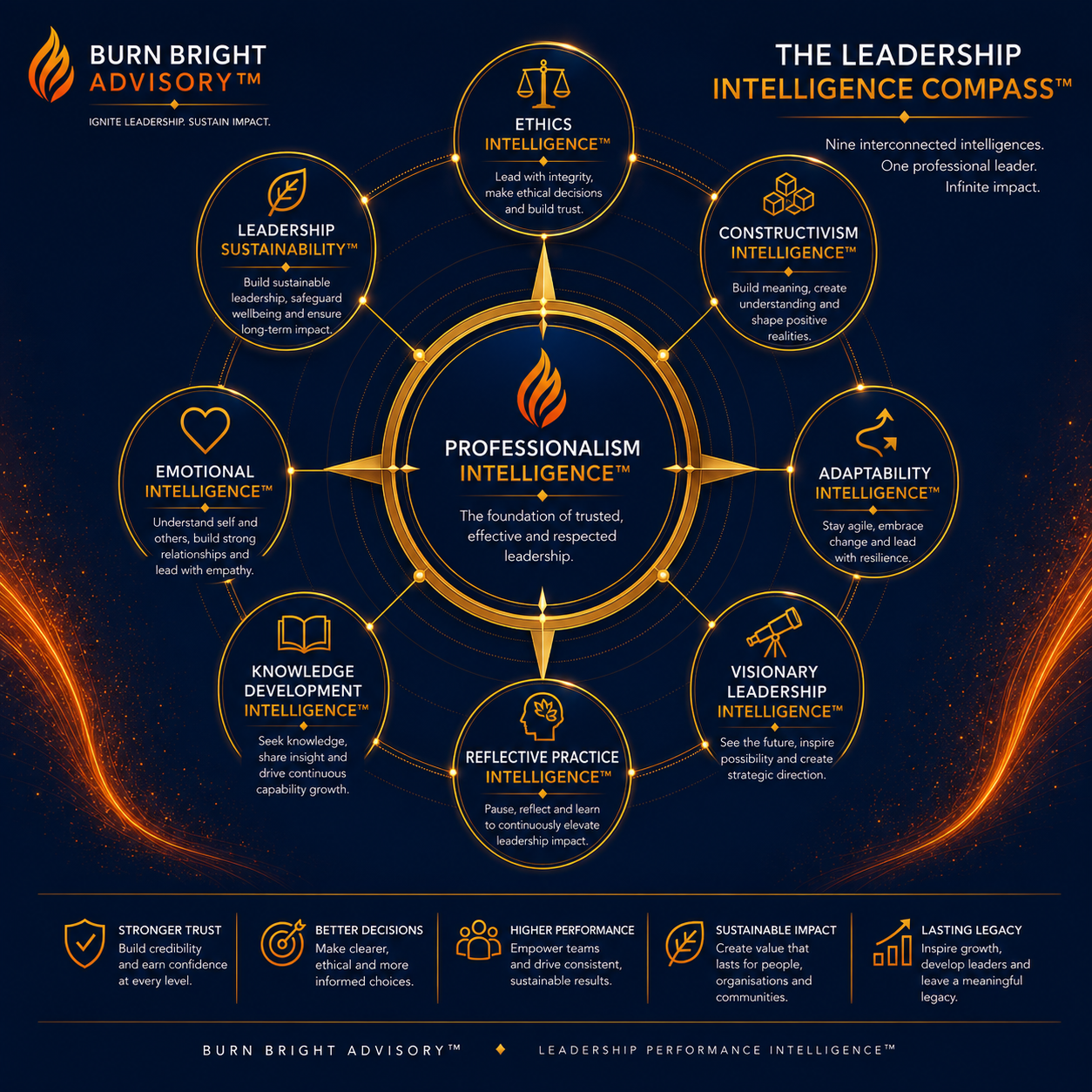
This article explores why professionalism remains one of the most important foundations of effective leadership, how it contributes to sustainable performance, and how leaders across business, healthcare, education, public service, and entrepreneurial environments can intentionally develop Professionalism Intelligence™ as part of the Leadership Intelligence Compass™.
Professionalism Is More Than Professional Appearance
For decades, leadership development has associated professionalism with visible workplace behaviours: dressing appropriately, arriving on time, communicating respectfully, following organisational procedures and maintaining professional etiquette. These behaviours certainly matter. However, they represent only the visible expression of professionalism rather than its true foundation.
Outstanding leadership is not defined by appearance.
It is defined by judgement.
Professionalism begins internally before it is demonstrated externally. It influences how leaders respond during difficult conversations, make ethical decisions under pressure, manage competing priorities, admit mistakes, support colleagues, and uphold organisational values when doing so becomes uncomfortable.
A leader may possess exceptional technical expertise yet consistently damage relationships through arrogance or inconsistency. Another leader may communicate confidently but avoid accountability whenever outcomes fall short. Neither demonstrates genuine professionalism.
Featured Snippet
Why Professionalism Has Become a Strategic Leadership Capability
Leadership has never been more demanding. Modern organisations operate within environments characterised by rapid technological advancement, artificial intelligence integration, hybrid working, workforce shortages, economic uncertainty, increasing public accountability and heightened stakeholder expectations.
Every day, leaders make decisions with incomplete information. Many must balance commercial performance, employee wellbeing, customer expectations, regulatory requirements, innovation, and organisational sustainability simultaneously. In this environment, technical competence alone is insufficient.
Teams observe far more than formal performance metrics. They ask themselves whether a leader remains calm during uncertainty, whether decisions are fair and transparent, whether the leader takes responsibility for mistakes, whether people are treated with respect regardless of position, and whether behaviour reflects organisational values. Over time, the answers to these questions determine whether trust develops or deteriorates.
This consistency also strengthens Leadership Sustainability™ by reducing unnecessary conflict, improving decision quality, and helping leaders preserve their own credibility over extended periods of organisational change.
Professionalism and Leadership Performance Intelligence™
Many leadership frameworks describe professionalism as a personal characteristic. Burn Bright Advisory™ views it differently — professionalism is a measurable contributor to leadership performance. Within the Leadership Performance Intelligence™ framework, Professionalism Intelligence™ influences leadership credibility, ethical decision-making, reflective judgement, organisational trust, stakeholder confidence, emotional regulation, sustainable performance and leadership capacity, simultaneously.
A leader with exceptional strategic thinking but poor professionalism may develop innovative ideas that fail because employees no longer trust their judgement. Likewise, a highly empathetic leader who lacks professional accountability may create supportive relationships but struggle to maintain organisational standards.
Professionalism acts as the integrating capability that allows technical competence, emotional intelligence, strategic thinking, and ethical leadership to work together. This explains why organisations frequently promote technically capable individuals into leadership positions only to discover that expertise alone does not produce effective leadership.
Leadership performance depends not only on what leaders know. It depends on how consistently they apply that knowledge through professional behaviour. Professionalism therefore becomes the operational expression of Leadership Performance Intelligence™, translating leadership capability into observable organisational impact.
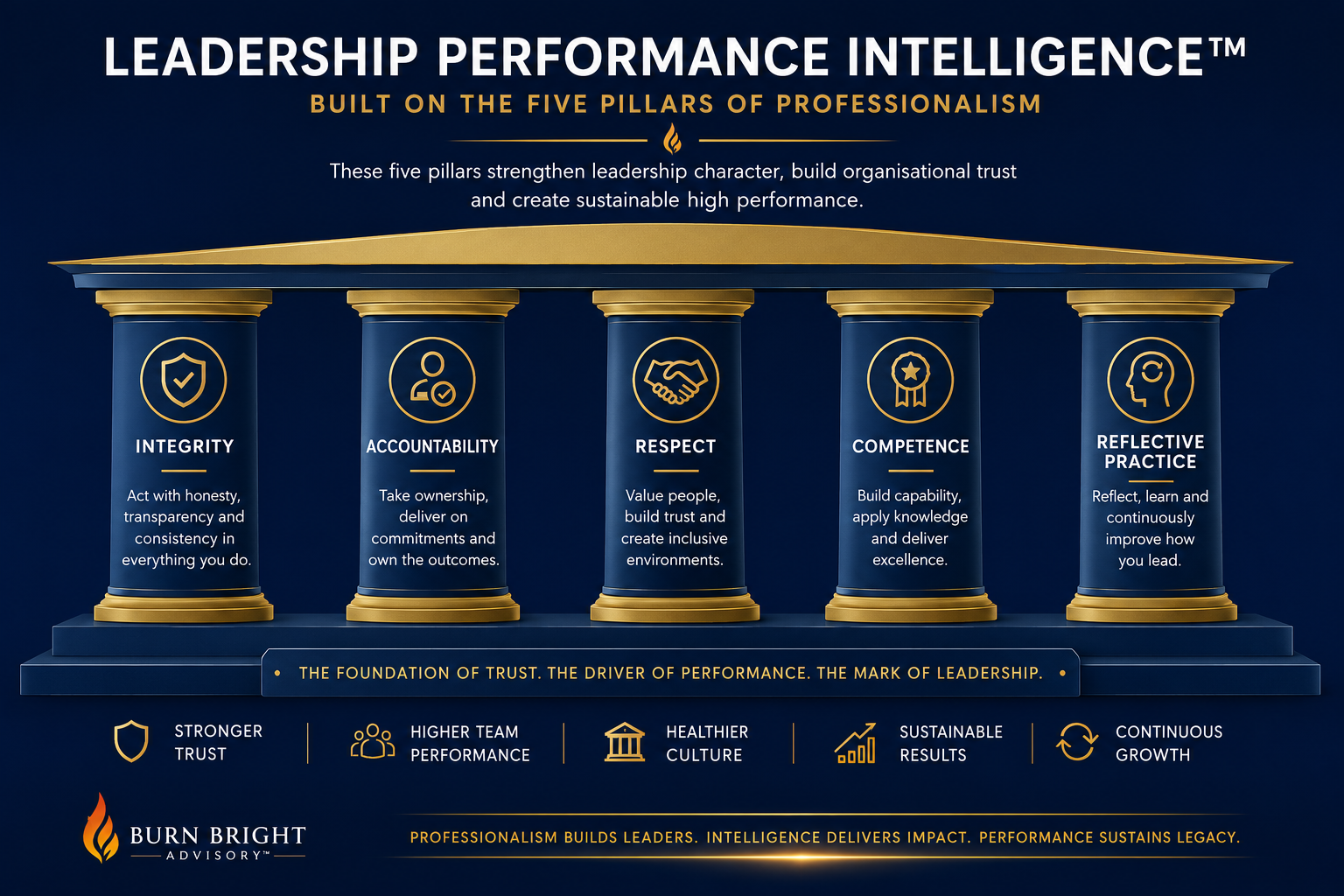
The Five Pillars of Professionalism Intelligence™
Professionalism is not a single leadership behaviour. It is an integrated capability developed through the interaction of multiple leadership competencies. Within Burn Bright Advisory™’s Leadership Intelligence Compass™, Professionalism Intelligence™ can be understood through five interconnected pillars.
Pillar 1
Integrity: The Foundation of Leadership Credibility
Integrity means alignment between values, decisions, behaviour and organisational purpose. Professional leaders remain consistent regardless of who is watching. When leaders consistently honour commitments, admit mistakes and apply organisational standards fairly, they create psychological certainty. Without integrity, professionalism becomes performance rather than character.
Pillar 2
Accountability: Professional Leaders Own Outcomes
Blame focuses on fault; accountability focuses on responsibility. Leaders with strong Professionalism Intelligence™ create cultures where accountability becomes part of organisational learning rather than organisational fear — openly acknowledging mistakes, analysing decisions objectively and encouraging reflection instead of defensiveness.
Pillar 3
Respect: Building Psychological Safety Through Professional Conduct
Respect recognises the dignity, capability and contribution of every individual regardless of hierarchy — listening before responding, encouraging constructive disagreement, recognising expertise across teams and treating mistakes as opportunities for learning. Respect creates psychological safety, which enables innovation.
Pillar 4
Competence: Professional Standards Require Continuous Learning
Professional leaders recognise that expertise has an expiry date. Instead of defending outdated knowledge, they demonstrate intellectual humility, remain curious and continue developing both technical and interpersonal capability — aligning closely with Knowledge Development Intelligence™.
Pillar 5
Reflective Practice: Learning Before Circumstances Force Change
Reflection transforms experience into expertise. Without reflection, leaders simply repeat experience; with reflection, experience becomes wisdom. This capability connects directly with Reflective Practice Intelligence™, another core domain within the Leadership Intelligence Compass™.
Professionalism Across Different Leadership Sectors
Professionalism looks remarkably similar across sectors because trust, credibility and accountability remain universal leadership requirements. However, the way professionalism is demonstrated varies according to organisational context.
Business Leadership
Professionalism prevents short-term performance from undermining long-term reputation — making ethical commercial decisions, communicating transparently with stakeholders, balancing profitability with organisational values and protecting reputation through consistent leadership behaviour.
Education Leadership
School leaders influence learning cultures by demonstrating fairness, supporting staff development, modelling lifelong learning, encouraging reflective practice and creating psychologically safe environments where teachers can innovate.
Healthcare Leadership
Clinical decisions directly influence patient outcomes. Professional healthcare leaders demonstrate ethical judgement, multidisciplinary collaboration, transparent communication, compassionate leadership and accountability for patient safety.
Public Service Leadership
Public trust represents one of the most valuable assets within government and public service organisations. Professional public sector leaders demonstrate impartial decision-making, ethical governance, transparency and responsible stewardship of public resources.
Entrepreneurial Leadership
Professionalism accelerates sustainable growth — establishing clear values early, communicating consistently, building trustworthy relationships and balancing innovation with responsible governance so growing businesses can scale without sacrificing organisational identity.
Why Professionalism Determines Long-Term Leadership Success
Many leaders succeed because of technical capability. The most influential leaders sustain success because of professionalism. Professionalism shapes organisational trust, leadership credibility, employee engagement, stakeholder confidence, ethical decision-making, organisational resilience and sustainable performance.
While technical expertise may create opportunities, professionalism determines whether leaders retain influence over time. Professionalism is therefore not an optional leadership quality — it is the operating system through which Leadership Performance Intelligence™ consistently delivers value across every organisational context.
Developing Professionalism Intelligence™: From Intention to Daily Practice
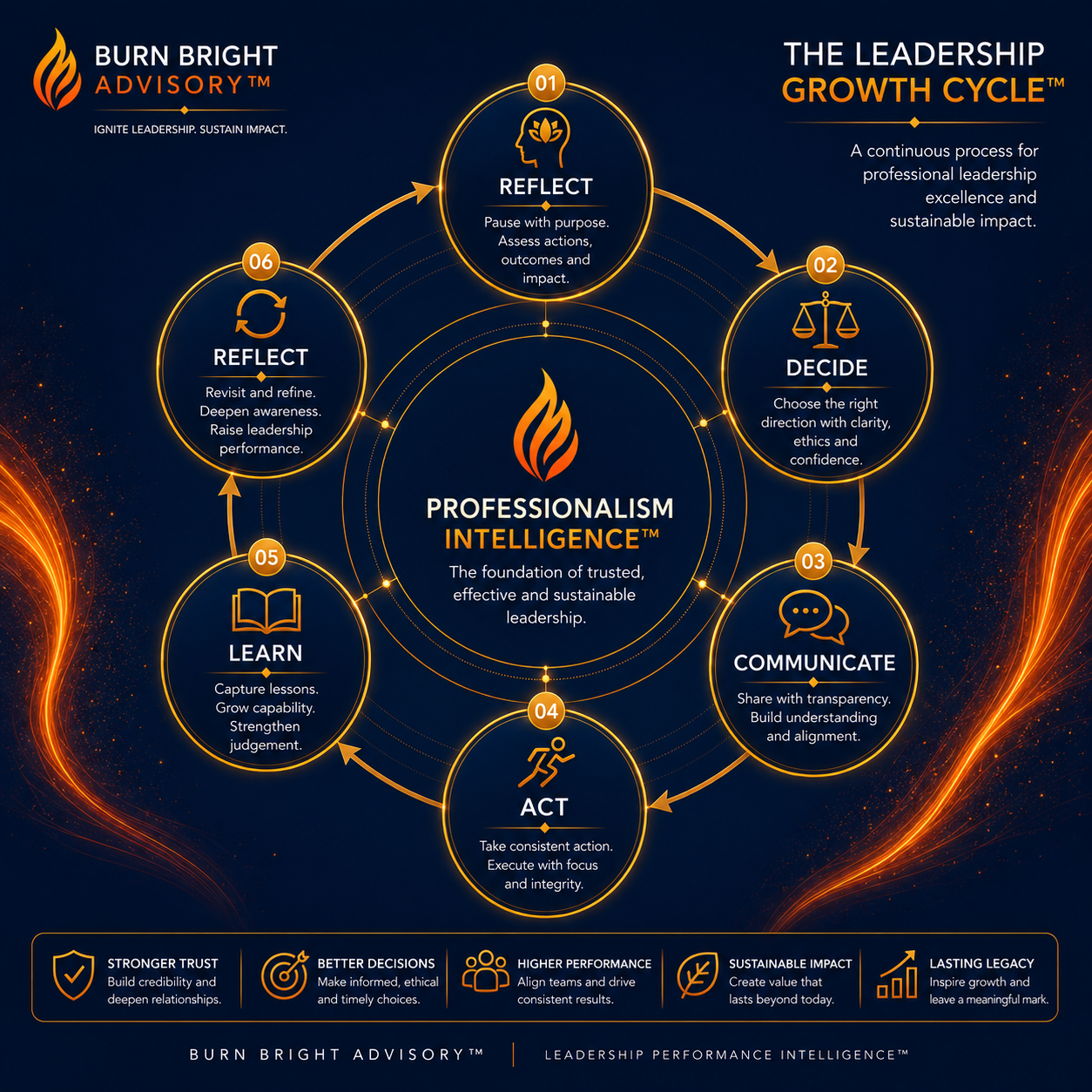
Professionalism is not developed through a single leadership programme, qualification, or promotion. It is built through thousands of daily decisions. Every conversation, meeting, difficult decision, performance review, and ethical dilemma presents an opportunity to either strengthen or weaken professional credibility.
Leaders who consistently demonstrate Professionalism Intelligence™ understand that professionalism is a discipline rather than a personality trait. The more valuable question is no longer “Am I professional?” but “What professional habits am I reinforcing every day?”
1. Lead With Consistency
Professional leaders maintain consistent standards regardless of pressure, organisational politics, personal preferences, hierarchy or external scrutiny. Consistency creates psychological certainty.
2. Communicate With Purpose
Before speaking, professional leaders consider whether something is accurate, necessary, respectful, positively contributive and well-timed. Professional communication avoids unnecessary drama, gossip and ambiguity.
3. Make Decisions Transparently
Leaders should explain the principles behind important decisions whenever possible — the evidence considered, competing priorities, organisational values and expected outcomes. Transparency demonstrates confidence rather than weakness.
4. Protect Professional Relationships
Trust accumulates slowly but can disappear quickly. Professional leaders invest intentionally through active listening, regular feedback, recognising contributions, and respectful challenge.
5. Demonstrate Emotional Discipline
Professionalism does not require leaders to suppress emotion — it requires leaders to regulate it. Emotional discipline enables leaders to remain calm during conflict, make balanced decisions and preserve organisational confidence.
6. Continue Learning
Professional leaders never assume they have finished learning. Continuous learning strengthens adaptability while reducing professional complacency.
7. Reflect Before Repeating
Experience alone does not create expertise. Professional leaders regularly review successes, mistakes, assumptions, behaviours and outcomes to prevent repeated errors and strengthen judgement.
8. Leave Every Situation Better
Professional leaders ask whether they increased clarity, strengthened trust, helped someone grow or improved the organisation. Professionalism becomes visible through the cumulative impact of these small daily actions.
Common Barriers to Professional Leadership
Even experienced leaders encounter obstacles that weaken professionalism. Recognising these barriers is the first step towards overcoming them.
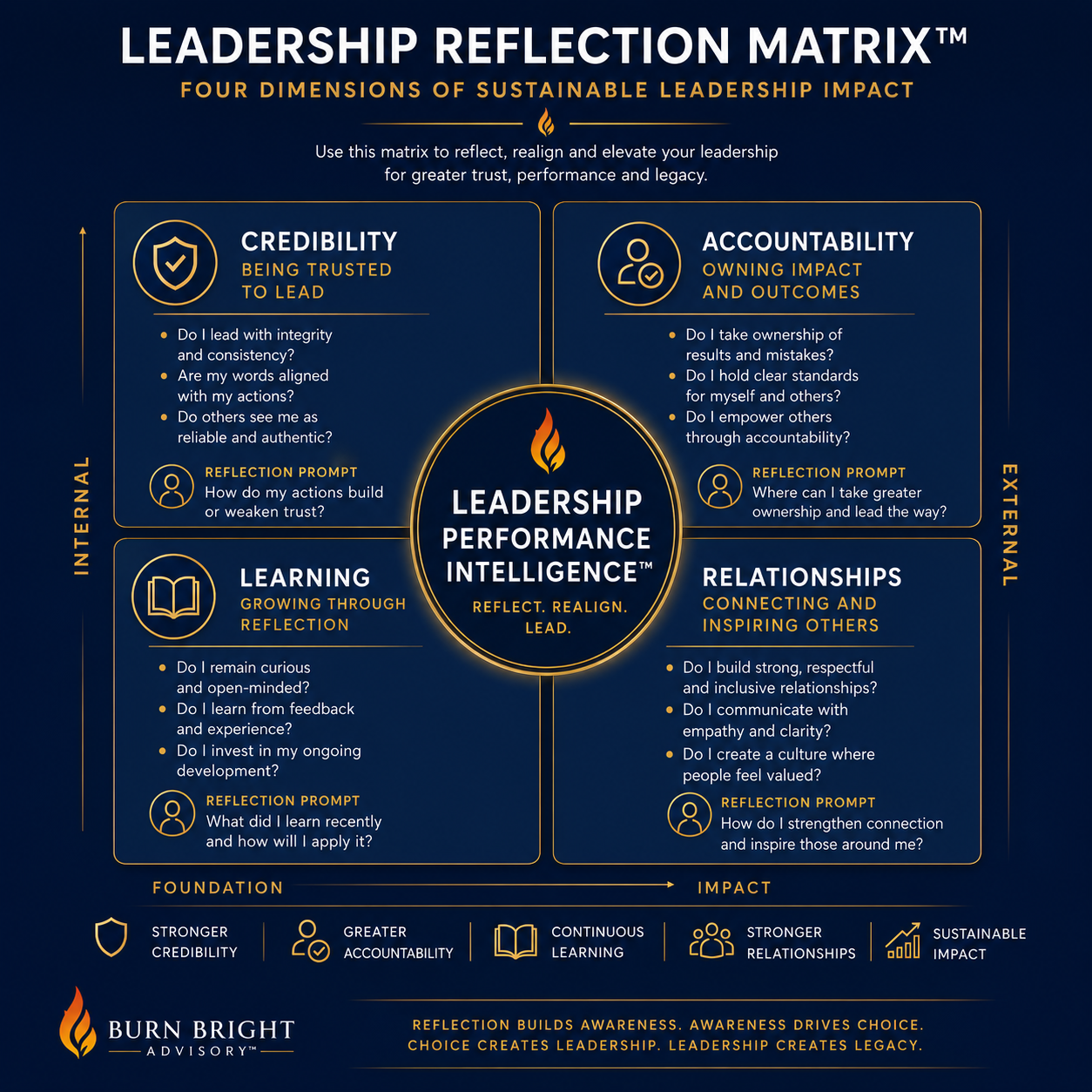
A Professionalism Intelligence™ Self-Reflection Framework
Professional growth begins with honest reflection. Consider the following questions across five areas.
Area Credibility
- Do people trust my decisions?
- Am I consistent under pressure?
- Do my actions align with my stated values?
Area Communication
- Do I communicate with clarity and respect?
- How often do I genuinely listen before responding?
- Do I encourage open dialogue?
Area Accountability
- How do I respond when I make mistakes?
- Do I model accountability for my team?
- Do I create a culture where learning is safe?
Area Continuous Learning
- What have I learned during the past month?
- What leadership capability am I intentionally developing?
- When did I last seek constructive feedback?
Area Reflection
- Which recent decision best demonstrated my professionalism?
- Which decision would I approach differently today?
- What leadership habit requires the greatest improvement?
Moving From Professional Competence to Professional Excellence
Competence allows leaders to perform their roles effectively. Professional excellence enables them to influence organisations positively for years. The difference lies in intentionality.
Competent leaders complete responsibilities. Professional leaders shape cultures.
Competent leaders solve today’s problems. Professional leaders build organisational capability for tomorrow.
Competent leaders manage performance. Professional leaders inspire confidence.
Leadership is not measured solely by outcomes. It is measured by the quality of the leadership behaviours that consistently produce those outcomes. Professionalism therefore becomes one of the strongest predictors of sustainable leadership effectiveness because it influences every interaction, every decision, and every organisational relationship.
Conclusion
Professionalism is often described as a workplace expectation. In reality, it is a strategic leadership capability.
As organisations navigate increasing complexity, leaders can no longer rely solely on technical expertise or positional authority. Sustainable leadership requires credibility, ethical judgement, reflective practice, accountability, and a commitment to continuous learning.
Within Burn Bright Advisory™’s Leadership Performance Intelligence™ framework, Professionalism Intelligence™ provides the foundation upon which every other leadership capability is built. It strengthens decision-making, supports ethical behaviour, enhances stakeholder confidence, and creates organisational cultures where trust and performance develop together.
The leaders who will shape the future are unlikely to be those with the loudest voices or the most impressive titles. They will be those whose professionalism consistently earns confidence, develops others, and creates organisations capable of thriving long after individual leaders have moved on.
Leadership Reflection Questions
- Which professional values guide my leadership decisions when I experience pressure?
- Where am I most consistent as a leader?
- Where am I least consistent?
- How would my team describe my professionalism if I were not present?
- Which recent leadership decision strengthened trust?
- Which recent decision may have unintentionally weakened trust?
- How effectively do I balance organisational performance with people-centred leadership?
- What professional behaviour should I intentionally improve over the next 90 days?
Team Reflection
- Do our organisational values influence daily decisions?
- Does our team feel psychologically safe to challenge ideas?
- Are mistakes viewed as opportunities for learning?
- Do we celebrate professionalism as much as performance?
- Are professional standards consistently applied across every level of the organisation?
Practical Action Steps
Developing Professionalism Intelligence™ requires intentional practice. Leaders can begin strengthening professionalism immediately through the following actions.
Week One
Review your personal leadership values. Ask three trusted colleagues for honest feedback about your professional behaviours. Identify one behaviour that consistently builds trust and one that unintentionally reduces it.
Month One
Introduce reflective leadership conversations within your team. Review decision-making processes for transparency. Establish regular professional development discussions and encourage constructive feedback during meetings.
Quarter One
Complete a Leadership Intelligence Assessment™, develop an individual Leadership Development Plan, benchmark leadership capability against organisational priorities, and introduce regular reflective practice sessions.
What is professionalism leadership?
Professionalism leadership is the consistent demonstration of ethical judgement, accountability, competence, respect and reflective practice that enables leaders to build trust and deliver sustainable organisational performance.
Why is professionalism important in leadership?
Professionalism creates credibility, strengthens relationships, improves decision quality and establishes trust across organisations. Without professionalism, leadership influence becomes difficult to sustain regardless of technical expertise.
How does professionalism improve organisational performance?
Professional leaders build cultures characterised by trust, accountability, psychological safety and continuous improvement. These environments typically experience higher engagement, stronger collaboration and better long-term performance.
Can professionalism be developed?
Yes. Professionalism is not a fixed personality trait. It develops through continuous learning, reflective practice, ethical decision-making and deliberate behavioural improvement.
How does Professionalism Intelligence™ relate to Leadership Performance Intelligence™?
Professionalism Intelligence™ is one of the core domains within the Leadership Intelligence Compass™. It supports Leadership Performance Intelligence™ by strengthening credibility, ethical judgement, accountability, reflective practice and sustainable leadership capacity.
Which leaders benefit most from Professionalism Intelligence™?
Every leader. Professionalism is essential across business, education, healthcare, public service, non-profit organisations, entrepreneurship, executive leadership and emerging leaders alike.
What is the biggest misconception about professionalism?
Many people believe professionalism is primarily about appearance or workplace etiquette. In reality, professionalism is demonstrated through consistent behaviour, ethical judgement, accountability and the ability to build trust over time.
How can organisations strengthen professionalism?
Organisations strengthen professionalism by defining clear leadership standards, encouraging reflective practice, investing in leadership development, rewarding ethical leadership, measuring behaviours alongside performance outcomes and embedding Professionalism Intelligence™ into leadership frameworks.
How Strong Is Your Professionalism Intelligence™?
Take the free Leadership Burnout Self-Assessment to see how your professionalism, decision-making and leadership capacity are holding up under pressure.
Free Leadership Intelligence
Get Weekly Leadership Insights
Join thousands of leaders receiving practical strategies on burnout prevention, workload design, and sustainable performance every week.