Quick Answer
Key Takeaways
- Professionalism is a performance capability, not simply appearance, etiquette or policy compliance.
- It is most observable under pressure — during conflict, criticism, mistakes and uncertainty.
- Professionalism Intelligence™ sits within the Leadership Intelligence Compass™, alongside Ethics Intelligence™, Emotional Intelligence™ and Leadership Sustainability™.
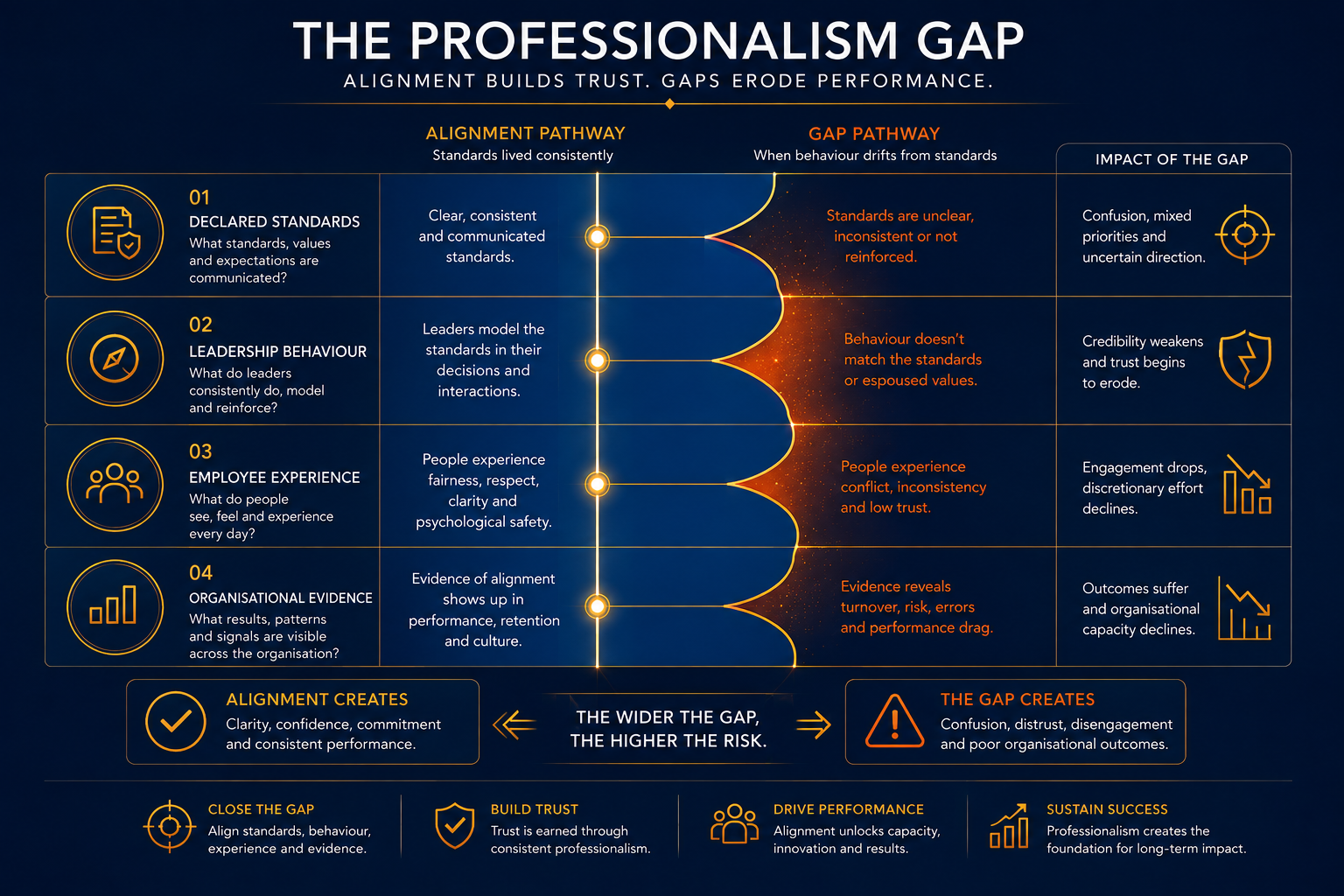
- The Professionalism Gap measures the distance between declared standards and experienced leadership behaviour.
- Professionalism Intelligence™ can be deliberately developed through a five-stage cycle: Recognise, Reflect, Recalibrate, Reinforce, Review.
Professionalism in Leadership: Why Standards, Trust and Accountability Define Leadership Performance
Leadership credibility is rarely destroyed by one dramatic event. More often, it erodes through accumulation.
A commitment is made and quietly forgotten.
A difficult conversation is avoided.
A standard applied rigorously to one employee is relaxed for another.
A confidential discussion becomes office conversation.
None of these moments necessarily appears catastrophic in isolation. Collectively, however, they teach people something important: the leader cannot be relied upon to behave consistently with the responsibilities of the role. That is a professionalism problem. And because leadership operates through relationships, judgement, authority and trust, it is also a performance problem.
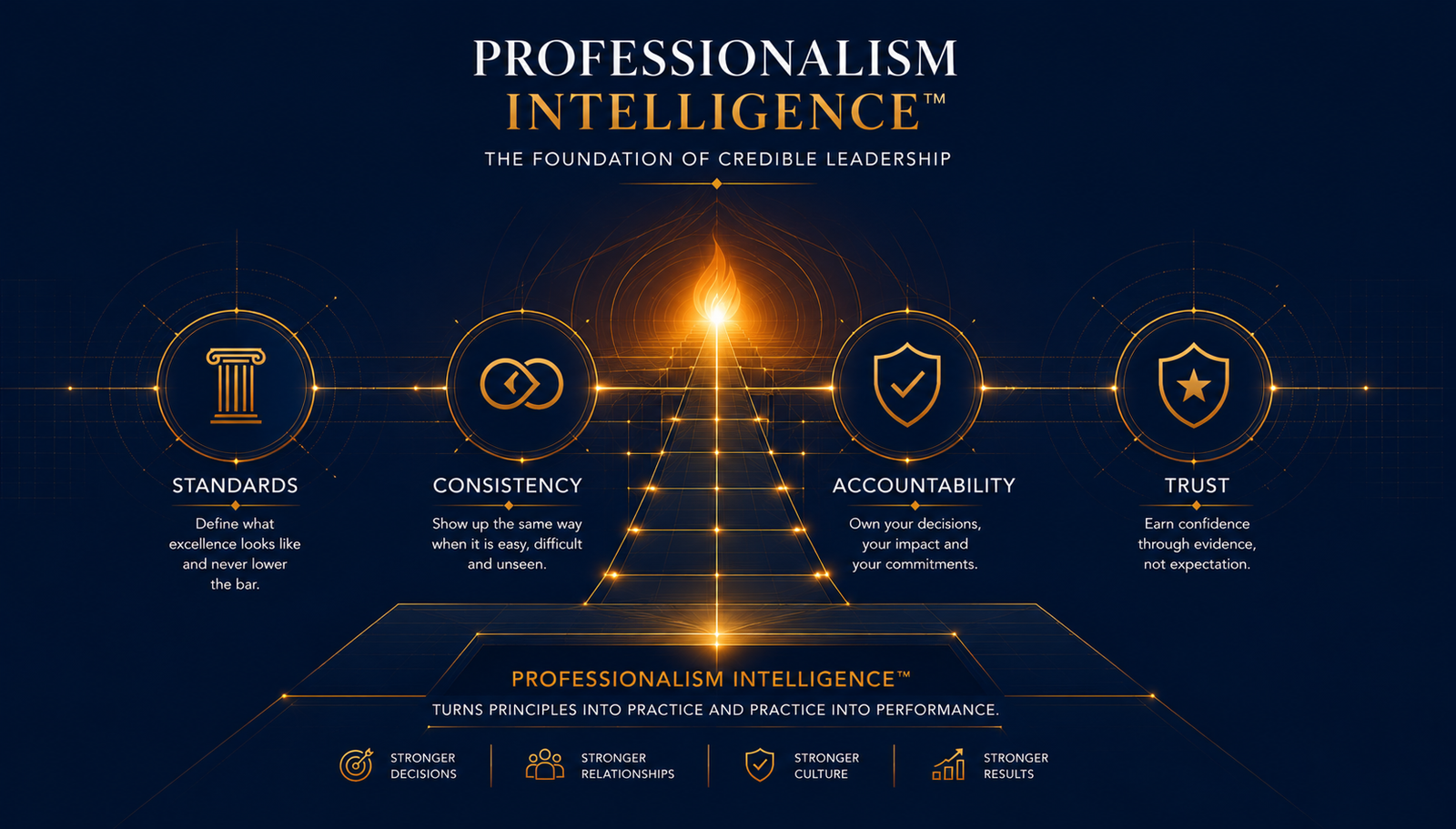
Featured Snippet
Professionalism Is More Than Looking Professional
A leader can be impeccably presented and profoundly unprofessional. They can speak eloquently while avoiding accountability. They can understand organisational policy while applying it inconsistently. They can maintain perfect meeting etiquette while undermining colleagues outside the room.
Reputation is what people believe about a leader. Professionalism is what repeatedly gives them evidence for that belief.
The Professionalism–Trust Relationship
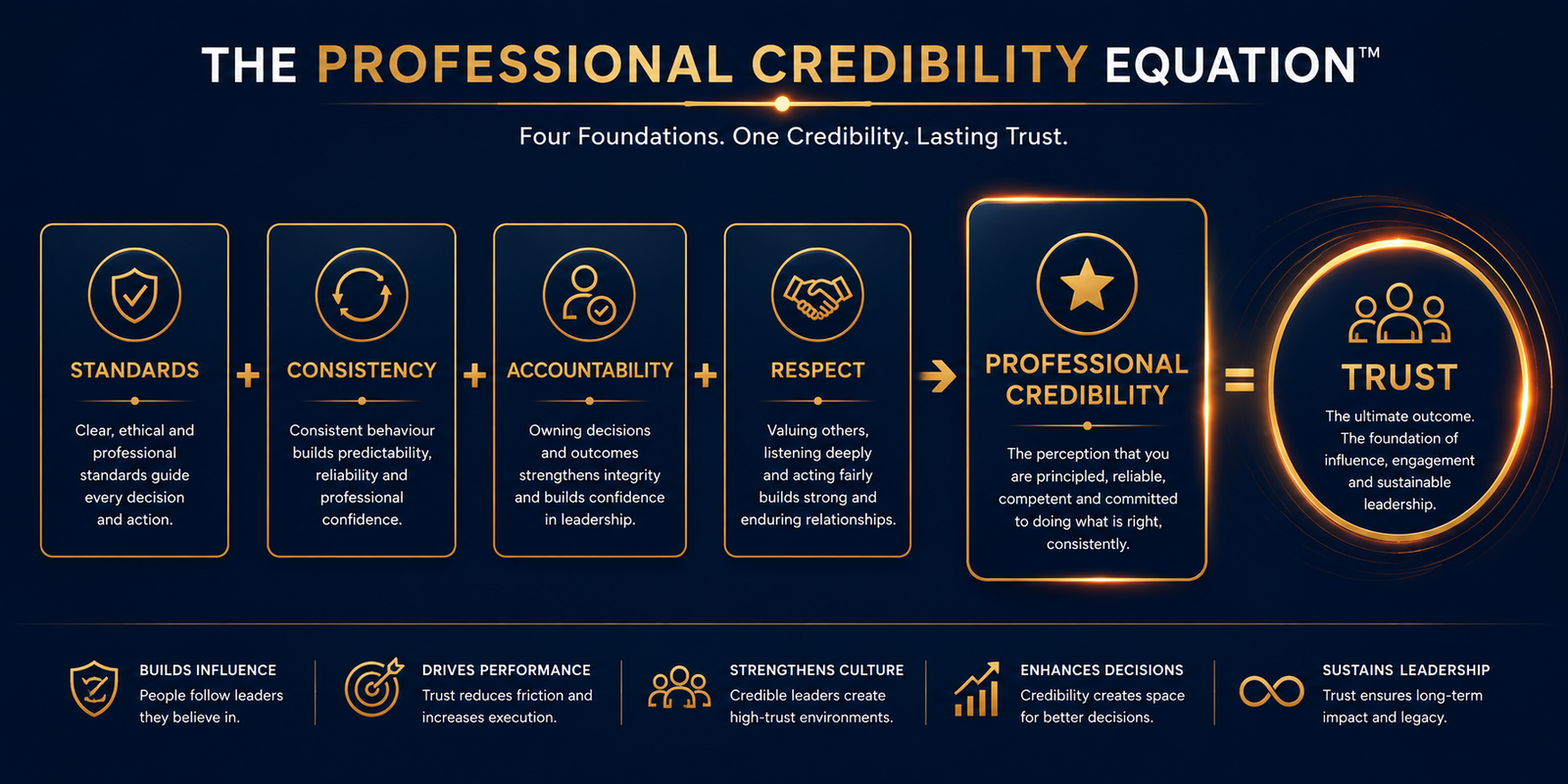
Trust is frequently discussed as though leaders can create it directly. They cannot. A leader cannot simply instruct a team to trust them — trust is an inference people make after observing behaviour over time. Employees watch whether leaders keep commitments, tell the truth when it is uncomfortable, maintain confidentiality, acknowledge errors, follow through, apply standards consistently and behave similarly when powerful people are absent.
When standards are inconsistent, accountability is avoided and behaviour changes according to audience or circumstance, credibility deteriorates. People learn the real leadership standard not from the organisation’s values statement but from the behaviours leadership repeatedly permits — including its own.
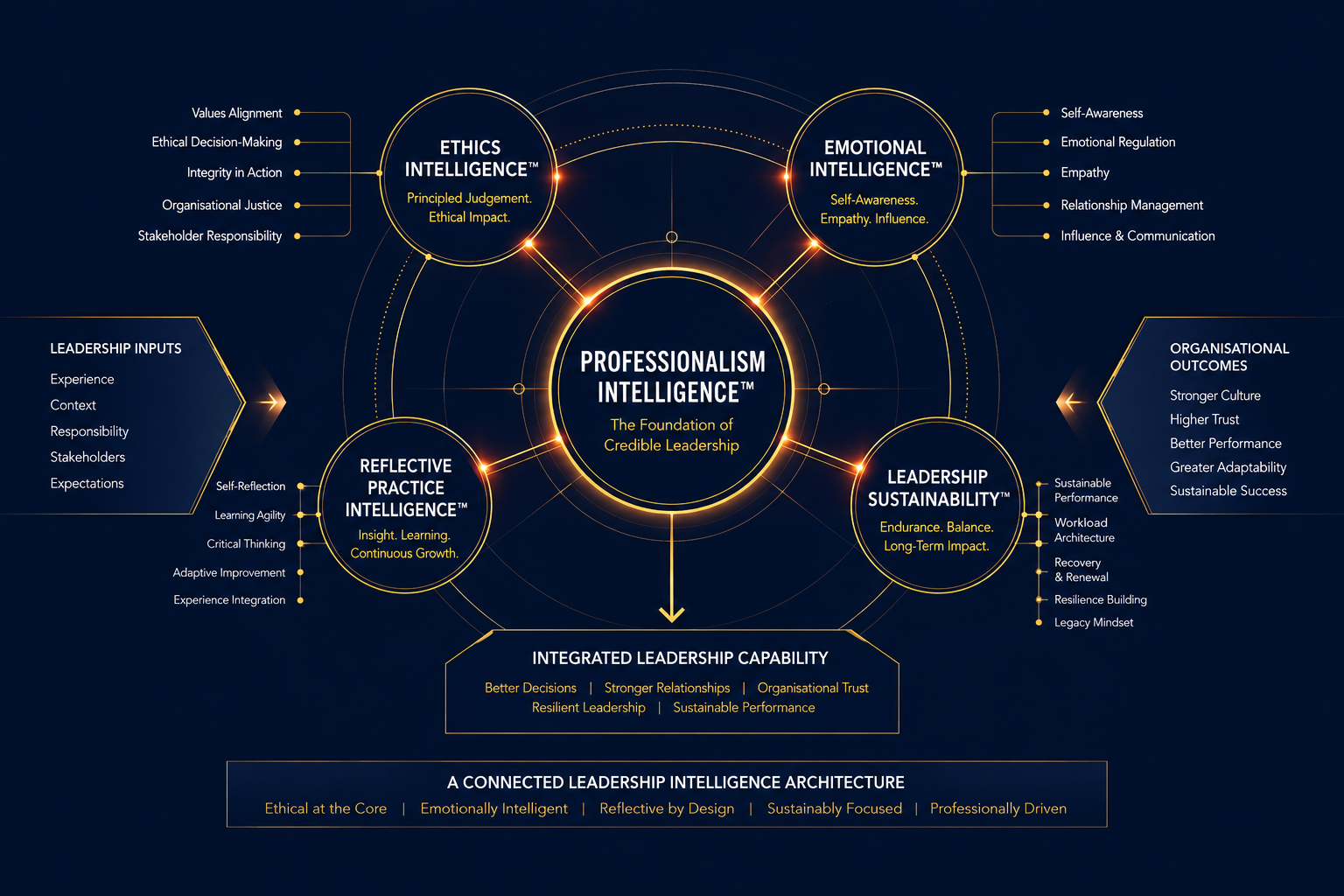
Professionalism Intelligence™ Within the Leadership Intelligence Compass™
Burn Bright Advisory’s Leadership Intelligence Compass™ positions Professionalism Intelligence™ as one of nine interconnected domains of leadership capability, framed around the capacity to act with integrity, lead with accountability and build enduring trust. It does not operate independently.
Pairing Professionalism Intelligence™ + Ethics Intelligence™
Professionalism asks what standards a role requires. Ethics asks what is the responsible and principled thing to do. Usually these reinforce one another; occasionally they create tension. Strong leadership requires both capabilities.
Pairing Professionalism Intelligence™ + Emotional Intelligence™
Professionalism without emotional intelligence can become sterile. Emotional Intelligence™ helps leaders understand how professional decisions are experienced by others — the goal is to conduct difficult conversations professionally and humanely.
Pairing Professionalism Intelligence™ + Reflective Practice Intelligence™
Professionalism can become rigid when leaders assume their established behaviour is automatically correct. Reflective Practice Intelligence™ asks: what effect is my professional behaviour actually having? Intent does not always equal impact.
Pairing Professionalism Intelligence™ + Leadership Sustainability™
Pressure exposes professional capacity. When leaders become chronically overloaded, patience shortens, preparation deteriorates and communication becomes reactive. Sustainable leadership protects the capacity required to continue behaving professionally under pressure.
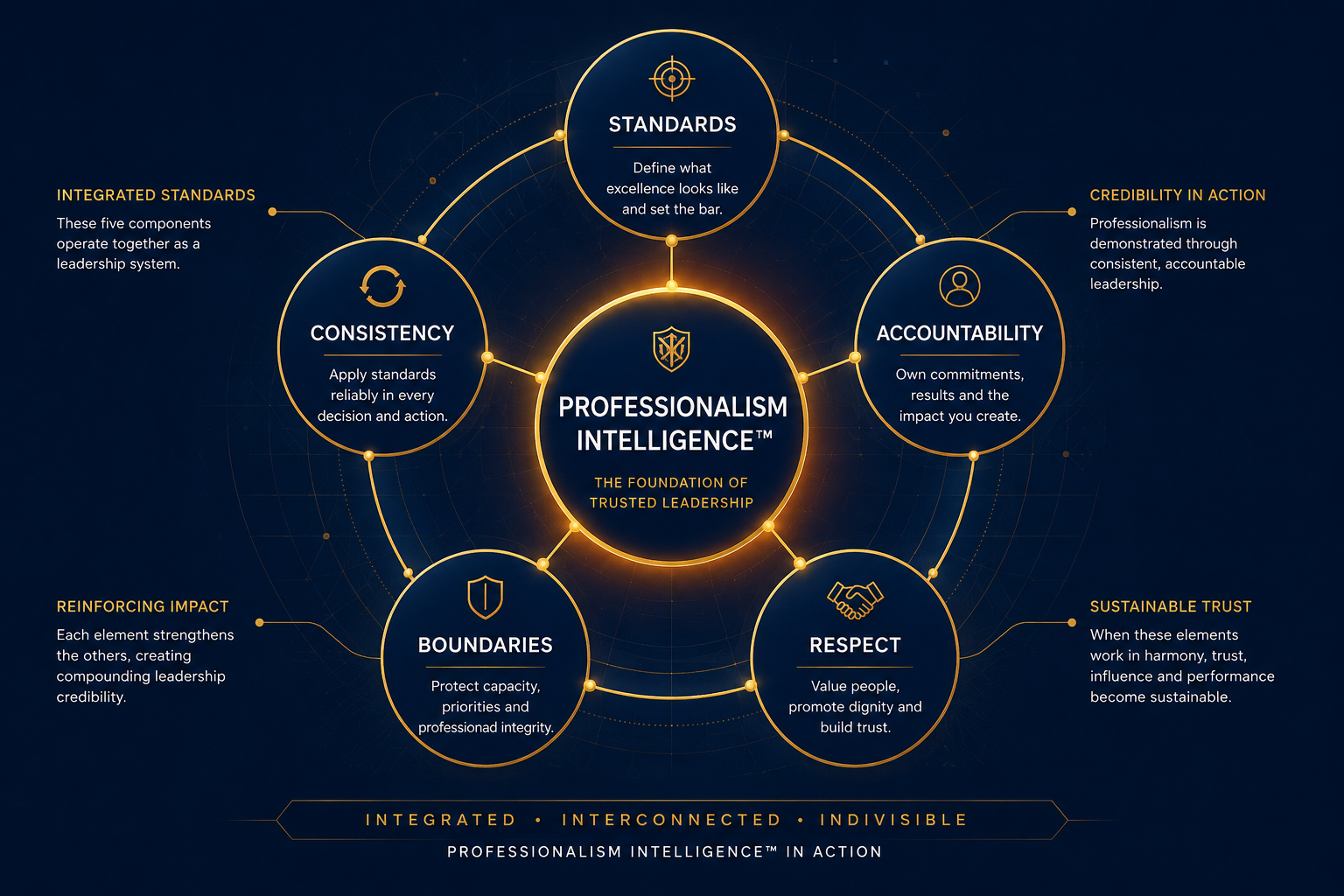
The Five Dimensions of Professional Leadership
To make professionalism measurable rather than rhetorical, leaders can examine five interconnected dimensions.
Dimension 1
Standards
Professional leaders understand what good leadership requires — but the important question is whether those standards remain active when pressure rises. A leader who champions respectful communication but humiliates an employee has revealed a gap between stated and enacted standards.
Dimension 2
Consistency
People need sufficient behavioural consistency to understand what leadership means in practice. Consistency does not mean rigidity — decisions should adapt to context, but the principles governing them should remain stable.
Dimension 3
Accountability
Accountability is one of professionalism’s clearest tests. Professional leadership asks what belonged to the leadership role, rather than pushing responsibility downward when an outcome fails.
Dimension 4
Boundaries
Leaders hold information, influence and authority that others do not — that asymmetry creates responsibility. Boundaries govern confidentiality, conflicts of interest, communication and decision-making authority. They are trust infrastructure, not bureaucratic inconvenience.
Dimension 5
Respect
Respect does not require agreement, nor does it prevent challenge or decisive action. People should be able to experience disagreement without degradation — correction without humiliation, accountability without intimidation.
Professionalism Is Most Visible Under Pressure
A leader facing a missed target, staffing shortage, serious complaint or financial setback experiences competing pressures simultaneously. Pressure narrows attention, increasing the temptation to react quickly, defend reputation, assign blame or communicate before sufficient information is available.
A leader demonstrating Professionalism Intelligence™ under pressure creates a deliberate gap between stimulus and response — asking “what do we know?” instead of “who caused this?”, and “what responsibility belongs to my role?” instead of “how do I protect myself?”
The Professionalism Gap
One of the most useful ways to assess leadership professionalism is to examine the distance between declared standards and experienced behaviour — what Burn Bright Advisory™ describes as the Professionalism Gap.
The Professionalism Gap Sequence
Why the Gap Matters
Formal values tell employees what the organisation wants to believe about itself. Leadership behaviour tells them what actually counts. Eventually, the informal system becomes more powerful than the formal one — which is why professionalism cannot be delegated to policies or codes of conduct. Leadership itself becomes the behavioural evidence against which those standards are judged.
Four Professionalism Gaps Leaders Should Monitor
Professionalism Intelligence™ Across Sectors
Professional standards are universal in principle but contextual in practice. What remains consistent is the underlying requirement: authority must be exercised in ways that preserve responsibility, credibility, standards and trust.
Business Growth Intelligence™
Results do not excuse behaviour. If performance depends on fear, exhaustion or silence, the organisation may be converting future capability into present results — performance debt rather than sustainable high performance.
School Leadership Intelligence™
School leaders operate in unusually visible environments. Leadership provides cultural permission — teachers, students and parents learn the real standard by watching leadership behaviour, not policy documents.
Healthcare Leadership Intelligence™
Professionalism includes the ability both to challenge responsibly and to receive challenge responsibly. Professional environments need credible evidence that speaking up is genuinely safe, not just permitted.
Public Service Leadership Intelligence™
Authority belongs to the office or institution, not simply to the individual exercising it. Personal preference cannot become the sole basis for exercising institutional authority.
HR & People Leadership Intelligence™
People leaders must preserve confidentiality without allowing silence to become perceived indifference — aiming for both appropriate outcomes and credible processes.
Entrepreneur Performance Intelligence™
In early-stage businesses, founder behaviour becomes organisational behaviour. Professionalism is culture before bureaucracy exists.
The Professionalism Intelligence™ Diagnostic
Leaders can begin examining their own professionalism through five questions.
| Dimension | Diagnostic Question |
|---|---|
| Standards | Would I be comfortable if everyone I lead copied the behaviour I demonstrate? |
| Consistency | Would employees describe my leadership similarly on a difficult day and an easy one? |
| Accountability | When outcomes disappoint, do I examine my contribution before allocating responsibility elsewhere? |
| Boundaries | Do I consistently protect information, relationships and authority in ways appropriate to my role? |
| Respect | Can people disagree with me without sacrificing dignity or professional standing? |
These questions should not be answered only by the leader. A stronger diagnostic compares three perspectives: how the leader believes they lead, how others experience their leadership, and what organisational evidence shows.
From Professionalism to Leadership Performance Intelligence™
Professionalism Intelligence™ matters because professional behaviour does more than protect reputation — it influences the operating capacity of the organisation.
Developing Professionalism Intelligence™
Experience can deepen professional judgement, but it can also reinforce habits that have never been properly examined. Professionalism Intelligence™ should be treated as a developmental leadership capability rather than a fixed personal characteristic.
The Professionalism Intelligence™ Development Cycle
1. Recognise the Standard
Development begins with behavioural clarity — what professional leadership actually requires in a given role, beyond vague expectations such as “be professional.”
2. Reflect on Behaviour
Does my behaviour actually demonstrate the standard I believe I hold? Leaders have privileged access to their own intentions; other people only experience behaviour.
3. Recalibrate the Response
Reflection without behavioural change becomes observation rather than development. Small behavioural adjustments — such as inviting challenge before deciding — can change the information available to leadership.
4. Reinforce the Behaviour
Professional behaviour becomes credible through repetition. One apology does not create accountability; trust is rebuilt behaviourally, over time.
5. Review the Evidence
Leaders need evidence of change — fewer repeated misunderstandings, increased willingness to raise concerns, improved follow-through — not just a belief that they have improved.
Seven Practices of Professionally Intelligent Leaders
- Make fewer casual commitments. Distinguish between intention and commitment — if you commit, track it; if circumstances change, communicate.
- Separate urgency from emotion. “This requires action today” does not require “everyone should panic because I am anxious.”
- Correct privately, clarify publicly. Address individual correction directly; reserve public clarification for issues affecting the whole team.
- Explain decisions without performing certainty. Disciplined confidence — acknowledging what is not yet known — is not weaker than false certainty.
- Apply standards upward, downward and inward. Professionalism that appears only in the presence of power is impression management.
- Protect boundaries before they become problems. Clarify expectations around availability, confidentiality and decision rights before a crisis forces the issue.
- Repair professional breaches. Acknowledge, own, correct and learn — a credible repair produces behavioural evidence, not just an apology.
When Professionalism Begins to Deteriorate
Professional decline rarely announces itself dramatically. Leaders should pay attention to early indicators: irritation becoming the default response, developmental conversations cancelled repeatedly, preparation feeling optional, confidentiality feeling inconvenient, or communication changing according to someone’s status.
These signals do not automatically mean somebody is a poor leader — they indicate the need for examination. The appropriate response is diagnosis rather than immediate judgement: what is happening, why is it happening, what impact is it creating, and what must change?
Professionalism Is a System, Not Just an Individual Responsibility
An organisation cannot credibly demand professionalism while structurally rewarding its opposite. Organisations should ask what leadership behaviour their systems actually reward and tolerate, and what happens when a high performer behaves unprofessionally or when somebody responsibly challenges senior authority. This is where Professionalism Intelligence™ becomes part of a wider Leadership Development System™.
From Professionalism Intelligence™ to Leadership Benchmarking™
Traditional leadership measurement often focuses heavily on operational outcomes — revenue, growth, delivery, compliance. These indicators matter, but they tell us relatively little about the leadership capability producing them. Leadership Benchmarking™ asks not only “what was achieved?” but “what leadership capability made that achievement possible, and is that capability sustainable?”
The Leadership Intelligence Assessment™
Self-awareness is necessary for development, but self-assessment alone has limitations — leaders have blind spots, and positional authority can reduce the candid feedback reaching them. A structured Leadership Intelligence Assessment™ helps leaders examine Professionalism Intelligence™ alongside the wider Leadership Intelligence Compass™, moving from assessment to reflection, development priorities, action and evidence.
Leadership Reflection Questions
- What professional standards do I expect from people I lead?
- Which of those standards do I find hardest to demonstrate consistently myself?
- How does my behaviour change when I am tired, overloaded, criticised or under pressure?
- Would employees describe me as predictable in my principles even when my decisions vary according to context?
- When something goes wrong, where does my attention go first: responsibility, explanation, blame or learning?
- Which commitments have I made recently, and have I completed or explicitly renegotiated them?
- How safe is it for somebody with less organisational power to disagree with me?
- Do I communicate differently with senior leaders than I do with people who report to me?
- Where might my intention and other people’s experience of my leadership differ?
- What behaviour would I change if I knew everybody I lead would copy it tomorrow?
A 30-Day Professionalism Intelligence™ Review
Week 1 — Observe
Track commitments, difficult conversations, emotional triggers and moments when your professional standards are tested. Gather evidence before trying to change everything.
Week 2 — Compare
Choose one professional standard that matters significantly in your role. Compare what you expect, what you do, how others may experience it, and what evidence exists — identify the Professionalism Gap.
Week 3 — Recalibrate
Choose one observable behavioural change — protecting scheduled one-to-ones, asking for challenge before finalising decisions, or tracking every commitment.
Week 4 — Review
Ask what changed, what became easier, what remained difficult, and what feedback emerged — then choose the next development priority.
What is professionalism in leadership?
Professionalism in leadership is the disciplined practice of exercising leadership responsibility consistently with appropriate standards, boundaries, accountability, competence, respect and judgement. It is demonstrated through repeated behaviour rather than appearance or status alone.
Why is professionalism important for leaders?
Professionalism strengthens credibility and makes leadership behaviour more predictable, supporting trust, clearer accountability, safer working relationships and more consistent organisational performance.
What is Professionalism Intelligence™?
Within Burn Bright Advisory’s Leadership Intelligence Compass™, Professionalism Intelligence™ describes the leadership capability associated with professional standards, accountability, credible conduct and trust, connected to the wider system of Leadership Performance Intelligence™.
Is professionalism the same as ethics?
No. Professionalism concerns the standards, responsibilities and conduct associated with exercising a role credibly, while ethics concerns principled judgement about what is right, responsible and defensible. Strong leadership requires both.
Can a high-performing leader still be unprofessional?
Yes. A leader may produce strong short-term results while demonstrating poor accountability, disrespectful behaviour, weak boundaries or inconsistent standards. Leadership Performance Intelligence™ examines both outcomes and how they are achieved.
Does professionalism mean leaders should always remain formal?
No. A leader can be warm, humorous, approachable and highly professional. The relevant issue is whether their behaviour remains appropriate to their responsibilities, relationships and context.
How does professionalism influence trust?
People infer trustworthiness from repeated evidence. When leaders consistently honour commitments, communicate responsibly, maintain boundaries and accept accountability, professional credibility strengthens.
How can leaders improve professionalism?
Improvement begins by clarifying professional standards, reflecting on actual behaviour, gathering evidence about impact, recalibrating specific behaviours, reinforcing them consistently and reviewing progress.
What causes professional behaviour to deteriorate?
Professional behaviour may deteriorate through workload pressure, exhaustion, unclear expectations, poor organisational culture, weak boundaries or unresolved conflict. Diagnosis should precede intervention.
Conclusion: Professionalism Is Leadership Made Visible
Leadership contains many capabilities that people cannot directly observe — they cannot see a leader’s internal reasoning or fully know their intentions. What they can observe is behaviour: whether the leader arrives prepared, whether promises are honoured, whether confidentiality is respected, whether standards change according to hierarchy, and whether pressure changes character.
Professionalism Intelligence™ should not stand alone. It works alongside Ethics Intelligence™ to examine what is right, Emotional Intelligence™ to understand people and relationships, Reflective Practice Intelligence™ to examine impact and learn, Adaptability Intelligence™ to respond when context changes, and Leadership Sustainability™ to preserve the human capacity required to keep performing effectively. Together, these capabilities contribute to Leadership Performance Intelligence™.
The stronger question for leaders is not “do I consider myself professional?” but “what evidence does my behaviour give other people about the professional standard of my leadership?” Professionalism is not the decorative surface of leadership. It is one of the structures that makes leadership trustworthy.
Discover Your Leadership Intelligence Profile
Explore where your Professionalism Intelligence™ stands within the wider Leadership Intelligence Compass™, and identify your next development priority.
Free Leadership Intelligence
Get Weekly Leadership Insights
Join thousands of leaders receiving practical strategies on burnout prevention, workload design, and sustainable performance every week.