Quick Answer
Key Takeaways
- Strategic time is leadership work, not empty calendar space. Thinking, planning and anticipating problems are part of the job.
- A permanently full calendar is usually a structural warning sign — it can indicate excessive meetings, unclear decision authority, scope creep or poor workload architecture.
- Protecting strategic time requires more than time blocking. A protected block is useless if the organisation still expects immediate availability.
- Leaders need to separate operational urgency from strategic importance. Not every problem deserves senior-level attention.
- Sustainable leadership requires deliberate time architecture. Better systems protect leadership capacity more effectively than simply asking leaders to become more productive.
Protecting Strategic Time: A Guide for Leaders
Protecting strategic time is one of the most important disciplines for leaders who feel permanently busy but increasingly unable to think.
The problem is rarely a lack of commitment. It is often the architecture of the role.
A leader starts Monday intending to think about next quarter.
Then the calendar takes over.
Meetings multiply. Messages arrive. Someone needs approval.
By Friday, the work that required leadership rather than simple availability remains untouched.
This pattern matters because modern leadership roles have expanded. Leaders are expected to manage people, operations, communication, performance, change, stakeholders and increasingly complex digital workflows at the same time. The Burn Bright Not Out Framework™ identifies Workload Architecture™ and Time Architecture™ as structural components of sustainable leadership rather than treating overload as an individual productivity problem.
The answer is not squeezing more activity into every hour. It is protecting the hours in which leadership actually happens.
Strategic time becomes easier to protect once you can see how different forms of work compete for leadership capacity.
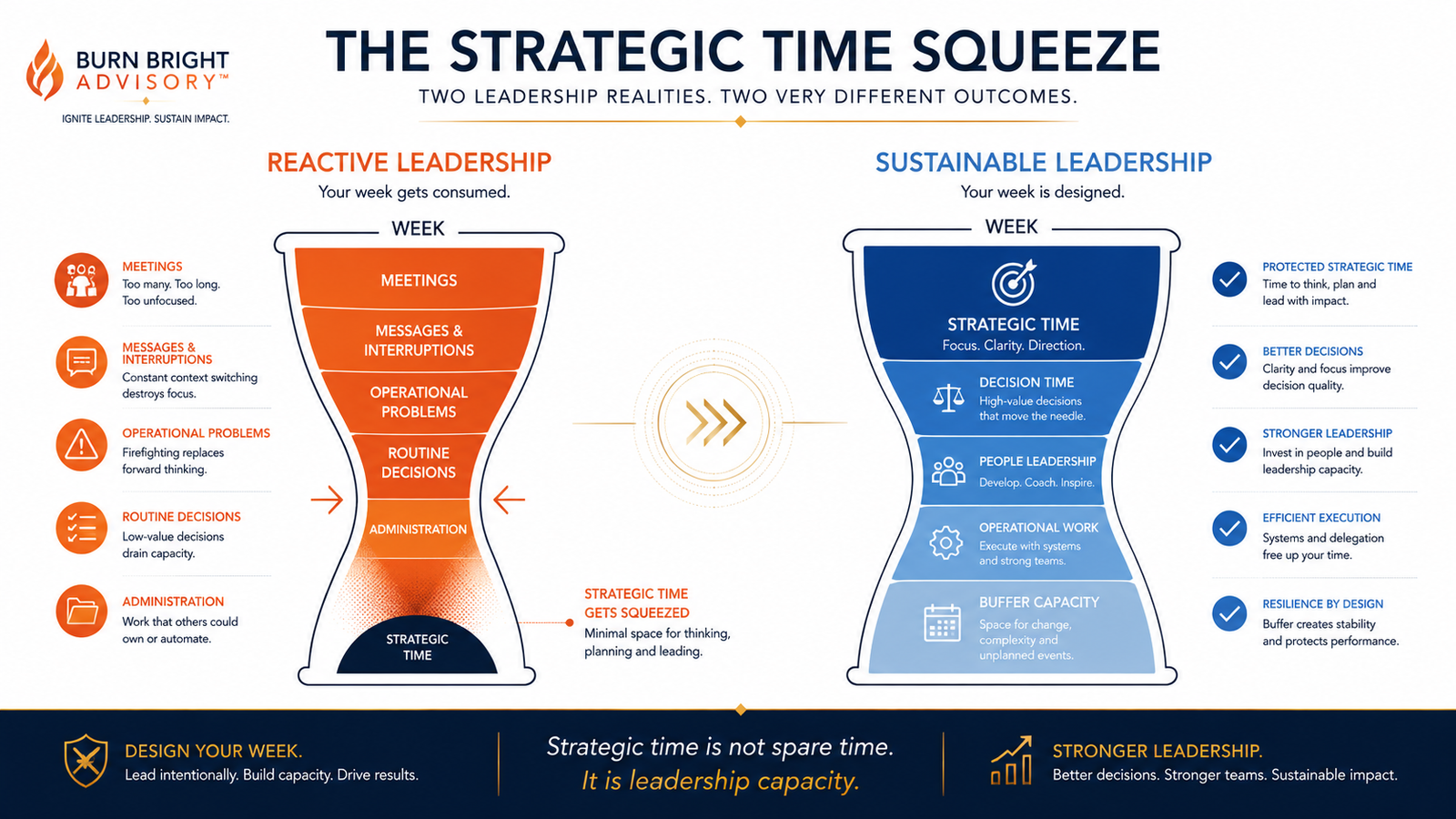
The point of this model is simple: strategic work rarely disappears because leaders decide it does not matter. It disappears because work that is louder, faster and more immediate repeatedly takes priority.
The more senior your role becomes, the more strategic thinking the organisation needs from you. Yet the same increase in responsibility often produces more meetings, more decisions, more stakeholders and more interruptions. Without deliberate structural protection, the work with the greatest long-term value becomes the easiest work to postpone.
Featured Snippet
Why Do Leaders Lose Strategic Time?
Leaders rarely lose strategic time in one dramatic moment. They lose it in fragments — a meeting is added, a decision is escalated, a recurring report becomes permanent. Six months later, nobody remembers that the arrangement was supposed to be temporary. This is why protecting strategic time requires diagnosis before another productivity technique.
The Burn Bright Framework™ identifies five root causes of burnout: scope creep, meeting culture, communication chaos, decision overload and perfectionism culture. Four of those causes directly compete for strategic time.
The pattern can be summarised simply: scope creep increases what leaders own, meeting culture consumes when they can think, communication chaos fragments their attention, and decision overload consumes their cognitive capacity. The result is not simply a busy calendar — it is a leadership system that systematically prioritises responsiveness over thought.
That question moves the problem away from personal productivity and towards organisational design. And that is where protecting strategic time actually begins.
What Happens When Strategic Time Disappears?
The first consequence of losing strategic time is not an empty strategy document. It is reactive leadership. When leaders have no protected capacity to think ahead, their attention shifts towards whatever is most immediate.
This creates a reinforcing cycle: less strategic time leads to more reactive decisions, which leads to more unresolved structural problems, which leads to more operational interruptions, which leads to even less strategic time.
Reactive Leadership Creates More Firefighting
A reactive leader treats each incident separately, without asking why the problem keeps returning. Without strategic time, leaders repeatedly treat symptoms because they lack the capacity to diagnose the system producing them. The Burn Bright Framework™ describes this wider organisational cost as the Culture Tax™: the hidden financial cost of turnover, disengagement and burnout paid by organisations that repeatedly treat symptoms rather than fixing structures.
Decision Quality Starts to Deteriorate
As cognitive load accumulates, leaders begin choosing the fastest acceptable answer rather than examining the best available one. The Burn Bright Framework™ identifies decision overload as one of the five root causes of burnout and includes Decision Fatigue Management™ among its nine practical frameworks.
Cognitive Space Becomes Fragmented
Strategic thinking has a start-up cost — reconstructing the problem, the assumptions and the evidence. An interruption forces you to rebuild that mental model from scratch. The calendar may show two hours spent on strategy; the brain may have experienced six separate fragments. This is why strategic time must be protected, not merely scheduled.
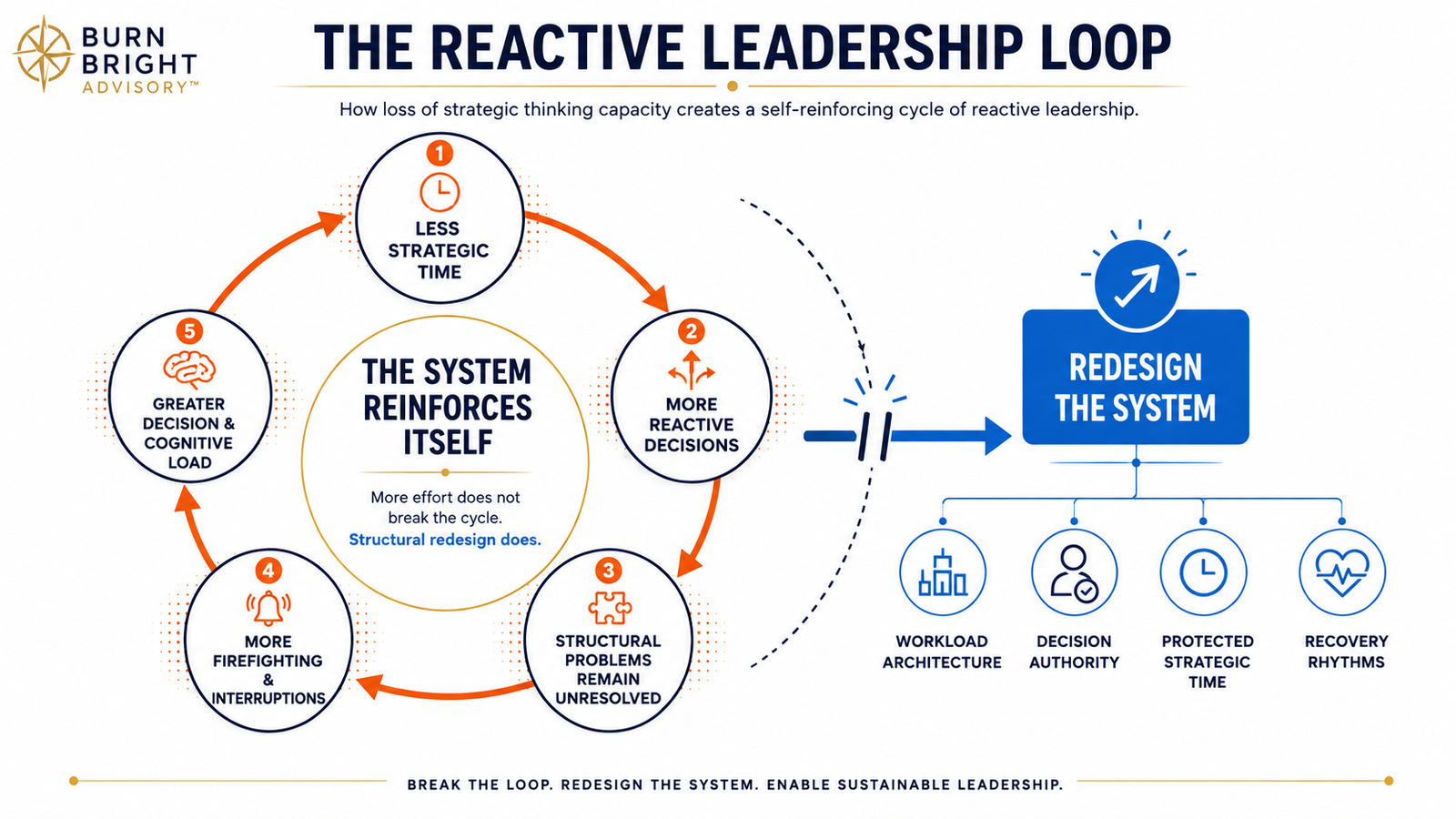
Leaders often assume they will protect strategic time once operations become calmer. But if the lack of strategic thinking is helping to create the operational problems, calm never arrives. The system keeps generating the interruptions that prevent the leader from redesigning the system.
Leadership Becomes the Bottleneck
Eventually, everything starts waiting for the leader — approvals, problems, projects, team members. This is more often evidence of organisational dependency than personal importance. The leader responds by working longer, which temporarily increases throughput but does not remove the bottleneck.
Strategic Time and Burnout Are Connected
The Burn Bright Not Out Framework™ distinguishes ordinary stress from burnout by emphasising the chronic nature of burnout and the failure of normal recovery to restore capacity, identifying declining concentration, reduced creativity, difficulty making decisions and mental fatigue as warning signs. A depleted leader does not simply feel worse — the organisation can lose access to the judgement, perspective, creativity and clear decision-making it most needs.
This is why protecting strategic time for leaders should never be treated as a calendar luxury. It is organisational infrastructure. The sustainable alternative is a deliberate balance: close enough to operations to understand reality, but protected enough from operations to think about what reality requires next.
How Can Leaders Protect Strategic Time?
Protecting strategic time does not begin by opening your calendar and colouring two hours blue. It begins by changing what is allowed to compete for those hours. Many leaders already block time for strategy — the block exists until someone requests a meeting or an apparently urgent message arrives. The time was scheduled. It was never protected.
1. Diagnose Where Your Strategic Time Is Going
Review the previous two to four weeks of your calendar and classify the work: strategic, operational, people leadership, meetings, administration, decision work, crisis response, communication. This is Time Architecture™ — examining how the organisation is allocating leadership capacity, not merely managing appointments.
2. Decide What Only You Can Do
Separate leadership work from work currently performed by the leader. Ask: does this require my judgement, my authority, or does it carry significant organisational risk if someone else owned it? The RACI Delegation Framework™ creates clearer ownership across who is Responsible, Accountable, Consulted and Informed.
3. Create Protected Strategic Zones
Design recurring periods with a defined purpose and explicit protection rules — notifications off, routine meetings unable to be scheduled, a clear escalation route for genuine emergencies. The objective is not isolation. It is controlled access.
4. Build Recovery Into the Architecture
Protected time does not guarantee high-quality thinking if it follows a confrontational meeting. Recovery Rhythms™ and Recovery by Design™ form structural pillars alongside Workload Architecture™, Decision Authority™ and Management Frameworks™ — protect your best cognitive capacity for your highest-value leadership work.
Traditional time management asks how you can organise everything you need to do. Time Architecture™ asks whether everything you are doing should be competing for your time in the first place. Because protecting strategic time for leaders is ultimately not about defending a diary. It is about protecting the organisation’s capacity to think.
How Should Leaders Redesign Their Calendars?
A leader’s calendar is not just a scheduling tool. It is a record of organisational priorities. The mistake is trying to solve this by finding gaps — there usually are no gaps. Strategic time has to be designed before lower-value demand consumes the available capacity.
Start With a Calendar Audit
Assess recurring commitments against four questions: did this require my presence, did it produce a decision or meaningful outcome, could I have contributed asynchronously, and what would happen if this meeting occurred without me? That last question often exposes organisational dependency that accumulates unnoticed over months.
Use the IMPACT Matrix™ on Recurring Commitments
Every recurring calendar commitment should lead to one of four actions.
Action 1 Keep It
The activity requires your contribution and produces sufficient value.
Action 2 Redesign It
The purpose is legitimate, but the format, frequency, duration or attendance needs changing.
Action 3 Delegate It
The work matters, but your presence is unnecessary.
Action 4 Remove It
The commitment continues because of habit rather than organisational need.
Stop Giving Every Meeting the Same Status
A useful meeting architecture distinguishes between decision meetings, problem-solving meetings, development conversations, information updates and strategic sessions. The question changes from “when can everyone attend?” to “what is the minimum structure required to achieve the outcome?”
Build the Strategic Work Into the Week First
Most leaders build calendars backwards — meetings go in first, then operational commitments, then requests, and strategic work is fitted into whatever remains. Nothing remains. Reverse the sequence: identify the strategic work that must happen and allocate protected capacity before filling the rest of the calendar.
| Leadership Capacity | Purpose | Protection |
|---|---|---|
| Strategic zone | Planning, organisational design, future priorities | No routine meetings or notifications |
| Decision zone | High-consequence decisions requiring senior judgement | Decisions grouped rather than scattered |
| People zone | Coaching, difficult conversations, leadership development | Protected from routine operational work |
| Operational zone | Reviews, coordination and delivery oversight | Defined rather than allowed to consume the week |
| Buffer capacity | Genuine unexpected demands | Deliberately left unallocated |
Do not design a calendar at 100% capacity. If every hour is allocated, the first unexpected problem destroys the architecture — and leadership contains unexpected problems. Buffer capacity is not wasted time. It is operational resilience.
Protect the Edges of Strategic Time
A two-hour strategic block surrounded by meetings can look effective on paper, but the edges matter. Where possible, create a short buffer before strategic sessions to close previous tasks, and protect the other edge so conclusions have room to emerge rather than being cut off by the next meeting.
Group Shallow Work Instead of Spreading It Everywhere
Ten small approvals scattered across the day can be more disruptive than processing all ten together. Batching lower-complexity tasks replaces continuous partial attention with predictable availability — your team should know when you are available, when you are concentrating, what qualifies as urgent, and how genuine emergencies should be escalated.
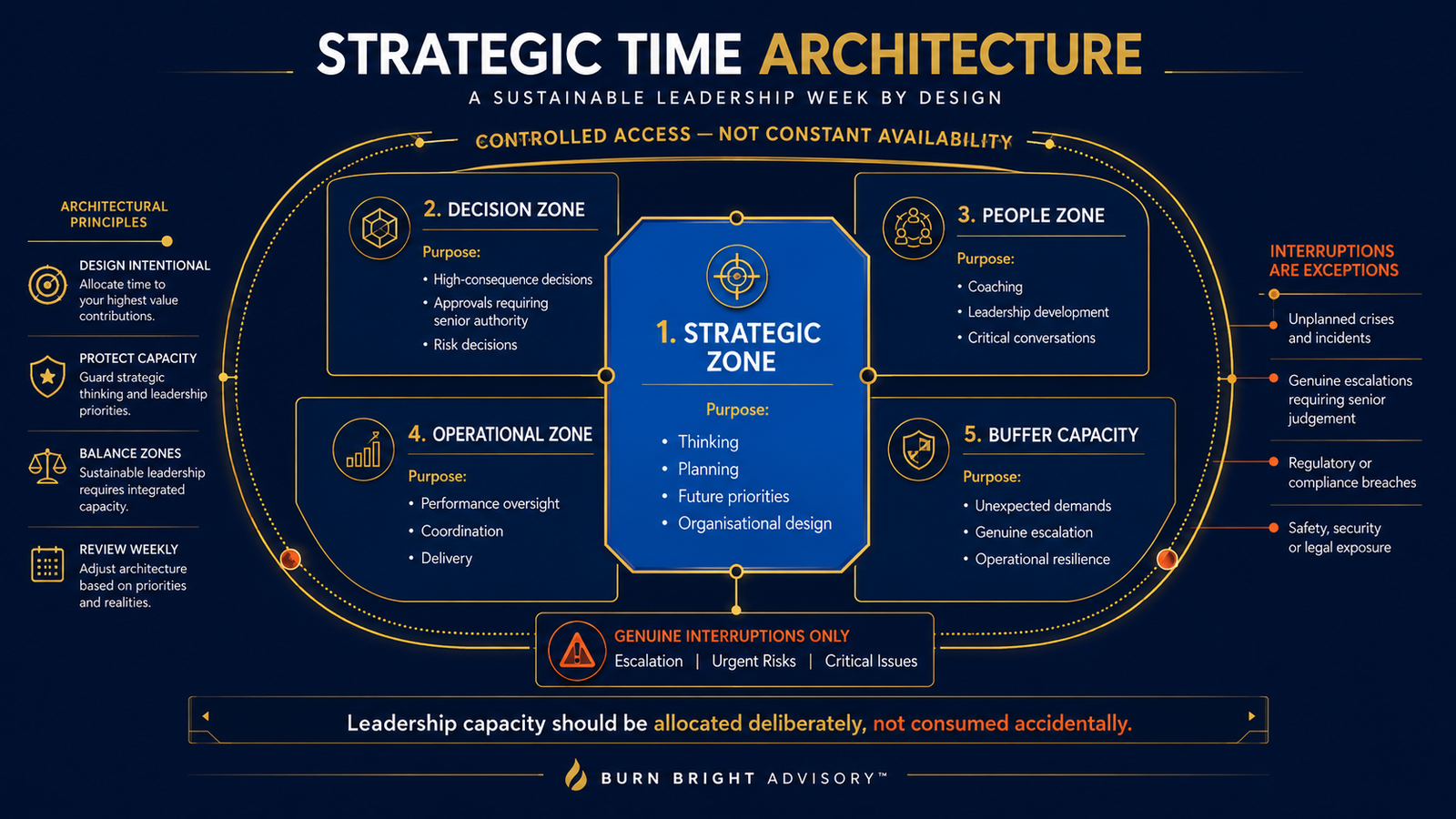
Leadership roles differ — a headteacher, chief executive, hospital director and operations leader will have different operational requirements. The principle is what matters: leadership capacity should be allocated deliberately rather than consumed accidentally.
Compare the Two Calendar Architectures
| Reactive Calendar | Strategic Calendar |
|---|---|
| Meetings accepted as requests arrive | Strategic capacity allocated first |
| Strategy fitted around operations | Operations designed around leadership priorities |
| Leader attends for visibility | Attendance based on contribution required |
| Decisions arrive throughout the day | Similar decisions are grouped where possible |
| Communication remains continuously open | Response and escalation rules are explicit |
| Calendar operates near 100% capacity | Buffer capacity absorbs genuine disruption |
| Strategic work moves when pressure rises | Strategic work has defined protection |
| Longer hours compensate for overload | Workload is challenged before hours expand |
Run a 30-Day Strategic Time Experiment
Do not attempt to redesign your entire working life on Monday morning. For the next 30 days:
- Protect at least one recurring strategic zone each week.
- Remove, delegate or redesign one recurring meeting.
- Batch one category of routine decisions or approvals.
- Establish one explicit rule for interruptions.
- Keep deliberate buffer capacity in the calendar.
- Record how often protected strategic time is breached and why.
The sixth action provides the diagnosis. If protected time is repeatedly interrupted by genuine crises, meetings, routine decisions or your own habit of checking in on delegated work, that evidence tells you what repeatedly destroys strategic capacity — and diagnosis makes redesign possible.
How Do You Make Protected Strategic Time Organisationally Sustainable?
A leader can protect strategic time for a week through discipline. Protecting it for a year requires a system. If your team expects instant responses, every decision travels upwards and meetings can be placed anywhere in your diary, strategic time will remain vulnerable. You may defend it temporarily. Eventually, the system wins.
Make Availability Predictable Rather Than Unlimited
Define what counts as routine, important and urgent, so your team knows when you are available and what circumstances justify interrupting protected time. Without definitions, “urgent” becomes subjective — and once everything can be urgent, nothing can be protected.
Push Decision Authority™ Towards the Work
A leader who wants strategic time but insists on approving everything has created an impossible system. Define financial thresholds and risk boundaries, then allow decisions within those boundaries to happen without senior approval — turning the leader into the architect of good decisions rather than the answer to every question.
Create Organisational Rules Around Meetings
No routine meetings during defined strategic periods, agendas required for decision meetings, attendance based on contribution not hierarchy, and recurring meetings reviewed regularly. A weekly 60-minute meeting with eight senior people is not a one-hour commitment — it is 368 hours of senior capacity across a year.
Use Upward Advocacy™ When the Role Itself Is Overloaded
Sometimes the problem cannot be solved within the leader’s own authority. The Upward Advocacy Framework™ asks leaders to bring evidence — competing demands, calendar allocation, displaced strategic work — and frame the choice as capacity management rather than personal stress.
Stop Absorbing Organisational Failure Personally
Capable leaders compensate — covering for absences, creating workarounds, working later. Repeated indefinitely, this becomes structural concealment, because the organisation never experiences the true consequence of insufficient capacity. Responsible leadership sometimes means making the capacity problem visible instead of absorbing it.
Measure Strategic Time as Capacity, Not Intention
Track protected strategic hours planned versus achieved, the breach rate, the reason for each breach, and the strategic output that emerged. If most strategic blocks are being breached, the answer is unlikely to be stronger personal discipline — the breach data will reveal the real cause.
Reactive Leadership vs Sustainable Strategic Leadership
| Reactive Leadership | Sustainable Strategic Leadership |
|---|---|
| Strategic work happens when time remains | Strategic capacity is designed into the role |
| Availability is continuous | Availability is predictable |
| Decisions move upwards | Decision authority sits at the appropriate level |
| Meetings dominate the calendar | Meetings must justify leadership capacity |
| Urgency determines priority | Risk, value and strategic importance determine priority |
| Leaders personally absorb capacity gaps | Capacity gaps are made visible and addressed |
| Delegation focuses on tasks | Delegation includes authority and accountability |
| Recovery happens after exhaustion | Recovery is designed into working rhythms |
| Heroic leadership keeps the system moving | Sustainable leadership makes the system less dependent on heroics |
Heroic leadership can be valuable during a genuine crisis. The problem begins when crisis behaviour becomes the standard operating model. If the organisation requires heroics every week, that is not an exceptional leader — it is a structural warning sign. Better systems outperform more effort because they reduce unnecessary dependency on individual capacity.
Protecting strategic time for leaders ultimately benefits more than the leader. It creates space to anticipate problems before they become crises, improves the quality of high-consequence decisions, forces clearer delegation, exposes unnecessary meetings and makes workload constraints visible.
What is strategic time for leaders?
Strategic time is protected capacity for work that requires leadership judgement rather than routine availability — thinking about future priorities, anticipating risks, solving systemic problems, making high-consequence decisions and reviewing organisational direction. It should not be confused with spare time.
How much strategic time should a leader protect?
There is no universal number of hours because leadership roles differ. Start by protecting one meaningful recurring block each week and measure whether it survives — the more important question is whether enough uninterrupted capacity exists to perform the strategic responsibilities attached to your role.
Why is time blocking not enough for senior leaders?
Time blocking creates calendar space but does not remove the demands competing for that space. If meetings can override the block and colleagues expect immediate responses, the time is scheduled rather than protected — effective protection requires changes to meeting culture, decision authority and workload architecture.
How can leaders protect strategic time without becoming unavailable?
Replace unlimited availability with predictable availability. Tell your team when you are accessible, establish response expectations and define what qualifies as a genuine interruption. The objective is controlled access, not isolation.
What should leaders do when everything feels urgent?
Separate urgency from consequence. Ask what happens if the issue waits, what risk delay creates, and whether the decision genuinely requires senior authority. Clear escalation criteria help organisations distinguish genuine urgency from habitual immediacy.
Can protecting strategic time help prevent leadership burnout?
It can contribute, but strategic time alone will not fix an unsustainable role. Protected strategic time becomes powerful when combined with workload redesign, clearer decision authority, delegation and recovery rhythms — the goal is a more sustainable leadership system, not simply more thinking time.
Protecting Strategic Time Is a Leadership Discipline
Protecting strategic time for leaders is not about escaping operational responsibility. It is about ensuring operational demands do not consume the entire leadership role. When every hour is occupied by meetings, messages, approvals and recurring problems, leaders can remain highly active while losing the capacity to anticipate what comes next.
Organisations do not only need leaders to respond. They need leaders to notice patterns, challenge assumptions, make difficult choices, develop people, anticipate risk, design better systems and decide what the organisation should stop doing as well as what it should do next. Those responsibilities require cognitive space.
The Burn Bright Advisory™ approach starts from a simple premise: leaders cannot outwork broken systems. The wider Burn Bright Not Out Framework™ argues that sustainable leadership requires changes to workload, delegation, boundaries, recovery and organisational structures rather than relying indefinitely on individual effort.
So do not simply defend another two-hour calendar block. Diagnose what keeps invading it. Redesign the meetings. Clarify the decisions. Challenge the workload. Delegate authority. Create escalation rules. Protect recovery. Then measure whether the system actually changes.
Because strategic time is not time away from leadership. It is where leadership moves from reacting to designing. And sustainable leadership requires both.
Assess What Is Consuming Your Leadership Capacity
If your strategic time is continually disappearing under meetings, decisions, competing priorities and operational demands, start with a diagnosis of where the pressure is accumulating.
Free Leadership Intelligence
Get Weekly Leadership Insights
Join thousands of leaders receiving practical strategies on burnout prevention, workload design, and sustainable performance every week.