Quick Answer
Key Takeaways
- Professionalism in leadership is not simply behavioural polish — it is a performance intelligence that shapes trust, decision quality and accountability.
- Burn Bright Advisory™ frames this capability as Professionalism Intelligence™, built on five dimensions: Standards, Judgement, Consistency, Accountability and Stewardship.
- Professionalism is tested most under pressure, not in comfortable conditions — this is where genuine capability becomes visible.
- The Professionalism Gap describes the distance between what a leadership role requires and what a leader can currently demonstrate consistently.
- Professionalism Intelligence™ can be developed deliberately through the CLEAR Professionalism Development Framework™: Clarify, Locate, Examine, Adjust, Review.
- Professionalism does not require emotional concealment — it requires handling fallibility responsibly.
Professionalism in Leadership: Why Professionalism Is a Performance Intelligence, Not Just a Standard of Behaviour
Leadership professionalism is easiest to notice when it disappears.
A commitment is quietly forgotten.
A confidential conversation becomes office knowledge.
A senior leader arrives at a meeting without having read the material everyone else was expected to prepare.
A manager demands accountability from employees but repeatedly misses their own deadlines.
A difficult decision is explained differently depending on who is asking.
Feedback becomes personal.
Pressure becomes permission for incivility.
None of these incidents may appear catastrophic in isolation. Collectively, however, they communicate something important: the leader cannot be relied upon to maintain professional standards consistently.
That conclusion has consequences. Trust begins to decline. Employees become more cautious. People document conversations they once would have trusted. Decisions are questioned. Informal workarounds emerge. Employees learn that the organisation’s stated standards and its lived standards are different.
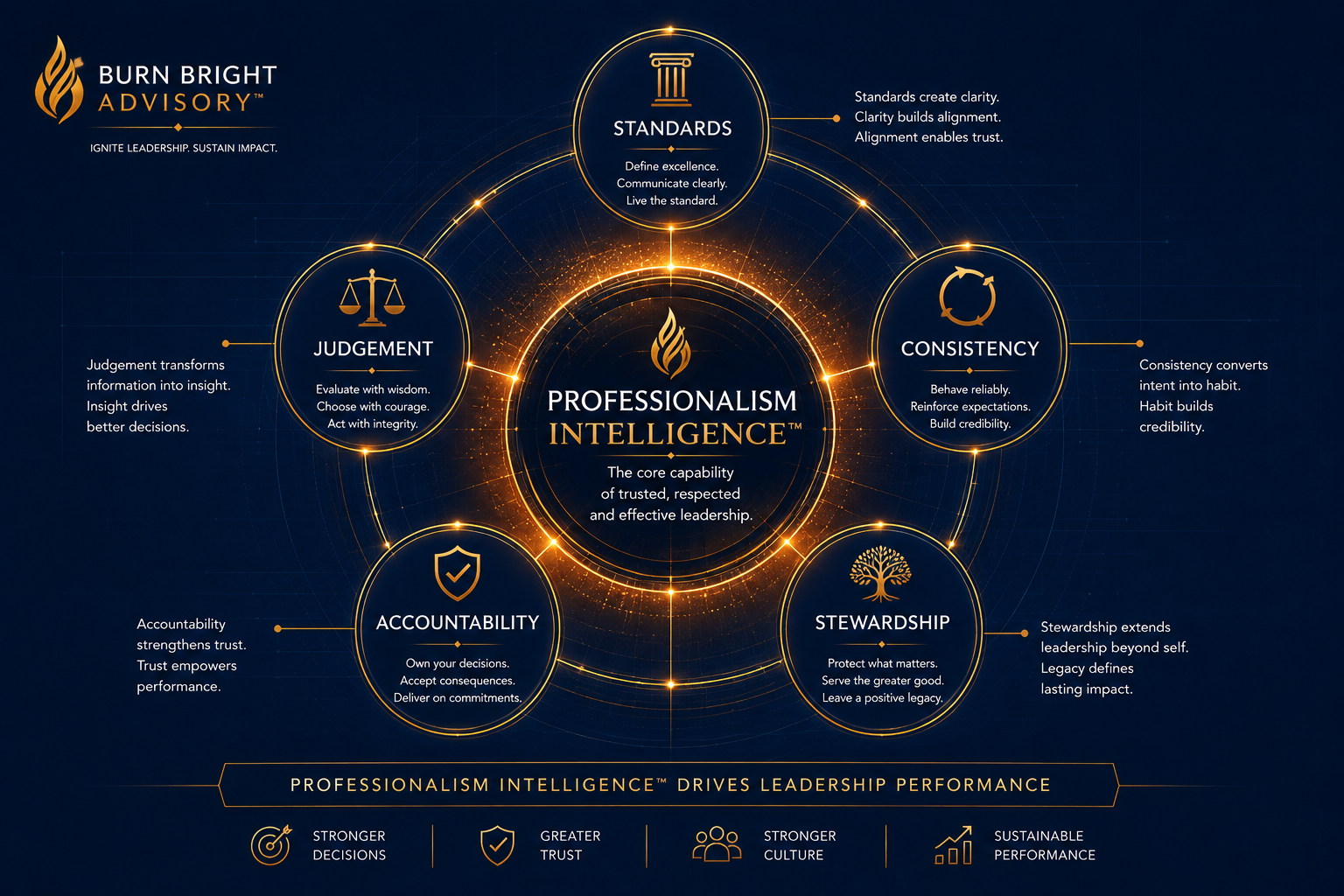
For Burn Bright Advisory™, this is why professionalism belongs within the wider discipline of Leadership Performance Intelligence™. Leadership Performance Intelligence™ examines the capabilities that allow leaders not simply to occupy leadership positions, but to perform leadership effectively and sustainably.
Within the Leadership Intelligence Compass™, Professionalism Intelligence™ represents a leader’s capacity to understand, maintain and apply appropriate professional standards across behaviour, judgement, relationships, responsibilities and decisions.
It is the intelligence behind professional conduct. And that distinction changes how organisations should think about leadership development.
What Is Professionalism in Leadership?
Featured Snippet
Professional leadership requires the capacity to:
- exercise sound judgement
- communicate appropriately
- maintain appropriate boundaries
- respect confidentiality
- prepare properly
- fulfil commitments
- accept responsibility
- manage disagreement constructively
- apply standards consistently
- use authority appropriately
- recognise the impact of personal behaviour
- maintain standards when pressure makes doing so difficult
This last point is particularly important. Professionalism demonstrated only when circumstances are comfortable is fragile professionalism. The real test occurs when the leader is tired, challenged, criticised, under-resourced, uncertain or confronted with competing interests.
Professionalism becomes a leadership intelligence when the leader can interpret those conditions and still choose an appropriate response.
From Professional Behaviour to Professionalism Intelligence™
Traditional discussions of professionalism often concentrate on observable behaviours. Was the person punctual? Were they appropriately dressed? Was their communication respectful? Did they follow organisational procedures?
These standards matter. But leadership creates a more complex problem because leaders routinely operate in situations for which there is no perfect rule.
Consider a manager dealing with an underperforming employee. Professional conduct does not mean simply being polite. The leader must determine:
- what evidence is reliable
- what expectations were genuinely clear
- whether contextual factors contributed to the problem
- what information should remain confidential
- how directly the issue should be addressed
- what support is reasonable
- when accountability becomes necessary
- how the conversation can preserve dignity without avoiding responsibility
There may be a policy governing part of the process. There is unlikely to be a policy governing every judgement within it. That gap between rules and reality is where Professionalism Intelligence™ operates.
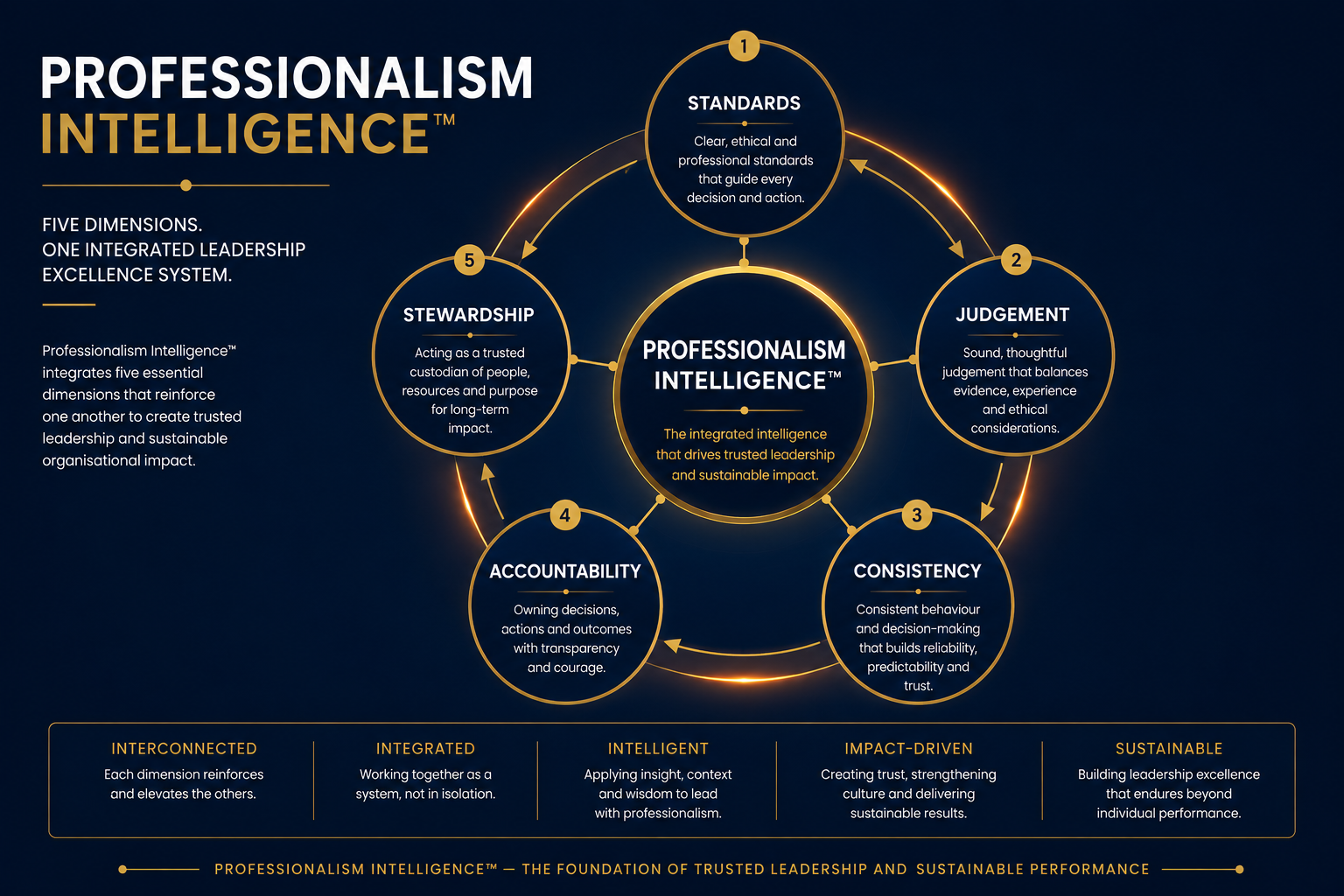
A professionally intelligent leader does not merely know the rules. They understand the purpose behind the standards and can apply them intelligently when circumstances are ambiguous.
That makes Professionalism Intelligence™ closely connected to several other domains of the Leadership Intelligence Compass™. Ethics Intelligence™ helps leaders determine what is right. Emotional Intelligence™ helps them understand and regulate the human dynamics involved. Reflective Practice Intelligence™ enables them to examine their own behaviour and learn from experience. Adaptability Intelligence™ helps them adjust to changing contexts. Leadership Sustainability™ helps ensure that professional standards remain maintainable rather than collapsing under chronic overload.
Professionalism Intelligence™ converts these capabilities into credible professional practice. The domains are therefore interconnected rather than isolated. Professionalism becomes the visible expression of several deeper leadership capabilities working together.
Why Professionalism Matters More as Leadership Responsibility Increases
The more responsibility a person acquires, the greater the consequences of inconsistent professionalism. An individual employee’s behaviour may affect colleagues immediately around them. A leader’s behaviour can establish norms for an entire team. A senior executive’s behaviour can influence organisational culture.
This is one reason leadership development cannot treat professionalism as something leaders should already have mastered before promotion. Responsibility changes the professional challenge.
A leader gains access to information others do not have.
They acquire authority over decisions affecting other people’s careers.
They may influence pay, opportunity, workload, recognition and progression.
They become privy to confidential information.
Their comments acquire greater weight.
Their moods become more consequential.
Leadership therefore amplifies behaviour. The question is no longer merely: “Was that behaviour appropriate?” The more important question becomes: “What did that behaviour teach the organisation about what is acceptable here?” That is a leadership-performance question.
Professionalism Creates Predictability
High-performing environments require a degree of behavioural predictability. Employees do not need leaders to be identical every day. They do need reasonable confidence about the standards governing their interactions.
They need to know that disagreement will not result in retaliation, that confidential information will be protected, that expectations will not change according to mood, that mistakes will be assessed fairly, that authority will not be used arbitrarily and that commitments mean something.
Professionalism provides this predictability. When professional standards are consistent, people spend less cognitive energy trying to interpret the leader. They can concentrate on the work.
When standards are inconsistent, the opposite occurs. Employees begin asking questions such as: What mood are they in today? Can I raise this safely? Will the same rule apply tomorrow? Will I be blamed if this goes wrong? Can I trust this conversation to remain private?
These are not trivial distractions. They are forms of organisational friction. And leadership friction consumes capacity that should be available for performance.
The Five Dimensions of Professionalism Intelligence™
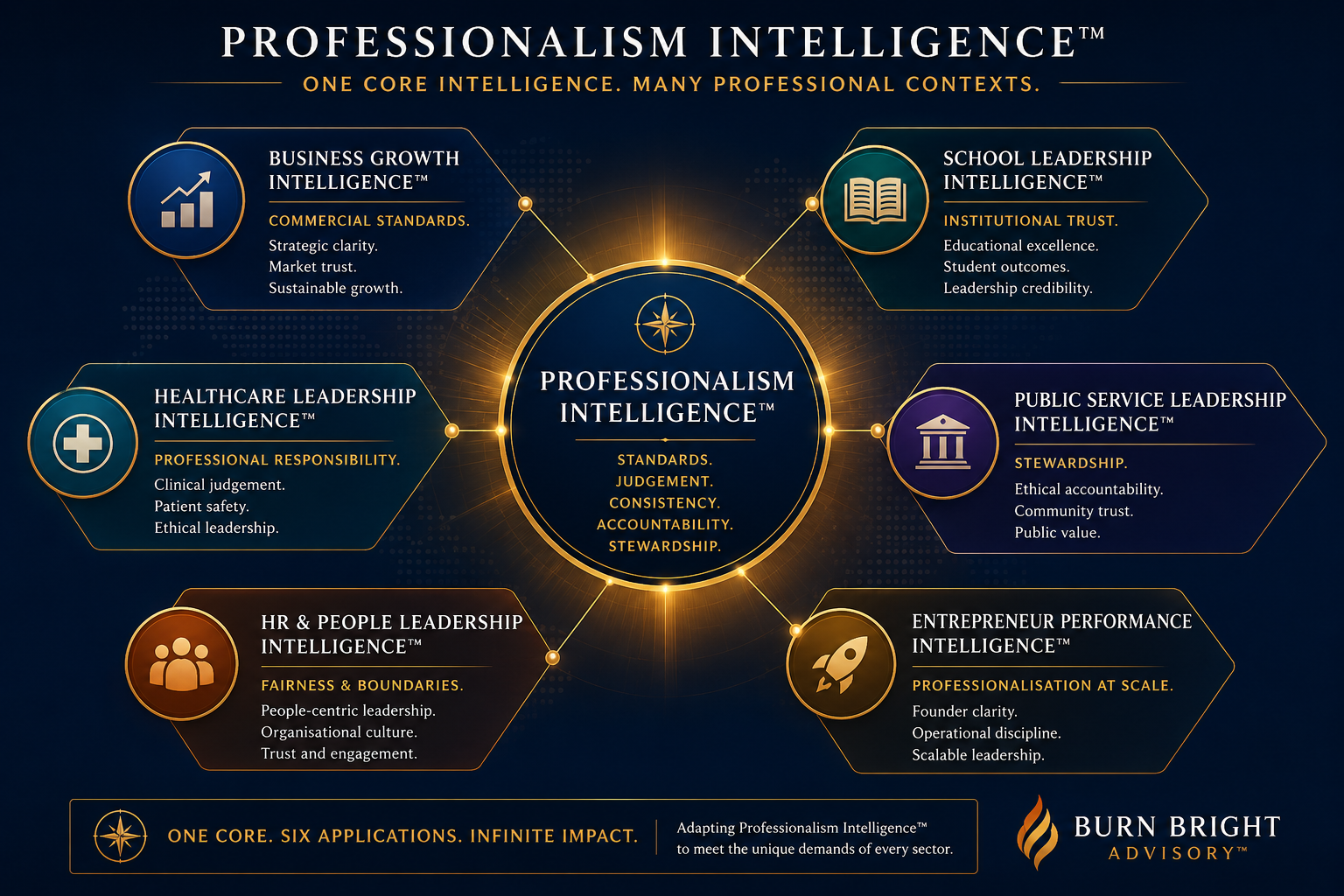
Burn Bright Advisory™ can conceptualise Professionalism Intelligence™ through five mutually reinforcing dimensions.
Dimension 1
Standards
Do I understand the professional expectations attached to my role? Professional leadership begins with clarity about standards — formal standards such as regulation, policy, governance and professional codes, as well as contextual standards surrounding communication, preparation, responsibility and conduct. The intelligent leader does more than comply; they understand why those standards exist and what they protect.
Dimension 2
Judgement
Can I determine what professional leadership requires when the answer is not obvious? Judgement connects principles to context. Leaders need to distinguish what is urgent from what merely feels urgent, confidentiality from secrecy, accountability from punishment, transparency from inappropriate disclosure and confidence from overclaiming certainty.
Dimension 3
Consistency
Do my standards survive pressure, hierarchy and inconvenience? Consistency reveals whether stated values actually influence behaviour — whether the same standard applies to a high performer as an average performer, and whether a boundary is respected even when doing so makes your own workload more difficult.
Dimension 4
Accountability
Do I take ownership of the consequences of my leadership? Professional leaders clarify expectations, acknowledge mistakes, address underperformance, follow through on commitments and accept scrutiny of their own decisions. Leadership cultures reproduce what leaders model.
Dimension 5
Stewardship
Do I use my position in ways that protect the organisation, its people and its purpose? Leadership authority is temporary and its consequences extend to everyone affected by the leader’s decisions. Stewardship means using authority with an awareness that leadership is entrusted rather than owned.
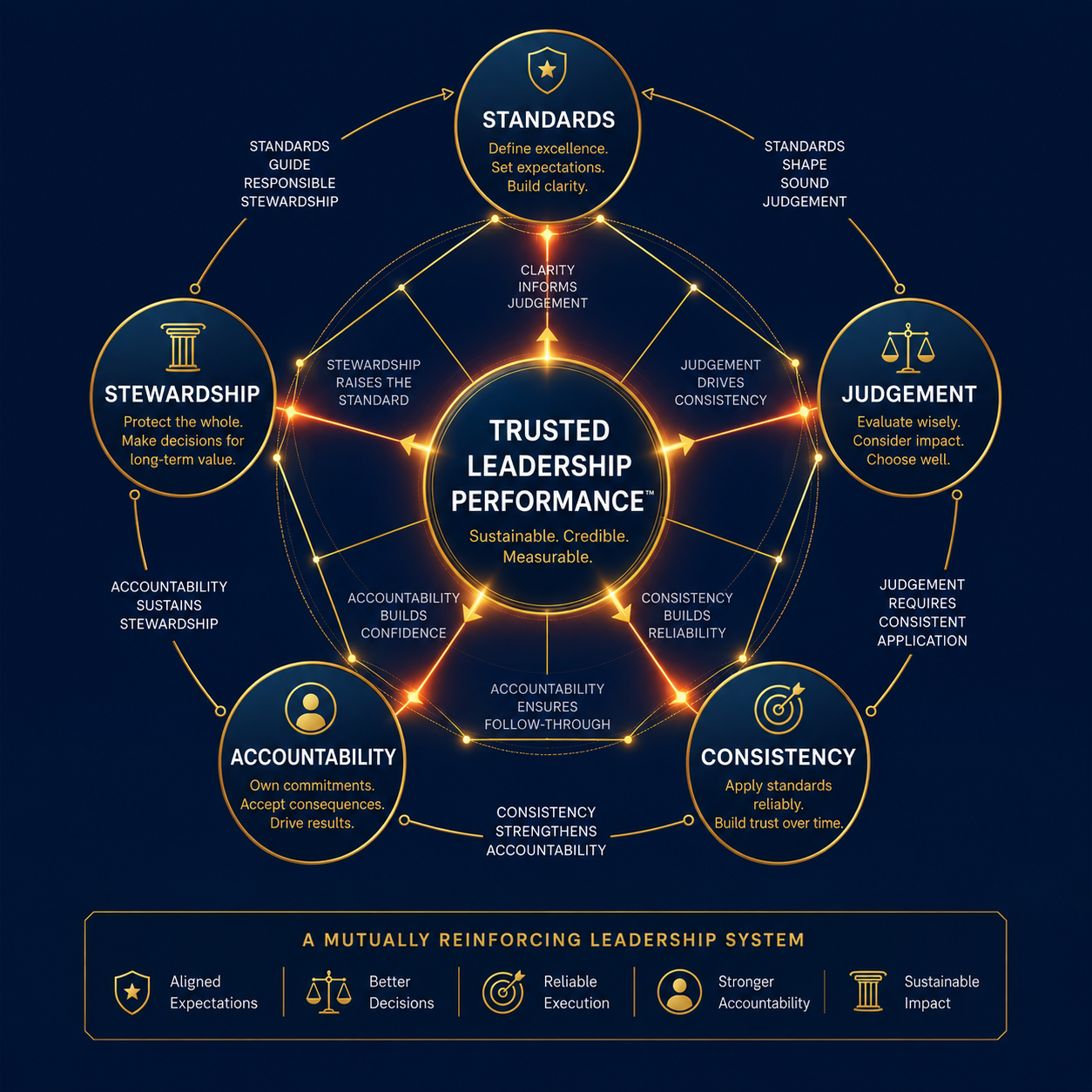
Together, these dimensions provide a more useful definition of leadership professionalism: Professionalism Intelligence™ is the capacity to understand professional standards, exercise sound contextual judgement, behave consistently, accept accountability and steward leadership responsibility in ways that build trust and sustain performance.
This transforms professionalism from an etiquette issue into a leadership capability. And once professionalism is understood as a capability, it can be assessed, developed, reflected upon and strengthened.
Professionalism Is Tested Under Pressure
Professionalism is relatively easy when conditions are favourable. The more revealing test comes when conditions deteriorate — a deadline moves forward, a key employee resigns, a board demands an explanation, a colleague makes a serious mistake, or a leader discovers that a decision they supported was wrong.
These moments expose the difference between professional appearance and Professionalism Intelligence™. Under pressure, leaders experience competing demands on attention, emotion and judgement. Their cognitive bandwidth narrows. Patience can decrease. Decisions accelerate. Communication becomes more transactional. Reflection is displaced by reaction.
This is precisely when professional standards matter most. A leader who becomes dismissive when challenged, careless with confidentiality when frustrated or inconsistent when under pressure may still describe themselves as highly professional. Their behaviour communicates otherwise.
Professionalism Intelligence™ therefore includes the capacity to preserve standards when maintaining them carries a cost — time, convenience, admitting uncertainty, delaying a preferred decision, or having a difficult conversation rather than allowing an issue to continue. Sometimes it means acknowledging: “I made the wrong decision.”
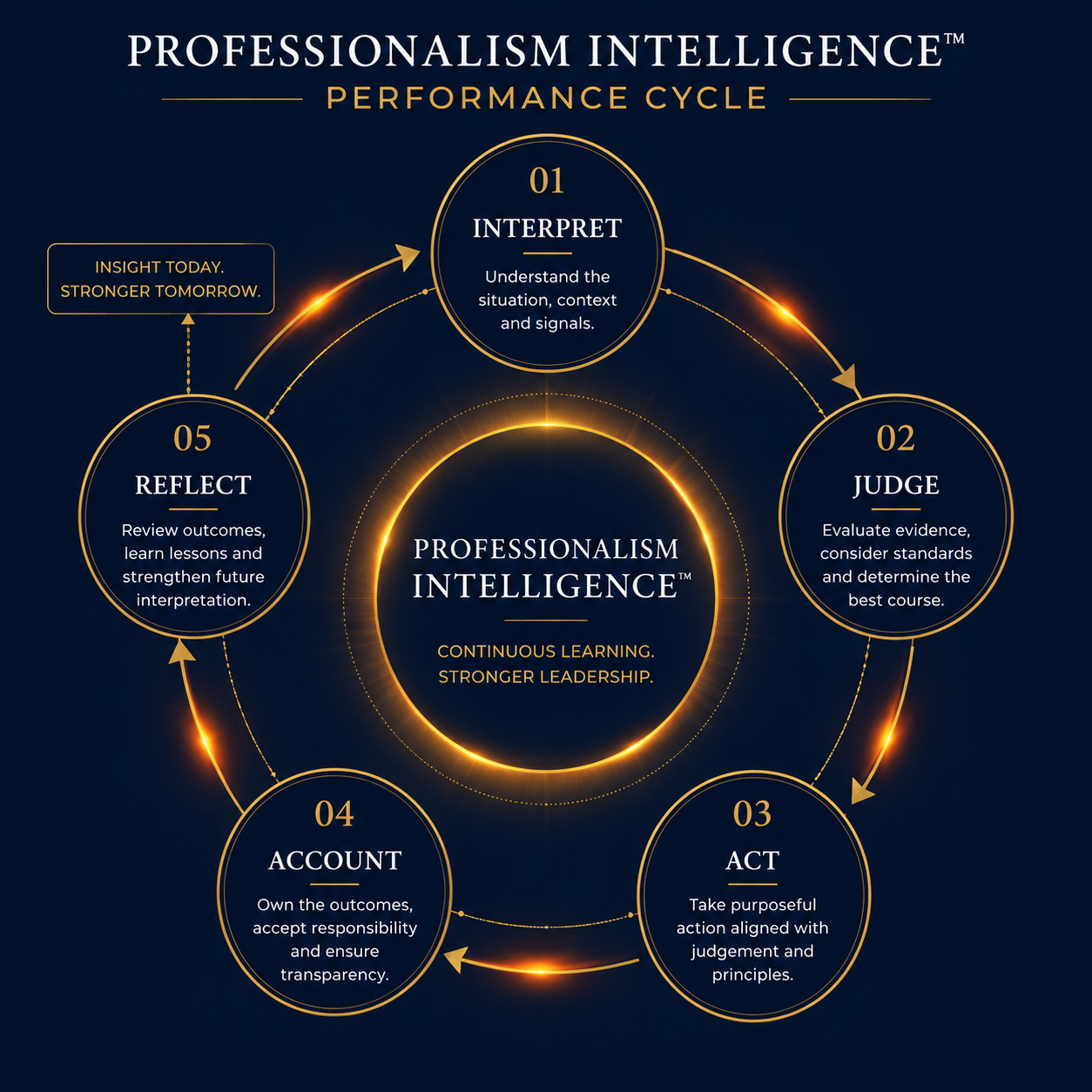
The Professionalism Intelligence™ Performance Cycle
Professional leadership can be understood as a recurring cycle rather than a fixed personal quality.
1. Interpret
What does this situation require of me professionally? The leader must understand what has happened, what information is reliable, who is affected, what responsibilities apply and what professional, ethical or organisational standards are relevant.
2. Judge
What is the most professionally appropriate course of action? The leader considers competing interests, consequences, responsibilities, evidence and boundaries. The critical question is whether the leader can explain why the decision is appropriate.
3. Act
Can I translate my judgement into appropriate behaviour? Professionalism must become visible through how the leader communicates, listens, challenges, uses authority, handles information, manages disagreement and follows through.
4. Account
Can I explain and take responsibility for my actions? This means accepting that leadership authority carries responsibility for how that authority is exercised, without hiding behind hierarchy.
5. Reflect
What should this experience teach me? Did the decision achieve what was intended? What was missed? Did pressure alter the leader’s behaviour? Reflection then informs future interpretation, and the cycle begins again.
This relationship is important within the wider Leadership Intelligence Compass™. Professionalism Intelligence™ is strengthened by Reflective Practice Intelligence™, supported by Emotional Intelligence™, intersects with Ethics Intelligence™, and depends increasingly on Leadership Sustainability™, because depleted leaders have less capacity available for considered judgement, emotional regulation and reflection.
Professionalism is therefore not an isolated leadership characteristic. It is part of an interconnected leadership-performance system.
Professionalism, Credibility and Trust
Leadership credibility is accumulated through repeated experiences. A single impressive presentation rarely creates it. A job title cannot guarantee it. A qualification does not permanently establish it.
People build their assessment of a leader over time — does the leader do what they said they would do, do they prepare, do they listen before deciding, do they treat people consistently, do they admit mistakes, do they protect confidential information. These repeated observations create a form of leadership evidence, and that judgement becomes trust.
Trust Is Not the Same as Agreement
Professional leaders will make decisions that some people dislike. They will reject proposals, challenge performance, enforce standards, allocate limited resources, and may restructure teams or discontinue work.
The objective of professionalism cannot therefore be universal approval. The objective is to create confidence in the integrity of the leadership process. An employee might disagree with a leader’s decision while still believing the evidence was considered, the expectations were clear, and the process was fair.
That is a significant form of organisational trust. Professionalism does not remove disagreement. It makes disagreement governable.
The Professionalism Gap: When Position Exceeds Capability
One of the risks organisations face is assuming that professional competence automatically expands alongside organisational authority. It does not.
A technically outstanding employee may be promoted because of expertise. A successful clinician may acquire responsibility for a department. An excellent teacher may become a school leader. A high-performing salesperson may become a sales director. An entrepreneur may suddenly find themselves responsible for dozens of employees.
In each case, the person enters a new professional context. The standards change because the consequences of their behaviour change.
Featured Snippet
The existence of a gap does not automatically mean someone is a poor leader. It means development is required. The greater danger occurs when neither the leader nor the organisation recognises that the gap exists.
Seven Warning Signs of a Professionalism Gap
None of these behaviours necessarily begins dramatically. That is what makes them dangerous. Repeated small inconsistencies can gradually alter the leadership environment.
Research and experience around toxic leadership in small teams reinforce the importance of noticing these patterns early. In close teams, where relationships are frequent and there are few organisational buffers, leadership dysfunction can quickly influence trust, collaboration and the wider atmosphere of work.
Professionalism Is Not Perfection
There is an important risk in discussions about professionalism. Leaders can begin interpreting professionalism as emotional concealment: never show uncertainty, never admit difficulty, never acknowledge a mistake, always appear composed, always know the answer.
This creates performative professionalism. And performative professionalism can make leadership less effective rather than more professional.
The Burn Bright perspective is different. Professionalism does not require pretending to be infallible. It requires handling fallibility responsibly.
A professional leader can say: “I don’t know yet.”
They can say: “I need more evidence before making that decision.”
They can say: “I handled that conversation poorly.”
They can say: “You raised something I hadn’t considered.”
They can say: “I need support.”
The important issue is what follows. Does uncertainty lead to responsible inquiry? Does the mistake lead to accountability? Does feedback lead to reflection? Does seeking support improve the decision?
This connects Professionalism Intelligence™ with a broader idea developed in Burn Bright’s work on unguarded leadership: effective leadership does not require leaders to protect an image of having every answer. Curiosity, appropriate vulnerability and the willingness to learn can strengthen rather than diminish leadership.
The Relationship Between Professionalism and Leadership Sustainability™
Professionalism is usually discussed as though it depends entirely on character. That overlooks capacity.
A leader can care deeply about professional standards and still find those standards increasingly difficult to sustain when operating under chronic overload. Exhaustion affects attention. Constant interruption affects judgement. Decision fatigue affects consistency. Emotional depletion affects patience. Unsustainable workload reduces the time available for preparation and reflection.
This does not excuse poor professional conduct. It does, however, help organisations understand why professionalism cannot be separated completely from the systems within which leadership occurs.
Burn Bright’s work on leadership burnout argues that modern leadership roles can become structurally unsustainable when responsibility expands without corresponding resources, support and capacity. It distinguishes workload management from conventional time-management solutions and emphasises systems thinking over individual heroics.
If an organisation wants consistently professional leadership, it must ask two questions: Does the leader possess the required capability? And does the leadership system provide sufficient capacity for that capability to operate? This is the relationship between Professionalism Intelligence™ and Leadership Sustainability™. Professionalism protects standards. Sustainability protects the capacity required to maintain those standards.
Professionalism Across Sectors
The underlying principles of Professionalism Intelligence™ are universal. Their expression, however, changes according to context. That is why leadership capability should be interpreted through the relevant Burn Bright Sector Hubs, rather than assuming that identical behaviours constitute effective leadership everywhere.
Business Growth Intelligence™
Professionalism becomes particularly visible through decision quality, commercial relationships, governance, accountability and execution. When a project will miss its promised delivery date, the professionally intelligent response establishes the facts, communicates appropriately with affected stakeholders, distinguishes explanation from excuse and examines why the original commitment became unrealistic. Rapid expansion can create pressure to sacrifice professional discipline for speed — Professionalism Intelligence™ ensures growth does not outrun governance.
School Leadership Intelligence™
Professionalism carries distinctive responsibilities because school leaders operate simultaneously within relationships involving staff, students, families, governing bodies and communities. Facing an aggressive parental complaint, the professionally intelligent leader must listen, protect confidentiality, establish evidence, avoid undermining staff prematurely, follow relevant processes and reach a decision that can withstand professional scrutiny.
Healthcare Leadership Intelligence™
Professionalism has direct implications for quality, trust and potentially safety. Hierarchy creates a particular challenge, since a technically senior person may not be correct in every circumstance. Professionalism Intelligence™ includes creating conditions in which concerns can be raised appropriately regardless of status, and protecting patient confidentiality while maintaining accountability.
Public Service Leadership Intelligence™
Adds another dimension: stewardship of public trust. Decisions may face greater scrutiny because authority is exercised on behalf of citizens and communities, requiring procedural integrity, appropriate transparency, responsible use of resources, fairness, accountability and careful management of conflicts of interest.
HR & People Leadership Intelligence™
Few functions expose the importance of professionalism more clearly than people leadership. HR and people leaders regularly encounter confidential information, competing narratives and decisions affecting careers. Their credibility depends on the perceived fairness and integrity of the process, not simply on knowing policy.
Entrepreneur Performance Intelligence™
Creates a different professionalism challenge because founders often build organisations before formal leadership structures exist. The founder’s behaviour can become the culture almost immediately, requiring a transition from “this is my business” towards stewarding an organisation that now affects other people’s livelihoods, careers and opportunities.
A Practical Professionalism Intelligence™ Diagnostic
Leaders can begin examining their own professionalism through five questions aligned with the framework.
- Standards: What professional standards does my leadership role require that my previous role did not?
- Judgement: Where am I currently making decisions in which policy alone cannot provide the answer?
- Consistency: Which of my standards become hardest to maintain when I am tired, challenged or under pressure?
- Accountability: How easy is it for other people to question my decisions or tell me that I have made a mistake?
- Stewardship: Am I using my authority primarily to protect the purpose and people entrusted to me — or increasingly to protect my own position, convenience or reputation?
These questions are deliberately more demanding than a conventional professionalism checklist. Professionalism Intelligence™ is not adequately assessed by asking whether someone knows how they should behave. The more important question is whether they can translate that knowledge into consistent leadership performance.
From Professional Standards to Leadership Performance
Professionalism is sometimes positioned as the minimum expected of a leader. That framing understates its value. Professionalism is not merely the baseline beneath high performance — it is one of the conditions that makes high performance sustainable.
When leaders demonstrate strong Professionalism Intelligence™, trust becomes easier to build, accountability becomes more credible, difficult conversations become more constructive, decision-making becomes easier to scrutinise, authority becomes less dependent on hierarchy, professional boundaries become clearer and organisational standards become more predictable.
Leadership performance cannot be assessed solely through outcomes. A leader may achieve a target while damaging trust. They may increase short-term output while exhausting the team. They may deliver change while weakening professional standards.
Performance intelligence asks a broader question: what leadership capability produced the result, what did that result cost, and can the performance be sustained? Professionalism Intelligence™ contributes an essential part of that answer.
When Professionalism Becomes a Leadership Performance Issue
Consider a composite leadership scenario. A growing organisation has promoted an experienced technical specialist into a departmental leadership position. The new leader is knowledgeable, committed and respected for their expertise. During the first months, performance remains strong.
Gradually, however, the leadership environment begins to change. Because the leader is under increasing pressure, decisions become more centralised. Meetings regularly start late. Feedback becomes shorter and more abrupt. A high-performing employee is permitted to ignore processes that everyone else is expected to follow. Confidential concerns raised in one-to-one conversations begin appearing indirectly in wider discussions. When employees question decisions, the leader interprets those questions as resistance.
None of these behaviours individually announces a leadership crisis. The leader is still working hard. Targets may still be achieved. Yet something important is deteriorating. People begin becoming careful around the leader. They share less. Problems are raised later. Team members increasingly check decisions with one another before approaching the leader.
Eventually, one respected employee leaves. Another begins looking elsewhere. The organisation may describe what follows as a retention problem, an engagement problem or a culture problem. But beneath those symptoms may be a Professionalism Intelligence™ problem. The leader’s technical capability has remained strong. Their leadership professionalism has not developed at the same rate as their responsibility.
The Lesson: Good Intentions Do Not Neutralise Leadership Impact
Organisations frequently assess leaders according to intention. They care about the team. They are under enormous pressure. They mean well. All may be true. None resolves the performance issue.
Professional leadership requires leaders to understand the difference between intention and impact. A leader can intend to create accountability and create fear. They can intend to protect standards and create excessive control. They can intend to communicate transparently and disclose information inappropriately.
Professionalism Intelligence™ helps leaders examine this gap without immediately reducing it to a question of character. The developmental question becomes: what capability does this leader need to strengthen so that their professional intention produces a more professionally effective impact?
This approach is particularly important when dealing with emerging problematic leadership patterns. Burn Bright’s work on toxic leadership in small teams emphasises that damaging patterns can develop gradually and that well-intentioned professionals can still create harmful team conditions when leadership behaviour goes unexamined. The objective should therefore be early intelligence development rather than waiting until poor professional habits become embedded cultural patterns.
Developing Professionalism Intelligence™: The CLEAR Framework
If professionalism is an intelligence rather than simply a behavioural expectation, leadership development must move beyond telling leaders to “be professional.” Leaders need structured opportunities to examine how professional standards translate into real situations. Burn Bright Advisory™ can frame this through the CLEAR Professionalism Development Framework™.
C Clarify the Standard
What does professional leadership require here? Many professionalism failures begin with ambiguity about organisational standards, professional codes, legal or regulatory obligations, ethical responsibilities and confidentiality requirements. Leaders should not assume everyone shares the same interpretation of professionalism — make expectations explicit.
L Locate the Pressure
What is making the professional response difficult? Professional standards frequently deteriorate at predictable pressure points, including excessive workload, time pressure, uncertainty and emotional exhaustion. This is particularly important because sustainable leadership requires attention to workload, capacity and the systems surrounding leadership performance, rather than leaders compensating indefinitely for structural overload through greater individual effort.
E Examine the Impact
How is my behaviour being experienced by other people? Leadership self-perception is incomplete evidence. Useful evidence can include structured feedback, employee observations, recurring complaints, turnover patterns and the leader’s own reflective observations. The goal is to understand impact accurately enough to lead intelligently.
A Adjust the Response
What would a more professionally intelligent response look like? That might mean communicating earlier, explaining decision criteria, establishing clearer boundaries, documenting decisions, apologising where appropriate or deliberately slowing a decision. The adjustment should address the underlying leadership pattern rather than merely improve appearances.
R Review and Reinforce
Did the change improve the quality of my leadership? The leader reviews whether the adjusted behaviour produced a better outcome and whether the new approach can be sustained. This final stage connects directly with Reflective Practice Intelligence™ — development becomes real when insight changes future behaviour.
This framework can be applied to individual leadership reflection, coaching, team development, diagnostics and organisational leadership programmes. For example, a leader who receives feedback that employees experience them as inconsistent can clarify what standard of consistency employees should reasonably expect, locate when inconsistency occurs most often, examine how it affects decisions and trust, adjust the practices that would create greater predictability, and review whether employee experience has changed.
Professionalism Intelligence™ Should Be Diagnosed, Not Assumed
Organisations commonly invest heavily in leadership competencies such as strategy, communication and change management while treating professionalism as a prerequisite. The assumption is understandable — if someone has reached leadership level, surely they already understand professional conduct.
But knowing expected behaviour and consistently demonstrating professional judgement are different things. A Leadership Intelligence Assessment™ should examine not simply whether leaders recognise desirable behaviours but whether they can interpret complex situations involving competing responsibilities, ambiguous information, confidentiality, power differences, accountability, stakeholder pressure, professional boundaries and difficult trade-offs.
The purpose is developmental rather than punitive. A diagnostic should help leaders understand where their Professionalism Intelligence™ is strongest, where it becomes less reliable, what conditions weaken it, which other Leadership Intelligence Compass™ domains influence it, and what development would strengthen it.
Professionalism Intelligence™ and the Leadership Intelligence Compass™
One of the strengths of the Leadership Intelligence Compass™ is that leadership capabilities can be understood relationally. Professionalism rarely fails in isolation.
Consider a leader who reacts defensively whenever challenged — the visible problem may concern professionalism, but deeper examination could reveal weaknesses in Emotional Intelligence™ or Reflective Practice Intelligence™. Consider a leader who continues following an established procedure even when circumstances have fundamentally changed — professional standards may appear strong, but Adaptability Intelligence™ may require development. Consider a leader whose professional standards deteriorate after months of excessive workload — the issue may connect strongly with Leadership Sustainability™ and Leadership Capacity™.
This is why Leadership Performance Intelligence™ should resist fragmented leadership development. Leaders are systems. Their capabilities interact. Development becomes more powerful when those relationships are visible.
Building Professionalism Into the Organisation
Individual leadership development is necessary. It is not sufficient. Organisations also create conditions that either strengthen or weaken professionalism. A company cannot reasonably demand professional accountability while senior executives remain exempt from scrutiny.
Professionalism must therefore exist at three levels:
- Individual: the leader possesses the capability to exercise professional judgement and behaviour.
- Relational: professional standards govern how people use authority, communicate, challenge and hold one another accountable.
- Systemic: organisational structures, policies, incentives and leadership practices reinforce the professional standards the organisation claims to value.
Misalignment between these levels creates cynicism. If an organisation publishes professional values but rewards leaders who violate them while delivering short-term results, employees quickly learn which standard is real. Culture follows consequences more reliably than slogans.
The Leadership Professionalism Audit
Leadership teams can begin by asking:
- What behaviours receive recognition here?
- What behaviours are tolerated because the person delivers results?
- Who can challenge senior leaders safely?
- How consistently are standards applied across levels of authority?
- What happens when leaders make mistakes?
- How is confidential information protected?
- Where do workload pressures regularly compromise professional practice?
- What leadership behaviour would employees describe as normal here that we would not deliberately include in our leadership standards?
The final question is particularly revealing. Culture often becomes visible through behaviours that nobody formally designed but everyone has learned to accommodate.
Leadership Reflection Questions
- What does professionalism mean in the context of my current leadership responsibility?
- Which professional standards have become more important as my authority has increased?
- When am I most likely to behave below my own professional standards?
- Which pressures most affect my judgement, patience or consistency?
- Are there different standards for different people within my team?
- How do I respond when someone questions my judgement?
- When did I last acknowledge publicly that I had made a leadership mistake?
- Would members of my team describe me as predictable in how I apply standards?
- What information do people trust me to hold, and how carefully do I protect that trust?
- Where might my intentions and leadership impact currently differ?
- Which Leadership Intelligence Compass™ domain would most strengthen my Professionalism Intelligence™?
- What professional behaviour am I currently modelling that could become part of my organisation’s culture?
Action Steps
Professionalism Intelligence™ develops through deliberate practice rather than declaration.
- Define your professional leadership standard. Write down five standards that should remain visible in your leadership regardless of workload or pressure, using observable commitments rather than abstract statements.
- Identify your pressure signature. Notice what changes when your capacity is stretched — do you become abrupt, stop listening, over-control, or communicate less?
- Ask for one piece of uncomfortable evidence. Ask a trusted colleague what professional behaviour would make you more effective to work with, and explore the answer rather than defending against it.
- Audit consistency. Select one standard you expect from employees and examine whether you demonstrate that same standard yourself.
- Strengthen one connected intelligence. Use the Leadership Intelligence Compass™ to identify a neighbouring capability affecting your professionalism.
- Review one consequential decision. Apply the Professionalism Intelligence™ Performance Cycle — Interpret → Judge → Act → Account → Reflect — and identify where your leadership could have been more professionally intelligent.
- Build professionalism into development. Move professionalism beyond induction policies and codes of conduct into leadership diagnostics, performance conversations, coaching, succession planning and Leadership Intelligence Assessment™ pathways.
What is professionalism in leadership?
Professionalism in leadership is the consistent application of appropriate standards, judgement, accountability, boundaries and behaviour in the exercise of leadership responsibility. Burn Bright Advisory™ develops this further through Professionalism Intelligence™: the capacity to interpret what professional leadership requires in context and translate that understanding into credible, responsible and sustainable performance.
Why is professionalism important for leaders?
Leadership amplifies behaviour. Leaders influence decisions, resources, careers, culture and the behaviour other people consider acceptable. Professionalism helps create trust, consistency, accountability and confidence in how authority is exercised.
What is Professionalism Intelligence™?
Professionalism Intelligence™ is a domain within Burn Bright Advisory’s Leadership Intelligence Compass™. It describes the leadership capability required to understand professional standards, exercise sound contextual judgement, behave consistently, accept accountability and steward responsibility appropriately.
Is professionalism the same as ethics?
No. They are closely related but distinct. Ethics Intelligence™ concerns the leader’s capacity to recognise and navigate questions involving values, responsibility and what ought to be done. Professionalism Intelligence™ concerns the broader application of professional standards, judgement, conduct, accountability and stewardship.
Can a leader be professional and still show vulnerability?
Yes. Professionalism does not require emotional concealment or pretending to possess certainty that does not exist. Appropriate vulnerability can include acknowledging mistakes, recognising uncertainty, asking for expertise or changing a position when better evidence emerges.
What causes professionalism to deteriorate?
Several factors can contribute, including unclear expectations, poor leadership development, excessive workload, emotional pressure, weak accountability, inconsistent organisational standards and leadership cultures in which seniority protects people from scrutiny. Declining professionalism should be examined at both individual and systemic levels.
How can leaders improve their professionalism?
Leaders can strengthen Professionalism Intelligence™ by clarifying standards, identifying pressure points, examining the impact of their behaviour, adjusting their responses and reviewing the results. The CLEAR Professionalism Development Framework™ provides a practical sequence: Clarify → Locate → Examine → Adjust → Review.
How does professionalism affect organisational culture?
Leaders signal what is acceptable through repeated behaviour. When leaders model preparation, confidentiality, accountability, respectful challenge and consistency, those behaviours are more likely to become cultural expectations. When leaders violate stated standards without consequences, employees learn that the stated culture and operational culture are different.
How can an organisation assess leadership professionalism?
Assessment should go beyond knowledge of policies. Organisations can examine judgement scenarios, behavioural consistency, stakeholder feedback, accountability, confidentiality, decision processes, leadership reflection and how professional standards hold up under pressure.
What is the relationship between professionalism and leadership performance?
Professionalism influences how leadership performance is achieved. Leadership Performance Intelligence™ considers not only whether leaders produce results, but the capability through which those results are produced and whether performance can be sustained. A result achieved through inconsistent standards, damaged trust or depleted teams may represent short-term output without sustainable leadership performance.
Conclusion: Professionalism Is the Intelligence Behind Trustworthy Leadership
Professionalism is easy to underestimate because much of it appears ordinary. Preparing. Listening. Keeping a confidence. Following through. Explaining a decision. Admitting a mistake. Maintaining standards. Treating authority as responsibility rather than entitlement. None sounds revolutionary.
Yet organisations depend on these behaviours every day. Professionalism creates the reliability upon which leadership relationships operate. It allows employees to challenge without continually calculating personal risk. It allows stakeholders to disagree while retaining confidence in the process. It allows accountability to exist without becoming arbitrary.
That is why professionalism should not be reduced to etiquette, appearance or compliance. For leaders, it is an intelligence. Professionalism Intelligence™ represents the capacity to recognise what professional responsibility requires, exercise judgement when circumstances are ambiguous and translate those judgements into consistent, accountable leadership behaviour.
It also reveals an important principle at the heart of Leadership Performance Intelligence™: leadership performance is not defined only by what a leader achieves. It is also defined by the intelligence through which those results are achieved.
The question for organisations is no longer simply “Are our leaders professional?” A more useful question is: “Do our leaders possess sufficient Professionalism Intelligence™ for the responsibility we have placed in their hands?” And for the individual leader, the question becomes more personal: when circumstances become difficult, what version of my professional standards survives?
That is where professionalism becomes visible. That is where credibility is built. And that is where professional behaviour becomes leadership intelligence.
Discover Your Professionalism Intelligence™
Take the free Leadership Burnout Self-Assessment to understand where your leadership standards are strongest — and where pressure puts them most at risk.
Free Leadership Intelligence
Get Weekly Leadership Insights
Join thousands of leaders receiving practical strategies on burnout prevention, workload design, and sustainable performance every week.