Quick Answer
Key Takeaways
- Operational drag is often a system problem disguised as a productivity problem.
- Leaders should measure not only workload, but the friction surrounding that workload.
- Meetings, approvals, communication and repeated decisions can consume capacity without appearing on a conventional task list.
- Working faster rarely solves operational drag because greater efficiency leaves the underlying system intact.
- Sustainable leadership requires redesigning work so that leadership capacity is spent where it creates the greatest value.
Reducing Operational Drag: A Guide for Leaders
Reducing operational drag is one of the fastest ways to create leadership capacity without asking people to work harder.
Most overloaded leaders can see their formal workload. They know about the projects, targets, reports and people they are responsible for. What is harder to see is everything surrounding that work.
The meeting before the decision.
The email after the meeting.
The follow-up required because ownership was unclear.
The approval that travels through four people.
The report containing information already available somewhere else.
The interruption that takes three minutes to answer and another twenty minutes to recover from.
Individually, these demands look insignificant. Collectively, they can consume a substantial proportion of a leader’s working week. This is operational drag: organisational friction that absorbs time, attention and decision-making capacity without producing proportionate value.
It matters because leaders frequently respond to this friction in the wrong way. They work faster. Extend their day. Shorten lunch. Answer messages at night. Compress strategic thinking into whatever space remains. That can maintain performance temporarily. It cannot make an inefficient system sustainable.
A Useful Way to See Operational Drag
Before trying to improve individual productivity, leaders need to see where their capacity is actually going.
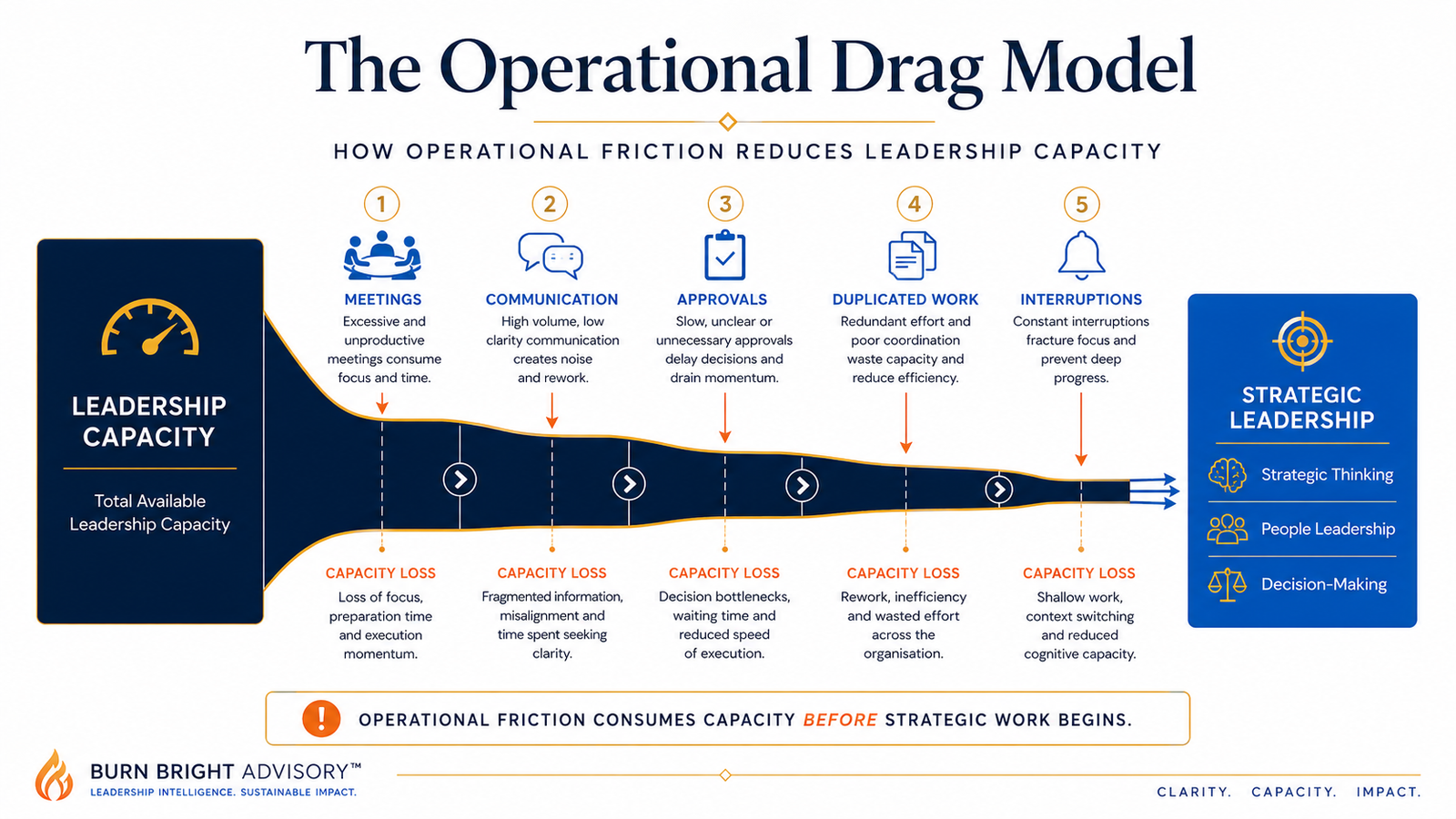
The important point is that operational drag rarely arrives as one obvious problem. It accumulates. Five unnecessary meetings may not look catastrophic. Neither do twelve minor approvals or twenty avoidable messages. But together they create a system in which leaders spend most of their capacity servicing the organisation rather than leading it.
That distinction changes the question. Instead of asking “How can I get through all of this?” ask “Why does all of this work exist in the first place?” That is where reducing operational drag begins.
Featured Snippet
What Causes Operational Drag in Leadership?
Operational drag rarely comes from one dramatic failure. It comes from accumulation. A reporting process is added after a problem. A weekly meeting is introduced during a project. Another approval is created to reduce risk. A new communication channel appears. A leader temporarily takes responsibility for something because nobody else is available.
Each decision can look reasonable on its own. The problem is that organisations are usually better at adding work than removing it. Over time, temporary processes become permanent. Responsibilities expand. Decisions migrate upwards. Meetings remain in calendars long after their original purpose has disappeared.
This is closely connected to one of the five root causes in the Burn Bright Not Out Framework™: scope creep. The framework also identifies meeting culture, communication chaos, decision overload and perfectionism culture as structural causes of burnout. Those five causes can also become sources of operational drag.
Consider a senior leader who starts Monday with twenty meaningful priorities. Around those priorities sit:
- Six recurring meetings
- Dozens of messages requiring responses
- Three reports requiring review
- Decisions that could have been made elsewhere
- Requests for information already held in another system
- Problems escalated without attempted solutions
- Approvals that exist because “we have always done it this way”
None appears large enough to trigger a workload crisis. Together, they consume the capacity required to lead.
McKinsey’s research illustrates the problem. Surveyed middle managers reported spending 18% of their working time on administrative work and 31% on individual-contributor work. Only 23% was spent on strategy-focused work and 28% on talent and people management. That means almost half of managerial capacity can be consumed by work that is not actually management. This is operational drag made visible.
The question is not whether administrative work can be eliminated completely. It cannot. The question is whether the amount of leadership capacity it consumes is proportionate to the value it creates. Very often, it is not.
How Can Leaders Identify Operational Drag?
Start with a different kind of workload audit. Most workload reviews ask: what are you doing? An operational drag audit asks: what has to happen around the work before anything useful gets done?
That distinction matters. Imagine a leadership team preparing a monthly performance report. The visible task may take two hours. But before the report reaches the executive meeting, five managers collect data, three people reformat it, two leaders check it, somebody corrects inconsistencies, another person creates slides, and several managers attend a meeting to discuss what will later be discussed again. The two-hour task may actually represent twenty hours of organisational capacity. The report is not necessarily the problem. The architecture surrounding the report is.
This is why examining operational drag through five lenses helps:
Lens 1 Repetition
What work keeps being recreated? Look for duplicated reports, repeated conversations, multiple systems containing the same information and questions that are answered repeatedly.
Lens 2 Interruption
What continually breaks concentration? Messages, unscheduled requests and unnecessary escalation create more cost than their duration suggests because leaders must repeatedly reconstruct their concentration.
Lens 3 Approval
Where does work stop while somebody waits for permission? If senior leaders routinely approve low-risk operational decisions, the organisation has probably created both a bottleneck and unnecessary leadership workload.
Lens 4 Coordination
How much activity is required simply to keep everybody aligned? Meetings, update emails and status requests can indicate that ownership or information architecture is unclear.
Lens 5 Correction
How much leadership capacity is spent fixing work that should have been completed correctly elsewhere? Repeated correction often points towards unclear standards, insufficient capability, weak delegation or confused accountability.
Do not assess these categories from memory. Observe them for a working week. Every time something consumes your attention, ask: did this require my leadership, or did the system simply route it to me? That question can expose a surprising amount of hidden work.
Why Does Operational Drag Increase Burnout Risk?
Operational drag does more than consume time. It consumes cognitive capacity. A leader can have eight hours available and still lack sufficient capacity for eight hours of meaningful leadership. Why? Because leadership requires judgement. You need cognitive space to see patterns, anticipate problems, coach people, resolve ambiguity and make consequential decisions. When that space is fragmented by low-value operational activity, leaders become increasingly reactive.
The World Health Organization defines burnout as resulting from chronic workplace stress that has not been successfully managed, characterised by exhaustion, increased mental distance or cynicism towards work, and reduced professional efficacy. That definition matters. Burnout is not simply a question of how many hours somebody works. The structure of those hours matters too.
WHO guidance on psychosocial risks also identifies factors including time pressure, lack of control, long working hours and lack of support as contributors to occupational stress, burnout and fatigue. Its preventive recommendations include organisational interventions such as workload reduction, schedule changes, improved communication and teamwork. In other words, changing the environment matters. This is consistent with the Burn Bright principle: fix the system, not the person.
Professionals increasingly manage fragmented communication streams alongside their original responsibilities. Work shifts away from sustained focus towards perpetual availability. Operational drag accelerates that shift.
A leader begins the day intending to work strategically.
Then comes a message.
An approval.
A meeting.
A “quick question”.
Another meeting.
An escalation.
A document to review.
By 4:30pm, the leader has been active for eight hours but has barely touched the work that required their highest level of judgement. So strategic work moves into the evening. That is how organisational inefficiency becomes personal overwork.
What Operational Drag Does to Leadership Capacity
The pattern becomes clearer when the data is visualised.
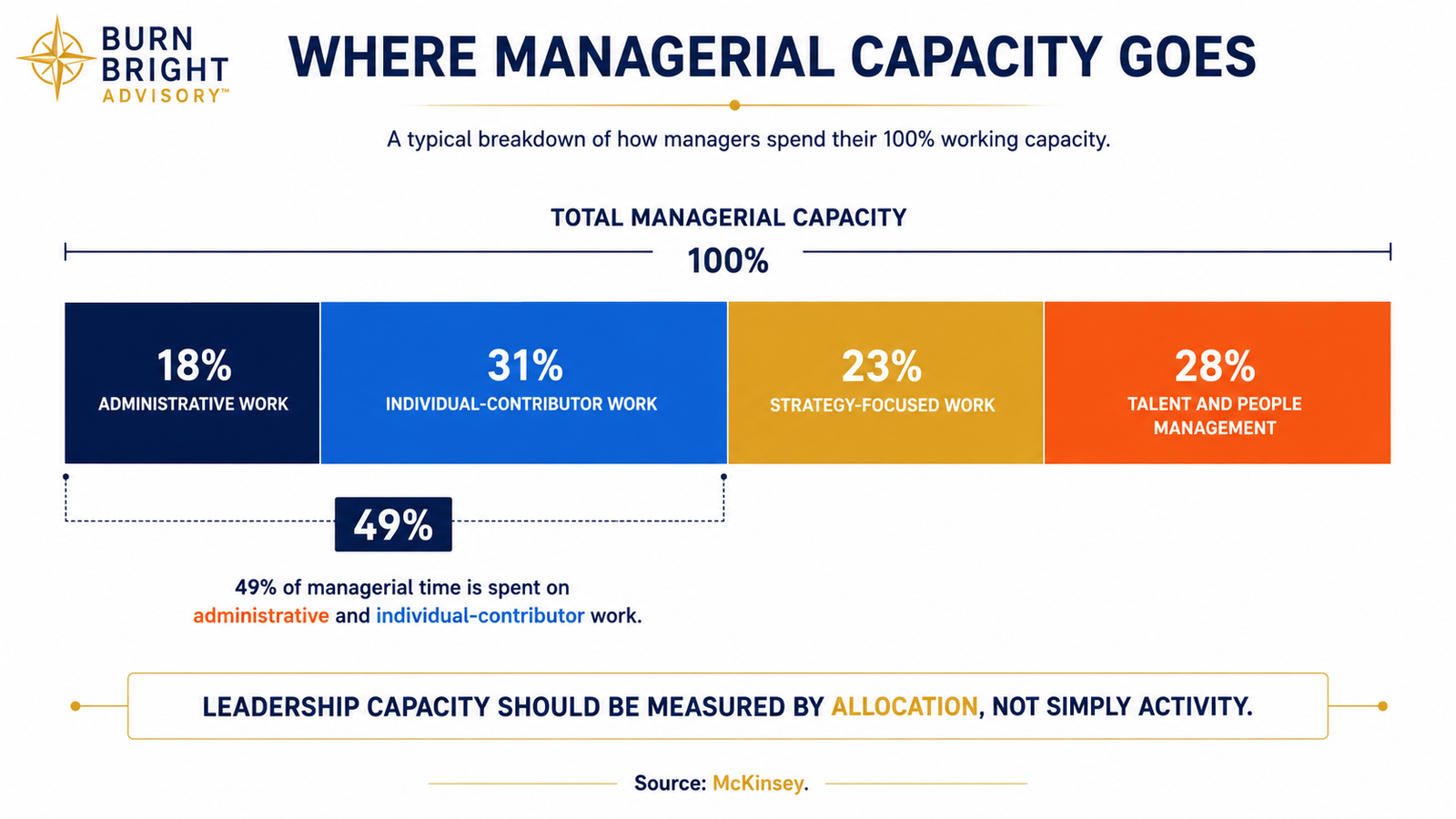
The interpretation matters more than the chart itself. This is not an argument that managers should never perform administrative or individual-contributor work. It is an argument about allocation. When almost half of managerial capacity is consumed outside core management activity, organisations should examine whether their operating model is using expensive leadership capacity intelligently.
The consequences extend beyond the manager. Gallup has reported that managers account for 70% of the variance in team engagement, which makes the condition and capacity of managers an organisational issue rather than merely a personal one. If a manager’s working week is consumed by administration, unnecessary coordination and constant escalation, something else has to disappear. Usually it is coaching, strategic thinking, development, reflection, relationship building or recovery — precisely the activities organisations need from their leaders, yet often the first things squeezed out by operational drag.
Why Doesn’t Better Time Management Solve the Problem?
Because you cannot productivity-hack your way out of badly designed work.
A leader may respond to operational drag by becoming exceptionally efficient. Emails are answered faster. Meetings are shortened. The calendar is colour-coded. Tasks are batched. Notifications are managed. AI summarises documents. All of those interventions can help. But there is a critical distinction between making unnecessary work more efficient and removing unnecessary work.
Suppose a leader spends five hours every week producing a report that nobody uses. A productivity intervention might reduce that task to three hours. A systems intervention asks why the report exists. The first saves two hours. The second saves five. This is why reducing operational drag requires subtraction before optimisation.
McKinsey describes a similar accumulation of managerial work as “administrivia”: layers of process, paperwork and meetings that accumulate around managers. In one healthcare organisation cited by McKinsey, middle managers had to filter through more than 300 requests from headquarters in a typical week. No time-management technique solves 300 unnecessary requests. The demand itself has to be examined.
This is where sustainable leadership differs from heroic leadership. Heroic leadership asks: how can I personally absorb more? Sustainable leadership asks: how should this system operate so that absorbing more is unnecessary? That shift is fundamental.
The goal of reducing operational drag is not to create empty calendars. It is to reclaim leadership capacity for work that actually requires leadership — strategy, people, judgement, prioritisation, direction. Those are difficult to measure because they do not always produce an immediate visible output. But they are where leadership creates leverage.
A manager processing unnecessary administration faster may look productive. A manager redesigning the system so that the administration is no longer necessary creates something more valuable: capacity. And capacity is one of the foundations of sustainable performance.
How Can Leaders Reduce Operational Drag?
Reducing operational drag starts with one principle: do not optimise work before deciding whether the work should exist. Leaders often approach overload by trying to become more efficient — new productivity tools, shorter meetings, automated emails, reorganised calendars. These interventions can help. But they come too late in the sequence. The first question should be: does this activity need to happen at all?
The Burn Bright Not Out Framework™ treats Workload Architecture™ as one of four pillars of structural transformation, alongside Decision Authority™, Recovery Rhythms™ and Management Frameworks. Workload Architecture™ means deliberately designing what work enters a leadership role, where it goes, who owns it and what should leave.
A practical way to begin is with an Operational Drag Audit. For one working week, record recurring activities that consume leadership capacity. Do not only record major tasks. Capture the friction around them. Then ask four questions:
Framework 1 Eliminate — Does this need to exist?
Some work should simply stop. Look for reports nobody uses, meetings without decisions, duplicated updates, legacy processes and recurring tasks whose original purpose has disappeared. Do not ask how to perform them faster. Ask what would happen if they stopped. If the answer is “very little,” you have probably found operational drag.
Framework 2 Delegate — Does this require my authority or expertise?
A task can be necessary without requiring senior leadership involvement. If someone else has the information, capability and appropriate authority to complete it, leadership involvement may represent poor workload architecture rather than good leadership.
Framework 3 Automate — Is this predictable and repeatable?
Routine scheduling, information collection, standard reporting, reminders and data movement may be candidates for automation. But automation comes after elimination. Automating unnecessary work simply makes waste travel faster.
Framework 4 Redesign — Is the work necessary but badly structured?
Some processes cannot disappear. They can, however, be redesigned. A sixty-minute weekly meeting might become a fifteen-minute decision meeting supported by asynchronous updates. Four approval stages might become one. Multiple status reports might become a shared dashboard.
The objective is not to make leaders work harder. It is to make the system require less unnecessary work from them.
What Should Leaders Eliminate, Delegate, Automate or Redesign?
Not all operational drag should be treated in the same way. This is where leaders need diagnosis rather than another productivity technique.
| Type of Work | Diagnostic Question | Primary Response | Example |
|---|---|---|---|
| Unnecessary | Does this still create meaningful value? | Eliminate | A legacy report nobody uses |
| Necessary but misplaced | Does this require my level of authority? | Delegate | Routine operational approvals |
| Necessary and repetitive | Can a reliable system perform this? | Automate | Recurring data collection |
| Necessary but inefficient | Could the workflow be simpler? | Redesign | A six-stage approval process |
The sequence matters. Eliminate before you delegate — otherwise you simply transfer waste to somebody else. Delegate before you automate — first establish where responsibility belongs. Automate only stable processes — technology applied to a confused process usually creates faster confusion. Redesign what remains, so the final workload contains work that genuinely contributes to organisational outcomes.
This approach also protects teams from a common leadership mistake: solving executive overload by pushing excessive workload downwards. That is not structural transformation. It is workload displacement. The purpose of redesigning leadership workload is to reduce unnecessary demand across the system, not simply relocate it.
The Operational Drag Filter
Before accepting a recurring responsibility, ask:
- Value: What outcome does this create?
- Ownership: Who is the lowest appropriate level at which this can be owned?
- Frequency: Does it need to happen this often?
- Format: Is there a simpler way to achieve the same outcome?
- Authority: Why does this require leadership involvement?
Five questions can expose years of accumulated complexity. Consider a monthly performance meeting attended by twelve senior managers. The meeting lasts ninety minutes. That sounds like ninety minutes of organisational time. It is not. Twelve people multiplied by ninety minutes represents 18 leadership hours before preparation and follow-up are counted. If each participant spends another thirty minutes preparing, the meeting consumes 24 hours. If the meeting primarily communicates information that could have been viewed on a dashboard, the organisation is not merely holding a meeting — it is purchasing that meeting with a full working day of senior leadership capacity, three times over. That is the kind of calculation an Operational Drag Audit should expose.
Traditional Efficiency vs Sustainable Work Architecture
The difference between traditional workload management and sustainable workload architecture is not subtle. One attempts to help the leader survive the existing system. The other questions whether the existing system deserves to survive.
| Traditional Efficiency | Sustainable Work Architecture |
|---|---|
| Work faster | Reduce unnecessary work |
| Improve personal productivity | Improve organisational flow |
| Fit more into the calendar | Protect capacity |
| Process messages faster | Reduce communication demand |
| Attend meetings efficiently | Remove or redesign meetings |
| Make decisions faster | Distribute decision authority |
| Delegate when overwhelmed | Design ownership before overload occurs |
| Add productivity tools | Remove structural friction |
| Treat overload as an individual problem | Treat overload as a system signal |
| Reward heroic effort | Build sustainable performance |
The distinction matters because heroic leadership can disguise organisational weakness. When a highly capable leader continually absorbs poor processes, unclear ownership and excessive demands, the organisation may appear to function. The system is not functioning well. The leader is compensating for it. That compensation has a cost. Eventually, the leader runs out of spare capacity.
Modern leadership roles have expanded while time and resources have not expanded at the same rate. Leaders are then expected to compensate personally for the gap. This is why sustainable workload design requires more than personal discipline. Better systems outperform more effort.
How Do Decision Bottlenecks Create Operational Drag?
One of the most expensive forms of operational drag is invisible on the leader’s task list. It is the work waiting for the leader.
A manager needs approval.
A project team needs a decision.
Finance needs a signature.
A client issue needs escalation.
HR needs confirmation.
The leader becomes the point through which dozens of unrelated workflows must pass. From the leader’s perspective, each request may take only five minutes. From the organisation’s perspective, the consequences are much larger. Ten people may be waiting for those five-minute decisions. Projects slow. Teams hesitate. Messages multiply. People chase responses. Meetings are arranged because decisions have not been made. Then the leader experiences even more incoming demand. This creates a decision bottleneck.
The Burn Bright framework addresses this structurally through Decision Authority™, the RACI Delegation Framework™ and Decision Fatigue Management. The solution is not simply to make decisions faster. It is to determine which decisions should reach the leader at all. A useful test is: does this decision genuinely require my authority, judgement or risk ownership? If not, move the decision closer to the work. Give people clear boundaries within which they can act. For example:
“Spend up to £5,000 within the approved project budget without additional authorisation.”
“Resolve customer complaints within these three parameters without escalation.”
“Recruit against an already approved headcount without requesting executive approval at every stage.”
Clear decision rights reduce two forms of drag simultaneously. They reduce the leader’s decision load. And they reduce the team’s waiting time. That is leverage.
Good delegation is therefore not simply about moving tasks. It is about moving authority. Without authority, delegation frequently creates reverse delegation: responsibility appears to move downwards while decisions continually return upwards. That leaves the leader overloaded and the team dependent.
What Does a Low-Drag Leadership System Look Like?
A low-drag organisation is not an organisation without processes. Nor is it an organisation where everybody simply does whatever they want. Good systems create clarity with less friction.
- Leaders know which decisions belong to them.
- Teams know what they can decide independently.
- Meetings exist because conversation or collective judgement is genuinely required.
- Information has a clear home.
- Communication channels have defined purposes.
- Reports exist because somebody uses them to make a decision.
- Escalation criteria are explicit.
- Strategic time is protected rather than treated as spare capacity.
- Recovery is designed into the operating rhythm rather than left until somebody reaches exhaustion.
That final point matters. The Burn Bright framework identifies Recovery Rhythms™ as a structural pillar, not an optional personal practice. Reducing operational drag therefore creates more than productivity. It creates breathing room.
From Operational Drag to Leadership Capacity
This is the structural shift leaders should be trying to create:
The model should not end with “more available time.” Recovered capacity needs a purpose. Direct it towards:
- Strategic thinking — time to anticipate rather than continually react.
- People leadership — coaching, feedback, development and difficult conversations require cognitive and emotional capacity.
- Better decisions — important judgement improves when leaders are not making hundreds of unnecessary minor decisions first.
- System improvement — some recovered capacity should be reinvested into fixing the next source of organisational friction.
- Recovery — not every recovered hour needs another task inserted into it.
This is where many organisations make a mistake. They remove ten hours of unnecessary work and immediately fill those ten hours with new demands. Nothing has fundamentally changed. Sustainable leadership requires some capacity to remain deliberately unallocated. That buffer enables leaders to absorb genuine volatility without converting every unexpected event into evening work. It is the difference between a system operating at sustainable capacity and one permanently running at its limit.
Reducing operational drag therefore requires more than asking how much work can we remove. The stronger question is: what should leadership capacity be used for once we get it back? Answer that well, and reducing operational drag becomes much more than an efficiency exercise. It becomes organisational redesign — the conditions in which leaders can stop servicing unnecessary complexity and return to the work they were appointed to do: lead.
How Can Leaders Prevent Operational Drag From Returning?
Removing operational drag once is useful. Preventing it from rebuilding is leadership discipline.
Organisations naturally accumulate complexity. A new problem produces a new process. A mistake produces another approval. A project produces another meeting. A communication failure produces another reporting requirement. The addition may make sense at the time. The difficulty is that organisations rarely create an expiry date for it. Six months later, the original problem may have disappeared while the process remains. That is how operational drag rebuilds.
The answer is to treat organisational processes as things that require periodic justification rather than permanent fixtures. A simple quarterly review built around four questions helps:
- What have we added? Review new meetings, reports, approvals, communication channels, responsibilities and recurring tasks introduced during the previous quarter.
- What has stopped creating value? Identify processes whose cost now exceeds their contribution.
- What has moved upwards unnecessarily? Look for decisions and responsibilities that have gradually migrated towards senior leaders.
- What should now disappear? Make subtraction an explicit management activity.
This last question matters. Most leadership meetings contain discussions about what the organisation should start doing. Far fewer contain a serious discussion about what it should stop doing. That imbalance creates workload growth.
A sustainable operating system requires both. Every significant addition should eventually trigger a corresponding question: what can we remove, simplify or reduce to create capacity for this? Without that discipline, priorities do not replace each other. They accumulate. That is not prioritisation. It is overload.
How Can Leaders Measure Whether Operational Drag Is Falling?
What gets measured should reflect what you are trying to change. If leaders measure only output, operational drag can remain hidden. The team may still hit its targets. Projects may still launch. Customers may still receive what they need. But leaders may be maintaining those outcomes through longer hours, skipped recovery, constant availability and personal compensation for broken processes. Performance remains visible. The cost of producing it does not.
This is why workload dashboards should measure capacity as well as output. A useful operational drag dashboard might include:
Meeting load
How many leadership hours are consumed by recurring meetings each week? Do not measure only the number of meetings — measure the combined organisational hours. A one-hour meeting involving ten senior people costs ten leadership hours.
Approval load
How many routine decisions require senior approval? Track both the number of approvals and the time work spends waiting for them.
Escalation rate
How frequently are operational decisions being pushed upwards? Increasing escalation can indicate unclear decision authority, insufficient confidence or poorly designed accountability.
Communication volume
How much work is being created through internal messaging, email and duplicated status updates? The goal is not to eliminate communication — it is to distinguish communication that moves work forward from communication required because the system is unclear.
Strategic capacity
How much protected time remains for strategic work, coaching, reflection and system improvement? If leaders consistently have no time for leadership work, the operating model is telling you something. Listen to it.
The Burn Bright framework makes this distinction through Workload Architecture™ and Time Architecture™. A workload dashboard should not become another reporting burden. Keep it simple. The purpose is diagnosis, not administration.
What Is the Link Between Operational Drag and the Culture Tax™?
Operational drag has a financial cost even when it does not appear as a line on the profit and loss statement. This is part of the Culture Tax™.
The Burn Bright Not Out Framework™ defines the Culture Tax™ as the hidden financial cost of high turnover, disengagement and burnout paid by organisations that treat symptoms instead of fixing structures. Operational drag contributes directly to that tax.
Consider the economics of a recurring executive meeting. Eight leaders attend for ninety minutes every week. That represents twelve leadership hours. Across 48 working weeks, the meeting consumes 576 leadership hours. And that is before preparation, travel between locations, follow-up activity or the cognitive switching cost surrounding the meeting.
The correct question is not “was the meeting useful?” — that threshold is too low. Ask instead: “did this meeting create enough value to justify 576 hours of senior leadership capacity?” Now the economics look different. Apply the same logic to duplicated reporting, approval chains, repeated corrections, unnecessary escalation and poorly designed communication. Operational drag becomes expensive surprisingly quickly.
The cost increases further when leaders eventually leave. The Burn Bright framework estimates replacement costs of £75,000 for a middle manager and more than £500,000 for a senior leader, while also identifying a 34% productivity loss during leadership transitions. Those figures demonstrate the intended argument: leadership capacity has economic value. Organisations should therefore stop treating unnecessary demands on that capacity as free.
Every unnecessary approval has a cost. Every unnecessary meeting has a cost. Every duplicated report has a cost. Every preventable interruption has a cost. And when the cumulative system requires leaders to compensate through chronic overwork, the Culture Tax™ becomes larger still. This is why reducing operational drag belongs in conversations about organisational effectiveness, not merely wellbeing.
What Should Senior Leaders Do Differently?
Senior leaders have a particular responsibility because much operational drag originates above the people experiencing it.
A CEO requests another weekly update.
A director adds an approval stage.
Head office launches another initiative.
A senior team introduces a dashboard.
A new communication expectation emerges.
Each request travels down the organisation. But its total cost is rarely calculated. One senior leader can create hundreds of hours of downstream work with a single request. Imagine asking 40 managers to prepare a new weekly report taking 45 minutes each. The request appears small. The organisational cost is 30 hours every week. Across 48 working weeks, that becomes 1,440 hours.
Before introducing a recurring requirement, senior leaders should therefore ask: what is the total organisational cost of this request? Then ask: what decision will this information improve? If there is no clear answer, reconsider the requirement.
Senior leaders should also examine their own behaviour. Do people escalate because you require escalation? Do people copy you into messages because they fear being accused of withholding information? Do managers seek approval because previous independent decisions were criticised? Do meetings expand because senior leaders expect to be consulted on everything? Do people send evening messages because leaders model constant availability?
Systems are shaped by signals. A leader may say, “You do not need my approval,” while repeatedly challenging decisions made without them. The spoken message says autonomy. The behavioural message says permission. People follow the behavioural message. Reducing operational drag therefore requires leaders to examine not only formal processes but the informal expectations their behaviour creates.
How Can Managers Start Reducing Operational Drag This Week?
Structural transformation does not require changing everything at once. Start with visible friction. Choose one recurring process that consumes disproportionate capacity. It might be a weekly meeting, a report, an approval process, an escalation pattern, a communication routine, or a responsibility that should sit elsewhere.
Then run it through the Operational Drag Filter: what value does this create, who should own it, how often does it genuinely need to happen, could we achieve the same outcome more simply, and why does this require leadership involvement?
Then make one structural change. Cancel the meeting. Reduce its frequency. Remove two attendees. Replace updates with a dashboard. Move decision authority. Stop producing the report. Clarify escalation criteria. Delegate ownership and authority together.
Then measure what happens. Did anything break? Did decisions become slower or faster? Did accountability improve? Did leadership capacity increase? Did the team become more independent?
This experimental approach matters because leaders often retain inefficient processes because of imagined consequences: “We cannot cancel that meeting.” “We have always produced that report.” “Senior management needs to approve this.” “Everyone needs to be copied in.” Maybe. Test the assumption.
Sustainable leadership does not mean removing controls indiscriminately. It means making sure every control earns its place. The goal is not organisational minimalism. The goal is clarity without depletion.
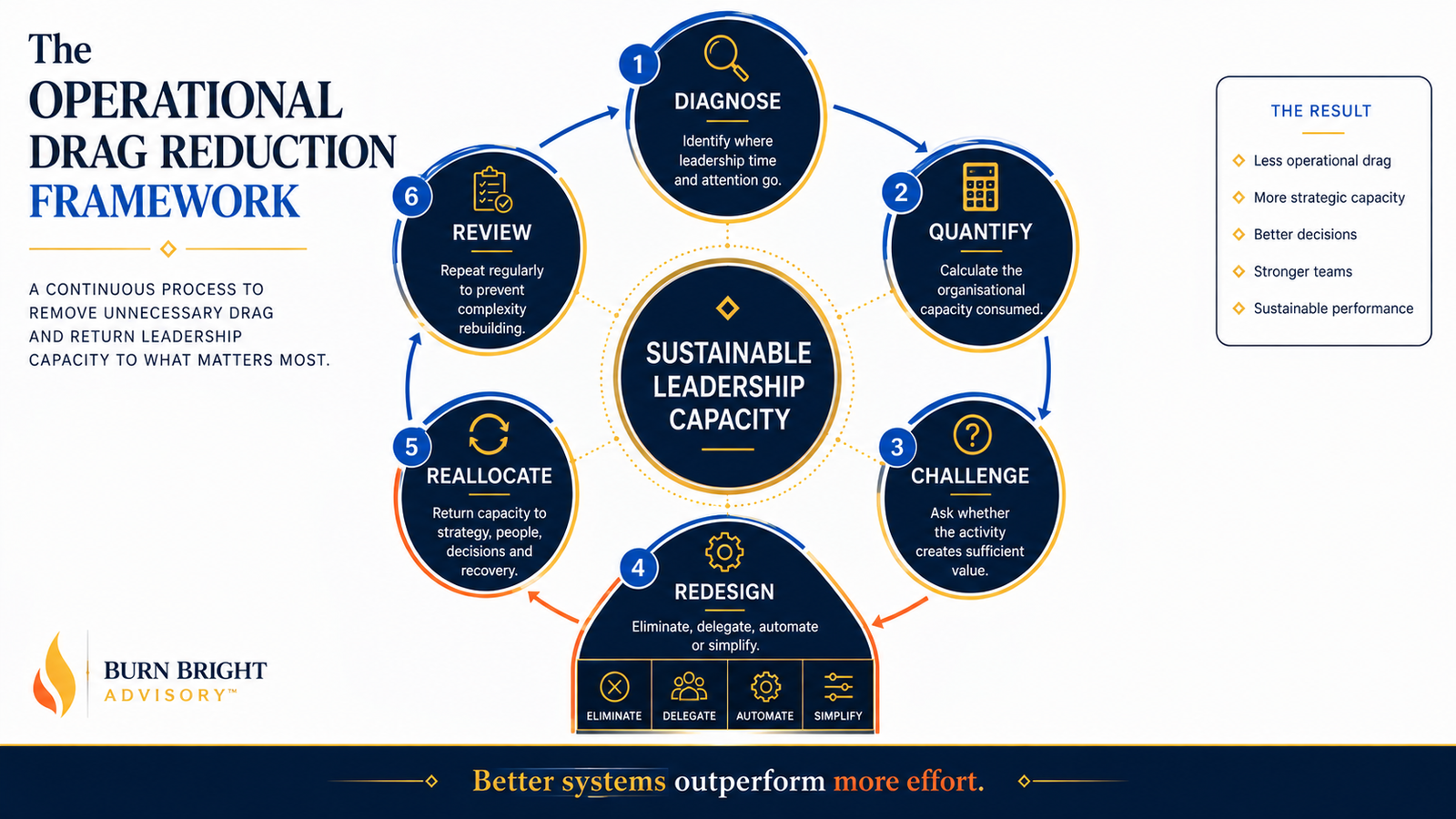
The Operational Drag Reduction Framework™
Reducing operational drag can therefore be summarised as a repeatable six-stage process.
Stage 1
Diagnose
Observe where leadership time and attention are actually going.
Stage 2
Quantify
Calculate the organisational capacity being consumed, not simply the duration of individual activities.
Stage 3
Challenge
Ask whether each recurring demand still creates enough value to justify its cost.
Stage 4
Redesign
Eliminate, delegate, automate or simplify unnecessary friction.
Stage 5
Reallocate
Return recovered capacity to strategy, people leadership, better decisions and recovery.
Stage 6
Review
Repeat the process quarterly so complexity does not silently rebuild.
The sequence matters. If you diagnose without redesigning, you simply become more aware of the problem. If you redesign without measuring, you cannot tell whether the intervention worked. If you recover capacity and immediately fill it with new demands, you recreate the original conditions.
The Burn Bright approach is different. Better systems outperform more effort. Leaders cannot outwork broken systems. And organisations should not build operating models that depend on them doing so. Reducing operational drag is ultimately about removing the structural friction that prevents capable leaders from using their capacity where it creates the greatest value. That is not merely an efficiency exercise. It is sustainable leadership by design.
Frequently Asked Questions
What is operational drag in leadership?
Operational drag is the unnecessary friction that consumes leadership time, attention and decision-making capacity without creating equivalent value. It includes excessive meetings, duplicated reporting, unclear ownership, unnecessary approvals, repeated escalation and communication overload. Reducing operational drag means redesigning these systems rather than asking leaders to absorb them through longer hours or greater personal efficiency.
How do you know if operational drag is affecting your organisation?
Look for leaders who are permanently busy but have little protected time for strategy, coaching or improvement. Other warning signs include recurring meetings with unclear outcomes, decisions constantly moving upwards, duplicated reports, high communication volume and senior people completing work that could be owned elsewhere. Persistent firefighting is often evidence of structural friction rather than insufficient effort.
Can operational drag cause leadership burnout?
Operational drag can contribute to the conditions that make leadership burnout more likely because it consumes capacity while increasing fragmentation and workload. The Burn Bright framework identifies scope creep, meeting culture, communication chaos, decision overload and perfectionism culture as five root causes of burnout. When several operate simultaneously, leaders can spend increasing amounts of energy servicing the system rather than leading effectively.
What is the fastest way to reduce operational drag?
Start with one high-frequency source of friction. Audit a recurring meeting, report, approval or escalation process and ask whether it should be eliminated, delegated, automated or redesigned. High-frequency activities are useful starting points because even small structural improvements compound. Removing a one-hour weekly meeting for eight leaders can recover hundreds of leadership hours over a year.
Is reducing operational drag the same as improving productivity?
No. Productivity usually focuses on completing work more efficiently. Reducing operational drag asks whether the work, process or leadership involvement should exist in its current form at all. Making an unnecessary report faster is productivity improvement. Removing the unnecessary report is structural improvement. Sustainable leadership needs both, but subtraction should usually come before optimisation.
Should leaders automate operational drag with AI?
Only after deciding that the activity is necessary. AI can reduce the administrative burden associated with summarising information, processing routine material and supporting repeatable workflows, but automating unnecessary work preserves the underlying problem. Eliminate first, establish ownership second, then automate stable processes where technology genuinely reduces friction.
Conclusion: Reducing Operational Drag Creates Leadership Capacity
Reducing operational drag is not about squeezing another 10% of productivity from already stretched leaders. It is about questioning why so much of their capacity is being consumed in the first place.
Meetings accumulate.
Approvals move upwards.
Reports survive beyond their usefulness.
Communication fragments attention.
Responsibilities expand.
Leaders compensate.
For a while, the system appears to work. But it is often the leader — not the system — holding everything together. That distinction matters.
Sustainable leadership cannot depend on permanent personal compensation for structural inefficiency. Leaders cannot continually extend their working day, sacrifice strategic thinking and reduce recovery simply because the organisation has failed to redesign how work moves.
The alternative is structural. Diagnose the friction. Quantify its cost. Eliminate what creates insufficient value. Delegate work and authority to the appropriate level. Automate stable processes. Redesign what remains. Then protect some of the capacity you recover.
The Burn Bright philosophy is simple: burnout is a system failure. Fix the system, not the person. The framework places Workload Architecture™, Decision Authority™, Recovery Rhythms™ and Management Frameworks at the centre of that structural transformation. Better systems outperform more effort. And reducing operational drag is one practical way to start building them.
Take the Leadership Burnout Self-Assessment
If your working week is consumed by operational demands and there is little capacity left for strategy, people or recovery, start by diagnosing where the pressure is coming from. Use it to identify the structural pressures affecting your leadership capacity and establish where change needs to begin.
Free Leadership Intelligence
Get Weekly Leadership Insights
Join thousands of leaders receiving practical strategies on burnout prevention, workload design, and sustainable performance every week.