Quick Answer
Key Takeaways
- The hardest ethical decisions rarely look like a clean choice between right and wrong — they emerge when two legitimate responsibilities collide.
- Ethics Intelligence™ is a leadership capability, not a compliance checklist: it requires recognising complexity, examining assumptions and making defensible judgement calls under pressure.
- Compliance sets a floor. It does not guarantee good leadership judgement, and technically correct decisions can still erode trust.
- Power increases ethical responsibility — formal permission to speak is not the same as people actually feeling able to disagree.
- Ethical drift happens gradually, through small, individually reasonable-sounding exceptions that accumulate into a changed standard.
- The Recognise → Examine → Evaluate → Decide → Review framework gives leaders a disciplined structure for ethically complex decisions.
Ethics Leadership: The Intelligence to Lead When the Right Answer Is Not Obvious
Featured Snippet
Leaders are told to act with integrity, follow their values, do the right thing and comply with organisational policies. Each instruction sounds reasonable. None adequately describes the reality of ethical leadership.
The most difficult ethical decisions rarely present themselves as an obvious choice between right and wrong. They emerge when two legitimate responsibilities collide.
Protect confidentiality—or disclose information because others may be at risk.
Protect employment—or restructure because the organisation may otherwise become financially unsustainable.
Support an individual team member—or address behaviour that is damaging the wider team.
Move quickly during a crisis—or slow down sufficiently to hear perspectives that could change the decision.
Follow established procedure—or challenge a process that appears procedurally correct but produces an unjust outcome.
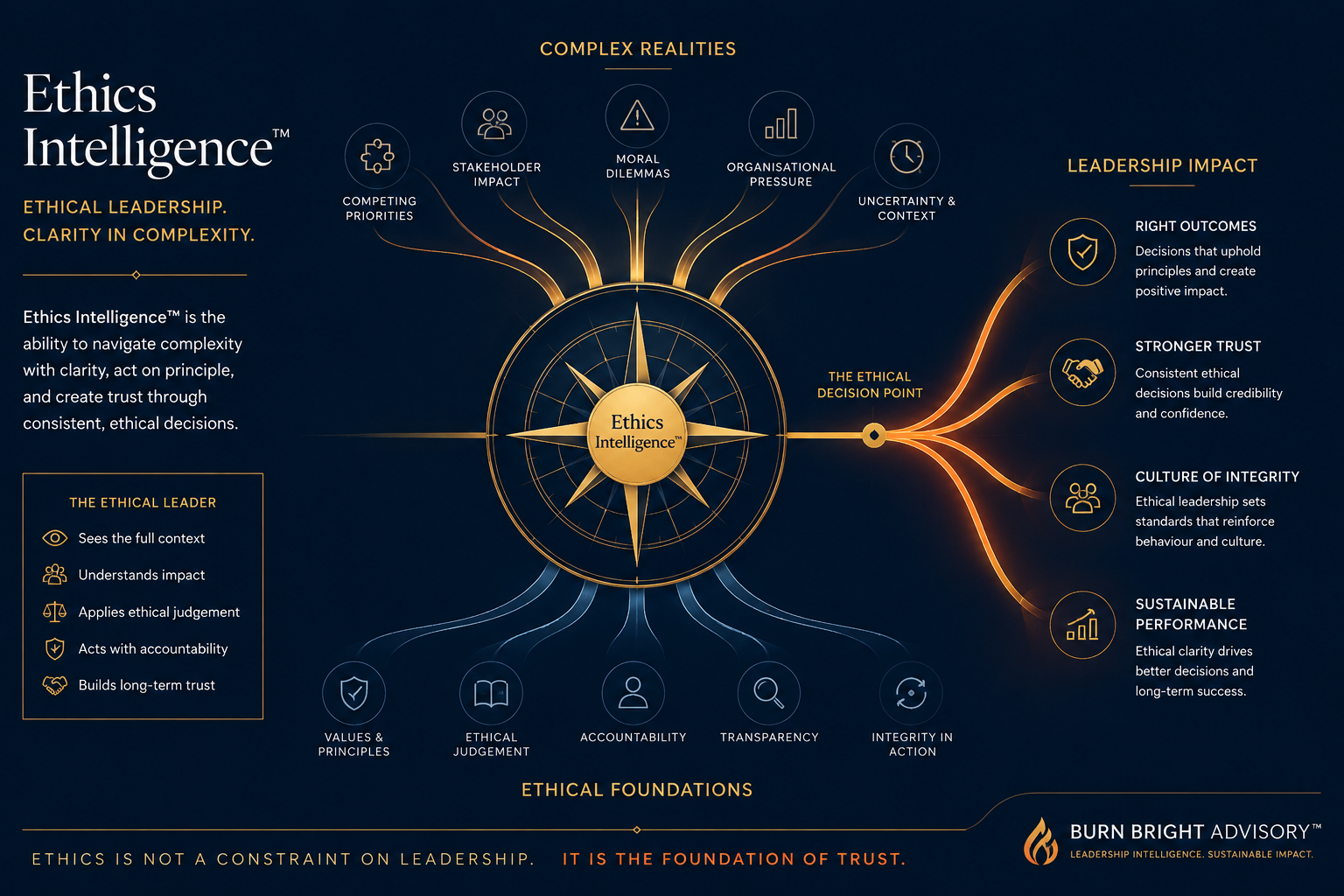
This is where Ethics Intelligence™ becomes important. Within Burn Bright Advisory’s Leadership Intelligence Compass™, Ethics Intelligence™ should not be understood merely as knowing ethical rules. It concerns a leader’s capacity to recognise ethical complexity, interrogate competing obligations, anticipate consequences, examine their own assumptions and exercise judgement that can withstand scrutiny.
Performance cannot be judged only by whether a leader achieves an outcome. Leadership quality also depends upon how the outcome was achieved, whose interests were considered, what consequences were created, what compromises were made and whether the decision remains defensible after the immediate pressure has passed.
Ethics Leadership Begins Where the Easy Answers End
Most leaders would describe themselves as ethical. That is precisely why ethics leadership deserves deeper examination.
Serious ethical failures do not always begin with leaders consciously deciding to behave badly. They can begin with rationalisation, pressure, loyalty, urgency, ambition or an increasingly narrow definition of what matters.
- A leader under intense pressure to deliver a result may gradually start treating the result as the only meaningful measure of performance.
- A manager protecting a valued employee may overlook behaviour that is affecting everyone else.
- A senior executive may withhold uncomfortable information because they believe they are protecting organisational confidence.
- A school leader may apply a policy consistently while failing to recognise that equal treatment does not necessarily produce equitable outcomes.
- A healthcare leader may pursue efficiency targets that make operational sense while increasing pressure on professionals responsible for safe care.
- A public-service leader may satisfy procedural requirements while losing sight of the citizens those procedures were designed to serve.
None of these situations can be resolved adequately by telling leaders simply to “have good values.” They require judgement.
What Is Ethics Leadership?
Ethics leadership is the disciplined practice of making and influencing decisions in ways that recognise responsibilities, values, consequences, power and accountability. That definition matters because leadership ethics operates at more than one level.
- The ethics of the decision: What should we do?
- The ethics of the process: How should we decide?
- The ethics of power: Whose voice counts, and who carries the consequences?
- The ethics of implementation: Are we doing what we said we would do?
- The ethics of reflection: What does the outcome reveal about our judgement, assumptions and system?
Ethical leadership therefore cannot be reduced to personal morality. Leadership takes place within systems. Budgets, policies, incentives, hierarchies, performance measures, professional standards, organisational cultures and stakeholder expectations all influence what leaders notice and how they respond. The leader must operate within those systems while retaining the capacity to question them. That distinction is central to Ethics Intelligence™.
Ethics Intelligence™: From Values to Leadership Capability
Values matter. But values without the capability to apply them under pressure can remain little more than statements of intent.
- An organisation may say that it values people while rewarding managers almost exclusively for short-term financial performance.
- It may describe psychological safety as important while senior leaders punish dissent.
- It may promote transparency while important decisions occur behind closed doors.
- It may declare wellbeing a priority while designing leadership roles around permanently excessive workloads.
The gap between declared values and operational behaviour is one of the most important places to examine leadership ethics. Ethics Intelligence™ asks leaders to move beyond asking “What do we say we believe?” towards the more demanding question: “What do our decisions demonstrate that we actually value?”
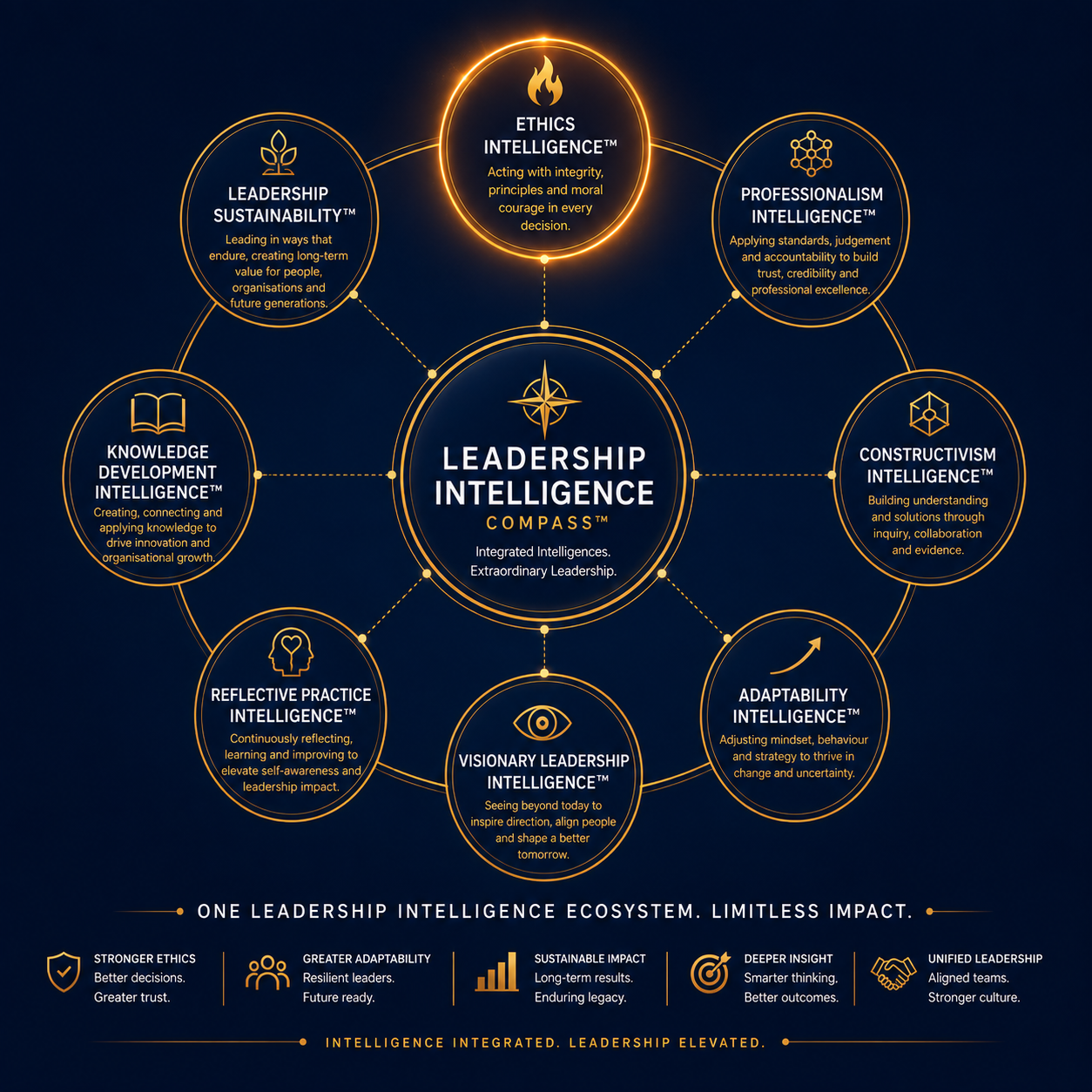
This distinction also connects ethics to the wider Leadership Intelligence Compass™. A leader may demonstrate exceptional Professionalism Intelligence™, yet professionalism without ethical examination can become rigid conformity. A leader may possess strong Emotional Intelligence™, yet emotional skill without ethics can potentially be used to influence people in ways that serve the leader rather than the collective good. A leader may demonstrate Adaptability Intelligence™, yet adapting quickly to an unhealthy culture is not necessarily effective leadership. A leader may be highly visionary, but vision without ethical scrutiny can legitimise harmful means in pursuit of an attractive end. And a leader may engage in reflection without confronting uncomfortable questions about power, responsibility and consequences.
Leadership intelligences therefore should not operate as isolated capabilities. Their value lies partly in how they inform and regulate one another.
The Five Questions Behind Ethical Leadership Judgement
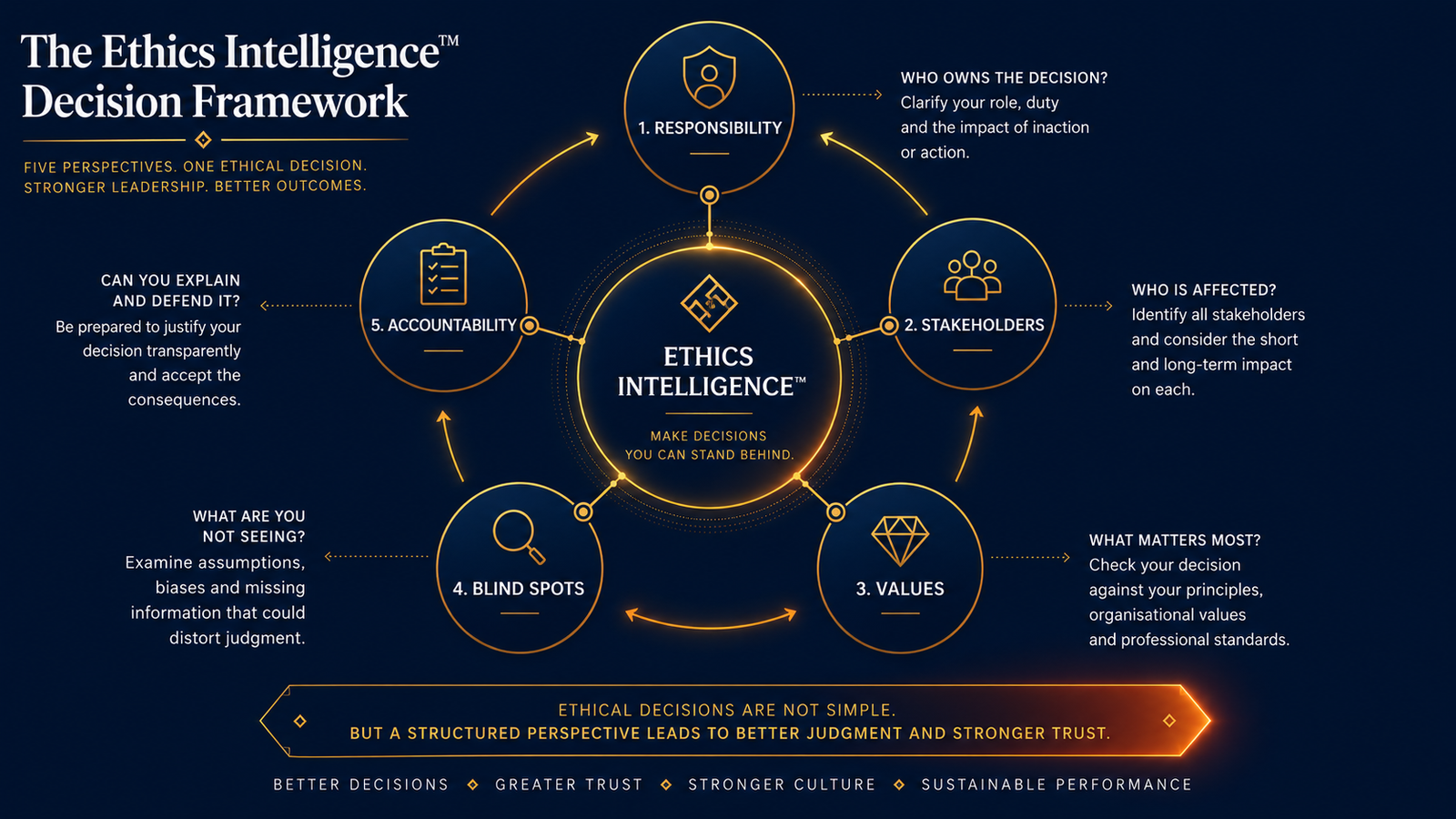
When leaders face genuine ethical complexity, five questions can create a more disciplined decision process.
Question 1 What responsibility am I carrying?
Ethical decisions begin by clarifying responsibility. What are you accountable for? To whom? Under what professional, organisational or societal obligations? Leaders frequently hold several responsibilities simultaneously. The challenge is recognising when those responsibilities conflict rather than pretending they do not.
Question 2 Who is affected?
Leadership decisions distribute consequences. Some people gain. Some lose. Some carry risks they did not choose. Ethics Intelligence™ requires leaders to examine those effects, particularly for stakeholders with less power to influence the decision.
Question 3 What values are in tension?
Ethical dilemmas frequently involve competing values rather than the presence or absence of values — transparency versus confidentiality, compassion versus accountability, speed versus participation, individual autonomy versus collective responsibility. Recognising the tension prevents a leader from presenting a complex decision as morally simpler than it really is.
Question 4 What am I failing to see?
This may be the most important question. Senior leaders have access to information others do not have—but they can also become insulated from information that others experience every day. This is where Ethics Intelligence™ connects directly with Reflective Practice Intelligence™ and Constructivism Intelligence™: leaders must question not only the information before them, but the way they have constructed their understanding of the situation.
Question 5 Could I explain this decision openly?
A useful test of ethical defensibility is not whether everyone would agree with the decision. The stronger question is: could you explain what you decided, why you decided it, whose interests you considered, what alternatives you rejected and what consequences you accepted? Ethical leadership demands decisions for which leaders are prepared to accept meaningful accountability.
Ethics Leadership Is More Than Compliance
One of the most damaging misunderstandings in organisations is the assumption that an ethical decision is simply one that complies with the rules. Compliance matters. But compliance establishes a boundary; it does not automatically provide sufficient leadership judgement.
- A decision can comply with policy and still be poorly judged.
- A workplace process can be technically correct while silencing legitimate concerns.
- A leader can satisfy minimum legal obligations while damaging trust.
- An organisation can hit every formal performance measure while creating conditions that are unsustainable for the people delivering those results.
This distinction becomes particularly important when examining harmful leadership cultures. Burn Bright’s work on toxic leadership in small teams highlights how damaging leadership can develop through repeated behaviours such as undermining, excessive control, blame shifting and the erosion of psychological safety. In small teams especially, close relationships and limited organisational buffers can magnify the effect of leadership behaviour.
Ethical leadership therefore requires attention not only to dramatic misconduct but to patterns. What behaviour is being normalised? What are people learning that they must tolerate? What gets rewarded? What happens when someone challenges authority? What does silence mean in this team? These are ethical questions because leadership shapes the conditions under which other people work, speak, decide and contribute.
Ethical Judgement Under Pressure
Ethical leadership becomes most visible when pressure rises. When time is available, information is complete and stakeholder interests broadly align, leaders can usually make considered decisions. The greater test comes when those conditions disappear: when information is incomplete, consequences are significant, people disagree and a decision still has to be made.
Ethical leadership is not demonstrated by avoiding difficult decisions. It is demonstrated by developing the capacity to make difficult decisions without allowing urgency, authority or performance pressure to eliminate reflection.
The Ethics Intelligence™ Decision Framework
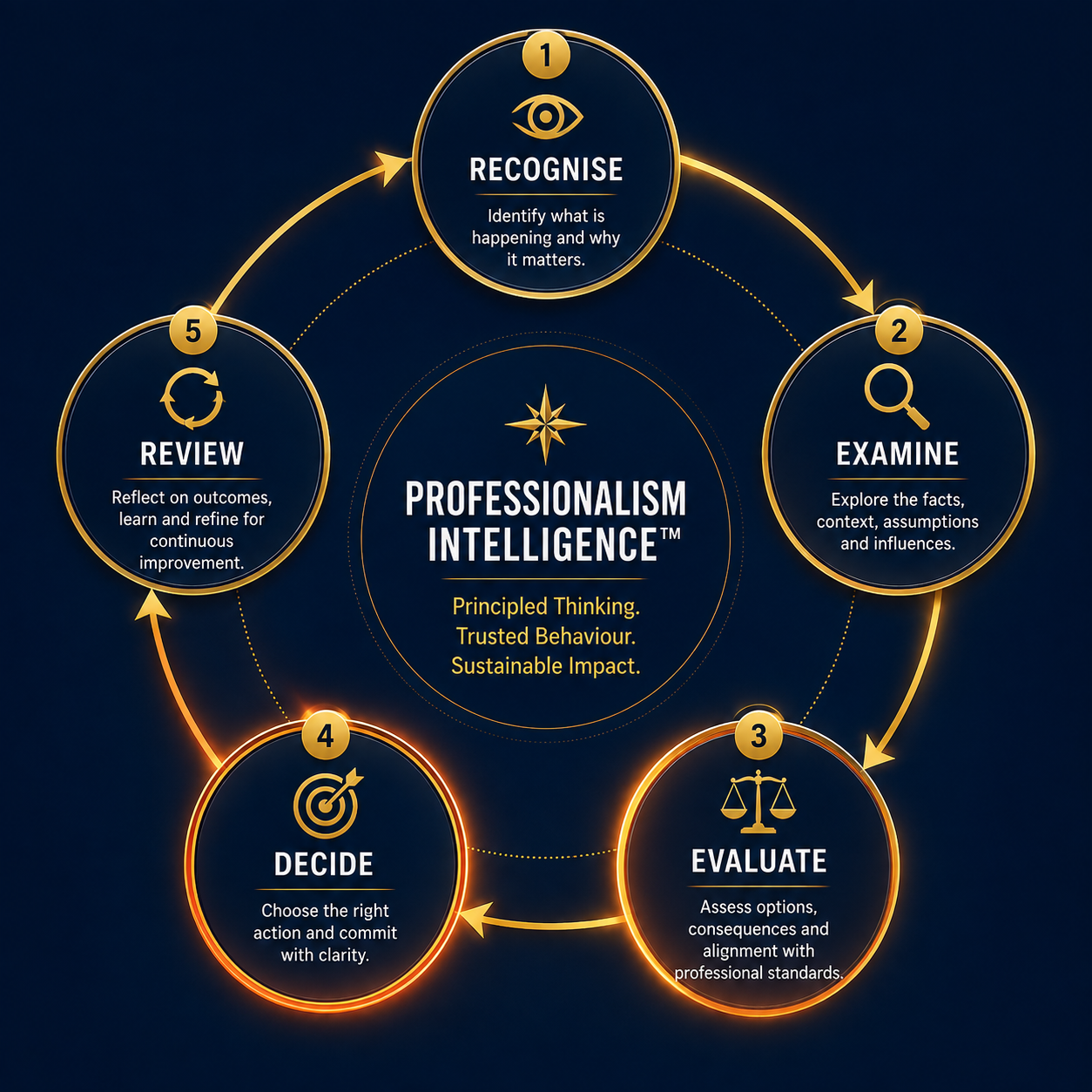
A useful way to think about ethical judgement is through five interconnected stages: Recognise → Examine → Evaluate → Decide → Review. This is not intended to turn ethical judgement into a mechanical checklist — leadership situations are too complex for that. Instead, the framework creates deliberate points at which a leader can interrupt assumption, examine competing responsibilities and improve the quality of judgement.
Stage 1
Recognise the Ethical Dimension
A restructuring proposal may initially appear to be a financial decision. An employee performance issue may appear to be a management decision. Introducing an AI system may appear to be a technology decision. Yet each may contain significant ethical questions: who benefits, who assumes the risk, who has been consulted, and what happens if the decision is wrong.
Stage 2
Examine the Situation
Leaders need to distinguish between what they know, what they believe, what they have assumed and what remains unknown. The more senior a leader becomes, the easier it can be for an interpretation to become treated as fact simply because the leader expressed it.
Stage 3
Evaluate Responsibilities and Consequences
This prevents two common errors: judging decisions solely by intention (“I meant well”) or solely by outcome (“it worked”). Neither is sufficient. Leadership Performance Intelligence™ requires examining performance and legitimacy together.
Stage 4
Decide and Take Responsibility
Reflection cannot become avoidance. There are situations in which every available option carries a cost. The quality of ethical leadership becomes visible in how responsibility for that decision is handled — not in distributing responsibility downward.
Stage 5
Review What the Decision Produced
Ethical responsibility does not end when the decision is announced. Review transforms ethics from a one-time judgement into an organisational learning process, connecting Ethics Intelligence™ with Knowledge Development Intelligence™.
Ethical Confidence Is Not Ethical Certainty
One of the paradoxes of leadership is that people often want leaders to appear certain precisely when certainty is least possible. During uncertainty, teams look towards leaders for direction. Boards want answers. Employees want reassurance. The temptation is to convert leadership confidence into certainty. But they are not the same.
Ethical certainty says: “I know this is the right decision.”
Ethical confidence says: “We have examined this carefully, considered the available evidence and competing responsibilities, and this is the decision we believe is most defensible. We will continue to review its consequences.”
The themes in Burn Bright’s The Unguarded Leader reinforce the importance of leaders remaining curious, capable of admitting uncertainty and willing to create conditions in which other perspectives can emerge rather than assuming expertise requires having every answer. Leaders who believe ethical authority requires absolute certainty can become resistant to challenge. Leaders who recognise the limits of their knowledge remain capable of correction. That distinction can determine whether an organisation learns or defends itself.
Power Changes Ethical Responsibility
A conversation between two colleagues is different from a conversation between a chief executive and a junior employee. The words may be identical. The consequences are not. Leaders influence access to opportunity, information, recognition, resources, promotion, workload and sometimes continued employment.
Power therefore increases ethical responsibility. The ethically intelligent leader asks not simply “Did I allow people to speak?” but “Did I create conditions in which they could realistically disagree with me?” That is a much higher standard.
A leader can invite feedback while communicating through tone, behaviour and past decisions that disagreement carries consequences. A meeting can be described as consultative even though everyone understands the decision has already been made. An employee can technically have access to a complaints procedure while reasonably believing that using it will damage their career. Formal permission is not the same as psychological permission.
Burn Bright’s work on toxic leadership in small teams illustrates the importance of this distinction. In small-team environments, leadership dysfunction can be amplified because relationships are close, organisational buffers may be limited and traditional escalation routes may not exist. Ethics Intelligence™ therefore requires leaders to examine not merely whether mechanisms exist, but whether those mechanisms can genuinely be used.
Ethics Leadership Across Sectors
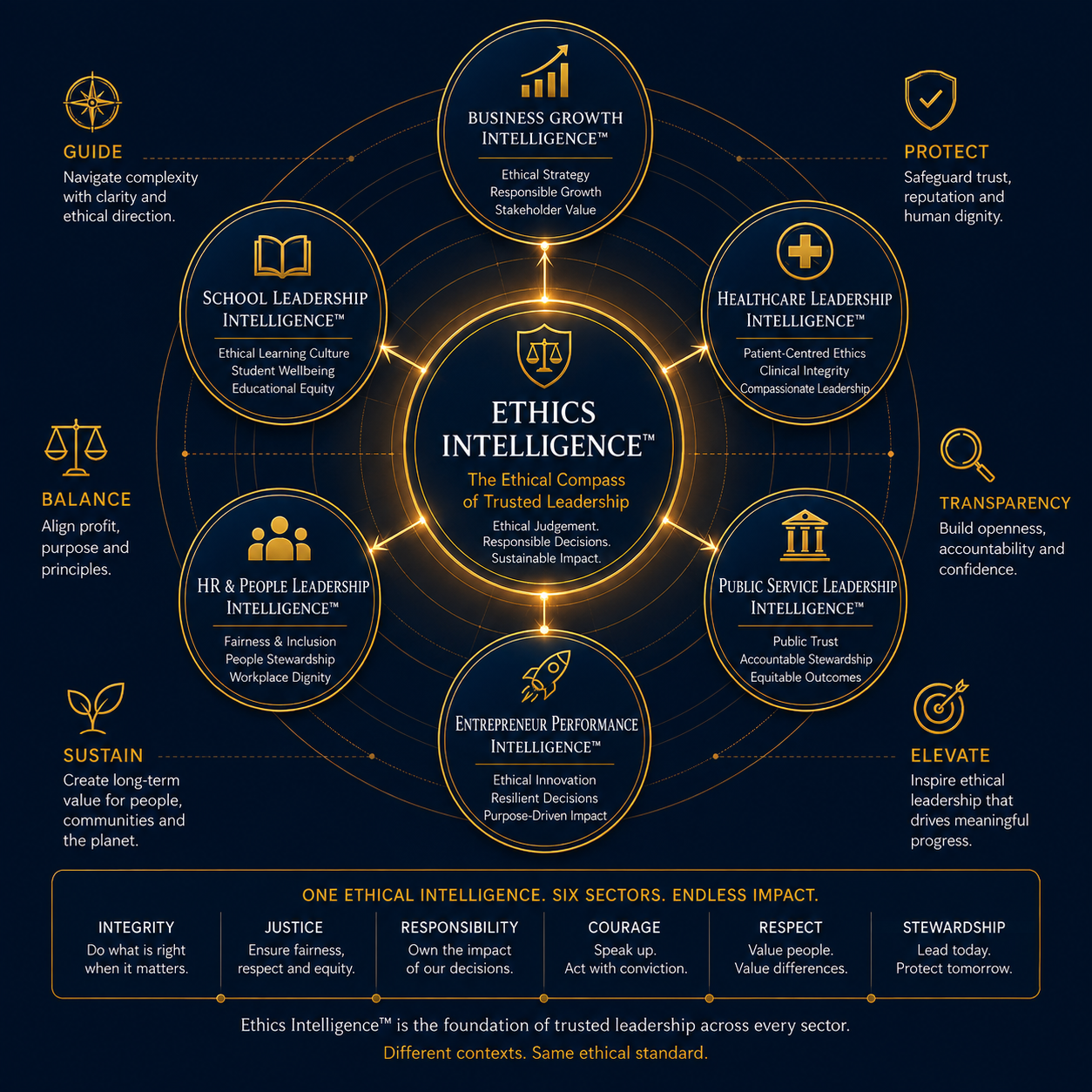
Ethical principles may be universal, but leadership contexts are not. The Leadership Intelligence Compass™ becomes more useful when its principles can be translated into the environments in which leaders actually work.
Business Growth Intelligence™
Consider a business facing declining revenue. The executive team identifies restructuring as necessary. The easy framing is financial: how quickly can we reduce costs? Ethics Intelligence™ expands the decision — how reliable are the assumptions, have alternatives been examined, how will workload be redistributed, are senior leaders sharing any of the sacrifice, and what support will affected employees receive? Ethical leadership does not mean avoiding commercially difficult decisions. It means refusing to treat human consequences as irrelevant simply because the spreadsheet is compelling.
School Leadership Intelligence™
A school leader discovers that a highly respected teacher consistently achieves strong academic results but colleagues report intimidating behaviour. A narrow performance system might protect the teacher because the measurable outcomes are strong. Ethics Intelligence™ asks a broader question: if results are achieved while colleagues become afraid to speak, talented staff leave or students experience inappropriate behaviour, the apparent performance may conceal organisational cost.
Healthcare Leadership Intelligence™
Imagine a healthcare leader managing significant staffing pressure where the organisation can technically maintain service levels, but professionals are repeatedly absorbing additional workload. Leaders must consider cumulative risk, professional fatigue, quality of care and whether the system depends upon repeated individual sacrifice. This connects Ethics Intelligence™ directly with Leadership Sustainability™: a system that achieves today’s target by consuming tomorrow’s capacity is not necessarily performing well.
Public Service Leadership Intelligence™
Public-service leaders frequently operate between political direction, professional advice, legislation, resource constraints and community expectations. A decision may be legally permissible and politically supported while still requiring careful examination of fairness, evidence and public consequences. The ethical leader must remain conscious that public authority is exercised on behalf of others, not possessed personally.
HR & People Leadership Intelligence™
People leaders regularly handle information that is confidential, contested and consequential. Ethics Intelligence™ requires confidentiality without secrecy, fairness without passivity, empathy without abandoning accountability and procedural discipline without losing sight of human consequences.
Entrepreneur Performance Intelligence™
Founders face a distinctive ethical challenge because organisational identity and personal identity can become intertwined, which can make disagreement feel personal. Ethical entrepreneurship therefore requires the founder to create mechanisms capable of challenging the founder — independent advisers, transparent decision criteria, meaningful governance and deliberate separation between personal preference and organisational interest.
Ethics Intelligence™ as Leadership Performance Intelligence™
The central proposition is straightforward: leadership performance cannot be fully understood without ethical performance. Traditional performance measurement tends to ask whether the target was achieved, whether revenue increased, whether the project was delivered. Leadership Performance Intelligence™ asks additional questions: what leadership capability produced the result, was that capability sustainable, what happened to team capacity, and what risks accumulated beneath the visible result?
This is why Ethics Intelligence™ should not sit at the edge of leadership development as a compliance module completed once a year. It belongs inside the architecture of leadership performance.
Ethics influences decision quality.
Decision quality influences trust.
Trust influences information flow.
Information flow influences learning.
Learning influences adaptability.
Adaptability influences performance.
And performance achieved without sustainability eventually threatens future capacity. A leader who develops Ethics Intelligence™ is therefore not merely becoming a more ethical leader. They are developing a more sophisticated understanding of what good leadership performance actually means.
The Ethics Intelligence™ Pressure Test
Ethical standards are easiest to defend when defending them costs very little. The more revealing question is what happens when ethical judgement competes with performance pressure, personal loyalty, reputation, financial interests or urgency. Before making a significant leadership decision, consider six tests.
1. The Evidence Test
What evidence supports this decision, and what evidence might challenge it? The purpose is to deliberately search for information capable of changing the decision, not simply to confirm what you already prefer.
2. The Stakeholder Test
Who benefits, who carries the cost and whose voice is missing? Leadership decisions rarely distribute consequences equally.
3. The Power Test
Would people with less authority feel able to challenge this decision? Silence should never automatically be interpreted as agreement.
4. The Consistency Test
Would I apply the same reasoning if the people involved were different? Consistency doesn’t mean identical treatment — it means being able to explain why differences are ethically relevant rather than personally convenient.
5. The Transparency Test
Could I explain this decision, including its difficult aspects, to the people most affected by it? If a decision only appears defensible when key facts remain hidden, further examination is warranted.
6. The Sustainability Test
What happens if we continue making decisions like this? A single decision can appear harmless; a repeated pattern can transform a culture. This question connects Ethics Intelligence™ directly to Leadership Sustainability™ and Leadership Capacity™.
A Practical Case: When the Highest Performer Becomes the Leadership Problem
Consider a fictional but realistic case. A growing professional-services organisation has a senior manager responsible for one of its strongest commercial teams. The manager consistently exceeds revenue targets and clients value their expertise. Yet employee turnover within the team has increased, with several employees describing the manager as unpredictable, criticised publicly, contacted repeatedly outside normal working hours and excluded from opportunities after disagreeing with the manager.
The Narrow Performance Interpretation
A narrow interpretation asks only: is the manager delivering results? Have they clearly violated a specific rule? Can the organisation afford to lose them? From this perspective, the logical response may be to provide some coaching while protecting the manager’s position.
The Leadership Performance Intelligence™ Interpretation
A broader assessment asks different questions: what is the cost of turnover, why are employees reluctant to challenge the manager, is commercial performance dependent upon unsustainable workload, and what message is being communicated to other managers? Now the definition of performance changes — the manager’s revenue remains relevant, but it is no longer the only evidence.
Burn Bright’s work on toxic leadership in small teams emphasises how damaging patterns may develop gradually through behaviours such as undermining, excessive control and the erosion of psychological safety, particularly where teams lack organisational buffers or credible escalation routes. The ethically intelligent response begins with evidence rather than labels: investigate the pattern fairly, establish behavioural expectations, protect legitimate employee voice, examine workload and turnover data, and hold the manager accountable for both what the team achieves and how leadership contributes to those achievements. This does not presume guilt, nor does it excuse harmful behaviour because someone performs well.
Ethical Drift: How Good Leaders Gradually Compromise Their Standards
Major ethical failures attract attention. Ethical drift is quieter. It occurs when small compromises gradually become normal, often beginning with apparently reasonable statements.
“We will make an exception this time.”
“There isn’t time to consult everyone.”
“We cannot afford to lose this person.”
“We will address the workload after the next deadline.”
“Technically, we haven’t broken any rules.”
Each statement may occasionally be defensible. The danger lies in repetition. A temporary exception becomes normal practice. An emergency workload becomes the operating model. A difficult employee becomes untouchable because they produce results. Eventually, the organisation can arrive somewhere nobody consciously intended to go.
This is why reflective practice is not an optional intellectual exercise. Reflection interrupts normalisation, giving leaders an opportunity to ask whether repeated decisions are slowly changing the standards they believe they are protecting.
Warning Signs That Ethics Intelligence™ Is Weakening
Leaders and organisations should pay particular attention when:
- Performance repeatedly excuses behaviour
- Seniority changes the standard of accountability
- Challenge is interpreted as disloyalty
- Employees increasingly discuss concerns privately rather than openly
- Urgency becomes the routine justification for avoiding consultation
- People focus on whether something is technically permissible rather than whether it is responsible
- Leaders defend intentions while dismissing impact
- Difficult information becomes less likely to travel upwards
- Workload depends repeatedly on discretionary sacrifice
- Organisational values appear prominently in communications but rarely in decision criteria
None of these signs proves unethical leadership. They are prompts for examination. Ethics Intelligence™ is strongest when leaders investigate warning signs before they become crises.
Leadership Reflection Questions
- Which ethical dimensions of my role am I most likely to overlook because I consider them operational rather than ethical?
- When did I last change an important decision because someone with less authority challenged my thinking?
- Which people carry the greatest consequences of my decisions while having the least influence over them?
- Where might performance results be concealing leadership costs?
- Which organisational behaviour do we tolerate from high performers that we would challenge in others?
- Where has an exceptional working practice quietly become a permanent expectation?
- What information is least likely to reach me because of my position?
- When I say that people can speak openly, what evidence demonstrates that they actually do?
- Which of my current decisions would be hardest to explain transparently to those affected?
- What would stronger Ethics Intelligence™ change about the way I lead this month?
Action Steps: Building Ethics Intelligence™ Into Leadership Practice
Ethical capability strengthens when it becomes part of routine leadership rather than something activated only during a crisis.
Identify ethically significant decisions
Add an explicit ethical-dimension question to major decision papers, project reviews and leadership meetings.
Separate evidence from assumption
Ask teams to identify what is known, inferred, disputed and still unknown before major decisions are approved.
Establish a challenge mechanism
Determine how people with less positional authority can question important decisions without disproportionate personal risk.
Measure leadership conditions, not just outcomes
Examine workload, turnover, psychological safety, capability development and sustainability alongside traditional performance indicators.
Review consequential decisions
Return to important decisions after implementation. Compare intended and actual consequences.
Connect ethical judgement to leadership development
Use the Leadership Intelligence Compass™, diagnostics, reflective tools and the Leadership Intelligence Assessment™ to examine Ethics Intelligence™ alongside other leadership capabilities.
Examine the system, not only the individual
When unethical or harmful behaviour occurs, ask what incentives, structures, workload conditions or cultural norms allowed it to continue.
The objective is not ethical perfection. It is stronger ethical capability.
Frequently Asked Questions
What is ethics leadership?
Ethics leadership is the practice of recognising the ethical dimensions of leadership decisions and exercising judgement that considers responsibilities, values, consequences, power and accountability. It extends beyond personal integrity or compliance because leaders also shape the conditions in which other people work and make decisions.
What is Ethics Intelligence™?
Within Burn Bright Advisory’s Leadership Intelligence Compass™, Ethics Intelligence™ describes the leadership capability to recognise ethical complexity, examine competing obligations and perspectives, anticipate consequences and make defensible decisions under pressure.
Why is ethical leadership important?
Leadership decisions affect people, resources, opportunities and organisational culture. Ethical leadership improves the quality and legitimacy of those decisions by ensuring that performance is not considered independently from responsibility, consequences and the way results are achieved.
Is ethical leadership the same as compliance?
No. Compliance establishes legal, regulatory or organisational requirements. Ethics leadership asks broader questions about fairness, responsibility, power, consequences and judgement. A decision can comply with a rule while still deserving ethical scrutiny.
Can an ethical leader make an unpopular decision?
Yes. Ethical leadership does not require universal agreement. Restructuring, performance management, resource allocation and other difficult decisions may remain unpopular. The relevant question is whether the leader has considered evidence, competing responsibilities and consequences and can account for the judgement made.
How does power affect ethical leadership?
Greater authority generally creates greater responsibility because leaders influence resources, information, careers and opportunities. Ethical leaders therefore examine whether people can realistically challenge them rather than assuming silence means agreement.
How can organisations prevent ethical drift?
Organisations can reduce ethical drift by making ethical considerations explicit in decision processes, protecting challenge, examining patterns rather than isolated incidents, reviewing consequences and ensuring that performance does not excuse harmful leadership behaviour.
How does Ethics Intelligence™ relate to Leadership Performance Intelligence™?
Ethics Intelligence™ contributes to Leadership Performance Intelligence™ because leadership quality cannot be assessed only through outcomes. Sustainable performance also depends on how results are produced, what leadership capability created them, what consequences followed and whether the approach strengthens or depletes future organisational capacity.
Leadership Is Revealed in the Decisions That Cost Something
Ethical leadership is easy to endorse in principle. Its real value emerges under pressure — when protecting standards may cost revenue, when listening takes longer than deciding, when accountability involves someone valuable, when admitting uncertainty feels less comfortable than projecting confidence, when today’s target conflicts with tomorrow’s capacity.
Within Leadership Performance Intelligence™, ethical judgement is not separate from performance. It helps determine whether performance is legitimate, sustainable and worthy of trust. The strongest leaders do not simply ask “Can we do this?” They also ask who will be affected, what responsibility they carry, what they are failing to see, whether they could defend the decision openly, and what kind of leadership system repeated decisions like this will create.
That is the shift from ethics as policy to Ethics Intelligence™ as leadership capability. Ethical leadership is not demonstrated by claiming to have the right values. It is demonstrated by what leaders are prepared to notice, question, decide, explain—and change.
Where Does Your Ethics Intelligence™ Stand Today?
Take the free Leadership Burnout Self-Assessment to see how your leadership judgement, workload and decision-making pressures connect — and where to focus next.
Free Leadership Intelligence
Get Weekly Leadership Insights
Join thousands of leaders receiving practical strategies on burnout prevention, workload design, and sustainable performance every week.