Quick Answer
Key Takeaways
- Professionalism Intelligence™ is a performance intelligence, not just a presentation standard — it is revealed most clearly under pressure.
- Five foundations drive it: Standards, Judgement, Consistency, Accountability and Stewardship.
- The professionalism gap — the distance between stated standards and lived leadership experience — is what erodes credibility and trust.
- Professionalism does not mean perfection. Acknowledging mistakes and uncertainty can strengthen credibility rather than weaken it.
- Stewardship is the most mature expression of professionalism: leaving people, teams and systems stronger than a leader found them.
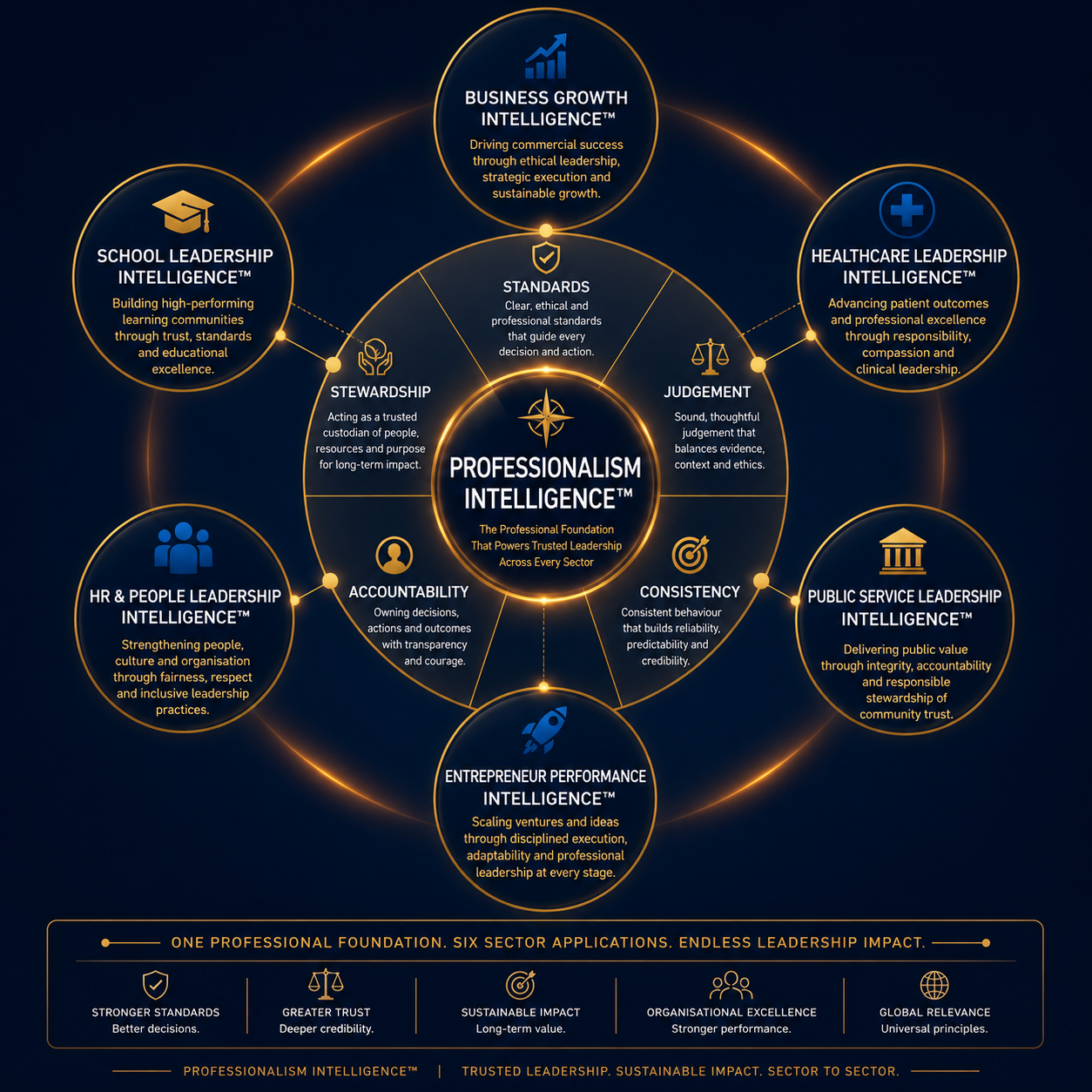
- Professionalism Intelligence™ applies differently across Business Growth, School, Healthcare, Public Service, HR & People and Entrepreneur leadership contexts.
Professionalism in Leadership: Why Standards Matter Most When Leadership Gets Difficult
What Is Professionalism in Leadership?
Professionalism in leadership is the consistent application of appropriate standards, sound judgement, accountable behaviour and responsible stewardship across decisions, relationships and organisational responsibilities. It extends beyond appearance or etiquette. Professionalism builds credibility because people can trust how a leader will think, behave and respond — especially when circumstances become difficult.
Professionalism is easy to demonstrate when circumstances are comfortable. The real test comes when they are not — when performance deteriorates, when a colleague disappoints you, when resources become constrained, when an employee challenges your judgement, when a customer becomes unreasonable, when political pressure increases, when a mistake becomes visible, or when there is no obviously correct decision.
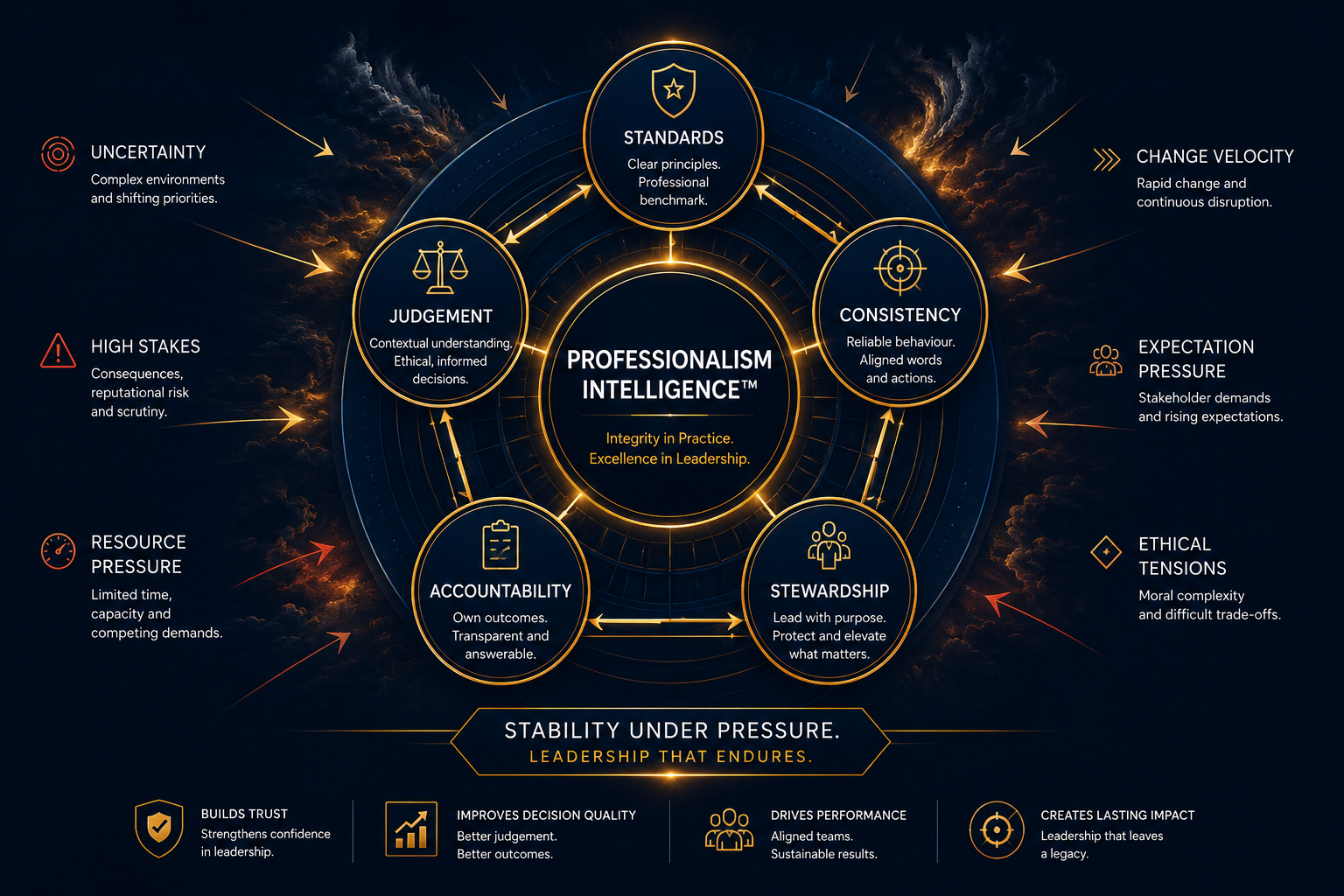
Those moments reveal something important about leadership: professionalism is not primarily a presentation standard. It is a performance intelligence. At Burn Bright Advisory™, we describe this capability as Professionalism Intelligence™ — the capacity to understand the standards associated with leadership responsibility and translate them consistently into judgement, behaviour, accountability and stewardship.
Featured Snippet
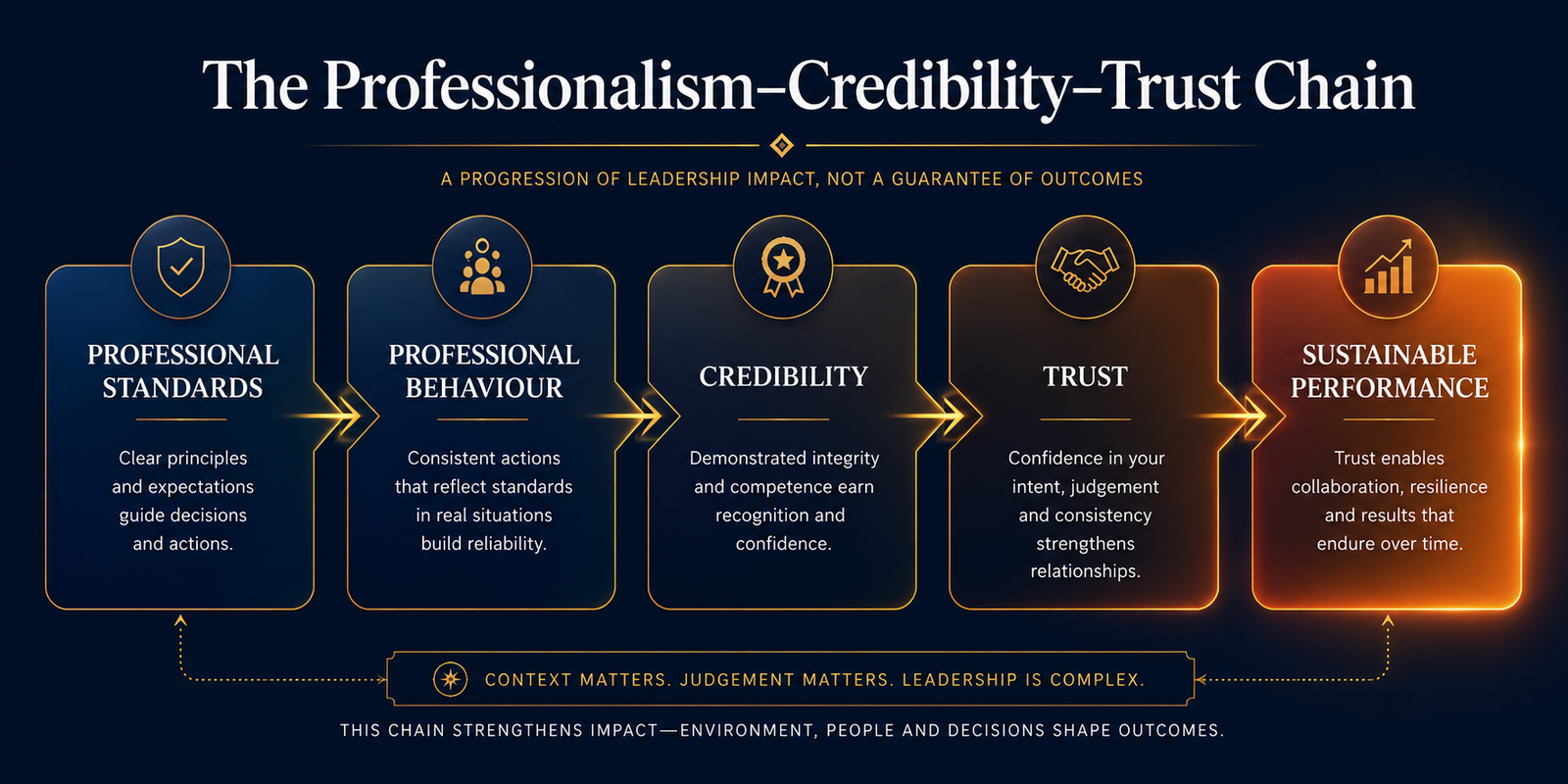
Professionalism Intelligence™ therefore sits within the wider system of Leadership Performance Intelligence™. It connects what leaders believe with what they actually do. It turns standards into behaviour, behaviour into credibility, credibility into trust, and trust into the conditions required for sustainable performance.
This distinction matters because organisations frequently approach professionalism too narrowly. Dress codes, communication etiquette, punctuality and appropriate workplace behaviour have their place, but they represent only the visible surface of a much deeper leadership capability. A leader can look professional while exercising poor judgement, communicate eloquently while avoiding accountability, understand organisational policies while applying them inconsistently, or possess significant expertise while treating colleagues without respect. None of these represents mature professionalism.
Professionalism becomes strategically significant when standards remain visible in the leader’s behaviour under pressure. That is why professionalism should be treated not simply as expected conduct but as leadership infrastructure.
Professionalism in Leadership Is Revealed Under Pressure
Most organisations can describe the leadership standards they want. Fewer can demonstrate those standards consistently. Values appear on websites, behavioural expectations sit inside leadership frameworks, and codes of conduct define acceptable practice. Yet employees do not experience leadership through documents — they experience it through decisions.
They notice what happens when someone makes a mistake.
They observe whose behaviour is challenged and whose is ignored.
They remember whether commitments are honoured.
They recognise whether difficult conversations remain respectful.
They see whether leaders apply the same expectations to themselves that they apply to everybody else.
This creates what Burn Bright Advisory™ describes as the professionalism gap: the distance between stated leadership standards and lived leadership experience. The larger that gap becomes, the more credibility deteriorates — and when credibility deteriorates, trust becomes increasingly expensive to maintain.
That question moves professionalism beyond appearance and etiquette into the territory of leadership performance.
The Five Foundations of Professionalism Intelligence™
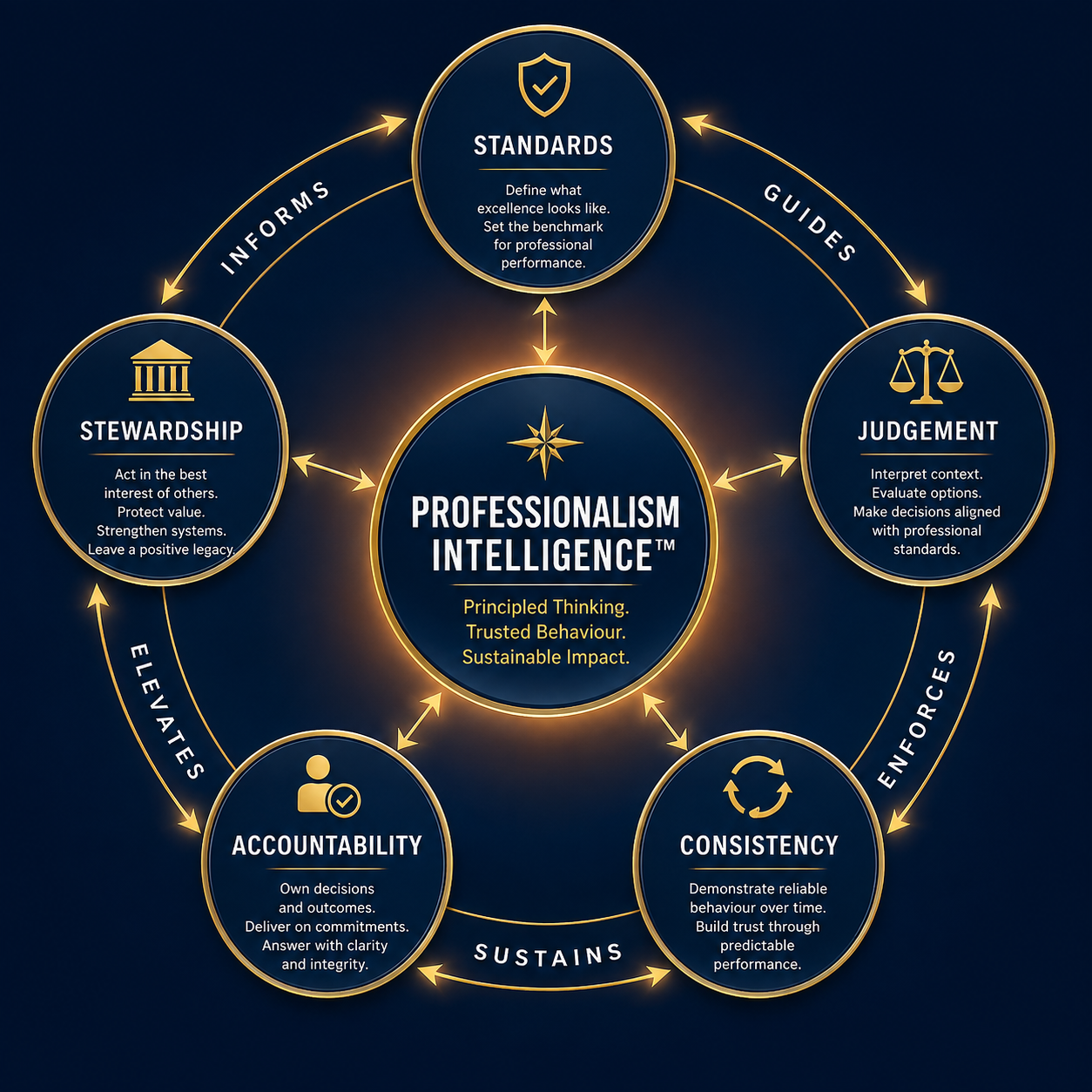
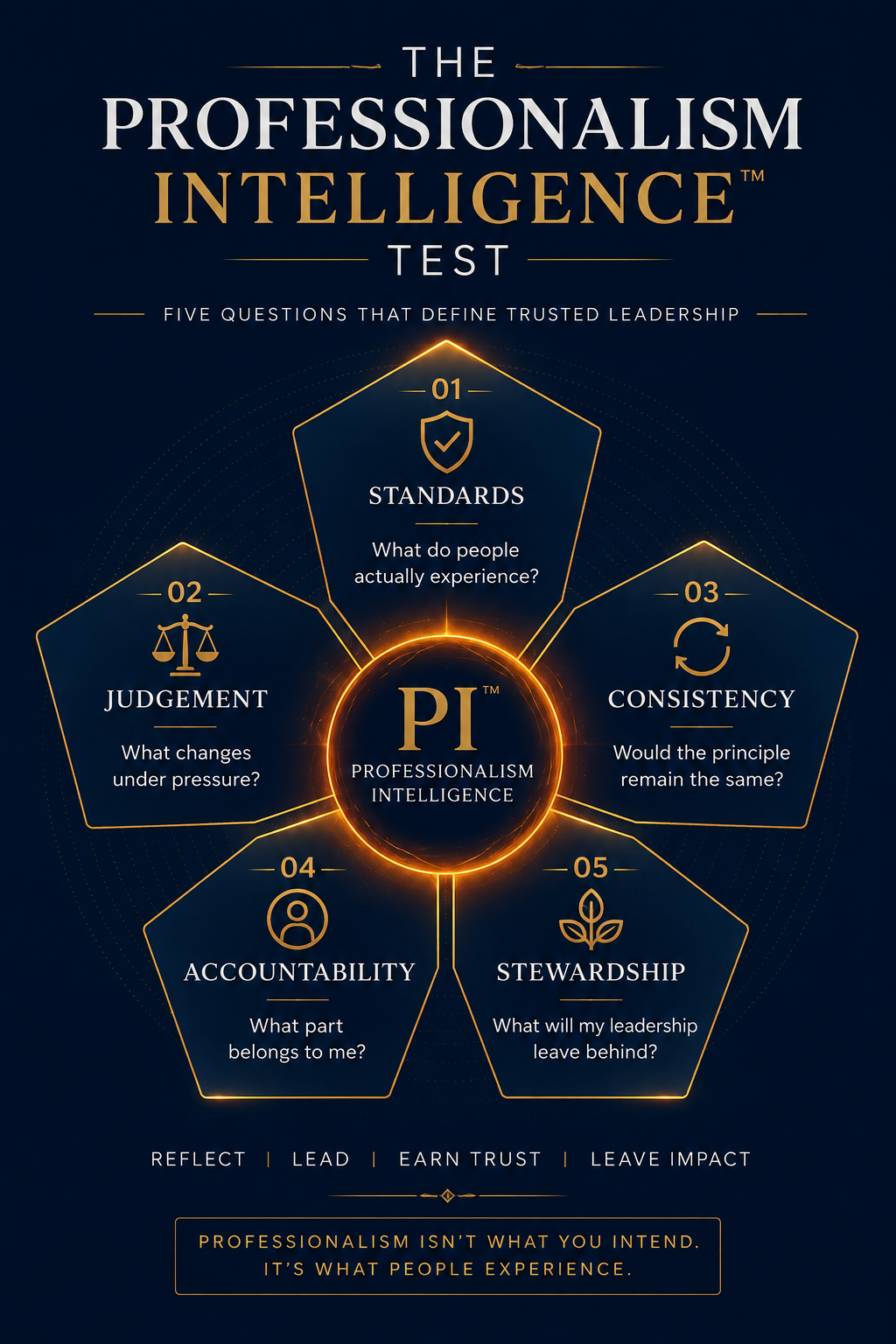
Within the Burn Bright leadership architecture, Professionalism Intelligence™ can be understood through five interconnected foundations. These should not be treated as independent competencies — they operate as a system.
Foundation 1
Standards
Know what good leadership requires. Standards establish the reference point against which leadership behaviour can be evaluated — but having standards on paper is not enough. The challenge is translation: converting abstract expectations into observable leadership practice.
Foundation 2
Judgement
Interpret standards in context. Rules cannot anticipate every situation, and policies cannot replace judgement. Professional judgement requires leaders to weigh context, evidence, consequences, stakeholder impact, ethical obligations and long-term implications.
Foundation 3
Consistency
Make leadership predictable where it matters. Consistency does not mean behaving identically in every situation — it means the underlying principles remain recognisable even when the response changes.
Foundation 4
Accountability
Demonstrate whether the leader is willing to stand behind the result. Accountability asks what part of an outcome belongs to the leader, rather than defaulting to blame.
Foundation 5
Stewardship
Consider what leadership decisions leave behind. Stewardship asks whether a team, organisation or system will be stronger because a leader led it.
1. Standards: Know What Good Leadership Requires
Professionalism begins with clarity. Leaders cannot consistently demonstrate standards they have never defined. Standards answer questions such as: What behaviour is expected here? What does good judgement look like? What responsibilities accompany this leadership role? What will we protect even when performance pressure increases? What is unacceptable regardless of who does it?
Professional standards establish the reference point against which leadership behaviour can be evaluated. But having standards is not enough. Many organisations have excellent standards on paper and inconsistent leadership in practice. The challenge is translation. A value such as respect, for example, remains abstract until leaders determine what respectful leadership looks like during disagreement, restructuring, performance management or crisis. Professionalism Intelligence™ converts abstract expectations into observable leadership practice.
2. Judgement: Interpret Standards in Context
Leadership rarely takes place in perfectly controlled circumstances. Rules cannot anticipate every situation, and policies cannot replace judgement. Two employees may make similar mistakes for entirely different reasons. Two apparently identical performance problems may require different interventions. A decision that is appropriate in a commercial environment may be unacceptable in healthcare, education or public service because the stakeholder risks are different.
Professional judgement therefore requires more than knowing the rules. It requires leaders to consider context, evidence, consequences, stakeholder impact, ethical obligations, organisational priorities, professional boundaries and long-term implications.
This is where Professionalism Intelligence™ begins connecting strongly with other areas of the Leadership Intelligence Compass™. Professional judgement requires Ethics Intelligence™ because not everything that is permissible is necessarily responsible. It requires Emotional Intelligence™ because decisions affect people. It requires Reflective Practice Intelligence™ because previous experience should inform future judgement. It requires Adaptability Intelligence™ because context changes. Professionalism is therefore not an isolated leadership characteristic — it is one of the mechanisms through which multiple leadership intelligences become visible in practice.
3. Consistency: Make Leadership Predictable Where It Matters
One of the most underestimated characteristics of effective leadership is appropriate predictability. People should not have to calculate which version of their leader will arrive today. Will poor performance be challenged this time? Will the agreed boundary still exist? Will the leader honour the commitment? Will disagreement be welcomed or punished? Will the standard change depending on who is involved?
When leadership becomes behaviourally unpredictable, employees spend cognitive and emotional energy interpreting the leader instead of performing their work. Consistency reduces that friction. It does not mean behaving identically in every situation — mature leadership remains responsive to context. Rather, consistency means that the underlying principles remain recognisable even when the response changes.
Rigid leadership repeats behaviour. Professional leadership preserves standards while adapting behaviour intelligently. That is a much higher level of capability.
The Professionalism–Credibility–Trust Chain
Professionalism has strategic consequences because leadership behaviour generates evidence. Every interaction tells people something. A commitment that is honoured provides evidence of reliability. A difficult conversation conducted respectfully provides evidence of maturity. A mistake acknowledged openly provides evidence of accountability. A boundary maintained fairly provides evidence of integrity. A thoughtful decision made under pressure provides evidence of judgement.
This relationship helps explain why trust cannot simply be demanded through leadership authority. Trust is partly an evidence judgement. People continually assess whether the person leading them is competent, reliable, fair and sufficiently consistent to justify confidence. Professionalism provides much of that evidence.
This is why apparently small acts of inconsistency can have disproportionate consequences. Imagine a leader who repeatedly tells employees that wellbeing matters but sends non-urgent messages late at night and expects immediate responses. The individual messages may seem insignificant, but the behavioural signal is not — employees learn that the stated standard and the operational standard are different.
Or consider an executive who promotes accountability but becomes defensive whenever their own decisions are questioned. Again, the individual interaction is only part of the problem. The deeper issue is that people are learning which standards are genuine and which are rhetorical. The professionalism gap widens. Credibility falls. Trust follows.
Professionalism Is Not Perfection
This point requires emphasis because unrealistic interpretations of professionalism can themselves damage leadership. Professionalism does not mean never making mistakes. It does not mean suppressing emotion. It does not mean maintaining executive distance. It does not require leaders to know everything. And it certainly does not require leaders to perform an artificial version of confidence.
Professionalism is better understood as the quality of the leader’s response to reality. Professional leaders can say:
“I made the wrong decision.”
“I don’t know yet.”
“I need more evidence.”
“I should have handled that conversation differently.”
“I need advice.”
“I have changed my view.”
Those statements do not automatically reduce credibility. Handled appropriately, they can strengthen it. Burn Bright’s wider leadership work repeatedly points toward the importance of moving away from leadership models based on individual heroics. Sustainable leadership depends on systems, honest assessment of capacity and the willingness to respond intelligently rather than simply maintaining an image of control.
Similarly, unguarded leadership recognises that curiosity and the capacity to acknowledge uncertainty can be leadership strengths rather than signs of incompetence. Professionalism should therefore never become another form of leadership armour. The objective is not flawless presentation. The objective is trustworthy practice.
Accountability: Where Professionalism Becomes Visible
If standards define expectations and judgement determines how they should be applied, accountability demonstrates whether the leader is willing to stand behind the result. Accountability is particularly revealing because leadership power can make avoidance surprisingly easy. Leaders can blame systems, employees, insufficient resources, predecessors, the market or communication. Sometimes those factors genuinely contribute to failure.
That question changes leadership behaviour. Instead of asking only who failed to deliver, the leader asks whether expectations were sufficiently clear. Instead of blaming poor communication, they examine whether they created the conditions for information to travel effectively. Instead of describing an employee as difficult, they consider whether unresolved conflict has been allowed to develop. Instead of treating burnout purely as an individual’s resilience problem, they examine workload, systems, boundaries and organisational expectations.
Burn Bright’s work on leadership sustainability identifies a recurring problem in modern management: organisations can create structurally unsustainable leadership roles and then place responsibility on individuals to cope with them. Sustainable leadership requires systems thinking rather than dependence on individual heroics. Professional accountability therefore extends beyond admitting mistakes — it includes examining the system a leader has helped create.
When Professionalism Breaks Down
The absence of professionalism is not always dramatic. Sometimes it arrives quietly.
A leader interrupts more often.
An exception is made for a favoured employee.
A commitment is forgotten.
An uncomfortable issue is postponed.
A colleague’s contribution is presented as the leader’s own.
Standards become flexible when senior people are involved.
Feedback becomes personal rather than developmental.
Information begins to be controlled.
People gradually become more cautious.
These behaviours matter because leadership cultures are rarely transformed by one isolated event. They are shaped by repeated signals. Burn Bright’s work on toxic leadership in small teams illustrates how apparently minor behaviours — dismissiveness, inconsistent accountability, credit-taking, micromanagement and emotional unpredictability — can progressively change the climate of a team. In smaller groups, where there are fewer structural buffers, those patterns can become particularly visible and damaging.
This provides an important lesson for Professionalism Intelligence™: culture is built through accumulated leadership behaviour. Every professional interaction has both an immediate and a systemic consequence. The immediate consequence is what happens in that moment. The systemic consequence is what people learn about how leadership operates here — and that second consequence is often more important.
The Professionalism Test
A useful way to evaluate leadership professionalism is to move beyond the question “Was my behaviour acceptable?” and ask five stronger questions.
Standards
Did my behaviour reflect the standard I expect from others?
Judgement
Did I properly consider context, evidence and consequences?
Consistency
Would my underlying principles remain the same if a different person were involved?
Accountability
Am I prepared to own my contribution to the outcome?
Stewardship
Did my decision strengthen or weaken the environment I am responsible for leaving behind?
Together, these questions move professionalism from compliance to intelligence. They transform it from a workplace expectation into a leadership performance discipline. The final question — stewardship — is particularly important because it changes the time horizon of leadership.
A leader may achieve today’s target while damaging tomorrow’s capacity. They may win an argument while weakening a relationship. They may solve a staffing problem while creating a retention problem. They may accelerate delivery while normalising unsustainable workload. They may protect their reputation while destroying psychological safety.
Professionalism Intelligence™ therefore asks leaders to consider not only “Can I do this?” or even “Will this work?” but: “What will this decision leave behind?” That is where professionalism becomes stewardship — and where professional leadership begins to move beyond individual conduct toward sustainable organisational performance.
Stewardship: The Long-Term Test of Professional Leadership
Professionalism reaches its most mature expression through stewardship. Accountability asks leaders to take responsibility for what happens. Stewardship asks them to take responsibility for what their leadership leaves behind.
Leadership decisions rarely end when the meeting finishes, the target is achieved or the immediate problem disappears. Decisions alter expectations. They influence relationships. They establish precedents. They consume or create capacity. They teach people what behaviour will be rewarded, tolerated or challenged.
Every leader therefore inherits something and leaves something. They inherit teams, systems, relationships, knowledge, resources, reputations and cultures shaped by those who came before them. Their responsibility is not simply to use those assets — it is to strengthen them.
This is why stewardship sits naturally within Professionalism Intelligence™ and connects directly with Leadership Sustainability™. A professionally intelligent leader does not continually extract performance from people until capacity is depleted. Sustainable leadership requires attention to workload, systems, boundaries and the conditions under which people are expected to perform. Burn Bright’s leadership sustainability work makes the distinction particularly clear: long-term effectiveness cannot depend indefinitely on individual heroics.
That question changes how performance is understood. Short-term output remains important, but so do capability, trust, institutional knowledge, leadership pipelines, psychological safety and the capacity to perform again tomorrow. Professional leadership must hold both perspectives simultaneously.
Professionalism Intelligence™ Across Six Leadership Contexts
The principles of professionalism are universal. Their application is contextual. A chief executive, school principal, clinical leader, public servant, HR director and entrepreneur may all require standards, judgement, consistency, accountability and stewardship — but the pressures under which those capabilities operate are different. That is why Leadership Performance Intelligence™ should not be reduced to generic leadership advice. Leadership capability must be interpreted through context.
Business Growth Intelligence™: Professionalism During Commercial Pressure
When growth slows, margins tighten or targets are missed, leaders can be tempted to treat professionalism as secondary to results. It is not — this is precisely when it matters most. Professional leadership does not reject commercial ambition; it disciplines it. Growth that repeatedly consumes trust, reputation or workforce capacity is not intelligent growth.
School Leadership Intelligence™: Standards Become Culture
A school leader is not merely managing operations — their behaviour helps define the professional culture experienced by teachers, support staff, students and families. A professionally intelligent response to inconsistent teaching performance addresses the problem through clear expectations, evidence, appropriate support, respectful challenge and accountability, teaching the organisation how adults are expected to work together.
Healthcare Leadership Intelligence™: Professionalism and Consequence
Leadership behaviour can influence whether people feel able to challenge decisions, raise concerns and acknowledge uncertainty — with consequences beyond employee experience. Professionalism Intelligence™ in healthcare requires humility alongside expertise, creating conditions where questions can be raised, evidence can challenge hierarchy, errors can be examined and learning can occur without unnecessary humiliation.
Public Service Leadership Intelligence™: Stewardship Beyond the Individual Leader
Public leaders operate within systems that frequently outlast individual appointments, and their decisions may affect citizens who never meet them. Professionalism therefore includes careful use of authority, resources and institutional responsibility, and is inseparable from institutional trust.
HR & People Leadership Intelligence™: The Credibility Test
Few functions are judged against their own stated standards as closely as HR and people leadership. Where policy, leadership behaviour and employee experience diverge, credibility deteriorates quickly. HR leaders must support professional behaviour across the organisation while ensuring their own function models the standards it advocates.
Entrepreneur Performance Intelligence™: Professionalising Without Losing Agility
What works when five people sit around one table can become increasingly fragile as an organisation grows. Professionalising does not mean suffocating entrepreneurship with bureaucracy — it means creating sufficient standards and systems for performance to become less dependent on individual heroics, moving from “people know how I want things done” to “people understand the standards by which we operate.”
A Practical Professionalism Intelligence™ Diagnostic
Professionalism becomes useful when leaders can examine it systematically. The following five-domain diagnostic can be used for individual reflection, leadership development conversations or team review.
Domain 1Standards
- Are leadership expectations explicit?
- Can people describe what professional leadership looks like here?
- Are important standards translated into observable behaviour?
- Do senior leaders model the standards expected from others?
Domain 2Judgement
- Are decisions informed by sufficient evidence?
- Is context considered before conclusions are reached?
- Can leaders distinguish urgency from importance?
- Are consequences for different stakeholders considered?
- Can leaders revise their judgement when better information emerges?
Domain 3Consistency
- Are comparable situations treated according to recognisable principles?
- Do standards change depending on status or personal relationships?
- Are commitments generally honoured?
- Can employees reasonably predict how leaders will respond to important issues?
Domain 4Accountability
- Do leaders acknowledge their contribution to poor outcomes?
- Are mistakes examined rather than hidden?
- Is accountability applied upward as well as downward?
- Are systemic causes investigated alongside individual responsibility?
Domain 5Stewardship
- Are decisions strengthening long-term organisational capacity?
- Is performance being achieved sustainably?
- Are future leaders being developed?
- Is institutional knowledge being protected?
- Will the team or organisation be stronger after the leader leaves?
The purpose is not to produce a perfect score. It is to identify the distance between leadership intention and leadership experience. That distance is where development work begins.
From Professional Conduct to Leadership Performance Intelligence™
Professionalism is sometimes treated as an entry-level expectation — something leaders should already possess before they reach senior positions. That assumption is misleading. The complexity of professionalism increases with responsibility. As leadership authority grows, decisions involve more stakeholders, greater ambiguity, competing interests and more significant consequences. Professionalism must therefore develop alongside leadership responsibility.
This is where the Leadership Intelligence Compass™ becomes valuable. Professionalism Intelligence™ does not operate alone. It interacts with:
- Ethics Intelligence™ — to examine what should be done.
- Constructivism Intelligence™ — to understand how meaning and solutions can be developed with others.
- Adaptability Intelligence™ — to respond intelligently when circumstances change.
- Visionary Leadership Intelligence™ — to connect immediate decisions with future direction.
- Reflective Practice Intelligence™ — to turn experience into learning.
- Knowledge Development Intelligence™ — to ensure judgement remains informed.
- Emotional Intelligence™ — to understand the human consequences of leadership behaviour.
- Leadership Sustainability™ — to ensure performance can be maintained without continually exhausting people or systems.
Professionalism Intelligence™ provides an important bridge across these domains because it asks whether leadership capability is actually becoming visible through behaviour. Knowledge without behaviour is insufficient. Values without behaviour are insufficient. Intentions without behaviour are insufficient. Leadership is ultimately experienced.
Leadership Reflection Questions
- What standards do people experience from my leadership rather than simply hear me describe?
- Where might a gap exist between the professional standards I advocate and the behaviour I demonstrate?
- How does my judgement change when I am under significant pressure?
- Are there people for whom I unconsciously apply different standards?
- How do I respond when someone challenges my judgement?
- When something goes wrong, how quickly do I examine my own contribution?
- What behaviours does my leadership unintentionally normalise?
- Does my current approach create sustainable performance or depend too heavily on individual effort?
- What will be stronger because of my period of leadership?
- If members of my team completed this Professionalism Intelligence™ diagnostic anonymously, where would their assessment differ from mine?
Action Steps: Strengthening Professionalism Intelligence™
Professionalism improves through deliberate practice rather than aspiration.
Define Three Non-Negotiable Standards
Identify three standards you want people consistently to experience from your leadership, and make them behavioural. Instead of “I value respect,” define what respect means: “I will challenge the issue without diminishing the person.” Specificity makes standards observable.
Audit Your Exceptions
Review recent decisions and ask where you have made exceptions. Some will be justified; others may reveal inconsistency, avoidance or bias. The objective is not rigid uniformity — it is conscious consistency.
Examine One Difficult Decision
Choose a significant recent decision and review it through all five dimensions — Standards, Judgement, Consistency, Accountability, Stewardship — and ask what you would repeat and what you would change.
Request Evidence, Not Reassurance
Do not ask your team “Do you think I’m professional?” — the question is too broad and socially difficult to answer honestly. Ask instead: “What is one leadership behaviour I should do more consistently?” or “Where do our stated standards and everyday practice differ?”
Build Reflection Into Leadership Practice
Professionalism deteriorates when leaders become too busy to examine their own behaviour. Use the Leadership Intelligence Assessment™, relevant diagnostics and Leadership Intelligence Library™ resources to convert reflection into a structured development process rather than an occasional exercise.
Conclusion: Professionalism Is What Remains When Leadership Is Tested
Professionalism is not demonstrated by having an impressive title. It is not defined by polished communication. It is not synonymous with formality. And it is not the absence of mistakes.
Professionalism is demonstrated through the standards leaders maintain when maintaining them becomes difficult.
It appears in the quality of judgement exercised when information is incomplete.
It appears in consistency when relationships complicate decisions.
It appears in accountability when outcomes disappoint.
And it appears in stewardship when leaders consider what their decisions will leave behind.
That is why Professionalism Intelligence™ matters within Leadership Performance Intelligence™. It converts leadership intention into leadership evidence, and that evidence accumulates. People learn whether your commitments mean something. They learn whether standards apply consistently. They learn whether disagreement is safe. They learn whether mistakes can be acknowledged. They learn whether performance matters more than people — or whether leaders are capable of designing conditions in which both can succeed.
Ultimately, professionalism answers one of the most important questions people ask about leadership: can I trust how this person will lead when circumstances become difficult? Strong leadership cannot guarantee easy circumstances. It can provide something more valuable — standards people recognise, judgement they can respect, consistency they can understand, accountability they can see, and stewardship that leaves the system stronger. That is Professionalism Intelligence™, and that is how professionalism moves from workplace conduct to sustainable leadership performance.
What is Professionalism Intelligence™?
Professionalism Intelligence™ is the leadership capacity to understand professional standards and translate them consistently into sound judgement, appropriate behaviour, accountability and responsible stewardship. It forms part of the wider Leadership Performance Intelligence™ system and the Leadership Intelligence Compass™, focusing on whether a leader’s behaviour creates credible evidence that they can be trusted with responsibility.
Why is professionalism important in leadership?
Professionalism matters because leadership credibility is built through repeated behaviour. Employees observe whether leaders honour commitments, apply standards consistently, exercise appropriate judgement, acknowledge mistakes and behave responsibly when circumstances become difficult. This feeds a wider performance chain: Professional Standards → Professional Behaviour → Credibility → Trust → Sustainable Performance.
What are the five foundations of Professionalism Intelligence™?
The five foundations are Standards, Judgement, Consistency, Accountability and Stewardship — together providing a practical framework for examining professional leadership behaviour.
What is the difference between professionalism and professional conduct?
Professional conduct focuses primarily on observable behaviour. Professionalism Intelligence™ goes deeper by examining the judgement, standards, accountability and stewardship underlying that behaviour, asking not simply whether behaviour is acceptable, but whether leadership practice is credible, responsible and sustainable.
Can a leader be professional and still show vulnerability?
Yes. Acknowledging uncertainty, requesting advice, changing a position when better evidence emerges and admitting mistakes can all be professionally intelligent responses. This connects Professionalism Intelligence™ with the wider principle of unguarded leadership — leaders do not necessarily strengthen credibility by protecting an image of certainty.
How does professionalism affect trust?
Trust develops partly through accumulated evidence. Every honoured commitment, fair decision, appropriately handled disagreement and acknowledged mistake provides information about a leader’s reliability. Inconsistency provides information too, and repeatedly saying one thing while doing another teaches employees that stated standards cannot be relied upon.
How can leaders improve their professionalism?
Leaders can define clear behavioural standards, review inconsistencies and exceptions, examine difficult decisions retrospectively, request specific feedback, identify recurring judgement patterns, strengthen accountability, and consider the long-term consequences of their leadership decisions.
How does Professionalism Intelligence™ connect with Leadership Sustainability™?
The connection is particularly strong through stewardship. Sustainable leadership requires systems rather than continual dependence on individual heroics. Professionalism Intelligence™ therefore asks not only whether a leader can produce results, but whether those results are being achieved responsibly and sustainably.
What happens when professional leadership standards deteriorate?
Deterioration may initially appear minor — commitments become less reliable, exceptions become more frequent, difficult conversations become personal, favouritism appears and accountability becomes selective. Over time these signals can reshape team culture, undermining trust, collaboration and psychological safety, particularly within small teams.
How can organisations measure Professionalism Intelligence™?
Measurement should examine both leader intention and stakeholder experience, including clarity of standards, quality of judgement, behavioural consistency, accountability, stewardship, trust, leadership credibility, and alignment between stated organisational values and experienced behaviour. The strongest assessment combines self-reflection with evidence from the people experiencing the leadership.
Where Does Your Leadership Stand?
Explore how Professionalism Intelligence™ interacts with the wider capabilities required for sustainable leadership performance.
Free Leadership Intelligence
Get Weekly Leadership Insights
Join thousands of leaders receiving practical strategies on burnout prevention, workload design, and sustainable performance every week.