Quick Answer
Key Takeaways
- Good intentions are not the same as ethical capability — leadership is experienced by others through impact, not intention.
- Ethics Intelligence™ rests on four connected dimensions: Judgement, Integrity, Responsibility and Impact.
- Serious ethical failures rarely arrive as one dramatic decision — they emerge through ethical drift, a series of individually defensible compromises.
- Five pressures distort ethical judgement: performance pressure, time pressure, authority pressure, loyalty pressure and normalisation pressure.
- The Ethics Intelligence™ Decision Framework — Recognise, Examine, Include, Decide, Act, Reflect — turns ethics into a repeatable leadership discipline.
- Culture is not what an organisation says it values. Culture is what repeated leadership decisions teach people to expect.
Ethics Intelligence™: Why Good Leadership Requires More Than Good Intentions
Most serious ethical failures do not begin with a leader announcing an intention to behave unethically.
They begin much more quietly.
A deadline moves forward.
A target becomes non-negotiable.
A difficult piece of information is softened before reaching senior leadership.
A high-performing employee is given another chance despite behaviour that would not be tolerated from somebody else. A decision is technically permitted, so nobody asks whether it is actually responsible. A leader knows that something feels wrong but convinces themselves that there is no realistic alternative.
Individually, these moments can appear relatively small. Collectively, they determine the ethical character of an organisation.
That distinction matters because conventional discussions of ethical leadership often focus heavily on values. Organisations publish codes of conduct, values statements, professional standards and governance policies. Leaders are expected to demonstrate integrity and employees are reminded to behave ethically. All of these mechanisms have value — but they can create a dangerous assumption: that if leaders know the organisation’s values, they will automatically make ethical decisions.
A leader may genuinely value fairness and still make an unfair decision. A leader may believe deeply in transparency and still withhold information when disclosure feels professionally threatening. A leader may advocate employee wellbeing while continually designing workloads that require unsustainable sacrifice. The problem is not always the absence of values. Sometimes it is the absence of ethical intelligence.
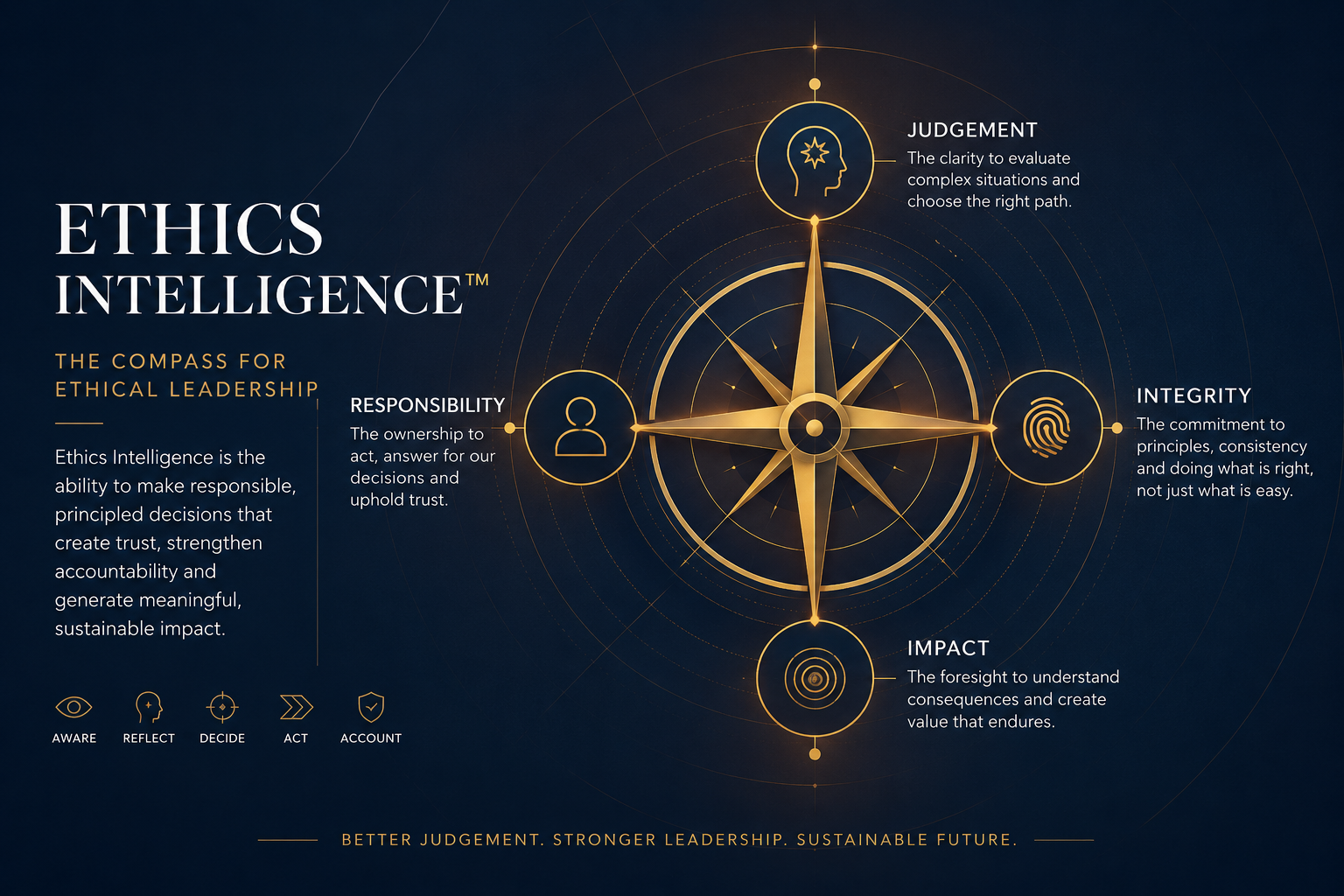
What Is Ethics Intelligence™?
Within the Burn Bright Advisory™ Leadership Intelligence Compass™, Ethics Intelligence™ describes a leader’s capacity to recognise ethical dimensions within leadership situations and translate principles into responsible judgement, behaviour and outcomes. It moves the conversation from “Am I a good person?” to “How intelligently am I identifying, examining and managing the ethical consequences of my leadership?” That is a significantly more demanding question.
Featured Snippet
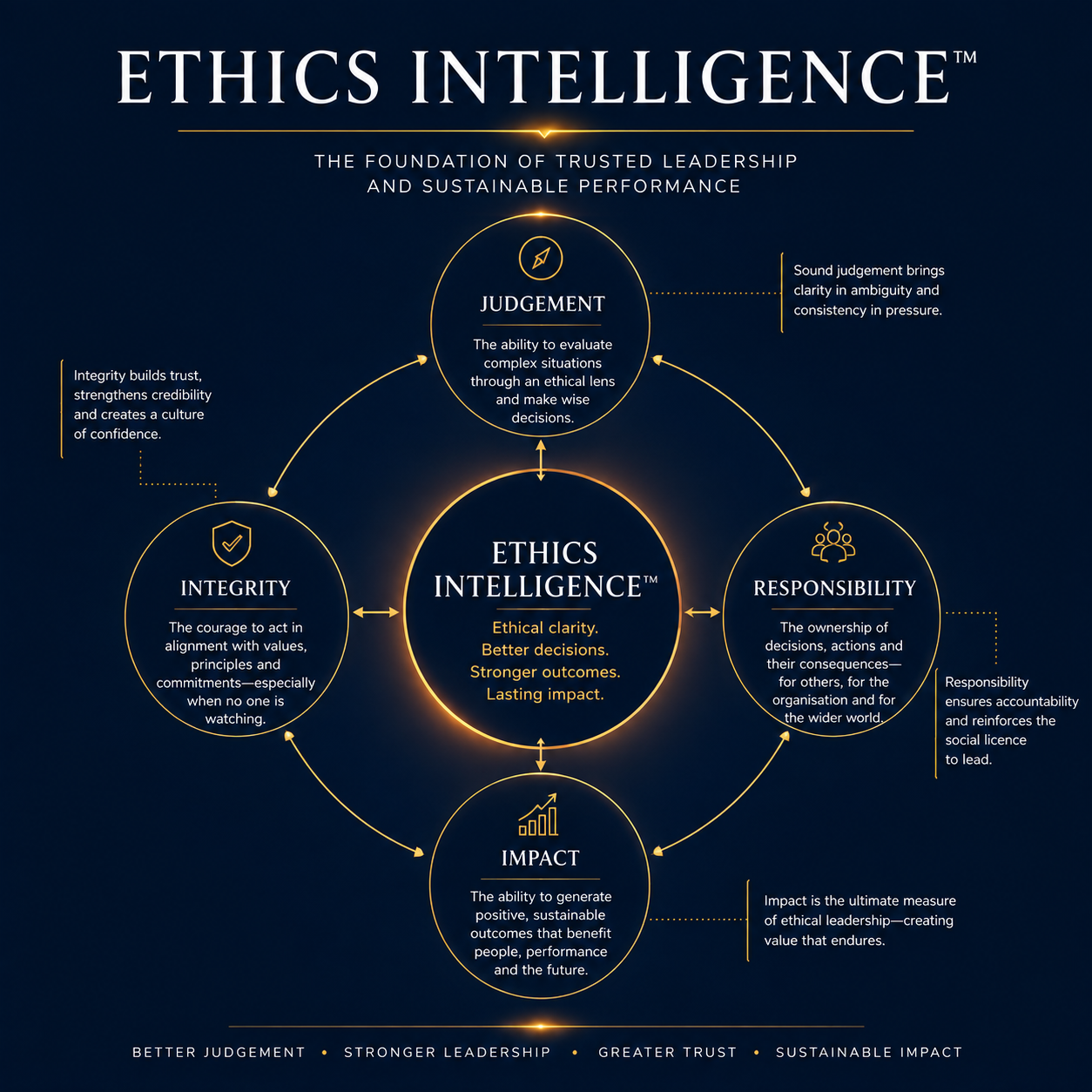
A useful Burn Bright framework is to consider four connected dimensions:
| Dimension | Leadership Question |
|---|---|
| Judgement | What is the ethically responsible decision? |
| Integrity | Will I remain aligned with our principles when pressure increases? |
| Responsibility | What am I accountable for as the leader? |
| Impact | Who will experience the consequences of this decision? |
Together, these dimensions move ethics away from abstract aspiration and into observable leadership practice.
Why Ethical Leadership Is Becoming More Difficult
Modern organisations operate in environments where leaders are expected to make decisions rapidly, frequently and often with incomplete information. That creates an important problem: ethical complexity is increasing at the same time as leaders are being given less time to think.
Consider the decisions increasingly facing contemporary leaders — should artificial intelligence be used to assess employees, how transparent should an organisation be about financial difficulty, when does performance monitoring become intrusive, should a highly successful employee remain in post when their behaviour damages colleagues. These are not questions that can always be solved by consulting a policy manual. They require judgement.
The ethical leader must frequently navigate several legitimate interests simultaneously. Customers may want speed. Employees may need sustainable workloads. Boards may demand financial performance. Regulators may require compliance. None of those expectations is necessarily unreasonable — the leadership challenge appears when satisfying one creates consequences for another.
The Ethics Leadership Gap: Intention Versus Impact
One of the most important distinctions in Ethics Intelligence™ is the difference between intention and impact. Leaders naturally interpret their own decisions through intention — “I was trying to protect the organisation,” “I wanted to maintain standards,” “I was only trying to help.” Those statements may be completely sincere. But leadership is experienced by other people through impact, not intention.
A leader may intend to raise standards while creating fear. They may intend to increase accountability while creating excessive surveillance. They may intend to accelerate performance while producing unsustainable workloads. This does not mean intentions are irrelevant — it means they are insufficient.
Ethically intelligent leadership asks two questions simultaneously: what was I trying to achieve, and what did my decision actually create? That second question introduces accountability and prevents leaders from using positive intention as an automatic defence against negative consequences. Authority amplifies impact — a senior leader’s “suggestion” may be experienced as an instruction, and a joke from a chief executive may carry consequences that the same comment from a colleague would not. That is why Ethics Intelligence™ must include an understanding of leadership power.
Ethical Leadership Begins With Judgement
Rules, policies and professional standards matter. But leadership frequently begins where the rulebook stops. Imagine a senior employee who consistently produces exceptional commercial results but regularly humiliates junior colleagues. There may be no single incident sufficiently severe to trigger a formal disciplinary process — the employee may be responsible for significant revenue, and senior executives may consider them indispensable.
A purely performance-based analysis might emphasise the employee’s results. A compliance-based analysis might ask whether any specific policy has technically been breached. Ethical judgement asks broader questions: what behaviour is the organisation effectively rewarding, what message is being communicated, whose interests are being prioritised, what precedent does the decision establish?
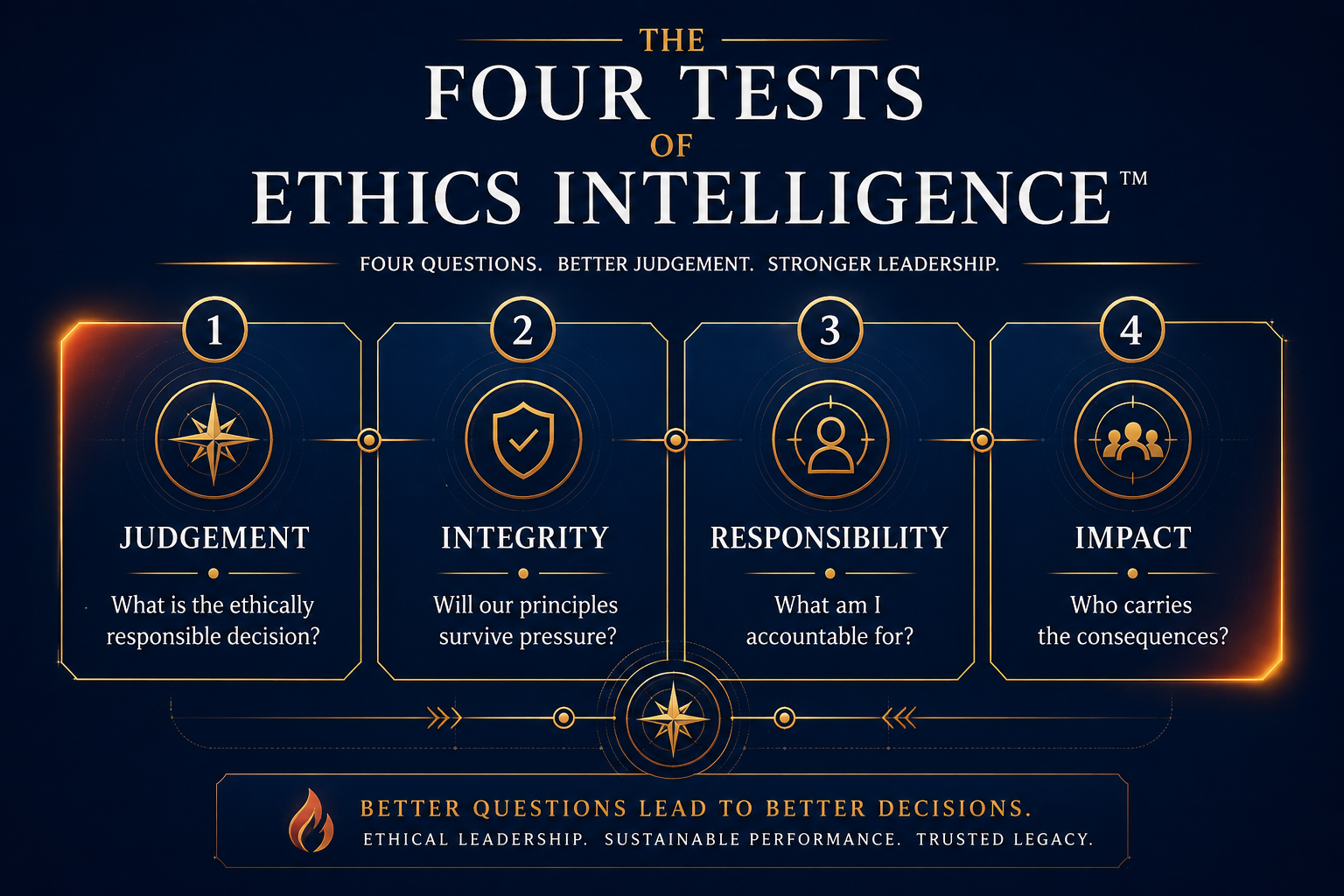
The Four Tests of Ethics Intelligence™
Burn Bright Advisory™ translates this into a practical leadership discipline. Before making a consequential decision, leaders can apply four tests.
Test 1 The Judgement Test
Have I identified the real ethical issue? A staffing decision may actually involve fairness. A procurement decision may involve conflicts of interest. A performance decision may involve dignity. Ethically intelligent leaders learn to identify the ethical dimension hidden inside apparently operational decisions.
Test 2 The Integrity Test
Would I make the same decision if doing the right thing became personally inconvenient? Integrity becomes meaningful when there is a cost attached. It measures the distance between the principles leaders announce and the principles they maintain under pressure.
Test 3 The Responsibility Test
What responsibility belongs to me because of the authority I hold? Delegating a task does not always delegate responsibility, and leaders must understand the obligation to create conditions where concerns can be raised safely.
Test 4 The Impact Test
Who carries the consequences if this decision is wrong? Leadership decisions rarely distribute benefits and risks equally, and the people making a decision are often not the people who live with it.
Ethics Intelligence™ Is Leadership Performance Intelligence™
Ethics should not sit at the edge of leadership development as a specialist topic discussed only during compliance training. It belongs at the centre of leadership performance — because trust, fairness, psychological safety, decision quality, accountability and reputation all affect performance, and the willingness of people to speak honestly to leaders affects almost everything.
Leadership performance cannot be evaluated only by asking whether the leader achieved the target. A more intelligent evaluation asks what the leader achieved, how it was achieved, what it cost, and whether the performance can be sustained. Those questions connect Ethics Intelligence™ directly with other domains of the Leadership Intelligence Compass™, including Professionalism Intelligence™, Reflective Practice Intelligence™, Emotional Intelligence™ and Leadership Sustainability™.
How Ethical Drift Happens
Serious ethical failures rarely arrive as a single dramatic decision. More often, standards move gradually. A compromise is made because circumstances are exceptional. The exception becomes precedent. The precedent becomes normal practice. Eventually, behaviour that would once have generated concern becomes part of how the organisation operates — a pattern known as ethical drift.
Consider a leader facing sustained performance pressure who begins requesting more frequent performance updates. Weekly monitoring becomes daily monitoring. People learn that disappointing information attracts scrutiny, so they become increasingly cautious about what they report. Nobody explicitly tells employees to conceal problems — but the environment begins rewarding positive information and discouraging uncomfortable information. The ethical failure did not begin with dishonesty. It began with pressure.
Leadership Performance Intelligence™ asks us to examine the interaction between the leader, the environment, the decision and the consequences. Ethics Intelligence™ therefore requires leaders to monitor not only behaviour but also the conditions shaping behaviour.
The Five Pressures That Can Distort Ethical Judgement
Ethical drift becomes more likely when several pressures converge.
From Ethical Principles to Ethical Decisions
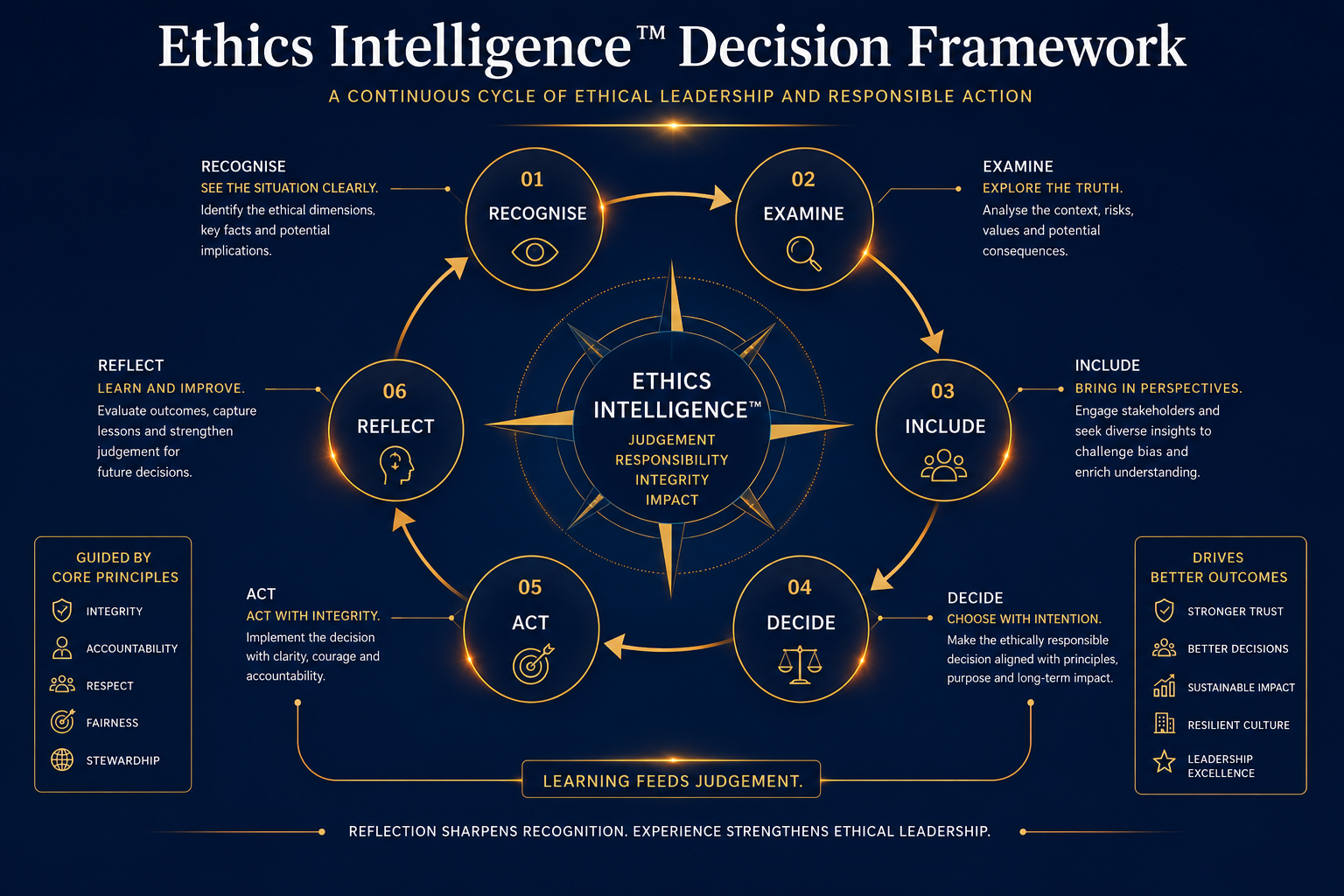
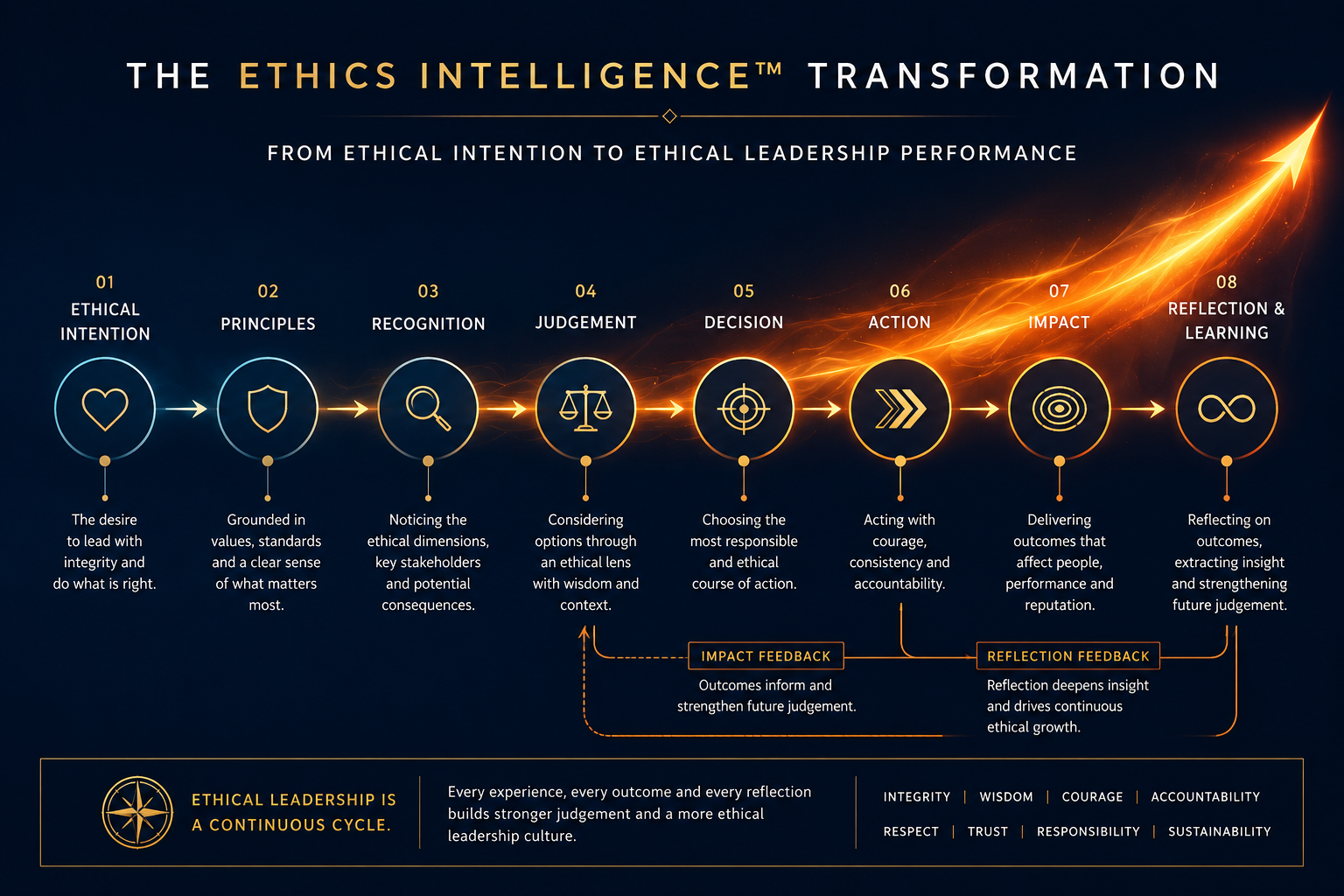
The challenge for leaders is practical: how do you make better ethical decisions when the situation is complex, information is incomplete and legitimate interests conflict? Burn Bright Advisory™ proposes an Ethics Intelligence™ Decision Framework built around six stages.
1. Recognise — What is the ethical dimension of this decision?
Many ethically consequential decisions arrive disguised as operational questions. A useful test: if this decision goes wrong, who could be harmed, disadvantaged, excluded or treated unfairly?
2. Examine — What assumptions are shaping my judgement?
Experience, professional identity, culture and incentives all influence interpretation. Strong leaders don’t eliminate assumptions — they become more capable of recognising them.
3. Include — Whose perspective is missing?
The more senior a leader becomes, the more likely information is to be filtered before it reaches them. Ethically intelligent authority actively seeks relevant perspectives before exercising judgement.
4. Decide — Which option best balances principle, responsibility and consequence?
Leaders should be able to explain what principles informed the decision, what alternatives were considered and what safeguards will reduce foreseeable harm. A decision that cannot survive explanation deserves further examination.
5. Act — Are our actions consistent with our ethical reasoning?
A sophisticated ethical discussion has little value if implementation contradicts it. Ethical leadership is demonstrated through the details of how, when and by whom a decision is communicated.
6. Reflect — What did the decision actually produce?
After significant decisions, leaders should examine who benefited, who experienced unintended consequences, and what would be repeated or changed next time.
Ethics Leadership Across Different Sectors
Ethical principles may be universal, but leadership dilemmas are contextual. The same Ethics Intelligence™ framework needs to operate differently across sectors.
Business Growth Intelligence™
When a top-performing sales director drives exceptional revenue but exit interviews reveal intimidation and unreasonable workload expectations, tolerating the behaviour sends a clear message: results can purchase exemption from standards.
School Leadership Intelligence™
Accountability measures introduced with good intentions can gradually concentrate attention on pupils most likely to influence performance data, raising workload and narrowing what education actually serves.
Healthcare Leadership Intelligence™
Efficiency targets designed to reduce appointment times can unintentionally reduce quality or equity for patients whose needs are genuinely more complex, if applied uniformly without clinical judgement.
Public Service Leadership Intelligence™
When every budget option creates consequences, the ethical standard becomes the quality, fairness and transparency of the decision-making process itself, not a painless outcome.
HR & People Leadership Intelligence™
Fairness is often mistaken for identical treatment. Ethics Intelligence™ asks whether the same defensible principle was applied fairly to different circumstances.
Ethical Culture Is Built Through Repeated Leadership Decisions
Organisations sometimes treat culture as something communicated through values statements or induction programmes. Culture is built much more powerfully through repeated decisions — what happens when a senior leader makes a mistake, when a high performer behaves badly, when bad news reaches executives, or when someone challenges authority. Those moments teach employees more about ethics than any poster on the wall.
From Ethical Leaders to Ethical Leadership Systems
The ultimate objective should not be organisations that depend upon unusually principled individuals. It should be organisations that make ethical leadership easier to practise consistently. That requires systems — structured decision reviews, accessible escalation routes, transparent criteria, workload monitoring and mechanisms for challenging decisions without disproportionate personal risk.
Individual character alone is an unreliable organisational safeguard. People become tired, pressured, and develop blind spots. Strong systems compensate for human limitations — this principle sits at the heart of Leadership Performance Intelligence™.
Developing Ethics Intelligence™ as a Leadership Capability
If Ethics Intelligence™ is a leadership capability rather than simply a personal characteristic, it can be developed. That changes the organisational question from “do we have ethical leaders?” to “what are we doing to strengthen ethical judgement across our leadership system?”
Create Space for Ethical Reflection
Leaders need structured opportunities to examine consequential decisions. This doesn’t require a new committee — it means building reflection questions into existing leadership processes, such as what unintended consequences a decision might create.
Strengthen Ethical Challenge
Organisations need people who can challenge decisions safely. A leadership team in which everybody agrees quickly may appear efficient — it may also be vulnerable. This connects Ethics Intelligence™ with Constructivism Intelligence™.
Measure What Leadership Produces
If leaders are rewarded exclusively for output or growth, those indicators will dominate behaviour. Leadership Performance Intelligence™ provides a broader lens — were standards maintained, was trust strengthened, was workload sustainable, were people able to raise concerns?
Ethics Intelligence™ and the Leadership Intelligence Compass™
Ethics does not operate independently from other leadership capabilities. A leader may understand ethical principles but lack the emotional awareness to recognise how their decisions affect people, or recognise an ethical issue but lack the adaptability to respond when circumstances change. This is why the Leadership Intelligence Compass™ positions leadership as an interconnected system rather than a collection of isolated competencies.
Ethics Intelligence™ is strengthened by Professionalism Intelligence™, Reflective Practice Intelligence™, Emotional Intelligence™, Constructivism Intelligence™, Adaptability Intelligence™, Visionary Leadership Intelligence™, Knowledge Development Intelligence™ and Leadership Sustainability™. The result is a more complete view of leadership — one that asks not simply whether leaders know right from wrong, but whether their wider capability enables them to recognise, reason, act and learn responsibly.
Conclusion: Ethics Is What Leadership Looks Like Under Pressure
The real test of ethics leadership rarely occurs when circumstances are comfortable. It occurs when the ethical decision is inconvenient — when targets are threatened, when a valued colleague must be challenged, when transparency carries reputational risk. Those moments reveal the difference between ethical intention and Ethics Intelligence™.
Ethically intelligent leaders recognise the ethical dimensions hidden inside everyday decisions. They examine assumptions, seek perspectives that authority might otherwise exclude, make decisions they can explain, and remain willing to learn from impact. Most importantly, they understand that ethical leadership is not separate from performance — it is part of performance.
Leadership Performance Intelligence™ therefore changes the central question. Not simply “did the leader deliver?” but “what did the leader deliver, how did they deliver it, what consequences followed, and can that performance be sustained responsibly?” That is a more demanding standard — and a more useful one.
Leadership Reflection Questions
- Which decisions in my current role contain ethical dimensions that I may be treating as purely operational?
- Where might performance pressure be narrowing my judgement?
- Are there behaviours I tolerate from high performers that I would challenge in other employees?
- Whose perspective is routinely missing from the decisions I make?
- How easily can people challenge my thinking without experiencing negative consequences?
- When did I last change a leadership decision because somebody offered a perspective I had not considered?
- Where is there a gap between my intention as a leader and the impact experienced by others?
- Which organisational incentives could unintentionally encourage ethical drift?
- What does my response to bad news teach people about whether honesty is genuinely valued?
- Could I explain the reasoning behind my most consequential decisions to the people most affected by them?
What is ethics leadership?
Ethics leadership is the practice of exercising leadership authority through responsible judgement, integrity, fairness, accountability and consideration of consequences. It involves both the decisions leaders make and the conditions they create for ethical behaviour throughout an organisation.
What is Ethics Intelligence™?
Ethics Intelligence™ is Burn Bright Advisory’s™ terminology for the leadership capability to recognise ethical dimensions, evaluate competing responsibilities, make defensible decisions, act consistently with principles and examine the resulting impact. It forms part of the Leadership Intelligence Compass™.
Why are good intentions insufficient for ethical leadership?
Intentions describe what a leader hoped to achieve. They do not necessarily describe what other people experienced. Ethical leadership therefore considers both intention and impact.
What is the difference between ethics and compliance?
Compliance asks whether behaviour satisfies applicable rules, policies or requirements. Ethics examines the wider question of what constitutes responsible action — something can comply with a rule while still raising questions about fairness, transparency, dignity or impact.
What causes ethical drift?
Ethical drift can develop when repeated small compromises gradually become normalised. Performance pressure, excessive workload, time pressure, loyalty, hierarchy and organisational incentives can all make drift more likely.
Can Ethics Intelligence™ be developed?
Yes. Leaders can strengthen ethical judgement through structured reflection, stakeholder analysis, constructive challenge, examination of assumptions, decision reviews and systematic learning from consequences.
How does Ethics Intelligence™ relate to Leadership Performance Intelligence™?
Leadership Performance Intelligence™ examines leadership performance as a wider system rather than evaluating leaders solely through outputs. Ethics Intelligence™ contributes by examining how outcomes are achieved, who experiences their consequences and whether performance is responsible and sustainable.
How does ethical leadership affect organisational culture?
Employees learn organisational culture partly by observing what leaders repeatedly reward, tolerate, challenge and protect. Leadership decisions therefore communicate the organisation’s practical ethical standards more powerfully than values statements alone.
Where Does Your Leadership Sit on the Ethics Intelligence™ Spectrum?
Take the free Leadership Burnout Self-Assessment to see how your leadership capacity, judgement and decision-making hold up under pressure.
Free Leadership Intelligence
Get Weekly Leadership Insights
Join thousands of leaders receiving practical strategies on burnout prevention, workload design, and sustainable performance every week.