Quick Answer
Key Takeaways
- Ethical leadership is a performance capability, not just a question of individual character.
- Most ethical deterioration begins gradually — through postponed conversations, quiet exceptions and softened information — long before any visible failure occurs.
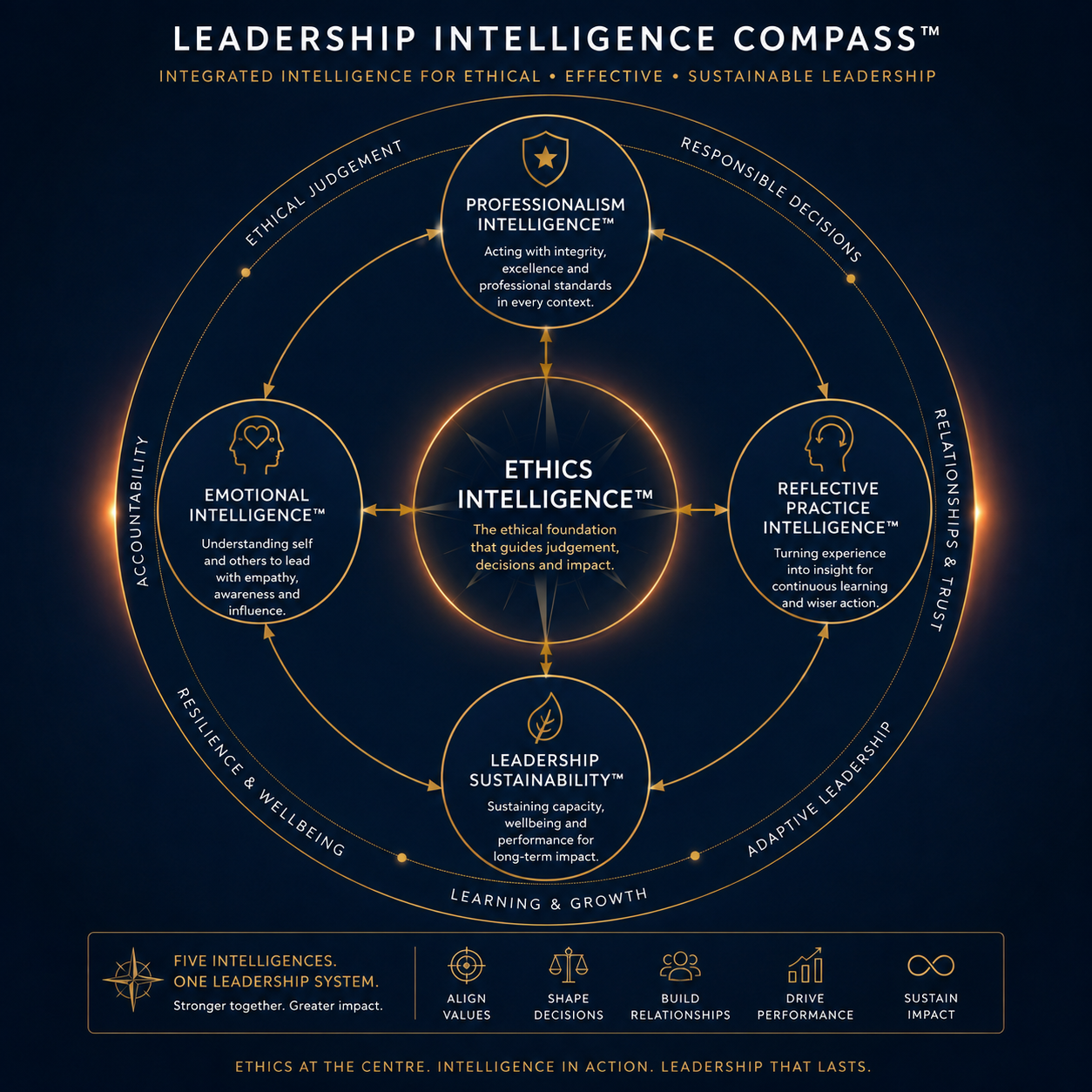
- Ethics Intelligence™ sits within the Leadership Intelligence Compass™ alongside Professionalism Intelligence™, Reflective Practice Intelligence™ and Leadership Sustainability™.
- Power changes how leadership behaviour is interpreted, which is why power-awareness is central to ethical judgement.
- Ethical leadership becomes visible under pressure, when values carry a genuine cost to maintain.
- Leaders can strengthen Ethics Intelligence™ through deliberate practice: challenge, decision frameworks, capacity monitoring and reviewing decisions rather than just results.
Ethical Leadership: Why Leadership Integrity Is a Performance Capability, Not a Compliance Exercise
Ethical leadership is the capacity to make, communicate and sustain decisions that align organisational performance with clearly understood principles, responsibilities and consequences. It extends beyond regulatory compliance because leaders must exercise judgement when rules are incomplete, priorities conflict and stakeholders have competing interests. Within Leadership Performance Intelligence™, this capability is developed through Ethics Intelligence™: the disciplined ability to recognise ethical implications, examine choices, anticipate consequences and act with accountable consistency.
Featured Snippet
Ethical leadership is frequently treated as a question of character: leaders either possess integrity or they do not. That interpretation is too narrow for contemporary organisations. Leadership ethics is also a question of performance capability.
Leaders routinely operate in situations where there is no obviously correct answer. They allocate limited resources, determine whose priorities receive attention, decide what information is disclosed, which risks are acceptable, when poor performance requires intervention, and how organisational pressure should be balanced against human consequences. These are not occasional ethical moments. They are leadership.
The critical question is therefore not simply whether a leader considers themselves ethical. It is whether they possess sufficient Ethics Intelligence™ to recognise ethical dimensions within ordinary decisions and respond with judgement, consistency and accountability.
Burn Bright Advisory™ positions Ethics Intelligence™ within the Leadership Intelligence Compass™ because sustainable leadership performance requires more than technical competence. Leaders need the capacity to understand the consequences of their decisions for people, systems, institutions and stakeholders. This creates an important relationship within Leadership Performance Intelligence™:
Values inform judgement.
Ethics Intelligence™ disciplines judgement.
Professionalism Intelligence™ shapes conduct.
Reflective Practice Intelligence™ examines impact.
Leadership Sustainability™ ensures performance can be maintained without normalising harmful practices.
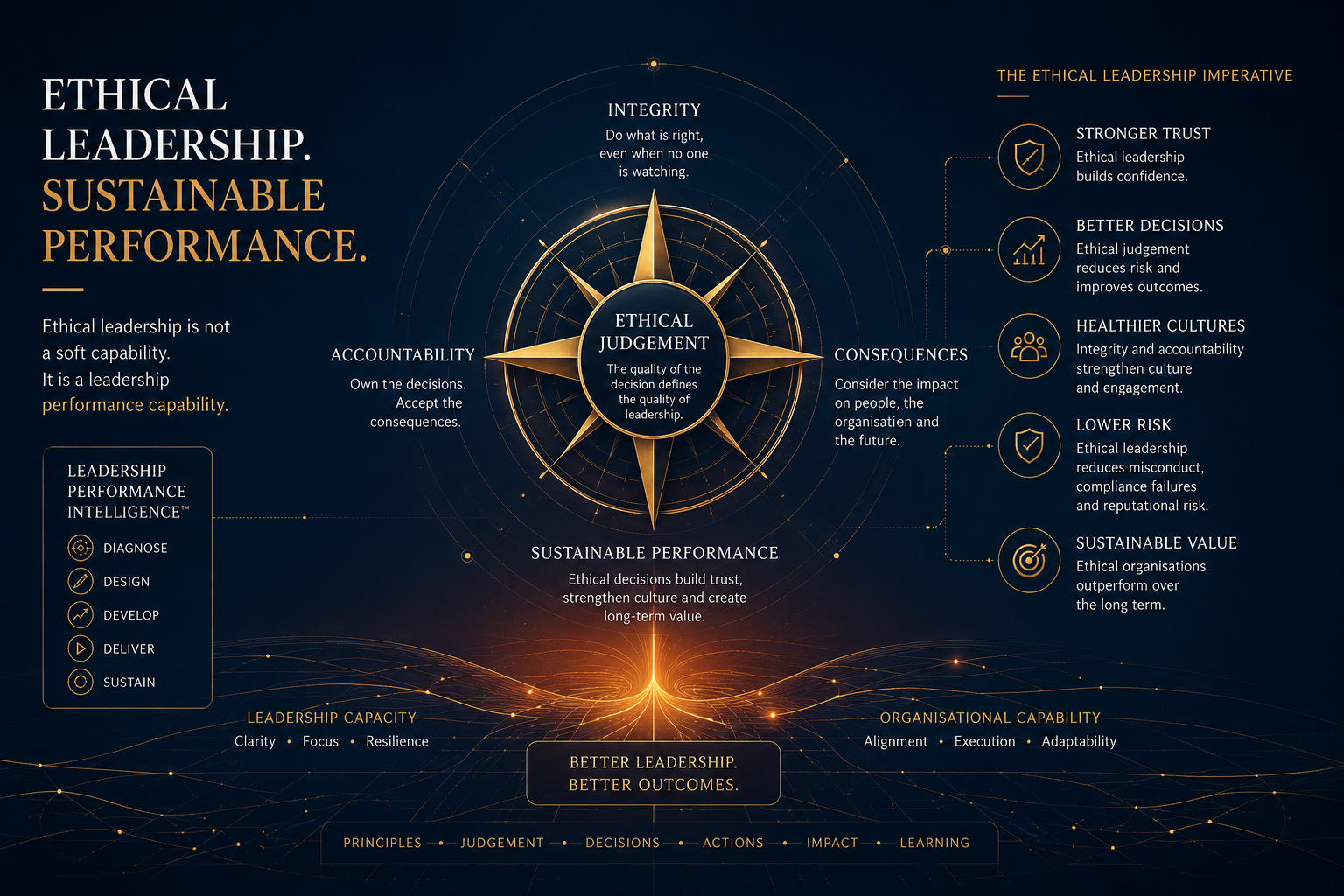
Ethical Leadership Has a Performance Problem
Leadership ethics tends to become highly visible when something goes wrong: a scandal emerges, a regulatory failure is uncovered, employees report unacceptable behaviour, a senior executive resigns, or a governance review identifies decisions that should never have been approved. At that point, organisations ask familiar questions — who knew, who approved it, why did nobody intervene, where was the oversight.
These questions matter. But they can create a misleading picture of how ethical leadership actually works. Most ethical deterioration does not begin with a spectacular act of misconduct. It begins much earlier — when a difficult conversation is repeatedly postponed, when a high performer is permitted behaviour that would not be tolerated from somebody else, when uncomfortable information is softened before reaching senior leadership, when workload expectations quietly become unreasonable, when a decision technically complies with policy but contradicts the principles the organisation claims to uphold, or when people learn that raising concerns carries greater personal risk than remaining silent.
Individually, these moments can appear insignificant. Collectively, they shape an ethical operating environment. That is why ethical leadership should not be understood only through the dramatic question “Did the leader do something wrong?” A more useful leadership-performance question is: “What conditions are shaping how this leader recognises, evaluates and responds to ethical complexity?”
That shift matters. It moves leadership ethics away from abstract declarations of values and towards observable leadership capability.
From Ethical Intentions to Ethics Intelligence™
Most leaders do not begin their working day intending to behave unethically. They begin with competing objectives. A chief executive needs to protect cash flow while retaining talented people. A school leader must balance the needs of an individual pupil against the needs of an entire school community. A healthcare leader must allocate constrained staffing capacity while maintaining safe care. A public-service leader must reconcile policy, public expectation, political pressure and responsible stewardship of public resources. An entrepreneur may be simultaneously responsible for investors, employees, customers and the survival of a young company.
These leaders may all possess strong personal values. Values alone, however, do not remove complexity. A leader can value fairness while facing two legitimate but incompatible claims, value transparency while holding information that cannot responsibly be disclosed, value loyalty while recognising that somebody they trust is no longer performing effectively, or value wellbeing while operating within a system whose workload exceeds available capacity.
This is where Ethics Intelligence™ becomes important. Within the Burn Bright Leadership Intelligence Compass™, Ethics Intelligence™ can be understood as the leadership capacity to identify the ethical dimensions of decisions, interrogate competing responsibilities, consider consequences, recognise bias and power, and act in ways that can withstand responsible scrutiny. It is not simply knowing organisational values. It is being able to use ethical judgement when values collide with reality.
Ethics Intelligence™ Within Leadership Performance Intelligence™
Leadership Performance Intelligence™ starts from a broader proposition: leadership effectiveness is not produced by a single competency. Performance emerges from interacting leadership capacities. A leader may possess extraordinary strategic intelligence and still create serious organisational risk if ethical judgement is weak. A leader may possess strong interpersonal skills while avoiding decisions that accountability requires. A leader may be technically brilliant but incapable of recognising how power changes the meaning of their behaviour.
Conversely, ethical intentions without adaptability, reflection, professionalism or sufficient leadership capacity can also produce poor outcomes. This is why the Leadership Intelligence Compass™ is useful: it encourages leaders to examine the interaction between different dimensions of leadership rather than treating individual competencies as isolated qualities. For ethical leadership, two relationships are particularly important.
Ethics Intelligence™ + Professionalism Intelligence™
Ethics asks: what should I do? Professionalism asks: how should I conduct myself while doing it? The distinction is subtle but important. A leader may make the correct decision but communicate it disrespectfully. Another may communicate sensitively while avoiding the decision entirely. High-quality leadership requires both ethical judgement and professional execution.
Ethics Intelligence™ + Reflective Practice Intelligence™
Ethical leaders must be capable of reviewing not only what they intended but what actually happened. A decision made with positive intentions may create unforeseen harm. A policy intended to improve accountability may produce fear. A productivity initiative may unintentionally create unsustainable workloads. A leader’s attempt to protect standards may suppress legitimate challenge. Reflective Practice Intelligence™ allows the leader to ask what happened, whose experience differed from mine, what assumptions shaped my decision, what consequences I failed to anticipate, and what needs to change. Without reflection, ethical certainty can become rigidity. With reflection, ethical leadership becomes a learning capability.
The Four Tests of Ethical Leadership
A practical way to move ethics from aspiration to leadership practice is to examine decisions through four tests.
Test 1 The Principle Test
Does this decision align with what we say we stand for? Organisations frequently publish values such as integrity, respect, inclusion, excellence and accountability. The ethical challenge begins when those values become inconvenient. If respect disappears during periods of poor performance, it is not yet embedded. If transparency applies only to favourable information, it is conditional. The principle test exposes the gap between declared values and operational values.
Test 2 The Stakeholder Test
Who carries the consequences of this decision? Leadership decisions distribute benefits, burdens, opportunities and risks. A restructuring may improve financial performance while increasing workload elsewhere. The stakeholder test does not mean every decision must benefit everybody — leadership often requires trade-offs. It means those trade-offs should be visible rather than hidden.
Test 3 The Transparency Test
Could I explain this decision clearly to the people affected by it? Not every leadership decision can be publicly disclosed in full, but leaders should still ask whether the reasoning behind their decision could survive appropriate scrutiny. Transparency is not simply about publishing information — it is about the explainability of leadership judgement.
Test 4 The Sustainability Test
What happens if this becomes normal? A leader who works every weekend to rescue a project may succeed once. But if the behaviour becomes standard practice, capacity becomes permanently stretched and exhaustion becomes evidence of commitment. This test connects Ethics Intelligence™ directly to Leadership Sustainability™, because some of the most damaging leadership practices become harmful through repetition, not through any single act.
Ethical Leadership Is Most Visible Under Pressure
Anyone can articulate values when the stakes are low. Leadership ethics becomes meaningful when maintaining those values carries a cost — when a deadline is approaching, when financial performance is deteriorating, when an influential stakeholder demands an exception, when admitting a mistake may damage credibility, or when speaking openly could create uncomfortable questions.
Pressure does not necessarily create a leader’s ethical weaknesses. It often reveals them. Under sustained pressure, leaders become more dependent on habits, assumptions and established organisational norms. Their available cognitive and emotional capacity can narrow, decisions become faster, and reflection decreases.
This makes Leadership Capacity™ relevant to ethical performance. An overloaded leader is not automatically an unethical leader. But overloaded leadership systems can create conditions in which ethical judgement becomes harder to exercise consistently. Ethical leadership cannot be strengthened solely through annual compliance training — organisations also need to examine workload, decision rights, psychological safety, governance, escalation routes and the behavioural signals sent by senior leadership. Ethics is partly individual. It is also systemic.
The Ethical Leadership Performance Chain™
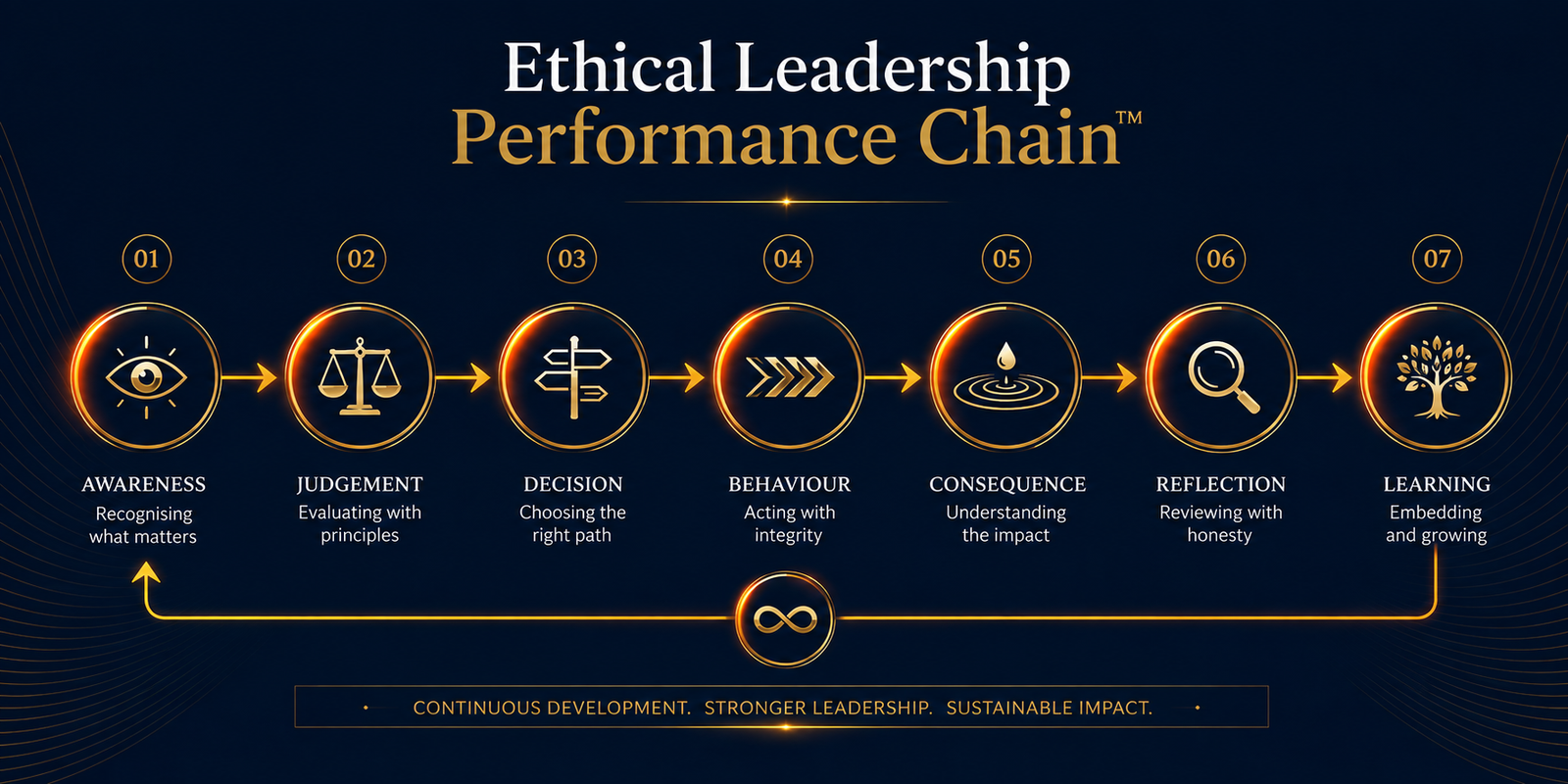
Burn Bright Advisory™ can conceptualise this relationship through an Ethical Leadership Performance Chain™:
Awareness → Judgement → Decision → Behaviour → Consequence → Reflection → Learning
Each stage matters. Awareness identifies that an ethical dimension exists. Judgement evaluates principles, evidence, stakeholders and alternatives. Decision establishes the chosen course of action. Behaviour determines how that decision is enacted. Consequence reveals its actual effect on people and performance. Reflection compares intention with impact. Learning modifies future leadership practice.
A weakness anywhere in the chain can undermine the outcome. A leader may have excellent values but fail at awareness because they do not recognise how their authority affects others. Another may recognise the problem but exercise poor judgement. Another may reach a sound decision but execute it badly. Another may act appropriately but refuse to examine unintended consequences. Ethics Intelligence™ therefore develops through repeated cycles of judgement, action and reflection. It is not a badge a leader earns. It is a leadership capability that must continually be exercised.
Ethical Blind Spots, Power, Silence and Organisational Trust
Ethical Failure Rarely Begins With an Intention to Fail
One of the most dangerous assumptions organisations make is that ethical failure is primarily caused by unethical people. Sometimes it is — deliberate dishonesty, exploitation, discrimination and abuse of authority exist and require decisive accountability. But many leadership failures develop through a less visible process.
A leader begins with a reasonable objective: performance needs to improve, costs need to fall, a project must be delivered, a struggling employee requires intervention. The objective itself may be entirely legitimate. The problem emerges through the decisions made in pursuit of it — a deadline becomes more important than the people carrying the workload, a performance target begins to justify behaviour that would normally be challenged, an influential employee receives exceptions unavailable to others, and people who challenge decisions become labelled as negative or resistant.
Nobody necessarily announces that ethical standards have changed. They simply begin to move. Ethics Intelligence™ requires more than good intentions — it requires leaders to detect the gradual normalisation of practices that increasingly conflict with the organisation’s stated principles. Ethical deterioration can be incremental, and incremental deterioration is particularly difficult to see from inside the system.
The Leadership Blind Spot Problem
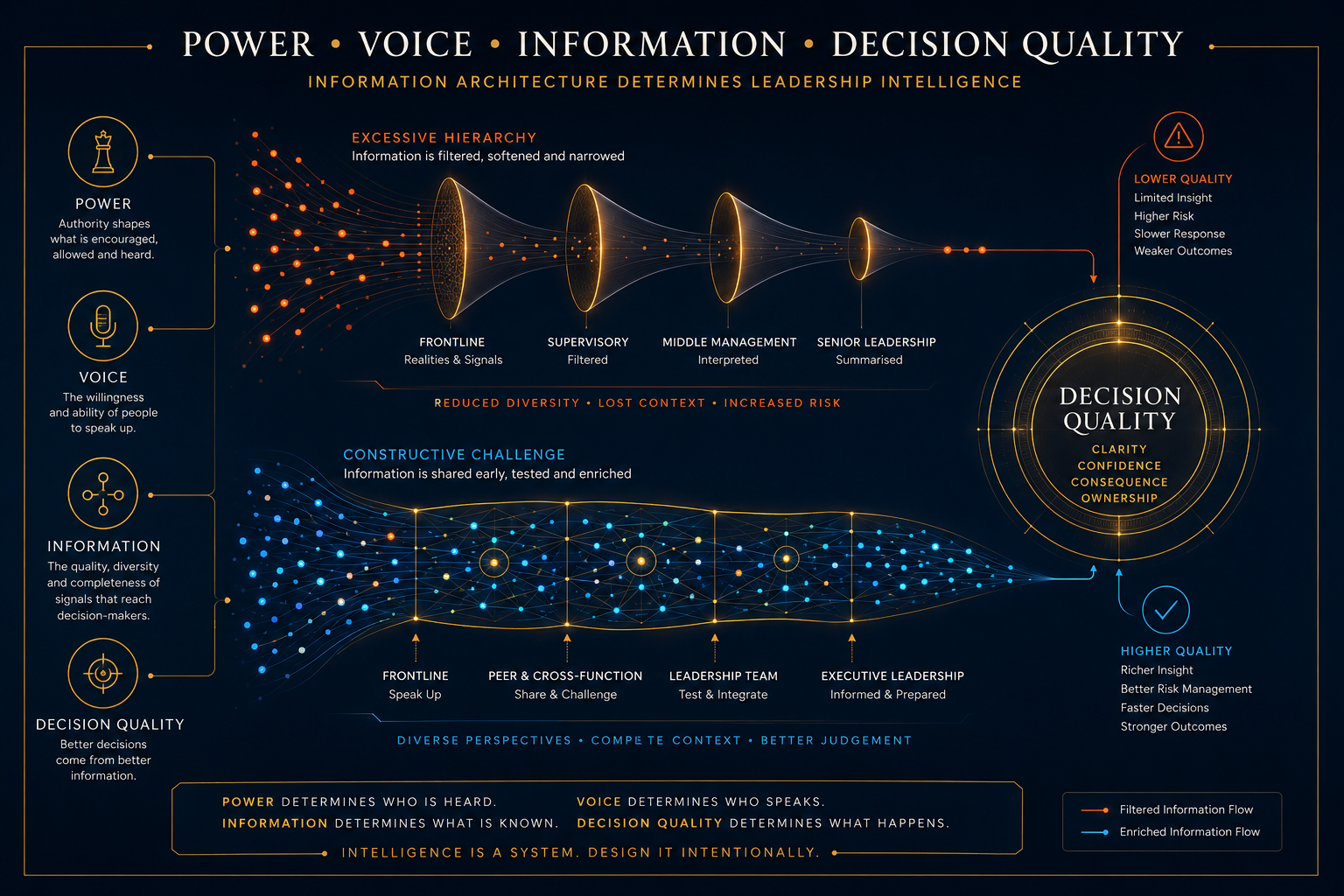
Leadership creates perspective. It also removes perspective. The more senior a leader becomes, the greater their formal authority may be — but increased authority does not necessarily produce increased visibility. Employees become more selective about what they communicate, problems are resolved before they reach the executive, and bad news acquires softer language.
Ethics Intelligence™ therefore requires intellectual humility. This does not mean leaders should become hesitant or abandon authority — it means recognising that authority changes the information environment in which leadership decisions are made. The absence of dissenting voices should not automatically reassure a leader. Sometimes silence means agreement. Sometimes it means people have learned that disagreement is expensive.
Power Changes the Meaning of Leadership Behaviour
The same sentence can have very different consequences depending on who says it. A senior executive saying “I think we should launch this by Friday” may believe they have offered a preference — the team may hear a deadline. A school principal asking for a volunteer may genuinely mean voluntary, but employees may interpret the request through hierarchy: who can safely refuse?
This is why leadership ethics cannot be understood without considering power. Leaders are responsible not only for what they intend to communicate but also for understanding how positional authority influences how their words and actions are interpreted. Power-aware leaders ask how easy it is for somebody to disagree with them, what happens to people who challenge established thinking, who speaks first in important discussions, and whether people bring them problems early or only when those problems have become unavoidable.
The Relationship Between Ethics Intelligence™ and Psychological Safety
Psychological safety is sometimes misunderstood as an environment in which people are protected from disagreement, discomfort or accountability. Its real leadership value lies in whether people can contribute relevant information without unnecessary interpersonal risk. A leader cannot exercise strong ethical judgement if critical evidence never reaches them.
Burn Bright’s existing work on small-team toxicity illustrates this dynamic particularly clearly. In small teams, leadership dysfunction can become amplified because relationships are close, alternatives are limited and every interaction carries greater weight. When people become afraid to question leadership, the effects can extend beyond morale into decision quality and, in settings such as healthcare, potentially into safety.
This is where Ethics Intelligence™, Emotional Intelligence™ and Professionalism Intelligence™ intersect. Ethics Intelligence™ asks whether dissent needs to be heard. Emotional Intelligence™ helps the leader recognise the interpersonal conditions affecting whether people will speak. Professionalism Intelligence™ shapes how disagreement is handled. Together, these capabilities create a more reliable leadership environment.
The Ethical Cost of Organisational Silence
Silence is one of the most underestimated forms of organisational data. When people stop challenging, questioning and reporting emerging concerns, leadership may initially experience the organisation as becoming easier to manage — meetings become quicker, there is less disagreement, and implementation appears smoother.
But apparent alignment can conceal deteriorating organisational intelligence. Frontline employees see operational weaknesses that never reach strategic dashboards. Eventually, the distance between the official organisational narrative and operational reality becomes significant. This is where ethical risk and performance risk begin to converge: a culture that cannot tell leadership uncomfortable truths is not simply culturally unhealthy. It is strategically vulnerable.
Ethical Leadership Across Sectors
Ethical leadership principles are universal, but their application changes according to context. The Leadership Intelligence Compass™ therefore needs to translate into the realities leaders actually face.
Business Growth Intelligence™: When Performance Pressure Tests Integrity
When targets look unlikely to be achieved and a major contract remains unconfirmed, leaders face choices about forecasting, pressure on customers and concessions on margin. Ethics Intelligence™ asks the leader to examine the consequences of both action and inaction, and which short-term incentives may be distorting judgement. Ethical leadership is compatible with ambition — the distinction is whether performance is pursued inside boundaries the organisation is willing to defend when pressure increases.
School Leadership Intelligence™: Fairness Is Not Always Sameness
A simplistic interpretation of fairness might suggest treating everyone identically. Ethics Intelligence™ asks a more sophisticated question: what does responsible fairness require in this situation? Providing additional support to one pupil, or additional development to an early-career teacher, may be justified because circumstances differ — but exceptions require explainable reasoning, otherwise flexibility can become favouritism.
Healthcare Leadership Intelligence™: Ethics Under Capacity Pressure
Healthcare leadership makes the relationship between ethics and capacity particularly visible. If a service repeatedly depends on exhausted professionals compensating for structural capacity shortages, leaders need to examine what the pattern means, not merely whether each shift was covered. Individual heroics can temporarily protect performance while concealing weaknesses in the underlying system.
Public Service Leadership Intelligence™: Stewardship and Scrutiny
Public-service leaders operate under a distinctive responsibility because their decisions involve resources, authority or services held on behalf of citizens. Ethics Intelligence™ helps leaders move beyond “Are we allowed to do this?” towards the more demanding question: “Is this a responsible exercise of the authority entrusted to us?”
HR & People Leadership Intelligence™: The High Performer Exception
One of the clearest tests of organisational ethics appears when a high-performing employee behaves poorly. Tolerating the behaviour may protect an immediate performance metric, but the organisation must calculate the wider cost: reduced trust, employee departure, suppressed challenge and the message sent about whose behaviour is exempt from organisational standards. Every exception teaches the organisation something about its real values.
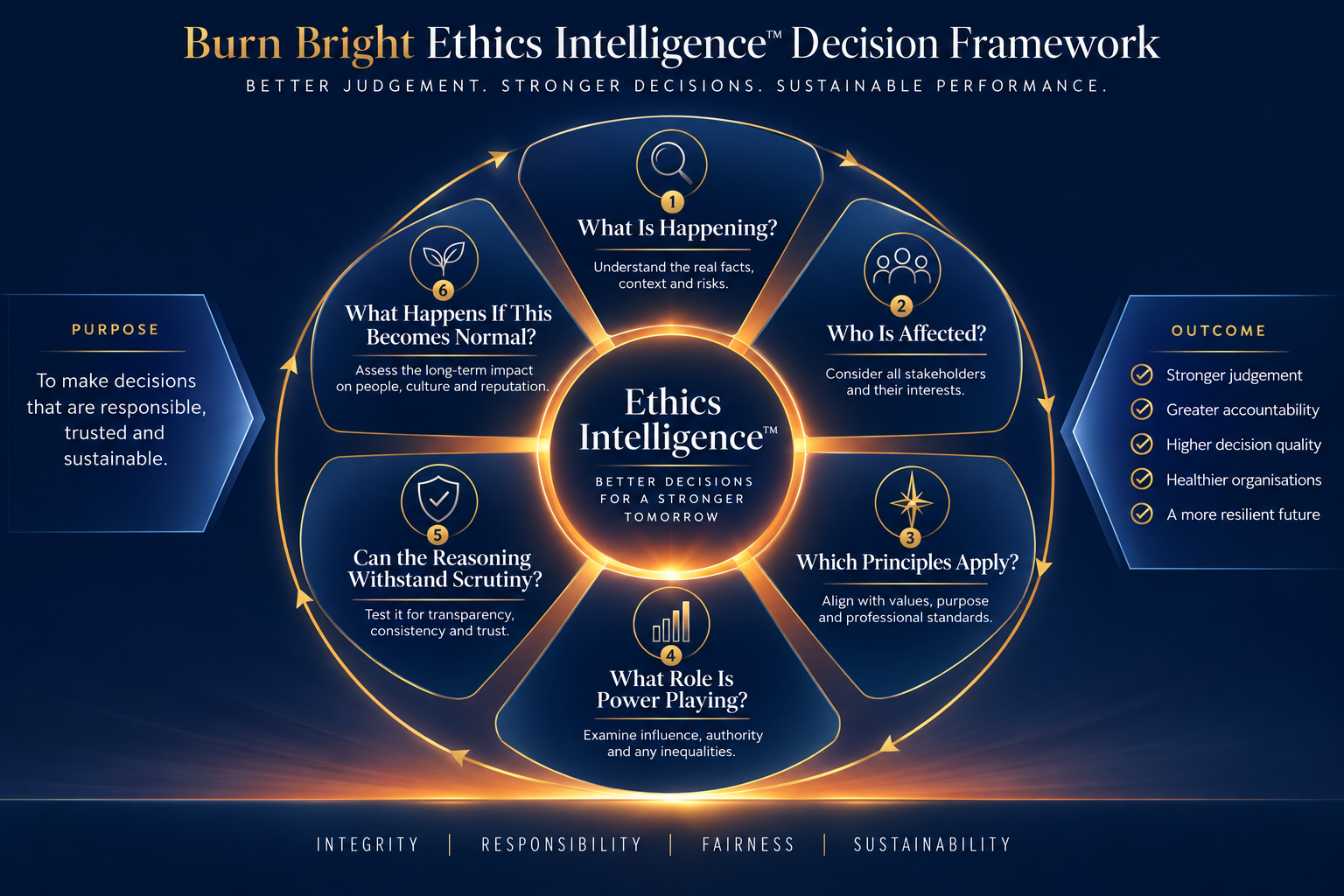
The Burn Bright Ethics Intelligence™ Decision Framework
Leaders need more than philosophical principles. They need a repeatable method for examining difficult decisions, structured around six questions.
- What is actually happening? Separate evidence from assumptions.
- Who is affected? Identify direct and indirect stakeholders, who benefits and who carries risk.
- Which principles are involved? Identify relevant responsibilities, values and professional standards, and where they conflict.
- What role is power playing? Consider who can influence or challenge the decision, and who may remain silent.
- Can the reasoning withstand scrutiny? Could the decision be responsibly explained to affected stakeholders or governance bodies?
- What happens if this becomes normal? Examine the precedent and whether repeating this decision would strengthen or weaken the organisation.
This final question connects ethics directly to Leadership Sustainability™.
Trust Is an Outcome of Repeated Ethical Experience
Organisations frequently describe trust as something leaders need to build. That is correct, but incomplete. Trust is not built primarily through statements about trust — it emerges from repeated experiences. Employees observe what happens when mistakes occur, notice whether leaders admit uncertainty, remember whether commitments are honoured, and watch what happens when values become inconvenient.
Trust is accumulated evidence about leadership reliability. Ethical leadership supplies that evidence. It shapes the quality of information leaders receive, affects whether people challenge flawed assumptions, influences retention and discretionary contribution, and determines whether leadership authority remains credible when difficult decisions must be made. That is why Ethics Intelligence™ should be developed before a crisis tests it — when the crisis arrives, leaders rarely have time to invent their ethical operating system. They rely on the one they have already built.
From Ethical Intention to Leadership Practice
The central argument of this article is straightforward: ethical leadership cannot remain an aspiration. It must become a repeatable leadership practice. Most organisations already have values, codes of conduct, governance structures and mandatory training — these structures matter, but none can completely anticipate the decisions leaders will encounter. A policy cannot tell a manager precisely how much additional work it is reasonable to ask from an already stretched team. That is why Ethics Intelligence™ needs to operate alongside the other capabilities within the Leadership Intelligence Compass™.
From Compliance to Ethical Capability
Compliance asks an essential question: what are we required to do? Ethical leadership adds several others — what is the responsible thing to do, what consequences are we creating, whose interests have we overlooked, and could we defend our reasoning under appropriate scrutiny? Something can be permissible without necessarily being wise. Ethics Intelligence™ therefore does not replace compliance; it strengthens the leadership judgement surrounding it. Compliance establishes boundaries. Ethical capability helps leaders navigate the complex territory between those boundaries.
The Ethics Intelligence™ Leadership Practice Cycle
For ethical leadership to become embedded, leaders need a process they can repeatedly apply: Notice → Question → Examine → Decide → Explain → Review.
Notice
Recognise that a decision contains an ethical dimension. Ethical questions do not always arrive labelled as ethical questions — they may initially appear to be questions about budgets, staffing or deadlines.
Question
Resist moving immediately from problem to solution. Ask what assumptions are shaping the initial interpretation and what information might be missing.
Examine
Consider evidence, stakeholders, principles, power, consequences and alternatives using the six-question Ethics Intelligence™ Decision Framework.
Decide
Ethical leadership is not endless deliberation. Eventually, leaders must exercise judgement to improve the quality of difficult choices.
Explain
Where appropriate, explain the reasoning. People may disagree with a decision and still regard the process as credible when they understand how it was reached.
Review
Examine actual consequences, what unintended effects emerged, and what should be learned — turning ethical leadership into organisational learning.
Five Practices That Strengthen Ethics Intelligence™
Practice 1
Create Deliberate Challenge
Senior leaders should not assume challenge will occur naturally. Hierarchy can suppress it, so create structures that make constructive challenge part of the decision process.
- Ask someone to test the preferred option before concluding a discussion.
- Invite the least-heard voice, and separate idea generation from senior judgement.
Practice 2
Separate Urgency From Importance
Pressure compresses thinking, and everything begins to feel urgent. Ethical leaders develop the discipline to distinguish between situations requiring immediate action and situations merely accompanied by pressure.
- Ask: “What would we examine differently if we had another 24 hours?”
- Use the answer to reveal what is being sacrificed for speed.
Practice 3
Examine Exceptions
Exceptions are particularly valuable ethical data. Not every exception is unethical, but repeated unexplained exceptions gradually create two organisations: the one described by policy and the one experienced through power.
- Ask who receives exceptions, why, and how often.
- Require exceptions to remain explainable.
Practice 4
Monitor Leadership Capacity™
Leadership Capacity™ should be treated as a governance concern, not merely a personal wellbeing issue. A permanently overloaded leader has less capacity for reflection and may become more reactive.
- Examine whether short-term fixes are replacing systemic solutions.
- Treat capacity as a condition for sound ethical judgement.
Practice 5
Review Decisions, Not Just Results
Organisations often review whether a target was achieved. Ethical organisations also examine how it was achieved — a result can look positive while concealing declining organisational health.
- Ask whether success reflects capability or depletion.
- Ask whether falling turnover reflects better leadership or fewer people willing to report concerns.
Ethical Leadership and the Danger of Normalised Overperformance
One of the more subtle ethical challenges in contemporary leadership is the celebration of unsustainable performance. A team facing a major deadline works late, cancels personal commitments and works through weekends. The deadline is achieved and leadership congratulates everyone. In isolation, this may represent an appropriate response to an exceptional situation. But suppose the same pattern happens next month, and the month after that.
Eventually, exceptional effort becomes the operating model, and the organisation begins budgeting on the assumption that employees will contribute capacity that does not officially exist. The problem is no longer simply workload — it becomes ethical, because leadership is benefiting from a resource it has not sustainably designed for: human overextension. This is why Leadership Sustainability™ belongs within conversations about ethical leadership.
When Ethical Leadership Requires Courage
Ethical leadership is easy to endorse conceptually. Its real cost appears when ethical judgement requires a leader to do something uncomfortable — to challenge a more senior executive, revise an unrealistic target, admit a previous decision was wrong, disclose an inconvenient problem, say no to a powerful stakeholder, or protect a dissenting voice.
These actions require more than knowing what is right. They require the capacity to tolerate the consequences of acting on that judgement. This is where Ethics Intelligence™ intersects with Professionalism Intelligence™, Emotional Intelligence™, Adaptability Intelligence™ and Reflective Practice Intelligence™. Ethical performance is rarely isolated from the rest of leadership. It depends upon the wider leadership system.
Leadership Reflection Questions
- Which ethical decisions in my role are so routine that I may no longer recognise them as ethical decisions?
- How easy is it for somebody with less organisational power to disagree with me?
- What happens when somebody brings me information I do not want to hear?
- Are our stated organisational values visible in difficult decisions or mainly in communications?
- Which individuals receive exceptions from normal expectations, and can those exceptions be justified?
- Where are we currently relying on extraordinary effort to compensate for inadequate capacity or weak systems?
- What behaviours are we tolerating because the person producing them is considered valuable?
- Which stakeholder perspectives are least represented in our decisions?
- When did I last change my position because somebody challenged my assumptions?
- If our current leadership practices became permanent, would they strengthen or weaken the organisation?
Action Steps
- Identify one recurring ethical decision. Choose a decision you make regularly involving people, resources, priorities, workload, information or performance, and apply the six-question Ethics Intelligence™ Decision Framework. Do not wait for a crisis.
- Audit your challenge environment. Identify who can genuinely challenge your judgement. If the answer is unclear, create a deliberate mechanism for dissent.
- Review one organisational exception. Select an exception currently being made for an individual, team or stakeholder and ask whether the reasoning is transparent, consistent and defensible.
- Examine hidden capacity. Identify where performance depends on overtime, emotional labour or repeated leadership intervention, and determine whether apparent success is concealing structural weakness.
- Conduct an intention-impact review. Choose one significant decision from the previous quarter and record the intended outcome, actual outcome, unintended consequences, leadership learning and required change.
- Build Ethics Intelligence™ into leadership development. Do not restrict ethics to induction or compliance training — integrate ethical judgement into leadership assessment, reflection, diagnostics, planning and development.
Conclusion: Ethical Leadership Is Performance Intelligence
The strongest argument for ethical leadership is not that organisations need to appear ethical. It is that leadership cannot perform sustainably without trustworthy judgement. Every significant leadership decision contains assumptions about what matters, who matters, which risks are acceptable and whose voice receives attention. Those assumptions shape organisational reality.
This is why Burn Bright Advisory™ positions Ethics Intelligence™ within the wider architecture of Leadership Performance Intelligence™. Ethics Intelligence™ strengthens judgement. Professionalism Intelligence™ strengthens conduct. Reflective Practice Intelligence™ strengthens learning. Emotional Intelligence™ strengthens awareness of human consequences. Leadership Sustainability™ asks whether the resulting performance can endure.
The future of ethical leadership lies beyond compliance alone. It lies in developing leaders capable of thinking ethically while pressure is present, information is incomplete, interests conflict and consequences matter. Not whether leaders can describe their values, but whether their values remain visible in the systems they create, the decisions they make, the behaviour they tolerate and the performance they pursue.
What is Ethics Intelligence™?
Ethics Intelligence™ is the leadership capacity to recognise ethical dimensions within decisions, examine competing responsibilities and consequences, understand the influence of power, exercise responsible judgement and reflect on the impact of decisions. Within Burn Bright Advisory™, it forms part of the Leadership Intelligence Compass™ and contributes to broader Leadership Performance Intelligence™.
What is the difference between ethical leadership and compliance?
Compliance establishes rules, requirements and minimum standards. Ethical leadership concerns the judgement required when leaders operate within, between or beyond those rules. Strong organisations need both.
Why is ethical leadership important for organisational performance?
Ethical leadership affects trust, information quality, challenge, accountability, decision-making and organisational learning. When people cannot raise concerns or believe standards are inconsistently applied, leadership receives poorer information and organisational risk increases.
Can a successful leader still have weak Ethics Intelligence™?
Yes. A leader may achieve strong short-term performance while creating hidden costs through excessive workload, fear, inconsistent standards or suppressed challenge. Leadership Performance Intelligence™ therefore examines the sustainability and quality of performance, not simply immediate results.
How does Ethics Intelligence™ relate to Professionalism Intelligence™?
Ethics Intelligence™ concerns responsible judgement about what should be done. Professionalism Intelligence™ concerns the standards of conduct through which leadership is exercised. Effective leadership requires both.
How does psychological safety support ethical leadership?
Psychological safety can make it easier for employees to contribute concerns, questions and contradictory information, which improves the evidence available for leadership judgement. This is particularly important in small teams, where toxic or intimidating leadership can quickly suppress communication and collaborative performance.
Is leadership workload really an ethical issue?
It can become one. Temporary periods of exceptional effort may be necessary, but when organisations routinely depend on unsustainable workloads, the way performance is being generated deserves ethical examination. Leadership Sustainability™ asks whether current performance protects or consumes future capacity.
How can leaders improve their Ethics Intelligence™?
Through deliberate reflection, exposure to challenge, examination of stakeholder consequences, awareness of power, decision reviews and structured ethical decision-making. Ethics Intelligence™ develops through practice rather than declaration.
Discover Your Leadership Intelligence Profile
Explore the Leadership Intelligence Compass™ and discover how Ethics Intelligence™ connects with the wider capabilities required for sustainable leadership performance.
Free Leadership Intelligence
Get Weekly Leadership Insights
Join thousands of leaders receiving practical strategies on burnout prevention, workload design, and sustainable performance every week.