Quick Answer
Key Takeaways
- Delegation problems are often structural problems disguised as leadership problems.
- Leaders hold onto work when accountability is high but decision authority remains unclear.
- Perfectionism creates a dangerous belief: it is quicker and safer if I do it myself.
- Delegating tasks without delegating sufficient authority creates reverse delegation and more work for the leader.
- Effective delegation requires clear outcomes, ownership, decision rights and review points — not constant supervision.
Why Leaders Struggle to Delegate
Why leaders struggle to delegate is usually explained as a problem with trust. The leader needs to let go. Trust the team. Stop micromanaging. Delegate more.
That advice sounds reasonable. But it misses what is actually happening inside many leadership roles. A senior leader may be responsible for an outcome that somebody else delivers. They may have experienced previous delegation failures. They may be working inside a culture where mistakes travel upwards but authority does not travel downwards. Or they may have spent years becoming the person everybody relies on when something needs to be done properly.
Under those conditions, holding onto work can feel rational. It is also unsustainable.
Delegation failure becomes one of the mechanisms through which leadership workload expands. More tasks remain with the leader. More decisions move upwards. More people wait for approval. Strategic time disappears. Eventually, the leader becomes both the organisation’s safety net and its bottleneck.
That is why fixing delegation requires more than telling leaders to trust their teams. We need to redesign the system around the work. The following framework shows the shift from personal workload retention towards distributed responsibility and authority.
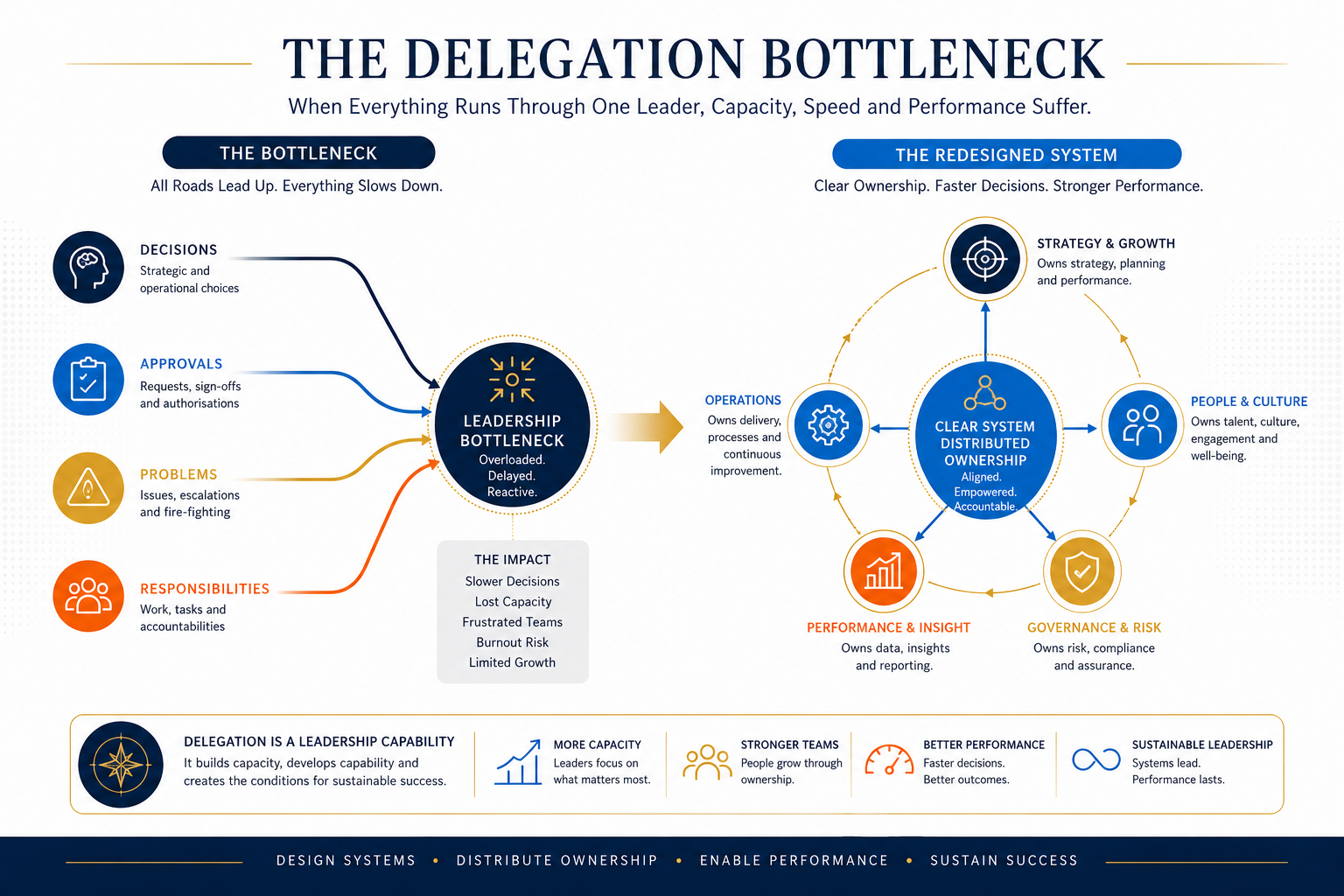
The important point is the direction of flow. In an unhealthy system, work repeatedly moves upwards. In a sustainable system, ownership sits at the appropriate level and only genuine exceptions escalate.
Featured Snippet
The distinction matters because burnout itself is not simply another word for being busy. The World Health Organization defines burnout as an occupational phenomenon resulting from chronic workplace stress that has not been successfully managed, identifying exhaustion, increased mental distance or cynicism towards work, and reduced professional efficacy as its three dimensions.
That definition points us towards the workplace, not just the individual. Delegation is one part of that workplace architecture. When every significant question requires your judgement, every difficult problem requires your intervention and every important piece of work needs your final touch, your leadership capacity eventually becomes the organisation’s capacity.
And the first step towards fixing it is understanding why capable leaders continue holding onto work even when they already know they have too much to do.
Why Does Delegation Feel So Difficult for Leaders?
Delegation looks simple on an organisational chart. A leader has too much work. Someone else has the capability to take on some of it. Responsibility moves from one person to another. Problem solved. Except that is rarely what happens.
For many leaders, delegation is not simply the transfer of a task. It is the transfer of risk. The leader may delegate the work, but they often remain accountable for the outcome. If something goes wrong, the consequences still travel upwards. That changes the calculation.
Imagine a senior leader preparing an important board report. A capable manager could produce the first draft. But the senior leader knows that inaccuracies will ultimately be attributed to them. So they delegate the report. Then they check the data. Rewrite several sections. Change the presentation. Review it again. And eventually spend almost as much time on the report as they would have spent writing it themselves.
This is why telling overloaded leaders to “delegate more” is inadequate. The Burn Bright framework treats delegation as part of workload and decision architecture rather than an isolated interpersonal skill.
The question is not simply: what can I give away? A better set of questions is:
- Who owns this outcome?
- What authority do they have?
- Which decisions can they make without me?
- When does the issue genuinely need to return to me?
Those questions move delegation away from task allocation and towards organisational design. That matters because when authority remains at the top, work eventually follows it.
Why Do Leaders Think “It Is Quicker If I Do It Myself”?
Because sometimes it is. That is what makes this belief so dangerous.
Suppose a task takes you 30 minutes because you have completed it dozens of times. Delegating it properly might require 20 minutes to explain the outcome, another 15 minutes answering questions and further time reviewing the result. Doing it yourself appears more efficient. For today.
But leadership cannot be designed around today’s transaction alone. If you complete that 30-minute task every week for a year, you have retained roughly 26 hours of work that someone else could potentially have learned to own. Multiply that across ten recurring responsibilities and the problem becomes obvious. The leader has optimised for immediate efficiency while destroying future capacity.
This creates what can be called the delegation debt cycle:
Too busy to delegate → do it yourself → team does not develop → work remains with you → workload increases → even less time to delegate.
The cycle can continue for years. It often happens to highly capable leaders because competence creates its own trap. The more problems you solve, the more problems people bring to you. Eventually, being useful becomes being indispensable. And being indispensable sounds like a compliment until you realise what it means operationally.
Nothing moves without you.
Decisions wait for you.
Problems escalate to you.
People seek your approval.
Your diary fills with work that somebody else could eventually own.
Your expertise has become a bottleneck.
This is one reason sustainable leadership requires a different definition of efficiency. The fastest way to complete today’s task is not necessarily the most effective way to build tomorrow’s organisation. Sometimes the strategically efficient decision is to spend 45 minutes teaching someone to do something you could complete yourself in 20. You are not merely transferring a task. You are building capacity.
How Does Perfectionism Prevent Effective Delegation?
Perfectionism is often rewarded in leadership. The leader who catches every mistake is described as having high standards. The executive who reviews everything is considered diligent. The manager who works late correcting other people’s work is seen as committed.
But there is a point where high standards stop improving performance and start restricting it. The problem is not excellence. The problem is believing that excellence requires your personal involvement.
Perfectionism culture is one of the five root causes identified within the Burn Bright Not Out Framework™ because it encourages leaders to retain work long after it should have moved elsewhere. The internal logic sounds familiar: they won’t do it the way I would. That may be true. But different does not automatically mean worse.
A leader may unconsciously compare another person’s developing capability with their own accumulated experience. They then interpret the inevitable gap as evidence that delegation does not work. That creates a self-reinforcing system: the leader delegates cautiously, the employee receives limited authority, the leader intervenes frequently, the employee never develops full ownership, the leader concludes that the employee cannot operate independently, and more work returns upwards.
The 80% Problem
A useful question is: does this work genuinely need to be done exactly as I would do it?
Some work does. Legal obligations, safeguarding, high-risk financial decisions or strategically sensitive issues may require very specific standards. Much leadership work does not.
If another capable person can produce an outcome that meets the required standard without reproducing your exact method, intervention may add little value. The objective of delegation is not to create copies of the leader. It is to create capable people who can produce reliable outcomes without unnecessary leadership intervention. That requires leaders to separate three things: required standard, preferred method and personal preference. Confusing them creates unnecessary control.
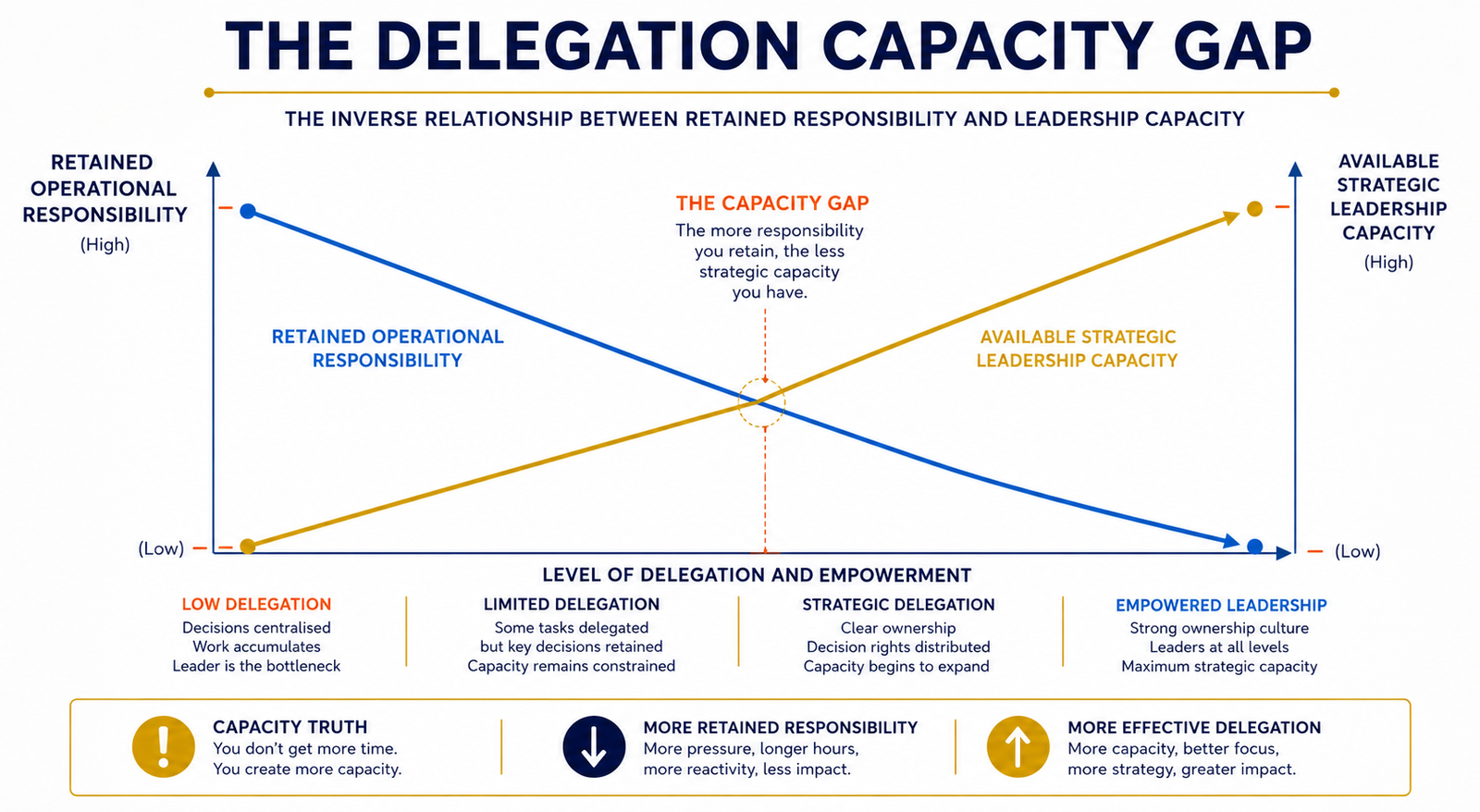
The interpretation is straightforward: delegation is not primarily about getting unwanted tasks off your desk. It is about protecting leadership capacity for work that genuinely requires leadership judgement.
What Is the Connection Between Delegation and Burnout?
Poor delegation creates more than a full calendar. It creates cognitive load. Every retained responsibility carries a mental cost — you need to remember it, monitor it, make decisions about it, respond to questions, track deadlines, resolve exceptions and switch attention towards it when something changes.
This means ten relatively small responsibilities can create a disproportionate leadership burden because they generate dozens of decision points and interruptions. The problem becomes particularly serious when leaders become the default escalation point. A team member encounters uncertainty and asks the manager. Another needs approval and asks the manager. A customer complains and the manager becomes involved. A deadline moves and the manager decides what happens next.
Individually, these interactions may take only minutes. Collectively, they fragment the working day. The leader finishes a day containing eight hours of activity but very little uninterrupted leadership work.
This is where delegation becomes directly connected to sustainable leadership. Burnout is not always produced by one enormous responsibility. Sometimes it emerges from hundreds of small demands competing continuously for finite cognitive capacity.
If your organisation requires you to personally absorb every exception, make every decision and rescue every problem, greater personal efficiency will eventually reach its limit. The system needs redesigning. That means examining where work enters your role, why decisions escalate and which responsibilities have remained with you simply because nobody has deliberately moved them elsewhere.
Delegation therefore becomes part of burnout prevention. Not because leaders should do less for the sake of doing less. Because leadership capacity is a finite organisational resource. Using that resource on work that could safely be owned elsewhere leaves less capacity for judgement, strategy, relationships and the decisions that genuinely require senior leadership.
Why Does Delegating Tasks Without Authority Fail?
One of the most common delegation mistakes sounds like this: “You own this, but check with me before making any decisions.” That is not ownership. It is administration.
The employee receives responsibility for moving the work forward while the leader retains the authority required to move it. Every significant decision therefore travels back upwards. This creates a decision bottleneck. It also produces reverse delegation: a team member brings a problem to the leader, the leader answers it, the next problem arrives, the leader solves that one too. Eventually, the leader has regained responsibility for the thinking while the employee waits for instructions. The workload has travelled back to where it started.
A stronger approach is to define the level of authority alongside the responsibility.
Decision Authority™ The Delegation Authority Ladder
Level 1 — Investigate: Gather the information and bring it to me.
Level 2 — Recommend: Analyse the situation and recommend what you think we should do.
Level 3 — Decide with approval: Make the proposed decision, then confirm it with me before acting.
Level 4 — Decide and inform: Make the decision within agreed boundaries and tell me afterwards.
Level 5 — Own: You own the outcome. Escalate only when agreed thresholds are crossed.
Not every responsibility should reach Level 5. The point is deliberate clarity. The leader and employee should know exactly where authority begins and ends. That is where frameworks such as the RACI Delegation Framework™ — Responsible, Accountable, Consulted and Informed — become useful.
RACI forces a team to identify who is actually responsible for completing work and who ultimately remains accountable. More importantly, it exposes situations where too many people believe they need to be consulted or where senior leaders have accidentally inserted themselves into routine decisions.
The result should not be delegation without oversight. It should be appropriate oversight without unnecessary control. That is the foundation of sustainable delegation.
How Can Leaders Delegate Without Losing Control?
The fear behind poor delegation is often not delegation itself. It is loss of control. Leaders worry that standards will fall, deadlines will slip or problems will remain hidden until they become expensive.
The answer is not to retain the work. It is to replace personal control with structural visibility. A sustainable delegation system needs five elements.
1. Define the Outcome
Do not begin with instructions — begin with the result. Instead of “Prepare the monthly performance report,” clarify: “Produce a report by the fifth working day that identifies performance against target, explains significant variance and recommends actions where intervention is required.” The second version defines success and gives the person receiving the responsibility room to think rather than simply follow instructions.
2. Define Decision Authority
Ask: what can this person decide without me? This is where many delegation systems fail. Responsibility moves down; authority stays up. The employee becomes responsible for delivery but still requires permission for every meaningful decision, which creates dependency rather than delegation.
3. Define the Boundaries
Good delegation needs guardrails: financial thresholds, legal or safeguarding requirements, reputational risks, strategic constraints, deadlines and circumstances requiring escalation. Boundaries create clarity without requiring constant supervision.
4. Agree Review Points
Delegation does not mean disappearing. Agree when progress will be reviewed before the work begins — for example, a review after two weeks, another at the midpoint and a final review before completion. That is different from asking for updates every day: one creates governance, the other recreates control.
5. Let Ownership Remain Where You Put It
This is the difficult part. When the person encounters a problem, resist immediately solving it. Ask “What do you recommend?” That small question changes the direction of responsibility. Instead of the problem automatically travelling upwards, the thinking remains with the person who owns the work. Over time, this creates capability, and capability creates capacity.
What Does Sustainable Delegation Look Like?
The difference between ineffective and sustainable delegation becomes clearer when we compare the systems behind them.
| Traditional Delegation | Sustainable Delegation |
|---|---|
| Delegates individual tasks | Delegates outcomes and ownership |
| Leader retains most decisions | Decision authority moves with responsibility |
| Success means “do it my way” | Success means meeting an agreed standard |
| Frequent checking | Agreed review points |
| Problems automatically escalate | Escalation thresholds are defined |
| Leader provides answers | Team members bring recommendations |
| Mistakes trigger tighter control | Mistakes inform capability development |
| Leader remains operational bottleneck | Work moves at the appropriate organisational level |
| Delegation creates temporary relief | Delegation creates long-term capacity |
| Dependent on leader availability | Designed for distributed ownership |
The distinction is structural. Traditional delegation often moves activity while keeping power, judgement and accountability concentrated around the leader. Sustainable delegation asks a more demanding question: what would need to be true for this work to operate successfully without my continuous involvement?
That question changes leadership behaviour. It forces you to consider capability, information, authority, boundaries and accountability together. It also exposes a difficult truth. Sometimes the reason somebody cannot take ownership is not that they lack potential. The system has never allowed them to practise ownership.
How Can Leaders Redesign Delegation in Practice?
Start with your current workload. Not your job description. Your actual workload. Look at what crossed your desk during the last two weeks. Then divide those responsibilities into four categories.
Category 1
Retain
Work requiring your judgement, authority or expertise.
Category 2
Delegate
Work another capable person could own.
Category 3
Develop
Work someone could own after targeted support or experience.
Category 4
Eliminate
Work that no longer creates sufficient value to justify continuing.
This is Workload Architecture™. It prevents delegation from becoming the usual exercise of handing somebody a collection of low-value administrative tasks while the leader retains every meaningful responsibility.
Then examine the Delegate and Develop categories through a RACI Delegation Framework™ lens: Responsible — who completes the work? Accountable — who ultimately owns the outcome? Consulted — whose expertise genuinely needs to be involved? Informed — who needs visibility but does not need to participate in the decision?
Be particularly careful with Consulted. Organisations frequently confuse inclusion with involvement. When six people must be consulted before one routine decision can be made, delegation slows down and responsibility becomes blurred.
Then establish decision thresholds: what can be decided independently, what needs notification, what requires consultation and what genuinely requires approval. Finally, establish review points. This creates a simple delegation architecture:
Outcome → Owner → Authority → Boundaries → Review → Escalation
If one element is missing, delegation becomes fragile. If all six are clear, the leader can step away without abandoning accountability.
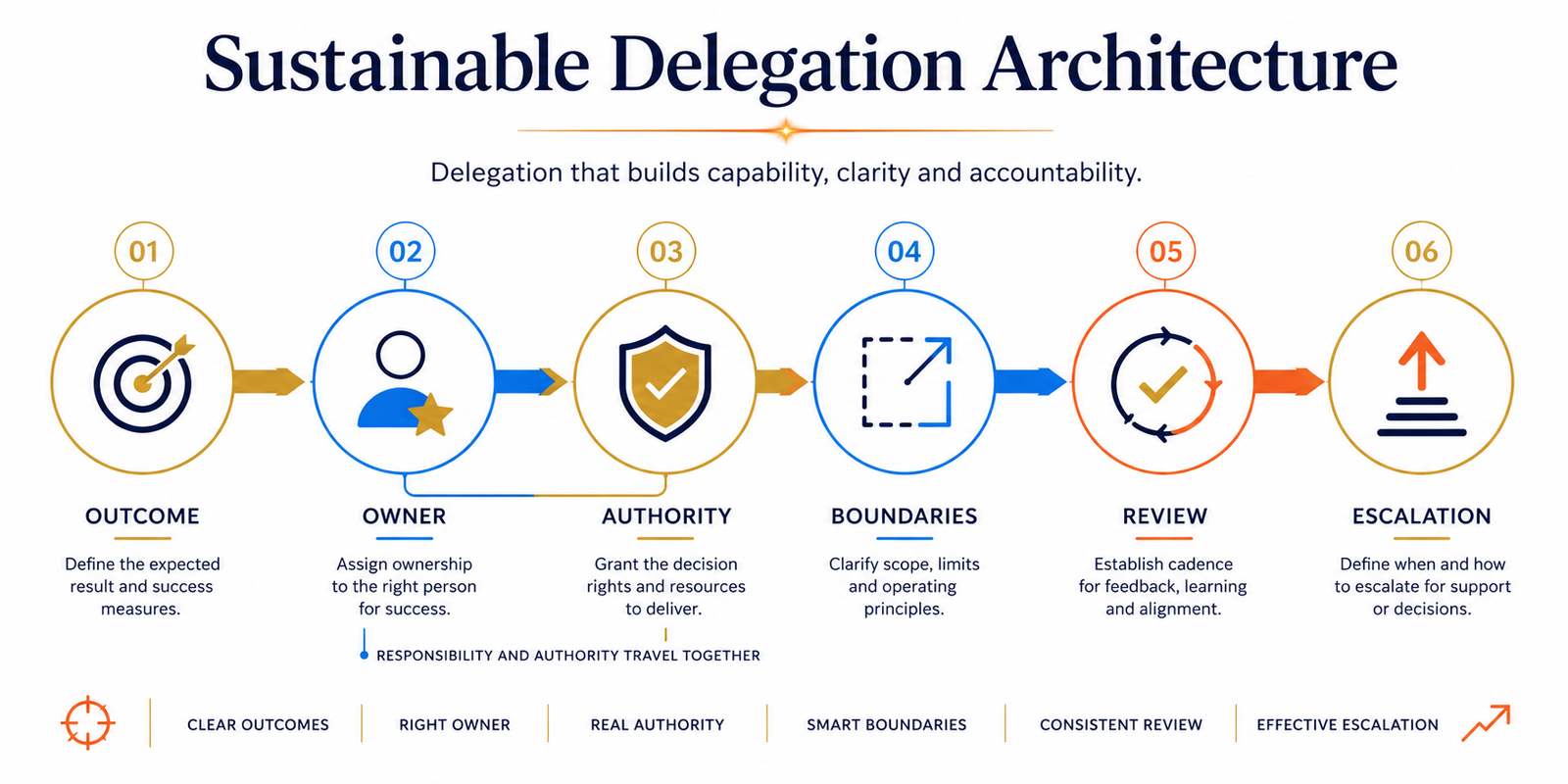
The goal is not maximum delegation. Some responsibilities should remain with senior leaders. The goal is appropriate ownership. Work should sit at the lowest sensible organisational level where the necessary capability, information and authority exist. That protects leadership capacity without creating uncontrolled risk.
Why do leaders struggle to delegate?
Leaders struggle to delegate because accountability, trust, perfectionism and decision authority often become intertwined. They may believe doing the work themselves is faster or safer. Sustainable delegation separates required standards from personal preferences and gives people sufficient authority to own agreed outcomes.
Is failure to delegate a sign of poor leadership?
Not necessarily. Failure to delegate can emerge from unclear roles, insufficient team capacity, previous mistakes or organisational cultures that punish leaders when delegated work goes wrong. However, repeatedly retaining work that others could own eventually restricts team development and creates leadership bottlenecks.
How can I delegate without micromanaging?
Define the required outcome, authority level, boundaries, deadline and review points before the work begins. Then allow the person to operate within those parameters. Scheduled visibility gives you oversight without requiring continuous intervention.
What should a leader not delegate?
Leaders should retain responsibilities that genuinely require their authority, judgement or accountability. Depending on the role, these may include sensitive people decisions, certain legal or safeguarding responsibilities, major strategic decisions and high-risk commitments. The principle is not to delegate everything — it is to place work at the appropriate level.
What is reverse delegation?
Reverse delegation occurs when responsibility given to a team member gradually returns to the manager. A team member brings a problem upwards and the manager takes ownership of solving it. Asking “What do you recommend?” can keep responsibility and thinking with the appropriate owner.
Can better delegation reduce leadership burnout?
Yes, when delegation changes the underlying workload rather than simply redistributing small tasks. Moving appropriate responsibility and decision authority reduces the number of operational decisions, interruptions and unresolved responsibilities competing for a leader’s attention. Delegation should therefore be treated as part of Workload Architecture™.
Conclusion: Delegation Is a Leadership System
Understanding why leaders struggle to delegate requires us to move beyond the idea that leaders simply need to let go. Sometimes they do. But telling an overloaded leader to trust people more does not fix unclear accountability, insufficient capability, concentrated decision authority or a culture that expects senior leaders to personally guarantee every outcome. Those are structural problems. They require structural solutions.
Effective delegation means putting work at the right level and providing the authority, information, boundaries and accountability required to make ownership real. That changes more than workload. Teams develop greater judgement. Decisions move closer to the work. Leadership bottlenecks decrease. And senior leaders regain capacity for the strategic thinking, relationships and judgement their roles actually require.
See What Your Workload Is Costing You
If delegation has become difficult because everything seems to depend on you, the first step is diagnosis. Discover where workload, decision pressure and leadership demands may be creating unsustainable patterns.
Free Leadership Intelligence
Get Weekly Leadership Insights
Join thousands of leaders receiving practical strategies on burnout prevention, workload design, and sustainable performance every week.